What is the Agentic AI in Healthcare Market Size?
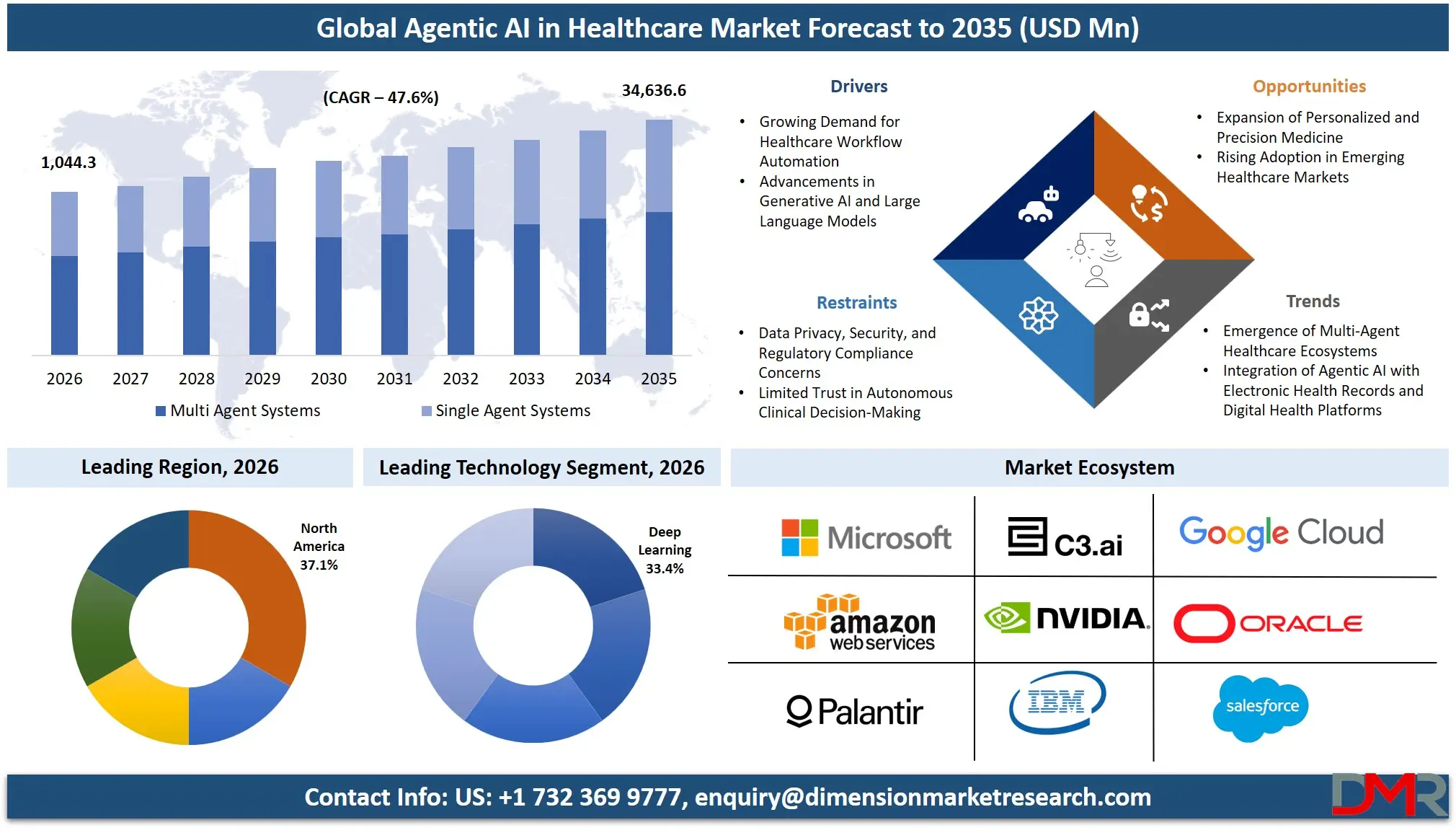
The Global Agentic AI in Healthcare Market is expected to reach a value of USD 1,044.3 million in 2026, and it is further anticipated to reach USD 34,636.6 million by 2035, growing at a CAGR of 47.6% during the forecast period.
ℹ
To learn more about this report –
Download Your Free Sample Report Here
Global Agentic AI in Healthcare Market represents an upcoming trend in the field of health technology due to the rising number of autonomous AI applications that are capable of performing tasks of reasoning, decision-making, and action without the human intervention. Agentic AI helps healthcare organizations to automate clinical operations, increase the efficiency of diagnostics, develop individualized treatment, perform routine administrative tasks, and interact with patients. Growth drivers in the global market for agentic AI include an ever-increasing amount of healthcare data, the need for process optimization, and progress in the field of generative AI, machine learning, and natural language processing. The market is set to witness considerable growth as regulatory policies are developed.
The US Agentic AI in Healthcare Market
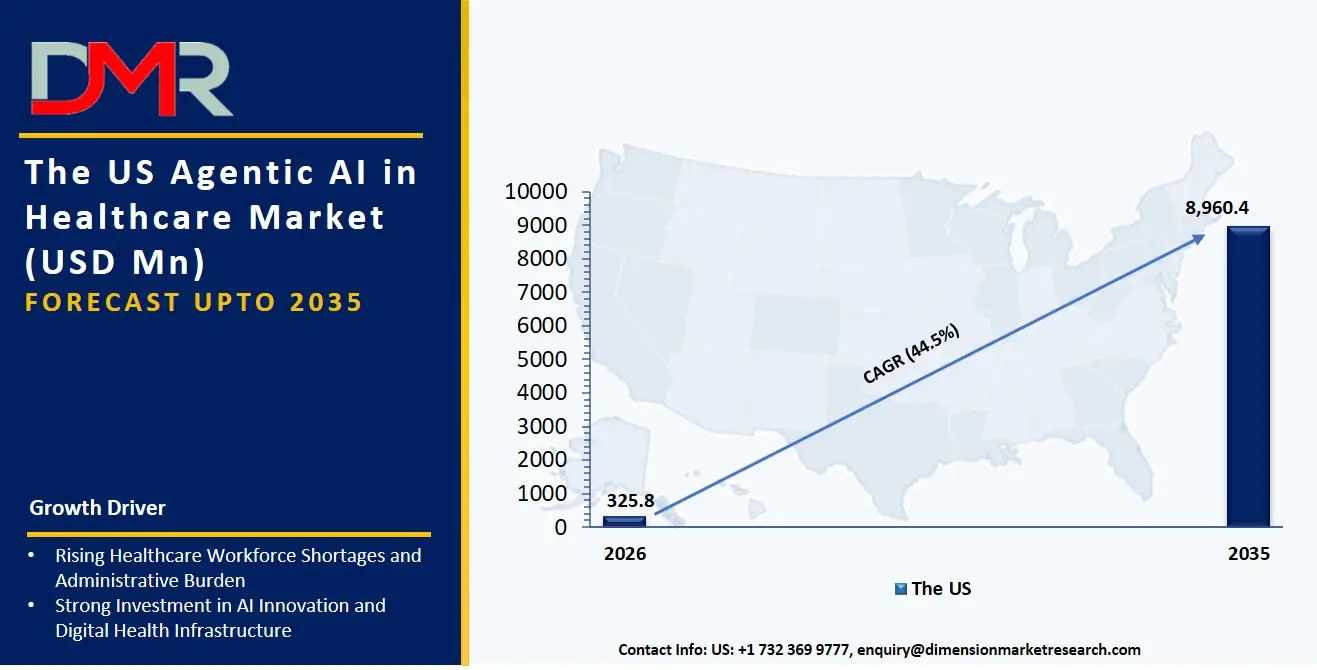
The US Agentic AI in Healthcare Market is projected to reach USD 325.8 million in 2026, growing at a compound annual growth rate of 44.5% over the forecast period to culminate in a value of USD 8,960.4 million by 2035.
ℹ
To learn more about this report –
Download Your Free Sample Report Here
The United States is the frontrunner in terms of being the most well-funded market due to a combination of dire nurse and primary care physician shortages, a difficult value-based care payment framework, and a concentrated market for health-tech startups focusing on AI first and hyperscale cloud computing companies. In this market, there is a high requirement for the creation of Clinical Workflow Agents capable of autonomously analyzing EHRs to create clinical notes, place orders, and complete prior authorizations. Moreover, with Generative AI models becoming more commonplace, there is an increasing requirement for Distributed Decision Making Agents that can synthesize information from radiology, pathology, and genomics to deliver multidimensional diagnostics in tumor boards.
The Europe Agentic AI in Healthcare Market
The Europe Agentic AI in Healthcare Market is estimated to be valued at USD 304.2 million in 2026 and is further anticipated to reach USD 9,467.8 million by 2035, growing at a CAGR of 46.5%. The European market is strongly influenced by the highly regulated nature of its ecosystem, with GDPR and EU AI Act being among the regulation acts that have categorized many uses of AI in the healthcare industry as high risk. Thus, the development of Human-AI Hybrid Agent Systems becomes necessary where the system should be able to function within an environment of strong explainability and auditability, thereby putting the clinicians "in-the-loop". There has been rapid adoption of Virtual Healthcare Assistants and Chronic Disease Management agents in public health systems within Germany and UK as they try to cater to their aging population base. Programs such as European Health Data Space (EHDS) are forcing the platform developers to build sovereign Agent Development Suites.
The Japan Agentic AI in Healthcare Market
The Japan Agentic AI in Healthcare Market is projected to be valued at USD 113.2 million in 2026 and is expected to reach USD 3,410.7 million by 2035, at a CAGR of 45.9%. The Japan market is distinct in its driving force known as "Society 5.0," where autonomous AI agents become the central element of solving super-aged society and the severe lack of the clinical workforce problem. Administrational Automation Agents and Diagnostic Support Agents make up a large portion of the budget, as many hospital chains and specialized medical clinics use AI to handle routine activities so that the scarce specialists could devote their time to more complicated patient treatment. There is a high need for deep localization, including Japanese language NLP and Context-Aware Computing. It leads to a certain niche market of Custom Development Frameworks needed to integrate advanced foundational models with Japanese specifics.
Key Takeaways
- Market Size & Forecast: The Global Agentic AI in Healthcare market is estimated to reach USD 1,044.3 million in 2026, growing exponentially to reach USD 34,636.6 million in 2035, due to the two drivers' breakthroughs in generative AI and excessive burden of clinical documentation.
- Growth Rate & Outlook: Global market growth is expected at a staggering CAGR of 47.6%, owing to the shift from AI copilots to autonomous agents able to perform complex reasoning and actions in dynamic multi-turn scenarios in the hospital information systems.
- Primary Growth Drivers: Key drivers include the global problem of clinicians' burnout, need for error-free Autonomous Clinical Decision-Making Support and financial benefits from automation of complex administrative processes such as revenue cycle management.
- Key Market Trends: The major trends are the development of Multi-Agent Systems which control teams of specialized agents, integration of Large Language Models into conversational agents for empathic triaging of patients and no-code platforms that enable building agents for healthcare organizations.
- By Technology Analysis: The generative AI technology and large language models (LLMs) will serve as the core technology stack, which will underlie the majority of agentic capabilities due to their superior reasoning capabilities and natural language comprehension. Professional services will become more oriented towards fine-tuning these sophisticated technologies in a medical setting and providing adequate guardrails for them.
- By Application Analysis: The clinical decision-making support and hospital resource optimization segments will experience the greatest transformation due to the technology. Radiology, pathology, and emergency departments have become fast-growing application areas where decision support agents help predict resource requirements hours in advance.
- Regional Leadership: North America is poised to dominate this market, holding 37.1% of the market share in 2026, because of its advanced digital health technology ecosystem, a large number of AI researchers, and venture capital environment that actively invests in the development of healthcare chatbots into autonomous agents.
What is the Agentic AI in Healthcare?
AI for Agency in Health Care is defined as the unique software and platforms that help design and deploy intelligent autonomous and, semi-autonomous digital agents able to perceive, think, plan, and take action in order to achieve some set goals in healthcare operations. Contrary to rigid algorithms or chatbots, these agents can respond in a highly dynamic fashion to the complex environment of healthcare settings. The Agentic AI in Healthcare Market includes Readymade to Deploy Agents, which are ready-for-use solutions for some specific tasks like preauthorization, and Build-Your-Own Agents platforms, which include low-code and no-code platforms allowing health systems to build their own agents without requiring any data science background. As more than 90% of all health data is currently locked up in unstructured form in such documents as clinical notes or medical images, this technology helps unlock the cognitive power needed for understanding and acting on this data.
Use Cases
- Autonomous Medical Coding and Billing: Departments of revenue cycle rely on Administrative Automation Agents that perform analysis of physician documentation and pathology reports to generate autonomous ICD-10 and CPT coding, predicting denial risks per specific payer and creating a complete claim narrative.
- Multi-Modal Tumor Board Orchestration: In departments of oncology, the Multi-Agent System is used, which includes Collaborative Clinical Agents: one specialized in radiology images, one in genomic data, and the third one in clinical literature that autonomously create a comprehensive case summary for the patient and propose an evidence-based treatment ranking for the further decision of humans.
- Hospital-Wide Septic Shock Prediction and Response: In the ICU, the Real-Time Decision Support agents constantly monitor streaming vitals, labs, and nursing notes. Once a pattern indicating the presence of sub-clinical sepsis is detected by the agent, this agent not only alerts but also autonomously executes a set of procedures like lactate levels, cultures, order for fluids bolus in MAR and alerting of rapid response team.
- Pandemic-Ready Public Health Surveillance: The government places the distributed decision-making agent on a network of hospital EHR systems. This agent searches and correlates the syndromic patterns (such as symptoms of respiratory distress, high prescriptions of anti-virals) within a population and creates an outbreak map of the risk in real time without collecting any patient data.
Market Dynamics
Key Drivers in the Global Agentic AI in Healthcare Market
Growing Demand for Healthcare Workflow Automation
Agentic AI is being adopted by healthcare facilities globally to automate processes that are often repetitive in nature. This is because there are more patients than ever before, combined with labor shortages, physician burnout, and increasing documentation needs. Therefore, the demand for automation solutions using intelligent technology continues to grow. Agentic AI technologies are capable of automating appointment scheduling, documenting, medical coding, patient triaging, and care coordination without needing much involvement from humans. In this way, healthcare facilities can optimize their operations and save on costs while providing better patient experiences. Autonomous AI agents are in high demand among hospitals and other healthcare networks due to digital transformation efforts.
Advancements in Generative AI and Large Language Models
The rapid development of generative AI and large language models is driving the rise of the agentic AI health care market significantly. The modern AI models can comprehend the medical language, analyze unstructured medical information, produce documentation, and make decision-making processes more complex. Such abilities allow the healthcare agents to operate more advanced processes. The constant improvement of the precision, reasoning, and multimodal data analysis by the models increases the scope of use cases in healthcare. The significant investments are being made into AI technology innovations by both technological companies and healthcare providers to increase the quality of patient treatment.
Restraints in the Global Agentic AI in Healthcare Market
Data Privacy, Security, and Regulatory Compliance Concerns
Healthcare data has very personal information that is associated with the patients, and privacy and security become key factors when implementing an AI that can be an agent. There is strict regulation on how to collect, store, share, and process such data in order to meet certain criteria set by the law. Autonomous AI needs a lot of patient data to perform its functions properly, which makes the possibility of unauthorized access even more dangerous. Moreover, regulatory bodies are very attentive to the use of autonomous AI systems for decision-making in healthcare. Compliance issues may complicate the process and raise costs.
Limited Trust in Autonomous Clinical Decision-Making
Even with all the technological progress, most healthcare practitioners tend to be very careful with the idea of utilizing autonomous AI in making important clinical decisions. The issues of transparency, explainability, bias, and responsibility can prevent the use of such an approach. Physicians and administrators in the healthcare sector need clear proof that the system in question is safe and effective from a clinical point of view. Errors in risky medical situations can be very dangerous not only for patients but for the hospital reputation as well. Besides, different levels of literacy in AI can cause reluctance to accept it.
Growth Opportunities in the Global Agentic AI in Healthcare Market
Expansion of Personalized and Precision Medicine
There are a number of opportunities that can be realized through agentic AI in personalized and precision medicine. The use of agents will make it possible to have highly customized treatment plans and approaches. These AI agents will always be analyzing the history of the patients, their genetics, the lab results, their lifestyles and their responses to treatments so that they can develop personalized medical care solutions. The increase in genomics sequencing efforts and precision medicine projects is increasing the demand for the interpretation of complex data sets and hence the need for intelligent systems will continue to rise.
Rising Adoption in Emerging Healthcare Markets
Agentic AI stands to benefit immensely from the emergence of these economies, with potential areas of development being driven by improved infrastructure of the healthcare sector, increased digitization, and rising demand for better medical services. The majority of the healthcare sectors in developing countries have been experiencing shortages of doctors, specialists, and administrative staff, which makes them interested in the use of intelligent automation technologies. It is possible to solve many problems related to the current state of the healthcare system through the use of agentic AI and improve accessibility, efficiency, and decision-making processes within the healthcare setting.
Trends in the Global Agentic AI in Healthcare Market
Emergence of Multi-Agent Healthcare Ecosystems
An emerging trend that is impacting the market is that of creating multi-agent ecosystems in the healthcare space where various AI agents work together to complete intricate tasks in the clinical and operational realm. This involves the use of more than one AI agent in performing different activities including but not limited to diagnosis, documentation, scheduling, patient interaction, monitoring, and resource management. The use of such multi-agents in the healthcare space allows for better scalability, flexibility, and efficiency in making decisions in the healthcare setting. Such multi-agent frameworks allow for coordination of the activities in real-time thus ensuring effective workflow automation.
Integration of Agentic AI with Electronic Health Records and Digital Health Platforms
Agentic AI solutions are now being incorporated directly into electronic health records, telehealth services, and digital health apps used by healthcare practitioners. The use of agentic AI solutions will help with patient data management, automation of medical documentation, decision-making, and care coordination tasks. AI agents have been developed to operate within the existing healthcare environment; hence, there is no need for additional interfaces. The vendors of such software are working on creating compatible products that can be seamlessly integrated with health information technologies. Data-driven care delivery and efficient operations in healthcare organizations are the priorities of the present times, and thus, digital health integration is a major trend for AI agents.
Research Scope and Analysis
The Global Agentic AI in Healthcare Market is segmented by product into ready-to-deploy agents and build-your-own agents, by agent system into multi-agent and single-agent systems, by technology into deep learning, machine learning, NLP, context-aware computing, and computer vision, by application, and by end use, including healthcare providers, healthcare companies, research institutes, healthcare payers, and government and public health organizations.
ℹ
To learn more about this report –
Download Your Free Sample Report Here
By Product Analysis
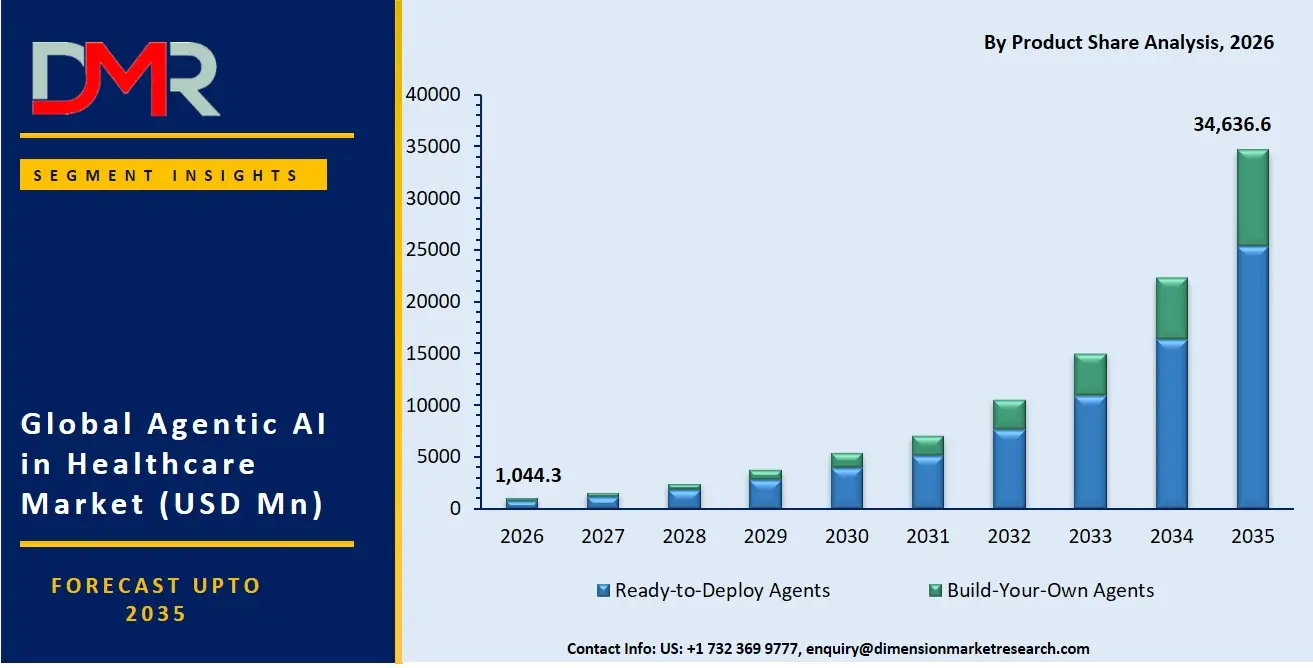
The Ready-to-Deploy Agents will is poised to emerge as the dominant players in the product segment as more healthcare providers look for fast implementation of AI-based solutions without much effort needed in developing them. They need ready-made agents that can quickly facilitate their clinical workflows, engage patients, help in documentation, and automate operations.
ℹ
To learn more about this report –
Download Your Free Sample Report Here
Such solutions take less time in deployment and implementation than those developed from scratch, and cost less in technical terms as well. The vendors keep improving the ready-to-deploy agents with healthcare-specific features, compliance, and EHR integration capabilities. As healthcare providers struggle with staffing issues and administrative challenges, the demand for scalable and instantly deployable AI agents remains high.
By Agent System Analysis
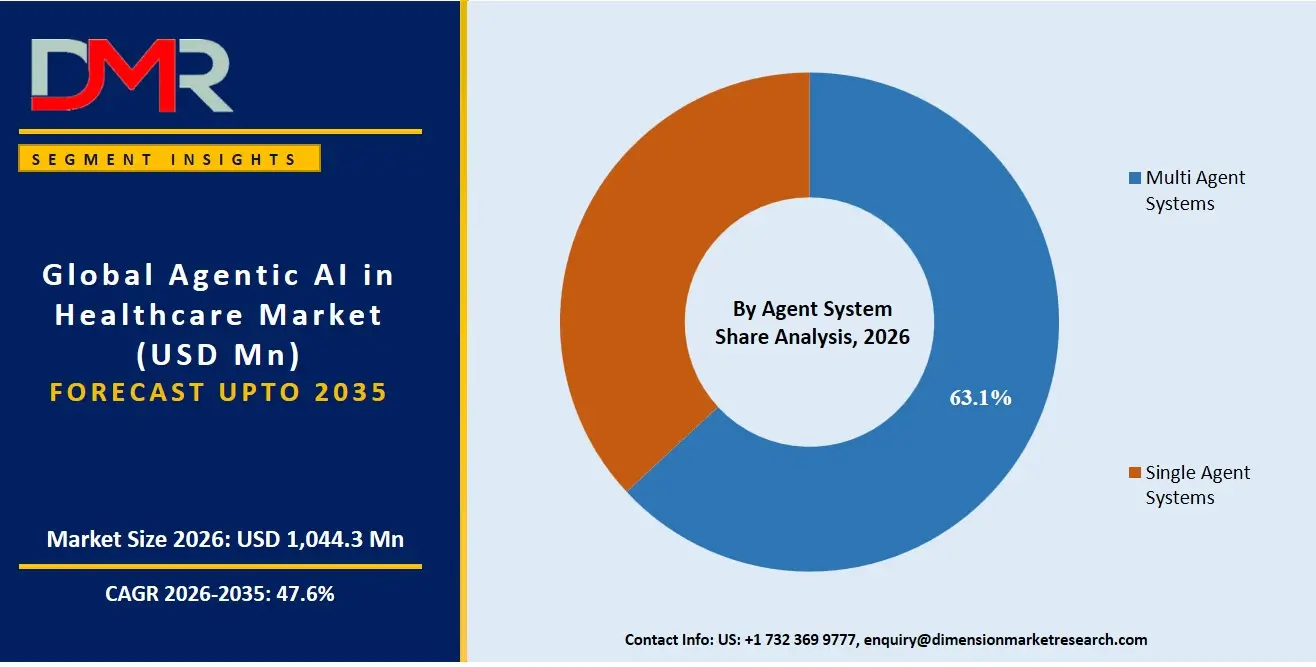
Multi agent systems are expected to form the largest segment because of their ability to coordinate several specialized AI agents that work together to accomplish various tasks in healthcare. Today's healthcare systems operate in an environment that is characterized by several processes which need decisions to be made at the same time within several different contexts. Using Multi-Agent systems improves efficiency through the sharing of responsibilities between several specialized agents such as those involved in diagnosis, documentation, scheduling, monitoring, and recommendation for treatment. Multi-Agent systems offer greater scalability and adaptability as compared to single agent systems.
By Technology Analysis
Deep Learning is predicted to take over the technology domain owing to its role as the foundational engine that powers the agentic AI in the healthcare sector. Deep learning algorithms have proven highly adept at analyzing large amounts of both structured and unstructured data in the healthcare industry such as medical imaging, electronic health records, genomic data, and clinical notes. Their pattern recognition abilities, predictive analytics, high level of accuracy, and capability to make independent decisions have made them indispensable in various domains of healthcare. Constant advancements in neural networks, computational capabilities, and access to data have helped improve their performance. Health institutions are now increasingly using deep learning-powered agents for detection of diseases, optimizing treatments, monitoring patients, drug discovery, and automation of processes.
By Application Analysis
Clinical decision support system is poised to be the leading application category since health care professionals are becoming more dependent on artificial intelligence for helping with diagnosis, treatment, risks, and recommendations. Agentic artificial intelligence solutions use big amounts of patient, scientific, laboratory, and radiology data for aiding doctors in making right decisions. The complexity of medicine practice, combined with the increasing number of patients that require medical assistance, is making intelligent decision support system indispensable. Such systems are providing greater accuracy, reducing variability of decisions, and ensuring better results for patients. Thus, clinical decision-making is becoming more trusted due to regulatory progress and increased acceptance of AI-assisted medicine.
By End Use Analysis
The Healthcare Providers segment is anticipated to represent the market's leading end-user due to the fact that hospitals, specialty clinics, and ambulatory care centers are the major consumers of agentic AI. This is because of the growing need of such institutions to improve patient outcomes, optimize the use of resources, streamline administrative tasks, and overcome staffing shortages. Agentic AI enables various applications in relation to healthcare providers, from decision-making and documentation to patient engagement and scheduling. There are currently many healthcare systems engaged in major transformation projects using AI. The existence of large clinical datasets and the potential for integrating into healthcare workflows also encourages the adoption of such technologies.
The Global Agentic AI in Healthcare Market Report is segmented on the basis of the following:
By Product
- Ready-to-Deploy Agents
- Clinical Workflow Agents
- Virtual Healthcare Assistants
- Administrative Automation Agents
- Diagnostic Support Agents
- Build-Your-Own Agents
- Low-Code Agent Platforms
- No-Code Agent Platforms
- Custom Development Frameworks
- Enterprise Agent Development Suites
By Agent System
- Multi Agent Systems
- Collaborative Clinical Agents
- Autonomous Workflow Agents
- Distributed Decision-Making Agents
- Human-AI Hybrid Agent Systems
- Single Agent Systems
By Technology
- Deep Learning
- Neural Networks
- Generative AI Models
- Foundation Models
- Large Language Models (LLMs)
- Machine Learning
- Supervised Learning
- Unsupervised Learning
- Reinforcement Learning
- Semi-Supervised Learning
- Natural Language Processing (NLP)
- Smart Assistance
- Optical Character Recognition (OCR)
- Auto Coding
- Text Analytics
- Speech Analytics
- Classification & Categorization
- Clinical Documentation Intelligence
- Conversational AI
- Context-Aware Computing
- Patient Context Modeling
- Clinical Context Recognition
- Real-Time Decision Support
- Computer Vision
- Medical Image Interpretation
- Radiology Analytics
- Pathology Image Analysis
- Surgical Vision Systems
By Application
- Clinical Decision-Making Support
- Medical Imaging
- Personalized Treatment & Drug Discovery
- Electronic Health Records (EHRs) Management
- Remote Patient Care & Monitoring
- Risk Prediction & Pandemic Preparedness
- Genomic Data Analysis
- Chronic Disease Management
- Hospital Resource Optimization
- Medical Research & Data Analysis
- Revenue Cycle & Administrative Management
- Other Applications
By End Use
- Healthcare Providers
- Hospitals
- Specialty Clinics
- Ambulatory Care Centers
- Healthcare Companies
- Pharmaceutical Companies
- Biotechnology Companies
- Digital Health Companies
- Medical Device Manufacturers
- Academic & Research Institutes
- Healthcare Payers
- Public Health Insurers
- Private Health Insurers
- Government & Public Health Organizations
- Other End Users
Regional Analysis
Leading Region by Market Share
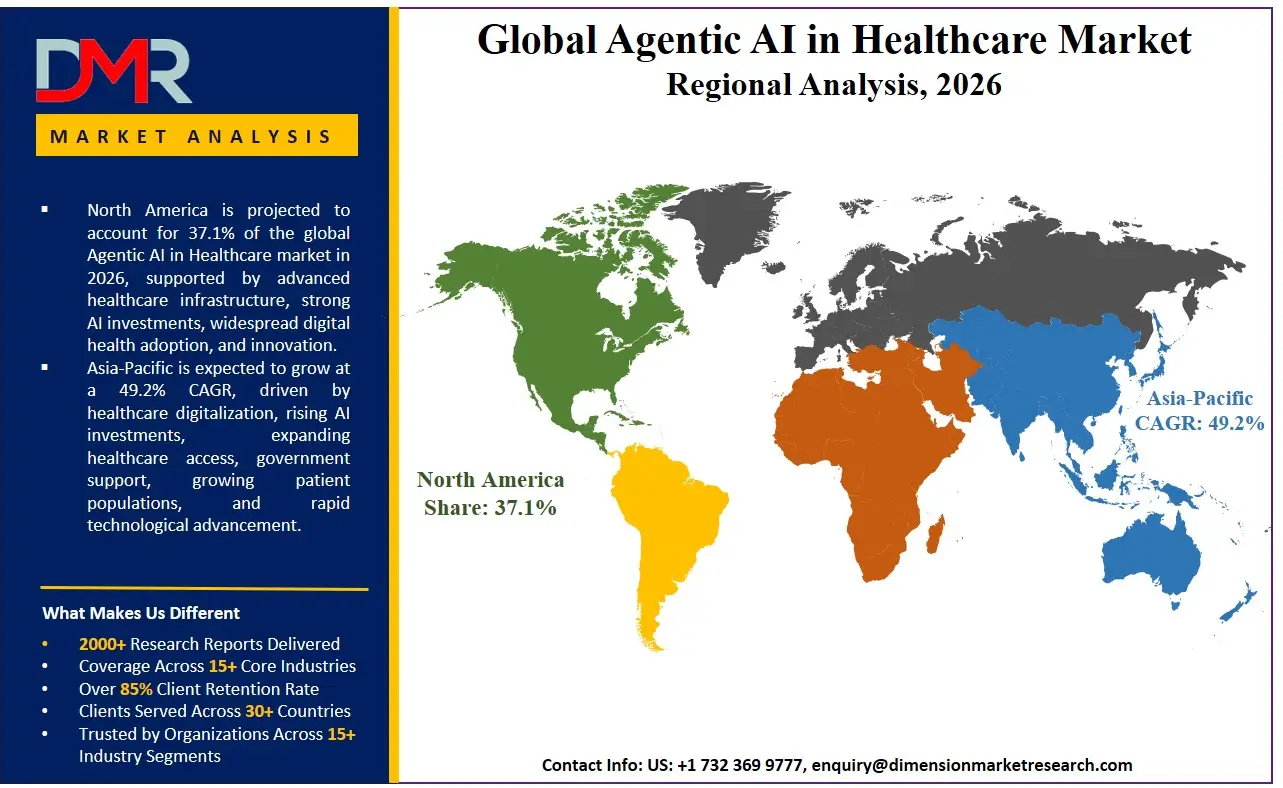
North America is poised to dominate the global agentic AI in healthcare market, holding a projected 37.1% of the market share by the end of 2026. This type of leadership is based on a perfect combination of market-driving factors such as documented physician burnout crisis that requires immediate attention, most concentrated region of venture-backed AI native digital health firms, and a tech-savvy large enterprise health systems eco-system that would be early adopters of next-generation AI technology. Specifically, the United States represents a unique region that has a high concentration of hyperscale cloud providers who offer AI services in healthcare sector that serve as a platform for developing agents. The "fail fast" culture of innovation in large academic medical centers and fee-for-service system that rewards efficiency through automation create strong economic incentive for clinical workflow agents and autonomous revenue cycle management solutions.
ℹ
To learn more about this report –
Download Your Free Sample Report Here
Fastest-Growing Regional Market
The Asia-Pacific region is expected to have the highest growth rate due to developing countries leaping over existing infrastructures used in healthcare IT. The Asian countries, such as India, China, and Singapore, are on the verge of implementing government-led initiatives for creating digital health with the intent to ignore old client-server infrastructures for creating new cloud-based infrastructure ready for Artificial Intelligence. With the huge population, the development is becoming absolutely essential due to an overwhelming demand from the population for autonomous triage and virtual agents that will be used to augment the efforts of physicians working in the healthcare system of the country. Another fast-evolving business model includes private hospital chains of Southeast Asia looking to position itself as medical tourism destinations with the use of human-AI diagnostic and precision medicine agents.
By Region
North America
Europe
- Germany
- The U.K.
- France
- Italy
- Russia
- Spain
- Benelux
- Nordic
- Rest of Europe
Asia-Pacific
- China
- Japan
- South Korea
- India
- ANZ
- ASEAN
- Rest of Asia-Pacific
Latin America
- Brazil
- Mexico
- Argentina
- Colombia
- Rest of Latin America
Middle East & Africa
- Saudi Arabia
- UAE
- South Africa
- Israel
- Egypt
- Rest of MEA
Competitive Landscape
Agentic AI for healthcare is in the midst of an ever-evolving, multi-dimensional race among digital health disruptors using native AI technologies, professional and healthcare service groups of global tech hyperscalers, and an emerging class of platform companies offering customized agent solutions. Domain specialization and workflow integration capabilities, not sheer raw model power, hold the key to market domination. Winning requires a well-crafted alliance strategy involving EHR market dominant vendors such as Epic and Cerner, with the value proposition of agentic AI being highly dependent on integration within the clinician's screen flow process. Rapid consolidation is being fueled by healthcare incumbents and tech hyperscalers acquiring specialized clinical AI firms for their proprietary algorithms and data sets as well as workflow integration expertise, not just their algorithms. Proprietary IP in the form of specialized Clinical Context Recognition algorithms and validated agentic reasoning workflows have become the ultimate competitive moat, even more valuable than generalized language models.
Some of the prominent players in the Global Agentic AI in Healthcare Market are:
- Microsoft Corporation
- Google Cloud
- Amazon Web Services (AWS)
- Oracle Corporation
- IBM Corporation
- NVIDIA Corporation
- Salesforce, Inc.
- Palantir Technologies
- C3 AI, Inc.
- Tempus AI, Inc.
- IQVIA Holdings Inc.
- GE HealthCare Technologies Inc.
- Siemens Healthineers AG
- Philips Healthcare
- Epic Systems Corporation
- Veradigm Inc.
- Aidoc Medical Ltd.
- PathAI, Inc.
- Insilico Medicine
- Hippocratic AI
- Other Key Players
Recent Developments
- January 2026: Microsoft announced the expansion of its Azure AI Health Bot service, integrating a new Multi-Agent System architecture that allows autonomous clinical and administrative agents to collaboratively solve patient triage and scheduling tasks under strict human-in-the-loop governance for critical decisions.
- November 2025: NVIDIA launched an Enterprise Agent Development Suite specifically for healthcare, providing researchers and health systems with a library of pre-trained foundation models, guardrail frameworks, and No-Code Agent Platforms to accelerate the creation of bespoke diagnostic and drug discovery agents.
- October 2025: Aidoc acquired a pioneering European company specializing in Real-Time Decision Support agents, integrating its clinical context recognition technology to create a more robust, fully autonomous AI care coordination layer for emergency radiology and inpatient settings.
Report Details
| Report Characteristics |
| Market Size (2026) |
USD 1,044.3 Mn |
| Forecast Value (2035) |
USD 34,636.6 Mn |
| CAGR (2026–2035) |
47.6% |
| The US Market Size (2026) |
USD 325.8 Mn |
| Historical Data |
2021 – 2025 |
| Forecast Data |
2027 – 2035 |
| Base Year |
2025 |
| Estimate Year |
2026 |
| Segments Covered |
By Product, By Agent System, By Technology, By Application, and By End Use |
| Regional Coverage |
North America – The US and Canada; Europe – Germany, The UK, France, Russia, Spain, Italy, Benelux, Nordic, & Rest of Europe; Asia-Pacific – China, Japan, South Korea, India, ANZ, ASEAN, Rest of APAC; Latin America – Brazil, Mexico, Argentina, Colombia, Rest of Latin America; Middle East & Africa – Saudi Arabia, UAE, South Africa, Turkey, Egypt, Israel, & Rest of MEA |
Frequently Asked Questions
How big is the Global Agentic AI in Healthcare Market?
▾ The Global Agentic AI in Healthcare market is poised to be valued at USD 1,044.3 million in 2026 and is projected to explode to USD 34,636.6 million by 2035, driven by the urgent need for autonomous systems to combat clinician burnout and manage the complexity of modern patient care.
What is the CAGR of the Global Agentic AI in Healthcare Market from 2026 to 2035?
▾ The market is expected to grow at a staggering CAGR of 47.6% from 2026 to 2035, reflecting a technology paradigm shift as healthcare moves from AI copilots to truly autonomous, action-taking agents for clinical and operational workflows.
What factors are driving the growth of the Global Agentic AI in Healthcare Market?
▾ Key drivers include the global clinical workforce burnout crisis, the impossibility of delivering precision medicine at scale without autonomous cognitive partners, and the proven economic imperative to automate complex, costly administrative processes.
Which region held the largest share of the Agentic AI in Healthcare Market in 2026?
▾ North America held a 37.1% market share in 2026, driven by a mature ecosystem of AI-first digital health companies, aggressive venture capital investment, and large health systems actively deploying autonomous agents as a systemic solution to workforce and operational challenges.
Which region is expected to grow the fastest in the Agentic AI in Healthcare Market?
▾ The Asia-Pacific region is expected to grow the fastest, fueled by national-scale digital health initiatives, a critical shortage of clinicians necessitating mass autonomous triage and care, and rapid innovation in sovereign, culturally and linguistically specific AI models.
What are the major trends in the Global Agentic AI in Healthcare Market?
▾ Major trends include the shift to Multi-Agent Systems that mimic a clinical care team, the embedding of Generative AI for complex diagnostic reasoning, the rise of Human-AI Hybrid Systems as the gold standard for safety, and the democratization of AI creation through no-code platforms.
Who are the key players in the Global Agentic AI in Healthcare Market?
▾ Key players include hyperscale cloud and tech giants like Microsoft, Google Health, and AWS; healthcare-specific AI innovators such as Aidoc, PathAI, and Tempus Labs; and medical device leaders like Siemens Healthineers and GE HealthCare that are embedding agentic AI directly into their hardware and software ecosystems.
How is the Global Agentic AI in Healthcare Market segmented?
▾ The market is segmented by Product, Agent System, Technology, Application, and End Use.