Market Snapshot
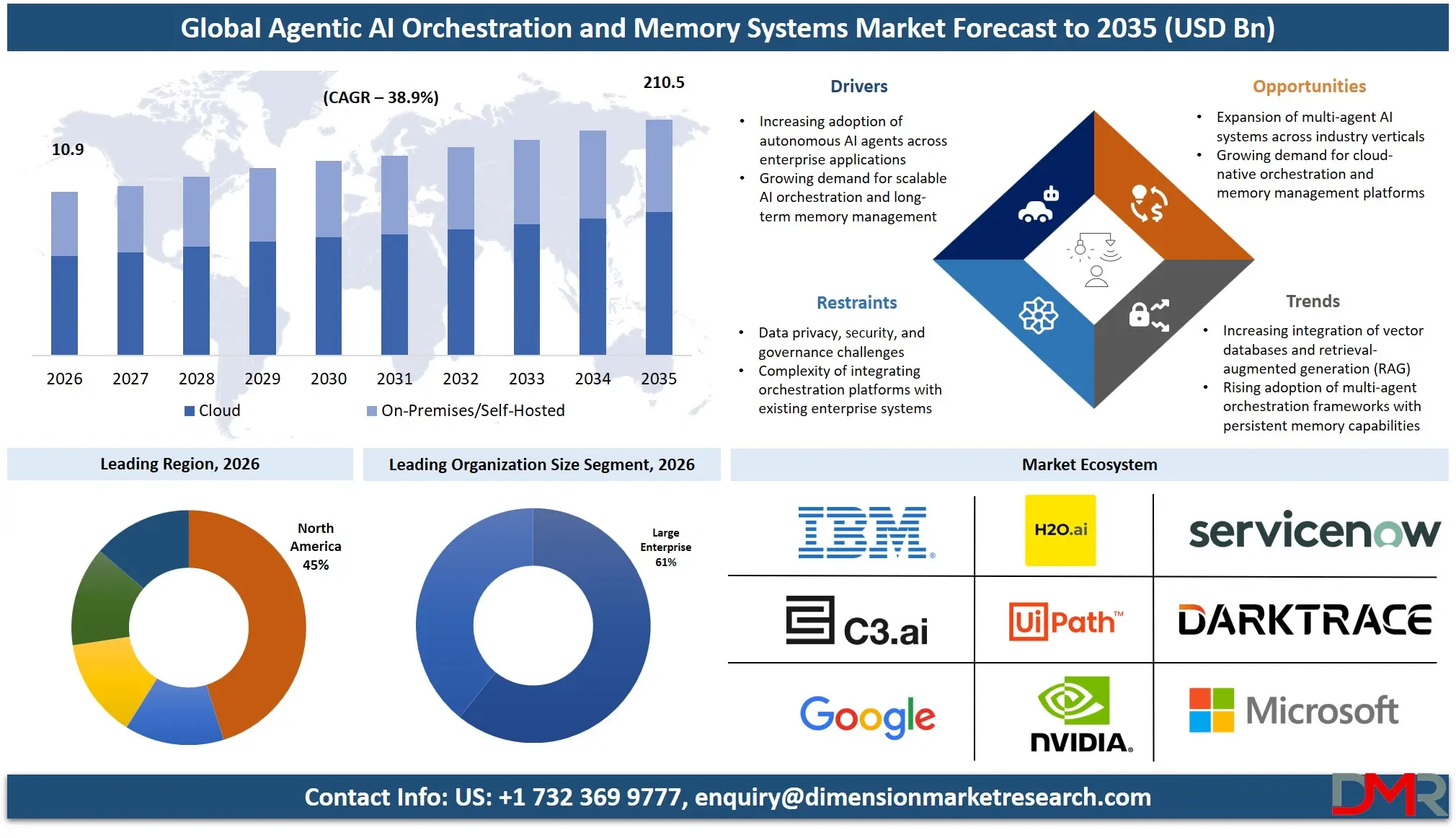
- The market size is USD 7.8 Billion in 2025, reached USD 10.9 Billion in 2026, and is projected to hit USD 210.5 Billion by 2035 at a CAGR of 38.9%.
- The US market reached at USD 2.9 Billion in 2025, growing at a CAGR of 22.5%.
- By Solution Type, Orchestration Frameworks lead with a 32.5% revenue share in 2026.
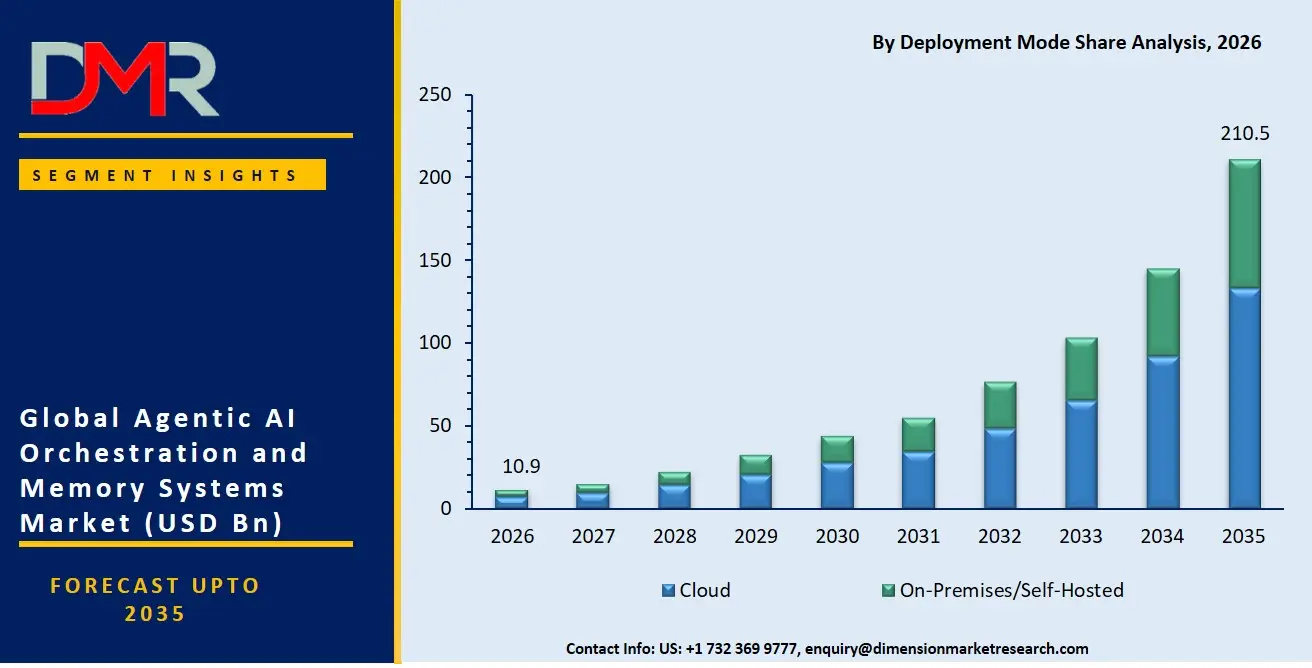
- By Deployment Mode, Cloud leads with a 67.8% revenue share in 2026.
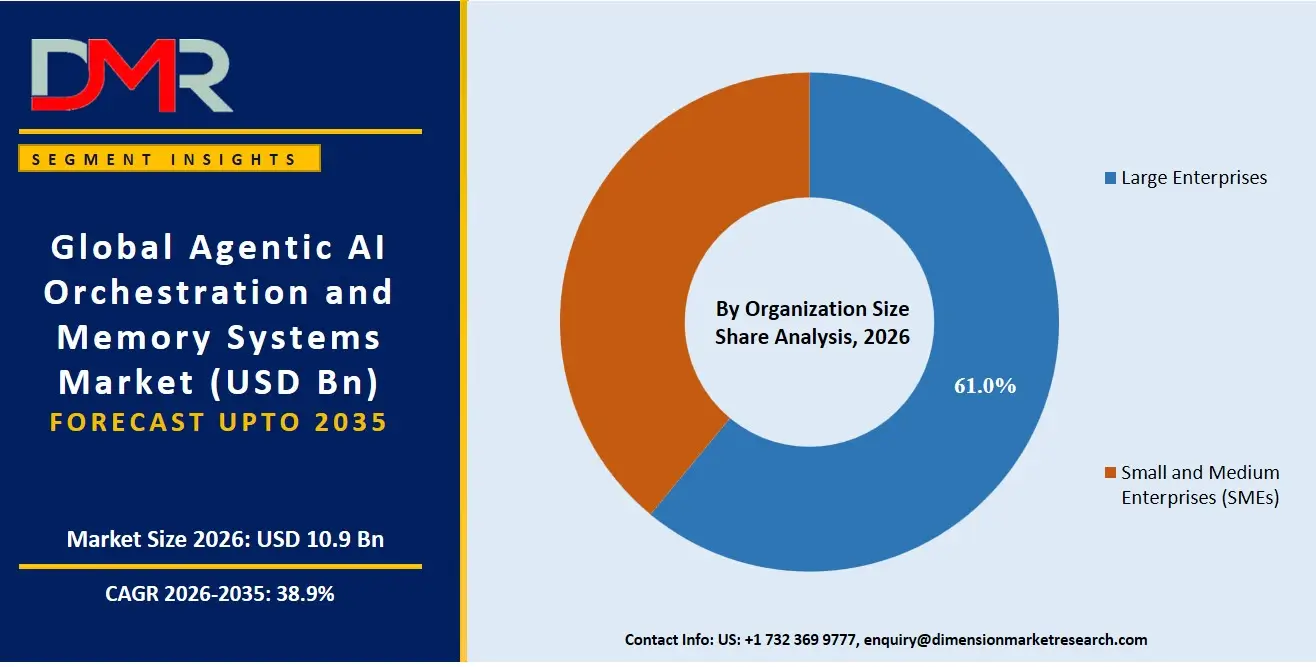
- By Organization Size, Large Enterprises dominate with a 61.0% share in 2026.
- By End-User Industry, IT and Telecom leads with a 23.40% revenue share in 2026.
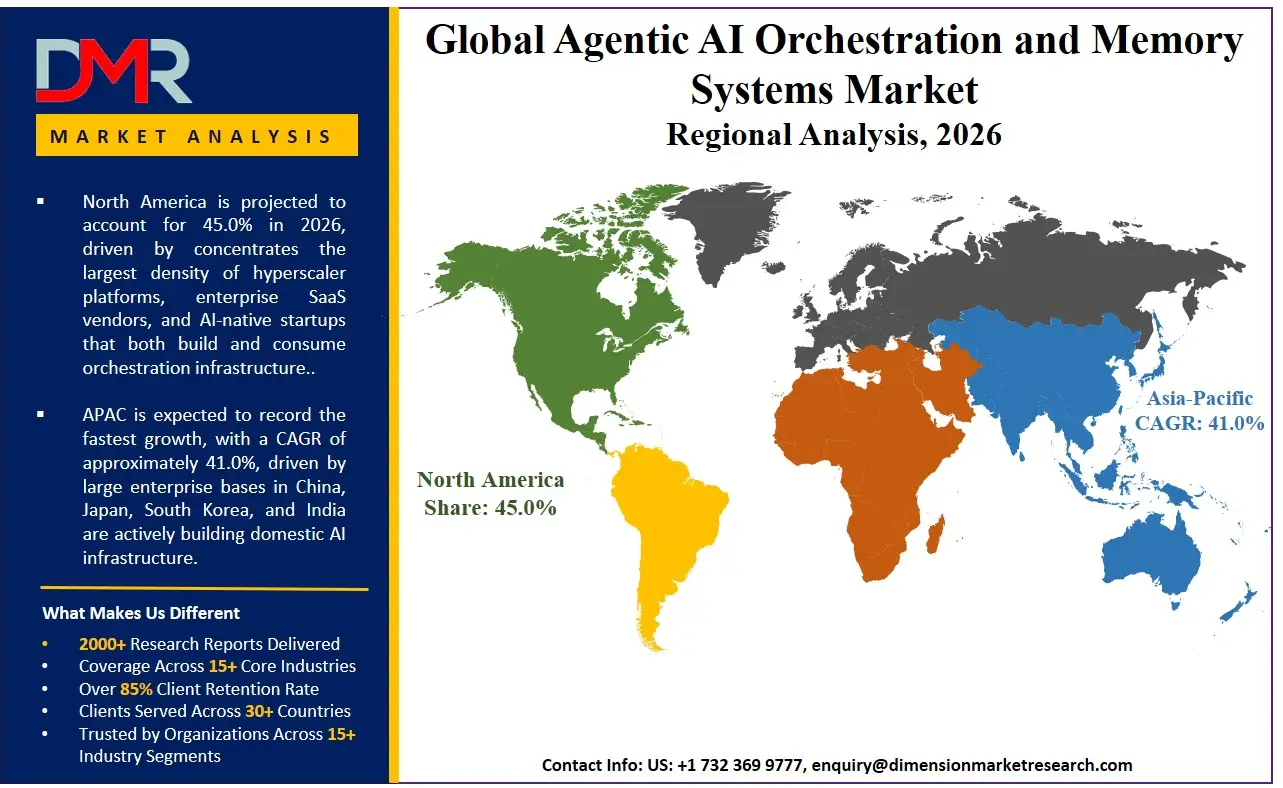
- North America holds the dominant regional position with a 45.0% share, valued at USD 4.9 Billion in 2026.
- Multi-agent systems accounted for 66.4% of the global market in 2026.
Market Overview
The Global Agentic AI Orchestration and Memory Systems Market covers the software infrastructure that enables autonomous AI agents to plan, execute, and remember tasks across multi-step workflows. This includes orchestration frameworks, vector databases, workflow engines, context-management SDKs, and observability tools. Raw large language models and standalone AI hardware fall outside Agentic AI Orchestration and Memory Systems Market's scope. DMR projects that 33% of enterprise software applications will embed autonomous AI capabilities by 2028, rising from less than 1% in 2024, which means orchestration and memory infrastructure will become a baseline procurement requirement across virtually every software category within three years.
ℹ
To learn more about this report –
Download Your Free Sample Report Here
The market connects directly to the broader enterprise software sector as a structural dependency rather than an optional layer. Organizations cannot run autonomous agents without the coordination and memory infrastructure Agentic AI Orchestration and Memory Systems Market provides. Findings from WNS confirm that only 14% of global organizations had deployed autonomous capabilities at full or partial scale by early 2026. The gap between executive intent and operational execution defines the market's near-term commercial opportunity. Vendors that reduce deployment friction will capture disproportionate share before the maturity curve narrows the window.
Governance and evaluation tooling are emerging as market multipliers within this infrastructure stack. Organizations that build observable, auditable agent pipelines convert pilot deployments into production systems at a rate that organizations relying on unmonitored agents cannot match. This dynamic is concentrating enterprise procurement budgets toward vendors that bundle orchestration, memory, and observability into integrated platforms rather than selling discrete point solutions.
Market Size and Forecast
The Global Agentic AI Orchestration and Memory Systems Market size is estimated at USD 10.9 Billion in 2026 from USD 7.8 Billion in 2025, and is projected to reach USD 210.5 Billion by 2035, exhibiting a CAGR of 38.9% during the forecast period.
The US segment reached USD 2.9 Billion in 2025 and grows at a 22.5% CAGR, a rate below the global average. The gap between the US and global CAGRs confirms that international markets will close the adoption distance faster than North America compounds. Three structural assumptions underpin the forecast: continued enterprise migration from pilot to production agent deployments, the embedding of autonomous capabilities into standard enterprise software, and the maturation of governance tooling that currently constrains full-scale deployment. Capgemini data confirms only 2% of organizations have deployed agents at true scale, which means the forecast captures a predominantly pre-penetration market at the base year.
Cohere's acquisition of biopharma AI specialist Reliant AI in May 2026 to build "North for Pharma" signals that horizontal AI infrastructure companies now treat domain-specific agentic workbenches as independent product categories. This pattern of cross-sector investment accelerates the market's expansion beyond its current IT and telecom base. A downside scenario materializes if DMR prediction that over 40% of agentic AI projects fail by 2027 due to legacy incompatibility triggers broad enterprise buyer hesitation, compressing procurement cycles and slowing vendor revenue growth below the base CAGR.
Solution Type Analysis
Orchestration Frameworks led the Solution Type segment with a 32.5% share in 2026.
Orchestration Frameworks hold this position because every multi-agent deployment requires a coordination layer without which individual agents cannot communicate, delegate, or execute sequentially across enterprise workflows. Multi-agent architectures have become the dominant production pattern, and each deployment adds a recurring orchestration dependency that compounds the segment's revenue base year over year. Frameworks that support supervisor agent architectures specifically generate higher contract values because they manage the full task decomposition and delegation cycle rather than single-agent execution.
Memory Layers and Vector Databases represent the fastest-scaling infrastructure sub-segment. Data published by Databricks shows that more than 80% of new databases in 2026 were built and managed by AI agents, creating sustained structural demand for AI-native storage and retrieval systems. Observability and Testing Tools carry the highest commercial leverage relative to their current revenue base. Databricks confirms that organizations using evaluation tools pushed 6x more AI projects to production while governance users achieved 12x more successful deployments, making testing infrastructure the primary adoption multiplier in the stack. Workflow Engines and Context-Management SDKs occupy critical execution layers, with the latter increasingly required to support seamless handoff points between autonomous execution and human review given that 89% of respondents in Landbase's data emphasized hybrid human-AI collaboration as a non-negotiable deployment requirement.
Deployment Mode Analysis
A 67.8% share made Cloud the clear leader across Deployment Mode categories in 2026.
ℹ
To learn more about this report –
Download Your Free Sample Report Here
Cloud infrastructure dominates because elastic compute is the only deployment model that can scale to meet the recursive demands of supervisor agent architectures that spin up sub-agents dynamically across unpredictable workloads. On-premises environments carry the highest legacy mismatch risk in the stack. Vendors targeting regulated industries with on-premises requirements must deliver pre-validated integration stacks to reduce failure rates at deployment.
Organization Size Analysis
Large Enterprises outpaced all other Organization Size categories with a 61.0% share in 2026.
ℹ
To learn more about this report –
Download Your Free Sample Report Here
Large enterprises generate the most complex orchestration requirements, integrating agents across multiple departments, data systems, and regulatory environments simultaneously. SMEs represent the highest-growth adoption cohort as ready-to-deploy agent frameworks lower the technical barrier. Landbase data shows ready-to-deploy agents comprised 58.5% of all implementations in 2026, directly serving organizations that lack the internal capacity to build custom orchestration stacks. Vendors packaging orchestration and memory into affordable turnkey SME solutions can capture this segment before hyperscalers redirect their go-to-market resources downmarket.
End-User Industry Analysis
IT and Telecom captured 23.40% of the End-User Industry segment in 2026, ahead of all rivals.
IT and telecom organizations possess native technical capability to deploy and manage orchestration frameworks, and their existing infrastructure of APIs, microservices, and cloud-native systems maps directly onto the architectural requirements of agentic deployments. BFSI represents the most trust-constrained vertical. Beam AI data confirms 83% of financial institutions planned agentic deployments for 2026, yet only 20% of enterprise leaders trust autonomous systems for financial transactions, creating a gap between pipeline intent and procurement execution that vendors must close with deterministic logic and full audit trail capabilities.
Retail and E-commerce leads all verticals in multi-model adoption. Databricks 2026 data shows 83% of retailers employ diverse model strategies, using different LLMs for different tasks to optimize cost and latency across millions of daily transactions. Healthcare and Life Sciences will adopt more slowly but generate significantly higher contract values per deployment because buyers require validated, compliant agent pipelines with full explainability. Manufacturing adoption centers on supply chain coordination and predictive maintenance orchestration, where existing industrial IoT infrastructure creates natural integration points for agentic middleware.
Key Market Segments
By Solution Type
- Orchestration Frameworks
- Memory Layers / Vector DBs
- Workflow Engines
- Context-Management SDKs
- Observability and Testing Tools
By Deployment Mode
- Cloud
- On-Premises / Self-Hosted
By Organization Size
- Large Enterprises
- Small and Medium Enterprises (SMEs)
By End-User Industry
- IT and Telecom
- BFSI
- Healthcare and Life Sciences
- Retail and E-commerce
- Manufacturing
- Government and Education
Regional Analysis
North America held a 45.0% share in 2026, valued at USD 4.9 Billion.
ℹ
To learn more about this report –
Download Your Free Sample Report Here
North America's leadership is structural. The region concentrates the largest density of hyperscaler platforms, enterprise SaaS vendors, and AI-native startups that both build and consume orchestration infrastructure. Microsoft customers in this region created over 1 million custom agents in a single quarter, a volume that requires deep, reliable orchestration and memory layers to sustain at production scale. The US market at USD 2.9 Billion alone confirms that North America is not just the largest region but the primary engine of current commercial activity.
Asia Pacific presents the highest long-term volume growth opportunity. Large enterprise bases in China, Japan, South Korea, and India are actively building domestic AI infrastructure, and high-frequency transaction environments in retail and financial services create natural demand for low-latency orchestration systems. Europe's adoption is shaped by stringent data governance obligations. Beam AI data shows only 20% of enterprise leaders trust autonomous systems for financial transactions, a confidence gap that European regulators are actively working to close through structured AI governance frameworks. Latin America remains an early-stage adoption market, with Brazil and Mexico anchoring commercial activity in financial services and retail automation. The Middle East, led by GCC nations, is deploying sovereign AI infrastructure at a national strategy level, creating government-backed demand for agentic platforms operating within strict data residency frameworks.
Key Regions and Countries
North America
Europe
- Germany
- France
- The UK
- Spain
- Italy
- Rest of Europe
Asia Pacific
- China
- Japan
- South Korea
- India
- Australia
- Rest of APAC
Latin America
- Brazil
- Mexico
- Rest of Latin America
Middle East & Africa
- GCC
- South Africa
- Rest of MEA
Market Dynamics
Multi-Agent Production Scale and Platform Expansion Redefine Enterprise Procurement
Enterprise multi-agent deployments rose by 327% in under four months in early 2026, per Databricks' 2026 State of AI Agents report. This rate of adoption confirms a structural shift where organizations commit to distributed autonomous workflows as a standard operational model rather than a test case. Microsoft customers created over 1 million custom agents in a single quarter, with agent creation growing 130% quarter-over-quarter in FY25 Q3. Low-code agent creation at this scale means orchestration demand now originates from business units, not just engineering teams, fundamentally expanding the buyer base. AWS reinforced this shift in April 2026 by launching "Amazon Bio Discovery," an agentic platform enabling scientists to orchestrate drug discovery pipelines autonomously using natural language.
Interoperability standards are removing the last major adoption friction barrier. Microsoft's March 2026 release introduced the Agent-to-Agent open protocol alongside the Microsoft 365 Agents SDK. McKinsey's 2025 State of AI Survey confirms that 88% of enterprises now report regular AI use. Together these signals confirm that the market has crossed the mainstream adoption threshold. Vendors must now compete on deployment depth and production reliability rather than persuading buyers of the concept's validity.
Legacy Infrastructure Failures and Trust Collapse Create Structural Deployment Ceilings
DMR predicts that over 40% of agentic AI projects will fail by 2027 due to legacy system incompatibility. This failure rate reflects a deep architectural mismatch between the recursive execution demands of autonomous agents and the static, batch-oriented design of most enterprise IT infrastructure. The failure risk is not evenly distributed. On-premises environments carry the highest mismatch exposure, and mid-market organizations without dedicated AI operations teams face the greatest cancellation probability.
Trust erosion compounds the technical challenge. Capgemini's 2025 research shows enterprise confidence in fully autonomous AI agents collapsed from 43% to 27% in a single year. Security readiness lags even further behind deployment ambition. Research published in 2026 confirms that only 29% of organizations report adequate security readiness for autonomous agent deployment. Vendors that cannot deliver deterministic logic, identity governance, and auditable memory trails will lose enterprise contracts to competitors that can meet these baseline requirements.
A USD 450 Billion Value Pool and Embedded Software Demand Define the Long-Term Upside
Capgemini projects that AI agents will generate USD 450 Billion in combined revenue growth and cost savings across surveyed markets by 2028. Vendors positioned within the orchestration and memory stack sit directly in the value chain enabling this outcome. Mem0 raised USD 24 Million in combined seed and Series A funding in October 2025 to build model-agnostic memory infrastructure, and simultaneously launched its "memory passport" framework enabling developers to store, retrieve, and evolve user memory across OpenAI, Anthropic, and open-source LLMs. The governance layer around these deployments represents a recurring revenue opportunity that did not exist three years ago.
Customer experience automation is the highest-value near-term vertical entry point. Landbase data confirms that 60% of brands will use autonomous customer interactions by 2028, while 68% of all customer service interactions with technology vendors will be managed autonomously by the same year. Vendors that build reliable, low-latency memory retrieval and execution pipelines for customer-facing workflows will capture the highest-margin enterprise contracts in Agentic AI Orchestration and Memory Systems Market before the deployment wave peaks.
Market Trends
Orchestration Becomes Enterprise Middleware While AI-Native Memory and Identity Governance Reshape the Stack
Supervisor agents now account for 37% of all agent usage, per Databricks 2026, confirming that multi-agent orchestration has moved from experimental pattern to production architecture. Zinnov's 2026 analysis identifies multi-agent orchestration sitting between people, processes, and platforms as the defining architectural standard of 2026, which means orchestration frameworks are now operational infrastructure that enterprises must govern and audit like any other mission-critical middleware layer. Non-human identity management has emerged as the most underappreciated risk layer in production deployments. Research data confirms that 78% of enterprises used two or more distinct LLM families by late 2025, making vendor-agnostic routing and unified identity governance across model providers mandatory features rather than optional capabilities. Insilico Medicine and Liquid AI jointly launched the "LFM2-2.6B-MMAI" model in March 2026, the first compact scientific foundation model built through a specialized curriculum, confirming that the market is generating purpose-built foundation models rather than adapting general-purpose architectures for domain-specific orchestration workloads.
Market Competition Overview
The Agentic AI Orchestration and Memory Systems market is highly fragmented at the infrastructure and tooling layer, with dozens of specialized vendors competing across discrete stack components. The enterprise application layer is consolidating rapidly as hyperscalers and large SaaS platforms embed agentic capabilities directly into existing product suites, compressing the addressable market for standalone point solutions. Salesforce delivered 2.4 billion agentic work units across its CRM platform by end of fiscal 2026, a throughput volume that pure-play orchestration vendors cannot match through direct sales cycles alone.
Pure-play infrastructure vendors are differentiating on technical depth rather than platform breadth. The open-source developer community has proven to be the most capital-efficient distribution channel, with community-led adoption preceding commercial enterprise contracts. 73% of corporate executives agree that how their organization deploys autonomous AI agents will determine competitive standing over the next 12 months, per PwC, accelerating procurement decisions across the market. The competitive dynamic most likely to reshape the market over the next three years is the battle between open-protocol interoperability and proprietary platform lock-in. Microsoft's March 2026 Agent-to-Agent open protocol signals that hyperscalers are willing to standardize orchestration interfaces to accelerate ecosystem growth. Vendors building on open standards will access broader distribution, while those betting on proprietary protocols risk being bypassed as enterprises prioritize vendor-agnostic portability.
Company Profiles
LangChain Technologies Ltd. built its competitive position on converting massive open-source developer adoption into a defensible commercial SaaS business. Revenue reached USD 16 Million in 2025, doubling from USD 8.5 Million in 2024, as enterprises paid for LangSmith observability and LangGraph stateful execution. LangChain secured a USD 125 Million Series B in October 2025 at a USD 1.3 Billion valuation, and simultaneously released LangChain 1.0 and LangGraph 1.0 as production-ready infrastructure for reliable agent deployment. The USD 1.3 Billion valuation at current revenue multiples confirms that infrastructure-layer ownership commands unicorn pricing in Agentic AI Orchestration and Memory Systems Market independent of model ownership.
Salesforce Inc. is converting its dominant CRM customer base into an agentic AI distribution advantage through its Agentforce platform. ServiceNow secured 244 transactions exceeding USD 1 Million in net new annual contract value in Q4 2025, driven by its Now Assist autonomous platform, confirming that buyers assign significant budget to agentic capabilities when delivered through trusted existing vendor relationships. Salesforce completed its approximately USD 8 Billion acquisition of Informatica in November 2025, adding data catalog, governance, quality, and metadata management capabilities directly addressing the data lineage requirements that govern agentic AI reliability at enterprise scale. CrewAI reached USD 3.2 Million in revenue by mid-2025 from zero in 2023, processed over 2 billion agentic executions, and accumulated 47,800 GitHub stars by early 2026, validating its role-based agent abstraction model as a production-scale framework rather than a developer experiment.
Key Players
- Pinecone Inc.
- LangChain Technologies Ltd.
- OpenAI LLC
- UiPath Inc.
- ServiceNow Inc.
- Mem0 AI PBC
- Microsoft Corp.
- Google LLC
- Temporal Technologies Inc.
- CrewAI Labs Inc.
- Qdrant Technologies GmbH
- Orq.ai BV
- Agno AI Inc.
- IBM Corp.
- AWS Inc.
- Salesforce Inc.
- NVIDIA Corp.
- Anthropic
- Perplexity AI
- LlamaIndex
- Palantir Technologies
- DataRobot
- C3.ai
- H2O.ai
- Darktrace
Supply Chain and Value Chain Analysis
The value chain flows from foundational model providers and cloud infrastructure at the base, through orchestration framework and memory layer vendors in the middle, to enterprise software integrators and end-user application platforms at the top. The middle layer captures the highest structural value because it sits between commoditizing model APIs and consolidating enterprise platforms. Cloud hyperscalers control the foundational compute on which the entire chain depends, and their dual role as infrastructure providers and direct orchestration competitors creates both dependency and competitive tension throughout the supply chain.
The biggest bottleneck in the current value chain is the integration gap between orchestration frameworks and legacy enterprise systems. System integrators and middleware vendors specializing in bridging orchestration frameworks with existing ERP, CRM, and data warehouse infrastructure occupy a critical and currently underserved position. Memory and vector database vendors sit at a high-leverage point because every orchestration framework depends on persistent, retrievable memory to function across multi-step tasks. Buyers currently face a fragmented procurement environment that requires assembling multiple point solutions from vendors with varying integration maturity. Vendors delivering integrated full-stack solutions reduce total procurement complexity and will command pricing premiums over best-of-breed component sellers as enterprise buyers prioritize operational simplicity over theoretical best-in-class performance.
Regulatory Landscape
The regulatory environment operates across three pressure points: data sovereignty requirements that govern where agent memory is stored, AI governance frameworks that define how autonomous decisions must be audited, and sector-specific compliance obligations in BFSI, healthcare, and government that set minimum standards for agent accountability. Europe's EU AI Act is the most structurally consequential regulation for Agentic AI Orchestration and Memory Systems Market globally. High-risk AI applications, which include autonomous agents in healthcare, financial services, and critical infrastructure, face mandatory conformity assessments, human oversight requirements, and full audit trail obligations. The FDA moved 63% of its internal AI use case portfolio into active production by FY2025 and authorized more than 1,000 AI/ML-enabled devices by early 2026, confirming that regulatory adoption of autonomous systems is accelerating within government bodies in parallel with the enforcement framework tightening for commercial deployments.
Non-human identity governance is the most urgent and least-regulated compliance gap in production deployments. Strategic 2026 frameworks identify agent identity, permissions, and lifecycle governance as the most underappreciated risk layer in current architectures. In North America, financial institutions planning agentic deployments must satisfy SEC, FINRA, and OCC guidance on automated decision-making, data retention, and model risk management. GCC nations are building national AI governance frameworks that mandate data residency within sovereign infrastructure, directly constraining cloud-first vendors operating exclusively on US-headquartered hyperscaler infrastructure. Vendors that invest in sovereign cloud partnerships and regionally isolated memory architectures will access government procurement channels structurally closed to non-compliant competitors.
Investment and White Space Analysis
Cognition AI raised over USD 400 Million at a USD 10.2 Billion post-money valuation in August 2025, with combined ARR reaching an estimated USD 150 Million in mid-2025 following its acquisition of Windsurf. Separately, Isomorphic Labs built a total pipeline partnership value of nearly USD 3.0 Billion in early 2024 through strategic collaborations, confirming that investors are concentrating capital in vendors that own specific, defensible layers of the agentic stack. Memory infrastructure, stateful multi-agent execution, and evaluation tooling are attracting the largest rounds because these layers sit closest to the production failure points that enterprise buyers most urgently need to solve.
The evaluation and governance tooling segment is the most underserved relative to its demonstrated commercial impact. Asia Pacific and Latin America represent the highest-opportunity regions for new entrants due to low competitive intensity relative to their enterprise AI adoption trajectories. Enterprise markets in India, Brazil, and Southeast Asia are building agentic AI strategies without incumbent vendor relationships, giving early movers the ability to establish platform standards before competition arrives. The SME segment is a structurally underserved white space within the organizational size dimension. Most vendor roadmaps prioritize enterprise feature requirements, leaving a viable opening for vendors that package orchestration and memory into turnkey, affordable SME-oriented solutions before hyperscalers commoditize the enterprise layer and redirect go-to-market resources downmarket.
Recent Developments
- August 2025: Cognition AI. Funding Round. Cognition raised over USD 400 Million at a USD 10.2 Billion post-money valuation, led by Founders Fund, to expand its Devin AI autonomous software engineer agent. Combined ARR reached an estimated USD 150 Million in mid-2025 following its acquisition of Windsurf.
- July 13, 2025: Cognition. Acquisition. Cognition signed a definitive agreement to acquire Windsurf, including its IP, product, trademark, brand, and personnel, following Google's USD 2.4 Billion licensing agreement with Windsurf which brought its CEO and core R&D team into Google DeepMind.
- May 2025: Microsoft Corp. Product Launch. Microsoft released Magentic orchestration within Semantic Kernel, productizing the Magentic-One multi-agent pattern comprising Orchestrator, WebSurfer, FileSurfer, Coder, and ComputerTerminal agents for solving open-ended web and file-based tasks at enterprise scale.
- October 2024: CrewAI Labs Inc. Funding Round. CrewAI raised USD 18 Million across seed and Series A rounds, led by Insight Partners, with angel participation from Andrew Ng and Dharmesh Shah. By early 2026, CrewAI processed over 2 billion agentic executions and accumulated 47,800 GitHub stars.
Report Details
| Report Characteristics |
| Market Value (2025) |
USD 7.8 Billion |
| Market Value (2026) |
USD 10.9 Billion |
| Forecast Revenue (2035) |
USD 210.5 Billion |
| CAGR (2026–2035) |
38.9% |
| Base Year for Estimation |
2025 |
| Historic Period |
2020 to 2024 |
| Forecast Period |
2026 to 2035 |
| Report Coverage |
Revenue Forecast, Market Dynamics, Competitive Landscape, Recent Developments |
| Segments Covered |
By Solution Type (Orchestration Frameworks, Memory Layers / Vector DBs, Workflow Engines, Context-Management SDKs, Observability and Testing Tools), By Deployment Mode (Cloud, On-Premises / Self-Hosted), By Organization Size (Large Enterprises, Small and Medium Enterprises), By End-User Industry (IT and Telecom, BFSI, Healthcare and Life Sciences, Retail and E-commerce, Manufacturing, Government and Education) |
| Regional Analysis |
North America – US and Canada; Europe – Germany, France, The UK, Spain, Italy, and Rest of Europe; Asia Pacific – China, Japan, South Korea, India, Australia, and Rest of APAC; Latin America – Brazil, Mexico, and Rest of Latin America; Middle East and Africa – GCC, South Africa, and Rest of MEA |
| Competitive Landscape |
Pinecone Inc., LangChain Technologies Ltd., OpenAI LLC, UiPath Inc., ServiceNow Inc., Mem0 AI PBC, Microsoft Corp., Google LLC, Temporal Technologies Inc., CrewAI Labs Inc., Qdrant Technologies GmbH, Orq.ai BV, Agno AI Inc., IBM Corp., AWS Inc., Salesforce Inc., NVIDIA Corp., Anthropic, Perplexity AI, LlamaIndex, Palantir Technologies, DataRobot, C3.ai, H2O.ai, Darktrace |
| Customization Scope |
Customization for segments and region or country level will be provided. Additional customization can be done based on requirements. |
| Purchase Options |
Three license options: Single User License, Multi-User License (Up to 5 Users), Corporate Use License (Unlimited Users and Printable PDF). |
Frequently Asked Questions
What is the biggest investment opportunity in Agentic AI Orchestration and Memory Systems Market ?
▾ Evaluation and governance tooling is the most underserved segment relative to its commercial impact. Capgemini projects AI agents will generate USD 450 Billion in combined revenue growth and cost savings by 2028, and vendors positioned in orchestration and memory infrastructure sit directly in the value chain enabling that outcome. Customer experience automation in retail and financial services offers the clearest near-term revenue entry point.
Who are the top companies in Agentic AI Orchestration and Memory Systems Market ?
▾ LangChain Technologies Ltd. and Salesforce Inc. anchor the competitive landscape alongside ServiceNow, CrewAI, and Microsoft. LangChain reached a USD 1.3 Billion valuation after its USD 125 Million Series B in October 2025. Salesforce delivered 2.4 billion agentic work units by end of fiscal 2026, confirming platform-scale distribution that pure-play vendors cannot currently replicate.
Which segment is growing fastest in Agentic AI Orchestration and Memory Systems Market and why?
▾ Observability and Testing Tools carry the fastest commercial momentum. Organizations using evaluation tools push 6x more AI projects to production, per Databricks, and governance users achieve 12x more successful deployments. This direct link between testing infrastructure and production conversion rates makes it the highest-compounding commercial segment in the stack.
Which region is growing fastest in Agentic AI Orchestration and Memory Systems Market and why?
▾ Asia Pacific presents the highest long-term volume growth opportunity. Large enterprise bases in China, Japan, South Korea, and India are actively building domestic AI infrastructure. High-frequency transaction environments in retail and financial services in this region create natural and sustained demand for low-latency orchestration and memory systems optimized for scale.
What is the biggest challenge holding Agentic AI Orchestration and Memory Systems Market back?
▾ Legacy infrastructure incompatibility and collapsing enterprise trust are the two compounding barriers. DMR predicts over 40% of agentic AI projects will fail by 2027 due to legacy system failures. Capgemini's 2025 data shows enterprise trust in fully autonomous agents fell from 43% to 27% in one year, slowing procurement even in organizations with allocated budget.