What is the AI Assistant Market Size?
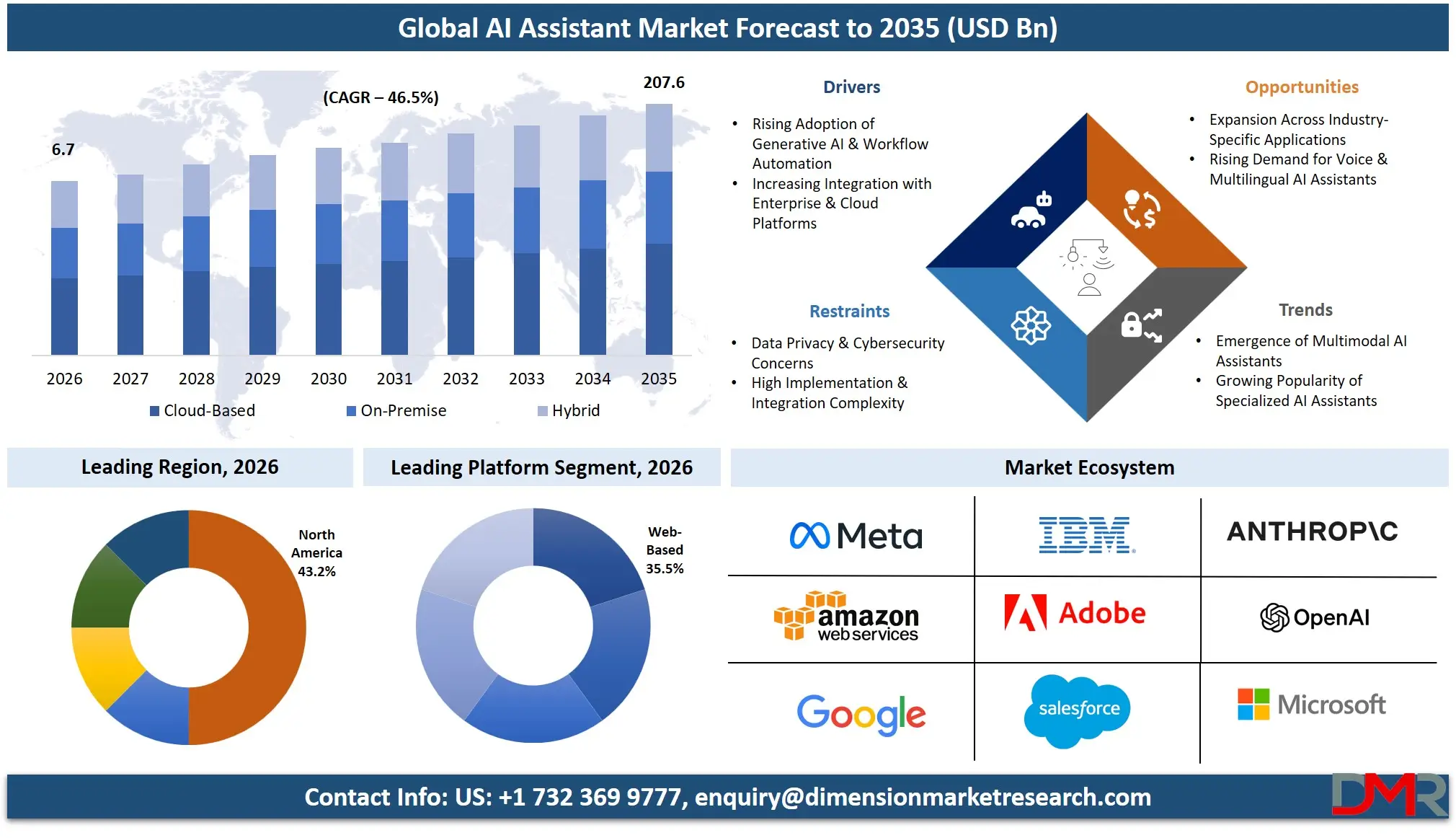
The Global AI Assistant Market is expected to reach a value of USD 6.7 billion in 2026, and it is further anticipated to reach USD 207.6 billion by 2035, growing at a CAGR of 46.5% during the forecast period.
ℹ
To learn more about this report –
Download Your Free Sample Report Here
The market for AI assistants has been witnessing exponential growth owing to their adoption by both enterprises and individuals who leverage generative AI as a part of their processes to automate knowledge work. This market comprises specific AI-based software products which empower people with their cognitive abilities in writing, meetings, research, scheduling, lead generation, developer activities, design, and analytics. The need for deploying AI assistants which are capable of enterprise-level AI security, context-aware automation, and cross-platform integration is driving the requirement for specialized integration and deployment services. Enterprises are the most common adopters of AI assistants, and cloud and SaaS-based AI assistants remain the most sought after owing to fast deployment and regular updating of models. Educational organizations, BFSI, IT and telecommunications, and the government sector are critical stakeholders as they require a secure, compliant, and context-aware AI ecosystem.
The US AI Assistant Market
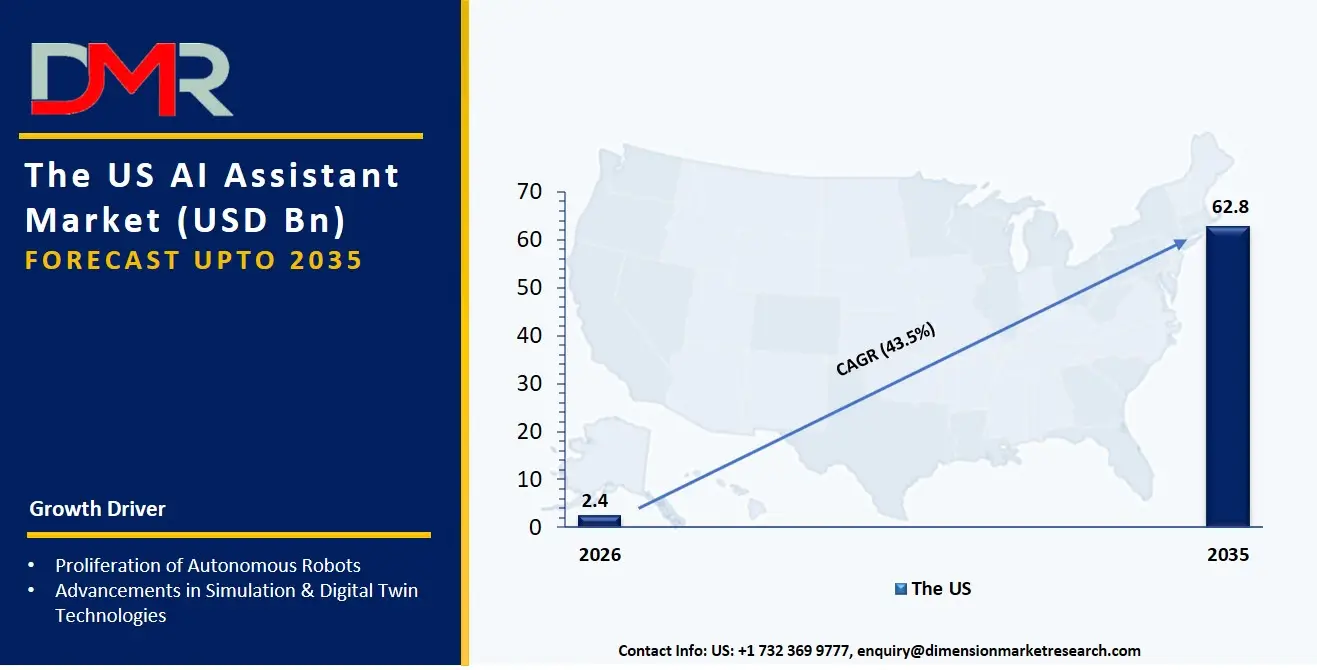
The US AI Assistant Market is projected to reach USD 2.4 billion in 2026 at a compound annual growth rate of 43.5% over its forecast period, which is further expected to reach a market value of USD 62.8 billion by 2035. The United States is still the largest and most advanced market for AI assistants because of the strong software modernization strategies adopted by Fortune 500 companies as well as the widespread adoption of large language models hosted on cloud computing. This market is characterized by high demand for developer productivity assistants since enterprises strive to modernize their legacy monolithic codebases into microservices through the use of AI-based code completion and review applications. In addition, the integration of AI systems that have situational awareness is creating a similar demand for knowledge and research assistants within enterprises to govern data and AI ethics.
ℹ
To learn more about this report –
Download Your Free Sample Report Here
The Europe AI Assistant Market
The Europe AI Assistant Market is estimated to be valued at USD 1.9 billion in 2026 and is further anticipated to reach USD 60.2 billion by 2035 at a CAGR of 46.5%. Influence on the European market due to regulation by GDPR and the upcoming EU AI Act requires the use of on-premises and hybrid solutions for Knowledge & Research Assistants to maintain data sovereignty. Increased adoption of meeting & collaboration assistants is also being witnessed in Europe due to the manufacturing and automotive sectors in countries like Germany and France striving to find the right balance between OT data privacy and AI meeting transcription and analytics. Furthermore, initiatives like GAIA-X are putting pressure on service providers to develop APIs that can help achieve data residency and interoperability within the European cloud ecosystems.
The Japan AI Assistant Market
The Japan AI Assistant Market is projected to be valued at USD 723.7 million in 2026 growing at a CAGR of 42.2%. Japanese market is quite different since there is a push towards DX from corporates driven by their shrinking workforce and outdated IT infrastructures. The bulk of spending goes towards Scheduling & Calendar Optimization Assistants as well as Analytical & Spreadsheet Assistants since conglomerates automate tasks that were earlier done by their employees through manual labor. Another important requirement is the deep integration within the local market for connecting EMR systems to industrial control systems to newer SaaS-native AI assistants. This creates an interesting niche opportunity for integration through APIs as well as workspace add-ons.
Key Takeaways
- Market Size & Forecast: The Global AI Assistant market size is forecasted to grow to USD 6.7 billion in 2026 and further anticipated to reach USD 207.6 billion by 2035 due to the duel effects of generative AI uptake in enterprises and the mandated modernization of automation in knowledge work.
- Growth Rate & Outlook: Global market growth will occur at a CAGR of 46.5% due to an acute need for AI engineers and rising complexities involved in the handling of context-based AI prompt generation and retrieval-augmented generation (RAG) pipeline.
- Primary Growth Drivers: These include the shift towards automated writing and editing of content by businesses, the necessity of knowledge & research assistants to avoid inefficiencies in data collection, and the inclusion of AI copilots in programming and coding environments needing specific expertise.
- Key Market Trends: The major trends include the emergence of domain-specific AI applications (AI for Legal Research, AI for Medical Documentation), leveraging context-aware AI applications through meeting & collaboration assistants for automated remediation of action items, and movement towards on-premise deployment strategies because of the increasing emphasis on data sovereignty by governmental agencies.
- By Deployment Mode Analysis: Cloud-based deployment modes are projected to dominate owing to data gravity and fast innovation cycles. Professional integrations are becoming mandatory to enable the development of an API layer that integrates on-premise private data sources with cloud-based AI inference engines.
- By End User Industry Analysis: The most profitable industries is this market include Large Enterprises and Government Institutions because of their compliance and data governance requirements. SMEs account for the fastest-growing category since easily deployable assistants need integration with typical CRM and ERP processes.
What is the AI Assistant?
AI Assistants are dedicated software applications based on NLP technology and generative AI, provided as independent software packages, native SaaS apps, or workspace integrations that will assist both individuals and companies in automating cognitive and creative activities. Unlike generic AI, AI Assistants emphasize the use of AI in the context of particular work processes. Specifically, these solutions include such types of AI assistants as writing & content assistants for creating and editing texts, meeting & collaboration assistants to record and extract key messages from meetings, and knowledge & research assistants to draw conclusions based on huge amounts of information kept in internal data repositories. Given that 90% of enterprises will employ an AI copilot in their workflows in the future, AI Assistants should be applied in order to provide context-based automation, data security, and work process integration.
Use Cases
- Legacy Code Modernization in Banking: Financial services use Developer Productivity Assistants that automate the refactoring of core banking application codes from COBOL into modern languages such as Python, and offer capabilities such as code completion and code reviews for cloud-native microservices.
- GenAI Clinical Research in Healthcare: Hospital networks use Knowledge & Research Assistants with on-premises deployment that query petabytes of their proprietary imaging data sets while ensuring HIPAA compliance, thereby preparing their data estate for training AI-based diagnostic models.
- Sovereign Data Governance in Government: Government organizations use analytical & spreadsheet assistants that use hybrid deployment models for exploring their sensitive data of citizens while ensuring all computations stay within the jurisdictional boundary through the use of AI.
- Hybrid Meeting Intelligence in Manufacturing: Manufacturing organizations use meeting & collaboration assistants embedded in workspaces to transcribe their safety briefings conducted in factories, thereby automatically creating action items in cloud-native ERP systems for compliance.
How AI is Transforming the AI Assistant Market
Generative AI, through its inherent ability to increase the capabilities of AI assistants, is helping create new and more dynamic methods of communication that leverage creativity. As far as Developer Productivity, it means that automatic coding assistants powered by AI can produce entire functions based on comments written in the code. The same is applicable for Knowledge & Research Assistants that help enterprises semantically search for information in their data silos, predict intentions, and suggest related documents, contributing to knowledge transfer and organizational development.
On the topic of Governance and enterprise transformations, AI is being used within the realm of Scheduling & Calendar Optimization when intelligent agents track multi-party availability and suggest optimal meeting times, taking into account priorities that may have shifted in the meantime. In addition, AI assists in Presentation & Design by generating visualizations of potential narratives and future presentation flows as part of planning process.
Market Dynamics
Key Drivers in the Global AI Assistant Market
Rising Adoption of Generative AI & Workflow Automation
Rise in implementation of generative AI technology solutions by businesses around the world has emerged as one of the leading factors driving the global AI assistant market. Businesses are using AI assistants in their day-to-day operations to save time and increase efficiency. The application areas for AI assistants include content creation, customer engagement, scheduling, programming code, and analytics, among others. Enterprises from BFSI, healthcare, retail, IT, and other industries are investing significantly in intelligent automation solutions. Ongoing developments in large language models, contextual AI, and real-time personalization solutions are expected to boost the use of AI assistant solutions worldwide.
Increasing Integration with Enterprise & Cloud Platforms
The growing adoption of AI assistants in enterprise solutions using cloud computing technology is one of the main factors fueling the expansion of the AI assistants market. Companies use AI assistants in productivity applications, CRMs, communication software, and project management applications. The integration of AI assistants with such solutions helps optimize processes and provide users with better experiences. Integration of AI assistants with workplace applications also facilitates automation of tasks and enhances collaboration among team members. With rising trends of digital transformation in enterprises, the demand for such solutions will keep growing.
Restraints in the Global AI Assistant Market
Data Privacy & Cybersecurity Concerns
Privacy issues and security concerns continue to act as major barriers for the worldwide AI assistants market. The use of AI assistants involves handling vast amounts of sensitive and personal data, which gives rise to worries pertaining to any security vulnerabilities, potential data leakage, and misuse of confidential information. Firms operating within strictly regulated sectors like healthcare, BFSI, and government are especially apprehensive about the application of AI assistants owing to stringent compliance mandates. In addition to these, worries around the spread of false information using AI, unapproved data collection, and lack of transparency in AI processes have further restrained the market's growth.
High Implementation & Integration Complexity
The high expense involved and the complexity of implementing advanced AI assistant solutions may pose as limitations to market growth, especially for SMEs. The implementation of AI assistants requires significant capital input in setting up the necessary infrastructure, data handling capabilities, software compatibility, and even training employees. Integration of AI assistants may also be difficult since they have to integrate with legacy systems and industry-specific applications. Furthermore, maintenance of accuracy and model updates increases the complexity of such solutions. The lack of technological know-how and the issues of profitability may prevent companies from adopting such solutions.
Growth Opportunities in the Global AI Assistant Market
Expansion Across Industry-Specific Applications
The increased adoption of AI assistants across various applications within industries offers immense opportunities for growth in the global AI market. The need for custom AI assistants for automation of processes, documentation, improved communications, and decision-making in industries like healthcare, law, education, banking & finance, and manufacturing has increased. These AI assistants offer unique functionalities depending on the nature of operations within specific industries, regulatory guidelines, and interactions with customers. With the increasing need for increased efficiency in operations within organizations, the use of AI assistants in different industries is projected to increase significantly.
Rising Demand for Voice & Multilingual AI Assistants
Voice-activated and multi-lingual AI assistants are providing significant growth prospects for the industry owing to the rising popularity of such AI systems. Both businesses and individual consumers are showing an increasing preference towards using AI systems that enable natural voice communication as well as real-time translations. The rise in smartphone usage, deployment of smart devices, and digitalization in developing countries are boosting the need for convenient AI assistant technology. Such voice-enabled AI assistants provide more comfort and convenience to users along with improving customer support services as well as making these systems more convenient to use by even non-technical individuals.
Trends in the Global AI Assistant Market
Emergence of Multimodal AI Assistants
One of the most significant developments in the global AI assistants market is the development of multimodal AI assistants. Modern AI assistants are increasingly becoming competent in receiving and giving answers through multiple modes, including text, voice, images, documents, and videos. The adoption of multimodality by AI assistants has made the technology more efficient in terms of context awareness and user interaction. This development allows AI assistants to carry out activities ranging from visual recognition to voice-enabled communication and intelligent document summarization and intelligent content generation in one place. As businesses become interested in making their interactions with AI assistants seem more natural, technology companies keep developing multimodal generative AI assistants.
Growing Popularity of Specialized AI Assistants
An increased need for AI assistants that have been designed specifically to perform functions for enterprises has started emerging in the market. Companies are utilizing AI assistants that have been created especially for performing coding tasks, customer care, sales, research, legal writing, and improving employee productivity. Contrary to general-purpose AI assistants, specialized AI assistants help organizations get insights related to their business domain and perform relevant work. The growing trend of building specialized large language models and enterprise AI assistants has made this even more prevalent.
Research Scope and Analysis
The Global AI Assistant Market is segmented by offering, deployment mode, integration type, platform, technology, application, and end-user industry including individuals, SMEs, large enterprises, educational institutions, and government organizations, covering writing, research, collaboration, scheduling, coding, analytics, and other productivity-focused AI applications.
ℹ
To learn more about this report –
Download Your Free Sample Report Here
By Offering Analysis
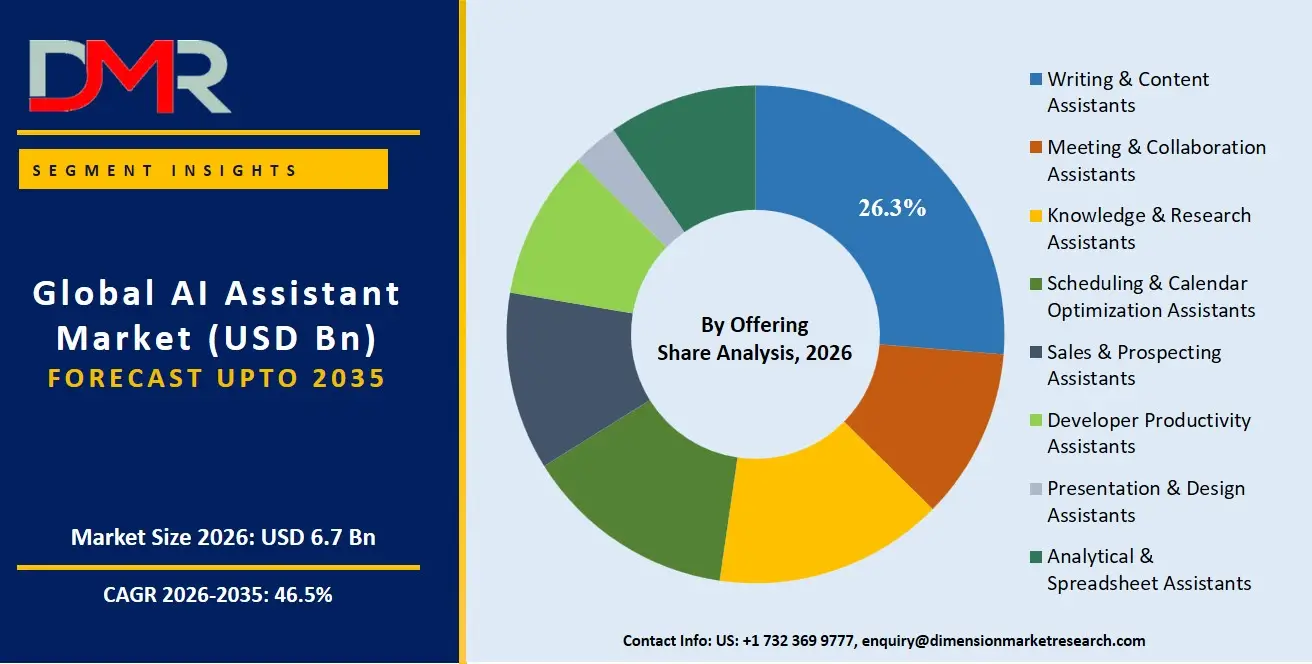
AI Assistant-Writing and Content is expected to hold dominance in the global AI assistant market because of increasing adoption within enterprise settings, education, marketing and media sectors, and by individuals for their personal productivity needs. Organizations are using these AI-powered tools to automate content creation tasks, draft emails, write reports, create advertisements, and translate messages into multiple languages, thereby making processes more efficient and saving costs in the process. The fast progress in the fields of generative AI and large language models has increased contextual comprehension and personalized content creation skills. Furthermore, the use of these tools through office suites, browsers, and collaboration platforms has boosted adoption rates.
By Deployment Mode Analysis
The cloud deployment model is projected to be the most prevalent in the AI assistant market because it provides enterprises and individuals with scalability, flexibility, cost savings, and updates. Enterprises are choosing cloud deployment models when it comes to AI assistants because they do not require any heavy infrastructure and allow quick deployment. The rising popularity of SaaS platforms, remote working arrangements, and the cloud computing environment has led to an increased demand for cloud deployments. It not only facilitates collaboration but also enables continuous learning and upgrading of AI models and easy integration into the existing enterprise system.
By Integration Type Analysis
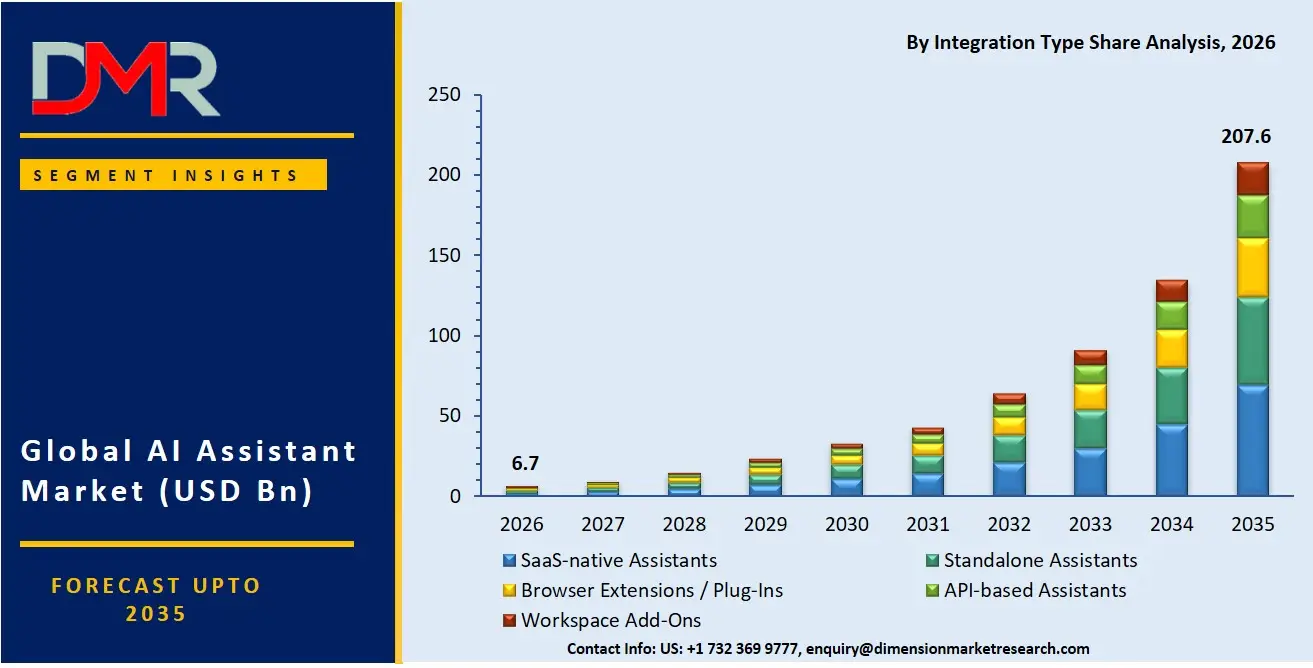
SaaS-native assistants are expected to dominate the market because of their ease of use in enterprise productivity and collaboration software. The use of AI assistants integrated directly into software environments like CRM, communications, document management, and project management systems has become popular among companies since they can boost users' productivity without installation on the computer.
ℹ
To learn more about this report –
Download Your Free Sample Report Here
The growing number of SaaS platforms is another reason for the popularity and dominance of SaaS-native assistants, as the shift towards subscription-based models and cloud-centric approaches is making SaaS platforms more common in enterprises.
By Platform Analysis
Web-based platforms are expected to be the preferred choice in AI assistants due to their user-friendly nature, compatibility on multiple devices, and easy implementation that does not need hardware resources. Web-based AI assistants can be used from any browser regardless of whether users have desktops, laptops, or smartphones; thus, they provide high convenience for businesses and people. Cloud computing and productivity applications based on browsers have made AI assistants more popular. Moreover, these systems allow users to update data and manage them easily while integrating with collaborative and corporate applications online.
By Technology Analysis
Generative AI is the anticipated to be the leading technology trend since it enables sophisticated conversation skills, content creation, context awareness, and intelligent automation within AI assistants. With the rise of large language models and multimodal AI solutions, AI assistants' capabilities have been drastically improved in fields such as writing, coding, researching, customer interactions, and optimization of workflows. Large enterprises are relying more on generative AI as a means of improving productivity, automating routine activities, and personalizing user experience. Ongoing developments in NLP, reasoning, and contextual memory enable fast-growing adoption. Lastly, significant investments made in the infrastructure and development of generative AI models by technology companies fuel market growth.
By Application Analysis
AI-powered writing & editing are expected to dominate the application segment owing to growing demand for automation in content generation, business communication, and increased productivity. AI-assisted software is being increasingly used by corporations, students, marketing agencies, and individuals alike to draft emails, reports, blogs, social media posts, and business documents. AI software considerably reduces time spent on content generation, while enhancing linguistic quality, grammar correctness, and personalization. The growth of digital marketing and multilingual communication needs further add weight to these applications, with ongoing advances in generative AI technology and contextual language processing helping to cement their dominance in the AI assistant market.
By End User Industry Analysis
Large enterprises are projected to dominate the AI assistant market due to their substantial investments in digitalization, automation, and improvement of their internal processes. They use AI assistants in areas such as customer service, sales, HR, IT operations, and knowledge management to enhance their operations. Moreover, large enterprises have enough resources, capabilities, and data to integrate AI assistants at scale. Growing demand for automation in organizational processes, remote work, and productivity improvements serves as additional incentives to adopt AI assistants. Besides, companies are looking for opportunities to save on operations, interact more effectively with customers, and gain competitive advantages in dynamic digital environments.
The Global AI Assistant Market Report is segmented on the basis of the following:
By Offering
- Writing & Content Assistants
- Meeting & Collaboration Assistants
- Knowledge & Research Assistants
- Scheduling & Calendar Optimization Assistants
- Sales & Prospecting Assistants
- Developer Productivity Assistants
- Presentation & Design Assistants
- Analytical & Spreadsheet Assistants
By Deployment Mode
- Cloud-Based
- On-Premise
- Hybrid
By Integration Type
- SaaS-native Assistants
- Standalone Assistants
- Browser Extensions / Plug-Ins
- API-based Assistants
- Workspace Add-Ons
By Platform
- Mobile
- Web-Based
- Desktop
- Smart Devices & IoT
By Technology
- Natural Language Processing (NLP)
- Machine Learning
- Generative AI
- Speech Recognition
- Context-Aware AI
- Computer Vision
By Application
- AI-Powered Writing & Editing
- Meeting Transcription & Follow-Up
- Knowledge Retrieval & Document Search
- Scheduling & Work Prioritization
- Lead Engagement & Email Sequencing
- Code Completion & Review
- Presentation & Narrative Design
- Data Exploration & Spreadsheet AI
- Other Applications
By End User Industry
- Individual Users
- Small & Medium Enterprises (SMEs)
- Large Enterprises
- Educational Institutions
- Government Organizations
Regional Analysis
Leading Region by Market Share
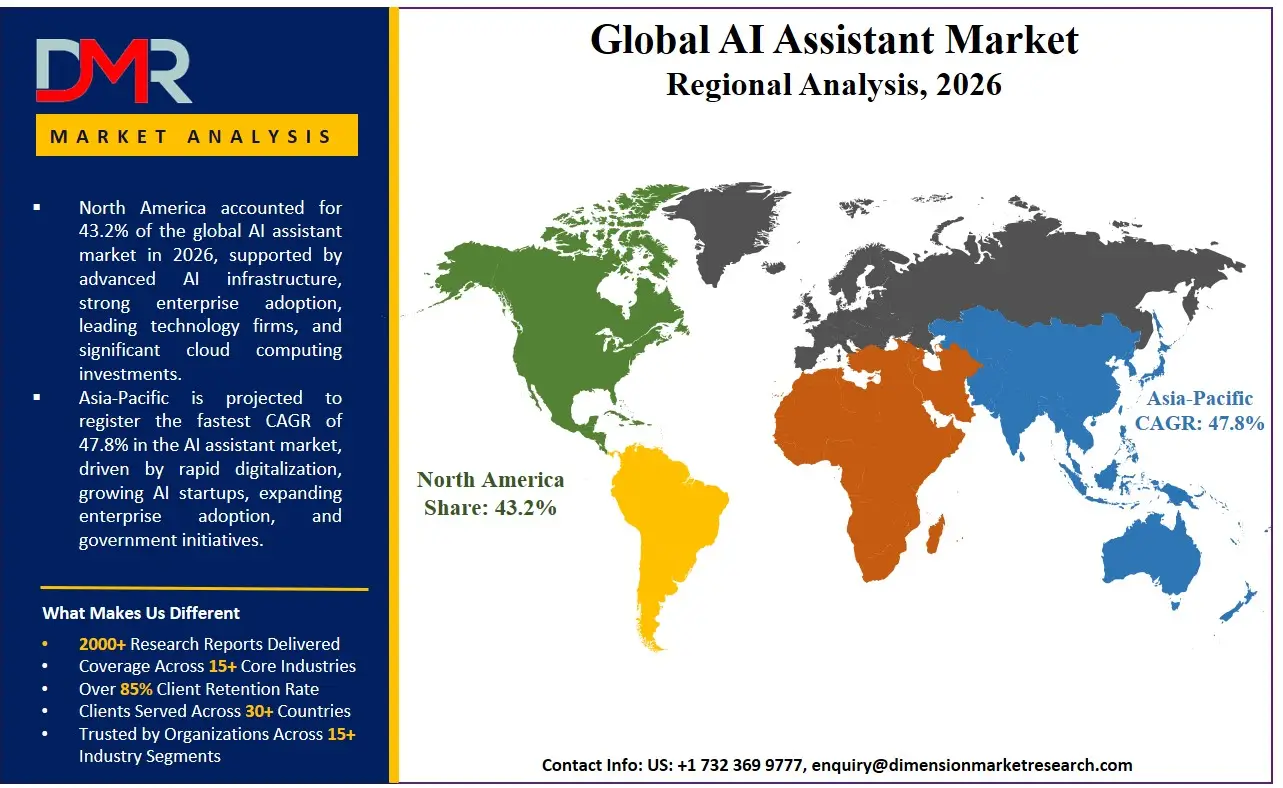
North America is poised to dominate the global AI assistant market as it is projected to hold 43.2% of the market share by the end of 2026. The United States, which dominates North America, has the highest share in the AI assistant market because of the unmatched concentration of leading AI research labs and the aggressive digital transformation agendas of the Fortune 500 companies. The area has an established ecosystem of global system integrators, boutique AI consultancies, and a rich pool of talent in NLP and machine learning engineers. Enterprise investment in generative AI, sophisticated analytics, and the overall automation of legacy knowledge work contributes to the continued demand for Knowledge & Research Assistants and Developer Productivity tools. Moreover, an optimistic venture capital climate persistently funds upcoming AI-native enterprises that need expert professional services to achieve expeditious growth and security compliance.
ℹ
To learn more about this report –
Download Your Free Sample Report Here
Fastest-Growing Regional Market
Asia-Pacific is expected to be the most rapidly expanding AI assistant market, driven by the government-led sweeping digital transformation initiatives in India, China, Japan, and Southeast Asia. The fast-paced economic growth, the rise of a middle-income population, and the dynamic expansion of the digital economy are compelling established conglomerates and state agencies to discard inefficient manual processes. Analytical & Spreadsheet Assistants and Scheduling & Calendar Optimization are in high demand to help these large organizations head in the direction of AI-native operating models. There is also a severe lack of qualified AI talent in the region, and it is necessary to outsource the deployment and integration of AI assistants to cover the skills gap and enable faster investments in automation projects.
By Region
North America
Europe
- Germany
- The U.K.
- France
- Italy
- Russia
- Spain
- Benelux
- Nordic
- Rest of Europe
Asia-Pacific
- China
- Japan
- South Korea
- India
- ANZ
- ASEAN
- Rest of Asia-Pacific
Latin America
- Brazil
- Mexico
- Argentina
- Colombia
- Rest of Latin America
Middle East & Africa
- Saudi Arabia
- UAE
- South Africa
- Israel
- Egypt
- Rest of MEA
Competitive Landscape
The competitive environment of the global AI assistant market has become highly dynamic with a heterogeneous array of multinational technology giants, specialized generative AI startups, and niche vertical-specific AI providers. The key to success will be the profound strategic alliances with foundational model providers like OpenAI, Anthropic, or Google because they will open the necessary early access to new model capabilities and co-innovation opportunities. The movement towards market consolidation is rapidly progressing with traditional software behemoths acquiring specialized developer productivity and knowledge retrieval startups to stay afloat. Proprietary intellectual property, including automated prompt optimization frameworks and industry-specific RAG (Retrieval-Augmented Generation) pipelines, is becoming a more important basis of competitive differentiation than just a generic user interface for a public API.
Some of the prominent players in the Global AI Assistant Market are:
- OpenAI
- Microsoft
- Google
- Amazon Web Services (AWS)
- Anthropic
- Meta Platforms
- IBM
- Salesforce
- Adobe
- Notion
- Grammarly
- Zoom
- Atlassian
- HubSpot
- Slack
- GitHub
- Canva
- ClickUp
- Otter.ai
- Perplexity AI
- Other Key Players
Recent Developments
- January 2026: Microsoft announced a major expansion of its Copilot ecosystem, a suite of AI assistants deeply integrated into Office and Azure, specifically targeting Meeting & Collaboration and Developer Productivity segments with new context-aware AI and code review capabilities.
- November 2025: Google Cloud strengthened its collaboration with Salesforce and introduced a specific practice for API-based Assistants and Workspace Add-Ons aimed at supporting BFSI clients in moving core CRM workloads to AI-driven lead engagement and email sequencing while keeping in compliance with international financial regulations.
- October 2025: OpenAI acquired a European enterprise security firm to further its Knowledge & Research Assistant and on-premise deployment solutions for sovereign cloud facilities, to support the complicated data residency requirements of Government and public sector customers.
Report Details
| Report Characteristics |
| Market Size (2026) |
USD 6.7 Bn |
| Forecast Value (2035) |
USD 207.6 Bn |
| CAGR (2026–2035) |
46.5% |
| The US Market Size (2026) |
USD 2.4 Bn |
| Historical Data |
2021 – 2025 |
| Forecast Data |
2027 – 2035 |
| Base Year |
2025 |
| Estimate Year |
2026 |
| Segments Covered |
By Offering, By Deployment Mode, By Integration Type, By Platform, By Technology, By Application, and By End User Industry |
| Regional Coverage |
North America – The US and Canada; Europe – Germany, The UK, France, Russia, Spain, Italy, Benelux, Nordic, & Rest of Europe; Asia-Pacific – China, Japan, South Korea, India, ANZ, ASEAN, Rest of APAC; Latin America – Brazil, Mexico, Argentina, Colombia, Rest of Latin America; Middle East & Africa – Saudi Arabia, UAE, South Africa, Turkey, Egypt, Israel, & Rest of MEA |
Frequently Asked Questions
How big is the Global AI Assistant Market?
▾ The Global AI Assistant market is poised to be valued at USD 6.7 billion in 2026 and is projected to reach USD 207.6 billion by 2035, driven by the universal need for specialized tools in content generation, knowledge retrieval, and developer productivity.
What is the CAGR of the Global AI Assistant Market from 2026 to 2035?
▾ The market is expected to grow at a CAGR of 46.5% from 2026 to 2035, reflecting the accelerating integration of generative AI into enterprise workflows and the persistent shortage of internal AI engineering talent.
What factors are driving the growth of the Global AI Assistant Market?
▾ Key drivers include the global AI skills gap, the imperative to automate knowledge work, the management complexity of multi-model AI deployments, and the surge in demand for context-aware Knowledge & Research Assistants amid evolving data sovereignty laws.
Which region held the largest share of the AI Assistant Market in 2026?
▾ North America, specifically the United States, held 43.2% of the market share in 2026, driven by a mature AI research ecosystem and aggressive enterprise investment in Developer Productivity Assistants and generative AI capabilities.
Which region is expected to grow the fastest in the AI Assistant Market?
▾ The Asia-Pacific region is expected to grow the fastest, fueled by rapid digital transformation in India, China, and Japan, where Analytical & Spreadsheet Assistants and Scheduling tools are critical for transitioning large conglomerates to AI-native operations.
What are the major trends in the Global AI Assistant Market?
▾ Major trends include the integration of Context-Aware AI into development and meeting workflows, the rise of vertical-specific AI solutions for legal and medical fields, the demand for sustainable GreenOps in AI, and the focus on On-Premise deployments for government data sovereignty.
Who are the key players in the Global AI Assistant Market?
▾ Key players include technology giants like Microsoft, Google, and Salesforce, specialized AI leaders like OpenAI and Anthropic, and a new wave of vertical-specific assistants like Grammarly and Otter.ai.
How is the Global AI Assistant Market segmented?
▾ The market is segmented by Offering, Deployment Mode, Platform, Technology, Application, and End User Industry.