What is the AI Data Center Market Size?
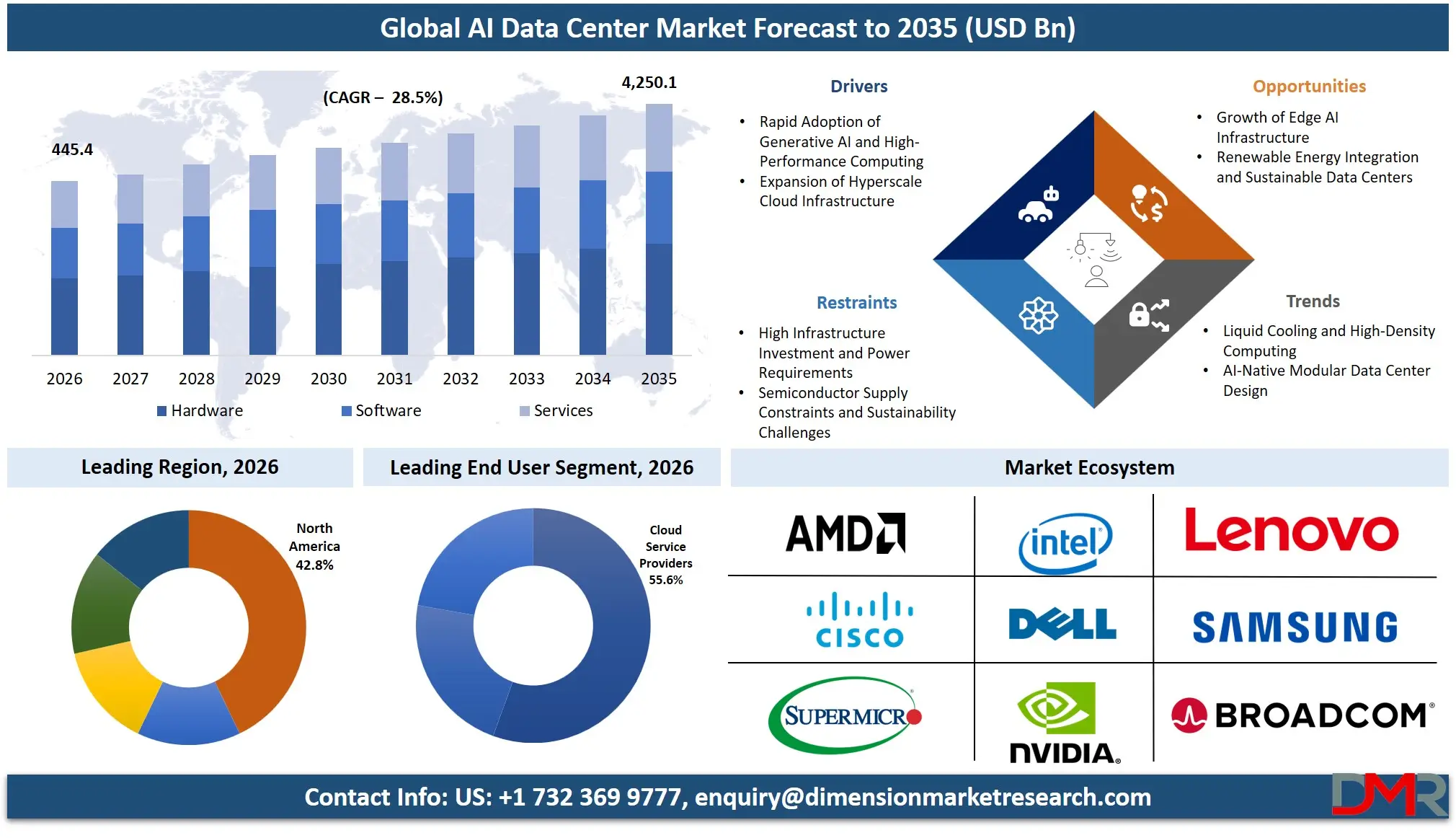
The AI Data Center Market size is expected to be USD 445.4 billion in 2026 and increase at a compound annual growth rate of 28.5% to USD 4,250.1 billion in 2035 due to rapid adoption of generative ai and high-performance computing.
ℹ
To learn more about this report –
Download Your Free Sample Report Here
An AI data center is a specialized computing facility designed to support artificial intelligence workloads through high-performance computing infrastructure, including GPU- and accelerator-based servers, advanced networking, high-bandwidth memory, scalable storage, and liquid or hybrid cooling systems. These facilities enable AI model training, inference, and large-scale data processing while supporting cloud-native and enterprise AI applications. AI data centers have become a strategic foundation of the digital economy as organizations increasingly deploy generative AI, machine learning, and analytics across industries. Rapid investments in hyperscale infrastructure, energy-efficient architectures, edge AI deployment, and advanced semiconductor technologies continue to reshape the market, while growing demand for sustainable power solutions and high-density computing further accelerates long-term market expansion.
The US AI Data Center Market
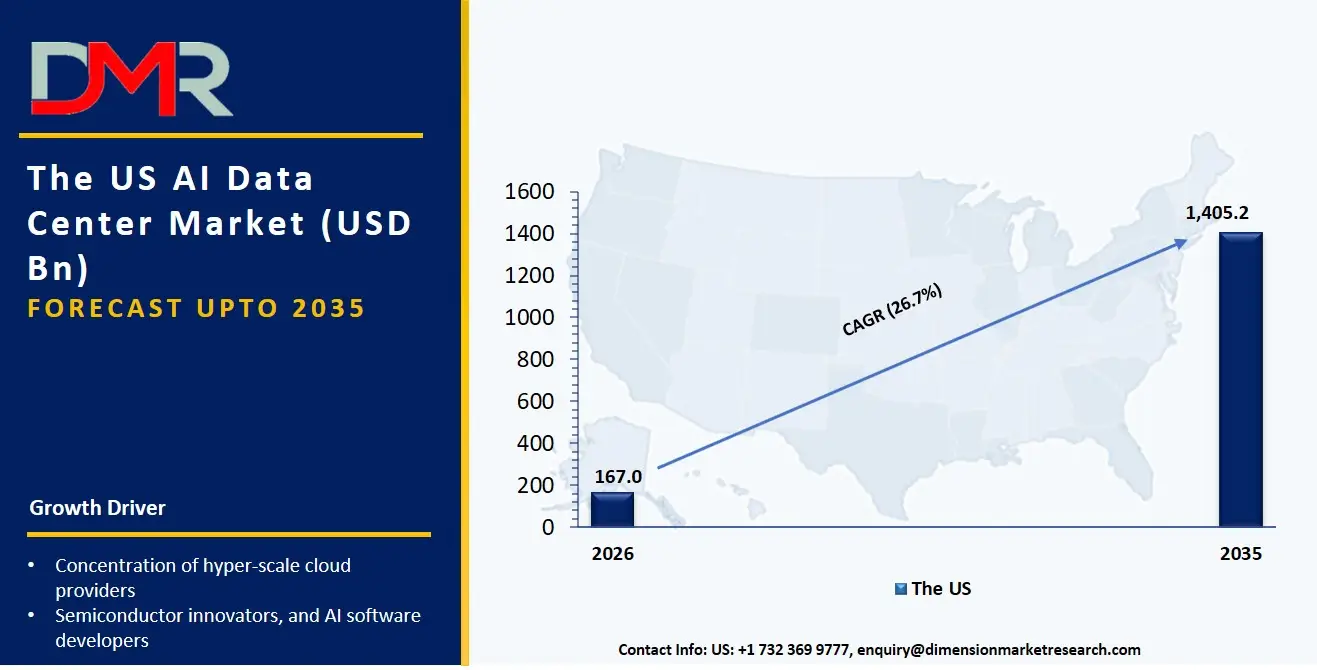
The US AI Data Center Market size is estimated to be USD 167.0 billion in 2026 and is expected to increase at a CAGR of 26.7% over the forecast period.
ℹ
To learn more about this report –
Download Your Free Sample Report Here
The United States represents the world's most mature AI data center market owing to its concentration of hyperscale cloud providers, semiconductor innovators, and AI software developers. Continuous investments in GPU clusters, advanced networking infrastructure, and renewable-powered campuses strengthen market expansion. Federal initiatives supporting semiconductor manufacturing, AI innovation, and digital infrastructure further encourage capacity growth. Increasing enterprise AI adoption across healthcare, financial services, manufacturing, and defense continues to generate substantial demand for next-generation AI computing facilities, while private investments in hyperscale campuses reinforce the country's leadership position.
Europe AI Data Center Market
The Europe AI Data Center Market size is estimated to be USD 106.9 billion in 2026 and is expected to increase at a CAGR of 27.0% over the forecast period.
Europe continues to expand its AI data center ecosystem through sustainability-focused policies, digital transformation initiatives, and increasing cloud adoption. The European Green Deal encourages operators to improve energy efficiency, integrate renewable energy, and reduce carbon emissions across digital infrastructure. Countries including Germany, France, the Netherlands, Ireland, and the Nordic region are experiencing significant investments in hyperscale and colocation facilities. Strong data protection regulations, increasing enterprise AI adoption, and growing investments in sovereign cloud infrastructure continue to stimulate innovation throughout the European market.
Japan AI Data Center Market
The market size of Japan AI Data Center will be USD 26.7 billion in 2026 and at a CAGR of 28.3% in the forecast period.
Japan's AI data center market is expanding through strong government support for digital transformation, semiconductor development, and AI innovation. Rising investments in smart manufacturing, robotics, autonomous mobility, and financial technologies increase demand for high-performance computing infrastructure. Domestic enterprises continue modernizing legacy data centers while hyperscale providers expand cloud capacity to support generative AI applications. Japan's emphasis on energy-efficient infrastructure, disaster-resilient facilities, and advanced cooling technologies creates favorable conditions for sustainable AI data center deployment despite constraints related to land availability and electricity costs.
Key Takeaways
- Market Size & Forecast: The AI Data Center Market size is projected to reach USD 445.4 billion in 2026 and is anticipated to have a value of USD 4,250.1 billion in 2035.
- Growth Rate & Outlook: The AI Data Center Market size is set to grow at a compound annual growth rate of 28.5% during the forecast period of 2026 to 2035.
- Primary Growth Drivers: Some of the major growth drivers in the market are Rapid Adoption of Generative AI and High-Performance Computing and more.
- Key Market Trends: Some of the major trends in the market are AI-Native Modular Data Center Design and more.
- By Component Type: Hardware segment is anticipated to get the majority share of the AI Data Center Market in 2026.
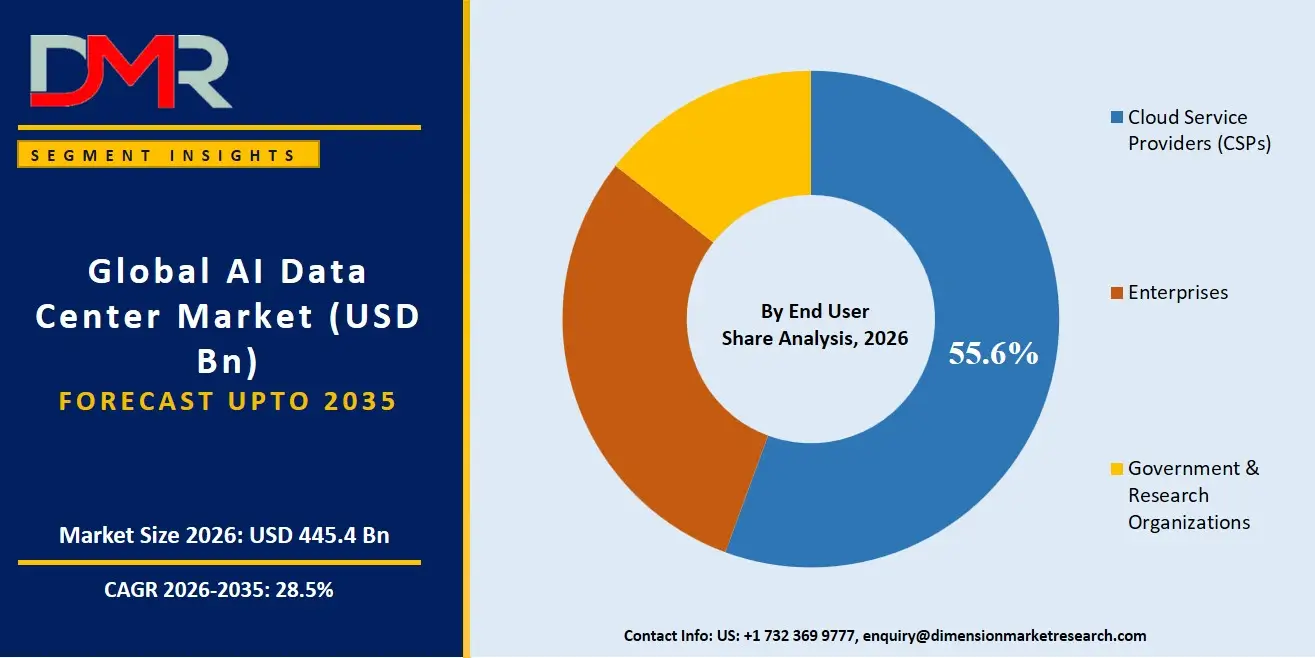
- By End User Type: Cloud Service Providers are expected to get the largest revenue share in 2026 in the AI Data Center Market.
- By Deployment Type: Hyperscale/Cloud AI Data Centers is expected to get the largest revenue share in 2026 in the AI Data Center Market.
- Regional Leadership: North America is set to lead the AI Data Center Market with an estimated 42.8% share in 2026.
What is the AI Data Center?
An AI data center is a specialized computing facility designed to support artificial intelligence workloads by integrating high-performance servers, AI accelerators, advanced networking, high-bandwidth memory, scalable storage, and efficient cooling systems. It enables large-scale AI model training, inference, and data processing while delivering the computational power, reliability, scalability, and energy efficiency required for enterprise, cloud, and research applications.
Use Cases
- Generative AI Model Training: AI data centers provide the enormous computational resources required to train foundation models and large language models using thousands of GPUs operating simultaneously. Their scalable architecture enables faster model development while supporting continuous optimization and experimentation.
- Enterprise AI Deployment: Organizations deploy AI data centers to support predictive analytics, fraud detection, customer personalization, intelligent automation, and decision support systems. These facilities deliver secure and scalable computing environments capable of processing massive enterprise datasets with low latency.
- Scientific Research and Healthcare: Research institutions utilize AI data centers for genomics, drug discovery, climate modeling, molecular simulation, and medical imaging analysis. High-performance AI infrastructure significantly reduces computation time while improving research accuracy and accelerating innovation.
- Edge AI and Smart Infrastructure: AI data centers support edge computing by processing real-time information generated from IoT devices, autonomous vehicles, smart factories, and intelligent cities. Distributed AI infrastructure minimizes latency while improving operational efficiency and enabling real-time decision-making.
How AI Is Transforming the AI Data Center Market
Artificial intelligence is directly transforming the AI Data Center market by improving infrastructure management, operational efficiency, and resource utilization. AI-powered monitoring systems analyze real-time data from servers, networks, and cooling systems to optimize performance and reduce downtime. Predictive maintenance technologies help identify potential equipment failures before they occur, improving reliability and reducing operational costs.
AI technologies are also enhancing workload management by automatically allocating computing resources according to demand patterns. Intelligent automation enables better energy management, improved cooling efficiency, and optimized power consumption. Additionally, AI-driven security solutions strengthen data center protection by identifying abnormal activities and preventing cyber threats. The integration of AI into data center operations is creating smarter, more efficient, and highly scalable infrastructure capable of supporting future AI workloads.
Market Dynamic
Driving Factors in the AI Data Center Market
Rapid Adoption of Generative AI and High-Performance Computing
The explosive adoption of generative AI, foundation models, and large language models is significantly increasing demand for AI-optimized data centers worldwide. Organizations across healthcare, BFSI, manufacturing, retail, and telecommunications require advanced computing infrastructure capable of supporting large-scale AI model training and inference. Growing investments in GPU clusters, AI accelerators, high-speed networking, and high-bandwidth memory continue transforming conventional data centers into AI-native facilities. As AI applications become increasingly compute-intensive, infrastructure providers are accelerating capacity expansion to meet enterprise and cloud service provider requirements.
Restraints in the AI Data Center Market
High Infrastructure Investment and Power Requirements
Building AI data centers requires substantial capital investment in GPU servers, specialized cooling systems, high-capacity electrical infrastructure, networking equipment, and backup power systems. The growing energy consumption associated with AI workloads creates additional operational costs while increasing dependence on reliable electricity supply. Grid constraints, lengthy permitting processes, and rising construction costs may delay new projects, limiting rapid market expansion despite strong demand from enterprises and cloud providers.
Opportunities in the AI Data Center Market
Growth of Edge AI Infrastructure
Increasing deployment of intelligent manufacturing systems, autonomous transportation, healthcare diagnostics, industrial automation, and smart city applications is creating strong demand for distributed AI computing infrastructure. Edge AI data centers enable real-time analytics with reduced latency while supporting mission-critical workloads closer to end users. Continuous advancements in compact AI hardware, high-speed connectivity, and software orchestration platforms further expand deployment opportunities across both developed and emerging markets.
Trends in the AI Data Center Market
AI-Native Modular Data Center Design
Operators increasingly deploy modular and prefabricated AI data centers to reduce construction timelines and improve scalability. Software-defined infrastructure, intelligent workload orchestration, automated resource allocation, and digital twin technologies enable efficient management of rapidly expanding AI environments. Modular deployment also provides greater flexibility for hyperscale expansion while supporting faster response to changing enterprise computing requirements.
Research Scope and Analysis
The AI Data Center Market research scope analyzes the industry across key segments, including component, deployment type, end user, and region, while evaluating market size, growth potential, competitive dynamics, technological advancements, and investment trends. The analysis examines demand drivers, adoption patterns, emerging opportunities, regulatory influences, and innovation strategies to provide comprehensive insights into current market conditions and future growth prospects.
ℹ
To learn more about this report –
Download Your Free Sample Report Here
By Component Analysis
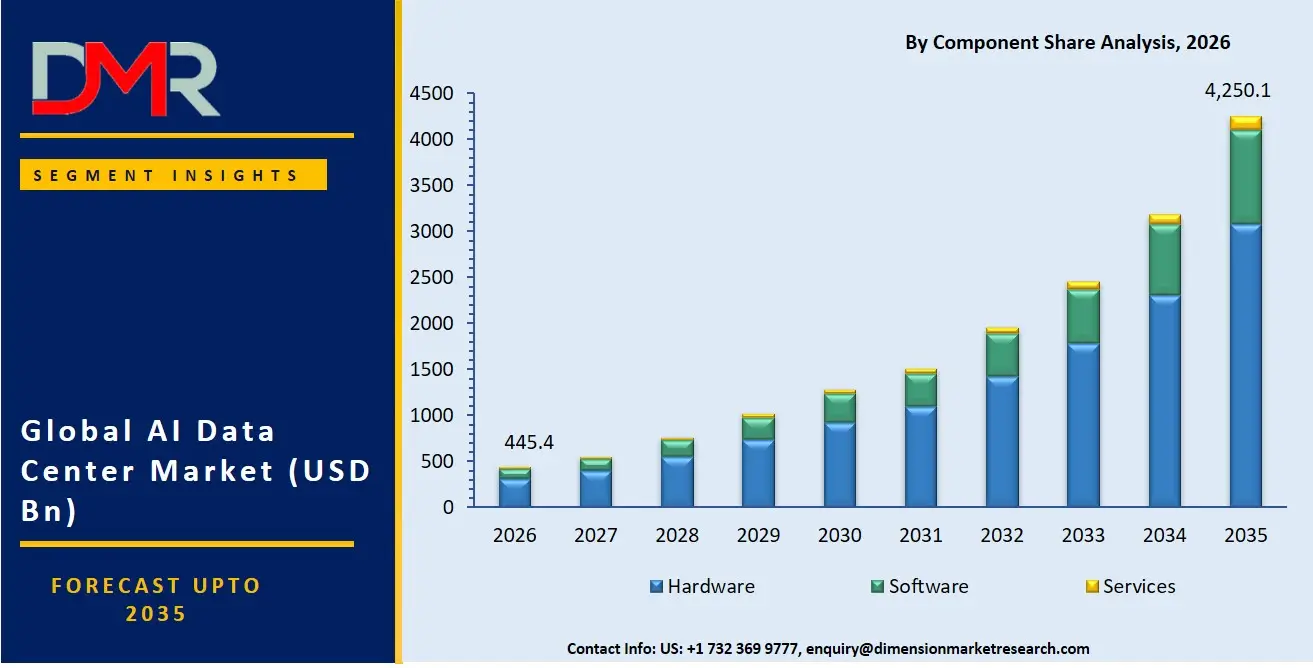
The AI Data Center market by component is segmented into hardware, software, and services. Hardware represents the leading segment and is estimated to account for approximately 72.5% share of the global AI Data Center market in 2026 due to the increasing demand for AI servers, GPUs, AI accelerators, high-bandwidth memory, and advanced networking equipment required for intensive AI workloads.
ℹ
To learn more about this report –
Download Your Free Sample Report Here
The hardware segment dominates because AI applications depend heavily on specialized computing infrastructure for model training and inference operations. Within hardware, AI accelerators are expected to remain the fastest-growing sub-segment due to rising adoption of GPUs, TPUs, NPUs, and ASIC-based solutions for generative AI applications. Software and services are also expanding as organizations require AI management platforms, cloud integration, and infrastructure optimization solutions.
By Deployment Type Analysis
Based on deployment type, the AI Data Center market is categorized into hyperscale/cloud AI data centers, colocation AI data centers, on-premises AI data centers, and edge AI data centers. Hyperscale/cloud AI data centers are projected to lead the market with an estimated 48.2% share in 2026, supported by growing demand for cloud-based AI services, large language model development, and scalable computing resources. Cloud providers are investing heavily in massive AI infrastructure to support enterprise AI adoption. Meanwhile, edge AI data centers are expected to be the fastest-growing deployment segment due to increasing demand for low-latency processing in autonomous vehicles, smart cities, industrial automation, and Internet of Things applications. The shift toward distributed AI computing is accelerating edge infrastructure development worldwide.
By End User Analysis
The AI Data Center market by end user includes cloud service providers, enterprises, and government and research organizations. Cloud service providers are expected to remain the dominant segment, accounting for approximately 55.6% share of the market in 2026, as major cloud platforms continue expanding AI infrastructure to provide scalable artificial intelligence services. Enterprises represent the fastest-growing segment due to increasing adoption of AI applications across BFSI, healthcare, manufacturing, retail, telecommunications, and media industries. Businesses are investing in AI capabilities for automation, predictive analytics, customer personalization, and operational optimization. Government and research organizations are also increasing investments in AI computing facilities to support scientific research, national AI strategies, and advanced technology development.
The AI Data Center Market Report is segmented on the basis of the following:
By Component
- Hardware
- AI Servers
- AI Accelerators (GPUs, TPUs, NPUs, ASICs)
- Networking Equipment
- Storage Systems
- High-Bandwidth Memory (HBM)
- Software
- Services
By Deployment Type
- Hyperscale/Cloud AI Data Centers
- Colocation AI Data Centers
- On-Premises AI Data Centers
- Edge AI Data Centers
By End User
- Cloud Service Providers (CSPs)
- Enterprises
- BFSI
- Healthcare & Life Sciences
- Manufacturing
- Retail & E-commerce
- IT & Telecommunications
- Media & Entertainment
- Government & Research Organizations
Regional Analysis
Leading Region in the AI Data Center Market
ℹ
To learn more about this report –
Download Your Free Sample Report Here
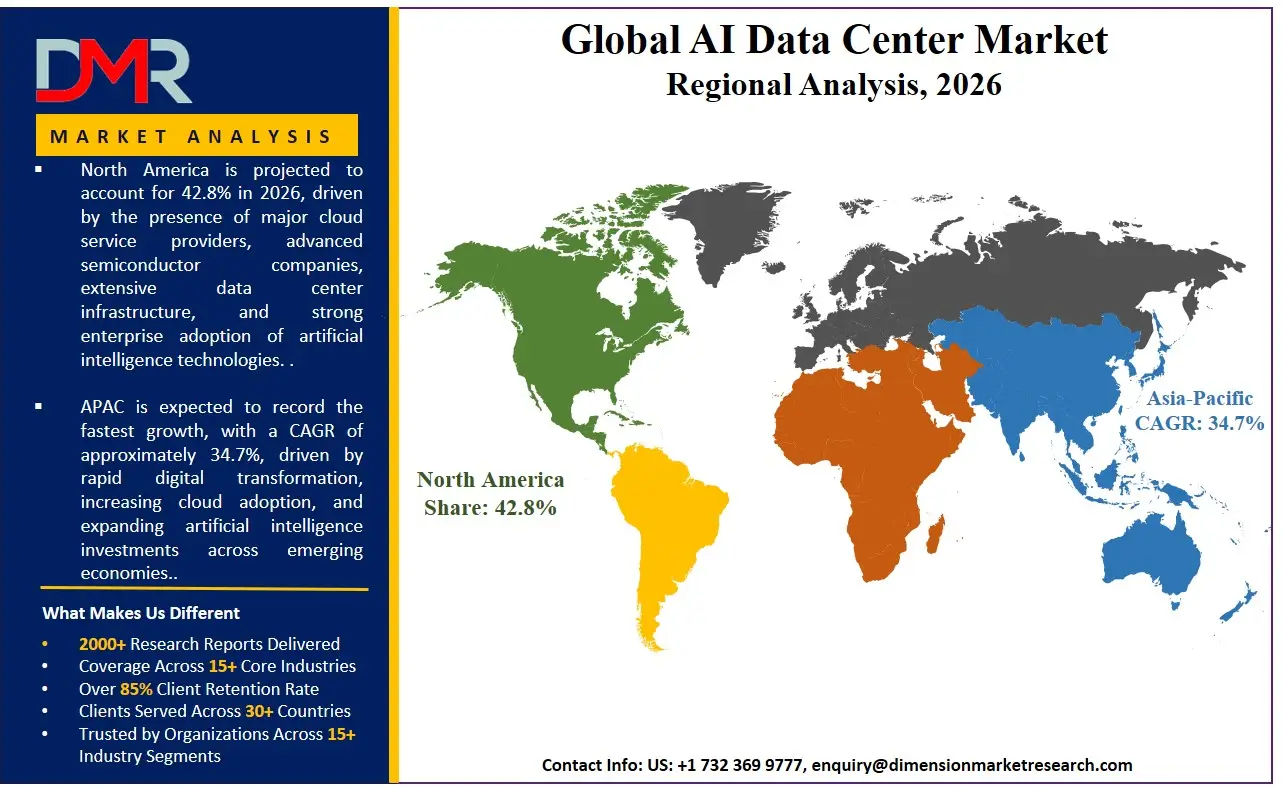
North America is expected to remain the leading region in the AI Data Center market, accounting for approximately 42.8% share of the global market in 2026. The region's dominance is supported by the presence of major cloud service providers, advanced semiconductor companies, extensive data center infrastructure, and strong enterprise adoption of artificial intelligence technologies. The United States is the primary contributor due to significant investments in generative AI, high-performance computing, and large-scale AI infrastructure projects. Government initiatives supporting domestic semiconductor production and AI innovation further strengthen regional growth. Availability of skilled technology professionals, advanced energy infrastructure, and strong venture capital investment continues to position North America as the global AI data center leader.
Fastest Growing Region in the AI Data Center Market
Asia-Pacific is projected to be the fastest-growing region in the AI Data Center market due to rapid digital transformation, increasing cloud adoption, and expanding artificial intelligence investments across emerging economies. Countries such as China, Japan, South Korea, India, and Singapore are developing advanced AI infrastructure to support enterprise automation, smart manufacturing, and digital services. Government initiatives promoting artificial intelligence, semiconductor manufacturing, and data localization are accelerating market development. Rising demand from industries including automotive, telecommunications, healthcare, and financial services is creating significant opportunities. Additionally, increasing investments in hyperscale facilities and edge computing infrastructure are expected to drive strong regional expansion during the forecast period.
By Region
North America
Europe
- Germany
- The U.K.
- France
- Italy
- Russia
- Spain
- Benelux
- Nordic
- Rest of Europe
Asia-Pacific
- China
- Japan
- South Korea
- India
- ANZ
- ASEAN
- Rest of Asia-Pacific
Latin America
- Brazil
- Mexico
- Argentina
- Colombia
- Rest of Latin America
Middle East & Africa
- Saudi Arabia
- UAE
- South Africa
- Israel
- Egypt
- Rest of MEA
Competitive Landscape
The AI Data Center market is characterized by intense competition driven by technological innovation, infrastructure expansion, and increasing demand for AI computing capacity. Market participants are focusing on strengthening their competitive position through investments in advanced AI hardware, energy-efficient technologies, strategic partnerships, and large-scale infrastructure development. Companies are prioritizing research and development activities to improve processor performance, cooling efficiency, networking capabilities, and AI workload optimization. Competitive advantages are increasingly determined by access to advanced semiconductor technologies, supply chain capabilities, data center scalability, and sustainable infrastructure solutions. High capital requirements, technical expertise, and complex infrastructure development create significant entry barriers for new market participants.
Some of the prominent players in the global AI Data Center are:
- NVIDIA
- Advanced Micro Devices (AMD)
- Intel Corporation
- Super Micro Computer (Supermicro)
- Dell Technologies
- Hewlett Packard Enterprise (HPE)
- Lenovo
- Cisco Systems
- Arista Networks
- Broadcom
- Marvell Technology
- Micron Technology
- Samsung Electronics
- SK hynix
- Fujitsu
- IBM
- Oracle
- Amazon Web Services (AWS)
- Microsoft
- Google Cloud
- Other Key Players
Recent Developments
- In June 2025, Amazon Web Services continued expanding its artificial intelligence infrastructure capabilities by investing in additional AI-focused cloud data center resources. The company focused on improving AI computing availability through advanced infrastructure, customized AI processors, and scalable cloud solutions. These investments supported growing enterprise demand for machine learning, generative AI applications, and AI-powered business services. AWS's expansion strategy reflected the broader industry movement toward developing highly scalable AI data centers capable of handling increasing computational requirements. The company emphasized improving efficiency, flexibility, and accessibility of AI infrastructure for organizations adopting artificial intelligence technologies.
- In March 2025, NVIDIA expanded its AI data center ecosystem through advancements in AI computing platforms and accelerated infrastructure solutions. The company continued promoting next-generation AI chips, networking technologies, and software platforms designed for large-scale AI workloads. These developments supported enterprises and cloud providers seeking improved performance for generative AI training and inference applications. NVIDIA's focus on integrated AI infrastructure solutions strengthened its position within the AI data center industry. The company's technology developments contributed to broader adoption of accelerated computing architectures and increased demand for high-performance AI data center deployments globally.
- In January 2025, Microsoft continued expanding its artificial intelligence infrastructure investments by increasing AI data center capacity to support growing demand for cloud-based AI services. The company focused on strengthening computing capabilities through advanced AI servers, accelerated computing systems, and enhanced cloud infrastructure. The expansion was aimed at supporting enterprise adoption of generative AI applications, large language models, and AI-powered productivity solutions. Microsoft's continued investment in AI infrastructure highlights the increasing importance of hyperscale AI data centers in enabling global AI deployment. The initiative also emphasized improving scalability, reliability, and efficiency of AI workloads across its cloud ecosystem.
Report Details
| Report Characteristics |
| Market Size (2026) |
USD 445.4 Bn |
| Forecast Value (2035) |
USD 4,250.1 Bn |
| CAGR (2026–2035) |
28.5% |
| Historical Period |
2021 – 2025 |
| Forecast Period |
2027 – 2035 |
| Base Year |
2025 |
| Estimate Year |
2026 |
| Segments Covered |
By Component, By Deployment Type, By End User |
| Regional Coverage |
North America – The US and Canada; Europe – Germany, The UK, France, Russia, Spain, Italy, Benelux, Nordic, & Rest of Europe; Asia-Pacific – China, Japan, South Korea, India, ANZ, ASEAN, Rest of APAC; Latin America – Brazil, Mexico, Argentina, Colombia, Rest of Latin America; Middle East & Africa – Saudi Arabia, UAE, South Africa, Turkey, Egypt, Israel, & Rest of MEA |
Frequently Asked Questions
How big is the AI Data Center Market?
▾ The AI Data Center Market size is expected to reach USD 445.4 billion by 2026 and is projected to reach USD 4,250.1 billion by the end of 2035.
What is the CAGR of the AI Data Center Market from 2026 to 2035?
▾ The market is growing at a CAGR of 28.5 percent over the forecasted period.
What factors are driving the growth of the AI Data Center Market?
▾ Rapid Adoption of Generative AI and High-Performance Computing, and more are the factors driving the growth of the AI Data Center Market.
What are the major trends in the AI Data Center Market?
▾ AI-Native Modular Data Center Design, and more are some of the major trends in the market.
Who are the key players in the AI Data Center Market?
▾ Some of the key players in the AI Data Center Market include AMD, Cisco, NVIDIA and more
How is the AI Data Center Market segmented?
▾ The AI Data Center Market is segmented by component, deployment type, end user.
Which region held the largest share of the AI Data Center Market in 2026?
▾ North America is set to lead the AI Data Center Market with an estimated 42.8% share in 2026.
Which region is expected to grow the fastest in the AI Data Center Market?
▾ Asia Pacific is the fastest-growing region in the AI Data Center Market during the forecast period.