Market Overview
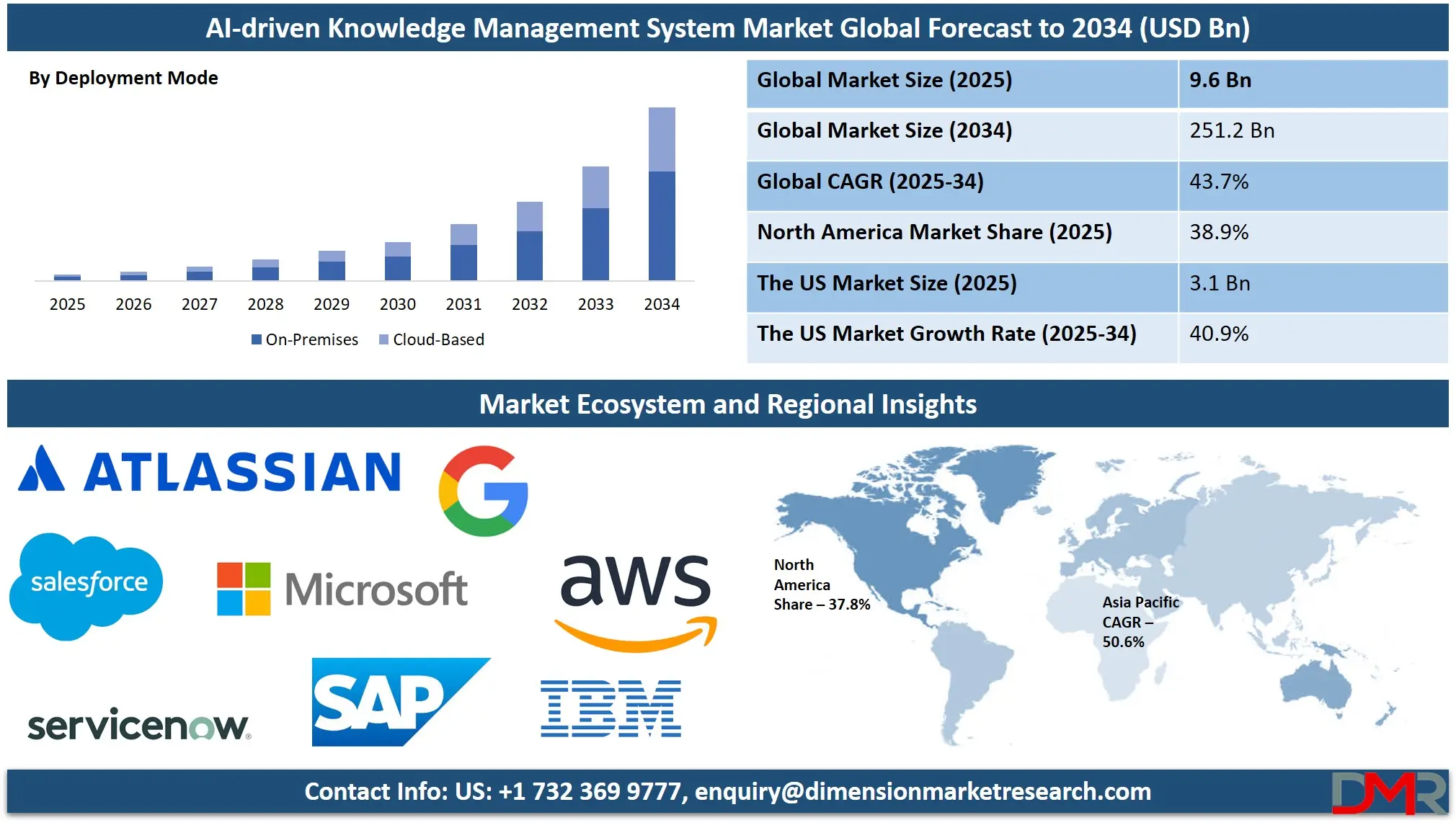
The Global AI-driven Knowledge Management System market is predicted to value at USD 9.6 billion in 2025 and is expected to grow to USD 251.2 billion by 2034, registering a compound annual growth rate (CAGR) of 43.7% from 2025 to 2034.
The global AI-driven Knowledge Management System Market encompasses software platforms and associated services that use artificial intelligence to capture, organize, classify, search, retrieve, summarize, and distribute organizational knowledge. The market includes AI-powered knowledge management platforms, intelligent enterprise search solutions, AI-enabled knowledge bases, conversational knowledge assistants, knowledge-focused content management tools, and related implementation, integration, consulting, training, and support services.
AI-driven knowledge management systems combine natural language processing, machine learning, generative AI, semantic search, and retrieval-augmented generation technologies to improve information accessibility and organizational decision-making. These platforms support applications across customer service, enterprise knowledge sharing, employee onboarding, document management, research, and regulatory compliance. The market covers software and directly associated services attributable to AI-powered knowledge management functions, while excluding unrelated enterprise software, general-purpose AI infrastructure, and broader artificial intelligence spending that cannot be specifically assigned to knowledge management applications.
ℹ
To learn more about this report –
Download Your Free Sample Report Here
Organizations across healthcare, finance, IT, and customer support require efficient knowledge management to stay competitive. AI-driven KMS reduces redundancy, improves response times, and ensures knowledge is easily accessible. With remote work becoming more prevalent, companies need AI-powered solutions to maintain seamless communication and information sharing.
The AI-driven KMS market is expected to grow significantly, with advancements in natural language processing and machine learning. Integration with chatbots, voice assistants, and predictive analytics will further enhance knowledge accessibility. As industries increasingly adopt AI, the demand for intelligent KMS will continue to rise, ensuring a promising future for this market.
ℹ
To learn more about this report –
Download Your Free Sample Report Here
The US AI-driven Knowledge Management System Market
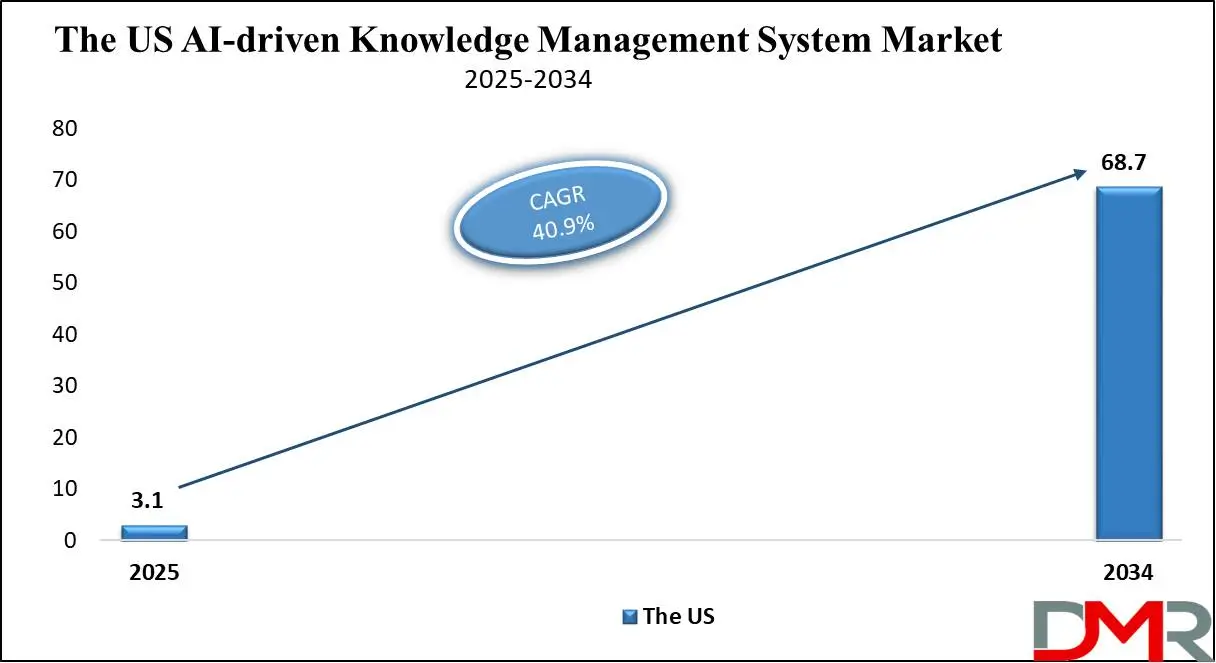
The
US AI-driven Knowledge Management System market is projected to be
valued at USD 3.1 billion in 2025. It is expected to witness subsequent growth in the upcoming period as it holds
USD 68.7 billion in 2034 at a
CAGR of 40.9%.
The
U.S. AI-based Knowledge Management System market is driven by a boost in demand for automation and efficient management of data across industries. Organizations need AI-based systems to enhance decision-making, process optimization, and customer experience. Advances in natural language processing (NLP) and machine learning enable more intuitive knowledge retrieval and personalized insights. Remote working and digital transformation drive adoption further, with firms concentrating on knowledge-sharing platforms to optimize productivity and collaboration and reduce information silos.
Key trends in the U.S. AI-based Knowledge Management System market are incorporating generative AI for more contextual and adaptive knowledge delivery. AI chatbots and digital assistants are moving to center stage in self-service knowledge systems. AI is being utilized to automate content classification, semantic search, and recommendation systems by firms. AI ethics and data privacy legislation are being given greater priority in system design. Cloud-based AI knowledge management systems are being increasingly favored, enabling enterprise-wide deployment in a scalable and secure way.
AI-driven Knowledge Management System Market: Key Takeaways
- Market Growth: The global AI-driven Knowledge Management System Market is projected to expand by USD 241.6 billion, increasing from USD 9.6 billion in 2025 to USD 251.2 billion by 2034, registering a CAGR of 43.7% over the forecast period.
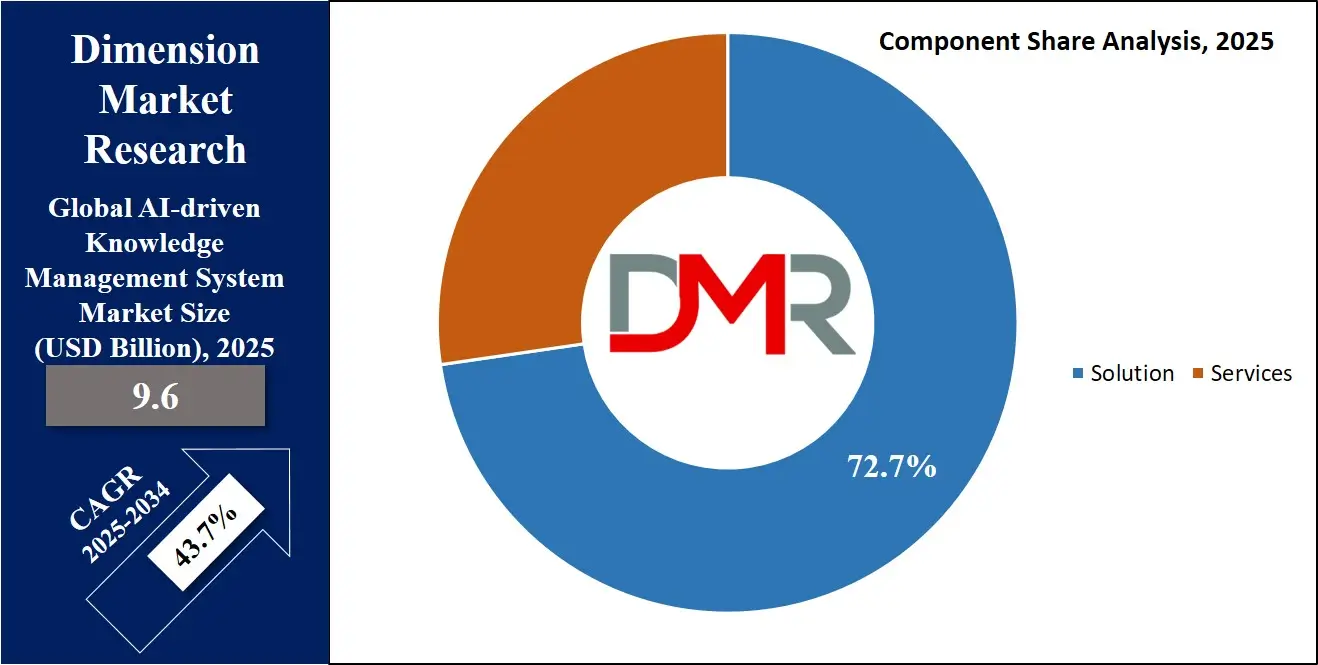
- Component Analysis: The Solution segment is projected to dominate the global AI-driven Knowledge Management System Market, accounting for a revenue share of 73.3% in 2025, supported by increasing adoption of AI-powered knowledge platforms, intelligent search solutions, automated content management systems, and enterprise knowledge bases.
- Deployment Mode Analysis: The On-premise model is likely to lead in the AI-based Knowledge Management System market with a revenue share of 60.2% by the end of 2025.
- Enterprise Size Analysis: Large enterprises are likely to dominate in the AI-driven knowledge management system market with a revenue share of 69.2% in 2025
- Technology Analysis: Natural Language Processing (NLP) is projected to prevail with the highest revenue share of 38.3% by the end of 2025.
- Application Analysis: Enterprise Knowledge Management is expected to dominate the AI-Driven Knowledge Management System Market with a revenue share of 28.4% by the end of 2025.
- End User Analysis: It is estimated that BFSI is likely to lead with a revenue share of 26.7% in the AI-powered Knowledge Management System (KMS) market by the end of 2025.
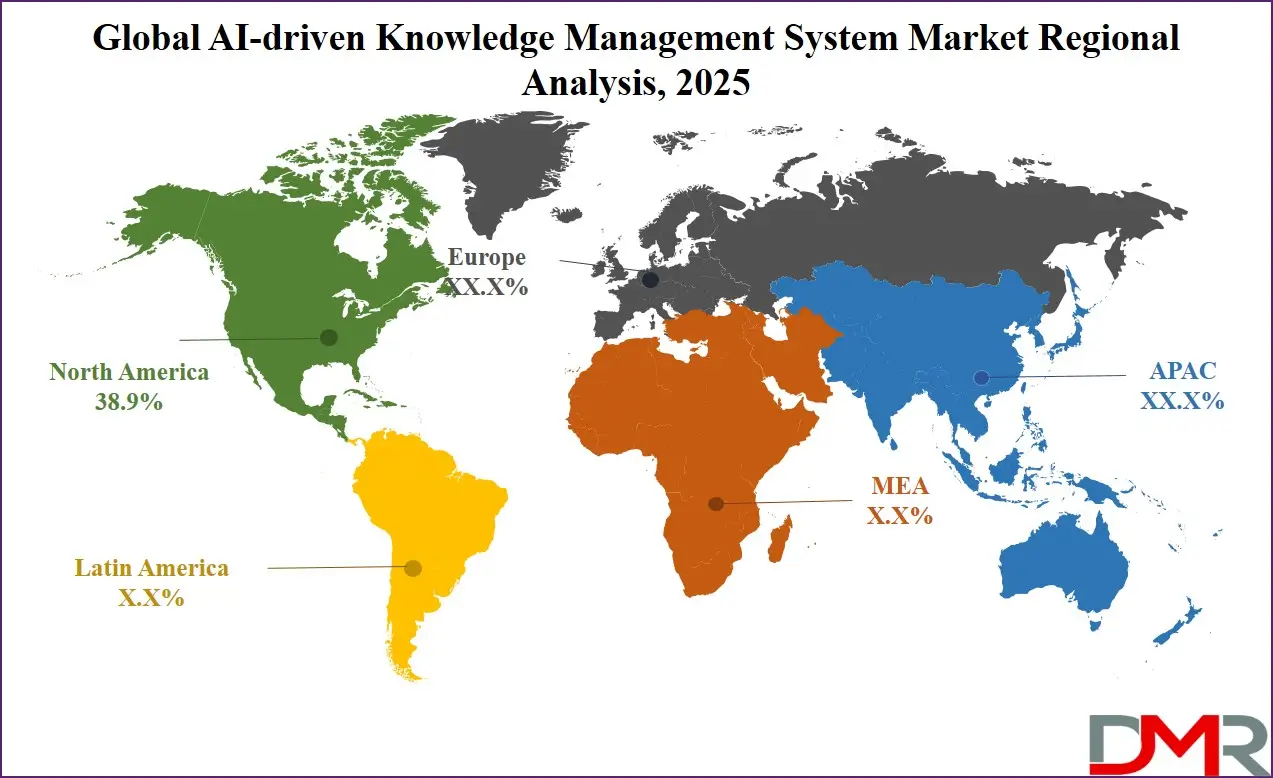
- Regional Analysis: North America is predicted to lead the global AI-driven Knowledge Management System Market with a revenue share of 38.9% in 2025.
- Prominent Players: Some of the major key players in the Global AI-driven Knowledge Management Systems Market are Microsoft Corporation, International Business Machines Corporation (IBM), Amazon Web Services, Inc., and many others.
AI-driven Knowledge Management System Market: Use Cases
- Customer Support and Self-Service Portals: An AI-powered Knowledge Management System can power chatbots and virtual assistants that offer instantaneous answers to customer inquiries. By studying past interactions and tapping a dynamic knowledge base, AI increases self-service options while shortening response times and improving customer satisfaction.
- Enterprise Knowledge Sharing & Collaboration: Organizations leverage artificial intelligence knowledge management systems (KMSs) to centralize institutional knowledge for easy searchability by employees. AI helps recommend relevant documents, insights, or experts within an organization for improved collaboration and decision-making processes.
- Regulatory Compliance & Risk Management: Compliance, Risk & Organizational AI-driven KMS solutions help businesses remain compliant with industry regulations by continuously tracking, updating, and organizing compliance documents. AI can also alert employees when policies have changed while helping employees understand legal & regulatory obligations.
- Accelerated Research and Development (R&D): In industries like pharmaceuticals, AI-powered KMS can analyze vast datasets, research papers, and patents to spot trends, foster innovation and accelerate product development. AI can summarize complex studies while simultaneously discovering patterns or suggesting areas worthy of further exploration.
AI-driven Knowledge Management System Market: Stats & Facts
- According to Gartner, more than 80% of enterprises were expected to adopt generative AI APIs, models, or GenAI-enabled applications by 2026, compared with fewer than 5% in 2023.
- According to McKinsey's 2025 AI survey, 88% of surveyed respondents reported regular AI adoption in at least one business function, increasing from 78% in the previous year.
- McKinsey's 2025 research indicated that approximately one-third of surveyed organizations had begun scaling artificial intelligence initiatives beyond initial experimentation.
- Microsoft's 2025 Work Trend Index revealed that 81% of surveyed business leaders expected AI agents to become moderately or extensively integrated into their organizations' AI strategies within 12 to 18 months.
- Microsoft's 2025 Work Trend Index found that 82% of surveyed leaders considered 2025 a pivotal year for rethinking business strategies and operational processes.
AI-driven Knowledge Management System Market: Market Dynamic
Driving Factors in the AI-driven Knowledge Management System Market
Advanced Natural Language Processing (NLP) for Contextual Understanding
Advancements in natural language processing are strengthening the adoption of AI-driven knowledge management systems by enabling organizations to interpret complex queries, understand user intent, and retrieve contextually relevant information. Unlike traditional keyword-based searches, NLP-powered platforms analyze semantic relationships between documents, questions, and organizational information to deliver more accurate and useful responses. Integration with generative AI and retrieval-augmented generation further supports intelligent document summarization, conversational search, and automated knowledge discovery. These capabilities reduce time spent locating information, improve employee productivity, and enhance collaboration across departments. As enterprises manage increasing volumes of unstructured content, demand for context-aware knowledge retrieval technologies is expected to support market expansion.
Automated Knowledge Organization and Categorization
Advancements in natural language processing are strengthening the adoption of AI-driven knowledge management systems by enabling organizations to interpret complex queries, understand user intent, and retrieve contextually relevant information. Unlike traditional keyword-based searches, NLP-powered platforms analyze semantic relationships between documents, questions, and organizational information to deliver more accurate and useful responses. Integration with generative AI and retrieval-augmented generation further supports intelligent document summarization, conversational search, and automated knowledge discovery. These capabilities reduce time spent locating information, improve employee productivity, and enhance collaboration across departments. As enterprises manage increasing volumes of unstructured content, demand for context-aware knowledge retrieval technologies is expected to support market expansion.
Restraints in the AI-driven Knowledge Management System Market
Data Fragmentation and Quality Issues
Data fragmentation and inconsistent information quality represent major challenges for organizations implementing AI-driven knowledge management systems. Enterprise information is frequently distributed across disconnected applications, document repositories, databases, and collaboration platforms, making integration and knowledge retrieval more complex. Incomplete records, outdated documents, inconsistent metadata, and duplicate information can reduce the accuracy of AI-generated responses and recommendations. Organizations must invest in data cleaning, system integration, governance frameworks, and continuous content maintenance to improve reliability. These requirements can increase implementation costs, extend deployment timelines, and limit adoption among organizations with fragmented IT infrastructures.
Security and Compliance Risks
Security and regulatory compliance concerns can restrict the adoption of AI-driven knowledge management systems, particularly among organizations handling confidential customer information, financial records, healthcare data, and proprietary business knowledge. AI-powered platforms often connect multiple enterprise information sources, increasing the importance of access controls, encryption, identity management, and data governance. Inadequate permissions or poorly configured integrations may expose sensitive information or create compliance risks. Organizations must also consider applicable data protection requirements, including GDPR and other jurisdiction-specific regulations. The need for secure infrastructure, continuous monitoring, and compliance management can increase implementation complexity and operational expenditure.
Opportunities in the AI-driven Knowledge Management System Market
Enhanced Decision-Making with Predictive Analytics
AI-driven knowledge management systems use predictive analytics to deliver businesses actionable insights derived from both historical and real-time data, providing actionable insight for decision-making proactively based on emerging trends, customer behaviors, market shifts, and risks and opportunities allowing organizations to optimize strategies, streamline operations and enhance customer experiences with minimal risks or disruptions allowing businesses to stay ahead of competitors, mitigate disruptions early or take advantage of opportunities before mainstream adoption creates innovation and long-term growth for any given enterprise.
Automated Knowledge Discovery and Optimization
AI can transform knowledge management by automating the discovery, organization, and retrieval of crucial information. Through natural language processing (NLP) and machine learning algorithms, these AI systems categorize relevant data quickly for employees and decision-makers - eliminating time spent manually searching. Collaboration improves, and knowledge retention is ensured even amid workforce turnover - giving organizations leverage over manual searches with efficient knowledge retention policies to drive innovation, boost productivity, and optimize internal processes to drive fast decision-making operations in an ever-evolving market environment.
Trends in the AI-driven Knowledge Management System Market
Emergence of Knowledge-as-a-Service (KaaS)
Knowledge-as-a-Service is emerging as an important trend in the AI-driven Knowledge Management System Market as organizations increasingly adopt cloud-based platforms for centralized information management and on-demand knowledge access. These solutions allow employees to retrieve organizational information, access AI-powered search capabilities, and collaborate across locations without relying entirely on internally maintained infrastructure. Integration with enterprise applications, conversational AI, and automated content management improves information accessibility and supports distributed work environments. Subscription-based delivery models, scalable infrastructure, and continuous software updates further encourage adoption among enterprises seeking flexible knowledge management solutions.
Personalized and Context-Aware Knowledge Delivery
AI-powered knowledge management systems have advanced rapidly over time to offer highly customized and context-aware information delivery. Leveraging machine learning, natural language processing, and user behavior analytics to dynamically adjust content according to an individual's job role, preferences, and ongoing tasks allows AI systems to ensure relevant insights arrive at just the right moment reducing information overload and increasing productivity while tailoring responses, and recommendations for customers and creating knowledge-driven work cultures which ultimately foster innovation and competitive advantage for businesses.
AI-driven Knowledge Management System Market: Research Scope and Analysis
By Component Analysis
The Solution segment is expected to dominate the global AI-driven Knowledge Management System Market with a revenue share of 73.3% in 2025. This leadership is supported by growing enterprise demand for AI-powered knowledge management platforms, intelligent search engines, automated knowledge bases, and AI-driven content management systems. These solutions enable organizations to capture, organize, retrieve, and distribute information efficiently across departments. Integration with natural language processing, machine learning, and generative AI technologies further improves contextual search, knowledge discovery, and automated content summarization. The Services segment is also expected to experience significant growth, supported by increasing demand for implementation, integration, consulting, employee training, and ongoing technical support.
ℹ
To learn more about this report –
Download Your Free Sample Report Here
By Deployment Model Analysis
Cloud-based deployment is emerging as a major growth area in the global AI-driven Knowledge Management System Market, supported by increasing enterprise demand for scalable, flexible, and remotely accessible knowledge management solutions. Cloud platforms enable organizations to centralize information from multiple applications, integrate AI-powered search and knowledge assistants, and provide employees with access to relevant information across locations and devices. Subscription-based pricing, automated software updates, and integration with enterprise collaboration platforms further encourage adoption among small, medium-sized, and large organizations.
The increasing use of generative AI, natural language processing, and retrieval-augmented generation is strengthening demand for cloud-enabled knowledge management systems. These solutions can support automated document classification, contextual information retrieval, intelligent content summarization, and real-time collaboration. Meanwhile, on-premises deployment remains relevant for organizations requiring greater control over sensitive information, internal infrastructure, and customized security policies, particularly in regulated industries. Deployment preferences vary according to organizational requirements, data governance policies, infrastructure capabilities, and total implementation costs.
By Enterprise Size Analysis
Large enterprises are likely to dominate in the AI-driven knowledge management system market with a revenue share of 69.2% in 2025, due to their strong financial assets, extensive data management needs, and regulatory compliance obligations. Organizations may invest heavily in AI solutions that seamlessly integrate into existing infrastructure. Large enterprises manage massive datasets across global operations, necessitating sophisticated knowledge management tools that deliver real-time insights and decision-making capabilities in real-time. AI-powered systems enhance productivity, streamline workflows, and foster collaboration across departments; furthermore, strict regulatory environments demand that large enterprises adopt AI solutions for governance and risk management that reinforce market leadership in this space.
SME businesses are growing with the highest CAGR in the AI-powered knowledge management systems market due to increasing digital transformation efforts, the availability and affordability of AI solutions, and increased operational efficiency requirements. Cloud AI solutions have become more accessible, enabling SMEs to implement cost-effective knowledge management systems without major upfront investments. Small businesses utilizing AI systems for decision-making, productivity enhancement, and knowledge sharing gain a competitive edge through these systems. Furthermore, AI-powered automation reduces manual process dependency allowing SMEs to scale efficiently; as their focus lies more on innovation and agility the rapid adoption of AI-powered tools fuels market growth with impressive compound annual growth rates.
By Technology Analysis
Natural Language Processing (NLP) is projected to dominate the global AI-driven Knowledge Management System Market by technology, accounting for a revenue share of 38.3% in 2025. Its leading position is supported by increasing demand for intelligent information retrieval, contextual search, automated document summarization, and conversational knowledge management solutions. NLP enables AI-powered systems to interpret natural language queries, identify relevant information, extract insights from unstructured content, and generate contextually appropriate responses. Integration with transformer-based language models, semantic search technologies, and enterprise knowledge repositories further strengthens its application across customer support, document management, research, and internal knowledge-sharing activities. As organizations prioritize faster access to reliable information, NLP is expected to remain a major technology component of AI-driven knowledge management systems.
By Application Analysis
Enterprise Knowledge Management is expected to dominate the AI-Driven Knowledge Management System Market with a revenue share of 28.4% by the end of 2025 due to organizations' growing recognition that knowledge is an indispensable asset. Implementation of AI-powered knowledge management solutions increases efficiency of capturing, storing and sharing knowledge for improved decision making and operational effectiveness. Furthermore, remote work increases the demand for strong knowledge management solutions that ensure seamless information access among distributed teams.
Customer Support & Self-service solutions dominated the second most prevalent segment. AI-powered knowledge management systems in this arena enable customers to self-serve issues through intelligent chatbots and extensive knowledge bases, relieving support staff of any unnecessary burden while improving customer satisfaction and quicker resolution times for organizations. As customer expectations of instantaneous support increase rapidly, investing in AI solutions for customer care has become a top strategic priority.
By End User Analysis
The Banking, Financial Services and Insurance (BFSI) segment is expected to dominate the global AI-driven Knowledge Management System Market, accounting for a revenue share of 26.7% in 2025. Financial institutions manage extensive volumes of regulatory documents, internal policies, customer records, financial information, and operational procedures, creating significant demand for intelligent knowledge management solutions. AI-powered platforms support automated document classification, internal knowledge retrieval, employee assistance, customer service automation, and access to compliance-related information. Integration with natural language processing and machine learning technologies enables financial institutions to improve information accessibility and streamline knowledge-intensive workflows. Growing digital banking activities, regulatory complexity, and enterprise automation initiatives are expected to strengthen adoption of AI-driven knowledge management systems across the BFSI sector.
The AI-driven Knowledge Management System Market Report is segmented based on the following
By Component
- Solution
- AI-powered Knowledge Management Platforms
- AI-enabled Knowledge Bases
- AI-powered Search Engines & Chatbots
- AI-driven Content Management Systems (CMS)
- Others (Analytics & Reporting Tools. etc.)
- Services
- Implementation & Integration
- Consulting & Training
- Support & Maintenance
By Deployment Model
By Enterprise Size
By Technology
- Machine Learning (ML)
- Natural Language Processing (NLP)
- Robotic Process Automation (RPA)
- Computer Vision
- Deep Learning
- Others
By Application
- Enterprise Knowledge Management
- Customer Support & Self-service
- Document Management & Content Retrieval
- Training & E-learning
- HR & Employee Onboarding
- Market Intelligence & Competitive Analysis
- Legal & Compliance Management
- Others
By End User
- Banking, Financial Services & Insurance (BFSI)
- Healthcare & Life Sciences
- IT & Telecommunications
- Retail & E-commerce
- Government & Public Sector
- Education & E-learning
- Manufacturing
- Energy & Utilities
- Others
Regional Analysis
Region with the largest Share
North America is predicted to dominate the AI-powered Knowledge Management System (KMS) market with a
revenue share of 38.9% in 2025 due to its advanced technological infrastructure, substantial digital transformation investments, and early adoption of AI-powered solutions by businesses of various industries across different verticals. KMS solutions facilitate innovation while strengthening collaboration, optimizing workflows, and aiding decision-making processes across organizations across industries. Businesses leveraging KMS also prioritize innovation across sectors while benefitting from strong government and corporate support of AI initiatives coupled with its robust economy, as well as the presence of major tech companies and AI research centers which ensure North America remains at the helm even into future years.
ℹ
To learn more about this report –
Download Your Free Sample Report Here
Region with Highest CAGR
Asia-Pacific is projected to experience the highest CAGR for AI-driven KMS due to rapid digital transformation, increasing adoption of AI technologies, and an explosion in demand for efficient knowledge management solutions. India and China are driving this expansion with robust IT sectors, vibrant startup ecosystems, and government initiatives promoting digitalization proving instrumental. Further increasing KMS adoption is expanding internet penetration rates as workplace efficiencies become a greater focus within organizations as expanding internet penetration rate drives up KMS adoption - as businesses integrate AI-powered solutions into productivity increases enhancing collaboration, Asia is set to become a quickly expanding AI KMS market.
By Region
North America
Europe
- Germany
- The U.K.
- France
- Italy
- Russia
- Spain
- Benelux
- Nordic
- Rest of Europe
Asia-Pacific
- China
- Japan
- South Korea
- India
- ANZ
- ASEAN
- Rest of Asia-Pacific
Latin America
- Brazil
- Mexico
- Argentina
- Colombia
- Rest of Latin America
Middle East & Africa
- Saudi Arabia
- UAE
- South Africa
- Israel
- Egypt
- Rest of MEA
Competitive Landscape
The global AI-driven Knowledge Management System Market is characterized by competition among enterprise technology providers, AI-powered search platforms, knowledge management software developers, and specialized automation companies. Major participants, including Microsoft, IBM, Google, AWS, ServiceNow, Salesforce, SAP, and Atlassian, offer enterprise AI, intelligent search, content management, and knowledge-sharing capabilities. Specialized providers such as Glean, Guru, Bloomfire, Lucidworks, Coveo, and Sinequa strengthen competition through semantic search, generative AI, contextual information retrieval, and automated knowledge discovery.
Companies are increasingly integrating natural language processing, machine learning, retrieval-augmented generation, and conversational AI into knowledge management platforms to improve enterprise productivity and information accessibility. Competitive differentiation depends on search accuracy, data security, integration with enterprise applications, deployment flexibility, scalability, and the ability to deliver reliable AI-generated responses grounded in organizational information. Strategic partnerships, product innovation, AI infrastructure investments, and growing demand for knowledge automation are expected to influence the competitive landscape throughout the forecast period.
Some of the prominent players in the global AI-driven Knowledge Management System are
- Microsoft Corporation
- International Business Machines Corporation (IBM)
- Google LLC
- Amazon Web Services, Inc.
- ServiceNow, Inc.
- Salesforce, Inc.
- SAP SE
- Atlassian Corporation
- OpenText Corporation
- Glean Technologies, Inc.
- Guru Technologies, Inc.
- Bloomfire
- Lucidworks
- Coveo Solutions Inc.
- Sinequa
- Other Key Players
Recent Developments
- In October 2026, Glean introduced Glean for Data Analysis, expanding its enterprise AI capabilities to help employees access and analyze business data using organizational context. The solution builds on existing enterprise data infrastructure and supports knowledge discovery, data interpretation, and more informed decision-making.
- In August 2026, Glean introduced enhancements to its enterprise AI platform, including proactive AI capabilities, expanded agent functionality, and Glean Transform. These developments focus on improving enterprise context, knowledge accessibility, AI governance, and organizational workflow automation.
- In May 2026, Glean introduced its Enterprise Agent Development Lifecycle framework, designed to help organizations build, govern, deploy, and measure AI agents in production environments. The development supports enterprise adoption of AI-powered knowledge systems and automated information workflows.
- In June 2025, Glean secured USD 150 million in Series F funding at a valuation of USD 7.2 billion. The funding was intended to support product innovation, global expansion, and enterprise AI agent development, strengthening the company's position in AI-powered enterprise search and knowledge management.
Report Details
|
Report Characteristics
|
| Market Size (2025) |
USD 9.6 Bn |
| Forecast Value (2034) |
USD 251.2 Bn |
| CAGR (2025-2034) |
43.7% |
| Historical Data |
2019 – 2024 |
| The US Market Size (2025) |
USD 3.1 Bn |
| Forecast Data |
2026 – 2034 |
| Base Year |
2024 |
| Estimate Year |
2025 |
| Report Coverage |
Market Revenue Estimation, Market Dynamics, Competitive Landscape, Growth Factors and etc. |
| Segments Covered |
By Component (Solution, and Services), By Deployment Model (Cloud-Based, On-Premises), By Enterprise Size (Large Enterprises, SMEs), By Technology (Machine Learning (ML), Natural Language Processing (NLP), Robotic Process Automation (RPA), Computer Vision, Deep Learning, Others), By Application (Enterprise Knowledge Management, Customer Support & Self-service, Document Management & Content Retrieval, Training & E-learning, HR & Employee Onboarding, Market Intelligence & Competitive Analysis, Legal & Compliance Management, Others), By End User (Banking, Financial Services & Insurance (BFSI), Healthcare & Life Sciences, IT & Telecommunications, Retail & E-commerce, Government & Public Sector, Education & E-learning, Manufacturing, Energy & Utilities, Others) |
| Regional Coverage |
North America – The US and Canada; Europe – Germany, The UK, France, Russia, Spain, Italy, Benelux, Nordic, & Rest of Europe; Asia- Pacific– China, Japan, South Korea, India, ANZ, ASEAN, Rest of APAC; Latin America – Brazil, Mexico, Argentina, Colombia, Rest of Latin America; Middle East & Africa – Saudi Arabia, UAE, South Africa, Turkey, Egypt, Israel, & Rest of MEA |
| Prominent Players |
OpenText Corporation, ServiceNow, Inc., SAP SE, Salesforce Inc., Atlassian Corporation, Microsoft Corporation, International Business Machines Corporation (IBM), Amazon Web Services, Inc., Google LLC, Coveo Solutions Inc., Lucidworks, Sinequa, and Other Key Players |
| Purchase Options |
We have three licenses to opt for: Single User License (Limited to 1 user), Multi-User License (Up to 5 Users) and Corporate Use License (Unlimited User) along with free report customization equivalent to 0 analyst working days, 3 analysts working days and 5 analysts working days respectively. |
Frequently Asked Questions
How big is the Global AI-driven Knowledge Management System Market?
▾ The Global AI-driven Knowledge Management System Market size is estimated to have a value of USD 9.6 billion in 2025 and is expected to reach USD 251.2 billion by the end of 2034.
Which region accounted for the largest Global AI-driven Knowledge Management System Market?
▾ North America is expected to be the largest market share for the Global AI-driven Knowledge Management System Market with a share of about 38.9% in 2025.
Who are the key players in the Global AI-driven Knowledge Management System Market?
▾ Some of the major players in the global AI-driven Knowledge Management System Market include Microsoft Corporation, IBM, Google LLC, Amazon Web Services, ServiceNow, Salesforce, SAP, Atlassian, OpenText, Glean, Guru, Bloomfire, Lucidworks, Coveo, Sinequa, and other key players.
What is the growth rate in the Global AI-driven Knowledge Management System Market?
▾ The market is growing at a CAGR of 43.7 percent over the forecasted period.
How big is the US AI-driven Knowledge Management System market?
▾ The US AI-driven Knowledge Management System Market size is estimated to have a value of USD 3.1 billion in 2025 and is expected to reach USD 68.7 billion by the end of 2034.