What is the AI-First Enterprise Architecture Market Size?
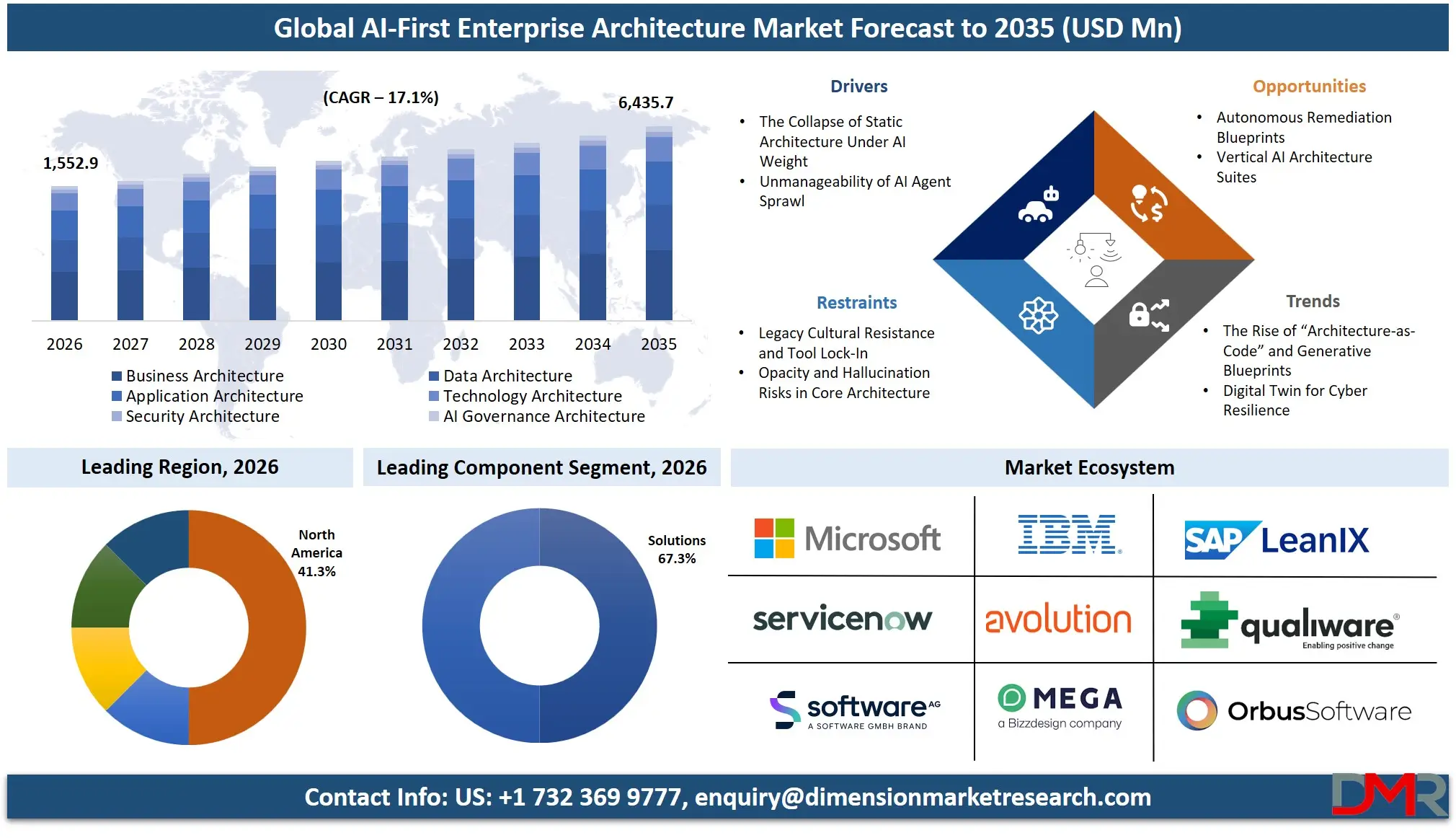
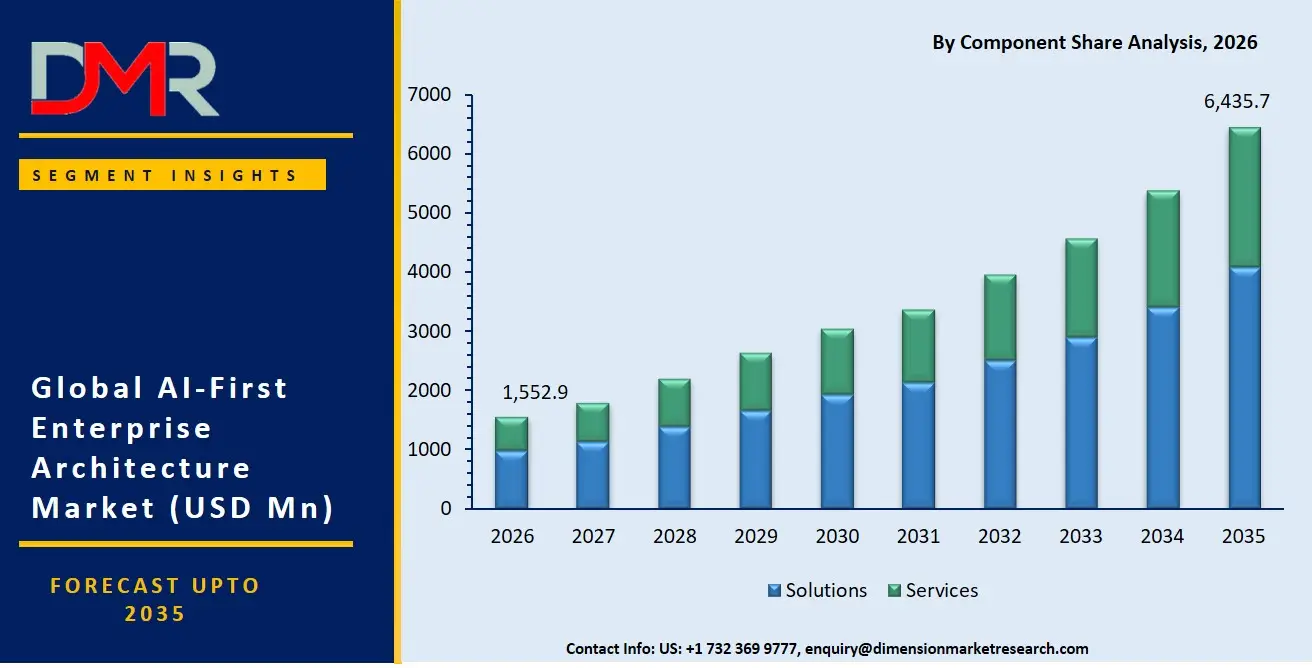
The Global AI-First Enterprise Architecture Market is expected to reach a value of USD 1,552.9 million in 2026, and it is further anticipated to reach USD 6,435.7 million by 2035, growing at a CAGR of 17.1% during the forecast period.
ℹ
To learn more about this report –
Download Your Free Sample Report Here
AI-first enterprise architecture market is growing, with organizations fundamentally reimagining their underlying IT blueprints to be intelligent, autonomous, and predictive by default. This market includes solutions and services that introduce AI into the foundational backbone of an enterprise, ranging from enterprise modeling tools, AI-powered architecture platforms, to governance & compliance tools, enabling real-time decision-making and automated orchestration.
The transformation of static, document-centric architecture to dynamic, AI-enabled digital twin architecture is fueling the need for specific services, such as integration & deployment and managed services. The adoption is typically by large enterprises in heavily regulated industries like BFSI, healthcare or government, where these tools are used to navigate through complex risk landscapes and to move away from legacy technical debt towards AI-powered, cloud-native ecosystems.
ℹ
To learn more about this report –
Download Your Free Sample Report Here
The US AI-First Enterprise Architecture Market
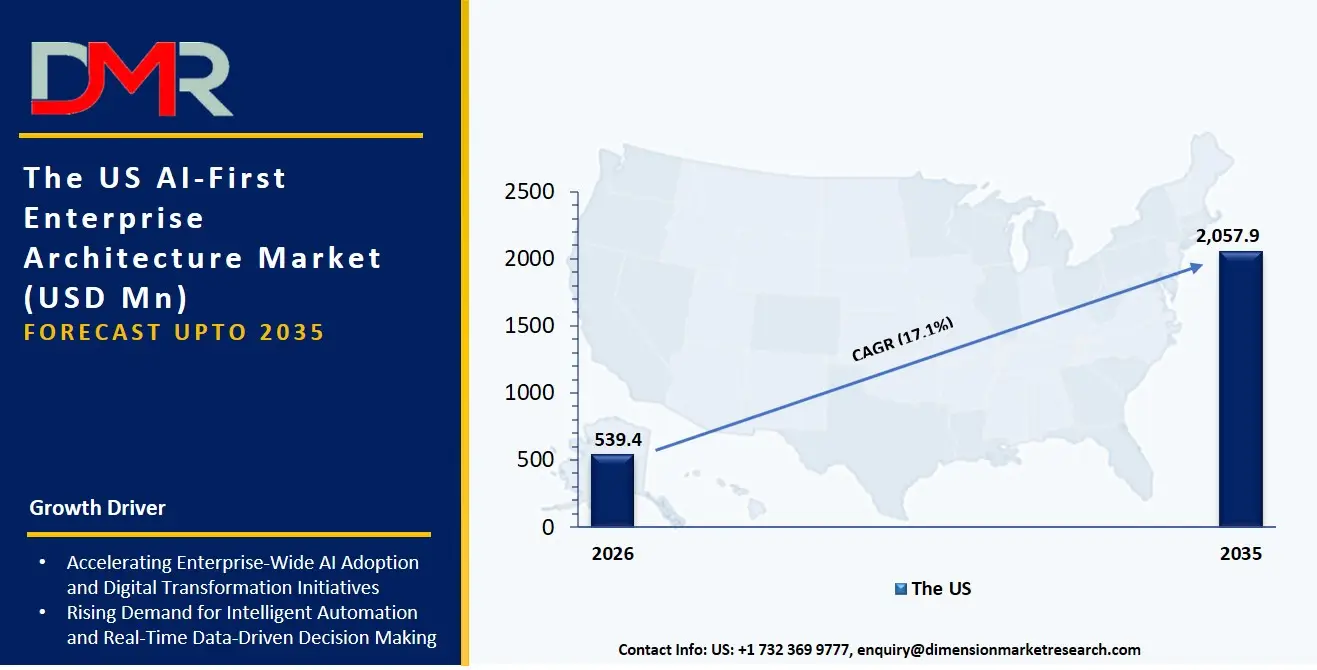
The US AI-First Enterprise Architecture Market is projected to reach USD 539.4 million in 2026 at a compound annual growth rate of 16.0% over its forecast period, culminating in a value of USD 2,057.9 million by 2035.
The United States leads the market, as Fortune 500 companies aggressively pursue the integration of AI and the country boasts the largest number of hyperscale cloud service providers, the backbone of AI workloads. The market is driven by a higher demand for Intelligent Decision Support Systems as organisations are looking for a shift from descriptive analytics to prescriptive architecture recommendations to meet business outcomes within IT portfolios. Moreover, with the swift adoption of AI Agents and Autonomous Systems in enterprise workflows, there is a parallel demand for AI Governance Architecture solutions that seamlessly align with ethical standards, data privacy, and federal regulations in automated decision-making processes.
ℹ
To learn more about this report –
Download Your Free Sample Report Here
The Europe AI-First Enterprise Architecture Market
Europe AI-First Enterprise Architecture Market is poised to be valued at USD 403.8 million in 2026 and is projected to reach USD 1,661.4 million by 2035, growing at a CAGR of 17.0% during the forecast period.
The Europe AI-First Enterprise Architecture Market is projected to be highly valued in 2026, with robust growth fueled by the enforcement of stringent regulations, such as the EU AI Act. In the European market, the demand for tools supporting Governance & Compliance and the requirement for applications within the field of Risk & Compliance Management are particularly pronounced and drive enterprises to link AI models directly to the pertinent articles of regulations to escape penalties. Accelerated adoption of Hybrid deployment strategies in the region is observed, such as the German and French manufacturing sectors, where Digital Twin Architecture is being used to connect legacy Operational Technology (OT) with AI-driven analytics on the cloud. Moreover, AI training data and decision engines are the target of initiatives focused on data sovereignty, which are driving service providers to create new Integration & Deployment services to make sure that these AI assets stay within European interoperable cloud ecosystems.
The Japan AI-First Enterprise Architecture Market
Japan AI-First Enterprise Architecture Market is projected to estimate at USD 118.0 million in 2026 and is expected to reach USD 494.6 million by 2035, growing at a CAGR of 17.3% during the forecast period.
The Japan AI-First Enterprise Architecture Market is projected to witness robust growth,, as the market is certainly unique with a national push towards Digital Transformation (DX) to address the fast shrinking workforce and ageing society infrastructure. A major area is Business Architecture and Workflow Automation Platforms, where big time conglomerates are devising enterprise blueprints to include independent systems into their mission-critical processes. In addition, there is a high local demand for AI-driven Application Portfolio Management, which enables the management of legacy mainframe applications alongside future-ready SaaS applications without compromising industrial continuity, by mapping the legacy code to future-ready, AI-native microservices.
Key Takeaways
- Market Size & Forecast: The Global AI-First Enterprise Architecture market is projected to reach USD 1,552.9 million in 2026, expanding to USD 6,435.7 million by 2035, as enterprises are looking for ways to manage the complexity of AI-driven IT estates and enforce automated governance.
- Growth Rate & Outlook: Global market growth is expected at a CAGR of 17.1%, due to the inability of enterprise architecture to scale with the dynamic nature of AI agents and the demand for predictive analytics in technology investment.
- Primary Growth Drivers: Key forces are the transition from manual diagramming to AI-Powered Architecture Platforms that automatically generate code, the requirement for Digital Twin Architecture to simulate cyber-risk scenarios, and the incorporation of AI Governance Architecture to ensure business and regulatory ethics are aligned.
- Key Market Trends: The major trends in the market include the convergence of enterprise modeling tools with generative AI, the emergence of the Autonomous AI agents for workflow remediation, and the use of intelligent decision support systems (IDSS) to optimize application portfolio in real-time.
- By Deployment Mode Analysis: Cloud is projected to be the predominant model this segment, because of data gravity. There is a growing demand for professional services to implement the use of AI-Powered Architecture Platforms, which serve to effortlessly integrate on-premise private clouds with AI services from public clouds.
- By Industry Vertical Analysis: BFSI and Healthcare & Life Sciences are the most profitable verticals because of the zero-tolerance compliance requirements for AI Governance Architecture. The most rapid growth is in the manufacturing domain, where industrial digital twins demand a solid data architecture foundation.
- Regional Leadership: North America is poised to dominate this market with 41.3% of the market share in 2026, due to its well-established technological ecosystem of AI hyperscalers and strong enterprise investments in autonomous systems.
What is the AI-First Enterprise Architecture?
AI-First Enterprise Architecture is the industry discipline and toolsets that enable the enterprise architecture to be considered a living, intelligent operating system. They are far more than upgraded documentation platforms, but are AI-Powered Architecture Platforms and Digital Twin systems to model the enterprise in real-time. This market includes Solutions that are IT solutions that can predict the impact of IT changes prior to deployment, and Services that are IT services performed by third parties to architect the "AI factory" floor, including Consulting and Integration & Deployment. These architectures are key to eliminating the concept of "shadow AI" and managing the technical sprawl that comes from enterprises operating hundreds of AI models, ensuring that every model, from legacy databases to new NLP models, is mapped, governed, and aligned with the Business Architecture.
Use Cases
- Real-Time Fraud Architecture in BFSI: Banking institutions leverage AI-Powered Architecture Platforms to model transaction flows and can use the Technology Architecture to scale the pods of Kubernetes, and call Predictive Analytics engines the micro-second is suspected pattern is detected, achieving micro-second latency compliance.
- Digital Twin for Smart Hospitals: Hospital networks are using Digital Twin Architecture to simulate their physical and IT resources, which use Computer Vision and IoT data to predict bottlenecks and failure points in critical care systems without jeopardizing patient safety.
- Sovereign AI Governance in Defense: Government agencies deploy AI governance architecture and risk & compliance management tools to create airtight air-gapped clouds that process classified intelligence entirely within the boundaries of domestic data residency and under the watchful eye of automated compliance bots.
- Predictive Maintenance in Manufacturing: Global manufacturers are using Integration & deployment services to integrate computer vision solutions deployed on the factory floor with application architecture blueprints, and use the predictive maintenance signals to initiate automated procurement processes in ERP systems.
Market Dynamics
Key Drivers in the Global AI-First Enterprise Architecture Market
The Collapse of Static Architecture Under AI Weight
At present, global organisations are facing a challenge in maintaining traditional Enterprise Modeling Tools as it is difficult to keep them in sync with the ephemeral nature of AI Agents and serverless functions. Legacy tools cannot model autonomous decision flows, model drift and data lineage in real time. This generates a tremendous need for AI-Powered Architecture Platforms to serve as a GPS for the enterprise, automatically discovering and mapping application dependencies to offer a living view of the IT estate.
Unmanageability of AI Agent Sprawl
Enterprises dedicate hundreds of special AI agents, but in the absence of a Business or Technology Architecture, these agents clash and generate infinitely many loops in the production environment. A complex Security Architecture is needed to manage the identity, governance and orchestration of these independent systems across multiple clouds. This complexity has created a need for Integration & Deployment services which can focus on 'Agent-to-Agent' architecture, where these digital workers can be integrated to share context and be aligned to the business process logic without creating chaos on the operations.
Restraints in the Global AI-First Enterprise Architecture Market
Legacy Cultural Resistance and Tool Lock-In
Legacy cultural resistance and vendor lock-in remain significant barriers to adopting AI-first enterprise architecture. Many organizations still treat architecture blueprints as static documentation for compliance and auditing rather than dynamic systems that guide business decisions and operational change. Transitioning to AI-driven architecture requires a cultural shift, as business leaders may hesitate to rely on automated recommendations and intelligent decision-support systems over established human judgment. Additionally, replacing legacy modeling platforms can involve substantial migration costs, integration challenges, employee retraining, and operational risks. Dependence on existing tools and workflows can further delay modernization, slowing the adoption of AI-native architecture solutions across enterprises.
Opacity and Hallucination Risks in Core Architecture
It is not trivial that by directly embedding Generative AI in the enterprise blueprint, the risk of model hallucination is introduced into important technology planning. An AI-Powered Architecture Platform can cause cascading deletion of critical interfaces during automated refactoring if it incorrectly identifies an application dependency or introduces a fake flow. This "black box" risk leads to the scrutiny of the executive on any project that gives AI Agents write access to the architecture repository, requiring them to wait for robust human-in-the-loop guardrails to be demonstrated.
Growth Opportunities in the Global AI-First Enterprise Architecture Market
Autonomous Remediation Blueprints
A significant growth opportunity lies in platforms that don't just monitor but act. Clients want IDSSs that can automatically detect a security threat or performance bottleneck, find out the Business Architecture's blast radius and suggest an automatically re-calculated Target Architecture that neutralizes the threat, keeps revenue systems alive. Combining Managed Services with architectural strategy, professional services firms are developing practices around "Closed-Loop Architecture" in which the system architects the fix, tests it against a Digital Twin and deploys it with human sign-off.
Vertical AI Architecture Suites
Vertical AI architecture suites are gaining traction as cloud providers introduce industry-specific AI solutions that require tailored governance, data management, and enterprise architecture frameworks. Generic modeling tools often lack the specialized controls needed to address sector-specific requirements. Healthcare architectures must support regulatory compliance, patient data protection, and AI-enabled diagnostics, while banking and financial services require frameworks for open banking, fraud detection, and risk management. Enterprise modeling vendors and service providers can capitalize on this demand by embedding preconfigured industry templates, governance controls, and reusable AI accelerators into their platforms. These solutions can simplify implementation, improve compliance readiness, and strengthen opportunities in managed AI transformation services.
Trends in the Global AI-First Enterprise Architecture Market
The Rise of "Architecture-as-Code" and Generative Blueprints
There is a trend towards architecture diagrams being instantly executable with the help of platform engineering and Generative AI. Rather than drawing boxes and lines, architects specify the intent of the business in plain language and the AI-Powered Architecture Platform autogenerates the Terraform scripts, security groups, and API contracts. This makes it possible for Workflow Automation Platforms to close the design-to-runtime gap and reduces months of architecture approval to hours of fast prototyping.
Digital Twin for Cyber Resilience
Digital twin technology is emerging as a valuable approach to strengthening enterprise cyber resilience by creating virtual representations of IT infrastructure, networks, applications, and security dependencies. These models enable organizations to simulate cyberattacks, evaluate zero-day vulnerability scenarios, assess potential blast radiuses, and identify weaknesses before incidents affect live systems. By integrating real-time telemetry, threat intelligence, and security analytics, digital twins can help security teams understand how threats may propagate across interconnected environments and evaluate the effectiveness of existing controls. This transforms security architecture from a largely static design process into a dynamic, predictive capability that supports risk assessment, incident preparedness, and continuous improvement of enterprise cyber resilience.
Research Scope and Analysis
The AI-First Enterprise Architecture market is driven by rising adoption of AI-powered automation, cloud-native platforms, data-centric architectures, and enterprise modernization initiatives. Growing demand across BFSI and large enterprises is accelerating investments in intelligent governance, workflow automation, cybersecurity, and scalable AI-ready infrastructure solutions.
ℹ
To learn more about this report –
Download Your Free Sample Report Here
By Component Analysis
The component segment is projected to be driven by solutions that can automate the discovery, governance, orchestration, and real-time enterprise mapping all of which are AI-native platforms that enterprises are prioritizing. There is a growing need for enterprise modeling tools, AI-powered architecture platforms, and workflow automation platforms that can dynamically observe interconnected applications, AI agents, APIs, and data flows in hybrid cloud environments. As digital transformation programs continue to get more complex, and autonomous AI systems rapidly gain popularity, the demand for integrated architecture software is growing at a fast pace, because of the rise in adoption of autonomous AI systems. Digital twin architecture and intelligent decision support systems are also receiving significant attention from businesses, offering enhanced visibility, resilience, and compliance with operations. Scalable software-driven solutions create a more significant recurring revenue and are at the heart of enterprise modernization efforts around the world, although services are important for implementation and optimization.
By Deployment Mode Analysis
Cloud deployment expected to be the market leader, as enterprises are increasingly moving to cloud-based scalable, flexible, and AI-ready infrastructure that can be used to support continuous monitoring of the architecture and automation. Cloud platforms can help organizations quickly deploy AI-powered tools and architecture without requiring a significant investment in infrastructure and are designed for seamless integration with multi-cloud and hybrid environments. Cloud adoption is also boosted by the growing presence of remote operations, distributed applications and real-time data management. In addition, enterprises enjoy quicker software update cycles, central governance, less maintenance complexity, and better collaboration between architecture, security and operations teams. Cloud-native technologies are essential to AI-First Enterprise Architecture platforms for their ability to process massive enterprise data, automate workflows, and orchestrate AI agents at scale. Furthermore, hyperscale cloud service providers keep investing in AI ecosystems and cloud deployment is the most favored and fastest growing model around the globe.
By Architecture Type Analysis
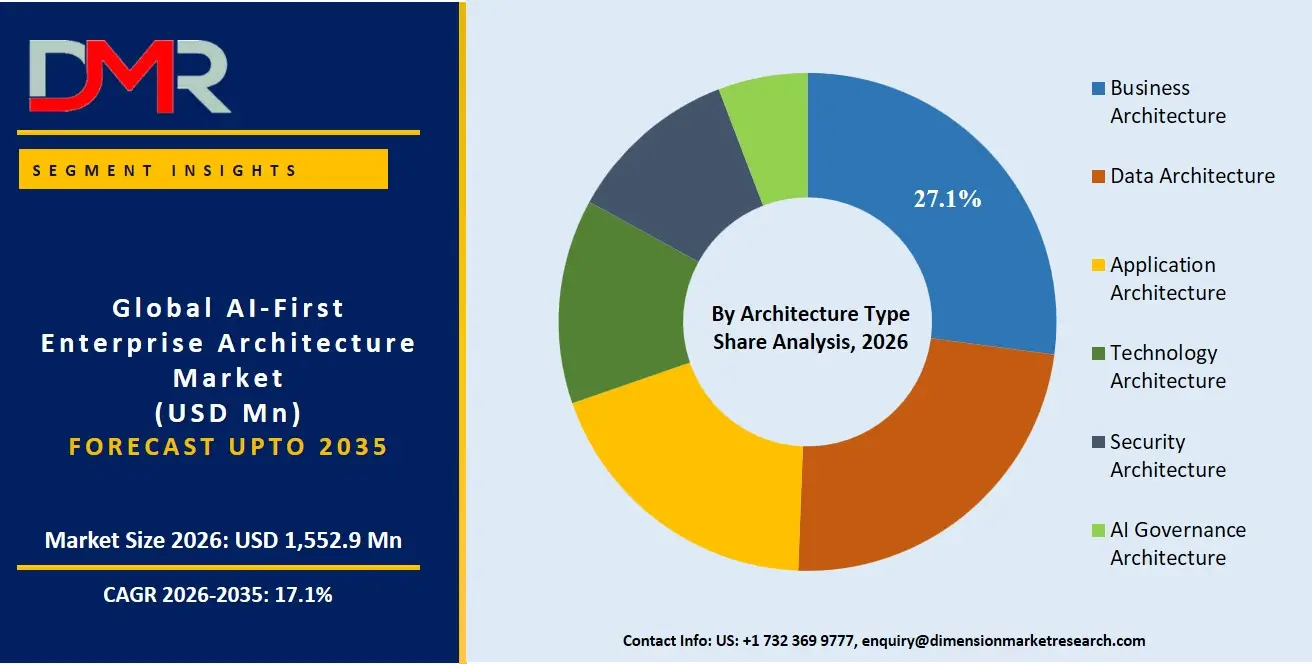
The Data Architecture is expected to dominate this segment as AI-first companies rely on well-governed, high-quality, and interconnected data ecosystems to fuel intelligent automation and predictive decision-making processes. To ensure the reliable deployment of AI across business functions, data lineage tracking, metadata management, interoperability, and real-time analytics are all areas of increasing focus. With the adoption of generative AI, machine learning, and autonomous systems in enterprises, efficient handling of structured and unstructured data is a key concern. Data Architecture also enables regulatory requirements, cybersecurity protocols, and inter-platform transparency in intricate digital environments. As cloud computing, IoT environments, and data-intensive applications continue to grow rapidly, there is a heightened demand for scalable and secure data frameworks. As a result, businesses are investing heavily in designing their data architecture to be AI-ready, offering efficiency, governance, and enterprise-wide intelligence.
By Enterprise Size Analysis
Large enterprises is expected to dominate the market due to their financial resources, technical expertise, and infrastructure, which allows them to deploy complex AI-first enterprise architecture frameworks on a large scale. These organisations span several business units, regions and cloud environments, so there is a high demand for integrated governance, workflow automation and AI orchestration platforms. Large enterprises, too, are constantly under pressure to modernize legacy systems, to make their cybersecurity resilient, and to make their operations more agile with intelligent architecture management. Their large investment in digital transformation allows them to invest in cutting-edge technologies like Digital Twin Architecture, AI governance systems, and predictive analytics tools. Additionally, large companies typically have large amounts of data and interdependent applications that need centralized architecture visibility and compliance management.
By AI Technology Analysis
The generative AI is poised to leading the AI technology segment as it is reshaping enterprise architecture from static documentation to dynamic, automated, and constantly evolving systems. Businesses are leveraging Generative AI to produce architectural blueprints, workflows, infrastructure configuration automation, and more efficient enterprise decision-making. The technology dramatically simplifies manual work and transforms natural language prompts into executable architecture models, governance policies, and integration frameworks. Generative AI also helps enterprises maximize application modernization, automate compliance reporting and boost operational efficiency in distributed environments. It plays a crucial role in AI-first transformation strategies due to its ability to speed up software development, advance workflow automation, and boost real-time enterprise intelligence. Generative AI's supremacy in the world of enterprise architecture is being propelled by a combination of technology provider investments and a surge in enterprise demand for intelligent automation.
By Application Analysis
IT and infrastructure modernization is projected to be the leading application segment as organizations across the globe are migrating from legacy application infrastructure to digital infrastructure, which is cloud-native, AI-powered, and highly automated. Legacy enterprise systems are struggling to keep pace with today's AI-driven operations in terms of scalability, flexibility, and intelligence. AI-First Enterprise Architecture platforms enable organizations to modernize legacy applications, maximize the use of infrastructure, and enhance the interoperability between cloud and on-premises environments. Another important goal of modernization is to enhance cybersecurity, cut down on operational expenses, and boost agility in the fast-evolving digital landscape. The drive towards intelligent infrastructure management solutions has grown even faster with the rise of hybrid working models, real-time analytics, and AI-powered automation. Moreover, enterprises see modernization as the prime first step towards the implementation of new technologies like AI agents, predictive analytics, and self-managing operational systems.
By Industry Vertical Analysis
The industry vertical segment is projected to be led by BFSI, as financial institutions are quickly transitioning to AI-first enterprise architecture to streamline complex digital ecosystems, bolster cybersecurity, and enhance regulatory compliance. Banks, insurance companies, financial service sector organizations have highly interconnected systems that must be continuously monitored, governed, and be able to make real-time decisions. AI-powered architecture platforms help BFSI companies modernize legacy infrastructure, automate risk management, optimize customer experiences, and enhance fraud detection processes. This industry also produces a vast amount of sensitive transactional and customer information, which is why advanced data architecture and data governance are essential. The growing investment in digital banking, open finance ecosystems and AI-powered automation also drive adoption. Further, the need to meet strict compliance standards and the rise of cyber threats force BFSI companies to adopt intelligent, resilient and adaptive approaches to enterprise architecture.
The Global AI-First Enterprise Architecture Market Report is segmented on the basis of the following:
By Component
- Solutions
- Enterprise Modeling Tools
- AI-Powered Architecture Platforms
- Governance & Compliance Tools
- Workflow Automation Platforms
- Digital Twin Architecture
- Intelligent Decision Support Systems
- Services
- Consulting Services
- Integration & Deployment
- Support & Maintenance
- Managed Services
By Deployment Mode
- Cloud-Based
- On-Premises
- Hybrid
By Architecture Type
- Business Architecture
- Data Architecture
- Application Architecture
- Technology Architecture
- Security Architecture
- AI Governance Architecture
By Enterprise Size
- Large Enterprises
- Small & Medium Enterprises (SMEs)
By AI Technology
- Generative AI
- Machine Learning
- Natural Language Processing (NLP)
- Predictive Analytics
- AI Agents & Autonomous Systems
- Computer Vision
By Application
- IT & Infrastructure Modernization
- Business Process Automation
- Risk & Compliance Management
- Data Governance
- Customer Experience Management
- Workforce Productivity Optimization
- Application Portfolio Management
By Industry Vertical
- BFSI
- Healthcare & Life Sciences
- IT & Telecom
- Manufacturing
- Retail & E-commerce
- Government & Defense
- Energy & Utilities
- Media & Entertainment
- Transportation & Logistics
- Education
Regional Analysis
Leading Region by Market Share
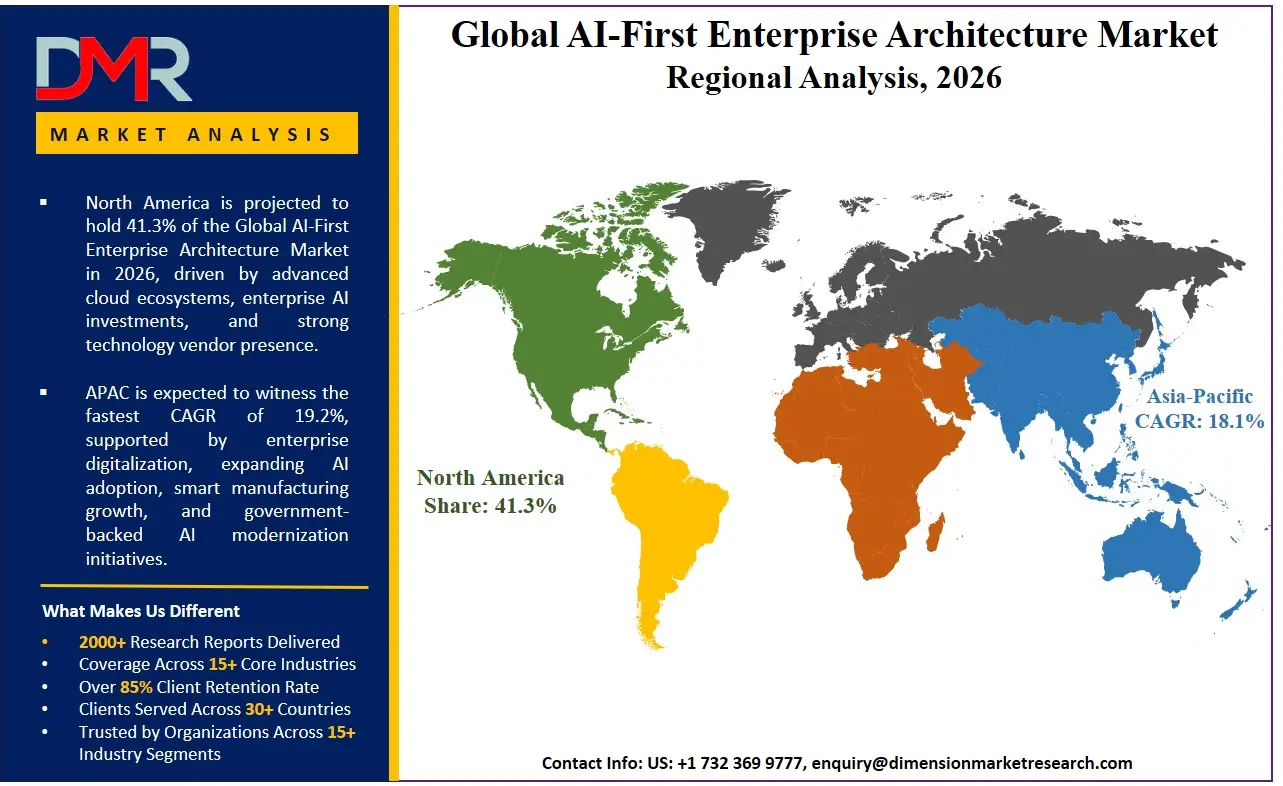
The North America region is anticipated to account for 41.3% share of the global AI-first enterprise architecture market by the end of 2026 as it is home to the advanced digital enterprises, hyperscale cloud vendors, and leading AI technology vendors. In industries like BFSI, healthcare, retail, defense, and manufacturing, more organizations are turning to AI enterprise architecture platforms to modernize legacy systems and automate decision-making to enhance operational agility. It has a favourable environment for cloud adoption, a well-established IT ecosystem and huge investments in the field of generative AI, machine learning, and enterprise automation. Furthermore, U.S. and Canadian businesses are focusing on enterprise architecture's intelligent governance, cybersecurity integration, and real-time analytics. The presence of robust research ecosystems, funding conditions, and quick adoption of AI transformation strategies continue to drive North America's dominant position in the market.
ℹ
To learn more about this report –
Download Your Free Sample Report Here
Fastest-Growing Regional Market
The Asia-Pacific region is expected to be the fastest growing market in the AI-First Enterprise Architecture market, fuelled by the rapidly increasing digital transformation initiatives, the growing adoption of AI in enterprises, and increasing investments in cloud-native infrastructure. The adoption of AI systems for enterprises is gaining traction in countries like China, India, Japan, South Korea, and Singapore, where AI-driven systems are used to optimize operations, manage data, and automate business processes. Driving this regional growth is the demand for scalable IT modernisation solutions from large enterprises and SMEs. Market growth is aided by government-led efforts to champion smart industry initiatives, the quick expansion of digital ecosystems, and the growing uptake of AI-powered analytics platforms. Moreover, investments from international technology vendors and local startups, together with the quickly rising pace of innovation in intelligent enterprise architecture tools and AI-driven organizational transformation strategies in the region, are fueling a new surge in innovation in Asia-Pacific.
By Region
North America
Europe
- Germany
- The U.K.
- France
- Italy
- Russia
- Spain
- Benelux
- Nordic
- Rest of Europe
Asia-Pacific
- China
- Japan
- South Korea
- India
- ANZ
- ASEAN
- Rest of Asia-Pacific
Latin America
- Brazil
- Mexico
- Argentina
- Colombia
- Rest of Latin America
Middle East & Africa
- Saudi Arabia
- UAE
- South Africa
- Israel
- Egypt
- Rest of MEA
Competitive Landscape
The global AI-First Enterprise Architecture market has become very dynamic with a diverse set of global system integrators (GSIs), specialized AI modeling tool vendors, and the professional services arms of large cloud hyperscalers. Developing deep strategic partnerships with the leading GenAI/Agentic AI platform providers becomes a critical factor for success, as it provides early access to the latest advancements in AI technology. A key factor is the current trend towards market consolidation, as traditional IT management software companies are busy buying up niche Digital Twin and Intelligent Decision Support System startups to complement their Solution portfolios. Proprietary intellectual property (IP), including automated algorithms for discovering architectures and vertical-specific risk pattern libraries, is becoming an ever more important differentiator for proprietary firms than generic consulting head count, and proprietary firms are bidding heavily on delivering closed-loop autonomous remediation capabilities.
Some of the prominent players in the Global AI-First Enterprise Architecture Market are:
- IBM
- Microsoft
- SAP LeanIX
- Software AG
- Orbus Software
- MEGA International
- BiZZdesign
- Avolution
- QualiWare
- BOC Group
- Sparx Systems
- Planview
- ServiceNow
- Oracle
- Salesforce
- Amazon Web Services (AWS)
- Google Cloud
- NVIDIA
- OpenText
- ValueBlue
- Other Key Players
Recent Developments
- In March 2026, TM Forum partnered with organizations like Google, Dell Technologies, Salesforce, and Huawei to promote AI-native enterprise architecture frameworks that enable scalable automation, interoperability, and intelligent enterprise operations.
- In February 2026, Infosys introduced its AI First Value Framework, which provides intelligent operational models and AI modernization strategies to help enterprises build AI-native architectures, automate processes, enhance governance and speed up large-scale enterprise digital transformation efforts in complex enterprise environments.
- In January 2026, Orbus Software enhanced its AI-powered enterprise architecture platform with additional capabilities in governance and integration with cybersecurity tools, and added intelligent transformation capabilities to assist organizations in modernizing legacy infrastructure and optimizing enterprise-wide operational visibility, compliance management, and strategic decision-making processes.
Report Details
| Report Characteristics |
| Market Size (2026) |
USD 1,552.9 Mn |
| Forecast Value (2035) |
USD 6,435.7 Mn |
| CAGR (2026–2035) |
17.1% |
| The US Market Size (2026) |
USD 539.4 Mn |
| Historical Data |
2021 – 2025 |
| Forecast Data |
2026 – 2035 |
| Base Year |
2025 |
| Estimate Year |
2026 |
| Segments Covered |
By Component, By Deployment Mode, By Architecture Type, By Enterprise Size, By AI Technology, By Application, and By Industry Vertical |
| Regional Coverage |
North America – The US and Canada; Europe – Germany, The UK, France, Russia, Spain, Italy, Benelux, Nordic, & Rest of Europe; Asia-Pacific – China, Japan, South Korea, India, ANZ, ASEAN, Rest of APAC; Latin America – Brazil, Mexico, Argentina, Colombia, Rest of Latin America; Middle East & Africa – Saudi Arabia, UAE, South Africa, Turkey, Egypt, Israel, & Rest of MEA |
Frequently Asked Questions
How big is the Global AI-First Enterprise Architecture Market?
▾ The Global AI-First Enterprise Architecture market is poised to be valued at USD 1,552.9 million in 2026 and is projected to reach USD 6,435.7 million by 2035, driven by the universal need for specialized platforms to govern autonomous systems and manage AI-driven IT complexity.
What is the CAGR of the Global AI-First Enterprise Architecture Market from 2026 to 2035?
▾ The market is expected to grow at a CAGR of 17.1% from 2026 to 2035, reflecting the accelerating failure of static architecture tools and the surge in demand for real-time, AI-powered governance and digital twin simulation.
What factors are driving the growth of the Global AI-First Enterprise Architecture Market?
▾ Key drivers include the inability of traditional Enterprise Modeling Tools to map ephemeral AI workloads, the complexity of managing sprawling AI Agents, and the regulatory imperative to maintain transparent AI Governance Architecture amid evolving AI safety laws.
Which region held the largest share of the AI-First Enterprise Architecture Market in 2026?
▾ North America, specifically the United States, held 41.3% of the market share in 2026, driven by a mature AI hyperscaler ecosystem and aggressive enterprise investment in Intelligent Decision Support Systems and Agentic AI capabilities.
Which region is expected to grow the fastest in the AI-First Enterprise Architecture Market?
▾ The Asia-Pacific region is expected to grow the fastest, fueled by rapid digital transformation and government-led AI initiatives in India, China, and Japan, where Business Architecture consulting is critical for transitioning conglomerates to AI-native operations.
What are the major trends in the Global AI-First Enterprise Architecture Market?
▾ Major trends include the shift to "Architecture-as-Code" using Generative AI, the deployment of Digital Twin Architecture for real-time cyber resilience simulations, and the rise of autonomous AI Agents for closed-loop architectural remediation.
Who are the key players in the Global AI-First Enterprise Architecture Market?
▾ Key players in the global AI-First Enterprise Architecture market include IBM, Microsoft, SAP LeanIX, Software AG, Orbus Software, MEGA International, BiZZdesign, Avolution, QualiWare
How is the Global AI-First Enterprise Architecture Market segmented?
▾ The market is segmented by Component, Deployment Mode, Architecture Type, Enterprise Size, AI Technology, Application, and Industry Vertical.