Market Snapshot
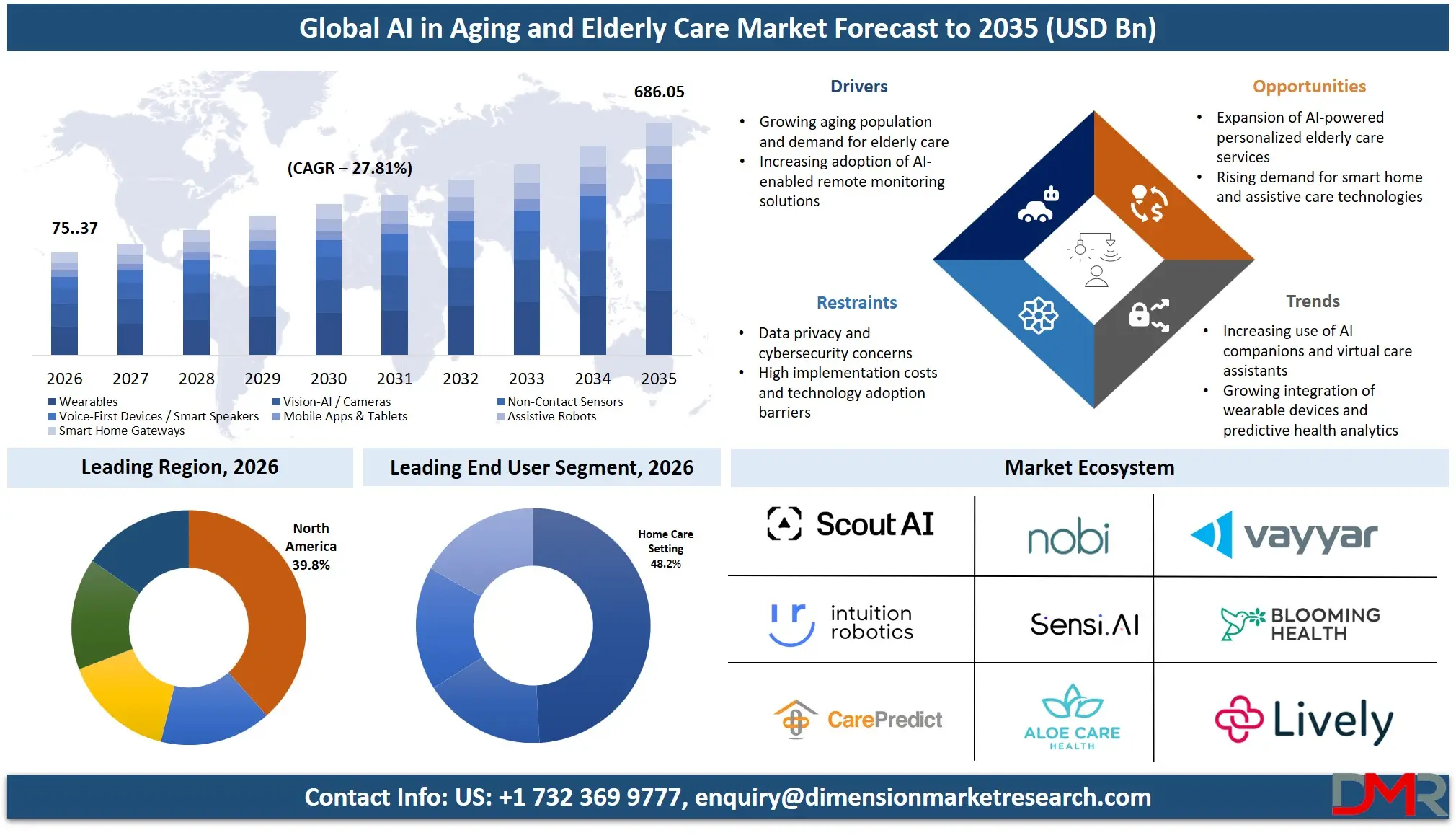
- The AI in Aging and Elderly Care market size is USD 58.98 Billion in 2025, reached USD 75.37 Billion in 2026, and is projected to hit USD 686.05 Billion by 2035 at a CAGR of 27.81%.
- AI-Powered Monitoring Systems leads the technology segment with a 34.2% revenue share in 2026, followed by Social Companion Robots at 22.7% and Cognitive Health Platforms at 12.3%.
- North America holds the dominant regional position with a 39.8% market share in 2026, valued at USD 23.47 Billion.
- Aging-in-Place Solutions commands the largest application share at 43.8%, with Assisted Living Facilities at 29.5%.
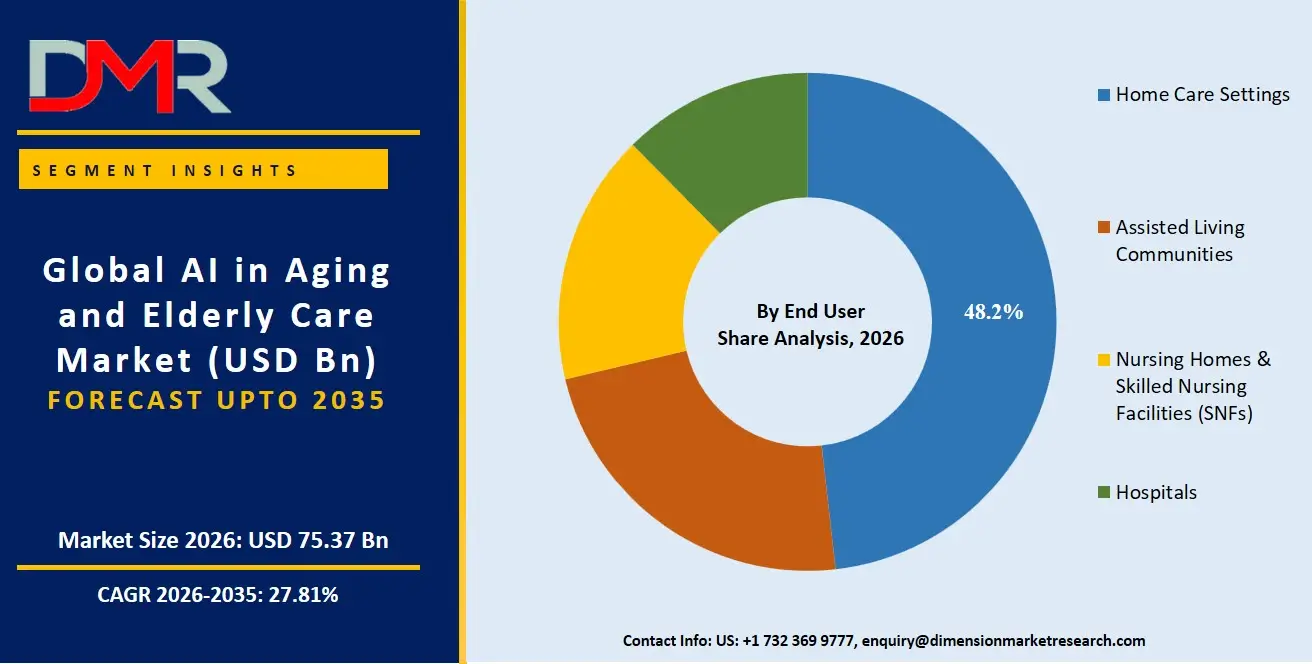
- Home Care Settings leads all end-user segments with a 48.2% share, followed by Nursing Homes and SNFs at 29.2%.
- Asia Pacific holds a 29.8% revenue share in 2026, the second-largest regional position.
Market Overview
The AI in Aging and Elderly Care Market covers technologies and platforms that monitor, assist, and support older adults across home, community, and institutional care settings. Scope includes AI-powered monitoring systems, social companion robots, cognitive health platforms, remote patient monitoring tools, and smart home sensing systems. Traditional non-AI medical devices, manual care staffing, and general hospital management software without eldercare AI functionality fall outside AI in Aging and Elderly Care Market's boundaries.
ℹ
To learn more about this report –
Download Your Free Sample Report Here
Healthcare systems face a widening structural gap between the number of older adults and the available caregiver workforce. AI platforms automate routine tasks, flag health risks early, and extend caregiver reach across more residents and home-based patients than manual workflows allow. Over 50% of U.S. adults aged 50 and above were actively using AI technologies by early 2025, per a University of Michigan poll cited in the Age in Place Technology report published in June 2025. Adoption at this scale among the target demographic removes one of the most historically cited barriers to eldercare AI market penetration.
Clinical validation is reshaping how procurement decisions are made. An NLP-based speech analysis model achieved 78.5% accuracy, 81.1% sensitivity, and 75.0% specificity in predicting progression from mild cognitive impairment to Alzheimer's disease over a six-year horizon, as confirmed by PMC research. Diagnostic performance at this level, without invasive testing, creates a viable early-detection product category that commands clinical procurement budgets rather than supplementary wellness budgets.
Market Size and Forecast
The Global AI in Aging and Elderly Care Market size is estimated at USD 75.37 Billion in 2026 from USD 58.98 Billion in 2025, and is projected to reach USD 686.05 Billion by 2035, exhibiting a CAGR of 27.81% during the forecast period.
A CAGR of 27.81% does not reflect incremental category growth. It signals a market moving from pilot-phase deployment to full institutional integration within a single decade. The forecast rests on three compounding forces, continued scaling of AI companion and monitoring platforms, accelerating government-backed deployment programs, and rising AI adoption among older adults themselves.
Sensi.AI secured USD 31 Million in its Series B round in June 2024 to accelerate ambient AI care intelligence tools for elderly safety monitoring, establishing a capital trajectory that its October 2025 Series C then extended to a total of USD 98 Million. Rounds of this sequence confirm that lead investors are backing platform-scale businesses, not point solutions.
Technology Analysis
AI-Powered Monitoring Systems led the technology segment with a 34.2% share in 2026.
Monitoring systems lead because they address the two highest-priority concerns for care facility operators, fall prevention and early health deterioration detection. Facilities that deploy monitoring platforms can demonstrate measurable liability reduction and document outcomes for CMS compliance purposes.
A secondary diagnostic algorithm tested on linguistically diverse populations achieved an AUC of 0.93 and overall testing accuracy of 88.4% in separating cognitively normal individuals from those with cognitive impairment, per PMC research. Accuracy at this level validates AI as a credible clinical screening tool, not just an operational convenience, and justifies clinical procurement budgets rather than discretionary technology spend.
Social Companion Robots hold a 22.7% share, making them the second-largest technology sub-segment. Government co-funded deployments, including ElliQ programs across U.S. states, have reduced the price sensitivity barrier that typically slows hardware adoption. Cognitive Health Platforms hold a 12.3% share and represent the highest clinical differentiation opportunity within the segment.
NLP-based speech models with published Alzheimer's prediction accuracy attract both clinical procurement budgets and federally funded research partnerships simultaneously. Computer Vision platforms address continuous monitoring without wearables, while Predictive Analytics shifts care delivery from reactive intervention to proactive risk management. Vendors who embed continuous gait deterioration tracking into predictive models can trigger nursing precautions automatically, without scheduled physician review, which justifies premium pricing over standard monitoring tools.
Application Analysis
Aging-in-Place Solutions accounted for 43.8% of application demand in 2026, the highest of any category.
Home-based AI platforms reduce care delivery cost compared to institutional placement while maintaining clinical oversight, making them attractive to older adults, families, and payors simultaneously. Three decision-making stakeholders converging on the same product category is what drives the segment's structural lead.
A multi-center study using Google Gemini 1.5 Pro to automate nursing handovers under the ISBAR framework reduced handover completion time from 3.45–4.32 minutes to 1.17–2.54 minutes, generating 474 to 981 hours of institutional time savings per month, per JMIR research. Platforms that embed this level of workflow automation into home-based care coordination models capture a larger share of clinical budgets than monitoring-only tools.
Assisted Living Facilities hold a 29.5% application share and represent the most operationally mature AI deployment environment. These facilities manage large resident populations under direct regulatory scrutiny, making AI tools with proven safety outcomes a compliance investment rather than an optional technology.
Memory Care is the fastest-growing application sub-segment by clinical urgency, with NIA's USD 40 Million AI AgeTech commitment specifically targeting Alzheimer's disease and related dementias. Caregiver Support Tools and Medication Management represent undermonetized application categories relative to available government funding and clinical demand. Remote Health and Vital Monitoring is among the most investor-validated sub-segments, with documented funding growth at Sensi.AI confirming durable commercial interest from institutional capital.
Device Analysis
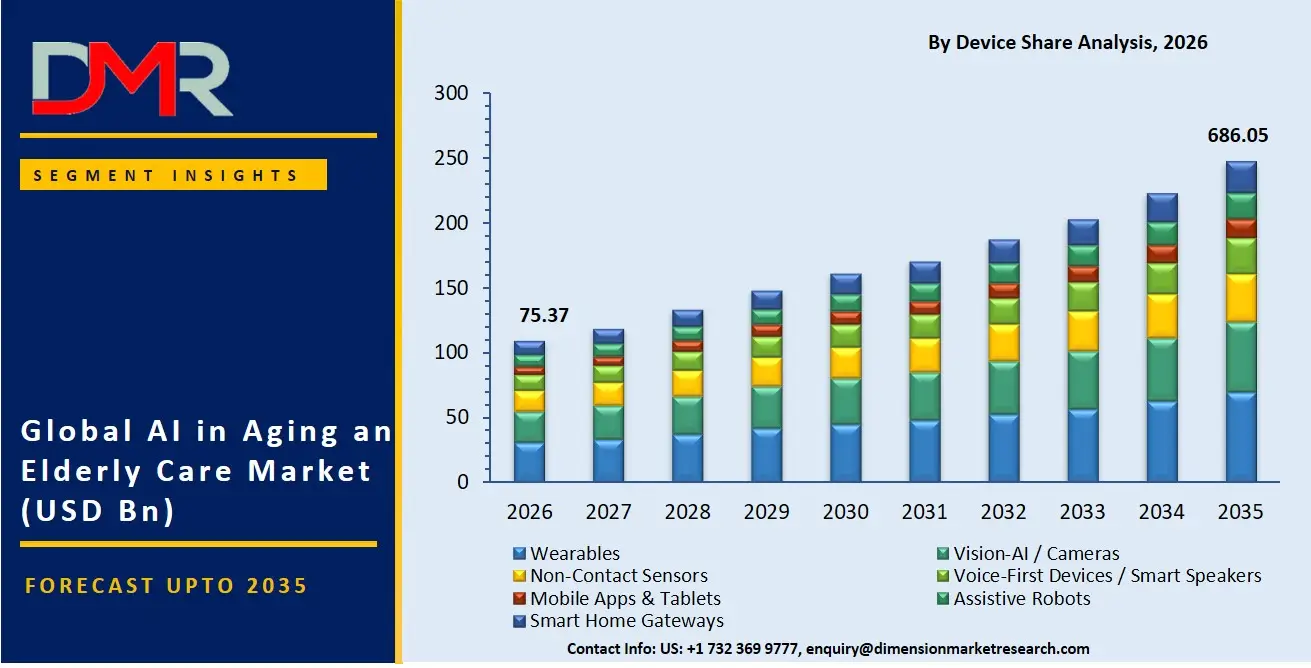
Wearables lead device adoption as the preferred home-based monitoring architecture.
Wearables enable continuous biometric tracking without environmental infrastructure, making them the default device for home-based deployments where facility-level sensor installation is not feasible. CarePredict's wearable-based ambient AI predictive platform accumulated USD 42.1 Million in cumulative funding over eight rounds by mid-2024, as confirmed by available data. This funding depth across eight rounds signals iterative commercial validation rather than speculative early-stage investment.
ℹ
To learn more about this report –
Download Your Free Sample Report Here
Non-Contact Sensors resolve the privacy objection that constrains camera-based monitoring in residential settings. Vayyar Care's radiofrequency sensor approach detects falls and monitors breathing without any visual data capture, a privacy-by-design architecture that is structurally advantaged in markets where resident consent and family trust are procurement prerequisites.
Voice-First Devices remove the screen interaction barrier for older adults with limited technical literacy, expanding the addressable user base to include populations who would not engage with app-based platforms. Vision-AI and Camera platforms retain strong penetration in communal and clinical spaces despite privacy trade-offs in residential environments.
Assistive Robots carry the longest commercialization timeline but attract the largest individual funding rounds, with Scout AI raising USD 115 Million in 2024 followed by USD 100 Million in April 2026. Smart Home Gateways form the connectivity infrastructure for aging-in-place AI deployment, linking environmental sensors, voice devices, and remote monitoring platforms into a single passive monitoring architecture.
End User Analysis
Home Care Settings captured 48.2% of end-user revenue in 2026, ahead of all other care settings.
Aging-in-place preference is both a cultural reality and a payor financial imperative. AI platforms that deliver clinical-grade monitoring in the home at a fraction of facility costs align structurally with the direction healthcare payors and policymakers are actively pushing the market.
ℹ
To learn more about this report –
Download Your Free Sample Report Here
CarePredict and ALIS completed bi-directional EHR integration in May 2025, linking automated AI caregiver logs directly to clinical records. Platforms that connect home care AI outputs to institutional EHR systems convert a monitoring tool into a core clinical workflow component, which substantially raises switching costs after initial deployment.
Nursing Homes and SNFs hold a 29.2% end-user share and represent the most regulated deployment environment. CMS oversight creates direct accountability for fall rates, readmission rates, and documentation accuracy. AI platforms with independently verified safety outcomes translate compliance obligations into a procurement argument.
Assisted Living Communities occupy the middle position between home care flexibility and nursing home regulatory intensity, serving a mobile resident population that benefits from companion AI and fall monitoring simultaneously. Hospitals use AI aging platforms primarily for post-acute monitoring and discharge planning, where workflow automation in geriatric units reduces clinical staff burden while improving documentation accuracy ahead of CMS quality reporting deadlines.
Key Market Segments
By Technology
- Machine Learning
- Natural Language Processing
- Computer Vision
- Predictive Analytics
- Companion & Conversational AI
- Robotics & Physical Assistance
- Smart Home / Ambient Sensing Systems
- AI-Powered Monitoring Systems
By Application
- Aging-in-Place Solutions
- Fall Detection & Prevention
- Medication Management & Adherence
- Remote Health & Vital Monitoring
- Caregiver Support Tools
- Memory Care
- Telehealth Integration
By Device
- Wearables
- Vision-AI / Cameras
- Non-Contact Sensors
- Voice-First Devices / Smart Speakers
- Mobile Apps & Tablets
- Assistive Robots
- Smart Home Gateways
By End User
- Home Care Settings
- Assisted Living Communities
- Nursing Homes & Skilled Nursing Facilities (SNFs)
- Hospitals
By Component
- Software
- Hardware
- Services
By Deployment
- Cloud-Based
- On-Premise
- Hybrid
Regional Analysis
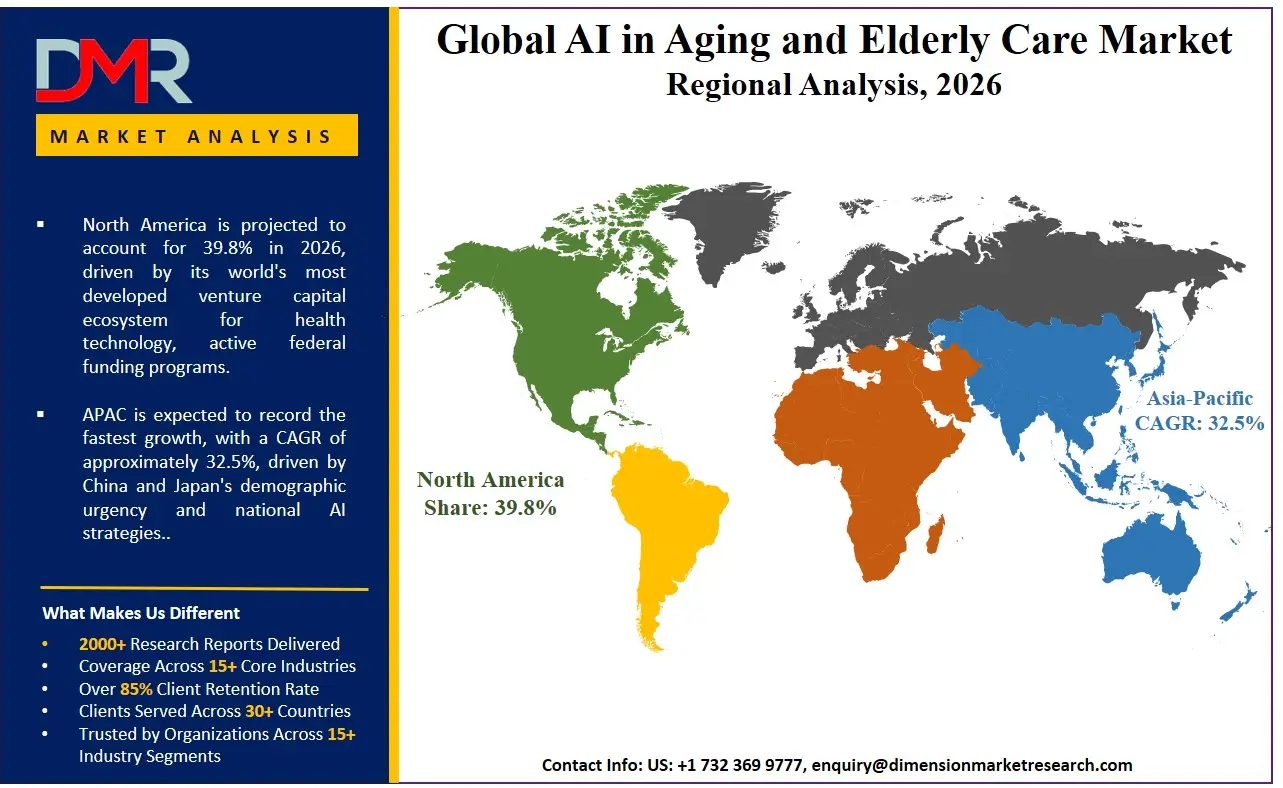
North America held a 39.8% share in 2026, valued at USD 23.47 Billion, the largest of any region in AI in Aging and Elderly Care Market.
ℹ
To learn more about this report –
Download Your Free Sample Report Here
The U.S. anchors North America's dominant position through the world's most developed venture capital ecosystem for health technology, active federal funding programs, and the highest density of commercially deployed AI eldercare platforms globally. NIA's USD 40 Million AI AgeTech commitment and HHS caregiver AI initiatives lower commercialization risk for U.S.-based vendors in ways that no other regional market currently replicates. Canada contributes through public health system procurement and academic research partnerships that accelerate clinical validation timelines for platforms seeking cross-border deployment.
Asia Pacific holds a 29.8% revenue share in 2026, driven by China and Japan's demographic urgency and national AI strategies. China's national Big Data and AI Elderly Care Guidelines issued in 2025 create a state-directed procurement framework across a large government-operated care network. Japan's government-funded humanoid eldercare prototypes and Kanematsu's equity investment in Intuition Robotics confirm that corporate and public capital are converging around eldercare AI in two of the world's fastest-aging populations. Europe's position reflects strong public health infrastructure alongside GDPR and national data residency requirements that extend procurement timelines for non-European AI vendors. Latin America and the Middle East and Africa remain early-stage regional markets where cloud-based platforms with lower infrastructure requirements are the most viable entry point for vendors seeking geographic diversification ahead of the next phase of market growth.
Key Regions and Countries
North America
Europe
- Germany
- France
- The UK
- Spain
- Italy
- Rest of Europe
Asia Pacific
- China
- Japan
- South Korea
- India
- Australia
- Rest of APAC
Latin America
- Brazil
- Mexico
- Rest of Latin America
Middle East & Africa
- GCC
- South Africa
- Rest of MEA
Market Dynamics
Federal Funding and Proven Labor Savings Push AI Care Into Standard Procurement
Caregiver shortages are an operational crisis that facilities face today, not a projected risk. Ambient AI scribes integrated with Epic across five academic medical centers cut EHR time by 13.4 minutes and direct documentation time by 16.0 minutes per encounter, as reported by JAMA and cited by the American Hospital Association. For care facilities managing thousands of patient encounters monthly, these time savings translate into measurable staff cost reductions. The NIA committed USD 40 Million in AI AgeTech funding through 2026, as confirmed by available federal program data. Public funding at this scale signals that the U.S. government views AI aging tools as healthcare infrastructure, giving vendors aligned with these programs faster institutional access and reduced sales cycle friction.
Government action in two of the world's largest eldercare markets is reducing commercialization risk for private vendors simultaneously. Japan has progressed to government-funded humanoid eldercare prototypes, and the U.S. Department of Health and Human Services launched caregiver AI initiatives in 2025. Vendors whose platforms demonstrate compliance with federally funded program requirements enter institutional procurement conversations with a validation credential that competitors without public program participation cannot easily replicate.
Documentation Error Rates and Privacy Exposure Slow High-Acuity Deployment
PMC research confirmed that 70% of AI-generated clinical draft notes contained at least one error, with an average of 2.9 errors per note and omission errors accounting for up to 83% of all errors across vendor pipelines. Until error rates fall below clinical acceptance thresholds, high-acuity settings require mandatory human review. That human review step adds a labor cost that partially offsets the efficiency gains driving adoption. Procurement committees at nursing homes and hospital systems are tracking this data and including it in vendor qualification criteria.
HIPAA and state-level privacy frameworks create structural compliance exposure for ambient audio, video, and biometric monitoring platforms. HHS and CMS issued guidance on algorithmic bias in AI-assisted clinical tools in 2024 and 2025, but guidance is not enforcement. Hardware-intensive solutions carry the additional barrier of capital expenditure timelines that most assisted living operators cannot absorb in a single budget cycle. Japan's AIREC humanoid prototype illustrates this constraint directly. Despite government backing, commercial readiness is not expected until approximately 2030, reflecting how long physical assistance robot certification takes even in policy-supportive environments.
Fall Prevention Outcomes and Caregiver Support Funding Open Near-Term Revenue Pathways
Nobi's AI smart lamps enabled 94% faster caregiver emergency response and reduced resident falls by 51% immediately upon installation, reaching 84% reduction with multi-phase tracking, per TSA Voice data from January 2025. Fall-related liability costs are material for nursing home operators. Outcomes at this performance level convert procurement from a budget discussion into a financial risk management decision, compressing approval timelines. PennAITech awarded USD 2.47 Million across 10 research teams in April 2026 for AI aging and Alzheimer's caregiver support projects. Public grant programs of this type create validated use cases and institutional credibility for early-stage vendors at near-zero customer acquisition cost.
HHS allocated USD 2 Million specifically for a Caregiver AI Prize Challenge in late 2025. Luma Health's Operational AI platform was deployed at 50-plus health systems saving over 2.5 million staff hours in 2025, demonstrating that caregiver workflow automation at population scale is operationally achievable today. Vendors positioned within HHS prize challenge programs gain procurement pathways into government-affiliated care networks that commercial sales teams cannot access through standard channels.
Market Trends
Companion Robots and Hybrid Care Models Advance From Pilots to Policy-Level Programs
Kanematsu Corporation made a strategic equity investment in Intuition Robotics in September 2025 to support domestic ElliQ localization and rollout across Japan. A trading firm committing equity to eldercare AI hardware signals that the commercial use case is credible enough to attract non-specialist investors beyond the health technology venture community. Intermountain Health recorded a 27% reduction in per-appointment documentation time through ambient AI scribe adoption, measured across clinicians using the tool for at least 10 patient encounters, as cited by the American Hospital Association. Hybrid human-AI care models that position AI as a caregiver augmentation tool rather than a replacement face faster adoption in unionized and regulated environments where workforce resistance is a material deployment risk.
Market Competition Overview
Tracxn data confirms 139 active competitors in virtual senior care management alone and 489 active competitors across the broader AgeTech sector. No single vendor holds platform-level dominance. The market remains in a share-capture phase where differentiated clinical outcomes and validated deployment at scale determine which companies attract the next round of institutional capital. Sage raised a USD 65 Million Series C in March 2026 to build a predictive engine analyzing nighttime wandering, sleep alterations, and fall-risk behaviors. Late-stage rounds at this scale signal that lead investors are backing companies they expect to become category leaders within this decade.
Vayyar Care leads the hardware segment with over USD 300 Million in total investment by late 2024, as confirmed by available funding data. SafelyYou reached USD 102 Million in total funding by 2024 through AI video analytics for fall management, per the same source. These funding levels create a widening capital advantage that smaller competitors cannot close through organic growth alone. Blooming Health expanded to 22 U.S. states with USD 32.5 Million in total venture funding, demonstrating that software-first cloud platforms can achieve national reach without the capital burden of hardware manufacturing. Software-first vendors are producing faster revenue growth than hardware-dependent competitors at comparable funding stages.
EHR integration is becoming the primary switching-cost mechanism. Platforms connected to EHR systems convert AI monitoring outputs into core clinical workflow components. Vendors without certified EHR integration are being filtered out of institutional procurement evaluations at the qualification stage rather than the pricing stage. Strategic partnerships between AI platform vendors and care management software providers are reshaping competitive boundaries faster than product differentiation alone could achieve.
Company Profiles
Sensi.AI has built the most heavily capitalized audio-based remote monitoring platform in the eldercare AI market, reaching USD 98 Million in total capital by late 2025 including a USD 45 Million Series C in October 2025, as confirmed by available funding data. Its proprietary ambient audio intelligence is purpose-built for home care agencies, giving it a structural positioning advantage in the fastest-growing end-user segment. Operating against 139 direct competitors in virtual senior care management, its capital depth provides a durable commercialization lead over rivals without equivalent funding or clinical validation at scale.
Intuition Robotics secured USD 83 Million in total funding through its Series C, backed by Mirai Creation Fund and Bloomberg Beta, as confirmed by available investment data. Its strategic value extends beyond commercial product sales into government eldercare infrastructure. New York State programs, Japanese national strategy alignment, and the September 2025 Kanematsu equity investment position ElliQ as a national eldercare program component rather than a commercial hardware product. Government-program status reduces sales cycle risk and creates volume deployment contracts that commercially sold hardware cannot replicate.
Key Players
- Sensi.AI
- Intuition Robotics (ElliQ)
- Nobi
- Blooming Health
- Vayyar Care
- CarePredict
- SafelyYou
- Endotronix
- Aloe Care
- K4Connect
- Kami Vision
- Scout AI
- Lively
- Aiva Health
- Sage
- Enzo Health
Supply Chain and Value Chain Analysis
The value chain begins with raw data inputs, biometric signals from wearables, audio from ambient sensors, video from vision-AI cameras, and environmental data from smart home gateways. Data quality at this stage determines the clinical accuracy of downstream AI models. Vendors who control proprietary data pipelines from their own deployed hardware build a compounding accuracy advantage that pure software platforms relying on third-party data sources cannot replicate over time.
AI model development sits at the next layer, where machine learning, NLP, and computer vision algorithms are trained and validated on eldercare-specific datasets. PMC research showing 78.5% Alzheimer's prediction accuracy from speech analysis models trained on neuropsychological interview data confirms that clinical validation at this stage is the primary differentiator between eldercare-specialist platforms and general-purpose AI vendors entering the space. Validated models command premium pricing and reduce procurement friction in regulated settings where clinical liability governs purchasing decisions.
Platform integration with EHR systems, telehealth platforms, and care coordination workflows is where maximum value is created and captured. Vendors connecting AI outputs to institutional clinical records convert monitoring tools into core operational systems. Core systems are significantly harder to displace than supplementary tools, creating durable revenue streams after initial deployment. The implementation and change management layer is where adoption rates are actually determined. Structured rollout support, staff training, and interoperability work determine whether clinicians use the tools at the utilization rates that health system leadership projected at contract signing.
The primary supply chain bottleneck sits at the integration layer between AI platforms and legacy care management systems. PMC research confirming that 70% of AI-generated clinical notes contain at least one error means human verification steps remain mandatory before AI outputs enter clinical records. This verification requirement adds a labor cost that partially offsets efficiency gains and slows the ROI argument that procurement teams rely on to justify AI capital expenditure. Vendors who reduce error rates through better model training and interoperability investment will compress this bottleneck and capture a larger share of clinical workflow budgets in subsequent procurement cycles.
Regulatory Landscape
HIPAA governs the collection and transmission of biometric and audio data captured by ambient monitoring platforms across the U.S. HHS and CMS issued specific guidance on algorithmic bias in AI-assisted clinical tools in 2024 and 2025, signaling that federal regulators are moving from observation to active oversight. CMS oversight of Nursing Homes and SNFs creates a direct compliance link between AI platform performance and facility reimbursement. Facilities deploying AI tools that generate inaccurate clinical documentation face audit exposure under existing CMS quality reporting requirements. PMC research confirming a 70% AI clinical note error rate makes mandatory human-in-the-loop verification a practical compliance requirement across high-acuity settings.
Japan's Ministry of Health, Labour and Welfare care facility certification framework governs eldercare robotics deployment. The government-funded AIREC humanoid prototype program targets commercial readiness only around 2030, reflecting the regulatory validation timeline required for physical assistance robots in clinical settings. Vendors seeking Japanese market entry must align product development cycles with this pathway rather than treating Japan as a near-term deployment market for hardware. China's national Big Data and AI Elderly Care Guidelines issued in 2025 establish a state-directed integration framework that functions as both a procurement directive and a data standardization requirement, creating effective localization and data residency obligations for foreign vendors seeking access to China's state care system.
NIA and PennAITech federal grant programs carry Institutional Review Board protocols, informed consent requirements, and NIH data sharing mandates as compliance conditions. These requirements add operational complexity but generate validated clinical evidence that supports institutional procurement. Vendors who complete federally funded programs exit with a clinical validation record and facility relationships that commercially sourced customer acquisition cannot replicate at equivalent cost. State-level regulation in the U.S. is advancing independently, with several states developing legislation requiring algorithmic transparency and bias audits for AI-assisted care decisions, creating a fragmented compliance landscape that multi-state platform vendors must actively manage.
Investment and White Space Analysis
Investment is currently concentrated in remote monitoring, fall prevention hardware, and social care automation platforms. Scout AI raised USD 115 Million in its 2024 Series A and an additional USD 100 Million in April 2026 for robotic applications expanding into specialty eldercare safety, as confirmed by available funding data. Rounds of this scale indicate that lead investors are backing companies they expect to become category leaders. Capital concentration at this level creates a widening funding gap between top-tier platforms and sub-scale competitors that will drive consolidation within the next three to five years.
Caregiver support tools are the most structurally underserved segment relative to available government funding signals. HHS allocated USD 2 Million for a dedicated Caregiver AI Prize Challenge in late 2025, and PennAITech awarded USD 2.47 Million across 10 research teams in April 2026. These public funding mechanisms create validated entry points for early-stage vendors. Cognitive health platforms aligned with NIA's USD 40 Million AgeTech funding represent the highest clinical differentiation opportunity. NLP models have achieved 78.5% Alzheimer's prediction accuracy, yet this category attracts far less venture capital than remote monitoring. The combination of federal funding availability and validated clinical performance creates a defensible investment window before the category attracts the volume of capital that fall detection has already received.
Latin America, the Middle East and Africa, and non-China Asia Pacific markets represent geographic white space. North America holds 39.8% and Asia Pacific holds 29.8%, leaving approximately 30.4% of global market share across Europe, Latin America, and MEA. These regions lack the AI eldercare vendor density that North America and Asia Pacific have developed. Cloud-native platforms that require minimal on-premises infrastructure and support multiple languages are the most viable entry architecture for vendors seeking to capture share in these markets before incumbent platforms extend their geographic reach.
Recent Developments
- April 2026: Scout AI. Series Funding. Scout AI closed a USD 100 Million funding round to expand high-end AI robotic applications into specialty eldercare safety segments, following its USD 115 Million Series A in 2024.
- May 2026: Enzo Health. Series A Funding. Enzo Health secured USD 20 Million in Series A funding to expand its AI-driven post-acute and home health platform into skilled nursing and hospice sectors, automating real-time OASIS documentation validation.
- April 2025: Blooming Health. Series A Funding. Blooming Health closed a USD 26 Million Series A led by Insight Partners, bringing total venture funding to USD 32.5 Million, to scale social care automation targeting 10 Million older adults across 22 U.S. states.
- March 2025: CarePredict. Product Launch. CarePredict launched CarePoint, an AI-powered senior living charting solution that autonomously tracks the exact minutes staff spend providing direct physical assistance without cameras.
- January 2025: Nobi. Series B Funding. Nobi secured £29 Million in an oversubscribed Series B round, raising cumulative investment to USD 51.2 Million, to enhance its AI smart lamps for eldercare fall detection and prevention.
- January 2024: Intuition Robotics. Product Launch. Intuition Robotics launched ElliQ 3 featuring upgraded 8-core system hardware built to integrate advanced Large Language Models for deeper context-aware companionship conversations.
Report Details
| Report Characteristics |
| Market Value (2025) |
USD 58.98 Billion |
| Market Value (2026) |
USD 75.37 Billion |
| Forecast Revenue (2035) |
USD 686.05 Billion |
| CAGR (2026–2035) |
27.81% |
| Base Year for Estimation |
2025 |
| Historic Period |
2020 – 2024 |
| Forecast Period |
2026 – 2035 |
| Report Coverage |
Revenue Forecast, Market Dynamics, Competitive Landscape, Recent Developments |
| Segments Covered |
By Technology (AI-Powered Monitoring Systems, Social Companion Robots, Fall Detection and Prevention, Cognitive Health Platforms, Remote Patient Monitoring, Machine Learning, Natural Language Processing, Computer Vision, Predictive Analytics, Companion and Conversational AI, Robotics and Physical Assistance, Smart Home / Ambient Sensing Systems), By Application (Aging-in-Place Solutions, Assisted Living Facilities, Memory Care, Caregiver Support Tools, Fall Detection and Prevention, Medication Management and Adherence, Remote Health and Vital Monitoring, Telehealth Integration), By Device (Wearables, Vision-AI / Cameras, Non-Contact Sensors, Voice-First Devices / Smart Speakers, Mobile Apps and Tablets, Assistive Robots, Smart Home Gateways), By End User (Home Care Settings, Nursing Homes and SNFs, Assisted Living Communities, Hospitals), By Component (Software, Hardware, Services), By Deployment (Cloud-Based, On-Premise, Hybrid Deployment), By Functional Area (Health Monitoring and Analytics, Emergency Response Systems, Social Engagement and Companionship, Cognitive Assistance, Mobility Assistance), By Care Setting (In-Home Care, Community Care Centers, Long-Term Care Facilities, Rehabilitation Centers), By User Interaction Mode (Voice-Based AI Assistants, Gesture-Based Interfaces, Mobile App Interfaces, Conversational Chatbots) |
| Regional Analysis |
North America – US and Canada; Europe – Germany, France, The UK, Spain, Italy, and Rest of Europe; Asia Pacific – China, Japan, South Korea, India, Australia, and Rest of APAC; Latin America – Brazil, Mexico, and Rest of Latin America; Middle East & Africa – GCC, South Africa, and Rest of MEA |
| Competitive Landscape |
Sensi.AI, Intuition Robotics, Nobi, Blooming Health, Vayyar Care, CarePredict, SafelyYou, Endotronix, Aloe Care, K4Connect, Kami Vision, Scout AI, Lively, Aiva Health, Sage, Enzo Health |
| Customization Scope |
Customization for segments and region or country level will be provided. Additional customization can be done based on requirements. |
| Purchase Options |
Three license options: Single User License, Multi-User License (Up to 5 Users), and Corporate Use License (Unlimited Users and Printable PDF). |
Frequently Asked Questions
What is the biggest investment opportunity in AI in Aging and Elderly Care Market?
▾ The market grows from USD 58.98 Billion in 2025 to a projected USD 686.05 Billion by 2035. Caregiver support tools backed by HHS's USD 2 Million prize challenge, cognitive health platforms aligned with NIA's USD 40 Million AI AgeTech funding, and home-based monitoring in geographically underserved markets outside North America and China represent the three highest-return entry points available today.
Who are the top companies in AI in Aging and Elderly Care Market?
▾ Leading companies include Sensi.AI, Intuition Robotics, Nobi, Blooming Health, Vayyar Care, CarePredict, SafelyYou, Endotronix, Aloe Care, K4Connect, Kami Vision, Scout AI, Lively, Aiva Health, Sage, and Enzo Health. Vayyar Care leads the hardware segment with over USD 300 Million in total funding, while Sensi.AI leads the software monitoring segment with USD 98 Million in total capital by late 2025.
Which segment is growing fastest in AI in Aging and Elderly Care Market and why?
▾ Cognitive Health Platforms and Caregiver Support Tools are the highest-growth sub-segments by investment and policy signal. NLP speech analysis models have demonstrated 78.5% accuracy predicting Alzheimer's progression over six years, per PMC research. Federal funding from NIA's USD 40 Million AI AgeTech commitment specifically targets Alzheimer's disease, creating a direct policy-to-procurement pipeline for vendors with validated cognitive AI tools.
Which region is growing fastest in AI in Aging and Elderly Care Market and why?
▾ Asia Pacific, holding a 29.8% revenue share in 2026, shows the strongest structural growth trajectory outside North America. China's national AI Elderly Care Guidelines issued in 2025 and Japan's government-funded robotics programs create policy-driven demand across two of the world's largest and fastest-aging populations, pulling AI workflow tools into state-operated care networks faster than private procurement cycles alone would support.
What is the biggest challenge holding AI in Aging and Elderly Care Market back?
▾ PMC research confirmed that 70% of AI-generated clinical notes contain at least one error, averaging 2.9 errors per note. Omission errors account for up to 83% of all errors across vendor pipelines. Until accuracy falls below clinical acceptance thresholds, high-acuity settings require mandatory human review steps that partially offset the labor savings driving purchasing decisions, extending ROI timelines and slowing procurement in nursing homes and hospital-based geriatric programs.