What is the AI in Clinical Trials Market Size?
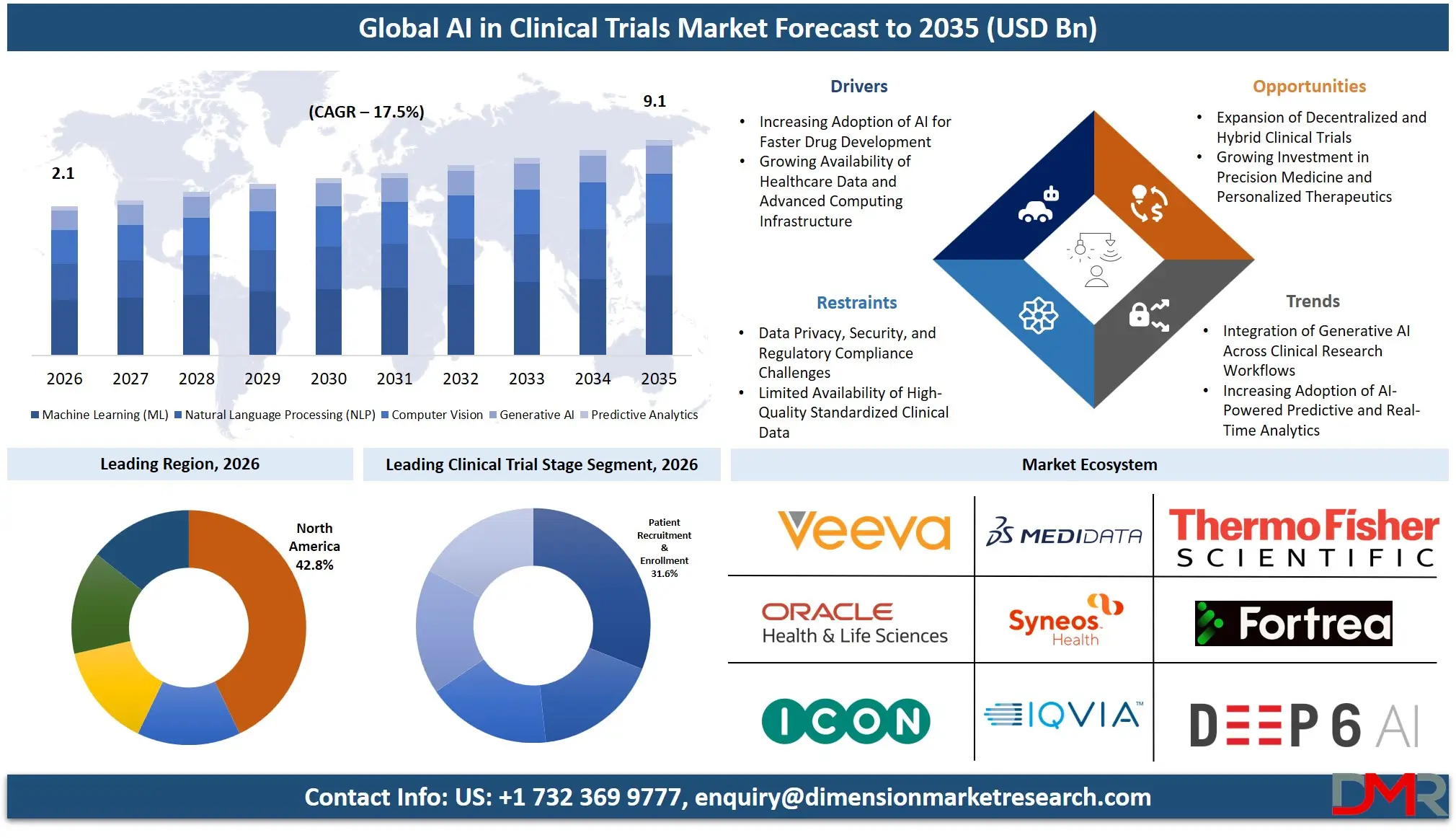
The AI in Clinical Trials Market size is expected to be USD 2.1 billion in 2026 and increase at a compound annual growth rate of 17.5% to USD 9.1 billion in 2035 due to increasing adoption of AI for faster drug development.
ℹ
To learn more about this report –
Download Your Free Sample Report Here
The AI in Clinical Trials Market is witnessing sustained expansion as pharmaceutical companies, biotechnology firms, and contract research organizations increasingly adopt artificial intelligence to improve trial efficiency, accelerate patient recruitment, optimize protocols, and enhance data analysis. The market benefits from growing investments in digital health technologies, increasing clinical trial complexity, and rising demand for cost-effective drug development. AI-powered predictive analytics, natural language processing, computer vision, and generative AI are transforming trial planning and execution while supporting regulatory compliance. Continuous advancements in machine learning algorithms, cloud computing, and real-world evidence integration are further strengthening market adoption across global healthcare and life sciences ecosystems.
The US AI in Clinical Trials Market
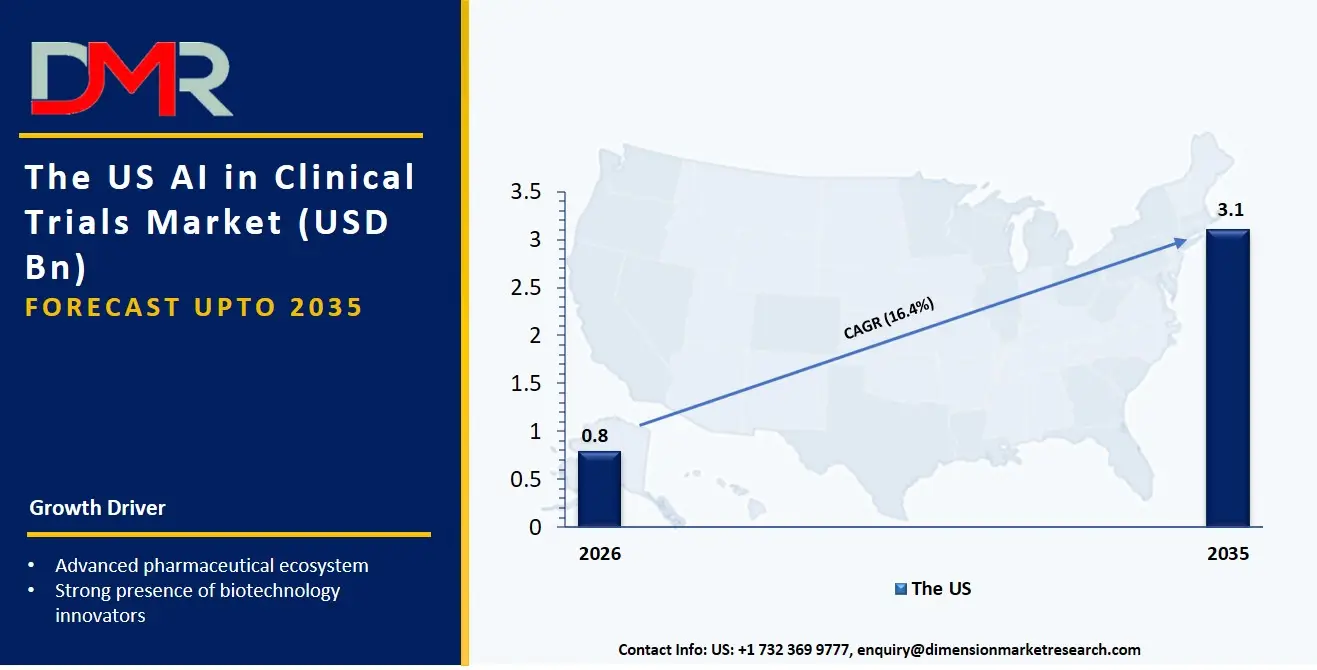
The US AI in Clinical Trials Market size is estimated to be USD 800 million in 2026 and is expected to increase at a CAGR of 16.4% over the forecast period.
ℹ
To learn more about this report –
Download Your Free Sample Report Here
The US AI in Clinical Trials Market remains the largest globally due to its advanced pharmaceutical ecosystem, strong presence of biotechnology innovators, extensive clinical research infrastructure, and widespread adoption of digital health technologies. High investments in AI-driven drug development, increasing collaborations between healthcare providers and technology companies, and favorable regulatory guidance for digital innovation continue to support market expansion. The growing number of decentralized clinical trials, availability of large-scale healthcare datasets, and continuous research funding further strengthen the country's leadership in AI-enabled clinical research.
Europe AI in Clinical Trials Market
The Europe AI in Clinical Trials Market size is estimated to be USD 525 million in 2026 and is expected to increase at a CAGR of 16.5% over the forecast period.
The Europe AI in Clinical Trials Market is expanding steadily as healthcare organizations increasingly integrate artificial intelligence into clinical research workflows to improve operational efficiency and patient outcomes. Supportive regulatory initiatives promoting digital healthcare innovation, data governance frameworks, and collaborative research programs encourage technology adoption across the region. Sustainability objectives, digital transformation strategies, and cross-border healthcare research initiatives also contribute to market growth. Pharmaceutical companies and research institutions continue investing in AI-powered analytics, protocol optimization, and patient recruitment solutions to enhance trial quality and accelerate drug development.
Japan AI in Clinical Trials Market
The market size of Japan AI in Clinical Trials will be USD 94.5 million in 2026 and at a CAGR of 16.3% in the forecast period.
The Japan AI in Clinical Trials Market is experiencing consistent growth, supported by the country's advanced healthcare infrastructure, aging population, and strong emphasis on medical innovation. Government initiatives encouraging digital transformation in healthcare, increasing pharmaceutical research investments, and the adoption of precision medicine are accelerating AI implementation across clinical trial processes. Japanese organizations are increasingly utilizing predictive analytics, machine learning, and automated data management to improve research efficiency. Growing collaboration between academic institutions, technology developers, and life sciences companies continues to create new opportunities for AI-driven clinical research.
Key Takeaways
- Market Size & Forecast: The AI in Clinical Trials Market size is projected to reach USD 2.1 billion in 2026 and is anticipated to have a value of USD 9.1 billion in 2035.
- Growth Rate & Outlook: The AI in Clinical Trials Market size is set to grow at a compound annual growth rate of 17.5% during the forecast period of 2026 to 2035.
- Primary Growth Drivers: Some of the major growth drivers in the market are Increasing Adoption of AI for Faster Drug Development and more.
- Key Market Trends: Some of the major trends in the market are Increasing Adoption of AI-Powered Predictive and Real-Time Analytics and more.
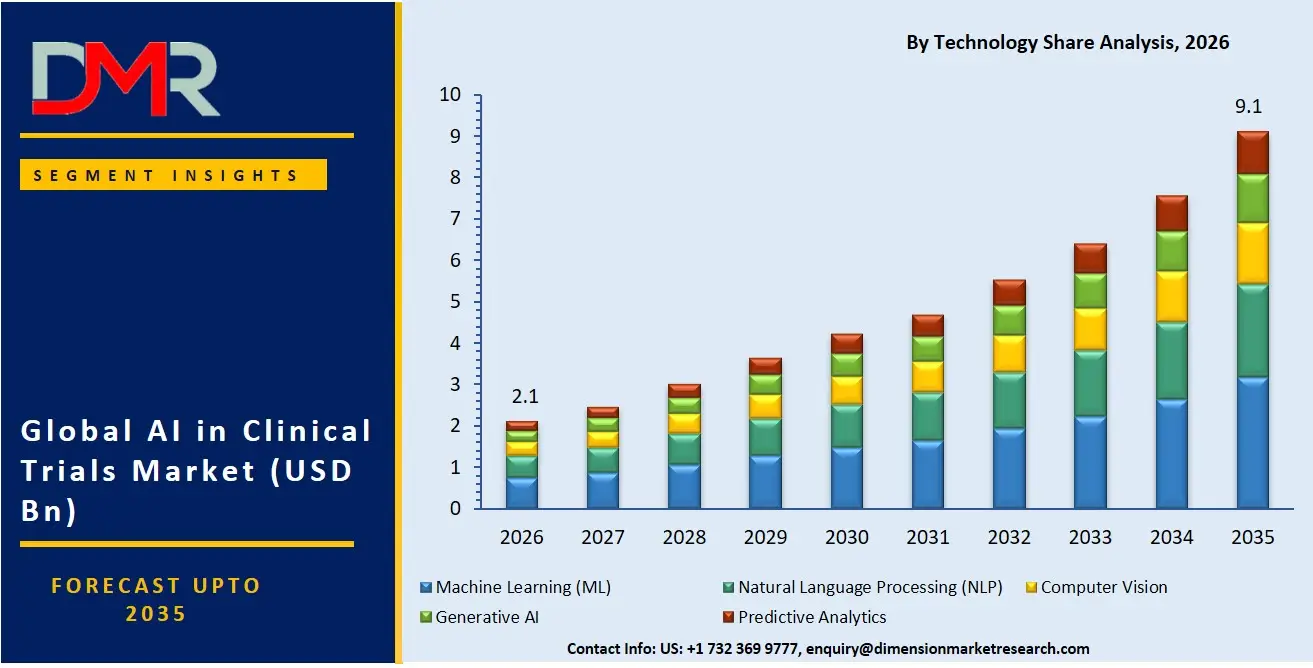
- By Technology Type: Machine Learning segment is anticipated to get the majority share of the AI in Clinical Trials Market in 2026.
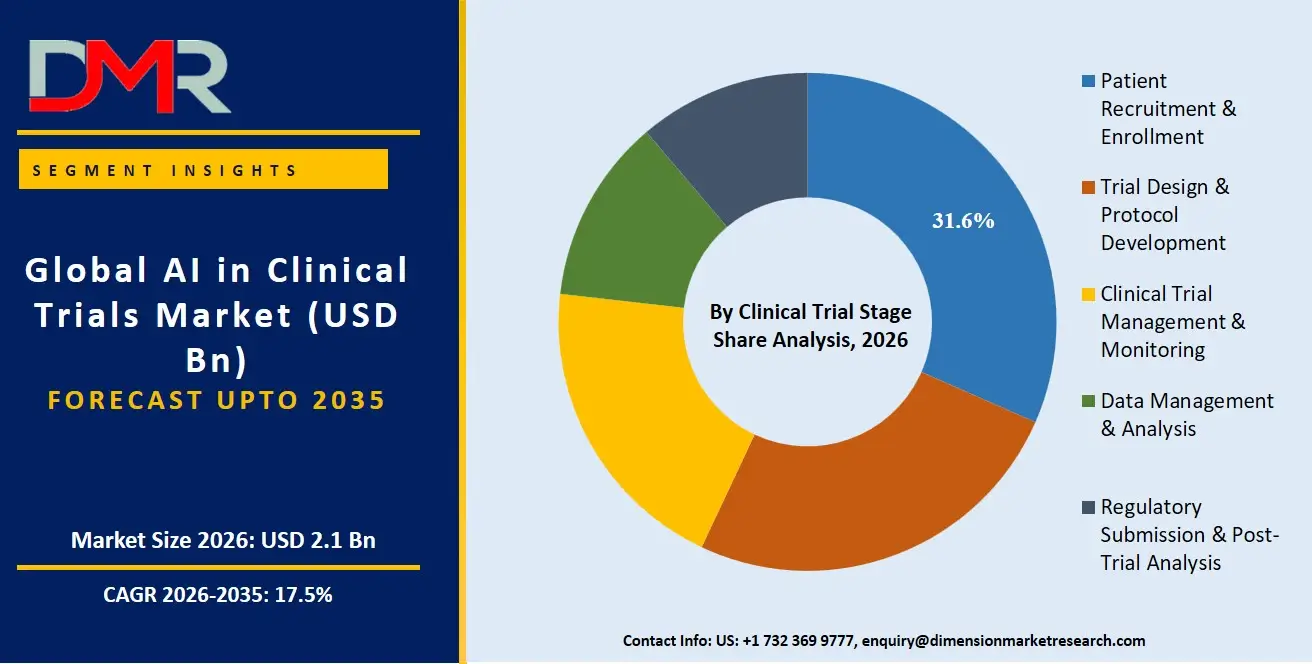
- By Clinical Trial Stage Type: Patient Recruitment & Enrollment are expected to get the largest revenue share in 2026 in the AI in Clinical Trials Market.
- By End User Type: Pharmaceutical & Biotechnology Companies is expected to get the largest revenue share in 2026 in the AI in Clinical Trials Market.
- Regional Leadership: North America is set to lead the AI in Clinical Trials Market with an estimated 42.8% share in 2026.
What is the AI in Clinical Trials?
AI in Clinical Trials refers to the application of artificial intelligence technologies, including machine learning, natural language processing, computer vision, predictive analytics, and generative AI, to support various stages of clinical research. These technologies analyze structured and unstructured healthcare data, automate repetitive processes, identify suitable trial participants, optimize study protocols, monitor patient safety, predict trial outcomes, and improve decision-making. AI enhances operational efficiency, data accuracy, and research productivity while enabling faster and more informed clinical development across pharmaceutical, biotechnology, and research organizations.
Use Cases
- Patient Recruitment & Enrollment: AI analyzes electronic health records, genomic information, and demographic datasets to identify eligible participants more efficiently. Intelligent matching algorithms reduce recruitment timelines, improve patient diversity, and enhance enrollment accuracy, helping sponsors complete trials faster while lowering recruitment costs.
- Clinical Trial Protocol Optimization: AI evaluates historical trial data, disease characteristics, and treatment outcomes to design more efficient clinical protocols. It helps minimize protocol amendments, identify operational risks before trial initiation, and improve study feasibility, leading to reduced delays and enhanced trial success rates.
- Clinical Data Management: AI automates data collection, validation, and anomaly detection across multiple clinical sites. Advanced analytics improve data quality, reduce manual errors, accelerate database cleaning, and enable researchers to make faster, evidence-based decisions throughout the clinical trial lifecycle.
- Safety Monitoring & Predictive Analytics: AI continuously analyzes patient data to detect potential adverse events, predict treatment responses, and identify emerging safety concerns. Predictive models support proactive risk management, enhance pharmacovigilance activities, and improve regulatory reporting while strengthening overall patient safety during clinical studies.
How AI Is Transforming the AI in Clinical Trials Market
Artificial intelligence is transforming clinical trials by automating participant recruitment, optimizing protocol design, improving site selection, and accelerating clinical data analysis. Machine learning algorithms efficiently process large volumes of structured and unstructured healthcare data, enabling researchers to identify suitable candidates more accurately while reducing recruitment timelines and operational costs. AI also enhances predictive modeling for trial outcomes, helping organizations make faster and more informed development decisions.
Additionally, AI improves patient safety through continuous monitoring of adverse events, supports regulatory documentation with intelligent automation, and strengthens data quality through automated validation and anomaly detection. The integration of predictive analytics, natural language processing, and generative AI enables faster clinical decision-making, reduces manual workloads, and enhances collaboration among pharmaceutical companies, biotechnology firms, contract research organizations, and regulatory stakeholders throughout the clinical development lifecycle.
Market Dynamic
Driving Factors in the AI in Clinical Trials Market
Increasing Adoption of AI for Faster Drug Development
Growing pressure to reduce drug development timelines and clinical trial costs is driving the adoption of artificial intelligence across the pharmaceutical industry. AI enables faster patient identification, automates protocol development, improves clinical data analysis, and predicts trial outcomes with greater accuracy. These capabilities reduce operational inefficiencies while improving productivity across the clinical research process. As pharmaceutical companies increasingly prioritize faster regulatory approvals and improved research outcomes, AI adoption continues to expand across both early-stage and late-stage clinical trials.
Restraints in the AI in Clinical Trials Market
Data Privacy, Security, and Regulatory Compliance Challenges
Clinical trials involve highly sensitive patient information that must comply with strict privacy regulations and ethical standards. Differences in regional data protection laws, cybersecurity risks, and complex regulatory requirements often limit seamless data sharing and AI model development. Organizations must invest heavily in secure infrastructure, governance frameworks, and compliance processes, increasing implementation costs and slowing AI adoption across multinational clinical research programs.
Opportunities in the AI in Clinical Trials Market
Expansion of Decentralized and Hybrid Clinical Trials
The increasing adoption of decentralized and hybrid clinical trial models presents substantial growth opportunities for AI-enabled solutions. Artificial intelligence supports remote patient monitoring, virtual participant engagement, automated data collection, and real-time analytics, enabling sponsors to improve patient retention and operational efficiency. Growing acceptance of telehealth, wearable medical devices, and digital biomarkers is further expanding AI applications across geographically diverse patient populations. As decentralized trials become more common, demand for intelligent platforms capable of managing distributed clinical research is expected to increase significantly.
Trends in the AI in Clinical Trials Market
Increasing Adoption of AI-Powered Predictive and Real-Time Analytics
Clinical research organizations are increasingly deploying predictive analytics platforms that continuously analyze trial performance, patient adherence, enrollment progress, and potential safety risks. AI-driven real-time dashboards enable proactive decision-making, optimize resource allocation, and improve overall trial execution. The growing integration of wearable devices, electronic patient-reported outcomes, and real-world evidence further strengthens predictive capabilities, enabling sponsors to identify operational issues early and improve clinical trial success rates.
Research Scope and Analysis
The research scope evaluates the AI in Clinical Trials Market across technology, clinical trial stage, application, end user, deployment model, therapeutic area, and regional performance. It examines market trends, growth drivers, competitive dynamics, adoption patterns, emerging opportunities, and estimated segment performance to provide a comprehensive assessment of the industry's future outlook.
ℹ
To learn more about this report –
Download Your Free Sample Report Here
By Technology Analysis
Machine Learning (ML) is expected to remain the leading technology segment in 2026, accounting for an estimated 34.8% of the global AI in Clinical Trials Market. Its leadership is driven by its extensive application in patient recruitment, predictive modeling, protocol optimization, clinical data analysis, and risk assessment across all stages of clinical research. ML algorithms continuously improve through exposure to expanding clinical datasets, enabling more accurate predictions and operational efficiencies.
ℹ
To learn more about this report –
Download Your Free Sample Report Here
Meanwhile, Generative AI is anticipated to be the fastest-growing technology segment as organizations increasingly adopt large language models for protocol drafting, medical document summarization, regulatory submission support, and automated clinical reporting. Growing investments in cloud-based AI platforms, scalable computing infrastructure, and advanced analytics continue to accelerate adoption across pharmaceutical companies, biotechnology firms, and contract research organizations seeking to reduce trial timelines and improve research productivity.
By Clinical Trial Stage Analysis
Patient Recruitment & Enrollment is projected to hold the largest market share in 2026, representing an estimated 31.6% of the AI in Clinical Trials Market. This dominance reflects the industry's continued focus on addressing one of the most expensive and time-consuming phases of clinical research. AI-powered patient identification, eligibility matching, and recruitment optimization significantly reduce enrollment delays while improving participant diversity and retention. Clinical Trial Management & Monitoring is expected to register the fastest growth as sponsors increasingly deploy AI-driven monitoring platforms that provide real-time insights into trial progress, protocol deviations, patient compliance, and operational risks. The growing adoption of decentralized clinical trials, wearable devices, and remote monitoring technologies further strengthens demand for intelligent trial management solutions capable of supporting more efficient and adaptive clinical research.
By Application Analysis
Patient Recruitment & Matching is anticipated to lead the application segment with an estimated 29.9% market share in 2026. Recruiting eligible participants remains one of the greatest operational challenges in clinical research, making AI-driven matching solutions highly valuable. Advanced algorithms analyze electronic health records, genomic information, medical histories, and demographic data to identify qualified participants quickly and accurately. Predictive Trial Analytics is forecast to be the fastest-growing application segment due to increasing demand for proactive decision-making throughout the clinical trial lifecycle. Predictive models help organizations forecast enrollment timelines, estimate trial success probabilities, optimize resource allocation, identify potential risks, and improve study performance. Continuous improvements in AI algorithms and expanding access to real-world healthcare data are expected to support sustained growth across predictive analytics applications.
By End User Analysis
Pharmaceutical & Biotechnology Companies are expected to dominate the end-user segment with an estimated 54.3% share of the global market in 2026. These organizations continue investing heavily in AI technologies to accelerate drug discovery, streamline clinical trial operations, reduce development costs, and improve regulatory success rates. Their substantial research budgets and increasing focus on digital transformation support widespread AI adoption across clinical development programs. Contract Research Organizations (CROs) are projected to experience the fastest growth as pharmaceutical sponsors increasingly outsource clinical research activities to improve flexibility, reduce operational expenses, and gain access to specialized AI capabilities. Growing demand for decentralized clinical trials, advanced analytics, and automated trial management solutions continues to strengthen AI adoption among global CROs.
The AI in Clinical Trials Market Report is segmented on the basis of the following:
By Technology
- Machine Learning (ML)
- Natural Language Processing (NLP)
- Computer Vision
- Generative AI
- Predictive Analytics
By Clinical Trial Stage
- Trial Design & Protocol Development
- Patient Recruitment & Enrollment
- Clinical Trial Management & Monitoring
- Data Management & Analysis
- Regulatory Submission & Post-Trial Analysis
By Application
- Patient Recruitment & Matching
- Protocol Optimization
- Clinical Data Management
- Risk-Based Monitoring
- Safety & Pharmacovigilance
- Predictive Trial Analytics
By End User
- Pharmaceutical & Biotechnology Companies
- Contract Research Organizations (CROs)
- Academic & Research Institutes
Regional Analysis
Leading Region in the AI in Clinical Trials Market
ℹ
To learn more about this report –
Download Your Free Sample Report Here
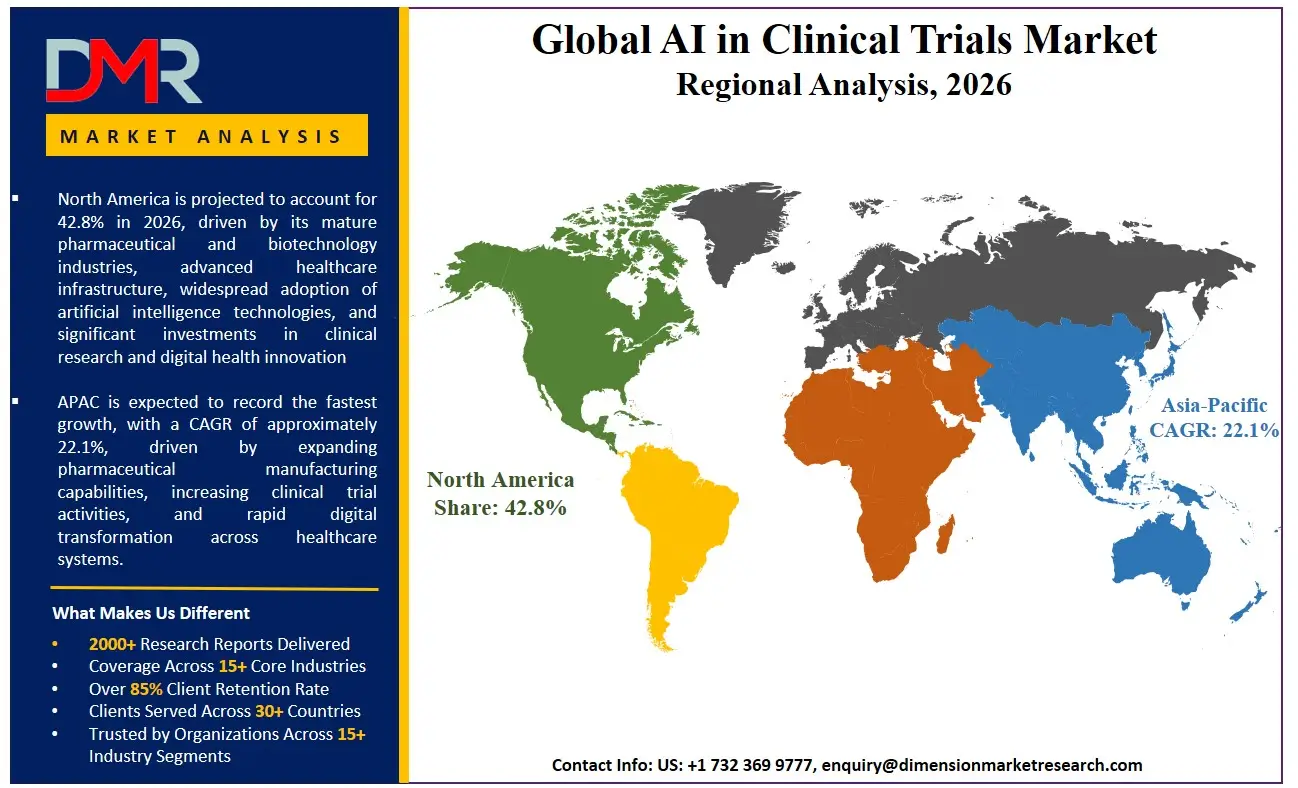
North America is projected to remain the leading regional market in 2026, accounting for an estimated 42.8% of the global AI in Clinical Trials Market. The region's dominance is supported by its mature pharmaceutical and biotechnology industries, advanced healthcare infrastructure, widespread adoption of artificial intelligence technologies, and significant investments in clinical research and digital health innovation. Strong regulatory frameworks encouraging technological advancements, extensive availability of electronic health records, and the presence of leading AI solution providers further strengthen market growth. Increasing adoption of decentralized clinical trials, robust research funding, and continuous collaboration among pharmaceutical companies, technology firms, research institutions, and healthcare providers are expected to sustain North America's leadership throughout the forecast period.
Fastest Growing Region in the AI in Clinical Trials Market
Asia-Pacific is expected to register the fastest growth during the forecast period due to expanding pharmaceutical manufacturing capabilities, increasing clinical trial activities, and rapid digital transformation across healthcare systems. Countries such as China, India, Japan, South Korea, and Singapore are investing heavily in artificial intelligence, healthcare infrastructure, and biomedical research to improve clinical development efficiency. Growing patient populations, rising demand for cost-effective clinical trials, supportive government initiatives promoting digital healthcare, and increasing collaboration between global pharmaceutical companies and regional research organizations continue to accelerate market expansion. The region's improving regulatory environment, expanding cloud infrastructure, and rising adoption of precision medicine are also creating favorable conditions for AI implementation throughout the clinical trial ecosystem.
By Region
North America
Europe
- Germany
- The U.K.
- France
- Italy
- Russia
- Spain
- Benelux
- Nordic
- Rest of Europe
Asia-Pacific
- China
- Japan
- South Korea
- India
- ANZ
- ASEAN
- Rest of Asia-Pacific
Latin America
- Brazil
- Mexico
- Argentina
- Colombia
- Rest of Latin America
Middle East & Africa
- Saudi Arabia
- UAE
- South Africa
- Israel
- Egypt
- Rest of MEA
Competitive Landscape
The AI in Clinical Trials Market is characterized by intense competition driven by continuous technological innovation, expanding application capabilities, and increasing demand for intelligent clinical research solutions. Market participants focus on strengthening their competitive positions through investments in artificial intelligence research, cloud-based platforms, product innovation, strategic collaborations, acquisitions, and long-term partnerships with pharmaceutical companies, biotechnology firms, and research organizations. High barriers to entry stem from regulatory compliance requirements, data privacy standards, advanced AI expertise, and access to high-quality clinical datasets. Companies are increasingly emphasizing scalable platforms, interoperability, cybersecurity, and explainable AI to differentiate their offerings while expanding their global customer base.
Some of the prominent players in the global AI in Clinical Trials are:
- IQVIA
- Medidata Solutions
- Oracle Health Sciences
- Veeva Systems
- Parexel
- ICON plc
- Fortrea
- Thermo Fisher Scientific (PPD)
- Syneos Health
- Labcorp Drug Development
- Clario
- Saama Technologies
- Unlearn
- Deep 6 AI
- ConcertAI
- Tempus AI
- Owkin
- PathAI
- Insilico Medicine
- AICure
- Other Key Players
Recent Developments
- In April 2025, IQVIA introduced significant enhancements to its One Home for Sites platform to simplify clinical trial site operations through advanced AI-enabled workflow automation and centralized study management capabilities. The upgraded platform integrates trial communications, document management, participant engagement, and operational analytics into a unified interface, enabling research sites to manage multiple sponsor studies more efficiently. The launch also introduced expanded interoperability with electronic clinical systems, helping reduce administrative burden, improve site productivity, and accelerate trial execution while supporting more efficient collaboration among sponsors, contract research organizations, and investigative sites.
- In March 2025, Oracle expanded the artificial intelligence capabilities within its clinical research portfolio by introducing enhanced AI-powered automation for clinical data management, study monitoring, and operational analytics. The updated platform leverages machine learning algorithms to improve data quality, automate routine validation processes, identify protocol deviations earlier, and generate predictive insights for trial performance. The enhancement supports pharmaceutical companies and contract research organizations in reducing manual workloads, accelerating decision-making, and improving compliance with regulatory requirements while enabling more efficient management of increasingly complex global clinical trials.
- In January 2025, Medidata, a Dassault Systèmes company, expanded its AI-powered clinical trial solutions by introducing advanced intelligent automation features across patient recruitment, clinical data analysis, and risk-based monitoring workflows. The new capabilities utilize machine learning and predictive analytics to improve participant identification, enhance protocol compliance, detect operational risks earlier, and optimize clinical trial execution. The enhancements also strengthen integration with decentralized clinical trial technologies, enabling sponsors and research organizations to improve operational efficiency, accelerate study timelines, and support higher-quality data collection throughout the clinical development process.
Report Details
| Report Characteristics |
| Market Size (2026) |
USD 2.1 Bn |
| Forecast Value (2035) |
USD 5.1 Bn |
| CAGR (2026–2035) |
17.5% |
| Historical Period |
2021 – 2025 |
| Forecast Period |
2027 – 2035 |
| Base Year |
2025 |
| Estimate Year |
2026 |
| Segments Covered |
By Technology (Computer Vision, Generative AI, Predictive Analytics), By Clinical Trial Stage, By Application, By End User |
| Regional Coverage |
North America – The US and Canada; Europe – Germany, The UK, France, Russia, Spain, Italy, Benelux, Nordic, & Rest of Europe; Asia-Pacific – China, Japan, South Korea, India, ANZ, ASEAN, Rest of APAC; Latin America – Brazil, Mexico, Argentina, Colombia, Rest of Latin America; Middle East & Africa – Saudi Arabia, UAE, South Africa, Turkey, Egypt, Israel, & Rest of MEA |
Frequently Asked Questions
How big is the AI in Clinical Trials Market?
▾ The AI in Clinical Trials Market size is expected to reach USD 2.1 billion by 2026 and is projected to reach USD 9.1 billion by the end of 2035.
What is the CAGR of the AI in Clinical Trials Market from 2026 to 2035?
▾ The market is growing at a CAGR of 17.5 percent over the forecasted period.
What factors are driving the growth of the AI in Clinical Trials Market?
▾ Increasing Adoption of AI for Faster Drug Development, and more are the factors driving the growth of the AI in Clinical Trials Market.
What are the major trends in the AI in Clinical Trials Market?
▾ Increasing Adoption of AI-Powered Predictive and Real-Time Analytics, and more are some of the major trends in the market.
Who are the key players in the AI in Clinical Trials Market?
▾ Some of the key players in the AI in Clinical Trials Market include Oracle, IQVIA, Veeva, and more
How is the AI in Clinical Trials Market segmented?
▾ The AI in Clinical Trials Market is segmented by technology, clinical trial stage, application, end user.
Which region held the largest share of the AI in Clinical Trials Market in 2026?
▾ North America is set to lead the AI in Clinical Trials Market with an estimated 42.8% share in 2026.
Which region is expected to grow the fastest in the AI in Clinical Trials Market?
▾ Asia Pacific is the fastest-growing region in the AI in Clinical Trials Market during the forecast period.