Market Snapshot
- Market Size (2026): USD 3.6 Bn
- Forecast Value (2035): USD 25.5 Bn
- CAGR (2026-2035): 24.3%
- Largest Region (2026): North America, approximately 43.5%
- Fastest-Growing Region: Asia-Pacific
- Leading Offering (2026): Software Platforms, around 62.4%
- Leading Technology (2026): Machine Learning and Predictive Analytics, close to 34.7%
- Key Players: BlueDot, IQVIA, SAS Institute and others
What is AI In Epidemiology Market and its Market Size?
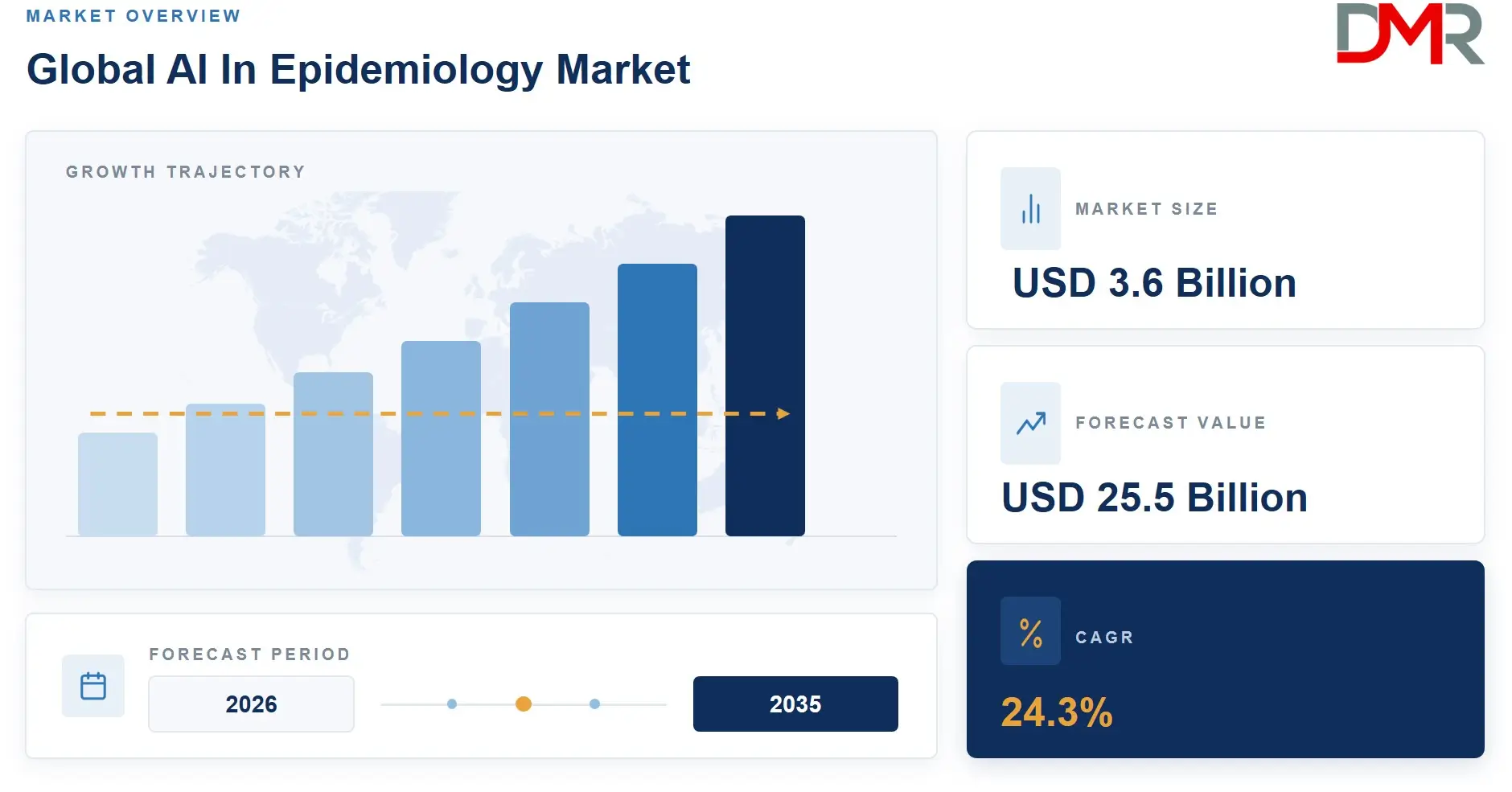
Global AI In Epidemiology Market size is estimated to reach USD 3.6 Bn in 2026 and is further anticipated to reach USD 25.5 Bn by 2035, at a CAGR of 24.3%. AI in epidemiology covers software, analytics services and data-driven workflows that apply machine learning, natural language processing, generative AI, geospatial modelling and related computational methods to population health questions. The commercial boundary includes platforms used to detect disease signals, estimate transmission risk, forecast outbreaks, characterize populations, support real-world evidence and guide public health decisions.
ℹ
To learn more about this report –
Download Your Free Sample Report Here
Demand comes from ministries of health, national and local surveillance agencies, hospitals, academic epidemiology groups, pharmaceutical companies, insurers and organizations managing health security. Buyers increasingly need to combine structured case records with less conventional inputs such as news reports, search behaviour, wastewater signals, mobility flows, climate variables, genomic information and claims data. AI becomes valuable when these streams are too large, fast or heterogeneous for manual review, especially where conventional reporting arrives with delays.
The sector is moving from isolated predictive models toward continuously operating epidemic intelligence systems. Modern deployments increasingly combine event detection, entity extraction, geospatial mapping, scenario modelling and human validation in one workflow. Large language models are also lowering the effort required to summarize multilingual reports, normalize disease terminology and turn complex surveillance outputs into decision briefs, while epidemiologists remain necessary for validation, bias control and causal interpretation.
Commercial growth is also being shaped by preparedness budgets, One Health surveillance, climate-sensitive disease monitoring and demand for faster evidence generation. The addressable market extends beyond infectious disease outbreaks to chronic disease epidemiology, pharmacovigilance, population stratification and real-world evidence. Even so, procurement cycles, fragmented health data, privacy restrictions and uneven model performance across geographies keep adoption below the theoretical technical opportunity.
Use Cases
- National Outbreak Intelligence: Public health agencies deploy AI surveillance engines to scan official notices, local media and epidemiological feeds for unusual disease activity. Automated triage moves high-risk signals to analysts earlier, helping teams prioritize verification, field investigation and resource deployment without requiring every incoming report to be reviewed manually.
- Pharmaceutical Evidence Planning: Life sciences companies use epidemiological AI to estimate eligible populations, map treatment pathways and identify underdiagnosed cohorts before protocol design or market access planning. Linking claims, electronic records and demographic data improves cohort definition and gives evidence teams a faster route to disease burden and utilization insights.
- Hospital Population Health: Health systems apply predictive models to admission patterns, laboratory results and community indicators to anticipate local disease pressure. The output supports staffing, bed planning and infection prevention decisions, while population segmentation helps care teams focus outreach on groups with a higher probability of deterioration or missed follow-up.
- Travel and Workforce Risk: Governments, travel operators and multinational employers combine outbreak intelligence with mobility and destination data to assess exposure across locations. Risk teams can adjust guidance, screening and contingency plans as epidemiological conditions change, replacing static country-level advisories with more granular and timely operational intelligence.
Key Takeaways
- Market Size & Share: North America is expected to account for roughly 43.5% of 2026 revenue, supported by high digital health spending and concentrated analytics capacity.
- Application Analysis: Disease Surveillance and Early Warning is projected to represent nearly 38.6% of application revenue in 2026 as governments prioritize faster signal detection.
- Regional Analysis: Asia-Pacific is forecast to expand at a CAGR of 27.6% through 2035 as digital public health infrastructure broadens across large populations.
- Data Source Analysis: Clinical and Public Health Data is set to hold approximately 31.8% of 2026 revenue because it remains the most institutionally accepted input for epidemiological decisions.
- End User Analysis: Government and Public Health Agencies are projected to command around 42.3% of 2026 demand, reflecting their central role in surveillance and preparedness.
- Technology Shift: Generative AI and LLM Analytics is expected to grow at 31.2% from 2026 to 2035 as multilingual event extraction and analyst summarization scale.
How AI/Gen AI is Transforming the AI In Epidemiology Market?
AI is changing epidemiology primarily by compressing the time between a weak population signal and an analyst-ready hypothesis. Natural language processing can classify multilingual disease reports, named entity recognition can identify locations and symptoms, and machine learning can combine epidemiological histories with climate, mobility, or vector data. These techniques do not replace surveillance standards or causal epidemiology. They reduce the manual work needed to screen large data volumes and allow scarce specialists to spend more time on verification, interpretation and response design.
Generative AI adds a second layer by making complex evidence easier to query and communicate. Retrieval-based LLM workflows can summarize event streams, compare emerging patterns with historical outbreaks and draft situation reports from approved evidence. Their value depends on source traceability, model governance, and expert review because hallucination or context loss can be consequential in public health.
- Multilingual Event Intelligence: NLP and LLM pipelines translate, classify and summarize local reports that may precede formal notifications.
- Spatiotemporal Forecasting: Machine learning combines case histories, mobility, climate and geospatial variables to estimate where risk may intensify.
- Cohort Phenotyping: AI identifies disease populations and risk groups from electronic records, claims and registry data for population studies.
- Analyst Copilots: Generative systems help epidemiologists search evidence, prepare briefs and document assumptions while retaining human approval.
Key Drivers in the Global AI In Epidemiology Market
Adoption is being pulled by the need to detect health threats earlier and by the rapid expansion of machine-readable population data.
- Pressure for Faster Epidemic Intelligence: Disease Surveillance and Early Warning is expected to represent nearly 38.6% of application revenue in 2026 because conventional reporting can lag fast-moving events. AI systems can prioritize open-source signals, laboratory trends and syndromic indicators before analysts would otherwise review them at scale. The mechanism is speed rather than automation alone: earlier signal triage creates more time for verification, targeted testing and resource allocation. Governments are therefore treating AI as an augmentation layer for existing surveillance networks, particularly for cross-border outbreaks, zoonoses and climate-sensitive diseases where weak signals may emerge across multiple data sources.
- Expansion of Real-World and Population Data: Clinical and Public Health Data is projected to account for approximately 31.8% of 2026 revenue by data source, giving model developers a growing base of longitudinal records for epidemiological analysis. Claims, electronic health records, registries, genomics and public health feeds can be linked to estimate incidence proxies, identify cohorts and characterize care pathways. As data infrastructure improves, buyers can move from periodic descriptive studies toward continuously refreshed evidence. This expands commercial demand from outbreak monitoring into chronic disease epidemiology, pharmacovigilance, health economics and evidence generation for life sciences.
Restraints in the Global AI In Epidemiology Market
Commercial adoption remains constrained by the sensitivity of health data and by the difficulty of validating models across populations.
- Fragmented Data Governance and Privacy Requirements: Government and Public Health Agencies are expected to represent around 42.3% of 2026 end-user demand, but these buyers operate under strict rules for personal health information, data residency and interagency sharing. Epidemiological AI often needs linkage across clinical, demographic, mobility and environmental sources, creating governance complexity before modelling begins. De-identification can reduce risk but may also remove granular attributes needed for spatial or subgroup analysis. Long approval cycles, incompatible data agreements and jurisdiction-specific privacy controls therefore slow deployment, particularly when vendors require cloud access to sensitive datasets.
- Model Bias, Signal Noise and Validation Burden: Software Platforms are projected to hold roughly 62.4% of 2026 offering revenue, yet platform scale does not guarantee epidemiological validity. Open-source intelligence can overrepresent connected populations, claims data can miss uninsured groups, and historical models can fail when pathogen behaviour or testing practices change. False positives consume scarce investigation capacity, while false negatives can create serious public health consequences. Buyers therefore require transparent source lineage, human review, local calibration and repeat validation, raising implementation cost and limiting fully automated use in high-stakes decisions.
Growth Opportunities in the Global AI In Epidemiology Market
White space is opening where AI can extend surveillance into underserved geographies and where life sciences buyers need faster population evidence.
- Multilingual Surveillance for Emerging Markets: Asia-Pacific is forecast to grow at 27.6% through 2035, creating an opening for systems that process local languages, regional media and subnational health feeds rather than relying mainly on English-language sources. Large populations, uneven reporting capacity and high exposure to climate-sensitive and zoonotic risks make early signal detection commercially relevant. Vendors that combine language models with local epidemiological taxonomies, offline-friendly workflows and government deployment options can address gaps that generic enterprise AI platforms miss. Partnerships with universities and public health institutes can also improve trust and provide local validation data.
- AI-Enabled Real-World Evidence for Life Sciences: Pharmaceutical and Life Sciences Companies are expected to expand at a CAGR of 27.1% as epidemiological AI moves deeper into indication sizing, cohort discovery and post-market evidence. Drug developers need faster estimates of diagnosed, treated and eligible populations across fragmented datasets, especially for rare diseases and specialty therapies. Platforms that combine transparent cohort logic with machine learning can shorten feasibility work and support evidence refreshes between major studies. The commercial opportunity is strongest where vendors can document provenance and reproducibility well enough for medical, market access and regulatory teams to use the same evidence base.
Trends in the Global AI In Epidemiology Market
Technology and procurement are shifting toward integrated, human-supervised systems rather than isolated prediction models.
- Convergence of LLMs with Epidemic Intelligence Pipelines: Generative AI and LLM Analytics is forecast to expand at 31.2% from 2026 to 2035, faster than the overall sector. LLMs are increasingly used after retrieval and classification steps to summarize multilingual reports, normalize terminology and generate analyst briefs. The important shift is architectural: vendors are combining deterministic data pipelines, specialized epidemiological models, and generative interfaces instead of asking a general model to make unsupported predictions. This improves usability for non-technical decision makers while preserving source references and expert review as part of the workflow.
- Integration of Mobility, Climate and One Health Signals: Mobility, Climate and Environmental Data is projected to grow at 28.9% through 2035 as epidemiology broadens beyond clinical case counts. Vector range, temperature, rainfall, travel flows, animal health and wastewater indicators can reveal risk before confirmed human cases accumulate. The trend favors geospatial platforms and data partnerships capable of synchronizing multiple temporal resolutions. It also supports One Health approaches that connect human, animal and environmental surveillance, creating new demand among governments, insurers and organizations exposed to operational disruption from infectious disease events.
Research Scope and Analysis
Segment performance is assessed across offering, technology, application, data source and end user. Each axis shows where 2026 revenue is concentrated and which sub-segment is moving fastest through 2035, linking current demand to the data, workflow and procurement changes shaping future adoption.
ℹ
To learn more about this report –
Download Your Free Sample Report Here
By Offering
Software Platforms are projected to hold the largest offering share in 2026, accounting for close to 62.4% of revenue, because surveillance engines, geospatial dashboards, model orchestration, and data integration are typically purchased as repeatable software capabilities. Subscription and cloud delivery also allow public health and life sciences teams to refresh evidence without rebuilding analytical pipelines for every study. Growth, however, is concentrated in Services, expanding at a CAGR of 27.8% between 2026 and 2035. Organizations need epidemiologists, data engineers and implementation partners to configure data access, validate models, and adapt workflows to local disease definitions. Service demand rises as buyers move from pilots into production environments where governance, training and continuous model monitoring become as important as the software itself.
By Technology
Machine Learning and Predictive Analytics is expected to lead technology revenue in 2026 with approximately 34.7%, supported by established use in risk scoring, time-series forecasting, hotspot detection and population stratification. These methods fit epidemiological workflows that require measurable performance and can be tested against historical outcomes. The steeper trajectory sits with Generative AI and LLM Analytics, growing at a CAGR of 31.2% through 2035. LLMs reduce the effort required to process multilingual unstructured reports, extract entities and prepare evidence summaries for analysts. Adoption is strongest when generative components sit behind retrieval, approved source libraries and human review, allowing organizations to improve analyst productivity without treating free-form model output as epidemiological ground truth.
By Application
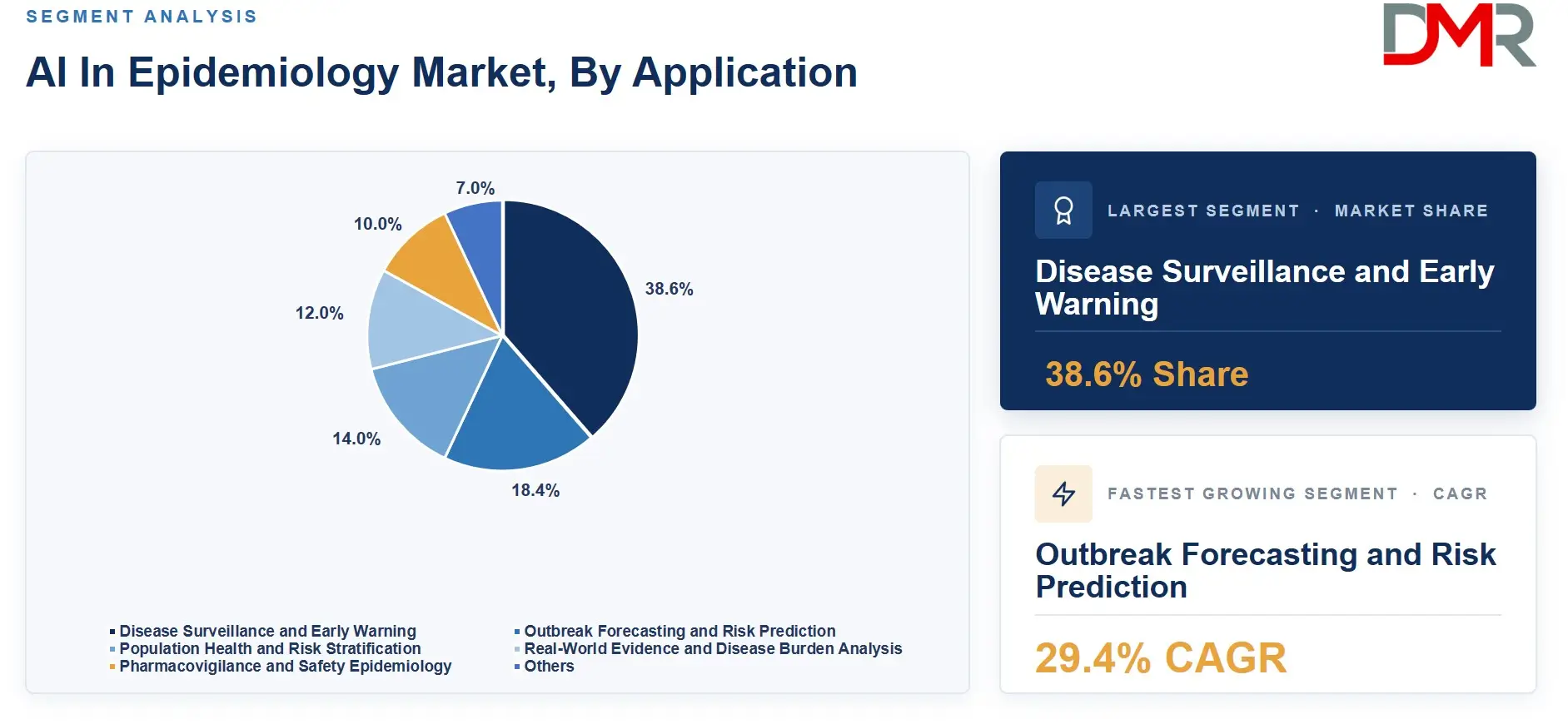
Disease Surveillance and Early Warning is projected to carry the largest application share in 2026 at around 38.6%, reflecting sustained investment in epidemic intelligence, syndromic surveillance and rapid event detection. Governments and health security organizations value tools that can screen large information flows and elevate signals for verification before conventional reporting is complete. Growth, however, is concentrated in Outbreak Forecasting and Risk Prediction, which is forecast to expand at a CAGR of 29.4% from 2026 to 2035. Better access to mobility, climate, genomic and geospatial data is improving the inputs available for forward-looking models. Buyers increasingly want not only to know what is happening, but also where transmission pressure may intensify and what operational resources could be required next.
By Data Source
Clinical and Public Health Data is expected to account for the largest data-source share in 2026 at nearly 31.8%, since case records, laboratory feeds, claims and registries remain the most accepted foundation for population-level evidence. These sources support cohort construction, disease burden analysis and outcome tracking with clearer governance than many consumer-generated signals. The fastest growth is expected in Mobility, Climate and Environmental Data, advancing at a CAGR of 28.9% through 2035. Disease risk is increasingly modelled against travel flows, temperature, rainfall, vector ecology, wastewater and other non-clinical indicators. This broadens the analytical lens from reported cases to conditions that precede or shape transmission, strengthening demand for geospatial integration and One Health surveillance architectures.
By End User
Government and Public Health Agencies are projected to remain the largest end-user group in 2026 with roughly 42.3% of revenue, because they own core surveillance mandates, outbreak response systems, and population health programs. National and local agencies also influence data standards and procurement patterns that shape the wider ecosystem. Growth, however, is expected to be faster among Pharmaceutical and Life Sciences Companies, at a CAGR of 27.1% between 2026 and 2035. Drug developers are expanding use of AI for indication sizing, cohort identification, trial feasibility, real-world evidence, and post-market surveillance. The commercial pull comes from the need to refresh epidemiological assumptions more frequently and connect population evidence with development, access, and portfolio decisions.
The Global AI In Epidemiology Market Report is Segmented Based on the Following
By Offering
- Software Platforms
- Services
- Others
By Technology
- Machine Learning and Predictive Analytics
- Natural Language Processing
- Generative AI and LLM Analytics
- Computer Vision
- Other AI Technologies
By Application
- Disease Surveillance and Early Warning
- Outbreak Forecasting and Risk Prediction
- Population Health and Risk Stratification
- Real-World Evidence and Disease Burden Analysis
- Pharmacovigilance and Safety Epidemiology
- Others
By Data Source
- Clinical and Public Health Data
- Claims and Administrative Data
- Genomic and Laboratory Data
- Open-Source and Social Intelligence
- Mobility, Climate and Environmental Data
- Others
By End User
- Government and Public Health Agencies
- Hospitals and Health Systems
- Pharmaceutical and Life Sciences Companies
- Academic and Research Institutes
- Payers and Insurers
- Others
Regional Analysis
Region with the Largest Revenue Share
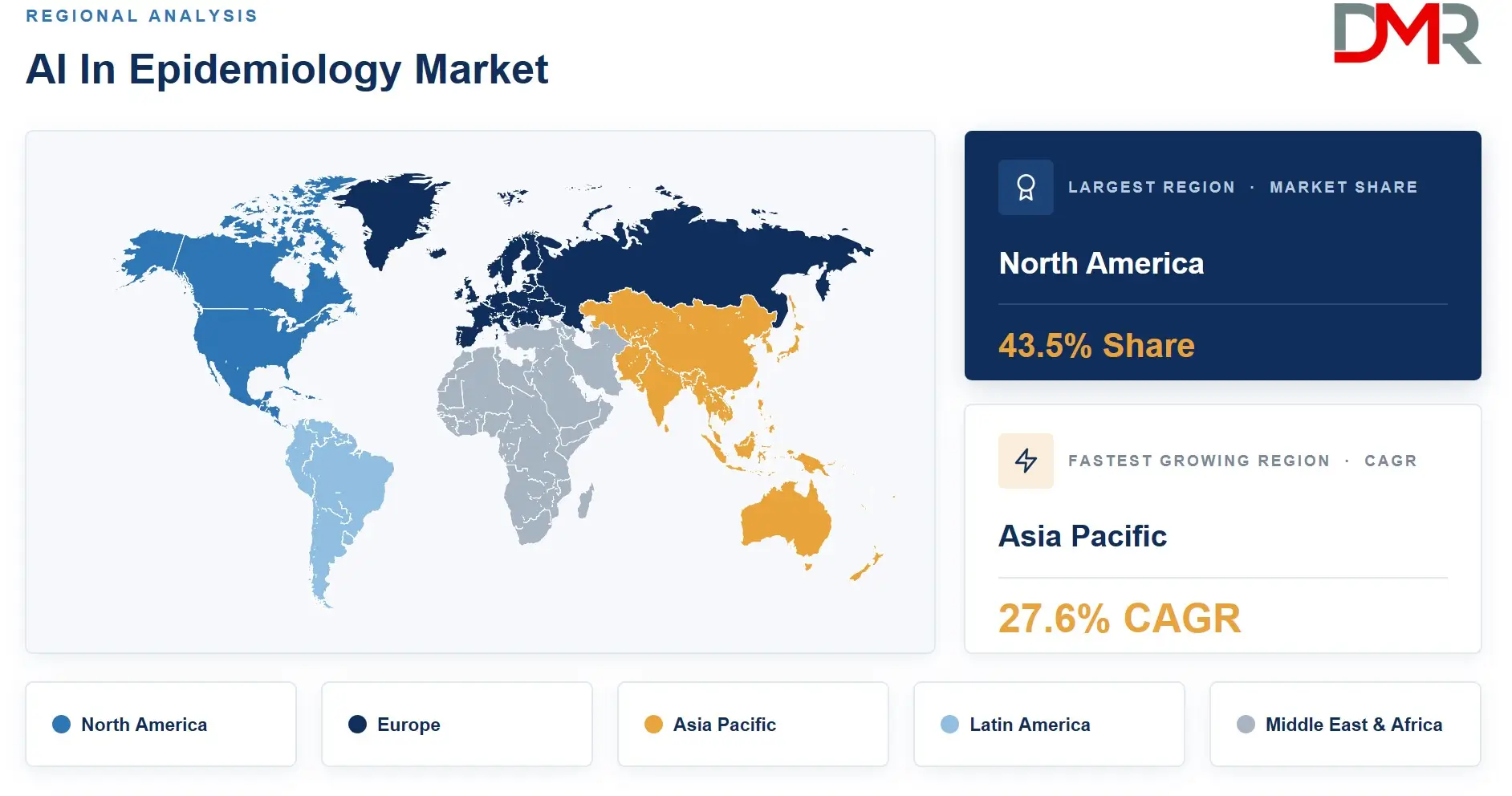
North America is expected to remain the largest regional market in 2026, representing approximately 43.5% of global revenue. The region combines large public health budgets, extensive electronic health and claims datasets, established cloud infrastructure and a dense base of epidemiology, analytics and life sciences companies. The US also has strong demand for real-world evidence, health security and population risk modelling across government, insurers and pharmaceutical developers. Commercial adoption benefits from access to specialist talent and mature data platforms, although privacy rules and fragmented ownership still complicate linkage. Canada contributes additional strength through infectious disease intelligence and public health analytics capabilities.
ℹ
To learn more about this report –
Download Your Free Sample Report Here
Region with the Highest CAGR
Asia-Pacific is forecast to record the highest regional CAGR of 27.6% from 2026 to 2035. Growth is being supported by digital public health programs, large-scale health data modernization, and the need to monitor infectious disease risk across dense and highly mobile populations. India, China, Japan, South Korea and Australia are building different combinations of national health platforms, AI capacity, genomic surveillance, and academic epidemiology. The region also creates demand for multilingual models and locally calibrated systems because disease reporting, language and health infrastructure vary widely. Vendors that can deploy within national data governance requirements and partner with domestic institutions are positioned to capture the strongest expansion.
By Region
North America
Europe
- Germany
- France
- The UK
- Italy
- Spain
- Rest of Europe
Asia-Pacific
- China
- Japan
- India
- Australia
- South Korea
- Rest of APAC
Latin America
- Mexico
- Brazil
- Colombia
- Argentina
- Rest of LATAM
Middle East & Africa
- Saudi Arabia
- The UAE
- South Africa
- Rest of MEA
Regulatory Landscape
Epidemiological AI sits across health-data regulation, medical research governance and emerging AI oversight rather than under one global rulebook. Privacy regimes such as HIPAA, GDPR and national health-data laws shape how identifiable records can be linked, transferred and reused, while public health agencies also impose security and procurement controls. Regulation is shifting toward risk-based AI governance, documentation of training data, human oversight and traceability of automated outputs. Commercial openings favor vendors that can support de-identification, audit logs, model cards, and jurisdiction-specific deployment. The main brake is compliance fragmentation, which raises implementation cost and can slow cross-border epidemiological analysis even when the underlying models are technically portable.
Technology Analysis
Technology competition is moving from single-purpose forecasting models toward multimodal epidemiological intelligence stacks. Current systems combine NLP, geospatial analytics, time-series models, knowledge graphs, and data engineering, while LLMs increasingly provide natural-language access to validated evidence. The shift now is toward retrieval-grounded agents that can triage signals, summarize source material, and coordinate analytical steps without removing epidemiologist review. Commercial white space sits in interoperable systems that connect clinical, genomic, mobility, climate, and open-source data under one governance layer. The key risk is over-automation: performance can degrade when reporting behavior changes or when models are transferred across populations, making local validation and transparent provenance decisive competitive features.
Competitive Landscape
Competition spans infectious disease intelligence specialists, real-world data platforms, enterprise analytics vendors, cloud providers, and health AI companies. Specialists compete on epidemiological expertise, early signal detection and curated intelligence, while larger technology vendors compete on data infrastructure, model tooling, security and procurement reach. Life sciences analytics companies are extending from retrospective evidence into predictive population intelligence, creating overlap with traditional public health use cases. Partnerships with governments, universities and data owners are strategically important because proprietary access to trusted datasets can matter more than model architecture alone. Differentiation increasingly rests on source coverage, multilingual processing, geospatial capability, validation, explainability, and the ability to deploy under local privacy requirements.
Some of the Prominent Players in the Global AI In Epidemiology Market Are
- BlueDot
- IQVIA
- SAS Institute
- Palantir Technologies
- Microsoft
- Google
- Amazon Web Services
- Oracle
- IBM
- Databricks
- Clarivate
- Tempus AI
- Komodo Health
- Truveta
- HealthVerity
- Aetion
- TriNetX
- Flatiron Health
- Owkin
- BenevolentAI
- Evidation
- ClosedLoop AI
- Biofourmis
- EPIWATCH
- HealthMap
- Airfinity
- Kinsa
- Predixion AI
- eVerse.AI
- Qure.ai
- Innovaccer
- SigTuple
- MediBuddy
- Niramai
- DeepTek
- Ping An Healthcare and Technology
- Alibaba Cloud
- Tencent Cloud
- Huawei Cloud
- Presagen
- Other Key Players
Recent Developments
- In June 2026, ICMR National Institute of Epidemiology, the Centre of Data for Public Good and the Isaac Centre for Public Health launched ADARV in India, combining epidemiological workflows with modern analytics infrastructure to accelerate conversion of outbreak field data into actionable intelligence.
- In February 2026, researchers reported the integration of Nigerian Pidgin English into EPIWATCH, demonstrating how localized language processing can expand open-source outbreak detection and improve the usefulness of AI surveillance in multilingual public health environments.
- In 2026, public health teams working on Ebola response in the Democratic Republic of Congo used aggregated mobile-phone mobility data with epidemiological analysis to anticipate transmission routes, illustrating growing operational use of non-clinical data in outbreak intelligence.
- In 2025, the HealthMap ecosystem expanded into the Biothreats Emergence, Analysis and Communications Network, combining automated alerts with large language model supported synthesis and expert review for more contextualized assessment of emerging disease threats.
- In March 2025, EPIWATCH was presented in the International Journal of Infectious Diseases as an AI early-warning system for outbreak surveillance, reinforcing commercial and institutional interest in open-source epidemic intelligence as an adjunct to conventional reporting.
Report Details
| Report Characteristics |
| Market Size (2026) |
USD 3.6 Bn |
| Forecast Value (2035) |
USD 25.5 Bn |
| CAGR (2026-2035) |
24.3% |
| The US Market Size (2026) |
USD 1.2 Bn |
| Historical Data |
2021 - 2025 |
| Forecast Data |
2026 - 2035 |
| Base Year |
2025 |
| Segments Covered |
By Offering, By Technology, By Application, By Data Source and By End User |
| Regional Coverage |
North America - The US and Canada; Europe - Germany, France, The UK, Italy, Spain, Rest of Europe; Asia-Pacific - China, Japan, India, Australia, South Korea, Rest of APAC; Latin America - Mexico, Brazil, Colombia, Argentina, Rest of LATAM; Middle East & Africa - Saudi Arabia, The UAE, South Africa, Rest of MEA |
Frequently Asked Questions
How big is the Global AI In Epidemiology Market?
▾ The sector is valued at USD 3.6 Bn in 2026 and is forecast to reach USD 25.5 Bn by 2035. Demand spans epidemic intelligence, population health analytics, real-world evidence and risk forecasting, with public health agencies and life sciences companies increasing investment in systems that can process larger and more diverse epidemiological datasets.
What is the growth rate of the Global AI In Epidemiology Market?
▾ Revenue is forecast to expand at a CAGR of 24.3% from 2026 to 2035. Growth reflects wider availability of health data, stronger preparedness spending, adoption of cloud analytics and increasing use of machine learning and generative AI to classify signals, forecast risk, build cohorts and summarize evidence for epidemiologists and decision makers.
Which region holds the largest share in the Global AI In Epidemiology Market?
▾ North America is expected to lead in 2026 with a share of roughly 43.5%. Its position reflects mature health data infrastructure, substantial government and life sciences analytics spending, established cloud adoption and a dense concentration of epidemiology technology providers. Asia-Pacific is expected to grow faster as national digital health and surveillance capacity expands.
Which application holds the largest share in the Global AI In Epidemiology Market?
▾ Disease Surveillance and Early Warning is projected to hold the largest application share in 2026 at approximately 38.6%. The segment benefits from demand for earlier outbreak signals, automated event triage and integration of official and open-source information. Forecasting applications are growing faster as mobility, climate and geospatial data become easier to combine with epidemiological histories.
What factors are driving adoption of AI in epidemiology?
▾ Key factors include pressure for faster outbreak detection, growth in real-world health data, stronger public health preparedness, wider use of cloud analytics and demand for continuously refreshed population evidence. AI is particularly useful when teams must integrate clinical, genomic, mobility, environmental and unstructured sources that are too large or fast for manual analysis alone.
What are the main restraints affecting AI in epidemiology?
▾ The main restraints are fragmented health-data access, privacy and residency requirements, uneven data quality, model bias and the need for local validation. Epidemiological outputs can influence high-stakes decisions, so buyers generally require source traceability and expert review. These controls increase implementation time and make cross-border scaling harder than deploying a generic enterprise analytics application.
Who are the key players in the Global AI In Epidemiology Market?
▾ Key participants include BlueDot, IQVIA, SAS Institute, Palantir Technologies, Microsoft, HealthVerity and Airfinity. Competition also includes cloud providers, real-world evidence platforms, academic spinouts and regional health AI firms. The AI In Epidemiology Market is therefore shaped by both specialist epidemiological intelligence and broader data infrastructure capabilities.