Market Snapshot
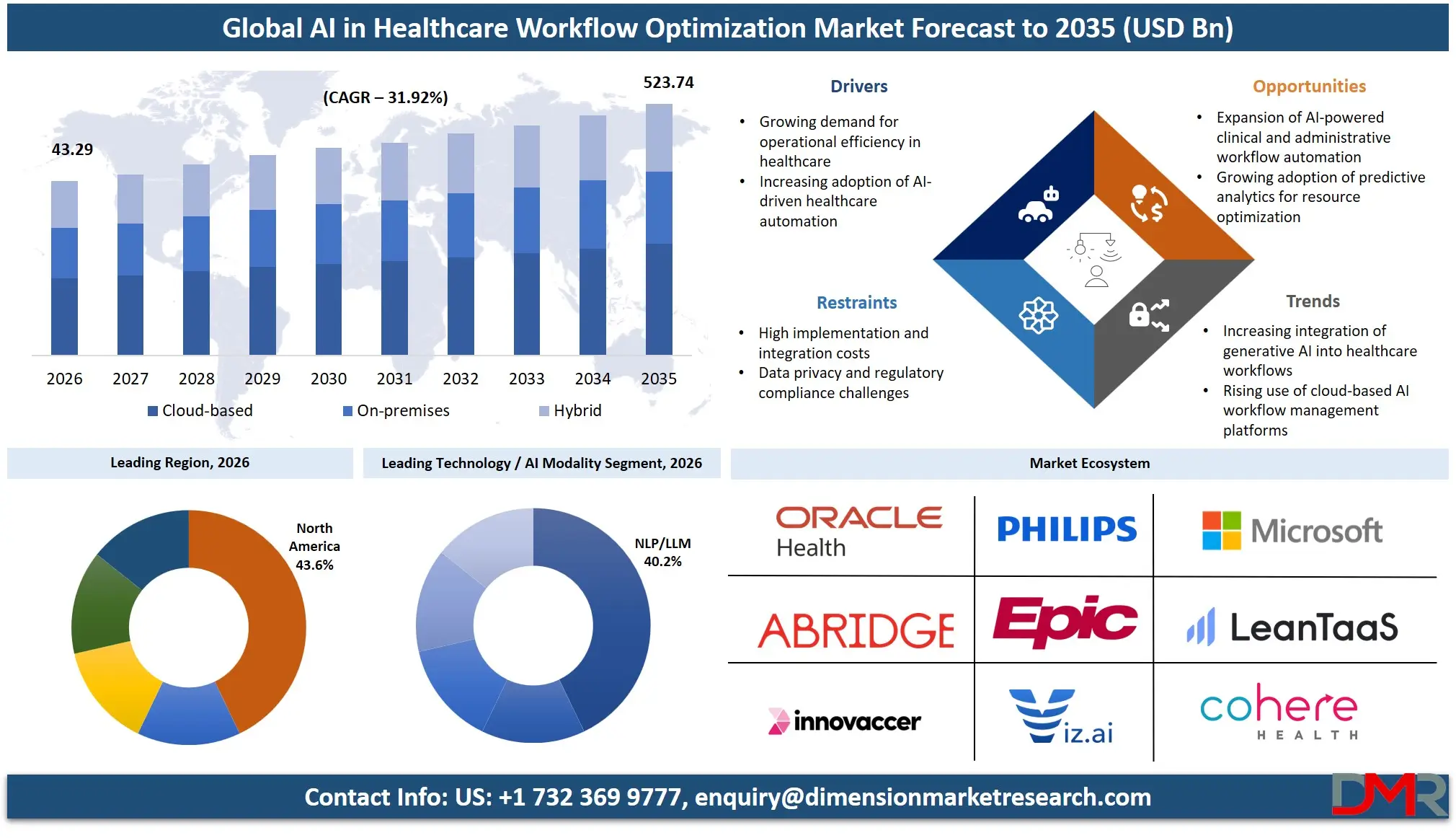
- The AI in healthcare workflow optimization market size is USD 32.81 billion in 2025, reached USD 43.29 billion in 2026, and is projected to hit USD 523.74 billion by 2035 at a CAGR of 31.92%.
- Clinical Documentation Automation leads all application segments with a 32.6% share in 2026.
- North America holds the dominant regional position with a 43.6% revenue share in 2026.
- Hospitals and Health Systems lead the end-user segment with a 49.71% share in 2026.
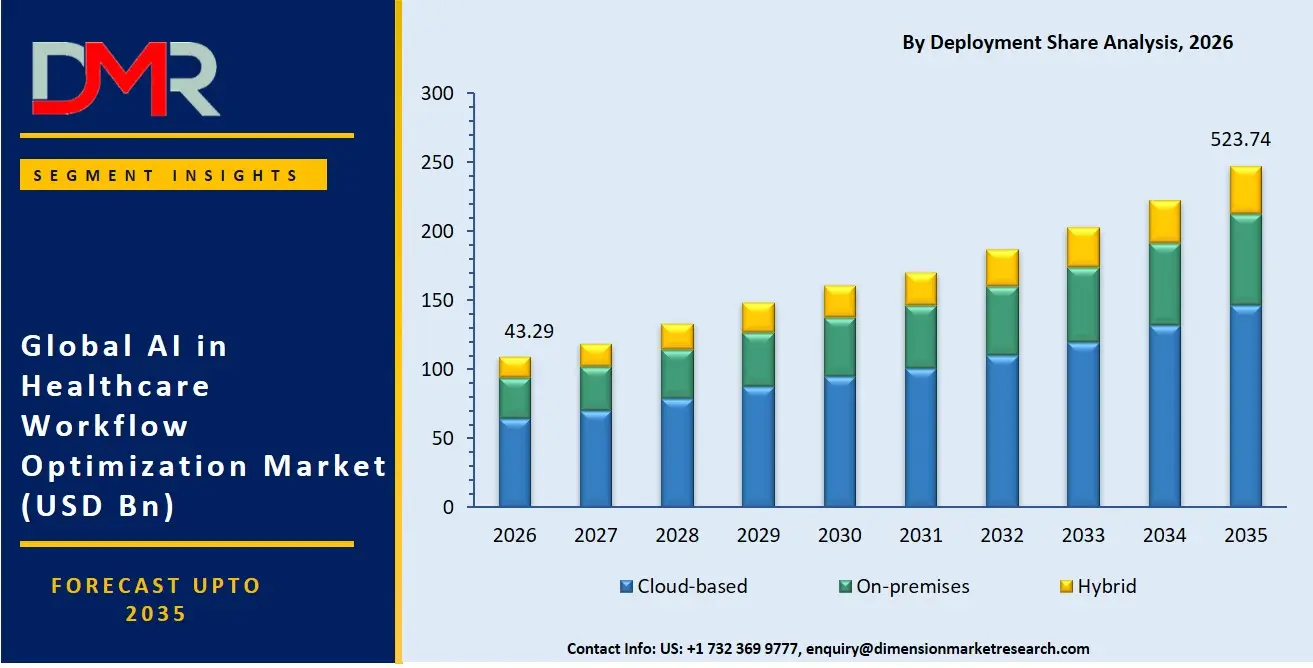
- Cloud-based deployment holds a 59.13% share in 2026; Hybrid deployment grows fastest at a CAGR of 26.32%.
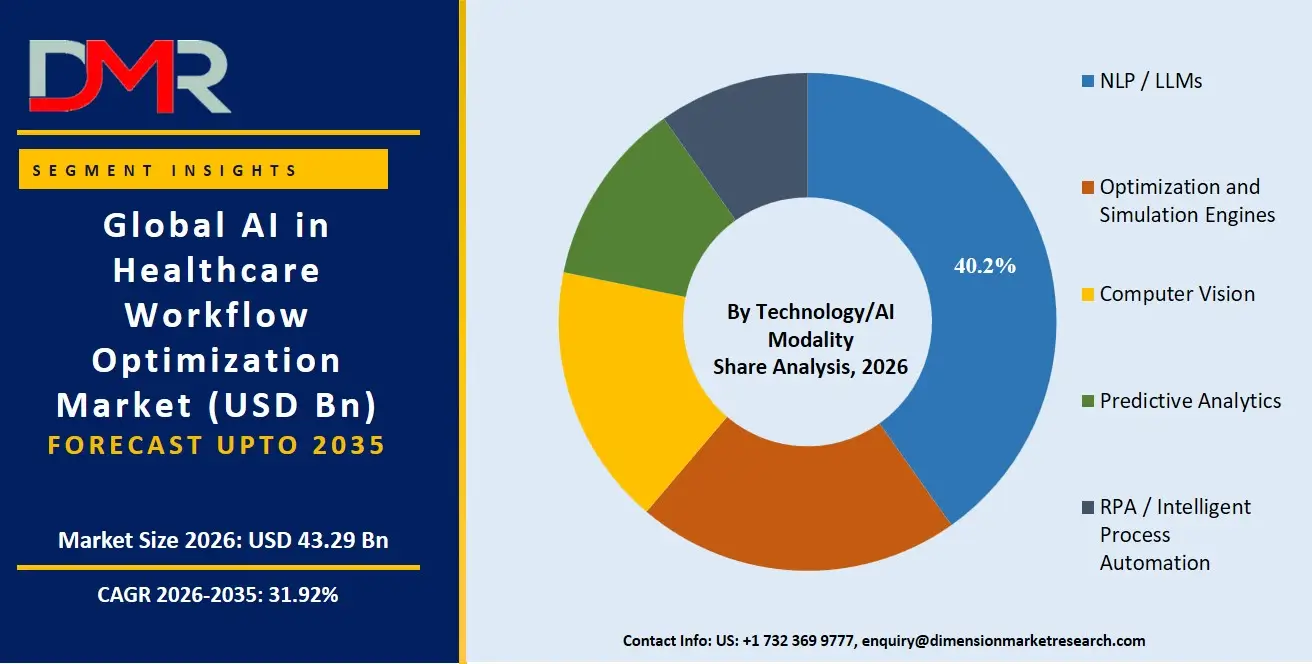
- NLP and LLMs hold the largest technology share at 40.21%; Optimization and Simulation Engines grow fastest at a CAGR of 28.35%.
- Inpatient Capacity and Patient Flow is the fastest-growing application segment at a CAGR of 25.21%.
- Ambulatory and Outpatient Clinics grow fastest among end users at a CAGR of 22.43%.
- Asia-Pacific holds a 25.8% revenue share in 2026, the second-largest regional position.
Market Overview
AI in healthcare workflow optimization covers the application of artificial intelligence to automate and coordinate clinical and administrative processes across health systems. Clinical documentation, imaging workflow sequencing, inpatient capacity management, surgical scheduling, and revenue cycle automation fall within AI in Healthcare Workflow Optimization Market's scope. General hospital IT infrastructure, EHR licensing without embedded AI functions, and standard medical devices without AI decision support fall outside it.
ℹ
To learn more about this report –
Download Your Free Sample Report Here
Health systems now treat workflow automation as a procurement standard rather than a discretionary upgrade. The pressure to reduce clinician burnout, control administrative costs, and meet value-based care targets has compressed what would have been a five-year adoption curve into two to three years. Vendors delivering measurable clinical and financial outcomes are moving from pilot discussions into enterprise contract negotiations faster than the market anticipated.
EHR platform integration separates AI in Healthcare Workflow Optimization Market cycle from earlier healthcare AI waves. Epic, Oracle, and Microsoft have embedded AI natively into clinical workflows, making ambient documentation and agentic tools a standard feature of EHR renewal conversations. Hospitals using Epic EHR systems reported a 62.6% ambient AI adoption rate by mid-2025, with higher uptake in larger and metropolitan facilities, as reported by the American Journal of Managed Care in January 2026. When adoption approaches two-thirds of eligible facilities, the market is no longer in the early stage.
Clinician burnout reduction has become one of the most urgent drivers in health system procurement. Nabla reported a 26% decrease in burnout following a five-week pilot at Iowa Health, as published by PHTI in March 2025. Health systems facing physician shortages treat documented burnout reductions as a workforce retention argument, giving AI workflow tools a budget justification that extends well beyond operational efficiency alone.
Market Size and Forecast
The Global AI in Healthcare Workflow Optimization Market size is estimated at USD 43.29 Billion in 2026 from USD 32.81 Billion in 2025, and is projected to reach USD 523.74 Billion by 2035, exhibiting a CAGR of 31.92% during the forecast period.
Healthcare organizations reported USD 1.4 billion in total AI spending in 2025, with providers directing 75% toward workflow tools, as reported by Menlo Ventures in October 2025. Ambient AI scribes led all clinical application categories with USD 600 Million in revenue in 2025, a 2.4x year-over-year increase per the same source. A single application category reaching this revenue level in one year confirms that health systems are committing at an enterprise scale. Budget concentration in workflow applications over diagnostic AI signals that operational efficiency is the primary value proposition driving capital allocation today.
Three forces compound this CAGR. EHR-native AI integration removes the procurement friction that slowed earlier adoption cycles. Federal policy is accelerating deployment across public health infrastructure. Use cases are expanding from physician documentation into nursing, pharmacy, perioperative, and revenue cycle workflows, multiplying the addressable budget per health system account. The upside scenario holds if agentic AI expands into nursing and specialty workflows at vendor-projected timelines and if FDA clearances for imaging and pathology AI continue at the pace observed in 2024 and 2025. Data privacy litigation and mandatory pre-deployment audit requirements represent the primary downside risk, extending vendor sales cycles without reversing long-term trajectory.
Application Analysis
Clinical Documentation Automation led the application segment with a 32.6% share in 2026.
Ambient AI scribes reached over 40,000 clinicians across the U.S. in 2026, as confirmed by Cornell University researchers. Hospitals deploying these tools report direct reductions in documentation time per visit and measurable improvements in clinician retention metrics. The segment leads because it addresses the most universal pain point across every specialty and care setting, the time burden of clinical note completion after patient encounters.
Inpatient Capacity and Patient Flow is the fastest-growing application segment at a CAGR of 25.21%. Hospitals facing structural bed constraints cannot resolve census volatility through manual scheduling at scale. AI tools that model admission volumes, optimize bed assignments, and predict discharge timelines allow health systems to treat more patients without adding physical capacity, connecting directly to revenue per available bed. Revenue Cycle and Prior Authorization Automation addresses denial management and claims processing with clear financial ROI. OR Scheduling and Perioperative Optimization reduces idle operating room time in one of the highest-cost clinical environments any hospital operates.
End User Analysis
With a 49.71% share in 2026, Hospitals and Health Systems outpaced all other end-user categories.
Large health systems carry the IT infrastructure, procurement authority, and multi-department use cases that justify enterprise AI contracts. Kaiser Permanente and Cleveland Clinic deployments illustrate how system-wide rollouts across hundreds of facilities become the standard procurement model. Smaller organizations buy point solutions. Large systems buy platforms, and vendors that cannot demonstrate enterprise-wide integration depth are excluded from these accounts at the evaluation stage.
Ambulatory and Outpatient Clinics are the fastest-growing end-user segment at a CAGR of 22.43%. Cloud-based ambient documentation tools now offer accessible entry points for independent and group practices that previously lacked the IT budget for enterprise AI. As EHR vendors embed AI natively into platform renewals, outpatient clinics adopt workflow automation without separate procurement cycles. Imaging Centers deploy AI worklist prioritization tools to reduce radiologist review time and improve urgent-case turnaround. Payers automate prior authorization and utilization review to reduce administrative cost per decision without adding headcount.
Deployment Analysis
Cloud-based deployment captured 59.13% of the deployment segment in 2026, ahead of all rivals.
ℹ
To learn more about this report –
Download Your Free Sample Report Here
Cloud architecture allows health systems to deploy ambient AI, scheduling, and revenue cycle tools without building on-premises server capacity. Epic, Oracle, and Microsoft have structured their AI workflow offerings as cloud-native products, making cloud the default path for any new AI contract signed through these platforms. Vendors without a credible cloud delivery model are not entering enterprise procurement conversations at large health systems.
Hybrid deployment is the fastest-growing model at a CAGR of 26.32%. Health systems with mixed infrastructure use hybrid architectures to run sensitive workloads on-premises while shifting scalable AI processing to the cloud. On-premises deployment retains relevance for academic medical centers and government-affiliated hospitals with data sovereignty obligations. Vendors serving this segment must invest in dedicated implementation capacity, which limits competitive density and supports stronger pricing for those that qualify.
Technology Analysis
A 40.21% share made NLP and LLMs the clear leader across technology categories in 2026.
ℹ
To learn more about this report –
Download Your Free Sample Report Here
Ambient scribes, clinical summarization tools, and prior authorization drafting applications all run on NLP and large language model foundations. The rapid embedding of generative AI into EHR platforms by Epic, Oracle, and Microsoft has concentrated NLP and LLM deployment at the center of the most active and best-funded workflow automation category. Vendors without a credible NLP or LLM architecture cannot compete in clinical documentation, which remains the largest single application segment.
Optimization and Simulation Engines are the fastest-growing AI modality at a CAGR of 28.35%. These tools model operational scenarios across scheduling, capacity, and supply chains to recommend decisions rather than simply automate tasks. Health systems under margin pressure use simulation engines to test staffing configurations and OR scheduling approaches before committing resources. Computer Vision supports imaging analysis and pathology review with FDA clearances accelerating integration into diagnostic workflows through 2024 and 2025. Predictive Analytics generates risk scores and patient deterioration alerts that clinical teams act on during care delivery. RPA and Intelligent Process Automation handles eligibility verification, claims submission, and appointment workflows, delivering immediate back-office cost reductions with low implementation risk.
Key Market Segments
By Application
- Clinical Documentation Automation
- Imaging Workflow and Orchestration
- Inpatient Capacity and Patient Flow
- OR Scheduling and Perioperative Optimization
- Revenue Cycle and Prior Authorization Automation
- Others
By End User
- Hospitals and Health Systems
- Imaging Centers
- Ambulatory Surgery Centers (ASCs)
- Payers
- Ambulatory and Outpatient Clinics
- Others
By Deployment
- Cloud-based
- On-premises
- Hybrid
By Technology / AI Modality
- NLP / LLMs
- Optimization and Simulation Engines
- Computer Vision
- Predictive Analytics
- RPA / Intelligent Process Automation
Regional Analysis
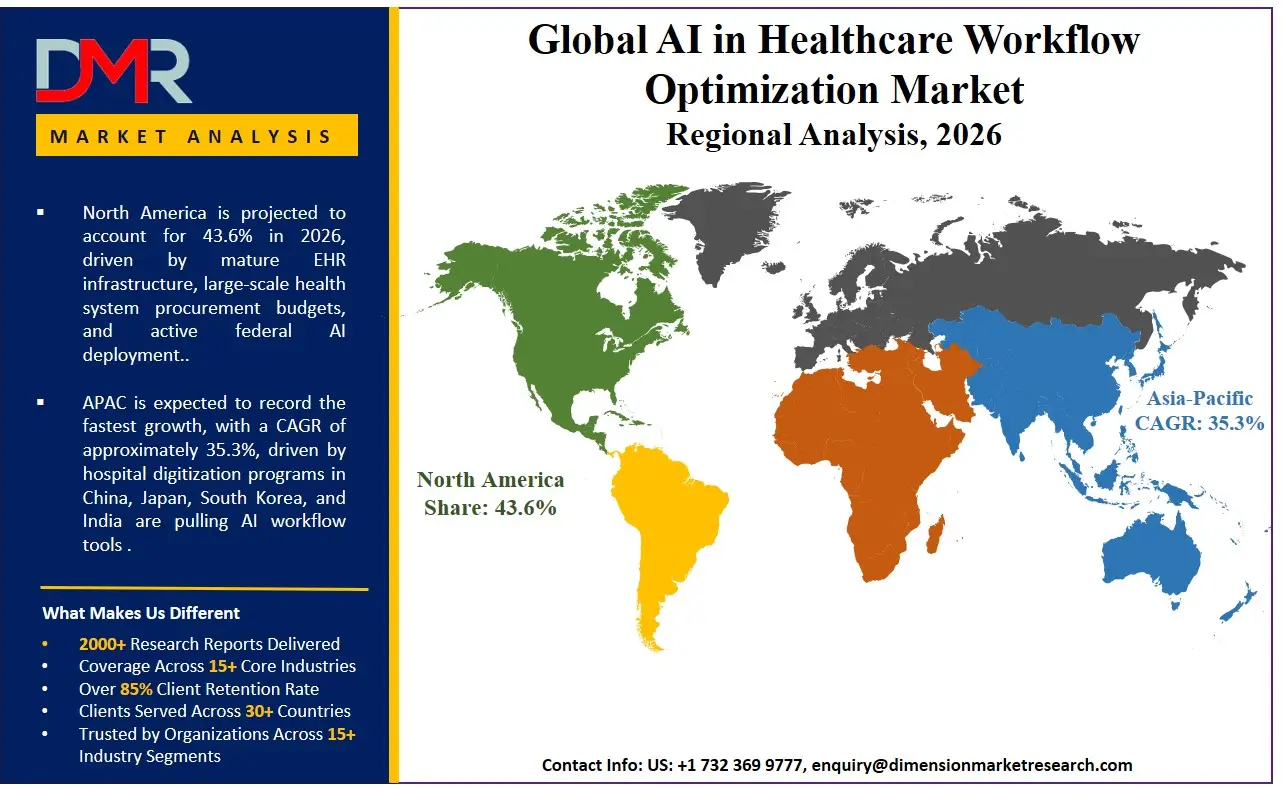
North America held a 43.6% share in 2026, the largest of any region in AI in Healthcare Workflow Optimization Market.
ℹ
To learn more about this report –
Download Your Free Sample Report Here
The U.S. drives this position through mature EHR infrastructure, large-scale health system procurement budgets, and active federal AI deployment. Cleveland Clinic had over 4,000 physicians and advanced practice providers using ambient AI within 15 weeks of rollout, relying on it for 76% of scheduled office visits and cutting note time by 14 minutes per day, as reported by Cleveland Clinic in August 2025. No other region combines institutional scale, vendor density, and federal policy alignment at this level.
Asia-Pacific holds a 25.8% revenue share in 2026, the second-largest regional position. Government-led hospital digitization programs in China, Japan, South Korea, and India are pulling AI workflow tools into public health systems faster than private procurement alone would support. Europe's position reflects strong public health infrastructure alongside complex regulatory requirements. The EU AI Act and GDPR add data residency and conformity assessment obligations that extend procurement timelines for U.S.-origin vendors without established European data frameworks. Latin America is early-stage, anchored by Brazil and Mexico, where cloud-based tools eliminate the need for on-premises capital investment in constrained budget environments. GCC countries in the Middle East are funding hospital AI infrastructure as part of national digital transformation agendas, while Africa's adoption remains limited to urban health networks and platform spillover from international system affiliations.
Key Regions and Countries
North America
Europe
- Germany
- France
- The UK
- Spain
- Italy
- Rest of Europe
Asia Pacific
- China
- Japan
- South Korea
- India
- Australia
- Rest of APAC
Latin America
- Brazil
- Mexico
- Rest of Latin America
Middle East & Africa
- GCC
- South Africa
- Rest of MEA
Market Dynamics
EHR Integration and Federal Policy Push AI Workflows Into Standard Procurement
U.S. hospitals reported a 71% AI uptake rate for inpatient risk prediction, billing automation, and scheduling optimization in 2024, as reported by Menlo Ventures in October 2025. This figure covers system-affiliated and large facilities. AI in clinical workflows has crossed from pilot-stage investment into a procurement standard for any health system operating at scale.
Oracle's Clinical AI Agent delivered a 41% reduction in total documentation time, saving clinicians an average of 66 minutes per day in 2025 pilots, per PHTI research published in March 2025. Data published by HHS in December 2025 confirmed 271 active or planned AI implementations in FY2024, with a projected 70% increase in new use cases for FY2025. When the largest healthcare payer and regulator in the U.S. commits publicly to AI workflow adoption, private health systems treat that as both a validation signal and a competitive pressure. Microsoft reported that 70% of clinicians using its ambient scribe tools said the technology improves work-life balance, per the same PHTI March 2025 publication.
Compliance Obligations and Workforce Gaps Slow Enterprise Deployment
Healthcare organizations consistently identify HIPAA compliance, interoperability failures, and regulatory uncertainty as the primary barriers to AI workflow adoption. Ambient AI scribes, revenue cycle tools, and patient flow systems all process sensitive clinical data at scale. Vendors unable to demonstrate Business Associate Agreement compliance and cross-system integration are disqualified before technical evaluation begins. One study published by HHS/ASPE in February 2026 found burnout fell from 51.9% to 38.8% after 30 days of ambient AI use, confirming clinical value. Yet that evidence alone does not resolve the legal and interoperability concerns that pause procurement decisions.
Workforce training gaps compound technical barriers. Mid-career physicians with established documentation habits perceive AI scribes as adding a verification burden rather than reducing workload. Health systems that have not built structured change management capacity alongside technology investment report lower-than-expected utilization in early deployment months. Resistance is not a technology problem. It is an organizational readiness problem that vendors and health system leadership must address together before full-scale deployment produces the projected outcomes.
Agentic AI and Revenue Cycle Expansion Open High-Value Growth Pathways
AI coding and billing automation generated USD 450 Million in 2025, a 2.3x year-over-year increase, as reported by Menlo Ventures in October 2025. Hospitals face average denial rates that cost millions annually in rework and write-offs. AI tools that reduce denial rates or accelerate prior authorization approvals carry calculable ROI, shortening the procurement approval cycle compared to tools with softer clinical outcomes. Abridge reported a 40% decrease in burnout at Christus Health using the Mini-Z Burnout Survey, per PHTI research published in March 2025, demonstrating that financial and workforce benefits are compounding in the same deployment.
Luma Health's Operational AI platform, powered by Spark multi-model generative AI, was deployed at 50+ health systems by February 2026, saving over 2.5 million staff hours in 2025. Platforms that orchestrate patient access, engagement, intake, and payment capture within a single agentic architecture are replacing point solutions across multiple workflow categories simultaneously. Value-based care contracts create structural demand for predictive risk stratification tools. Health systems carrying financial risk for patient populations need early-warning models that identify high-cost patients before acute intervention becomes necessary.
Market Trends
Ambient and Agentic AI Move From Pilot Layer to Enterprise Operating Standard
Kaiser Permanente deployed Abridge ambient documentation across 40 hospitals and over 600 medical offices, as reported by Menlo Ventures in October 2025. Advocate Health evaluated over 225 AI solutions before selecting 40 use cases including Microsoft Dragon Copilot, per the same source. Health systems are buying platforms with validated clinical evidence and enterprise integration depth, not point tools with unproven ROI. Vendors without multi-site deployment data and governance framework compatibility are being filtered out early in evaluation cycles. Tempus upgraded its Hub physician platform with next-generation agentic AI architecture in May 2026, signaling that even specialty-focused vendors are embedding autonomous workflow orchestration to remain competitive as buyer expectations shift from documentation capture toward decision support and action.
Market Competition Overview
The AI in Healthcare Workflow Optimization Market is fragmented across application categories but shows early platform-level consolidation. No single vendor holds dominant share across all workflow segments. EHR-native AI vendors are accumulating cross-segment positioning that point-solution providers cannot replicate. Vendors embedded in daily clinical workflow hold the structural advantage because health systems prefer buying AI through existing EHR relationships, reducing implementation complexity and contract management overhead.
Startups captured nearly 70% of new ambient AI scribe deployments in 2025 despite incumbents holding large installed bases, as reported by Menlo Ventures in October 2025. Ambience held 13% of ambient scribe share in 2025 per the same source, illustrating how multiple well-funded entrants are capturing growth simultaneously. The gap between installed base and new deployment share signals that incumbents are losing the growth contest even where they retain volume leadership. Vendors that can demonstrate agentic capability roadmaps across scheduling, prior authorization, and care coordination are winning new enterprise deals over those competing on documentation performance alone.
Company Profiles
Microsoft competes through its Nuance DAX Copilot ambient documentation platform, which held a 33% share in the ambient AI scribe segment in 2025 and was deployed across 77% of U.S. hospitals prior to recent competitive shifts, as reported by Menlo Ventures in October 2025. Microsoft's strategic advantage is its existing enterprise footprint across hospital IT, cloud infrastructure, and EHR integration partnerships. Bundling ambient AI into broader technology agreements rather than competing on documentation capability alone gives Microsoft a pricing and switching-cost advantage that pure-play AI vendors cannot match at the enterprise procurement level.
Abridge raised USD 300 Million in Series E funding in June 2025, reaching a USD 5.3 Billion valuation, as reported by STAT News. Its partnership with Kaiser Permanente covering 40 hospitals and over 600 medical offices shows that large health systems are building enterprise-scale contracts with AI-native vendors. Abridge held approximately 30% of ambient scribe market share in 2025. The risk it faces is sustaining differentiation as EHR vendors embed comparable documentation AI natively into platform renewals, shifting the competitive evaluation from standalone scribe performance to broader workflow integration depth.
Key Players
- Cohere Health
- Microsoft
- Abridge
- Philips
- Innovaccer
- Automation Anywhere
- Viz.ai
- Oracle Health
- LeanTaaS
- GE HealthCare
- Edifecs
- Aidoc
- Epic Systems
- InterSystems
- Validic
- Siemens Healthineers
- Notable
- Augmedix
- Qventus
Supply Chain and Value Chain Analysis
Cloud infrastructure providers sit at the foundation of this value chain. HIPAA-compliant cloud computing, storage, and connectivity underpin every clinical AI tool operating at enterprise scale. A small number of large technology companies control this layer, giving them pricing power over downstream AI vendors. Vendors relying on a single cloud provider carry concentration risk that buyers with multi-vendor infrastructure policies flag during procurement due diligence.
AI model development is the next layer, where NLP, LLM, and predictive analytics capabilities are built and trained on clinical data sets. Vendors with exclusive access to large, diverse health system data sets hold a durable accuracy advantage. Those relying on public or synthetic data face performance gaps that clinical buyers identify quickly during pilot evaluations. EHR and health IT platform integration is where maximum value is created and captured. Vendors achieving native integration into Epic, Oracle, or Cerner workflows embed themselves into daily clinical environments in ways that standalone tools cannot replicate. Health systems prefer buying AI through existing EHR relationships because it reduces implementation complexity. Implementation and change management services form a critical but undervalued layer. Structured rollout support, not software deployment alone, determines whether clinicians actually adopt the tools at the utilization rates health system leadership projected when approving the contract.
Regulatory Landscape
The HHS AI Strategy published in December 2025 formalized federal expectations for AI governance, transparency, and performance accountability across health operations. HHS documented 271 active AI implementations in FY2024 and projected a 70% increase in new use cases for FY2025. An agency with direct deployment experience now shapes regulatory expectations, which means vendors must demonstrate governance frameworks, not just clinical outcomes, to satisfy federal procurement criteria.
The FDA's clearance pathway for AI-enabled medical devices directly controls which imaging and diagnostic workflow tools health systems can deploy clinically. FDA clearances for AI-enabled pathology and imaging devices accelerated through 2024 and 2025. Each clearance reduces procurement risk for health system buyers and confirms a viable regulatory pathway for vendors investing in clinical-grade AI tools. HIPAA compliance remains the baseline requirement for any tool handling protected health information. Vendors unable to demonstrate Business Associate Agreement compliance, audit trail capability, and data minimization practices are disqualified before technical evaluation begins.
Europe's EU AI Act classifies several healthcare AI applications as high-risk systems requiring conformity assessments, technical documentation, and post-market monitoring. GDPR adds data residency and consent requirements that complicate U.S.-developed AI tool deployment in European health systems. Germany, France, and the UK are active buyers of imaging AI and clinical documentation tools, but contract structures must accommodate data residency obligations that extend implementation timelines significantly. State-level regulation in the U.S. is an emerging variable, with several states advancing legislation requiring algorithmic transparency, bias audits, and patient notification rights for AI-assisted clinical decisions.
Investment and White Space Analysis
Investment is concentrated in ambient AI documentation and revenue cycle automation. Abridge raised USD 300 Million in Series E funding in June 2025, reaching a USD 5.3 Billion valuation. Aidoc raised USD 150 Million in Series E funding in April 2026, led by Growth Equity at Goldman Sachs Alternatives. Both raises reflect investor conviction that enterprise health system contracts carry durable, multi-year revenue with high switching costs once embedded in clinical workflows.
Nursing and specialty workflow automation represents the clearest white space. AI tools have been deployed predominantly in physician-facing documentation and administrative workflows. Nursing handoff documentation, medication reconciliation, and care plan updates carry comparable documentation burden but have received far less vendor investment. Health systems that have deployed physician-facing AI are now asking vendors for equivalent tools across nursing and allied health workflows. Few vendors are currently positioned to meet that demand at enterprise scale.
Inpatient Capacity and Patient Flow tools grow at a CAGR of 25.21%, the fastest among application segments, yet attract less venture capital attention than documentation AI. Hospitals under bed capacity pressure and census volatility have strong financial motivation to deploy AI-driven census management and discharge prediction tools. Asia-Pacific holds a 25.8% revenue share in 2025 but operates with fewer established vendor relationships than North America or Europe. Government-driven hospital digitization in China, India, and Southeast Asia is creating procurement pipelines that vendors with localized clinical AI capabilities and data residency compliance can access before the market consolidates around domestic players.
Recent Developments
- April 2026: Aidoc. Series E Funding. Aidoc raised USD 150 Million led by Growth Equity at Goldman Sachs Alternatives, with participation from General Catalyst, SoftBank Vision Fund 2, and NVentures, to scale its CARE clinical foundation model and aiOS enterprise AI platform for medical imaging analysis and clinical workflow optimization.
- March 2026: GE HealthCare. Product Showcase. GE HealthCare presented its AI-powered Command Center for patient flow management and operational decision-making as part of its cloud-first solutions portfolio at HIMSS 2026, targeting health systems seeking integrated operational AI platforms.
- May 2026: Cross Country Healthcare. Strategic Partnership. Cross Country Healthcare announced an exclusive 36-month partnership to integrate the Optimé workforce strategy and planning solution into its Intellify platform for AI-powered forecasting, analytics, and workforce optimization across health systems.
Report Details
| Report Characteristics |
| Market Value (2025) |
USD 32.81 Billion |
| Market Value (2026) |
USD 43.29 Billion |
| Forecast Revenue (2035) |
USD 523.74 Billion |
| CAGR (2026–2035) |
31.92% |
| Base Year for Estimation |
2025 |
| Historic Period |
2020 – 2024 |
| Forecast Period |
2026 – 2035 |
| Report Coverage |
Revenue Forecast, Market Dynamics, Competitive Landscape, Recent Developments |
| Segments Covered |
By Application (Clinical Documentation Automation, Imaging Workflow and Orchestration, Inpatient Capacity and Patient Flow, OR Scheduling and Perioperative Optimization, Revenue Cycle and Prior Authorization Automation, Others), By End User (Hospitals and Health Systems, Imaging Centers, Ambulatory Surgery Centers, Payers, Ambulatory and Outpatient Clinics, Others), By Deployment (Cloud-based, On-premises, Hybrid), By Technology / AI Modality (NLP / LLMs, Optimization and Simulation Engines, Computer Vision, Predictive Analytics, RPA / Intelligent Process Automation) |
| Regional Analysis |
North America – US and Canada; Europe – Germany, France, The UK, Spain, Italy, and Rest of Europe; Asia Pacific – China, Japan, South Korea, India, Australia, and Rest of APAC; Latin America – Brazil, Mexico, and Rest of Latin America; Middle East & Africa – GCC, South Africa, and Rest of MEA |
| Competitive Landscape |
Cohere Health, Microsoft, Abridge, Philips, Innovaccer, Automation Anywhere, Viz.ai, Oracle Health, LeanTaaS, GE HealthCare, Edifecs, Aidoc, Epic Systems, InterSystems, Validic, Siemens Healthineers, Notable, Augmedix, Qventus |
| Customization Scope |
Customization for segments and region or country level will be provided. Additional customization can be done based on requirements. |
| Purchase Options |
Three license options: Single User License, Multi-User License (Up to 5 Users), Corporate Use License (Unlimited Users and Printable PDF). |
Frequently Asked Questions
What is the biggest investment opportunity in AI in Healthcare Workflow Optimization Market?
▾ The market reaches USD 523.74 Billion by 2035 from USD 32.81 Billion in 2025. Nursing workflow automation and Inpatient Capacity and Patient Flow tools growing at a CAGR of 25.21% represent the clearest underserved entry points. Asia-Pacific, with a 25.8% revenue share and lower competitive density than North America, offers the highest regional upside for vendors with localized clinical AI capabilities.
Who are the top companies in AI in Healthcare Workflow Optimization Market?
▾ Leading companies include Cohere Health, Microsoft, Abridge, Philips, Innovaccer, Oracle Health, LeanTaaS, GE HealthCare, Aidoc, Epic Systems, Automation Anywhere, Viz.ai, Edifecs, InterSystems, Validic, Siemens Healthineers, Notable, Augmedix, and Qventus. Abridge and Aidoc raised a combined USD 450 Million across 2025 and 2026, signaling where capital concentration and competitive intensity are highest.
Which segment is growing fastest in AI in Healthcare Workflow Optimization Market and why?
▾ Inpatient Capacity and Patient Flow grows fastest among application segments at a CAGR of 25.21%. Hospitals facing structural bed constraints and post-pandemic census volatility cannot resolve capacity pressure through manual scheduling. AI tools that predict admission volumes and optimize discharge timelines allow health systems to increase throughput without adding physical infrastructure, connecting directly to revenue per available bed.
Which region is growing fastest in AI in Healthcare Workflow Optimization Market and why?
▾ Asia-Pacific, with a 25.8% revenue share in 2026, is the fastest-growing regional market. Government-led hospital digitization programs across China, India, Japan, and South Korea are pulling AI workflow tools into public health systems faster than private procurement cycles alone would support. Large patient volumes and physician-to-patient ratios create a structural case for AI-assisted documentation and triage tools as compelling as the commercial case in North America.
What is the biggest challenge holding AI in Healthcare Workflow Optimization Market back?
▾ Data privacy compliance, interoperability failures, and workforce training gaps are the three primary constraints. Healthcare organizations identified these barriers in 2024 and 2025 assessments as the leading reasons AI workflow deployments stall after pilot completion. Vendors unable to demonstrate HIPAA-compliant cross-system integration are removed from enterprise procurement processes before clinical evaluation begins.