Market Overview
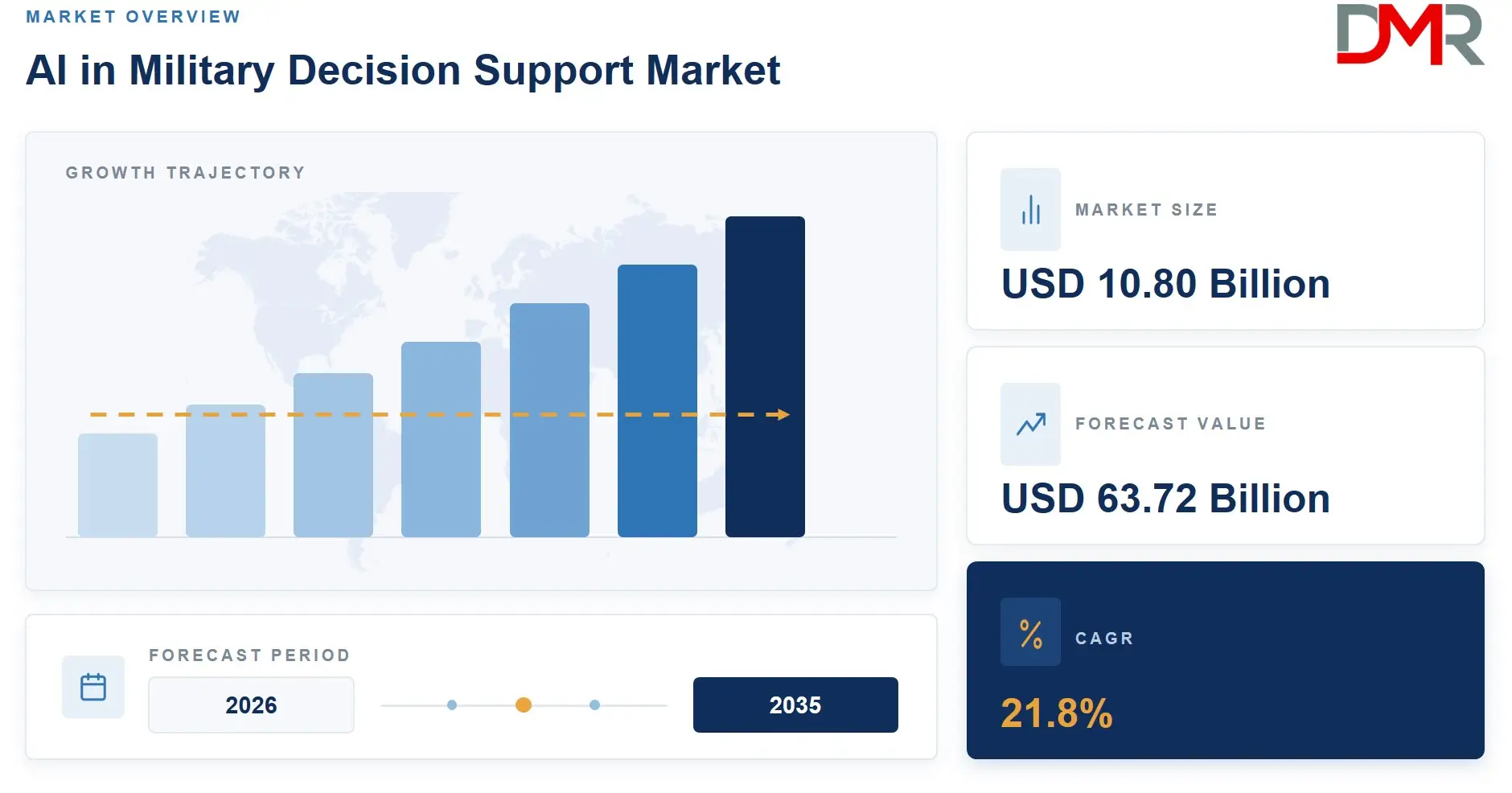
The Global AI in Military Decision Support Market size is estimated at USD 10.80 Billion in 2026, and is projected to reach USD 63.72 Billion by 2035, exhibiting a CAGR of 21.8% during the forecast period.
Defense establishments in NATO member states and Indo-Pacific partners accelerated AI procurement after battlefield data from Ukraine and Middle East operations demonstrated measurable kill-chain compression. The forecast rests on continued defense budget reallocation toward software-defined command systems, doctrine-level institutionalization of AI decision support under JADC2 and NATO Allied Command Transformation frameworks, and the demonstrated operational value of systems like Project ASGARD. As reported by the UK Chief of the General Staff, the ASGARD platform made the UK's 4 Light Brigade capable of acting 10 times faster and 10 times further than the prior year in 2025, a data point that reset allied procurement benchmarks.
The market covers AI software, hardware, and services integrated into military command, control, intelligence, surveillance, reconnaissance, threat detection, mission planning, and autonomous systems coordination. Civilian AI infrastructure and non-defense government intelligence applications fall outside the scope. The market connects directly to the broader AI in Defense ecosystem, where platforms originally developed for commercial inference are being re-engineered for classified, bandwidth-constrained, and adversarially contested environments. NATO's acquisition of the Maven Smart System in six months — the fastest procurement in NATO's history, finalized on 25 March 2025, as confirmed by SHAPE — signals that defense procurement cycles are compressing as urgency overrides traditional acquisition timelines.
ℹ
To learn more about this report –
Download Your Free Sample Report Here
Key Takeaways
- The market size is USD 10.80 Billion in 2026, and is projected to hit USD 63.72 Billion by 2035 at a CAGR of 21.8%.
- By Component: Software led as the largest category with a 48.80% share in 2026.
- By Platform: Airborne Systems led as the largest category with a 38.50% share in 2026.
- By Application: Situational Awareness led as the largest category with a 32.70% share in 2026.
- By AI Technology: Machine Learning & Deep Learning led as the largest category with a 43.60% share in 2026.
- By Decision Level: Tactical Decision Support led as the largest category with a 50.30% share in 2026.
- By Deployment: Edge-Based led as the largest category with a 46.70% share in 2026.
- By End User: Army led as the largest category with a 43.20% share in 2026.
- By Region: North America led with a 40.50% share in 2026.
- Top 5 key players: Lockheed Martin Corporation, RTX Corporation, Northrop Grumman Corporation, General Dynamics Corporation, BAE Systems plc.
Component Analysis
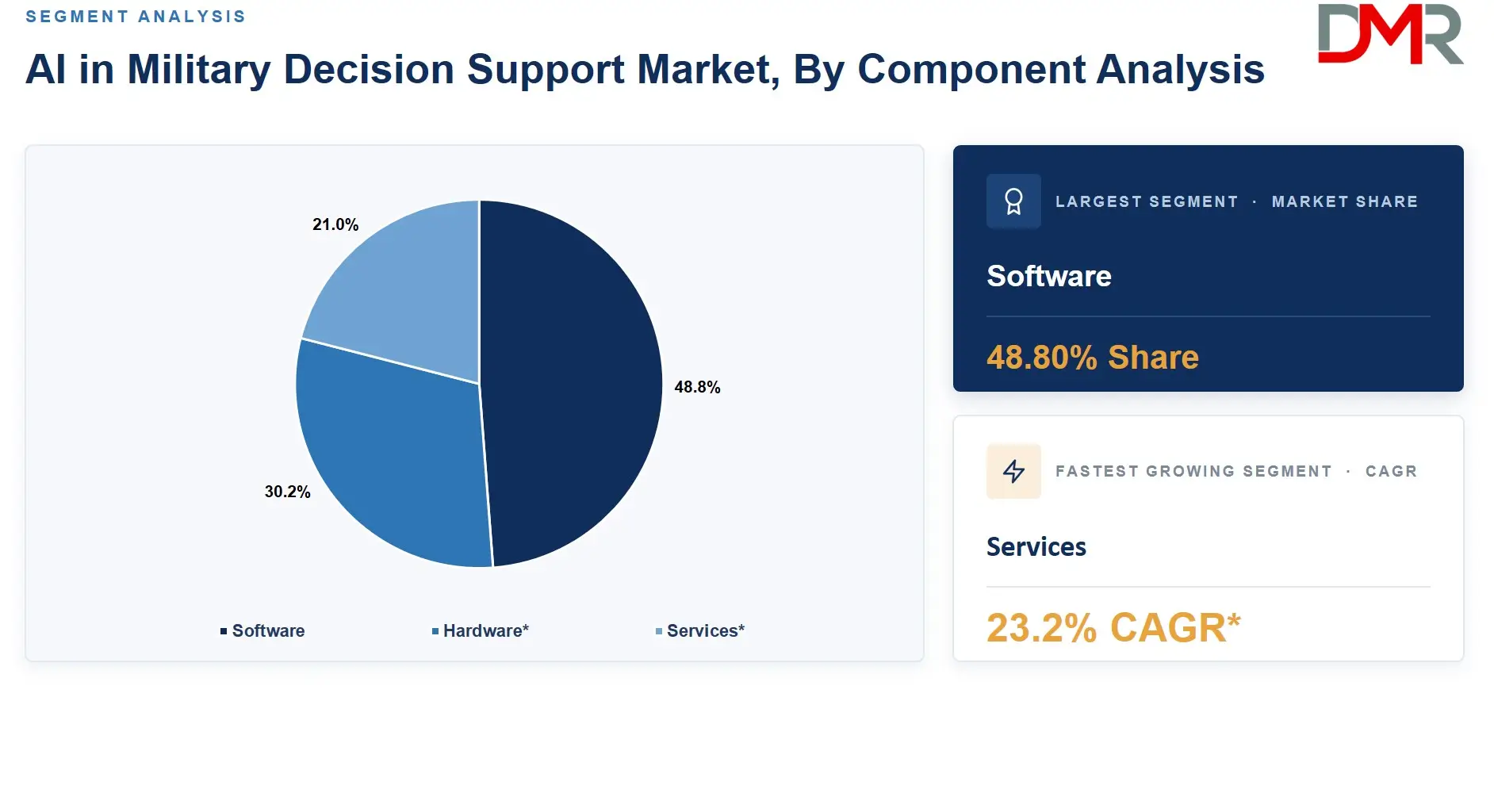
Software led the Component segment with a 48.80% share in 2026.
Software commands the largest component share because AI military decision support is fundamentally a data-processing and algorithm-delivery problem, not a hardware sourcing problem. Defense buyers invest in software platforms that can be upgraded continuously — a critical requirement in a threat environment where adversarial AI capabilities evolve between procurement cycles. Vendors with proprietary training pipelines and data ontologies for military applications hold a structural pricing advantage that hardware-equivalent competitors cannot easily replicate.
Hardware follows in share, anchored by edge compute units, sensor arrays, and ruggedized inference accelerators required for field deployment. Services represent the fastest-growing component as armed forces lacking organic AI engineering capacity contract out model training, system integration, and red-team validation. A US Army 2026 field test confirmed what service providers have long argued: an AI system deployed in the California desert identified, prioritized, and generated firing solutions for 15 separate targets in one hour, a task that would have required 12 to 24 hours and dozens of staff through traditional human kill-chain analysis. The growing backlog of integration work will sustain services revenue growth through the forecast period.
ℹ
To learn more about this report –
Download Your Free Sample Report Here
Platform Analysis
Airborne Systems captured 38.50% of the Platform segment in 2026, ahead of all rivals.
Airborne platforms generate the highest volume of time-sensitive sensor data, making them the natural priority for AI decision support integration. Persistent surveillance aircraft, manned strike jets, and unmanned aerial systems all feed ISR pipelines that require AI to compress sensor-to-analyst-to-strike cycles. Buyers in this segment prioritize low-latency inference, hardened data links, and models trained on multi-spectral imagery. The high per-platform cost creates significant revenue concentration for vendors who win airborne integration contracts.
Space-Based Systems represent the fastest-growing platform category as satellite proliferation and low-earth-orbit constellations multiply sensor coverage beyond what ground-based analytical teams can process. Land-Based and Naval Systems are expanding in parallel, driven by doctrine requiring all-domain sensor fusion. Autonomous Drones operating as networked swarm assets are accelerating platform-level AI investment, particularly in contested maritime and littoral environments where persistent ISR is operationally indispensable. Latent AI's edge-AI platform demonstrated the performance ceiling available on unmanned systems, increasing AI inference speed by up to 3x and extracting analytics up to 70% faster than centralized processing in a 2025 US Air Force case study, with negligible accuracy loss.
Application Analysis
Situational Awareness accounted for 32.70% of Application demand in 2026, the highest of any category.
Situational Awareness dominates application spend because commanders across all echelons rank common operating picture fidelity as the primary prerequisite for every downstream decision. AI systems that fuse radar, electro-optical, signals intelligence, and open-source feeds into a single coherent picture reduce decision latency at the corps and battalion levels simultaneously. Vendors who own the situational awareness layer effectively gate access to every downstream application — command and control, targeting, and mission planning — creating durable switching costs.
Intelligence, Surveillance and Reconnaissance exploitation is the fastest-growing application, driven by satellite and drone proliferation that has created sensor data volumes no human analyst corps can absorb. Command and Control follows closely as JADC2 mandates create procurement requirements across all US service branches. Threat Detection, Target Recognition, and Autonomous Systems Coordination are each expanding as combat experience in Ukraine and the Middle East validates AI-enabled fire control. Logistics and Supply Chain Optimization and Cybersecurity round out the application portfolio, with the latter gaining budget share as adversaries target AI training pipelines directly.
AI Technology Analysis
With a 43.60% share in 2026, Machine Learning & Deep Learning outpaced all other AI Technology categories.
Machine Learning and Deep Learning dominate because the target recognition, sensor fusion, and predictive maintenance problems at the core of military decision support are solved most reliably by neural architectures trained on large labeled datasets. Defense agencies have spent a decade curating those datasets — a moat that prevents new entrants from replicating performance simply by licensing a commercial foundation model. Maven-derived AI systems built on these architectures detected and classified targets from raw sensor data with accuracy rates exceeding 90%, at speeds thousands of times faster than human analysts working the same data, as reported by militarymachine.com in 2026.
Computer Vision and Natural Language Processing are both scaling, the latter accelerating as large language model integration enables natural-language tasking of ISR assets. Generative AI is the fastest-growing AI technology subcategory as defense planners begin using it for automated operation order drafting, red team scenario generation, and wargame stimulation. Predictive Analytics, Knowledge-Based AI, and Edge AI complete the technology stack, with Edge AI gaining ground specifically because persistent satellite communication cannot be assumed in a high-intensity conflict where adversaries target link infrastructure.
Decision Level Analysis
Tactical Decision Support led the Decision Level segment with a 50.30% share in 2026.
Tactical decision support dominates because the value proposition of AI is most legible — and most measurable — at the point of contact where decision cycles must close within seconds or minutes. Brigade and battalion commanders have the clearest metrics for AI performance: time to target, targets prosecuted per day, and fire mission duration. US Air Force Experiment 3, conducted June 4 through 13, 2025, ran a four-day stress test using a Maven Smart System–based AI application specifically to accelerate kill-chain decisions and reduce operator cognitive load at the tactical edge, confirming that the tactical tier drives the majority of near-term procurement volume.
Operational Decision Support is the next tier, supporting corps and theater-level planning cycles that AI systems are beginning to compress from days to hours. Strategic Decision Support holds the smallest current share but carries the longest contract values as defense ministries invest in AI platforms capable of modeling multi-domain campaign outcomes against adaptive adversaries. The progression from tactical to strategic AI investment follows a predictable path — tactical wins fund the political credibility needed to justify strategic AI procurement budgets.
Deployment Analysis
Edge-Based deployment captured 46.70% of the Deployment segment in 2026, ahead of all rivals.
Edge-Based deployment leads because military AI must function in GPS-denied, communications-degraded, and electromagnetically contested environments where cloud connectivity cannot be assumed. Forward-deployed units require inference hardware that operates autonomously without round-trip latency to a data center. The operational requirement for disconnected operation is a doctrinal mandate, not a buyer preference — it drives procurement decisions regardless of cloud cost economics.
Cloud-Based deployment is the fastest-growing deployment category, driven by rear-echelon planning, training, and intelligence analysis workloads that do not face the same connectivity constraints as front-line systems. On-Premises deployments anchor classified facility operations where data sovereignty requirements prohibit cloud storage. Hybrid configurations are gaining traction as defense agencies seek to combine edge inference for time-critical decisions with cloud-based model retraining pipelines that update deployed systems as new threat data accumulates.
End User Analysis
Army led the End User segment with a 43.20% share in 2026.
Army dominates end user share because land warfare generates the greatest volume of fast-moving, multi-domain decision problems across the widest geographic surface area. Dismounted and mechanized formations require AI support at every echelon from squad to corps, creating more procurement nodes than naval or air force structures. The scale of army modernization programs — particularly JADC2-aligned C2 upgrades — translates directly into larger software and integration contract volumes than peer service branches generate.
The Navy and Air Force each bring distinct AI procurement profiles. Air Force contracts carry high unit values concentrated in a smaller number of platform-level integrations. Navy procurement centers on maritime domain awareness, undersea threat detection, and fleet logistics AI. Both services are expanding AI decision support faster than historical procurement patterns would predict, as operational commanders observed the kill-chain compression achieved by allied forces in recent conflicts and translated those observations into budget requests.
Key Market Segments
By Component
- Software
- Hardware
- Services
By Platform
- Airborne Systems
- Land-Based Systems
- Naval Systems
- Space-Based Systems
By Application
- Situational Awareness
- Command & Control
- Intelligence Surveillance & Reconnaissance (ISR)
- Threat Detection & Analysis
- Target Recognition
- Mission Planning & Simulation
- Logistics & Supply Chain Optimization
- Cybersecurity & Threat Analysis
- Autonomous Systems Coordination
By AI Technology
- Machine Learning & Deep Learning
- Computer Vision
- Natural Language Processing
- Predictive Analytics
- Generative AI
- Knowledge-Based AI
- Edge AI
By Decision Level
- Tactical Decision Support
- Operational Decision Support
- Strategic Decision Support
By Deployment
- Edge-Based
- On-Premises
- Cloud-Based
- Hybrid
By End User
Regional Analysis
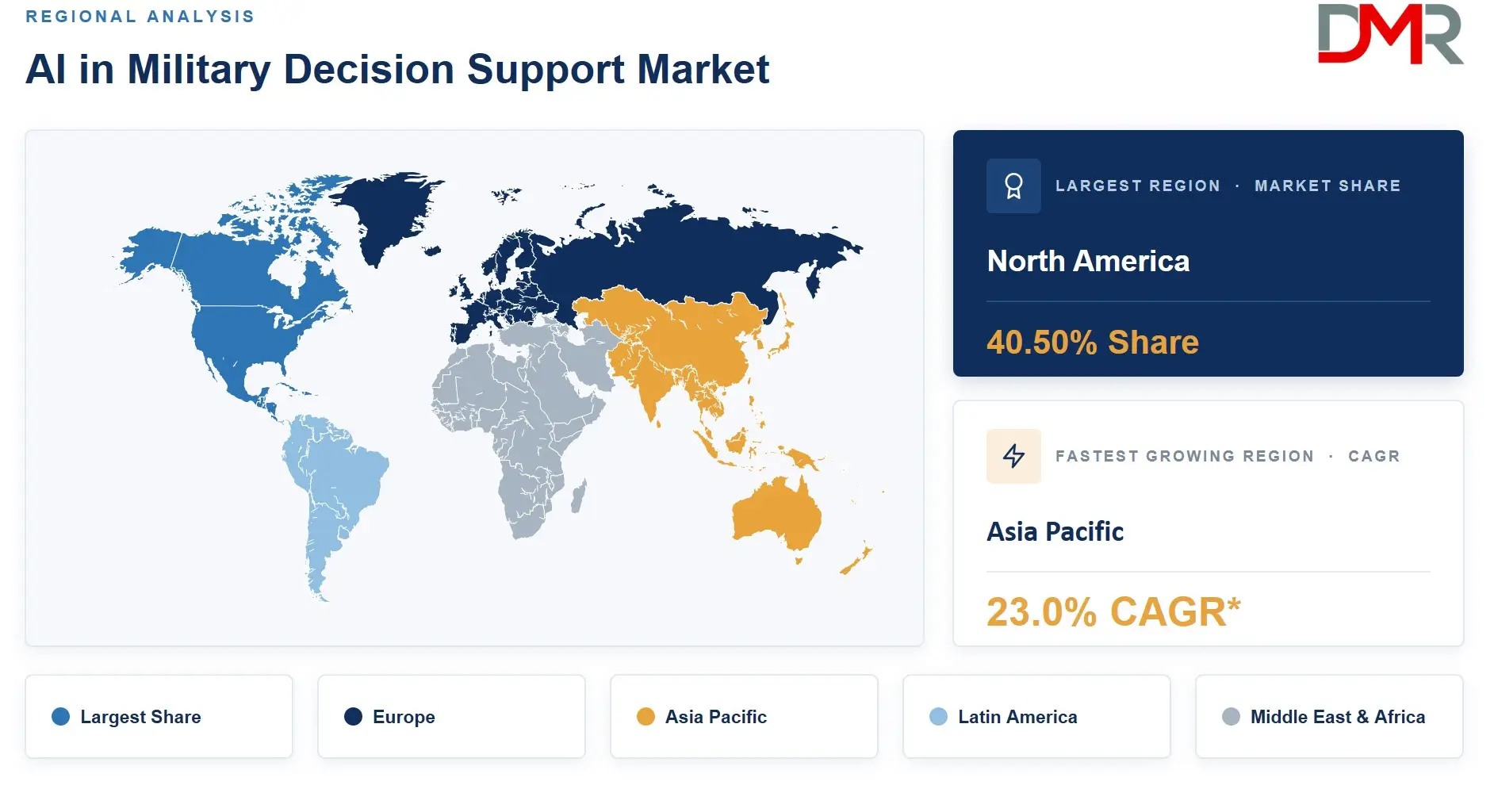
North America led the AI in Military Decision Support Market with a 40.50% share in 2026.
North America
North America's dominant share reflects decades of defense R&D investment, an established defense industrial base, and the US military's institutional commitment to AI-enabled command and control through the JADC2 framework. The Pentagon awarded four frontier-AI firms — Google, xAI, Anthropic, and OpenAI — contracts worth up to $200 million each, reaching a combined ceiling of $800 million, to build agentic AI workflows for national-security missions including decision support, as reported by Defense News in July 2025. No other regional defense establishment has mobilized commercial AI procurement at comparable scale or speed.
ℹ
To learn more about this report –
Download Your Free Sample Report Here
Europe
European defense AI investment accelerated after the Russian invasion of Ukraine reset threat assessments across NATO member states. NATO Task Force Maven reported approximately $6 million in annual savings from the Maven Smart System's deployment in training contexts, and roughly 10 NATO member nations lined up to acquire the technology independently, as reported by the Australian Strategic Policy Institute in 2026. NATO DIANA selected 10 companies for its "Decision Superiority for NATO Warfighters" challenge in July 2026, each receiving €100,000 in contractual funding, signaling a coordinated European push to develop sovereign AI targeting and operational planning tools.
Asia Pacific
Asia Pacific is the fastest-growing regional market, driven by China's Military-Civil Fusion strategy — which accelerates PLA AI decision support capability development — and by the defensive modernization programs of US treaty allies in Japan, South Korea, Australia, and India. Indo-Pacific exercises have repeatedly exposed the decision-cycle gap between AI-enabled and legacy command structures, creating political pressure on regional defense ministries to close the gap through urgent procurement. The combination of budget growth and threat urgency across multiple national programs within one region produces a higher collective CAGR than any single allied nation alone generates.
Latin America
Latin American defense establishments currently represent a small share of global AI decision support procurement. Budget constraints and the absence of high-intensity conventional threat scenarios limit near-term adoption. Border security, counter-narcotics operations, and disaster-response coordination offer the most viable near-term entry points for vendors seeking to expand in the region.
Middle East & Africa
Middle Eastern defense buyers — particularly Gulf Cooperation Council states — are actively investing in AI-enabled command systems as operational experience from regional conflicts validates the performance premium of AI-assisted targeting and ISR exploitation. African markets remain nascent, constrained by analytical infrastructure gaps and limited organic defense R&D capacity. Vendors targeting MEA should prioritize GCC opportunities first, where budget and willingness to pay for validated AI platforms are highest.
Key Regions and Countries
North America
Europe
- Germany
- France
- The UK
- Spain
- Italy
- Rest of Europe
Asia Pacific
- China
- Japan
- South Korea
- India
- Australia
- Rest of APAC
Latin America
- Brazil
- Mexico
- Rest of Latin America
Middle East & Africa
- GCC
- South Africa
- Rest of MEA
Macroeconomic Impact
Defense budgets across NATO member states and Indo-Pacific allies expanded in real terms through 2025 and 2026 as governments responded to the elevated threat environment in Eastern Europe and the Taiwan Strait. GDP growth in the US and allied economies sustained the defense spending floor, while rising inflation in labor and component costs pushed defense agencies toward software-intensive AI platforms that scale without proportional headcount increases. Currency strength in the US dollar relative to allied currencies created a procurement cost advantage for US-based vendors competing in European and Pacific markets.
Trade policy and export control regimes create a parallel macroeconomic pressure. US export controls on advanced AI chips limit the speed at which allied nations can build sovereign AI military infrastructure, concentrating near-term procurement around US-origin platforms and vendors. Countries facing these constraints are investing in domestic semiconductor capability — a multi-year program that delays but does not eliminate sovereign AI defense capability as a market dynamic.
Market Dynamics
Driver: Kill-Chain Compression Proves Measurable Battlefield Value
Battlefield data from Ukraine and the Middle East gave defense planners the documented performance evidence needed to override traditional acquisition caution. Britain's Chief of the General Staff confirmed that the Army's ASGARD AI platform reduced a corps-level planning cycle from 72 hours to roughly one hour, a 99% reduction that no procurement committee can dismiss as theoretical. The same corps that previously prosecuted 24 targets per day reached approximately 240 targets per day with AI-enabled planning, as reported by Reuters in June 2026 — a 10x output gain that reset allied planning assumptions about what a software upgrade can deliver.
In the same 2025 Convergence exercise, a British Army digital kill chain cut a fire mission from 16 minutes to 4 minutes, as documented by the UK government. Anduril Industries closed a $5 billion Series H funding round in May 2026, led by Thrive Capital and Andreessen Horowitz, pushing its valuation to $61 billion to accelerate software-defined targeting systems — a clear signal that private capital views the battlefield-validated AI arms race as a durable commercial opportunity, not a government contract anomaly. The convergence of verified operational data and private capital inflows creates a self-reinforcing procurement cycle that sustains double-digit market growth through the forecast period.
Restraint: Legal Constraints Cap Full Autonomy, Slowing Procurement Velocity
International Humanitarian Law governing Lethal Autonomous Weapon Systems requires human-on-the-loop architecture for any AI system with a lethal output, regardless of how fast or accurate the AI recommendation engine operates. Defense lawyers embedded in procurement teams block full-autonomy configurations, forcing vendors to build approval checkpoints that add latency back into the very kill chains AI was deployed to compress. A Georgetown University investigation reported in 2026 that US Army AI-enabled workflows reduced a target-development team from 2,000 intelligence analysts to just 20 — a workforce reduction that raises accountability questions no procurement officer can dismiss. Adversarial AI spoofing, sensor deception, and training data poisoning risks further suppress operational trust among senior commanders, who retain veto authority over AI recommendations in high-consequence scenarios. AI Model Risk Management frameworks are beginning to address these concerns, but formal validation standards for military AI systems lag the pace of deployment, creating a compliance gap that restrains full-scale rollout.
Opportunity: ISR Exploitation for Small-Nation Forces and Denied-Area Logistics
Small-nation defense forces without organic intelligence analyst corps face the same satellite and signals data volumes as large-nation peers but lack the staff to exploit them. AI-powered ISR exploitation platforms that deliver actionable intelligence from raw sensor feeds without analyst intermediaries represent a commercially underserved segment with predictable budget authority in NATO and partnership-for-peace nations. The Maven Smart System's confirmed fusion of more than 170 intelligence sources in a 2026 conflict, as documented by Army University Press, establishes the baseline capability benchmark that small-nation buyers will reference in their procurement specifications.
Contested logistics for denied-area operations presents a parallel opportunity. Human-planned supply convoys face unacceptable attrition risk in environments where adversaries target predictable route patterns. AI-powered autonomous resupply route optimization removes human planners from the targeting calculus. Military Vehicles operating in logistics corridors are a primary beneficiary of this capability, as autonomous ground vehicle routing reduces exposure in areas where air resupply is contested. The UK Land Training System's 2025 results — a 30% improvement in battlegroup KPI performance and a 33% reduction in sensor-to-shooter time, as confirmed by the UK government — demonstrate that AI investment across logistics and planning produces compounding returns across multiple operational metrics simultaneously.
Porter's Five Forces
The competitive structure of the AI in Military Decision Support market concentrates power among a small number of established prime contractors and a handful of AI-native challengers, creating an unusual dual-track rivalry. Barriers to new entry are high: classified data access requirements, security clearances, long qualification periods, and the need for proven performance in government testing environments filter out most commercial AI vendors before they reach a procurement evaluation. Supplier power is elevated for specialized edge inference chipmakers and satellite sensor manufacturers, as single-source dependencies in hardware supply chains give component vendors leverage over prime integrators. Buyer power among defense ministries is structurally constrained — governments cannot easily switch platforms mid-program without retraining, reintegration, and re-certification costs that exceed the savings from competitive switching. A 2025 IEEE study found AI-supported planning outperformed human-centric methods by an average of 12.8% in decision-making accuracy across wargaming scenarios, with the largest single improvement of 17% recorded in amphibious contexts — a result that quantifies the substitution cost of reverting to legacy methods and anchors buyers to their AI platform choices. Threat of substitutes from human-only planning is fading as operational evidence accumulates. A 2025 MODSIM World study ran a 64-simulation EMHAT experiment and an 1,800-trial BRIES population-simulation experiment testing compound AI for military decision advantage, confirming that structured AI-human teaming architectures consistently outperform either agent alone. Competitive rivalry between established primes and AI-native firms like Palantir and Anduril is intensifying, with the latter capturing share by moving faster through software update cycles than traditional defense acquisition timelines allow.
AI and Gen AI Impact
Generative AI is reshaping the planning layer of military decision support faster than any other AI technology subcategory. The US Army War College's early-2026 "MilBench" test confirmed that all four commercial AI systems tested — ChatGPT 5.2, Gemini 3.1, Claude 4.6, and Grok 4.2 — passed the oral comprehensive capstone examination across every round. Claude 4.6 earned the highest mean GPA of 3.98 on a 4.333-point scale, leading in integration, strategic thinking, and communication. The three other models clustered at B+: ChatGPT 5.2 at 3.38, Gemini 3.1 at 3.28, and Grok 4.2 at 3.38, with Claude leading the next model by approximately 0.60 GPA points. The result demonstrates that frontier language models now meet the analytical standard of a graduate military education, which directly validates their deployment in operational planning tools.
At the production end of the value chain, AI generated the combined staff planning products for Military Decision-Making Process steps 2 through 5 in approximately seven minutes with only a few prompts in a July–August 2025 Army account, versus the hours a traditional staff would require. Early movers who embedded generative AI into planning workflows gained measurable speed advantages before adversaries could recalibrate their own decision timelines. Laggards who delay face a widening gap — not just in planning speed, but in the quality and exhaustiveness of the options considered.
Market Trends
Live Conflict Validation Reshaping Procurement and Technology Transfer
Ukraine's role as a live AI decision support testbed has shortened the traditional proof-of-concept-to-procurement pipeline by years. Technologies validated in active combat zones enter NATO procurement pipelines with a credibility premium that simulated exercises cannot replicate. A 2025 MODSIM World study found that DARPA-configured AI populations showed 18 to 20% higher emotional regulation under adversarial cognitive attacks, and that "False Dichotomy" attacks produced 14-fold agency-specific differences in subjectivity metrics — findings that defense planners are incorporating into AI red-team testing requirements. Large language model integration for natural-language ISR tasking and Edge AI deployment on unmanned systems for autonomous target recognition are accelerating in parallel, reshaping how allied forces plan and execute at every echelon.
Market Competition Overview
The AI in Military Decision Support market is consolidating around a two-tier structure. Established defense primes — with long-term classified program access, cleared engineering workforces, and multi-decade customer relationships — anchor the first tier. AI-native challengers occupy the second tier, competing on software update velocity, commercial AI model integration speed, and a willingness to operate under fixed-price contracts that traditional primes avoid. The first tier holds larger installed-base revenue, but the second tier is gaining share in new program-of-record competitions. Software-centric solutions enabled a Corps HQ to prosecute 10 times as many targets per day across multiple missions in 2025, as confirmed by UK government reporting — an outcome that defense buyers now expect vendors to replicate, raising the entry threshold for the entire market.
Palantir's Maven Smart System had more than 20,000 users by May 2025, with its user base doubling roughly every six months for more than two years — implying approximately 80,000 users by early 2026, as reported by CSIS. That growth rate reflects both the platform's operational performance and the compounding network effect of shared intelligence data across a growing user base. Vendors who cannot demonstrate comparable adoption trajectories will find it increasingly difficult to compete for allied nation contracts that benchmarked against Maven's scale.
Pricing Analysis
Pricing in the AI in Military Decision Support market varies sharply by segment, contract vehicle, and vendor tier. Software platform licenses carry the highest margins, particularly for vendors with sole-source positions on classified programs where competitive re-bids are structurally difficult. Hardware pricing for ruggedized edge compute units faces upward pressure from semiconductor supply chain constraints and export control restrictions that limit alternative sourcing. Services contracts price on time-and-materials or cost-plus structures, with fixed-price contracts gaining traction among AI-native vendors seeking to differentiate on efficiency. The US Army awarded Smart Shooter a $13 million contract in May 2025 for the AI-enabled SMASH 2000L fire-control system, which claims a 95% probability-of-hit rate and reportedly quadrupled soldiers' hit probability in Israeli operational use — a contract unit value that illustrates the price premium buyers will pay for validated, mission-critical AI hardware with documented operational performance.
Market leaders price their platforms with multi-year license structures that lock in user bases before competitors can qualify alternatives. Challengers compete on lower per-seat pricing and faster delivery timelines. Defense budget cycles, which operate on annual appropriations in the US and biennial cycles in many allied nations, create predictable procurement windows that vendors use to anchor pricing negotiations.
Company Profiles
Palantir Technologies Inc. has built the dominant commercial AI platform position in US military decision support through the Maven Smart System, which functions as the primary AI targeting operating system for the US military. Palantir's advantage rests on a proprietary ontology layer that integrates heterogeneous intelligence data sources into a single operational picture, creating switching costs that no competitor has yet overcome at program scale. The platform's operator-centric interface — designed so that analysts without AI training can generate intelligence products — addresses the adoption barrier that has slowed AI deployment in other defense programs.
Anduril Industries, Inc. is positioning as the AI-native prime contractor for the next generation of software-defined defense platforms. Anduril's Lattice AI platform integrates sensor fusion, autonomous systems coordination, and command and control into a single architecture designed to operate at the edge without persistent connectivity. Shield AI closed a $240 million F-1 strategic funding round in March 2025, backed by L3Harris and Hanwha Aerospace, raising its valuation to $5.3 billion to scale its Hivemind Enterprise autonomy platform — a funding event that confirmed the private capital market's conviction that AI-native defense firms will capture a growing share of program-of-record competition from legacy primes.
Key Players
- Lockheed Martin Corporation
- RTX Corporation
- Northrop Grumman Corporation
- General Dynamics Corporation
- BAE Systems plc
- L3Harris Technologies, Inc.
- Thales Group
- Leonardo S.p.A.
- Leidos Holdings, Inc.
- Palantir Technologies Inc.
- Anduril Industries, Inc.
- C3.ai, Inc.
- Elbit Systems Ltd.
- Saab AB
- Rheinmetall AG
- Kratos Defense & Security Solutions, Inc.
- HENSOLDT AG
- CACI International Inc.
- Shield AI
- QinetiQ Group plc
- Bharat Electronics Limited
- Hexagon AB
- KBR Inc.
Supply Chain and Value Chain Analysis
The value chain flows from raw data capture — through satellite, drone, and ground sensor networks — through edge compute inference hardware, into AI software platforms, and finally into command interfaces used by decision makers at the tactical, operational, and strategic levels. Maximum value creation occurs at the software platform layer, where vendors who own the data ontology and model training pipeline capture the highest margins and the deepest customer lock-in. Raw hardware supply — edge inference chips, ruggedized servers, sensor payloads — is the layer most exposed to geopolitical supply chain risk, as US export controls and China's counter-controls each restrict component availability for allied-nation buyers.
The biggest bottleneck sits between sensor data collection and actionable intelligence output: the annotation and labeling of training data for classified military applications. Commercial datasets cannot substitute for mission-specific labeled imagery and signals data. Vendors who have built proprietary labeled datasets through years of government program access hold a structural advantage over new entrants who must start the labeling pipeline from scratch. Data pipeline partnerships — between primes and specialist AI firms — are emerging as the primary mechanism for closing this bottleneck without replicating the full annotation infrastructure internally.
Regulatory Landscape
The US Department of Defense Directive 3000.09 governs autonomous and semi-autonomous weapon systems, requiring that humans exercise appropriate judgment over lethal force. Allied nations reference this framework in their own procurement standards, creating a de facto regulatory floor for human-on-the-loop architecture requirements across NATO member defense acquisitions. The EU's AI Act introduces additional compliance obligations for dual-use AI systems developed within European jurisdictions, creating a regulatory divergence between US-origin and EU-origin AI defense platforms that procurement teams must navigate in cross-border program competitions.
Export control regimes — particularly the US International Traffic in Arms Regulations and Export Administration Regulations — restrict the transfer of AI decision support technology to non-treaty partners and condition allied-nation access on end-user certification and re-export controls. These restrictions create commercial barriers that benefit US-based vendors competing in allied markets, but also limit the scale of global deployment that US firms can achieve without case-by-case export licensing, slowing revenue recognition on international contracts.
Investment and White Space Analysis
Investment is concentrating in two areas: AI software platforms with classified program access, and AI-native hardware for edge inference on unmanned systems. The Pentagon awarded Scale AI a $99 million contract in August 2025 to accelerate the Army's AI adoption across data operations, platforms, tooling, and engineering support, as reported by Scale AI. The combined $800 million ceiling across four frontier-AI firm contracts awarded by the Pentagon's Chief Digital and Artificial Intelligence Office in July 2025 signals that the US government is now treating commercial AI firms as primary defense technology suppliers, not supplementary vendors.
White space exists in three underserved areas. Small-nation ISR exploitation without organic analyst corps represents a quantifiable unmet need with NATO-aligned budget authority. Wargaming and red-team simulation platforms using reinforcement learning agents to stress-test operational plans at classified scenario fidelity address a capability gap that no current vendor has fully closed. Predictive equipment readiness AI for legacy platforms — F-16s, M1 Abrams tanks, Arleigh Burke destroyers — operating under active geopolitical parts supply constraints is a third category where budget authority exists but vendor solutions remain immature. Each of these areas offers a path to first-mover advantage before established primes scale their coverage.
Recent Developments
- February 2024: BAE Systems and the United Kingdom Ministry of Defence unveiled a prototype of an AI-driven autonomous battlefield logistics planner, advancing the integration of AI into rear-echelon supply chain decision-making.
- May 2024: Northrop Grumman and Anduril Industries formed a strategic partnership to integrate Anduril's Lattice AI software with Northrop's ground radar systems, creating a fused battlefield data pipeline connecting detection assets to command networks.
- April 2024: Shield AI entered a definitive agreement to acquire Sentient Vision Systems, an Australia-based developer of AI-enabled real-time situational awareness and computer vision tools, expanding its edge AI capability portfolio for airborne and ground platforms.
- March 2025: The NATO Communications and Information Agency and Palantir Technologies finalized the acquisition of the Palantir Maven Smart System NATO for employment within Allied Command Operations, completing the procurement in six months — the fastest in NATO's history.
- May 2025: The US Pentagon increased the contract ceiling for Palantir's Maven Smart System to $1.3 billion, reflecting the platform's growing role as the primary AI targeting operating system for the US military across multiple service branches.
Report Scope
| Report Characteristics |
| Market Value (2026) |
USD 10.80 Billion |
| Forecast Revenue (2035) |
USD 63.72 Billion |
| CAGR (2026 to 2035) |
21.8% |
| Base Year for Estimation |
2025 |
| Historic Period |
2020 to 2024 |
| Forecast Period |
2026 to 2035 |
| Report Coverage |
Revenue Forecast, Market Dynamics, Competitive Landscape, Recent Developments |
| Segments Covered |
By Component (Software, Hardware, Services), By Platform (Airborne Systems, Land-Based Systems, Naval Systems, Space-Based Systems), By Application (Situational Awareness, Command & Control, ISR, Threat Detection & Analysis, Target Recognition, Mission Planning & Simulation, Logistics & Supply Chain Optimization, Cybersecurity & Threat Analysis, Autonomous Systems Coordination), By AI Technology (Machine Learning & Deep Learning, Computer Vision, Natural Language Processing, Predictive Analytics, Generative AI, Knowledge-Based AI, Edge AI), By Decision Level (Tactical, Operational, Strategic), By Deployment (Edge-Based, On-Premises, Cloud-Based, Hybrid), By End User (Army, Navy, Air Force) |
| Regional Analysis |
North America (US and Canada), Europe (Germany, France, The UK, Spain, Italy, and Rest of Europe), Asia Pacific (China, Japan, South Korea, India, Australia, and Rest of APAC), Latin America (Brazil, Mexico, and Rest of Latin America), Middle East & Africa (GCC, South Africa, and Rest of MEA) |
| Competitive Landscape |
Lockheed Martin Corporation, RTX Corporation, Northrop Grumman Corporation, General Dynamics Corporation, BAE Systems plc, L3Harris Technologies Inc., Thales Group, Leonardo S.p.A., Leidos Holdings Inc., Palantir Technologies Inc., Anduril Industries Inc., C3.ai Inc., Elbit Systems Ltd., Saab AB, Rheinmetall AG, Kratos Defense & Security Solutions Inc., HENSOLDT AG, CACI International Inc., Shield AI, QinetiQ Group plc, Bharat Electronics Limited, Hexagon AB, KBR Inc. |
| Customization Scope |
Customization for segments and region or country level will be provided. Additional customization can be done based on requirements. |
| Purchase Options |
Three license options: Single User License, Multi-User License (Up to 5 Users), Corporate Use License (Unlimited Users and Printable PDF) |
Frequently Asked Questions
What is the biggest investment opportunity in the AI in Military Decision Support Market?
▾ Small-nation ISR exploitation platforms and predictive equipment readiness AI for legacy platforms represent the highest-return underserved segments. Defense ministries without organic analyst corps can replace large intelligence staffs with AI-powered exploitation tools, while legacy platform maintenance AI addresses active geopolitical parts supply constraints that no allied nation has fully solved. Both segments carry budget authority and face minimal entrenched vendor competition.
Who are the top companies in the AI in Military Decision Support Market?
▾ The leading companies in the market are Lockheed Martin Corporation, RTX Corporation, Northrop Grumman Corporation, General Dynamics Corporation, BAE Systems plc, Palantir Technologies Inc., Anduril Industries Inc., L3Harris Technologies Inc., Leidos Holdings Inc., and Thales Group. Palantir and Anduril are gaining share at the fastest pace among AI-native competitors, competing against established primes on software update velocity and commercial AI integration speed.
Which segment is growing fastest AI in Military Decision Support Market and why?
▾ Services is the fastest-growing Component, ISR the fastest-growing Application, Space-Based Systems the fastest-growing Platform, Generative AI the fastest-growing AI Technology, Cloud-Based the fastest-growing Deployment, and Space-Based Systems the fastest-growing Platform category overall. Growth across these categories reflects the same underlying force: sensor data volumes have outpaced human analytical capacity, and every node in the decision support chain now requires AI augmentation to remain operationally competitive.
Which region is growing fastest AI in Military Decision Support Market and why?
▾ Asia Pacific is the fastest-growing region, driven by China's Military-Civil Fusion strategy — which accelerates PLA AI decision support capability — and by the defensive modernization programs of US treaty allies in Japan, South Korea, Australia, and India. Indo-Pacific exercises that exposed the decision-cycle gap between AI-enabled and legacy command structures created political urgency for procurement that no budget cycle has yet fully satisfied, sustaining above-market growth rates across multiple national programs simultaneously.
What is the biggest challenge holding AI in Military Decision Support Market back?
▾ International Humanitarian Law requirements for human-on-the-loop architecture in lethal autonomous systems cap the full autonomy configurations that would deliver the greatest decision-cycle compression. Vendors must build approval checkpoints that reintroduce latency into the kill chains AI was designed to compress. Adversarial AI spoofing and training data poisoning risks compound this challenge by sustaining operational distrust among senior commanders who retain veto authority over AI recommendations in high-consequence engagements.