What is the AI-Integrated Textile IoT Market Size?
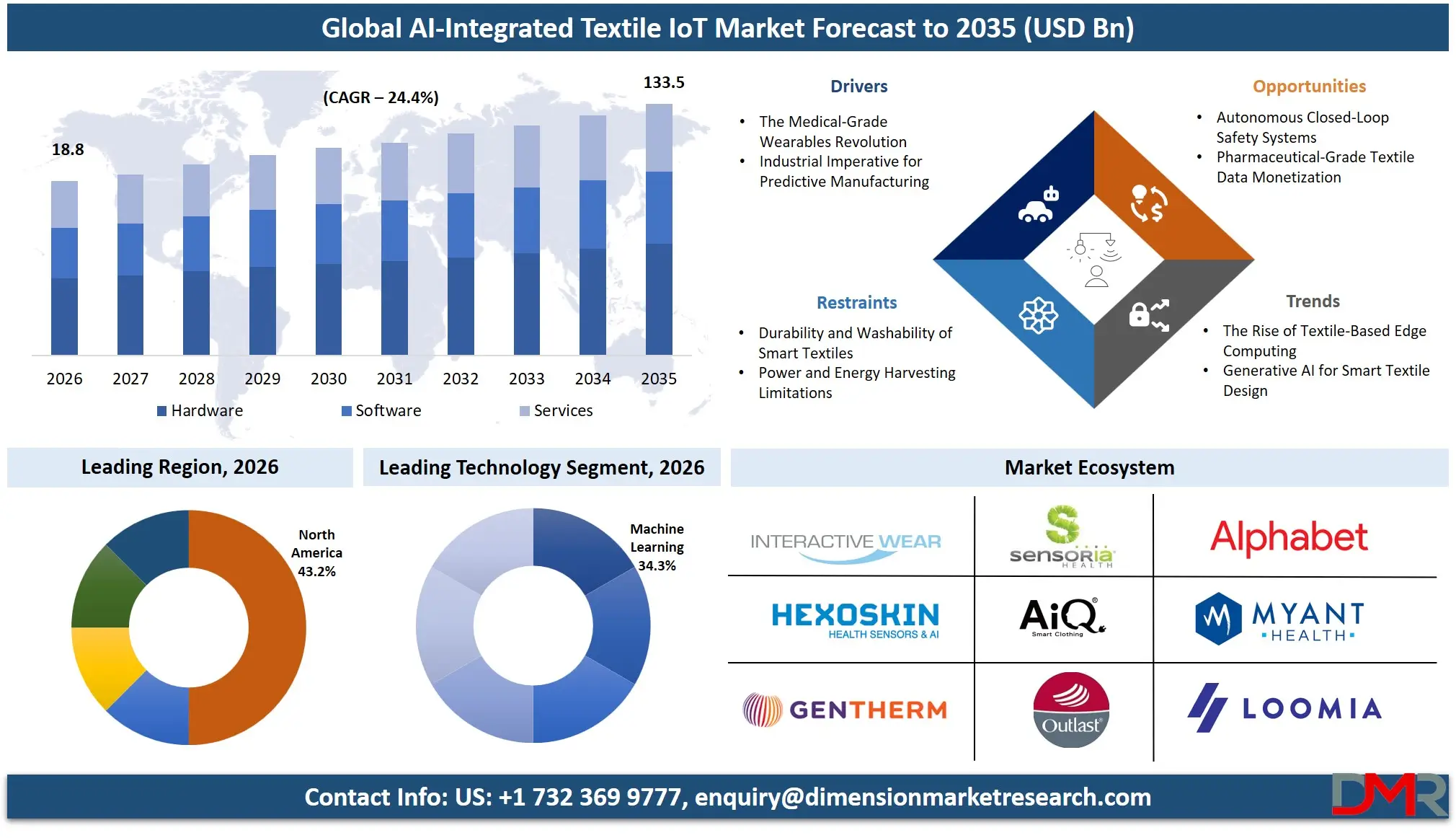
The Global AI-Integrated Textile IoT Market is expected to reach a value of USD 18.8 billion in 2026, and it is further anticipated to reach USD 133.5 billion by 2035, growing at a CAGR of 24.4% during the forecast period.
ℹ
To learn more about this report –
Download Your Free Sample Report Here
The AI-Integrated Textile IoT market is a fusion of cutting-edge materials science, edge computing, and artificial intelligence, resulting in a new generation of smart textiles capable of sensing, responding, and communicating. This market includes Hardware like Conductive Fibers & Fabrics, Sensors, and Wearable Modules integrated into textiles or apparel, alongside Software such as AI Analytics Platforms and Cloud-Based Textile Intelligence Systems for real-time data interpretation of biometric, environmental, and operational signals.
The fast-paced application of Active Smart Textiles & E-Textiles in healthcare, defense and manufacturing sectors is accelerating the demand for specific Services such as Integration & Deployment and Managed Services. With textiles becoming more than passive coverings and turning into active data generators, enterprises are pouring in huge investments in Predictive Analytics and Edge AI to process massive amounts of data generated by fabrics securely and in real-time.
ℹ
To learn more about this report –
Download Your Free Sample Report Here
The US AI-Integrated Textile IoT Market
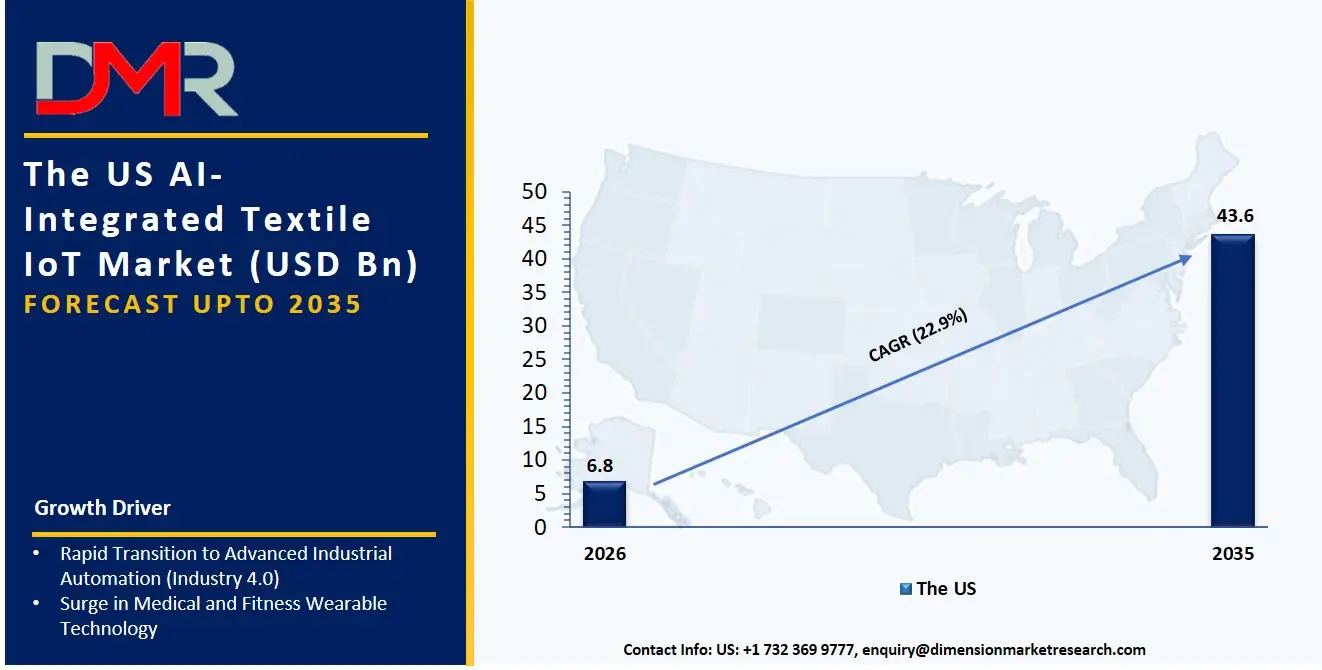
The US AI-Integrated Textile IoT Market is projected to reach USD 6.8 billion in 2026 at a compound annual growth rate of 22.9% over its forecast period, which is further poised to reach a value of USD 43.6 billion by 2035.
The US continues to lead this market with heavy defense department spending on smart uniform programs and smart wearables by key technology and apparel companies being quickly commercialized. The market is characterized by a high demand for Computer Vision systems to be integrated in textile manufacturing lines, allowing the detection of defects in the production of textile fabrics at sub-millimeter level in real time. Additionally, 5G Connected IoT textiles for professional sports and remote patient monitoring are driving a corresponding rise in demand for AI Analytics Platforms that deliver high-frequency biometric data processing capabilities in HIPAA compliant cloud-based textile intelligence systems.
ℹ
To learn more about this report –
Download Your Free Sample Report Here
The Europe AI-Integrated Textile IoT Market
Europe AI-Integrated Textile IoT Market is projected to be estimated at USD 4.9 billion in 2026 and is projected to reach USD 33.8 billion by 2035, growing at a CAGR of 23.9% during the forecast period.
The Europe market is expected to expand strongly and attain a significant valuation in 2026, as the region is a leader in luxury smart fashion and has strict industrial safety regulations. The GDPR compliance requirements have a strong influence in the European market, as it drives the demand for Edge AI solutions to process sensitive biometric data directly on the Wearable Module without transmitting raw signals to the cloud. In textile manufacturing plants, Predictive Maintenance Software is being adopted at a faster pace, with vibration and thermal Sensors installed in spinning and weaving machines, preventing catastrophic equipment failures in Germany and Italy. Also, the automotive industry in Germany is embracing Conductive Fibers & Fabrics for use in smart, interior vehicle components that alert drivers to their state of alertness, which drives demand for specialized Integration & Deployment services.
The Japan AI-Integrated Textile IoT Market
Japan AI-Integrated Textile IoT Market is expected to be estimated at USD 1.5 billion in 2026 and is projected to reach USD 11.2 billion by 2035, growing at a CAGR of 24.9% during the forecast period.
Japan's AI-Integrated Textile IoT Market is expected to exhibit notable growth, owing to the country's technological capabilities to develop miniaturized electronics and aging population. The Japanese market is special as they are mainly interested in Health Monitoring applications involving comfortable and washable E-Textiles with biosensors to continuously monitor cardiac and respiratory metrics for the elderly population who live alone. Another major area of demand for Computer Vision and Predictive Analytics in the manufacturing sector comes from Textile Manufacturers in Japan, where AI technologies are employed to automate the bid to traditional and technical textiles, and the notoriously complex quality inspection process. A very strong niche exists in the luxury apparel segment for integrating NFC Enabled RFID Tags & Smart Chips into garments for automatic retail checkout and for anti-counterfeiting, a combination of traditional craftsmanship and digital supply chain verification.
Key Takeaways
- Market Size & Forecast: The Global AI-Integrated Textile IoT market is projected to reach USD 18.8 billion in 2026, expanding exponentially to USD 133.5 billion by 2035, driven by healthcare consumerization and the digitalization of textile supply chains.
- Growth Rate & Outlook: Global market growth is expected at a CAGR of 24.4%, as miniaturization of flexible electronics is underway and the demand for Edge AI is steadily increasing to cater to complex data streams that do not require cloud latency.
- Primary Growth Drivers: Key forces include the transition from wearable gadgets to actual E-Textiles & Conductive Fabrics, the need for Predictive Maintenance to minimize downtime in high-speed looms, and the integration of computer vision for zero-defect quality control, among others.
- Key Market Trends: The increasing application of Ultra-Smart Textiles with self-adapting thermal properties, Computer Vision technology for automated textile grading, and the drive towards 5G Connected textiles for real-time telemetry on athletes are some of the major trends.
- By Deployment Mode Analysis: Cloud-Based models are expected to dominate data aggregation, but Edge AI is the critical co-requisite for latency-sensitive safety applications. Professional services are increasingly required to build Hybrid architectures that balance on-garment edge processing with centralized AI Analytics Platforms.
- By Application Analysis: Health Monitoring and Sports & Fitness Tracking are poised to dominate this segment as they are the most commercially mature applications due to consumer demand. Predictive Maintenance in Textile Manufacturing is the fastest-growing segment as industrial IoT retrofits legacy loom and knitting machinery with AI-driven vibration and acoustic sensors.
- Regional Leadership: North America is poised to dominate this market with 43.2% of the market share in 2026, as the region has a large share in defense & military spending for intelligent combat uniforms and an extensive network of wearable tech leaders and healthcare innovators.
What is the AI-Integrated Textile IoT?
AI-Integrated Textile IoT embodies the IoT of intelligent textiles, which are not only capable of sensing, computing, and communicating but are also an inherent part of the fabric. This market extends beyond "wearables" and includes Hardware such as Conductive Fibers, RFID Tags & Smart Chips and Edge Devices & Gateways which are woven or knitted into yarns and fabrics. The data from these smart structures is vast quantities of unstructured physical and biological data, that is processed by the use of specialized Software, including Predictive Analytics and AI Analytics Platforms. Fabrics can be a distributed sensor network, and professional Services are crucial for translating the textile signals into actionable intelligence, while maintaining the drape, comfort and washability expectations of the end user.
Use Cases
- Remote Cardiac Monitoring in Healthcare: Healthcare providers prescribe a washable active smart textiles with woven conductive ecg sensors and a connected edge device to cloud for remote cardiac monitoring in healthcare. AI analytics platforms process the data in real-time, identifying signs of AF and warning doctors before the event.
- Smart Soldier Lethality and Safety: Defense & Military organizations adopt Ultra-Smart Textiles into the combat uniform with embedded ballistic impact Sensors and LPWAN connectivity. The Edge AI instantly determines the location and severity of wounds, and the Big Data Analytics on the command post maps the location of the squad in real-time without detectable electronic signatures.
- Zero-Downtime Spinning Mills: Textile manufacturers install predictive maintenance software on ring spinning frames, which is integrated with vibration and acoustic sensors. Machine learning algorithms help predict bearing failures hours before they bring production to a halt, automatically scheduling maintenance shifts and preventing high cost damage to high speed spindles.
- Automotive Driver Monitoring via Smart Interiors: The Automotive industry incorporates conductive fibers in steering wheels and seat covers. These passive sensors, which are connected via Bluetooth/BLE, capture driver's heart rate, sweat and grip pressure. By combining this data, edge AI can identify driver drowsiness or medical issues and activate vehicle safety features to safely stop the vehicle on its own.
Market Dynamics
Key Drivers in the Global AI-Integrated Textile IoT Market
The Medical-Grade Wearables Revolution
The healthcare systems worldwide are facing a structural transformation towards continuous remote patient monitoring as a result of aging societies. In the healthcare environment, hospital networks are shifting from episodic spot check diagnostics to pro-activity health care and with comfortable, unobtrusive E-Textiles, real time data is captured. This shift sparks a growing need for clinically proven Conductive Fibers and AI Analytics Platforms that can accurately process continuous physiological waves to the medical standard, transforming smart textiles from a fitness novelty to a reimbursable medical necessity.
Industrial Imperative for Predictive Manufacturing
The textile manufacturing industry, which operates with thin margins and problems of labour scarcity, is in the process of aggressively embracing Industry 4.0. Vibration Sensors and Edge Devices & Gateways are no longer a choice, but a competitive requirement, to reach the goal of zero downtime, when implemented on legacy spinning, weaving, and knitting machines. To monitor high speed rotating machinery, avoiding catastrophic failures that can ripple along the supply chain, Predictive Maintenance Software powered by Machine Learning is essential for achieving lights-out manufacturing.
Restraints in the Global AI-Integrated Textile IoT Market
Durability and Washability of Smart Textiles
One of the main challenges facing mass commercialization is the lack of many E-Textiles that are able to withstand the mechanical and chemical stresses of normal industrial washing or household washing. Embedded Conductive Fibers and Wearable Modules may come apart or corrode or lose contact after multiple washings, significantly reducing the lifespan of the costly smart garments. These limitations of technical fragility are causing some hesitations in the procurement cycles of large-scale orders for the uniformed services and for healthcare providers, who demand exhaustive decontamination methods, before fully encapsulated, hermetically sealed textile architectures can be confirmed after thousands of wash cycles.
Power and Energy Harvesting Limitations
Active Smart Textiles and Ultra-Smart Textiles need constant power for the Edge Devices, Sensors and transmission modules, but battery technology is bulky and inflexible and can be a safety hazard when incorporated into flexible textiles. As there are no commercially viable options for energy harvesting from textiles, such as flexible photovoltaic yarns or triboelectric nano-generators that generate electricity from movement, designers are stuck with rigid lithium-polymer packs which not only detract from the comfort of the garment, but have to be recharged each night. Such "power constraint" is considered as the major limitation to the use of AI-enabled textiles in prolonged military deployments or extended patient monitoring systems where rechargeable devices are impractical.
Growth Opportunities in the Global AI-Integrated Textile IoT Market
Autonomous Closed-Loop Safety Systems
An exciting opportunity for growth is the development of AI systems that can respond by physically reacting to the garment. In industrial safety monitoring, E-textiles with embedded chemical sensors or accelerometers to detect toxic gas or a worker falling are in high demand, as they can trigger inflatable bladders for protection or call for emergency shutdown procedures for plants. Integration & Deployment service providers can monetize the value of these complex cyber-physical workflows by engineering them, creating an interface between the sensory textile data fabric and the programmable logic controllers (PLCs) in the facility through secure LPWAN gateways.
Pharmaceutical-Grade Textile Data Monetization
Pharmaceutical companies and clinical research organizations are looking for streams of continuous and objective data that can be used to measure the efficacy of drugs in the real world, not just in subjective patient diaries. This opens the door to Healthcare oriented Cloud Based Textile Intelligence Systems which rent out high fidelity, anonymised physiological textiles data to pharma companies to use for digital biomarker discovery. Managed Services providers can monetise the E-Textile hardware offering by providing a HIPAA compliant Data Brokerage platform as well, ensuring the textile sensor stream is HIPAA compliant and analytics ready for pragmatic clinical trial endpoints.
Trends in the Global AI-Integrated Textile IoT Market
The Rise of Textile-Based Edge Computing
For health and defense applications, where decisions are needed in real-time and privacy of data is paramount, the market is moving toward powerful Edge AI microcontrollers becoming part of the fabric architecture. Rather than piping raw gigabit sensor data to the cloud, these smart Conductive Fibers & Fabrics process and analyze the signal on body, sending only data-alerting info such as "arrhythmia detected" or "shooter location triangulated." This significantly decreases power usage, removes cloud latency and addresses GDPR/HIPAA compliance issues of data sovereignty, as raw biometric signals never leave the user's garment.
Generative AI for Smart Textile Design
Generative AI platforms are simulating the interplay between textiles and electronics, revolutionizing the design of AI-integrated textiles. Designers can specify their desired performance characteristics, including thermal conductivity, strain sensitivity, and drape, and the AI can produce new knit patterns and material combinations using Conductive Fibers. This reduces the time and expense of physical weaving trials by orders of magnitude to accelerate the prototyping cycle for Ultra-Smart Textiles, such as automotive smart interiors or space suit linings.
Research Scope and Analysis
The Global AI-Integrated Textile IoT market is driven by advancements in smart hardware, machine learning, active textiles, and cloud-edge integration. Growing adoption across healthcare, textile manufacturing, and industrial safety applications is accelerating demand for intelligent, connected, and data-driven textile ecosystems.
ℹ
To learn more about this report –
Download Your Free Sample Report Here
By Component Analysis
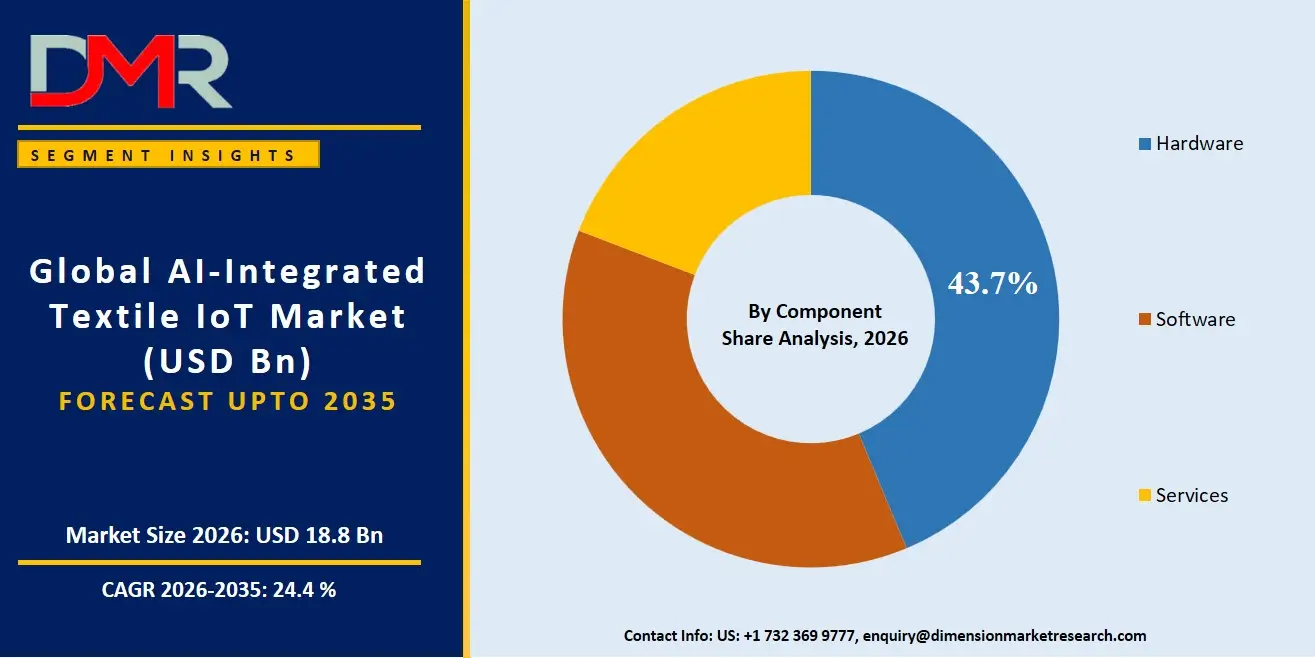
Hardware is expected to dominate the component segment in the market for Global AI-Integrated Textile IoT as it will provide the basic level of sensing and actuation which is a prerequisite for the existence of any intelligence. Conductive Fibers & Fabrics are emerging as the foundational technology, where passive yarns are replaced with electrical grids that generate data on pressure, strain, temperature, bioelectric signals and more, and can be integrated throughout the whole surface of garments. Additionally, Edge Devices & Gateways are especially sought after, given that they act as the crucial processing junction, acting as the point where raw analog signals from the distributed fabric Sensors are converted to filtered digital data streams for on-garment AI inference prior to sending alerts to other devices such as smartphones or other wearable devices (smart watches) using low-energy protocols like Bluetooth/BLE. However, if the hardware is not robust, miniaturized and flexible and can withstand washing and stretching, the entire software and services stack simply won't work and innovation in hardware is the biggest constraint and the biggest value driver in the ecosystem.
By Technology Analysis
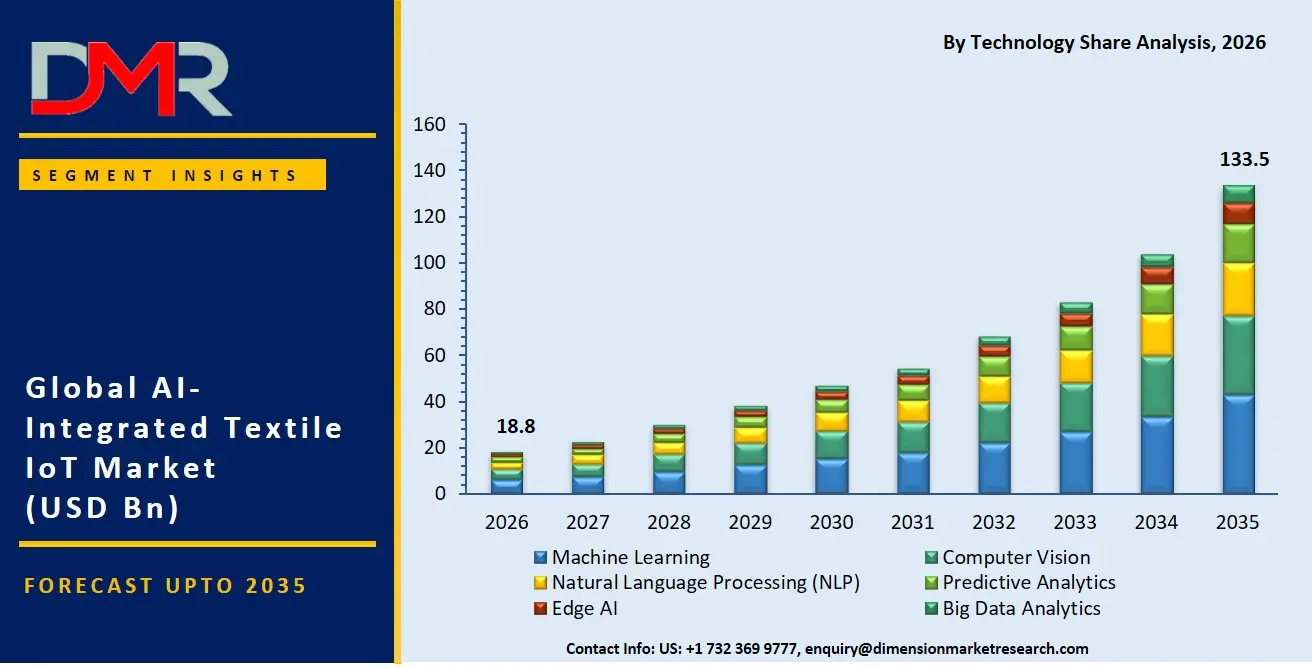
In terms of technology, Machine learning is projected to dominate this market due to its ability to serve as the principal analytical engine to decipher chaotic and low-signal data from fabric-based sensors. In contrast to traditional rigid sensors, body motion artifacts, sweat and fabric stretching make textile sensors create non-linear, noisy signals. Specialized ML algorithms trained with large datasets must be used to filter out the target biometric event (e.g., a specific cardiac arrhythmia) from this background noise. In manufacturing, ML is used to facilitate Predictive Maintenance Software, which can be used to detect unique acoustic patterns of a failing bearing, even in the midst of a textile mill's noise. Machine Learning is the most vertically pervasive technology segment, enabling the silent, continuous analytical heartbeat for health monitoring, industrial safety and physiological telemetry, while Computer Vision revolutionizes the visual inspection of fabrics.
By Textile Type Analysis
This segment is expected to be led by Active Smart Textiles, which offer an optimal blend of intelligent functionality and realistic manufacturing scaling. Passive Smart Textiles are designed to sense, whereas Active Smart Textiles include sensing elements and actuator function, meaning they are capable of detecting a stimulus (such as body heat or moisture) and responding by altering permeability, releasing a therapeutic substance or vibrating haptically. This provides more than just data logging and is useful for medical compression garments that adjust pressure dynamically, or garments that adjust thermal insulation according to ambient conditions. Although the concept of Ultra-Smart Textiles with embedded consciousness is aspirational, today's mass market is being led by Active systems that can offer a closed loop feedback, but that do not require the cost and complexity of full embedded micro-computing.
By Deployment Mode Analysis
The Cloud-Based deployment has projected to dominate this segment as deep analytics and fleet management because of the enormous amount of computational power that it offers to Big Data Analytics and longitudinal pattern recognition. With each garment producing gigabytes of waveform data every day, the only way to store and process this for millions of wearers and identify population level health trends or optimize predictive maintenance algorithms is through cloud services. But in terms of fabric computing, there is a need for Hybrid integration. In military or industrial environments, on-garment or on-premise Edge AI is essential to deliver real-time safety alerts with zero latency response. As such, Professional services are strongly oriented towards taking Hybrid approaches to workload distribution, with the ML inference engine being deployed locally to the textile where it provides immediate life protection, while metadata is encrypted and sent to the cloud-based textile intelligence system for historical analysis and algorithm retraining.
By Connectivity Analysis
The connectivity segment of AI integrated textiles is expected to be dominated by Bluetooth/BLE because of its universal connectivity with smartphones and ultra-low energy consumption, which is crucial for battery-constrained Wearable Modules and E-Textiles. It is the missing "personal area network" bridge that enables garments to stream processed health information directly to the users mobile device, and makes it easy for them to view, without the need of a dedicated infrastructure. For industrial and defense purposes, however, where range and freedom from network infrastructure are needed, a symbiotic system is evolving: BLE is used to link the garment to a tactical radio or edge gateway worn on the body, while LPWAN or 5G Connected modules provide the wide area backhaul to command centres. This opens up an opportunity for Integration & Deployment services to design multi-modal connectivity fabrics that seamlessly integrate between protocols.
By Application Analysis
Health Monitoring is anticipated to dominate the market in terms of application, fueled by the growing burden of chronic diseases globally and the transition to value-based care. E-Textiles can record clinical-grade data on electrocardiograms, respiration and blood oxygen levels and have the advantage of being worn by the patient every day, contributing to the important goal of bringing diagnostic capabilities outside the hospital. Healthcare providers and insurers are reimbursing for remote patient monitoring services and it's the application segment that is powered by them. The fastest growing application is a close, but separate, growth vector like predictive maintenance in textile manufacturing. The manufacturing floor is becoming a data-generating ecosystem, capable of processing vibration, thermal and acoustic signals from thousands of Sensors installed on the fabric, which facilitate the prevention of unscheduled downtimes and optimization of the full textile production value chain from spinning to finishing with the help of Edge AI.
By End User Analysis
In the end-user landscape, textile manufacturers is projected to stand out as the leading segment, with the complete transformation of the production floor from an artisanal and labor-intensive process to a lights-out operation with the help of AI-integrated IoT. As manufacturers come under existential threat from soaring labour costs and the need for speed in fast-fashion, they are launching armies of Sensors, Computer Vision cameras and Predictive Analytics software. This is then followed closely by Healthcare Providers as the most value-dense end-user segment as they may deploy fewer absolute units than a consumer sports brand, but the regulatory compliance, data security, and integration complexity of medical-grade E-Textiles can be the basis for multi-year, high-value Managed Services contracts. These two end users provide the majority of market value due to high density of the industrial sensors and high compliance of the medical applications.
The Global AI-Integrated Textile IoT Market Report is segmented on the basis of the following:
By Component
- Hardware
- Sensors
- RFID Tags & Smart Chips
- Conductive Fibers & Fabrics
- Edge Devices & Gateways
- Wearable Modules
- Software
- AI Analytics Platforms
- IoT Device Management Software
- Predictive Maintenance Software
- Data Visualization & Monitoring Platforms
- Cloud-Based Textile Intelligence Systems
- Services
- Consulting Services
- Integration & Deployment
- Maintenance & Support
- Managed Services
By Technology
- Machine Learning
- Computer Vision
- Natural Language Processing (NLP)
- Predictive Analytics
- Edge AI
- Big Data Analytics
By Textile Type
- Passive Smart Textiles
- Active Smart Textiles
- Ultra-Smart Textiles
- E-Textiles & Conductive Fabrics
By Deployment Mode
- Cloud-Based
- On-Premise
- Hybrid
By Connectivity
- Wi-Fi Enabled
- Bluetooth/BLE
- NFC Enabled
- LPWAN
- 5G Connected
- Cloud-Integrated IoT Textiles
By Application
- Health Monitoring
- Sports & Fitness Tracking
- Predictive Maintenance in Textile Manufacturing
- Supply Chain & Inventory Tracking
- Smart Fashion & Wearables
- Industrial Safety Monitoring
- Military & Defense Applications
- Automotive Smart Interiors
By End User
- Textile Manufacturers
- Apparel & Fashion Companies
- Healthcare Providers
- Sports & Fitness Industry
- Defense & Military
- Automotive Industry
- Industrial & Manufacturing Facilities
Regional Analysis
Leading Region by Market Share
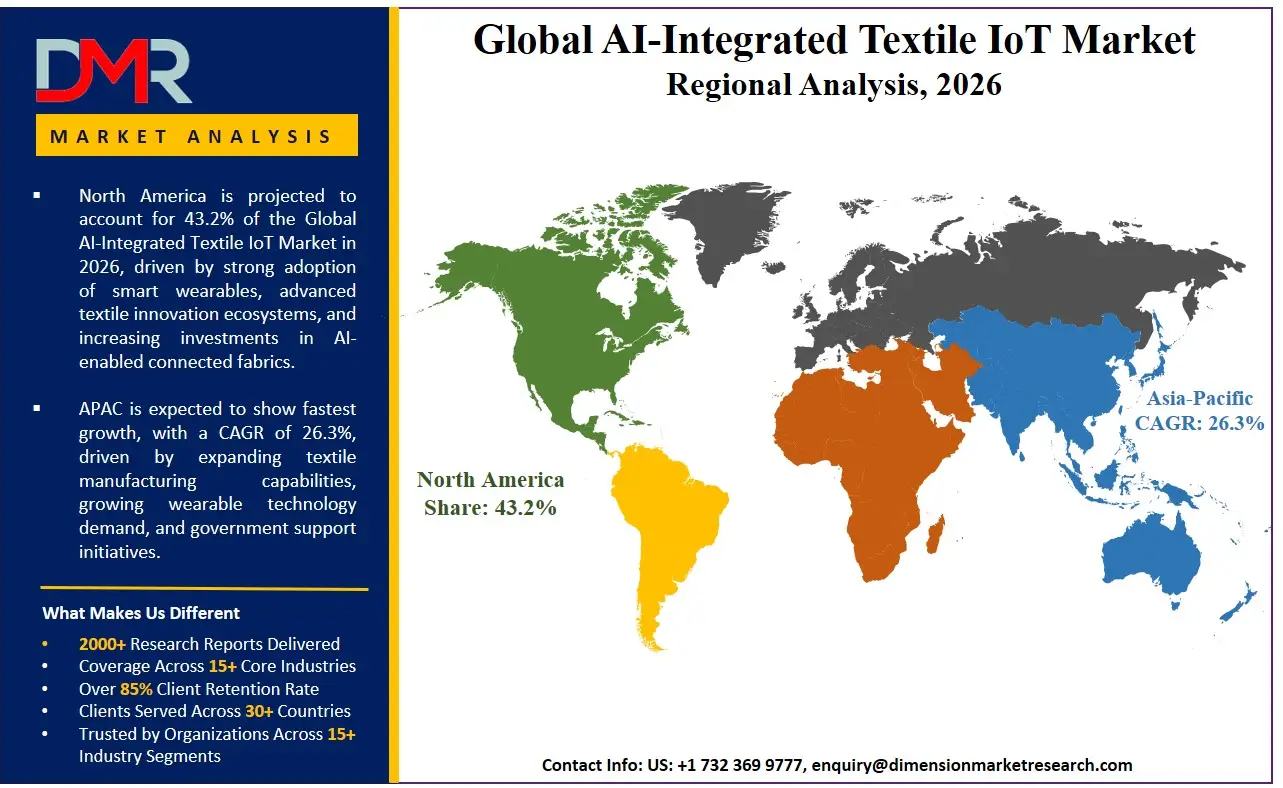
North America is projected to dominate the global AI-integrated textile IoT market with 43.2% of market share in 2026, owing to the presence of advanced digital infrastructure, high adoption rate of Industry 4.0 technologies and early adoption of AI-enabled smart manufacturing systems in the textile and apparel manufacturing plants in the region. Industrial automation, connected sensors, predictive analytics and smart factory solutions provide ample investments that focus on better operational efficiency, product quality and supply chain transparency in the region. The region's leadership is enhanced by the presence of leading technology developers, AI solution providers, and smart textile innovators. Furthermore, the rising demand for wearables smart textiles in the healthcare sector, defense, fitness, and sports is further propelling the market growth. Additionally, supportive government initiatives promoting digital manufacturing transformation and sustainability practices help drive the adoption of AI-powered IoT platforms across textile production ecosystems across North America.
ℹ
To learn more about this report –
Download Your Free Sample Report Here
Fastest-Growing Regional Market
Asia Pacific is anticipated to witness the fastest growth in the global AI-integrated textile IoT market as the region is witnessing rapid industrialization and a growing increase in textile production activities, coupled with the adoption of smart factory technologies in the emerging economies. There is significant investment in the area of AI-powered automation, connected machines and real-time production monitoring systems in countries like China, India, Japan and South Korea with the aim of improving efficiency and lowering the operational costs. The regional growth is further bolstered by the growing demand for intelligent wearables and smart fabrics, and digitally connected supply chains. Moreover, programmes by the government for digital manufacturing transformation and sustainable textile production are speeding the deployment of technologies. The region's textile industry, which is strong in the export sector, and the growing adoption of cloud computing, AI analytics, and IoT sensors continue to offer significant growth opportunities to market participants.
By Region
North America
Europe
- Germany
- The U.K.
- France
- Italy
- Russia
- Spain
- Benelux
- Nordic
- Rest of Europe
Asia-Pacific
- China
- Japan
- South Korea
- India
- ANZ
- ASEAN
- Rest of Asia-Pacific
Latin America
- Brazil
- Mexico
- Argentina
- Colombia
- Rest of Latin America
Middle East & Africa
- Saudi Arabia
- UAE
- South Africa
- Israel
- Egypt
- Rest of MEA
Competitive Landscape
The competitive environment of the global AI-Integrated Textile IoT market has become highly dynamic, featuring a complex matrix of traditional textile chemical giants, global technology conglomerates, flexible electronics pioneers, and specialized defense contractors. Success rests on the ability to bridge two historically disconnected worlds: the fashion and industrial textile supply chain, and the semiconductor and edge computing ecosystem. Key competitive dynamics involve deep co-engineering partnerships between Conductive Fibers producers and AI software companies to embed ML inferencing capabilities directly into the master batch of synthetic yarns. Market consolidation is accelerating as sports apparel brands acquire biometric sensor startups to internalize health monitoring IP, and industrial automation firms integrate niche Predictive Maintenance for textile machinery into their broader factory suites. Proprietary intellectual property, particularly around washable encapsulation of semiconductors and AI models trained on proprietary textile strain-and-drape datasets, forms the critical competitive moat.
Some of the prominent players in the Global AI-Integrated Textile IoT Market are:
- DuPont
- Toray Industries, Inc.
- Jabil Inc.
- Gentherm Incorporated
- AiQ Smart Clothing Inc.
- Sensoria Health Inc.
- Alphabet Inc. (Jacquard)
- Interactive Wear AG
- Outlast Technologies GmbH
- Hexoskin
- Myant Inc.
- Loomia Technologies
- Xenoma Inc.
- Ohmatex ApS
- Schoeller Textiles AG
- Textronics Inc.
- Wearable X
- Kolon Industries Inc.
- Adidas AG
- NIKE, Inc.
- Other Key Players
Recent Developments
- January 2026: Dot Ai partnered with Wiliot to expand industrial Ambient IoT solutions, enabling AI-powered asset tracking, automated inventory management, and real-time supply chain visibility across intelligent textile manufacturing and connected production environments globally.
- August 2025: Textronics and Myant expanded AI-enabled smart textile developments supporting healthcare, sports, and fashion industries through IoT-connected wearable technologies, intelligent monitoring systems, and digitally integrated textile ecosystem innovations worldwide.
- May 2025: Siemens accelerated deployment of AI, machine learning, and Industrial IoT technologies to strengthen predictive maintenance, automation, and operational monitoring capabilities supporting intelligent textile manufacturing and connected industrial production infrastructure advancement globally.
Report Details
| Report Characteristics |
| Market Size (2026) |
USD 18.8 Bn |
| Forecast Value (2035) |
USD 133.5 Bn |
| CAGR (2026–2035) |
24.4% |
| The US Market Size (2026) |
USD 6.8 Bn |
| Historical Data |
2021 – 2025 |
| Forecast Data |
2027 – 2035 |
| Base Year |
2025 |
| Estimate Year |
2026 |
| Segments Covered |
By Component, By Technology, By Textile Type, By Deployment Mode, By Connectivity, By Application, and By End User |
| Regional Coverage |
North America – The US and Canada; Europe – Germany, The UK, France, Russia, Spain, Italy, Benelux, Nordic, & Rest of Europe; Asia-Pacific – China, Japan, South Korea, India, ANZ, ASEAN, Rest of APAC; Latin America – Brazil, Mexico, Argentina, Colombia, Rest of Latin America; Middle East & Africa – Saudi Arabia, UAE, South Africa, Turkey, Egypt, Israel, & Rest of MEA |
Frequently Asked Questions
How big is the Global AI-Integrated Textile IoT Market?
▾ The Global AI-Integrated Textile IoT market is poised to be valued at USD 18.8 billion in 2026 and is projected to reach USD 133.5 billion by 2035, driven by the universal need for remote health monitoring and the digitalization of textile manufacturing.
What is the CAGR of the Global AI-Integrated Textile IoT Market from 2026 to 2035?
▾ The market is expected to grow at a CAGR of 24.4% from 2026 to 2035, reflecting the rapid convergence of flexible electronics, edge AI, and the apparel and industrial textile sectors.
What factors are driving the growth of the Global AI-Integrated Textile IoT Market?
▾ Key drivers include the clinical shift to remote patient monitoring via E-Textiles, the industrial imperative for Predictive Maintenance in textile factories, and defense investments in intelligent soldier systems.
Which region held the largest share of the AI-Integrated Textile IoT Market in 2026?
▾ North America, specifically the United States, is poised to h0ld the 43.2% of market share in 2026, driven by massive Defense & Military spending on smart fabrics and the presence of a mature healthcare and wearable technology innovation ecosystem.
Which region is expected to grow the fastest in the AI-Integrated Textile IoT Market?
▾ The Asia-Pacific region is expected to grow the fastest, fueled by the massive textile manufacturing base in China and India adopting Computer Vision and Predictive Analytics to remain globally competitive, alongside Japan's advanced elderly care robotics programs.
What are the major trends in the Global AI-Integrated Textile IoT Market?
▾ Major trends include the shift toward Edge AI processing embedded directly in fabrics for privacy and low latency, the use of Generative AI to design novel conductive knit structures, and the development of 5G Connected smart uniforms for real-time warfighter telemetry.
Who are the key players in the Global AI-Integrated Textile IoT Market?
▾ Key players include specialized conductive yarn producers, flexible electronics manufacturers, major sportswear and apparel companies with internal wearable divisions, defense primes, and the industrial IoT divisions of cloud hyperscalers providing AI Analytics Platforms and Cloud-Based Textile Intelligence Systems.
How is the Global AI-Integrated Textile IoT Market segmented?
▾ The market is segmented by Component, Technology, Textile Type, Deployment Mode, Connectivity, Application, and End User.