What is the AI-Powered Desalination Market Size?
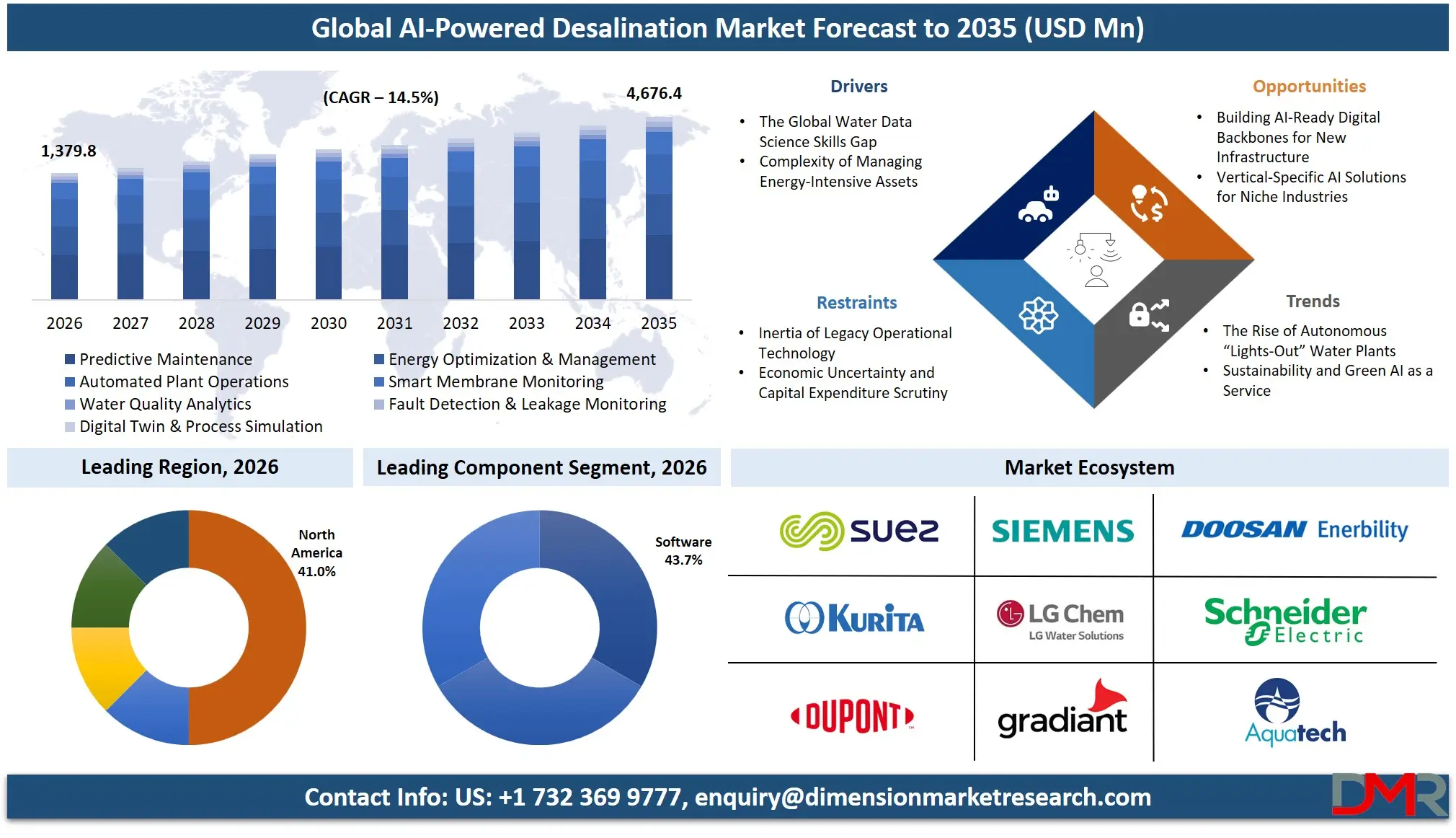
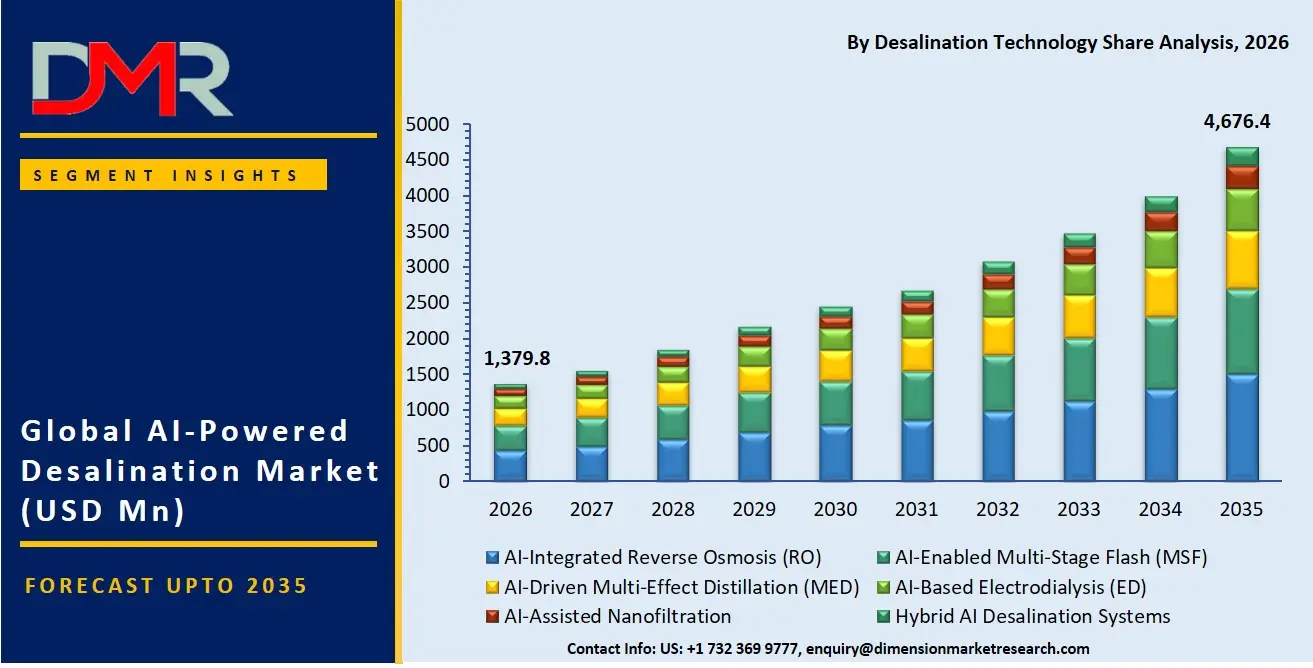
The Global AI-Powered Desalination Market is expected to reach a value of USD 1,379.8 million in 2026, and it is further anticipated to reach USD 4,676.4 million by 2035, growing at a CAGR of 14.5% during the forecast period.
ℹ
To learn more about this report –
Download Your Free Sample Report Here
The AI-powered desalination market has been growing at a high rate with water utilities and industries increasing the pace of digital transformation and transitioning out of manually operated, inefficient legacy infrastructure to intelligent, autonomous water treatment facilities.
The market can be segmented on the basis of Hardware, Software, and Services, each of which supports and optimises the membrane based and thermal desalination process for organizations. New requirements to adopt predictive maintenance, real-time energy optimisation, automated plant management and artificial intelligence-based water quality analysis are leading to the need for specific professional services and sophisticated technologies. Cloud deployment and AI-Integrated Reverse Osmosis (RO) are the most common, and the most popular are municipal water utilities, which can easily scale up. The municipal, industrial (oil & gas, power generation, semiconductor manufacturing), and agriculture sectors are key players as they need secure, compliant, and highly available water supply ecosystems.
ℹ
To learn more about this report –
Download Your Free Sample Report Here
The US AI-Powered Desalination Market
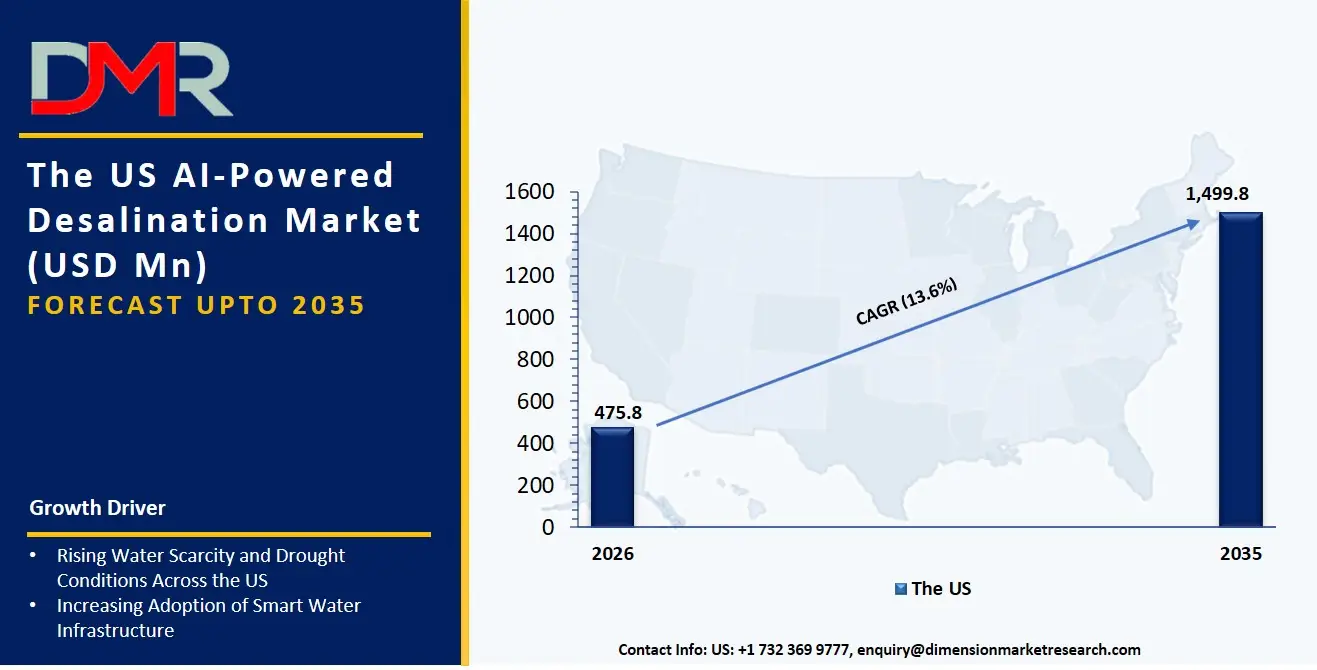
The US AI-Powered Desalination Market is projected to reach USD 475.8 million in 2026 at a compound annual growth rate of 13.6% over its forecast period, culminating in a value of USD 1,499.8 million by 2035.
The US remains the biggest and most advanced market for AI-based desalination technologies, with modernization efforts by drought-stricken states such as California, Texas and Florida, as well as the wide deployment of more sophisticated desalination plants. The market has been typified by high demand for Predictive Maintenance Software whereby organizations are aimed at preventing costly downtime of high-pressure pumps and membranes. Besides, the implementation of Digital Twin & Process Simulation tools in desalination workflows is producing a similar need in Consulting Services to manage the integration of complex data models and operational technology (OT) security frameworks.
ℹ
To learn more about this report –
Download Your Free Sample Report Here
The Europe AI-Powered Desalination Market
The Europe AI-Powered Desalination Market is estimated to be valued at USD 382.0 million in 2026 and is further anticipated to reach USD 1,270.0 million by 2035 at a CAGR of 14.0%. Regulatory measures such as the Industrial Emissions Directive and water abstraction charges play a major role in the European market and are a major incentive for the use of Energy Optimization & Management solutions and consulting services for compliance with the circular economy. Accelerated growth of AI-enabled desalination for wastewater & recycled water applications is also being experienced in the region, as manufacturing and agricultural industries in Spain, Germany, and the Netherlands try to strike a balance between water security and operational costs. In addition, efforts to build water-resilient smart cities are challenging service providers to create dedicated Installation & Integration Services for providing interoperability across existing municipal SCADA systems and new AI analytics platforms.
The Japan AI-Powered Desalination Market
The Japan AI-Powered Desalination Market is projected to be valued at USD 145.0 million in 2026. It is further expected to witness robust growth, holding USD 462.0 million in 2035 at a CAGR of 13.2%. Japan's market is special in that both the companies and the government are pushing for Society 5.0 to deal with a shrinking workforce and aging water infrastructure. A significant proportion of the expenditure is on Consulting Services and Smart Control Systems, with large conglomerates and municipal authorities moving from manually operated water treatment plants to autonomous, AI controlled systems. The need to integrate deeply in the local market to fill in the gap between old Programmable Logic Controllers (PLC) and Industrial Control Systems (ICS) up to new Cloud AI Analytics Platforms is great, also creating a niche in Fault Detection & Leakage Monitoring and workflow automation.
Key Takeaways
- Market Size & Forecast: The Global AI-Powered Desalination market is projected to reach USD 1,379.8 million in 2026, expanding to USD 4,676.4 million by 2035, driven by the rapid increase in water scarcity across the world and the necessity to modernize water treatment infrastructure.
- Growth Rate & Outlook: Global market growth is expected at a CAGR of 14.5%, as there are significant challenges related to in-house water data scientists, and the complexity of managing membrane fouling and energy consumption by dynamic AI algorithms is increasing.
- Primary Growth Drivers: The wide-spread push to reduce the energy footprint, the largest operational cost in desalination, by utilizing Energy Optimization & Management AI, the need for Consulting Services to design smart water plant retrofits, and the introduction of Predictive Analytics, which require specialized Hardware such as IoT Sensors, are the key drivers.
- Key Market Trends: Some of the significant trends in the market are the adoption of digital twin & process simulation technology for risk-free operator training and process refinement, AI-powered tools within smart membrane monitoring to auto-remediate fouling in real-time, and the evolution to cloud-based software platforms, as boards focus on operational resilience and data-driven sustainability reporting.
- By Deployment Mode Analysis: Cloud-Based models are projected to dominate enterprise conversations, as data centralisation requirements are central to most discussions and the advantages of remote operations are crucial. Seamless hybrid integration layers are now needed to integrate on-premise control systems with public cloud analytics engines, especially as professional services are increasingly being called on to create these layers.
- By End User Analysis: Municipal Water Utilities and Industrial end users (Oil & Gas and Semiconductor Manufacturing) are the most promising verticals because of the requirement for ultra-pure and reliable water. Agriculture & Irrigation is the fastest growing sector; precision farming necessitates Smart Meters and AI based water quality analytics for sustainable, resource efficient irrigation.
- Regional Leadership: North America is poised to dominate this market with 41.0% of the market share in 2026 as the region has a highly developed technological ecosystem that puts in the most effort to leverage this infrastructure, and make it the leader in this market, especially in solving the chronic water stress issue in the southwestern US.
What is the AI-Powered Desalination?
AI-Powered Desalination includes the specific technological components and advisory services provided by third-party experts, systems integrators and consultancies to help organizations throughout the life cycle of an intelligent water treatment plant. These are services and technologies which, while not part of the water but are linked to the how of operational optimisation. This includes not only Hardware, including IoT Sensors and Smart Control Systems, but also Software, such as AI Analytics Platforms and Digital Twins, to process and simulate this data, as well as Services, including Installation & Integration and Consulting, to plan a strategic roadmap. While 90% of new large-scale desalination plants implementation includes some level of digital control, AI-powered solutions are required to transform plant investments into a source of water security and efficiency, not technical debt and high operational cost, through cost governance, predictive asset health and energy-neutral targets.
Use Cases
- Predictive Maintenance in Semiconductor Fabs: A semiconductor manufacturing facility uses Vibrational IoT Sensors on high pressure pumps and Predictive Maintenance Software that uses AI to predict bearing failures weeks ahead of time, thereby avoiding unplanned downtime in ultrapure water production, which can be costly.
- Energy Optimization in Municipal Plants: A municipal water utility implements an AI Analytics Platform to dynamically optimize the pressure, and recovery rate, of the Reverse Osmosis (RO) membranes taking into account real-time electricity pricing and seawater salinity, reducing energy consumption by 15%.
- Smart Membrane Monitoring in Power Generation: AI Based Electrodialysis for cooling water treatment in a power generation plant, where the scaling events are detected at their early stages by continuous monitoring of the Smart Membrane. The AI self optimizes voltage and flow rates to prevent fouling and prolong membrane life.
- Automated Plant Operations for Agriculture: An agricultural irrigation district is connected to a Digital Twin & Process Simulation of its brackish water nanofiltration plant. The AI tries out new operational parameters in the simulation before transferring them to the physical Smart Control Systems, optimizing water recovery without putting any physical assets at risk.
Market Dynamics
Key Drivers in the Global AI-Powered Desalination Market
The Global Water Data Science Skills Gap
Global utilities and industrial companies are struggling to find the right talent with the skills in data science, membrane chemistry, and operational technology (OT) cybersecurity. The skills demanded are increasing faster than the number of skilled people and hence a structural shortage in the labor market has occurred. This is driving a shift to organisations trusting managed services or AI-powered software vendors over relying on an in-house data science team. These AI-powered technologies help in critical tasks such as predictive maintenance, energy forecasting, and remote monitoring, which are ongoing. Outsourcing such functions allows organizations to speed up their digital water transformation initiatives and minimize the chances of plant failures due to insufficient in-house analytics capacities.
Complexity of Managing Energy-Intensive Assets
Desalination plants are extremely energy-consuming, especially those employing thermal processes such as MSF and MED. The control of a variable process which is a balance of water quality, energy input and membrane health is highly complex. Various tools and standards should be used to ensure real time adjustment of pretreatment chemistry, pump operations, and post-treatment conditioning. Without the help of expert AI systems, this complexity can lead to inefficiencies, energy waste, and unnecessary wear on equipment. Thus, there is a growing need for AI Analytics Platforms and Digital Twin Software that can assist enterprises in operating in such dynamic environments.
Restraints in the Global AI-Powered Desalination Market
Inertia of Legacy Operational Technology
Most existing water utilities continue to use legacy Supervisory Control and Data Acquisition (SCADA) systems which are very customised and have been in use for many years and use air-gapped proprietary protocols. Even though AI could provide more efficiency, these outdated OT systems are a major hurdle when it comes to deployment of modern-day AI and digital twins. From a cybersecurity point of view, it may be complicated and dangerous to connect Smart Control Systems and IoT Sensors on secure unified network. When moving decades of non-digitized operational data across to a centralized Cloud-Based AI analytics platform, there's a lot of work to be done in the way of planning, testing and security hardening. Operational disruption or cyber attacks are a concern with many organizations. As a result, technical debt and legacy systems impede the assimilation of AI and often hinder or prevent the broader digital transformation initiative.
Economic Uncertainty and Capital Expenditure Scrutiny
Unstable economies and unpredictable business environments have caused organizations to be more hesitant to spend on new technology initiatives. Although autonomous operations are a strategic priority, plant managers are being pushed to prove an immediate return on investment for each hardware and software investment. Initial investments in IoT Sensors, Smart Control Systems and multi-year software licenses for AI Analytics Platforms are increasingly under the spotlight. Businesses now prefer to be in short, Service-oriented projects that deliver immediate operational results such as a specific piece of Consulting Services for energy reduction. Long-term Digital Twin and full AI integration efforts will be more likely to be postponed until providers can prove a definite short-term return on investment, such as chemical or energy savings. This change is compelling technology vendors to be more performance-driven and results-oriented.
Growth Opportunities in the Global AI-Powered Desalination Market
Building AI-Ready Digital Backbones for New Infrastructure
National oil companies and municipal utilities are among the key growth opportunities in the market, where they can benefit from AI solutions that enable the establishment of secure, cloud-native AI environments for new mega-desalination projects. Many governments, especially in the Middle East and Asia, are developing greenfield facilities, and want their own AI platform that is tailored to their local water salinity and energy mix. A series of specific skills are required for developing these sophisticated environments, including those of Installation & Integration, setting up Digital Twins, and creating custom Water Quality Analytics dashboards. Based on this, system integrators can help organizations create scalable, secure AI ecosystems for fully Autonomous Plant Operations, starting day one. This is a space with the potential to generate strong needs for very specific consulting and implementation services.
Vertical-Specific AI Solutions for Niche Industries
The need for integrating both water treatment expertise and deep knowledge of specific industries is driving growth as AI vendors create solutions tailored to a particular sector. These include water-for-injection systems for the Pharmaceutical industry, food & beverage process water systems, and acid mine drainage treatment systems for mining. Businesses in the Semiconductor Manufacturing and Oil & Gas industries have to comply with strict regulations and specific manufacturing requirements. Thus, they require for implementation partners that comprehend the desalination technology and the industry's compliance framework. Professional service providers and software developers can potentially enhance the integration of AI-Assisted Nanofiltration systems with current plant controls, compliance with FDA or industry standards, and customization of Digital Twin & Process Simulation workflows, thereby adding value to the product.
Trends in the Global AI-Powered Desalination Market
The Rise of Autonomous "Lights-Out" Water Plants
Water plants are becoming more and more self-sustaining with the rise of "lights-out" plants. The use of autonomous plant operation is gaining greater acceptance as a way of replacing the conventional 24/7 manned control room. Plant owners are building integrated control rooms, managed by AI, instead of relying on the reaction of operators, chemists, and maintenance personnel to alarms. These platforms allow for autogenous réagage against fouling, self-tuning chemical dosing and AI-supported energy procurement. In response to this, the market offers know-how and solutions related to Smart Control Systems, monitoring, automation and performance optimization. This "Lights-Out" model is particularly attractive for Defense & Marine applications and remote municipal installations.
Sustainability and Green AI as a Service
Environmental sustainability is another important characteristic of desalination, where companies are being forced to become 'Net-Zero' and reduce the impact of brine disposal. AI strategies that increase water output in a way that clearly reduce the energy and chemicals footprint are now interested by businesses. This has brought about the need for AI-driven Energy Optimization & Management consulting services. Energy-efficient configurations of the RO membrane are selected by professional service providers to help organizations maximize their RO system efficiency, while integrating renewable energy sources with the proper pump schedule and the use of intelligent chemical dosing to reduce waste. This is a "Green AI" strategy which is turning into a key competitive advantage.
Research Scope and Analysis
The global AI-powered desalination market is witnessing strong growth driven by increasing adoption of AI-based software, cloud deployment, reverse osmosis technology, seawater desalination, energy optimization applications, and rising investments by municipal utilities in smart and sustainable water infrastructure solutions worldwide.
ℹ
To learn more about this report –
Download Your Free Sample Report Here
By Component Analysis
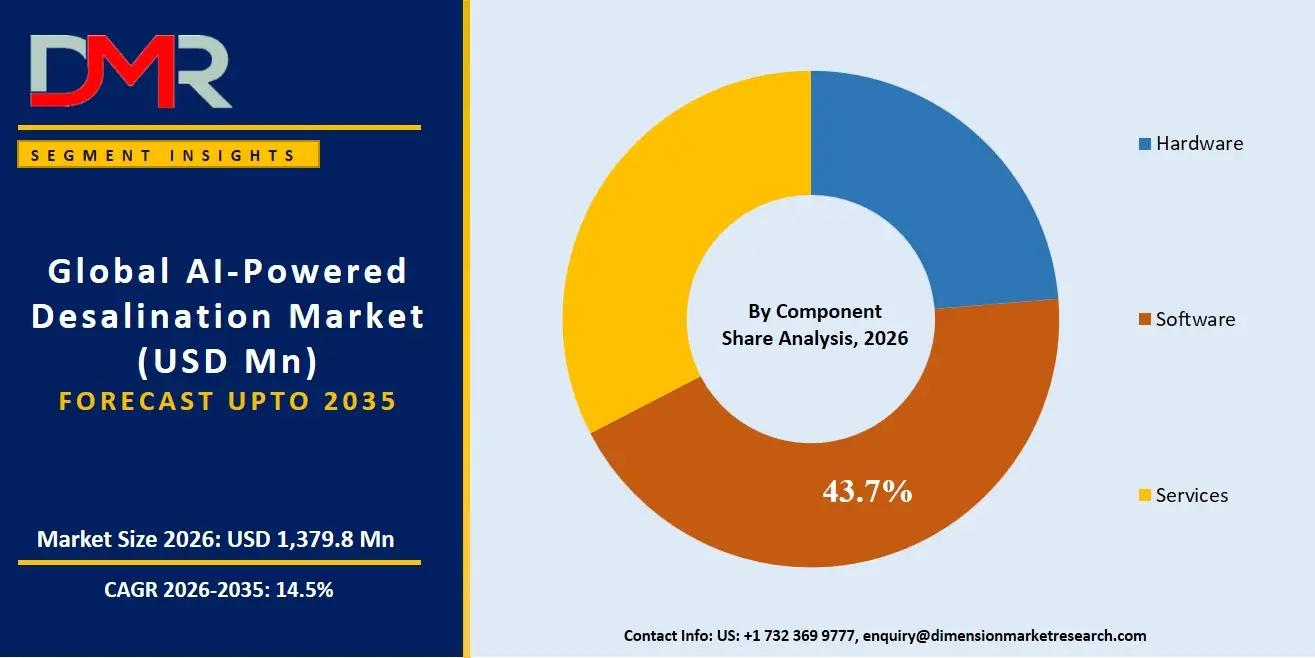
In terms of components, the software segment is poised to hold the largest share in the global AI-powered desalination market, as the demand for intelligent analytics, plant optimization automation, and predictive management grows. AI analytics platforms and monitoring software are being widely used to lower operational costs, extend the lifespan of membranes and optimize the use of energy in desalination plants. Digital twin software and predictive maintenance tools have been taking off as operators seek to reduce downtime and enhance plant efficiency. But physical elements like IoT sensors, smart meters, and energy recovery devices are still critical for collecting real-time data and monitoring processes. Support services such as installation, integration, and maintenance are also growing steadily, given the growing deployment of AI-powered infrastructure by utilities. The software leadership of water desalination operations in the global marketplace, powered by AI, is continuing to increase, as water utilities and industrial water treatment facilities are increasingly digitizing.
By Deployment Mode Analysis
Cloud-based deployment is an expected to be rhe leader of the deployment mode segment, because of its scalability, minimal initial infrastructure, remote access, and support of large amounts of operational data in real time. Cloud platforms are now the go-to choice for desalination operators for centralized monitoring, forecasting, AI model training, and cross-site management. Cloud systems can also assist with the constant software upgrades and simplified integration of IoT devices and smart sensors deployed throughout desalination facilities. In the industrial and municipal sectors, hybrid deployment models are becoming popular, offering a balance between data security and operational flexibility. Among sensitive government, defense, and critical infrastructure projects, on-premise remains relevant, with data privacy and security being top priorities. The growing adoption of digital water management solutions and industrial automation technologies are likely to further strengthen the cloud-based AI-powered desalination platforms' global dominance.
By Desalination Technology Analysis
AI-The desalination technology segment is projected to be led by AI integrated reverse osmosis (RO) technology due to its low energy consumption, high operational efficiency, and adoption in municipal and industrial desalination plants. AI technologies have a major impact on the performance of RO systems in terms of membrane optimization, predictive maintenance, pressure management and energy use. To minimize downtime and prolong the life of the membranes, there is a growing trend of incorporating machine learning algorithms and real-time monitoring systems into reverse osmosis plants. Multi-stage flash (MSF) and multi-effect distillation (MED) technologies remain relevant in areas where energy resources are available, especially in the Middle East. In addition, hybrid AI-powered desalination systems are beginning to take hold, driven by the desire for operators to achieve greater efficiency and sustainability. However, cost effectiveness, scalability and technological maturity of reverse osmosis makes it the preferred desalination technology in the world, especially in large scale seawater desalination and smart water infrastructure projects.
By Water Source Analysis
The water source segment expected to be dominated by seawater because of the widespread use of coastal desalination plants, which are being installed to solve the problem of freshwater shortages in urban and industrial areas. AI-powered operational optimization and energy management systems are increasingly becoming a staple in seawater desalination systems, enabling countries with chronic water scarcity to better manage their operations. Seawater desalination plants benefit from AI technologies to enhance the efficiency of the membranes, prevent fouling, reduce energy requirements, and optimize chemical dosing. The brackish water desalination market is also one of the major market segments due to the low cost of treatment and rising applications in inland industrial processes. As the trend toward more sustainable wastewater management and circular water economy moves forward, wastewater and recycled water desalination are seeing increased adoption. Nevertheless, the high water demand and the reliance on seawater desalination for municipal water supply by large-scale infrastructure investments remain the most important water source market segment.
By AI Application Analysis
Energy optimization and management is anticipated to be the major application segment due to the fact that energy consumption is amongst the major operating expenses at desalination plants. AI-powered energy management systems enable real-time monitoring, load balancing, process optimization, and predictive analytics that significantly reduce electricity usage and operational expenses. AI algorithms are now increasingly being used by desalination plant operators to optimize the performance of pumps, membranes, and energy recovery systems, while ensuring efficient water production. Predictive maintenance and automated plant operations also are fast-growing areas as utilities strive to reduce downtime and enhance the reliability of their assets. Smart membrane monitoring and digital twin technologies are emerging to simulate the operational conditions and boost the performance of the plants. The need to reduce energy intensity and enhance sustainability in desalination processes, though, remains the most important application of AI worldwide.
By End User Analysis
The end user segment is projected to be led by municipal water utilities, as freshwater supplies are becoming scarce across the globe, populations are rising in urban areas, and governments are investing in large desalination plants. Increasingly, AI-driven solutions are being integrated into municipal desalination plants to streamline operations, cut down on energy expenses, assure compliance with regulations, and optimize water distribution systems. For public water systems that are responsible for a large treatment facility, AI is capable of predictive maintenance, automated operations, and water quality analysis. AI-powered desalination systems also are being used more often in industrial applications such as oil & gas, power generation, chemicals, and semiconductors, to guarantee a steady water supply for operations. Emerging growth areas include agriculture, defense and commercial facilities, with increasing water reuse initiatives and sustainability goals. However, the need for vast quantities of potable water and public infrastructure construction persists and will continue to keep municipal utilities as the key end-user segment around the world.
The Global AI-Powered Desalination Market Report is segmented on the basis of the following:
By Component
- Hardware
- IoT Sensors
- Smart Meters
- Pumps & Energy Recovery Devices
- Smart Control Systems
- Software
- AI Analytics Platforms
- Monitoring & Automation Software
- Predictive Maintenance Software
- Digital Twin Software
- Services
- Installation & Integration
- Consulting Services
- Maintenance & Support
By Deployment Mode
- Cloud-Based
- On-Premise
- Hybrid Deployment
By Desalination Technology
- AI-Integrated Reverse Osmosis (RO)
- AI-Enabled Multi-Stage Flash (MSF)
- AI-Driven Multi-Effect Distillation (MED)
- AI-Based Electrodialysis (ED)
- AI-Assisted Nanofiltration
- Hybrid AI Desalination Systems
By Water Source
- Seawater
- Brackish Water
- Wastewater & Recycled Water
- Surface Water
- Groundwater
By AI Application
- Predictive Maintenance
- Energy Optimization & Management
- Automated Plant Operations
- Smart Membrane Monitoring
- Water Quality Analytics
- Fault Detection & Leakage Monitoring
- Digital Twin & Process Simulation
By End User
- Municipal Water Utilities
- Industrial
- Oil & Gas
- Power Generation
- Mining
- Chemicals
- Food & Beverage
- Pharmaceuticals
- Semiconductor Manufacturing
- Agriculture & Irrigation
- Defense & Marine
- Commercial Facilities
Regional Analysis
Leading Region by Market Share
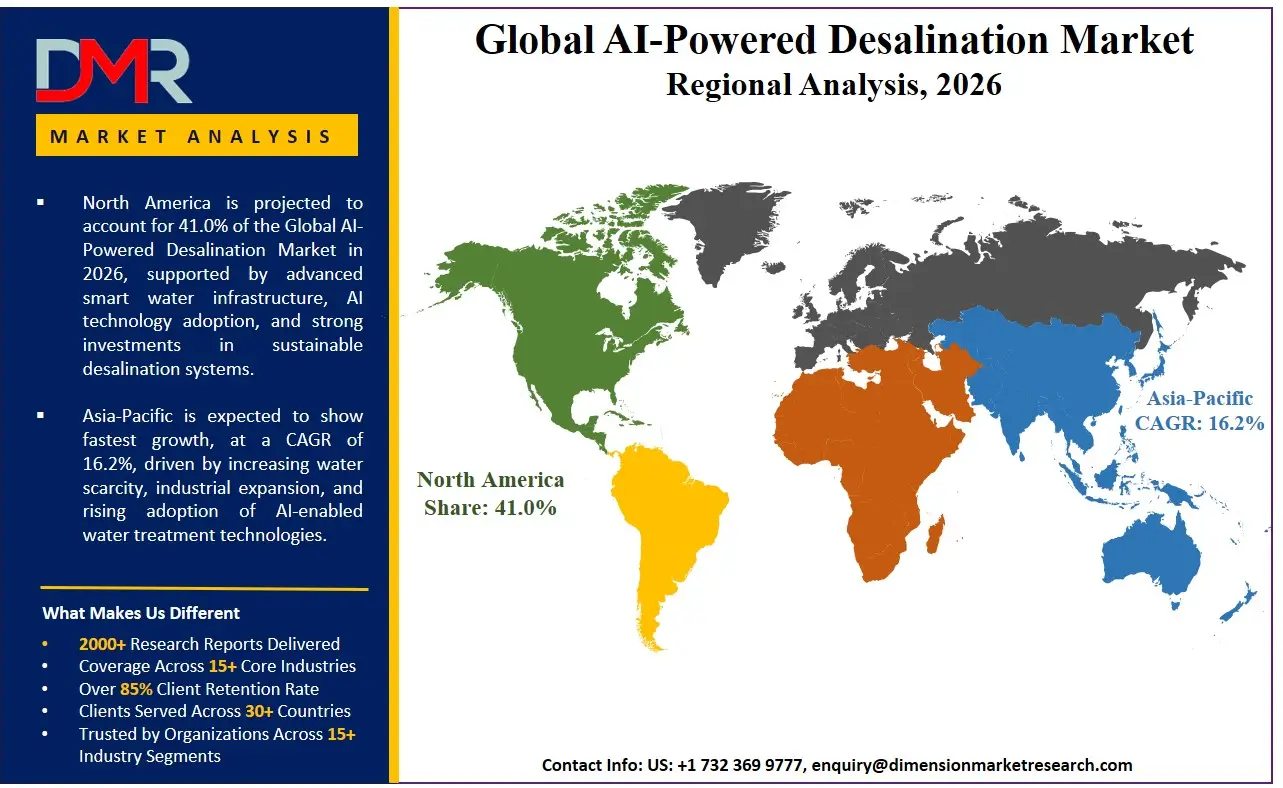
North America is poised to dominate the global AI-powered desalination market, as it is projected to hold a 41.0% share of the market by the end of 2026. The United States, which dominates North America, has the highest share in the market because of the unmatched concentration of advanced water innovation hubs and the aggressive climate resilience agendas of drought-prone states. The region already has a thriving global water technology integrator and boutique AI consultancy ecosystem and a deep talent pool in both water process engineering and data science. The demand for Hardware, Software and integration Services continues due to enterprise investment in Digital Twins, Water Quality Analytics – Advanced and the retirement of legacy SCADA Systems. Furthermore, a supportive venture capital environment continues to fund the next generation of water-tech startups that require professional services expertise to help them get to market quickly and seamlessly integrated into municipal controls.
ℹ
To learn more about this report –
Download Your Free Sample Report Here
Fastest-Growing Regional Market
Asia-Pacific is expected to experience the highest growth in the global AI powered desalination market as the region is witnessing high rate of urbanization, increasing scarcity of fresh water, industrialization, and awareness and investments towards smart water infrastructure. AI-powered desalination systems are taking center stage in countries like China, India, Singapore, and Australia, where they are being used to optimize operational efficiency, lower energy usage, and enhance membrane performance. In addition, the initiatives of the government on sustainable water management and the growing smart city projects are driving the deployment in both municipal and industrial sectors. The high presence of people along the coastlines and increasing demand for supply of freshwater has also boosted market growth. Moreover, growing partnerships among technology vendors, utilities, and research bodies are driving innovation in the Asia-Pacific predictive maintenance, real-time monitoring, and automatic desalination plant operation.
By Region
North America
Europe
- Germany
- The U.K.
- France
- Italy
- Russia
- Spain
- Benelux
- Nordic
- Rest of Europe
Asia-Pacific
- China
- Japan
- South Korea
- India
- ANZ
- ASEAN
- Rest of Asia-Pacific
Latin America
- Brazil
- Mexico
- Argentina
- Colombia
- Rest of Latin America
Middle East & Africa
- Saudi Arabia
- UAE
- South Africa
- Israel
- Egypt
- Rest of MEA
Competitive Landscape
The global AI-driven desalination market is now very dynamic, with a diverse mix of multinational water technology conglomerates, professional service arm of large industrial automation companies, and niche AI-startups focused on process optimisation. The success will depend on complex strategic relationships with key membrane manufacturers and EPC contractors – they will be able to offer access to the required go-to-market channels and plant-level operational data for algorithm training. The trend towards market consolidation is accelerating as traditional water treatment OEMs are buying AI engineering specialist boutiques and introducing a Software and Services component to their core Hardware business. More than simply installing sensors and providing simple data visualization solutions, proprietary IP such as validated AI models for predictive membrane fouling and industry-specific digital twin accelerators are increasingly establishing a competitive edge.
Some of the prominent players in the Global AI-Powered Desalination Market are:
- Veolia
- SUEZ
- DuPont Water Solutions
- Xylem Inc.
- IDE Technologies
- Toray Industries
- LG Water Solutions
- Aquatech International
- Kurita Water Industries
- Gradiant
- ACCIONA
- Doosan Enerbility
- Hitachi
- Siemens
- ABB
- Schneider Electric
- IBM
- Emerson Electric
- Honeywell
- Pentair
- Other Key Players
Recent Developments
- January 2026: Siemens revealed plans to open an AI Innovation Center for Desalination, and to provide their clients from the Semiconductor Manufacturing and Oil & Gas sectors with advanced installation and integration capabilities to create proprietary Digital Twin & Process Simulation models.
- November 2025: Schneider Electric further enhanced its partnership with Microsoft, launching Energy Optimization & Management and Smart Membrane Monitoring solutions for municipal water utilities that allow AI-driven analytics platforms to be kept while complying with regional data residency requirements for water critical infrastructure.
- October 2025: Xylem Inc. bought a European start-up focused on AI for anomaly detection, adding to its portfolio of consulting and automated plant operations, serving government and municipal customers that are looking for autonomous "lights-out" desalination and water treatment operations.
Report Details
| Report Characteristics |
| Market Size (2026) |
USD 1,379.8 Mn |
| Forecast Value (2035) |
USD 4,676.4 Mn |
| CAGR (2026–2035) |
14.5% |
| The US Market Size (2026) |
USD 475.8 Mn |
| Historical Data |
2021 – 2025 |
| Forecast Data |
2027 – 2035 |
| Base Year |
2025 |
| Estimate Year |
2026 |
| Segments Covered |
By Component, By Deployment Mode, By Desalination Technology, By Water Source, By AI Application, and By End Use |
| Regional Coverage |
North America – The US and Canada; Europe – Germany, The UK, France, Russia, Spain, Italy, Benelux, Nordic, & Rest of Europe; Asia-Pacific – China, Japan, South Korea, India, ANZ, ASEAN, Rest of APAC; Latin America – Brazil, Mexico, Argentina, Colombia, Rest of Latin America; Middle East & Africa – Saudi Arabia, UAE, South Africa, Turkey, Egypt, Israel, & Rest of MEA |
Frequently Asked Questions
How big is the Global AI-Powered Desalination Market?
▾ The Global AI-Powered Desalination market is poised to be valued at USD 1,379.8 million in 2026 and is projected to reach USD 4,676.4 million by 2035, driven by the universal need for specialized technologies to reduce energy costs, prevent downtime, and enable autonomous operation of water treatment plants.
What is the CAGR of the Global AI-Powered Desalination Market from 2026 to 2035?
▾ The market is expected to grow at a CAGR of 14.5% from 2026 to 2035, reflecting the accelerating complexity of water treatment processes and the persistent shortage of internal operational data science talent.
What factors are driving the growth of the Global AI-Powered Desalination Market?
▾ Key drivers include the global water crisis and energy costs, the imperative to modernize aging water infrastructure, the management complexity of scaling and fouling in membrane processes, and the surge in demand for Digital Twin & Process Simulation amid evolving regulatory scrutiny on brine and water quality.
Which region held the largest share of the AI-Powered Desalination Market in 2026?
▾ North America is poised to dominate this market with 41.0% market share in 2026, driven by a mature technology innovation ecosystem and aggressive municipal and industrial investment in Software and AI-driven operational capabilities.
Which region is expected to grow the fastest in the AI-Powered Desalination Market?
▾ Asia-Pacific is the fastest-growing AI-powered desalination market due to water scarcity, urbanization, industrialization, smart infrastructure investments, and increasing government sustainability initiatives.
What are the major trends in the Global AI-Powered Desalination Market?
▾ Major trends include the integration of Generative AI into operator training simulations, the rise of "Green AI" for sustainability reporting, the demand for industry-specific AI solutions (e.g., for ultrapure water), and the focus on fully autonomous "Lights-Out" plant operations.
Who are the key players in the Global AI-Powered Desalination Market?
▾ Key players include global water technology and automation leaders like Veolia, SUEZ, ABB, and Siemens, as well as specialized process simulation software firms and niche AI-scale-ups, alongside systems integrators bridging the IT/OT gap.
How is the Global AI-Powered Desalination Market segmented?
▾ The market is segmented by Component, Deployment Mode, Desalination Technology, Water Source, AI Application, and End User.