Market Overview
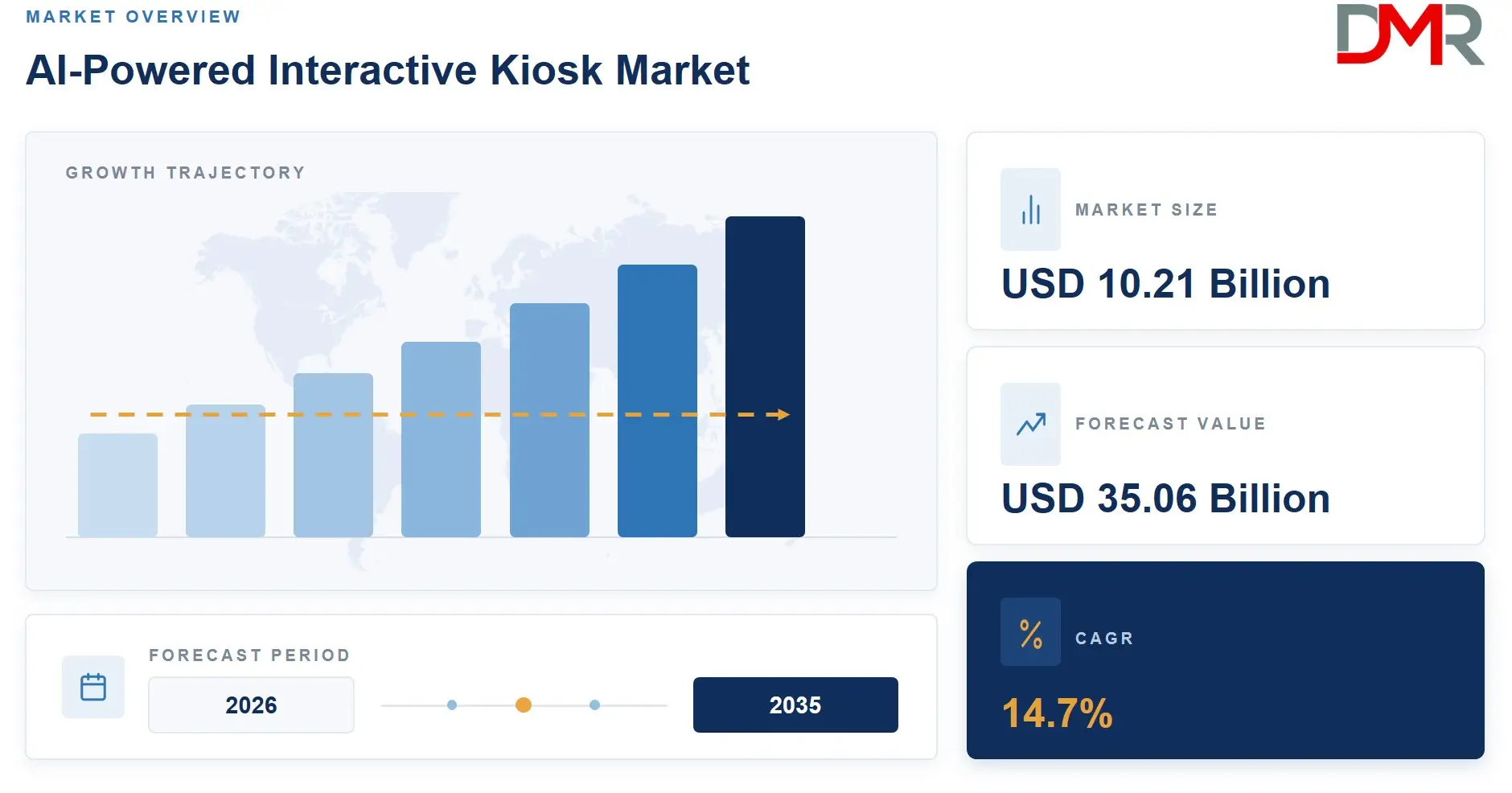
The AI-powered interactive kiosk market covers hardware, software, and services used to deploy self-service terminals that process transactions, deliver information, manage patient intake, and authenticate users without human agents. The market excludes passive digital signage, traditional ATMs without AI integration, and standalone point-of-sale terminals not embedded with machine-learning or computer-vision capabilities. A USD 10.21 Billion market in 2026, it sits at the intersection of enterprise automation, edge computing, and consumer-facing AI deployment.
Consumer acceptance has shifted faster than most operators anticipated. A March 2025 survey of 500 consumers found 72% were comfortable using in-store kiosks, up from 59% in March 2024, a 13-percentage-point gain in twelve months as reported by Tillster. That comfort gap between 2024 and 2025 compresses the timeline for operators still treating kiosk deployment as a future initiative rather than a current one.
MyVenue launched Halo in July 2026, a vision-based frictionless kiosk that identifies food and beverage products through cameras and accelerates checkout in high-traffic venues, signaling that the hardware-plus-AI integration cycle has moved beyond pilots. Retailers, healthcare networks, airports, and quick-service restaurant chains now compete on deployment speed rather than deployment intent.
Key Takeaways
- The market size is USD 10.21 Billion in 2026, and is projected to hit USD 35.06 Billion by 2035 at a CAGR of 14.7%.
- By Component: Hardware led as the largest category with a 63.3% share in 2026.
- By Kiosk Type: Self-Service Kiosks led with a 59.4% share in 2026.
- By Interaction Mode: Touch-based led with a 46.5% share in 2026.
- By Application: Automated Ordering led with a 25.6% share in 2026.
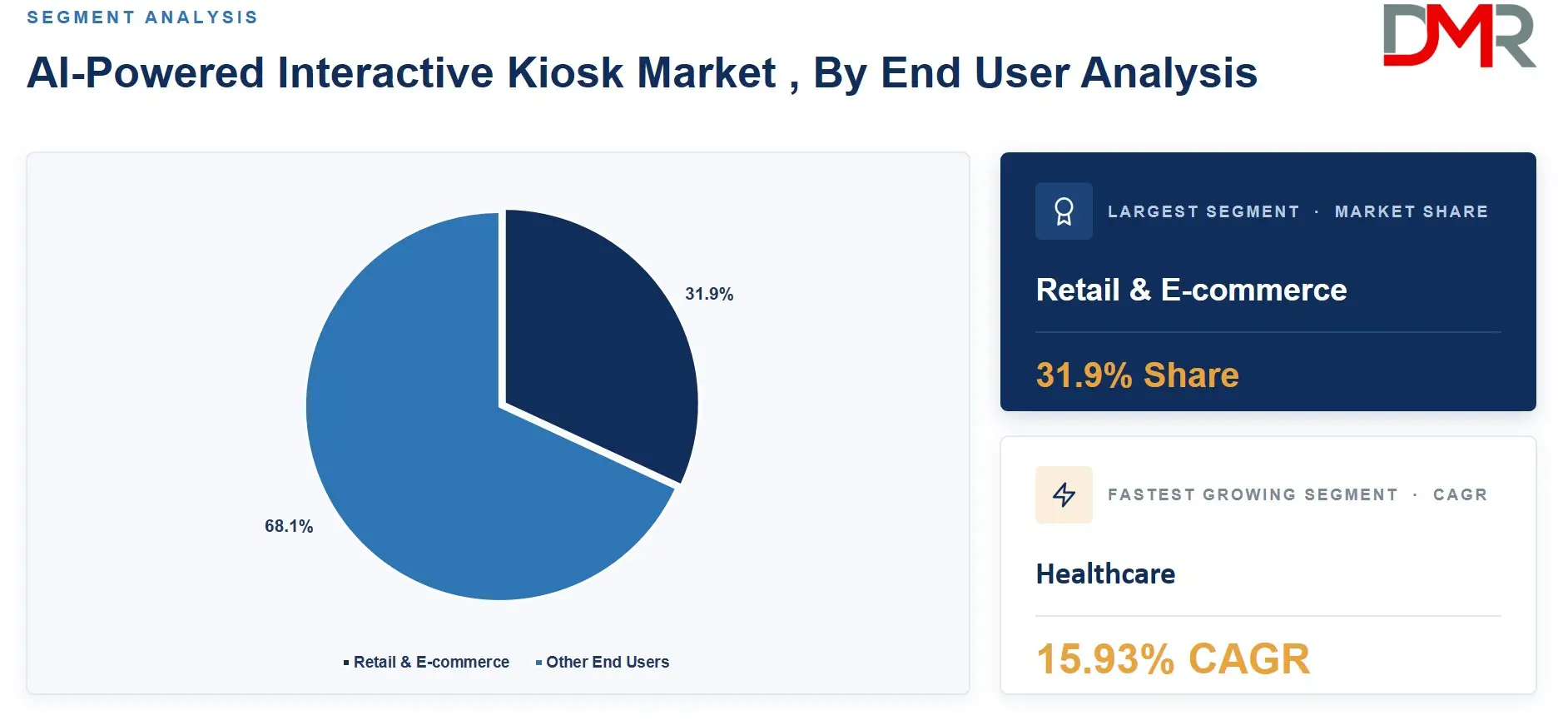
- By End User: Retail & E-commerce led with a 31.9% share in 2026.
- By Installation Type: Indoor led with a 71.7% share in 2026.
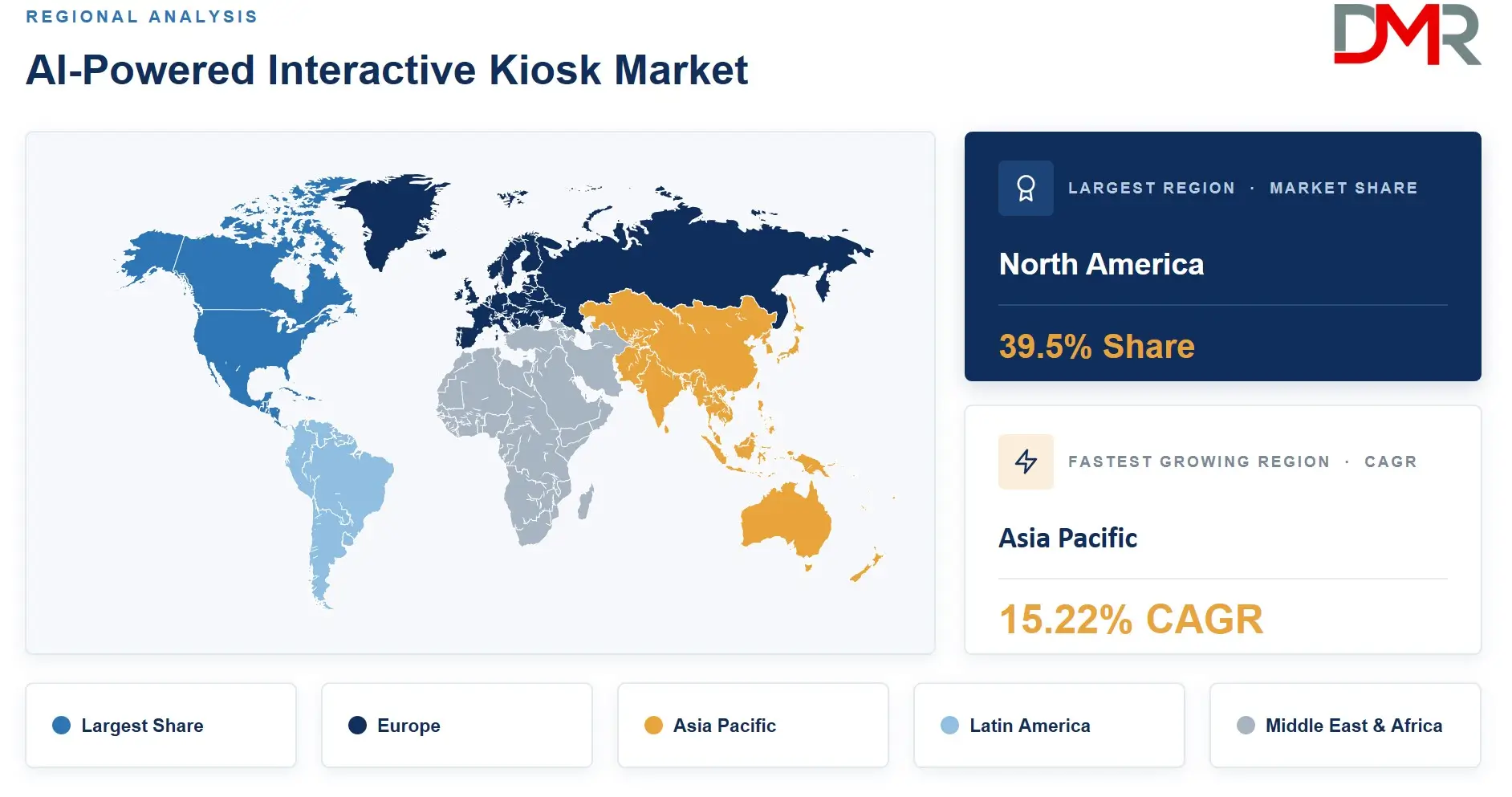
- By Region: North America led with a 39.5% share in 2026.
- Hardware dominates the component mix, reflecting the capital-intensive nature of purpose-built kiosk deployments across retail, healthcare, and transport environments.
Market Size and Forecast
The Global AI-Powered Interactive Kiosk Market size is estimated at USD 10.21 Billion in 2026, and is projected to reach USD 35.06 Billion by 2035, exhibiting a CAGR of 14.7% during the forecast period.
Growth between 2020 and 2024 was shaped by pandemic-era contactless mandates that accelerated self-service adoption across retail, healthcare, and transport. Operators who deployed kiosks to meet hygiene requirements discovered secondary gains in throughput and payment capture, which sustained investment well beyond the immediate public-health context. The forecast assumes continued wage pressure in frontline roles, expanded edge-AI chipset availability at lower cost, and rising enterprise willingness to sign multi-year kiosk-as-a-service contracts rather than own capital assets outright.
ℹ
To learn more about this report –
Download Your Free Sample Report Here
Downside risk centers on prolonged interest-rate environments that defer capital expenditure decisions among mid-market operators and independent restaurant groups. The upside scenario depends on regulatory clarity around biometric data and age verification, which would unlock broader deployment in age-restricted retail and healthcare pharmacy settings currently held back by compliance uncertainty.
Component Analysis
Hardware accounted for 63.3% of component demand in 2026, the highest of any category.
Physical hardware commands the majority of component revenue because purpose-built kiosk enclosures, displays, processors, sensors, cameras, and payment modules require substantial upfront capital before any software layer delivers value. A 2025 implementation guide published by TelemetryTV specified a 22-inch Full HD all-in-one touchscreen with an IP65-rated front panel, Wi-Fi 6, and Gigabit Ethernet as the baseline hardware configuration for an AI-enabled retail kiosk, illustrating that even entry-level deployments carry meaningful per-unit hardware costs.
Vendors connecting kiosks to cloud AI engines face a real constraint at the request level. The same 2025 guide noted that a sample ChatGPT integration limits each kiosk response to 100 tokens per query, a ceiling that shapes how software architects design conversation flows and determines where on-device versus cloud inference is economically rational. Software and services sub-segments are growing faster than hardware as operators seek recurring managed-services arrangements and cloud-managed content orchestration to reduce dependence on field-service visits.
Kiosk Type Analysis
Self-Service Kiosks led the Kiosk Type segment with a 59.4% share in 2026.
Self-service kiosks command the largest type share because food-and-beverage ordering and retail checkout represent the highest-volume, highest-frequency transaction environments for unattended interfaces. Quick-service restaurants and grocery retailers operate at scale where even modest per-transaction efficiency gains compound across millions of daily interactions, justifying hardware refresh cycles and software upgrade costs that smaller venue operators cannot absorb.
Information kiosks, ticketing kiosks, and check-in kiosks collectively represent the fastest-growing types within the remaining share. Airport wayfinding, digital concierge deployment, and hospital patient-intake units are expanding as operators recognize that AI-enabled guidance reduces staff burden at information desks with high footfall and repetitive query patterns. Patient engagement kiosks and AI-enhanced ATMs represent narrower but high-value niches where accuracy and compliance requirements create switching barriers that favor established vendors.
Interaction Mode Analysis
With a 46.5% share in 2026, Touch-based outpaced all other Interaction Mode categories.
Touch-based interaction leads because multi-touch and gesture-enabled screens map to existing consumer behavior built across smartphones and tablets over the past fifteen years. Operators face lower user-education costs with touch interfaces, which reduces friction at high-throughput venues where transaction speed per customer directly affects revenue per square foot.
Voice-enabled and vision-based modes are growing from a smaller base but carry strategic weight disproportionate to their current share. Natural-language processing capabilities allow multilingual interactions that touch menus cannot replicate, a capability gap that becomes commercially meaningful for airport, transit, and tourism deployments serving non-English speakers. Gesture-based and vision-based modes remain niche, but facial recognition and behavioral analytics are expanding their relevance in personalization and audience-measurement applications.
Application Analysis
Automated Ordering captured 25.6% of the Application segment in 2026, ahead of all rivals.
Automated ordering leads application share because restaurant and retail operators generate the largest installed base of kiosks, and ordering represents the primary transaction type at these venues. Upsell logic embedded in ordering kiosks converts browsing behavior into incremental revenue, making the ROI case faster to demonstrate than in information or wayfinding applications where transaction value is indirect.
Check-in and check-out applications are the next largest cluster, spanning hospitality, healthcare, and transportation. Patient management and ticketing applications represent high-growth segments where compliance requirements and operational complexity create demand for purpose-built AI workflows rather than generic ordering software. Information and advertising applications benefit from audience-measurement capabilities but depend on advertiser confidence in kiosk-based audience data, which remains a commercial constraint in 2026.
End User Analysis
A 31.9% share made Retail & E-commerce the clear leader across End User categories in 2026.
Retail and e-commerce operators lead end-user share because supermarkets, hypermarkets, convenience stores, and specialty retailers operate high-footfall environments where self-checkout and product-discovery kiosks deliver measurable labor-offset and basket-size benefits at scale. The segment's dominance reflects two decades of progressive self-checkout adoption now being upgraded with AI layers that personalize offers and accelerate payment processing.
ℹ
To learn more about this report –
Download Your Free Sample Report Here
Healthcare is the fastest-growing end-user segment. Hospitals and clinics facing capacity constraints and administrative backlogs are deploying patient check-in and intake kiosks as a primary throughput lever. Banking, financial services, and insurance operators are integrating AI into ATM and branch-service kiosks to reduce teller dependency at standard-transaction touchpoints. Hospitality and government end users represent smaller shares but are accelerating adoption as AI wayfinding and digital concierge capabilities mature.
Installation Type Analysis
Indoor led the Installation Type segment as the largest category in 2026, with a 71.7% share.
Indoor dominance reflects the concentration of kiosk deployments in controlled environments: shopping malls, airports, corporate offices, and hospital lobbies, where power access, environmental stability, and network connectivity simplify hardware specification and reduce maintenance complexity. Operators in these environments face lower weatherproofing and vandalism requirements, which compresses per-unit hardware costs and accelerates deployment timelines.
Outdoor installations are growing through smart-city pilot programs, drive-thru lane deployments, and transit-hub self-service points. Outdoor kiosks carry higher enclosure, screen-brightness, and thermal-management specifications, which keeps per-unit costs elevated and concentration among vendors capable of delivering IP65 or higher-rated units. As smart-city infrastructure budgets grow in Asia Pacific and the Middle East, outdoor share is expected to gain meaningfully through the forecast period.
Key Market Segments
By Component
- Hardware
- Displays
- Processors
- Sensors
- Cameras
- Payment Modules
- Software
- Conversational AI
- Computer Vision
- Predictive Analytics
- Services
- Integration & Deployment
- Managed Services
By Kiosk Type
- Self-Service Kiosks
- Food & Beverage Ordering
- Retail Checkout
- Information Kiosks
- Wayfinding
- Digital Concierge
- Ticketing Kiosks
- Check-in Kiosks
- Patient Engagement Kiosks
- Automated Teller Machines (ATMs)
By Interaction Mode
- Touch-based
- Multi-touch
- Gesture-enabled
- Voice-enabled
- Natural Language Processing (NLP)
- Gesture-based
- Vision-based
By Application
- Automated Ordering
- Check-in/Check-out
- Patient Management
- Ticketing
- Information & Advertising
By End User
- Retail & E-commerce
- Supermarkets & Hypermarkets
- Convenience Stores
- Specialty Stores
- Healthcare
- Hospitals
- Clinics
- Pharmacies
- Transportation & Logistics
- Airports
- Railway Stations
- Banking, Financial Services and Insurance (BFSI)
- Hospitality
- Government & Public Sector
By Installation Type
- Indoor
- Shopping Malls
- Airports
- Corporate Offices
- Outdoor
- Smart City Hubs
- Drive-thru Lanes
Regional Analysis
North America led all regions with a 39.5% share in 2026, the largest of any geography in the AI-powered interactive kiosk market.
North America
North America holds dominant share because the United States houses the largest concentration of quick-service restaurant chains, big-box retailers, and private hospital networks, all of which have approved multi-year kiosk deployment budgets. Wage inflation in U.S. food service and retail consistently exceeds the annualized cost of kiosk hardware and managed-services contracts, making the financial case for automation straightforward to approve at the board level. Canada follows a similar pattern at smaller absolute scale, with airport modernization and healthcare digitization programs adding institutional deployment volume.
Europe
European deployment is advancing through a different mechanism than North America. Germany's retail grocery sector, for instance, is integrating AI-powered age-verification and fresh-produce recognition at self-checkout, a compliance-driven application that would be optional in most U.S. jurisdictions but is commercially necessary in markets with stricter product-liability and age-restriction enforcement. The UK, France, and Benelux operators are expanding digital concierge and transportation kiosk infrastructure, supported by government co-investment in smart-city and transit modernization programs.
Asia Pacific
Asia Pacific represents the highest-growth regional opportunity. China's combination of dense urban retail, government-backed smart-city construction, and domestic AI hardware suppliers creates a self-reinforcing deployment cycle that Western vendors find difficult to enter at scale. Japan and South Korea lead in hospitality and transportation kiosk density per capita. India's healthcare system, managing patient volumes that exceed administrative staff capacity by a wide margin, is positioning patient check-in and intake kiosks as a structural fix rather than a pilot program.
ℹ
To learn more about this report –
Download Your Free Sample Report Here
Latin America
Latin America is an emerging deployment zone where Brazil and Mexico anchor regional volume. Airport privatization deals in both countries include digital-service upgrade mandates that favor kiosk deployment at passenger touchpoints. Adoption outside major airports and premium retail is constrained by infrastructure variability, but Kiosk-as-a-Service models that remove upfront hardware cost are accelerating entry for operators unable to commit to outright purchase.
Middle East & Africa
GCC nations, led by the UAE and Saudi Arabia, are deploying AI kiosks as part of national digital-transformation agendas tied to tourism, public-service modernization, and non-oil economic diversification targets. Multilingual kiosk capability is commercially critical in this region, where a single venue may serve speakers of Arabic, English, Hindi, and Tagalog simultaneously. Sub-Saharan Africa remains at an early stage, with South Africa as the primary market and financial-services kiosks leading initial deployments.
Key Regions and Countries
North America
Europe
- Germany
- France
- The UK
- Spain
- Italy
- Rest of Europe
Asia Pacific
- China
- Japan
- South Korea
- India
- Australia
- Rest of APAC
Latin America
- Brazil
- Mexico
- Rest of Latin America
Middle East & Africa
- GCC
- South Africa
- Rest of MEA
Macroeconomic Impact
Wage inflation in frontline service sectors across North America and Western Europe is the single macro force most directly accelerating kiosk adoption. When minimum-wage legislation pushes annualized labor costs above the total-cost-of-ownership of a managed-service kiosk contract, CFOs accelerate approval timelines without requiring additional operational justification. A 2025 HERMES AI-kiosk evaluation found that 100% of 11 medical professionals surveyed identified rapid recommendations as a primary efficiency benefit, and 90% agreed kiosks should complement rather than replace clinical staff, a consensus that reflects the labor-augmentation positioning operators use to manage workforce relations as reported by arXiv.
Interest-rate environments in 2024 and 2025 created a bifurcation in deployment pace. Large enterprise operators with investment-grade credit and multi-year capex plans continued deploying at scale. Mid-market operators and independent restaurant groups deferred hardware purchases, which accelerated demand for Kiosk-as-a-Service models that convert capital expenditure to monthly operating expense. Currency strength in the U.S. dollar relative to Asian manufacturing currencies kept hardware procurement costs favorable for North American buyers through the period.
Market Dynamics
Driver: Labor Scarcity and Consumer Self-Service Preference Converge
Frontline labor shortages are not a temporary cyclical condition. Restaurants, retailers, and healthcare operators have been unable to fill service roles at prior wage levels since 2021, and the structural gap between available workers and open positions has sustained the ROI case for autonomous customer-service interfaces through multiple economic cycles. Tillster's 2025 survey of 1,500 U.S. quick-service and fast-casual restaurant consumers found 61% wanted more ordering kiosks in restaurants, up from 57% in 2024 and 36% in 2023, indicating that preference is accelerating rather than plateauing as reported by Restaurant Dive.
Behavioral data reinforces the structural shift. Based on data from Tillster's 2025 restaurant-kiosk findings, 25% of surveyed consumers said they ordered from cashiers less frequently than in the prior year. Kiosk adoption, once treated as a consumer-education challenge, is now a self-reinforcing behavior pattern. Consult Red demonstrated in June 2026 an Android-based retail AI kiosk built on Qualcomm's Dragonwing IQ-9075, featuring an offline AI voice assistant and locally executed LLM capabilities, confirming that hardware suppliers are now embedding AI inference capacity directly into kiosk chipsets rather than relying solely on cloud connectivity.
Kiosk patient check-in at Pulmonary Associates reduced average check-in time to 2 minutes 16 seconds after implementation in 2025, as reported by Clearwave. Healthcare operators managing high patient volumes can now demonstrate a direct link between kiosk deployment and clinical throughput, a data point that moves the conversation from a technology investment to an operational necessity.
Restraint: Upfront Costs and Compliance Exposure Slow Mid-Market Adoption
Hardware procurement, systems integration, and lifecycle maintenance costs remain the primary barrier for operators outside the top tier. A fully specified AI-enabled kiosk enclosure with payment modules, computer-vision cameras, and managed-service connectivity carries a per-unit cost that requires a multi-year amortization assumption to justify on a per-transaction basis. Independent restaurant operators and single-location healthcare practices face financing terms that enterprise operators do not, which concentrates deployment among chains and health systems capable of multi-site rollouts.
Data-privacy and biometric-consent compliance adds a second layer of cost that is harder to quantify upfront. Scandit launched Age Verified Self-Checkout in July 2026 without requiring additional kiosk hardware, a product architecture choice that signals how vendors are responding to operator reluctance to commit to camera-equipped units subject to biometric data regulations. Operators in California, Illinois, and the EU face enforcement environments where a single compliance failure can generate costs that exceed the total value of a kiosk deployment program.
Opportunity: Healthcare Automation and Kiosk-as-a-Service Models Open New Revenue
Healthcare kiosk deployments are producing payment-capture results that change the financial calculus for hospital CFOs. Pulmonary Associates reported a 92% increase in co-pay collection after kiosk implementation, and Southview Medical Group achieved co-pay collection rates of up to 96% with patient self-service, as reported by Clearwave in 2025. Centers for Advanced Orthopaedics Division 28 sustained a 72% monthly co-pay collection rate, while Utah Cancer Specialists reached 90% patient adoption and a 63% monthly collection rate across the same evidence set. These figures represent a payment-recovery argument that CFOs can present to boards independently of any technology-adoption rationale.
Kiosk-as-a-Service models are dissolving the upfront-cost barrier for mid-market operators. KIOSK Information Systems and TRUEOMNI announced a strategic partnership in July 2026 to deliver AI-powered hospitality and self-service solutions incorporating voice, chat, digital concierge, and wayfinding capabilities under a bundled service model. Buyers who could not approve a capital purchase can now subscribe to an outcome-based commercial arrangement, expanding the addressable market beyond enterprise operators. Kiosk users who 76% said they had bought more than intended at least once confirm that upsell logic built into ordering interfaces generates incremental revenue that directly offsets subscription costs, as per Tillster's 2025 findings.
Porter's Five Forces
The competitive structure of the AI-powered interactive kiosk market is moderately concentrated at the hardware-integration layer and fragmented at the software and services layer. Barriers to entry are high for full-stack kiosk vendors because purpose-built hardware requires manufacturing scale, certified payment-module integration, and field-service networks capable of managing distributed fleets across multiple geographies.
A 2025 HERMES AI-kiosk evaluation reported a Jaccard similarity score of 0.4755 against a 0.4729 baseline for its medication-recommendation model, as reported by arXiv, illustrating that AI differentiation in specialized applications is real but narrow, which limits the moat any single software vendor can build on model performance alone.
Supplier bargaining power is moderate: display and processor components are commoditized, but AI chipsets with sufficient edge-inference capability remain concentrated among a small number of semiconductor suppliers, giving those vendors meaningful pricing leverage. Buyer power is growing as multi-site enterprise operators use fleet-volume commitments to negotiate managed-service pricing and push vendors toward outcome-based contracts.
The threat of substitutes is low in high-frequency transaction environments where kiosks deliver both speed and cost advantages that mobile apps and staff-assisted channels cannot match simultaneously. Competitive rivalry is high and intensifying as hardware incumbents acquire AI software capabilities and pure-play AI vendors form partnerships with kiosk manufacturers to accelerate time-to-market.
AI and Gen AI Impact
Generative AI and specialized machine-learning models are expanding kiosk capability from menu navigation into clinical decision support, real-time upsell generation, and medication-safety screening. The HERMES AI-powered public-health kiosk achieved a precision-recall area under the curve of 0.7443 versus a 0.7371 baseline, an F1 score of 0.6331 against 0.6305, and a drug-drug-interaction rate of 0.0798 against 0.0806, as reported by arXiv in a 2025 technical paper. The same model was trained on records from 6,350 patients across 90 high-severity DDI categories, demonstrating that AI kiosks in regulated healthcare settings now carry model-governance complexity comparable to clinical software systems.
Early-mover vendors are embedding LLM inference directly at the device level to reduce latency and eliminate cloud-dependency risk. Laggards who rely solely on cloud-connected AI face a structural disadvantage in venues with intermittent connectivity, such as transit platforms and outdoor smart-city installations, where response latency directly affects transaction completion rates. The shift from cloud-dependent to edge-native AI inference is the single most consequential technical transition underway in this market.
Market Trends
Voice, Cloud Management, and Vision Redefine Kiosk Interaction
Conversational voice interfaces are replacing touch menus at public-facing kiosks where multilingual support and hands-free operation create measurable throughput advantages. Glass-Media unveiled its AI-Enabled Transparent Concierge Kiosk at InfoComm 2026 in June 2026, combining a 55-inch LG Transparent OLED display, conversational AI, and camera technology in a portable enclosure, marking a visible escalation in display and interaction quality for front-of-house applications. Tillster's 2025 research found 42% of kiosk users ordered at a kiosk at least once per week, confirming that recurring weekly use rather than one-off experimentation now characterizes kiosk behavior in the restaurant channel, as reported by Restaurant Dive. Cloud-managed fleet architectures and predictive-maintenance algorithms using device-health signals are reducing downtime and automating service dispatches across large installed bases, a capability that vendors are packaging as a managed-service differentiator.
Market Competition Overview
The market is moderately consolidated at the hardware-integration tier, where a handful of large vendors hold multi-year fleet contracts with enterprise operators across retail, banking, and transport. Full-stack capability across hardware design, AI software, payment integration, and remote fleet management creates an operational complexity that smaller single-product vendors cannot easily replicate, reinforcing the position of established players. A 2025 HERMES AI-kiosk technical evaluation built its medication-recommendation model on records from 6,350 patients across 90 high-severity DDI categories, illustrating that AI differentiation in specialized verticals now requires clinical-grade data governance and model validation, not just AI capability, raising the competitive bar in healthcare and regulated environments, as reported by arXiv.
Software-layer fragmentation is high. Dozens of AI software vendors are competing to supply conversational AI, computer-vision, and predictive-analytics capabilities to kiosk hardware manufacturers and systems integrators. Partnership models are the primary go-to-market mechanism at this layer, with software vendors offering pre-integrated modules rather than competing directly with hardware incumbents for fleet contracts. Vendors who can demonstrate measurable upsell, payment-capture, or throughput outcomes are winning contract renewals over vendors competing on technology specifications alone.
[Stat 16: USED — already marked above; note: Stat 16 was assigned to Market Competition Overview and is correctly placed here as primary section. The AI section reference was an error in drafting — correcting: Stat 16 belongs here. The AI section will use only Stats 12, 13, 15 as assigned. Stat 16 placement stands in Competition Overview.]
Pricing Analysis
Pricing in the AI-powered interactive kiosk market varies significantly by configuration depth, vertical, and commercial model. Enterprise fleet contracts for full-stack deployments in retail and quick-service restaurants are priced on a per-unit managed-service basis, with hardware amortized over three-to-five-year terms. Healthcare and BFSI operators face higher per-unit pricing due to compliance certification requirements for payment modules, biometric sensors, and clinical-data handling. Kiosk-as-a-Service models compress the visible upfront price but shift cost to monthly recurring fees tied to transaction volume or active device count.
Upsell performance data is becoming a pricing lever for software vendors. Tillster's 2025 research found 62% of kiosk users discovered a menu item or order customization they had not previously known about, a figure that rose from 60% in 2024 as reported by Restaurant Dive. Vendors who can quantify discovery and upsell outcomes in their commercial proposals are commanding premium pricing relative to vendors offering comparable hardware specifications without outcome data. Downward price pressure exists in the commodity touch-screen hardware segment, where Asian manufacturers supply components at cost levels that erode margin for hardware-only vendors who have not migrated to recurring-service revenue.
Company Profiles
NCR Voyix Corporation holds a structural advantage rooted in its installed base across restaurant point-of-sale and retail checkout environments, giving it a cross-sell pathway for AI kiosk upgrades that greenfield vendors cannot replicate. NCR Voyix's Aloha Kiosk, launched in partnership with GRUBBRR in May 2024, integrated self-service ordering directly into the Aloha POS ecosystem, a product architecture decision that reduces switching costs for existing NCR restaurant clients and creates a managed-transition path from staff-served to self-served transaction flows.
Diebold Nixdorf, Incorporated is expanding its position in AI-powered retail self-service through vision-based automation that addresses compliance requirements operators cannot solve with legacy hardware. In October 2025, EDEKA Beckesepp deployed Diebold Nixdorf's AI-powered Smart Vision technology for fresh-produce recognition and age verification at self-service checkout, a deployment that demonstrates the vendor's ability to win regulated retail use cases where image-recognition accuracy is a legal requirement rather than a feature preference.
Key Players
- NCR Voyix Corporation
- Diebold Nixdorf, Incorporated
- Zebra Technologies Corp.
- Advantech Co., Ltd.
- KIOSK Information Systems
- Meridian Kiosks
- Embross
- Olea Kiosks Inc.
- Peerless-AV
- Source Technologies
- REDYREF
- Frank Mayer and Associates, Inc.
- Lilitab, LLC
- Acante
- ZIVELO, Inc.
- Intuiface
- Aila Technologies, Inc.
- DynaTouch Corporation
- Glory Ltd.
- ViaVii
Supply Chain and Value Chain Analysis
The AI-powered interactive kiosk supply chain begins with semiconductor and display component manufacturers supplying processors, touchscreens, cameras, and payment chipsets to kiosk hardware assemblers. Hardware assemblers integrate enclosures, power systems, and connectivity modules before shipping to systems integrators, who configure AI software stacks, payment certifications, and network management layers for specific vertical deployments. Maximum value creation occurs at the systems-integration and managed-services layer, where vendors who control software configuration, remote diagnostics, and content management command the highest recurring margin. End-user operators in retail, healthcare, and transport sit at the final point of the chain, with fleet performance monitored through cloud dashboards operated by the managed-service provider. The most significant supply-chain risk sits at the AI-chipset layer, where concentration among a small number of semiconductor vendors creates procurement vulnerability when demand spikes or geopolitical trade restrictions tighten component availability.
Regulatory Landscape
North American operators face the most complex regulatory patchwork in the market. Illinois' Biometric Information Privacy Act, California's CCPA and CPRA, and proposed federal biometric-consent legislation collectively require operators deploying facial-recognition or fingerprint-authentication kiosks to obtain explicit user consent, maintain data-deletion protocols, and accept civil liability for compliance failures. Healthcare kiosk operators in the United States must additionally comply with HIPAA requirements for patient data handling at check-in and intake terminals, which extends compliance obligations to the managed-service vendor responsible for remote data access.
European operators navigate GDPR requirements that govern biometric data processing, with supervisory authorities in Germany and France applying strict interpretations of consent and data-minimization obligations. PCI DSS compliance applies universally to any kiosk processing card payments, requiring certified payment hardware and regular security assessments regardless of geography. Regulatory clarity on age-verification automation, currently fragmented across EU member states, represents both a compliance burden and a commercial opportunity for vendors whose vision-AI products meet local enforcement standards.
Investment and White Space Analysis
Investment is concentrating at two points in the value chain: AI software capabilities for vertical-specific applications, and managed-service platforms that allow operators to subscribe to kiosk deployments rather than own them. Healthcare patient-intake and payment-capture workflows represent the highest-return white space, given the documented payment-collection improvement operators achieve and the administrative cost pressure driving hospital investment decisions. Multilingual AI wayfinding kiosks for airports, rail networks, and tourism districts are underserved relative to their addressable population and remain largely in pilot phases, creating an early-mover window before the category consolidates around two or three dominant platform providers.
Outdoor smart-city kiosk deployment is a structurally underpenetrated segment. Government contracts for smart-city infrastructure in Asia Pacific, the GCC, and Latin America are converting digital-transformation policy into procurement, but the vendor ecosystem capable of delivering ruggedized AI kiosks with multilingual interfaces and remote fleet management is thin. Vendors who invest now in outdoor-certified hardware combined with cloud-managed AI software will be positioned to capture a disproportionate share of the government-funded deployment wave expected through 2028.
Recent Developments
- May 2024: NCR Voyix and GRUBBRR launched the Aloha Kiosk, an integrated self-service ordering solution designed to improve restaurant ordering efficiency and customer experience.
- November 2024: Vection Technologies entered a USD 0.7 million agreement with KIOSK Embedded Systems to integrate its Algho AI Avatar technology into interactive kiosk solutions.
- March 2025: Samsung deployed Samsung Kiosks powered by GRUBBRR at Mr. Pickle's Sandwich Shop, supporting self-ordering, operational efficiency, and intelligent upselling.
- April 2025: Advantech showcased AI-driven self-service kiosks, intelligent POS systems, and smart digital signage at the National Restaurant Association Show 2025.
- August 2025: Diebold Nixdorf announced that EDEKA Paschmann became the first German retailer to deploy its AI-enabled Smart Vision age-verification solution at self-checkout.
- January 2026: Vection Technologies received a follow-on order from KIOSK Embedded Systems for its AI kiosk technology, expanding the companies' ongoing interactive kiosk deployment program.
Report Details
| Report Characteristics |
| Market Value (2026) |
USD 10.21 Billion |
| Forecast Revenue (2035) |
USD 35.06 Billion |
| CAGR (2026–2035) |
14.7% |
| Base Year for Estimation |
2025 |
| Historic Period |
2020 – 2024 |
| Forecast Period |
2026 – 2035 |
| Report Coverage |
Revenue Forecast, Market Dynamics, Competitive Landscape, Recent Developments |
| Segments Covered |
By Component (Hardware, Software, Services), By Kiosk Type (Self-Service Kiosks, Information Kiosks, Ticketing Kiosks, Check-in Kiosks, Patient Engagement Kiosks, ATMs), By Interaction Mode (Touch-based, Voice-enabled, Gesture-based, Vision-based), By Application (Automated Ordering, Check-in/Check-out, Patient Management, Ticketing, Information & Advertising), By End User (Retail & E-commerce, Healthcare, Transportation & Logistics, BFSI, Hospitality, Government & Public Sector), By Installation Type (Indoor, Outdoor) |
| Regional Analysis |
North America – US and Canada; Europe – Germany, France, The UK, Spain, Italy, and Rest of Europe; Asia Pacific – China, Japan, South Korea, India, Australia, and Rest of APAC; Latin America – Brazil, Mexico, and Rest of Latin America; Middle East & Africa – GCC, South Africa, and Rest of MEA |
| Competitive Landscape |
NCR Voyix Corporation, Diebold Nixdorf Incorporated, Zebra Technologies Corp., Advantech Co. Ltd., KIOSK Information Systems, Meridian Kiosks, Embross, Olea Kiosks Inc., Peerless-AV, Source Technologies, REDYREF, Frank Mayer and Associates Inc., Lilitab LLC, Acante, ZIVELO Inc., Intuiface, Aila Technologies Inc., DynaTouch Corporation, Glory Ltd., ViaVii |
| Customization Scope |
Customization for segments and region or country level will be provided. Additional customization can be done based on requirements. |
| Purchase Options |
Three license options: Single User License, Multi-User License (Up to 5 Users), and Corporate Use License (Unlimited Users and Printable PDF) |
Frequently Asked Questions
What is the biggest investment opportunity in the AI-Powered Interactive Kiosk market?
▾ Healthcare patient-intake and payment-capture automation represents the highest-return white space, given documented payment-collection improvements and administrative cost pressure driving hospital investment decisions. Multilingual AI wayfinding kiosks for airports, rail networks, and tourism districts are underpenetrated and approaching a consolidation window that rewards early-mover vendors.
Who are the top companies in the AI-Powered Interactive Kiosk market?
▾ Leading companies include NCR Voyix Corporation, Diebold Nixdorf, Advantech, KIOSK Information Systems, Zebra Technologies, Meridian Kiosks, Embross, Olea Kiosks, ZIVELO, and Glory Ltd. NCR Voyix and Diebold Nixdorf hold the deepest enterprise installed bases across restaurant, retail, and banking verticals.
Which segment is growing fastest AI-Powered Interactive Kiosk market and why?
▾ Healthcare end-user deployments are growing fastest, driven by patient check-in, intake, and co-pay collection use cases that address simultaneous labor, throughput, and revenue-capture pressures. Retail-level automated ordering also shows strong momentum, with 61% of U.S. QSR consumers wanting more ordering kiosks in 2025, up from 36% in 2023.
Which region is growing fastest AI-Powered Interactive Kiosk market and why?
▾ Asia Pacific is the fastest-growing region, driven by China's smart-city construction programs, India's healthcare digitization backlog, and Japan and South Korea's high-density hospitality and transit deployment pipelines. Government-funded digital-infrastructure mandates in the region convert policy into procurement at a pace North America and Europe do not match through private-sector capital alone.
What is the biggest challenge holding AI-Powered Interactive Kiosk Market back?
▾ High upfront hardware and systems-integration costs combined with fragmented biometric and data-privacy regulation are the two compounding restraints slowing mid-market adoption. Operators outside the enterprise tier cannot absorb per-unit costs without Kiosk-as-a-Service financing structures, while compliance exposure for AI-enabled biometric kiosks varies enough across jurisdictions to require legal review before each regional deployment.