Market Snapshot
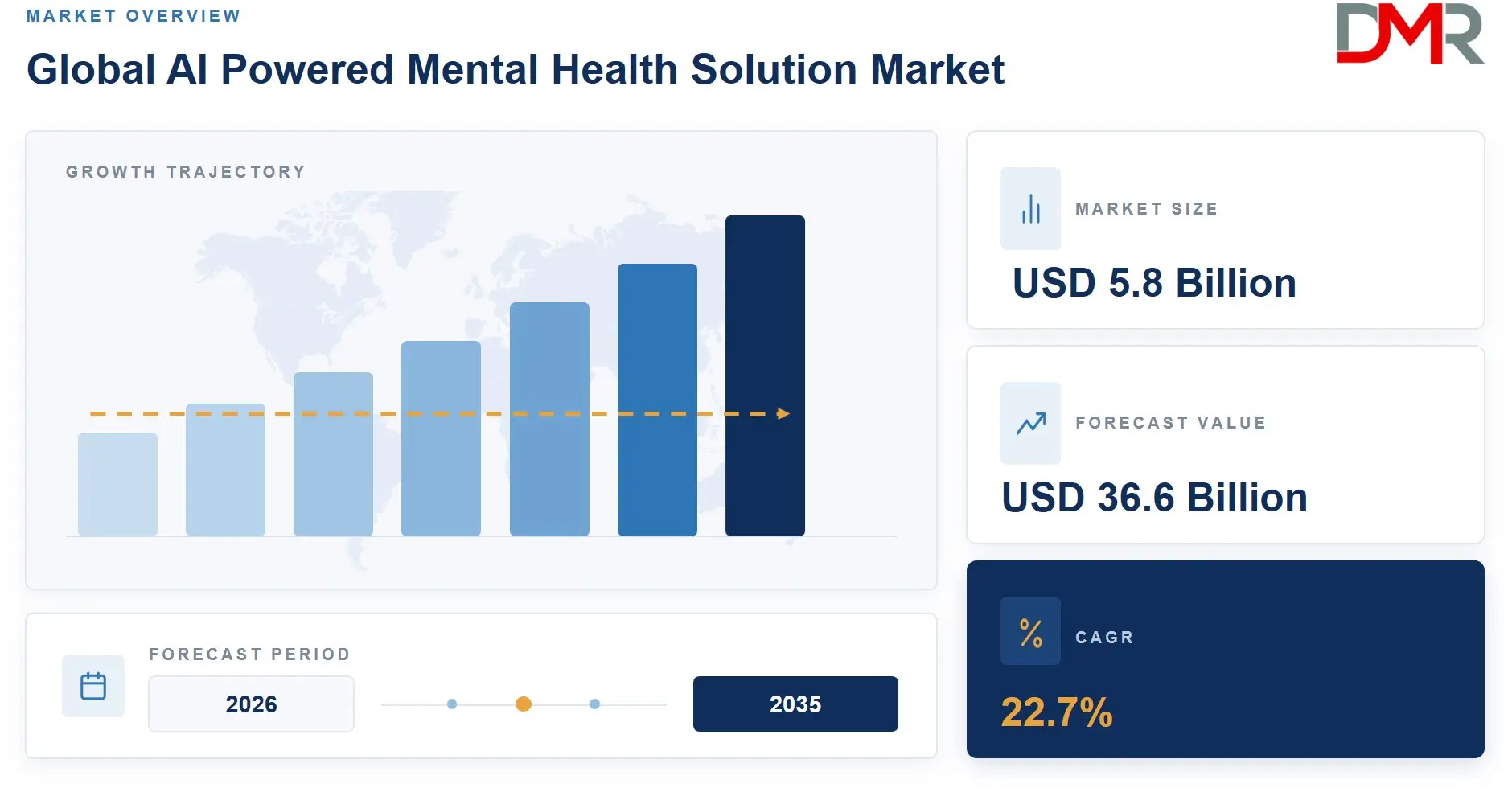
- Market Size (2026): USD 5.8 Bn
- Forecast Value (2035): USD 36.6 Bn
- CAGR (2026-2035): 22.7%
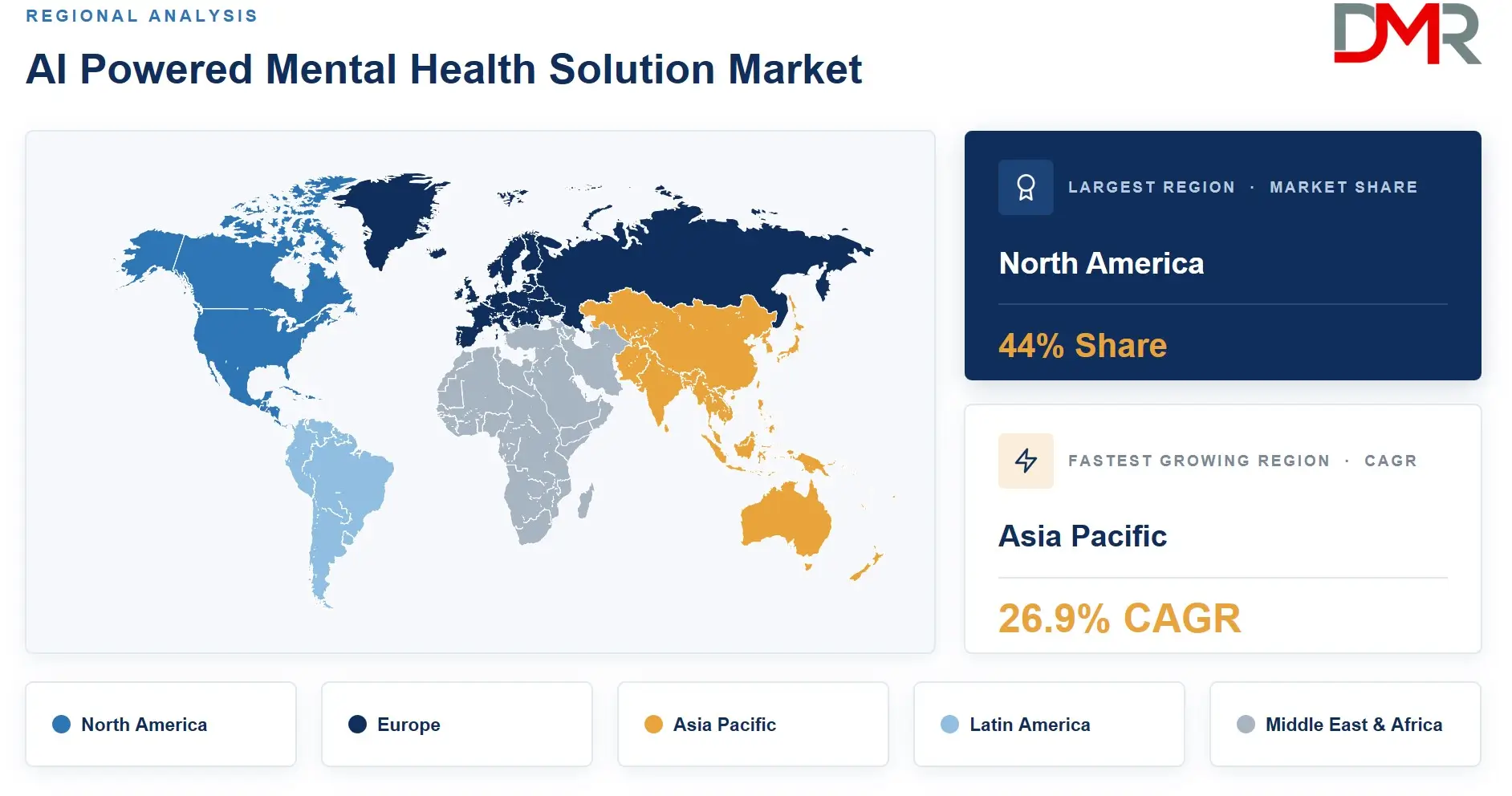
- Largest Region (2026): North America, approximately 44%
- Fastest-Growing Region: Asia-Pacific
- Leading Offering (2026): Platforms & Software, around 68%
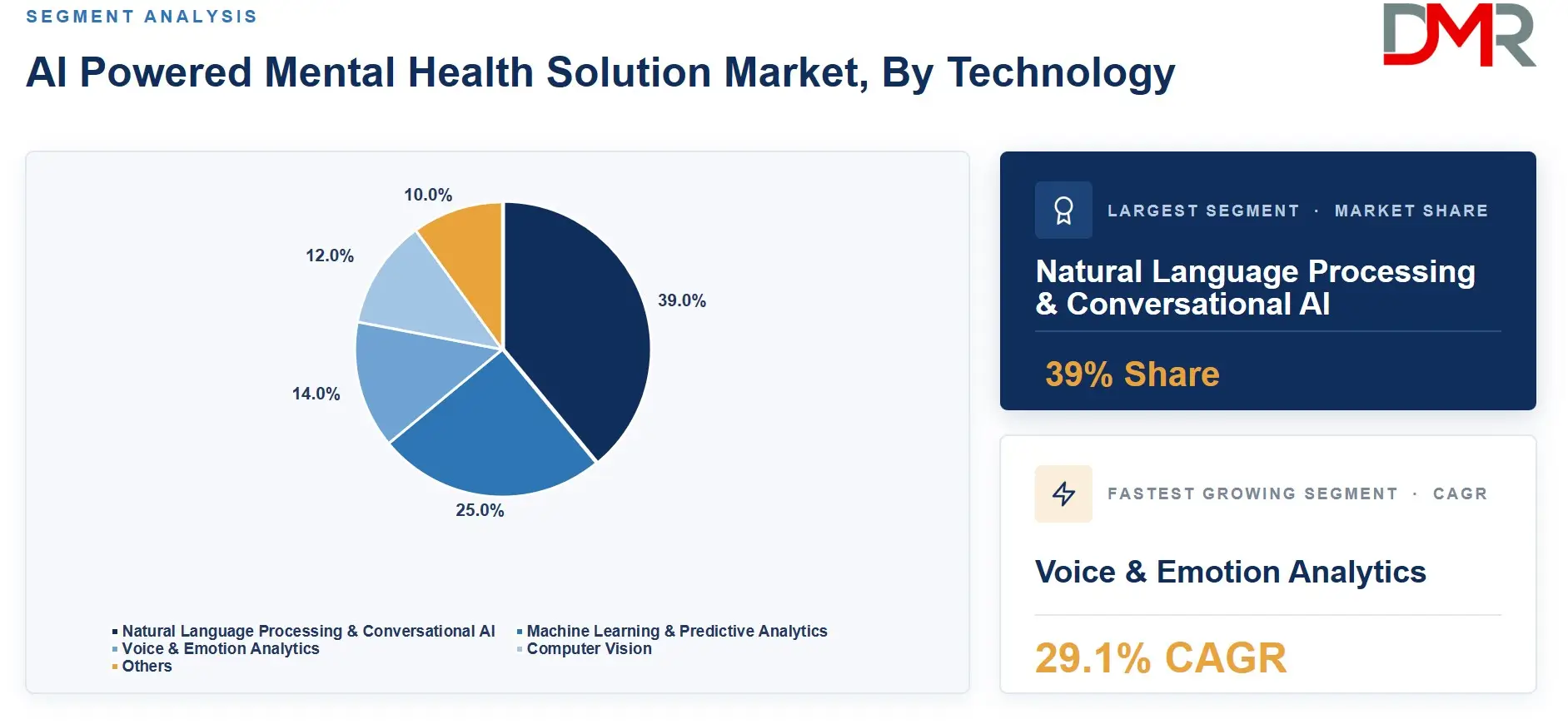
- Leading Technology (2026): Natural Language Processing & Conversational AI, close to 39%
- Key Players: Headspace, Spring Health, Talkspace and others
What is AI Powered Mental Health Solution Market and its Market Size?
Global AI Powered Mental Health Solution Market size is estimated to reach USD 5.8 Bn in 2026 and is further anticipated to reach USD 36.6 Bn by 2035, at a CAGR of 22.7%. AI powered mental health solutions combine software, clinical workflows and artificial intelligence to support screening, triage, self-guided interventions, therapist assistance, care navigation and continuous monitoring. The market boundary includes purpose-built digital mental health platforms where AI materially influences assessment, personalization, conversational support, risk detection or clinician productivity; generic wellness apps with no meaningful AI layer are excluded.
ℹ
To learn more about this report –
Download Your Free Sample Report Here
Demand comes from health systems, employers, insurers, universities, public agencies, behavioral health providers and consumers seeking faster access to support. Buyers increasingly prefer solutions that can identify the appropriate level of care, maintain engagement between appointments and reduce administrative work without removing clinician accountability. Natural language processing, large language models, predictive analytics, speech biomarkers and recommendation engines are becoming embedded into care pathways, while privacy, clinical validation and escalation protocols determine whether deployments can move beyond pilots.
Commercial models are also changing. Enterprise contracts increasingly combine digital self-care, coaching, therapy, psychiatry and AI-led navigation within one benefit, while provider-facing vendors sell documentation, session intelligence and risk-support tools as workflow software. Consumer products are shifting toward subscription access with clearer boundaries between wellness guidance and regulated clinical care. This creates a layered market in which clinical evidence, safety architecture, integration with electronic health records and payer reimbursement matter as much as model capability.
Structurally, the industry is moving from stand-alone chatbots toward hybrid systems that route users between automated support and human professionals. Growth is strongest where AI reduces waiting time, improves matching, extends support between sessions and makes scarce clinical capacity more productive. At the same time, high-risk conversations, hallucinations, bias, consent, data residency and uncertain regulatory classification limit fully autonomous care, keeping human oversight central to market development.
Use Cases
- Employer Mental Health Benefits: Large employers and benefits administrators deploy AI-enabled platforms to triage employees, recommend self-guided programs, route higher-acuity members to therapists and measure engagement. The result is a broader entry point into care while human clinicians remain available for diagnosis, treatment planning and crisis escalation.
- Behavioral Health Provider Workflows: Therapy groups and digital clinics use AI to summarize sessions, organize clinical notes, surface recurring themes and prepare providers for follow-up visits. This reduces documentation burden and gives clinicians more time for direct patient interaction while preserving review and sign-off responsibilities.
- University and Youth Support: Universities and student health programs use conversational tools and digital screening to provide after-hours support, identify students who may need professional evaluation and guide them toward campus or external resources. The model expands reach during periods when counseling centers face capacity constraints.
- Health Plan Care Navigation: Insurers and managed behavioral health organizations apply predictive models and digital intake tools to match members with appropriate care intensity, provider type and modality. Better routing can reduce failed referrals, shorten the path to treatment and support stepped-care programs across large covered populations.
Key Takeaways
- Market Size & Share: The industry is forecast to add approximately USD 30.8 Bn in annual revenue between 2026 and 2035 as AI becomes embedded across digital behavioral health delivery.
- Offering Analysis: Platforms & Software are expected to account for roughly 68% of 2026 revenue, reflecting recurring enterprise licensing and consumer subscription models.
- Regional Analysis: North America is projected to represent around 44% of global revenue in 2026 because of employer benefits adoption, digital health funding and payer integration.
- Technology Shift: Voice & Emotion Analytics is projected to expand at a CAGR of 29.1% through 2035 as vendors add passive and low-friction behavioral signal detection.
- Care Model: Hybrid AI plus clinician delivery is expected to outgrow fully self-guided models, with hybrid care expanding at a CAGR of 27.4% from 2026 to 2035.
- Buyer Concentration: Employers & Health Plans are expected to hold close to 37% of 2026 demand, supported by population-scale access and benefit-navigation requirements.
How AI/Gen AI is Transforming the AI Powered Mental Health Solution Market?
AI is shifting digital mental health from static content libraries toward adaptive systems that interpret user language, symptoms, engagement patterns and care history. Machine learning models can support triage and provider matching, while natural language processing helps structure free-text intake and detect clinically relevant themes. Generative AI adds conversational continuity, personalized psychoeducation and administrative support, but the strongest commercial deployments keep defined boundaries around diagnosis, crisis management and treatment decisions. Providers are also adopting AI as an assistive layer rather than a replacement for licensed care.
The next phase centers on safety-aware orchestration. Vendors are combining model outputs with rules engines, validated screening instruments, clinician review, audit trails and escalation workflows so automated interactions can hand off appropriately when risk rises. Enterprise buyers increasingly evaluate not only response quality but also model governance, privacy controls, evidence, monitoring and integration with existing care networks.
- Conversational Support: Purpose-built LLMs deliver guided reflection, psychoeducation and between-session engagement within defined safety boundaries.
- Risk and Triage Analytics: Predictive models combine intake responses and behavioral signals to prioritize members for human assessment.
- Clinical Documentation: NLP systems create draft notes, summaries and structured insights that clinicians can review before finalizing records.
- Personalized Care Navigation: Recommendation engines match users to digital programs, coaching, therapy, psychiatry or specialty care based on need and preference.
Key Drivers in the Global AI Powered Mental Health Solution Market
Demand is being pulled by an access gap on one side and pressure to improve clinical productivity on the other. These forces favor platforms that can scale first-line support while preserving pathways to professional care.
- Persistent Shortage of Timely Behavioral Health Access: Digital mental health buyers are using AI to widen the front door to care when therapist supply and appointment capacity are constrained. With Employers & Health Plans expected to represent close to 37% of 2026 demand, population-scale purchasers have a direct incentive to automate intake, navigation and low-acuity support. AI can handle repetitive screening and routing continuously, then transfer complex cases to clinicians. The mechanism is economic as well as clinical: a single digital layer can serve large covered populations, reduce failed referrals and help scarce providers focus on users who require licensed intervention.
- Provider Productivity and Administrative Automation: Behavioral health organizations are adopting AI to reduce time spent on documentation, intake synthesis, care-plan preparation, and follow-up administration. Provider & Health System deployments are projected to grow at a CAGR of 25.8% through 2035, faster than the overall industry. Session summarization and structured note drafting can shorten non-billable work, while analytics can highlight longitudinal patterns before a visit. The value proposition strengthens as caseloads rise because productivity gains compound across clinicians, making assistive AI easier to justify than fully autonomous therapy in regulated care settings.
Restraints in the Global AI Powered Mental Health Solution Market
Growth is constrained by the sensitivity of behavioral health data and by the consequences of unsafe model behavior. Buyers therefore impose a higher evidence and governance threshold than they do for general wellness software.
- Safety Risk in High-Acuity Conversations: Mental health systems must recognize when automated support is inappropriate and escalate users toward human or emergency resources. Fully Self-Guided AI Solutions are estimated to represent only around 24% of 2026 care-model revenue, partly because hallucinations, overconfidence, delusion reinforcement, and missed crisis signals can create material harm. Vendors must invest in red-team testing, constrained response policies, risk classifiers and clinician oversight. These controls raise development costs and can limit conversational flexibility, slowing rollout in use cases involving severe depression, suicidality, psychosis, abuse or complex medication decisions.
- Privacy, Consent and Regulatory Fragmentation: Mental health conversations contain unusually sensitive information, making data minimization, consent, retention controls and secure model operations central to procurement. On-premises & Private Cloud deployment is expected to retain nearly 26% of 2026 revenue despite higher implementation cost because some health systems and public-sector buyers require tighter data control. Vendors operating internationally must also adapt to different privacy laws, medical-device interpretations, and AI governance regimes. Compliance work lengthens enterprise sales cycles, while uncertainty over whether a feature constitutes wellness support, clinical decision support or a regulated medical function can delay product expansion.
Growth Opportunities in the Global AI Powered Mental Health Solution Market
White space is opening where AI can extend care without pretending to replace it. The strongest opportunities sit in hybrid delivery, multilingual access, and infrastructure that connects digital support to existing clinical networks.
- Hybrid AI and Human Care Platforms: Hybrid AI + Clinician Supported Solutions are projected to expand at a CAGR of 27.4% from 2026 to 2035 as employers, payers and providers seek a balance between scale and clinical accountability. These models use automation for intake, education, reminders and between-session engagement, while licensed professionals handle diagnosis, therapy, prescribing, and escalation. The commercial opening is particularly strong for vendors that can unify self-guided tools, coaching, therapy and specialty referrals in one member journey. Integrated networks can also improve retention because users do not need to leave the platform when acuity changes.
- Multilingual and Culturally Adapted Digital Support: Asia-Pacific is projected to grow at a CAGR of 26.9% through 2035, creating room for language-localized conversational systems and lower-cost care navigation. Large populations, uneven clinician distribution and high smartphone penetration make digital-first access attractive, but direct translation is insufficient for mental health. Vendors that adapt tone, idioms, screening logic and escalation resources to local contexts can serve employers, universities and insurers more effectively. The opportunity extends to diaspora workforces and multinational companies that want a common platform with country-specific privacy, language and referral pathways.
Trends in the Global AI Powered Mental Health Solution Market
Technology and buyer behavior are moving away from generic chat interfaces toward clinically bounded, workflow-integrated AI. Product differentiation increasingly depends on safety architecture, multimodal signals and measurable continuity with human care.
- Purpose-Built Mental Health Models and Guardrails: Natural Language Processing & Conversational AI is expected to hold close to 39% of technology revenue in 2026, but buyers are becoming less interested in unrestricted general-purpose chatbots. Vendors are fine-tuning models on mental health contexts, layering risk classifiers and designing escalation routes to clinicians. This shifts competition from conversational fluency toward reliability, evidence and governance. Platforms that can document why a user was routed, what safety checks were triggered and how clinicians remain in the loop are better positioned for enterprise procurement than products that offer open-ended emotional conversation without accountable care pathways.
- Multimodal Behavioral Signal Detection: Voice & Emotion Analytics is forecast to grow at 29.1% CAGR through 2035 as mental health platforms experiment with speech characteristics, language patterns and other passive signals to complement questionnaires. The attraction is lower-friction monitoring between formal assessments, especially for longitudinal care. Commercial adoption, however, will depend on validation across languages, demographics and recording environments because behavioral biomarkers can be sensitive to context and bias. As evidence improves, multimodal signals may become an input to triage and progress monitoring rather than a stand-alone diagnostic output.
Research Scope and Analysis
Segment performance is assessed across five axes: offering, technology, care model, deployment and end user. Each axis shows where 2026 revenue is concentrated and where adoption is moving fastest through 2035, linking market share to buyer economics, workflow fit, safety requirements and delivery models.
ℹ
To learn more about this report –
Download Your Free Sample Report Here
By Offering
Platforms & Software are projected to hold the largest share by offering in 2026, accounting for approximately 68% of revenue as employers, payers, providers and consumers increasingly buy recurring access to integrated digital mental health environments. Subscription economics, continuous feature updates and the ability to combine intake, navigation, self-guided support and analytics reinforce the software base. Growth, however, is concentrated in Services, expanding at a CAGR of 25.6% between 2026 and 2035. Implementation, clinical oversight, integration, model evaluation and managed-care support become more important as deployments move into regulated and enterprise settings. Buyers need help connecting AI workflows with provider networks, privacy requirements and escalation protocols, creating a service layer around the core platform.
By Technology
Natural Language Processing & Conversational AI is expected to lead technology revenue in 2026 with close to 39% share because text and dialogue are central to intake, self-guided support, psychoeducation and clinician documentation. Language interfaces lower user friction and can be embedded across mobile apps, portals and provider workflows. The steeper trajectory sits with Voice & Emotion Analytics, which is forecast to expand at a CAGR of 29.1% through 2035. Speech features and affective signals can add longitudinal context that questionnaires miss, particularly between appointments. Adoption will rise as validation improves, but vendors will need to demonstrate demographic fairness, consent and appropriate clinical interpretation before voice-derived signals become routine in high-stakes care.
By Care Model
AI-Assisted Human Therapy is projected to account for around 43% of 2026 revenue by care model because it improves clinician workflow without transferring treatment accountability to an autonomous system. Providers can use AI for preparation, documentation, measurement and between-session engagement while maintaining the therapeutic relationship. Growth, however, is concentrated in Hybrid AI + Clinician Supported Solutions, expanding at a CAGR of 27.4% through 2035. Hybrid programs can begin with automated intake or self-guided support and escalate members to coaching, therapy, psychiatry or specialty care as needs change. This model aligns with enterprise buyers seeking broad access, measurable navigation and clinical safety across heterogeneous populations.
By Deployment
Cloud-Based solutions are expected to represent roughly 71% of 2026 deployment revenue because digital mental health services depend on mobile access, rapid model updates, distributed provider networks and scalable enterprise administration. Cloud delivery also supports subscription pricing and faster integration with benefits platforms. Growth, however, is concentrated in On-Premises & Private Cloud deployment at a CAGR of 24.8% through 2035 as health systems, governments and sensitive-data environments seek tighter control over model access, storage and auditability. Private architectures can support data residency and security policies, although they require more integration effort and may slow model refresh cycles compared with multi-tenant cloud services.
By End User
Employers & Health Plans are projected to hold the largest end-user share in 2026 at approximately 37%, supported by population-scale purchasing, employee assistance programs, behavioral health benefits and insurer care-navigation needs. These buyers value broad access and measurable utilization across covered lives. Growth, however, is concentrated among Providers & Health Systems, expanding at a CAGR of 25.8% from 2026 to 2035 as clinician-facing AI moves deeper into documentation, intake, risk support and longitudinal care management. Integration with electronic health records and existing clinical governance gives provider deployments a different value proposition from consumer wellness, centered on capacity, quality and continuity rather than engagement alone.
The Global AI Powered Mental Health Solution Market Report is Segmented Based on the Following
By Offering
- Platforms & Software
- Services
- Others
By Technology
- Machine Learning & Predictive Analytics
- Natural Language Processing & Conversational AI
- Voice & Emotion Analytics
- Computer Vision
- Others
By Care Model
- Fully Self-Guided AI Solutions
- AI-Assisted Human Therapy
- Hybrid AI + Clinician Supported Solutions
- Others
By Deployment
- Cloud-Based
- On-Premises & Private Cloud
- Others
By End User
- Employers & Health Plans
- Providers & Health Systems
- Consumers
- Educational Institutions
- Government & Public Health Agencies
- Others
Regional Analysis
Region with the Largest Revenue Share
North America is expected to remain the largest regional market in 2026, accounting for approximately 44% of global revenue. The region combines high employer spending on behavioral health benefits, broad telehealth acceptance, deep venture and growth capital, established digital provider networks and payer willingness to contract with technology-enabled care platforms. The US also has a large base of digital mental health vendors building AI into triage, documentation, member support and provider matching. Enterprise procurement increasingly requires clinical evidence and privacy controls, which favors scaled platforms with established care networks. Canada contributes additional demand through employer programs and digital care initiatives, although the US remains the commercial center of gravity.
ℹ
To learn more about this report –
Download Your Free Sample Report Here
Region with the Highest CAGR
Asia-Pacific is projected to record the highest regional CAGR at 26.9% from 2026 to 2035. Growth is supported by large digitally connected populations, uneven access to mental health professionals, expanding employer wellness budgets and demand for lower-cost, multilingual support. India, Japan, Australia, South Korea and parts of Southeast Asia provide distinct routes to market through employers, universities, insurers and consumer apps. Local language capability and culturally adapted conversational design will be essential because mental health expression and referral pathways differ substantially across markets. Vendors that combine mobile-first delivery with country-specific privacy and escalation resources are positioned to capture the strongest incremental demand.
By Region
North America
Europe
- Germany
- France
- The UK
- Italy
- Spain
- Rest of Europe
Asia-Pacific
- China
- Japan
- India
- Australia
- South Korea
- Rest of APAC
Latin America
- Mexico
- Brazil
- Colombia
- Argentina
- Rest of LATAM
Middle East & Africa
- Saudi Arabia
- The UAE
- South Africa
- Rest of MEA
Regulatory Landscape
AI-enabled mental health products sit across overlapping regimes for health privacy, medical-device software, professional practice and emerging AI governance. In the US, HIPAA can apply when platforms operate for covered entities or business associates, while FDA oversight may become relevant when software makes regulated diagnostic or treatment claims. Europe adds GDPR obligations and risk-based AI requirements alongside medical-device rules where clinical functionality crosses the regulatory threshold. The current shift is toward documented model governance, human oversight, post-deployment monitoring and clearer consumer disclosure. Commercial opportunity favors vendors that design compliance into product architecture early. The brake is classification uncertainty, which can make the same technical feature face different obligations depending on claims, users and jurisdiction.
Patent Analysis
Intellectual property in AI mental health is increasingly centered on workflow-specific inventions rather than broad claims over conversational AI itself. Defensible positions can emerge around risk detection, multimodal behavioral signals, personalized intervention sequencing, clinician-assist systems, privacy-preserving model operations and integration of validated assessments into adaptive care pathways. As foundation models become widely accessible, proprietary advantage shifts toward curated clinical data, evaluation methods, safety layers and deployment know-how that may be protected through a mix of patents, trade secrets and contractual data rights. The commercial opening sits in narrow, clinically meaningful functions that can demonstrate repeatable performance. The risk is rapid model commoditization and crowded prior art, which can reduce the durability of software-only differentiation.
Competitive Landscape
Competition is fragmented across digital mental health platforms, therapy networks, AI-native conversational specialists, clinician workflow vendors and behavioral biomarker companies. Large platforms compete on covered lives, provider networks, employer and payer contracts, breadth of care and evidence, while specialists differentiate through conversational safety, speech analytics, clinical documentation or population-specific programs. Partnerships are common because no single vendor controls every layer from self-guided support to psychiatry and specialty care. M&A is also reshaping the category as scaled platforms add provider capacity, benefit navigation and specialty pathways. The strongest competitive positions combine trusted distribution with proprietary clinical workflows, measurable outcomes, privacy controls and a clear human-escalation model rather than relying on general-purpose model access alone.
Some of the Prominent Players in the Global AI Powered Mental Health Solution Market Are
- Headspace
- Spring Health
- Talkspace
- Lyra Health
- Wysa
- Woebot Health
- Kintsugi
- Sonde Health
- Eleos Health
- Limbic
- Unmind
- Modern Health
- Meru Health
- Big Health
- SilverCloud Health
- Ieso Digital Health
- Brightside Health
- Cerebral
- Quartet Health
- SonderMind
- Grow Therapy
- Alma
- NeuroFlow
- Ellipsis Health
- Cognoa
- Lucet
- Mantra Health
- Youper
- Intellect
- MindFi
- Amaha
- InnerHour
- MindPeers
- MindDoc
- HelloBetter
- Nilo.health
- Koa Health
- Oliva
- Clare&me
- Aiberry
- Other Key Players
Recent Developments
- In August 2026, Spring Health joined the Alight Partner Network, integrating mental health support into a benefits administration environment and widening employer access to AI-supported navigation, self-guided tools, coaching and clinical care.
- In July 2026, Headspace expanded its specialty care ecosystem through new referral partnerships covering neurodiversity, eating disorders and higher-acuity needs, strengthening the handoff between digital support and specialized human care.
- In June 2026, Talkspace introduced Tee, a purpose-built mental health AI agent with clinician oversight and risk-detection safeguards, signaling a shift from general-purpose chatbots toward domain-specific conversational systems.
- In April 2026, Spring Health launched Guide, an AI-led mental health experience designed to maintain context across care interactions and support members between formal clinical encounters.
- In December 2025, Wysa expanded its digital mental health tools into six additional languages, increasing the reach of its AI-supported intake and self-help products across multinational employers, health systems and insurers.
- In April 2025, Spring Health formalized a responsible AI approach across its mental health platform, emphasizing clinical rigor, human oversight and integrated use of AI across member and provider workflows.
Report Details
| Report Characteristics |
| Market Size (2026) |
USD 5.8 Bn |
| Forecast Value (2035) |
USD 36.6 Bn |
| CAGR (2026-2035) |
22.7% |
| The US Market Size (2026) |
USD 2.0 Bn |
| Historical Data |
2021 - 2025 |
| Forecast Data |
2026 - 2035 |
| Base Year |
2025 |
| Segments Covered |
By Offering, By Technology, By Care Model, By Deployment and By End User |
| Regional Coverage |
North America - The US and Canada; Europe - Germany, France, The UK, Italy, Spain, Rest of Europe; Asia-Pacific - China, Japan, India, Australia, South Korea, Rest of APAC; Latin America - Mexico, Brazil, Colombia, Argentina, Rest of LATAM; Middle East & Africa - Saudi Arabia, The UAE, South Africa, Rest of MEA |
Frequently Asked Questions
How big is the Global AI Powered Mental Health Solution Market?
▾ Global demand is estimated at USD 5.8 Bn in 2026 and is forecast to reach USD 36.6 Bn by 2035. Expansion is being supported by employer and payer adoption, AI-assisted clinical workflows, conversational support, care navigation and the need to extend behavioral health access while keeping clinicians involved in higher-risk decisions.
What is the growth rate of the Global AI Powered Mental Health Solution Market?
▾ The industry is projected to expand at a CAGR of 22.7% from 2026 to 2035. Growth is driven by the transition from stand-alone wellness apps toward integrated platforms that combine AI-led intake, personalized support, provider matching, documentation assistance, risk monitoring and escalation into therapy, psychiatry or specialty care when needed.
Which region holds the largest share in the Global AI Powered Mental Health Solution Market?
▾ North America is expected to hold the largest regional position in 2026, representing approximately 44% of global revenue. Employer-sponsored mental health benefits, payer contracting, telehealth familiarity, established digital provider networks and a dense base of technology vendors support adoption, with the US accounting for most regional commercial activity.
Who are the key players in the Global AI Powered Mental Health Solution Market?
▾ Key participants include Headspace, Spring Health, Talkspace, Lyra Health, Wysa, Eleos Health and Koa Health. Competition spans full-service mental health platforms, AI-native conversational systems, therapist workflow software and behavioral analytics vendors, with differentiation increasingly based on clinical evidence, safety controls, provider integration, privacy and distribution through employers, payers and health systems.
Which offering leads the AI powered mental health solutions industry?
▾ Platforms & Software are expected to lead the offering mix in 2026 with around 68% of revenue. Recurring subscriptions, enterprise licensing, continuous product updates and the ability to integrate intake, navigation, self-guided interventions, conversational support and analytics in one environment make software the primary commercial layer across employer, payer and provider deployments.
What technologies are gaining adoption in AI mental health solutions?
▾ Natural language processing, conversational AI, predictive analytics, voice analysis and recommendation systems are gaining adoption. The fastest commercial momentum is moving toward purpose-built models with risk detection, clinician escalation and auditable workflows rather than unrestricted chat. Multimodal tools are also emerging to complement questionnaires with speech and behavioral signals for longitudinal monitoring.
What factors will shape adoption through 2035?
▾ Adoption will depend on whether vendors can prove useful outcomes while controlling safety, privacy and regulatory risk. Buyers will favor systems that integrate with clinical networks, support human oversight, localize language and escalation pathways, document model governance and reduce provider workload. These conditions will determine which companies convert AI capability into durable revenue in the AI Powered Mental Health Solution Market.