Market Snapshot
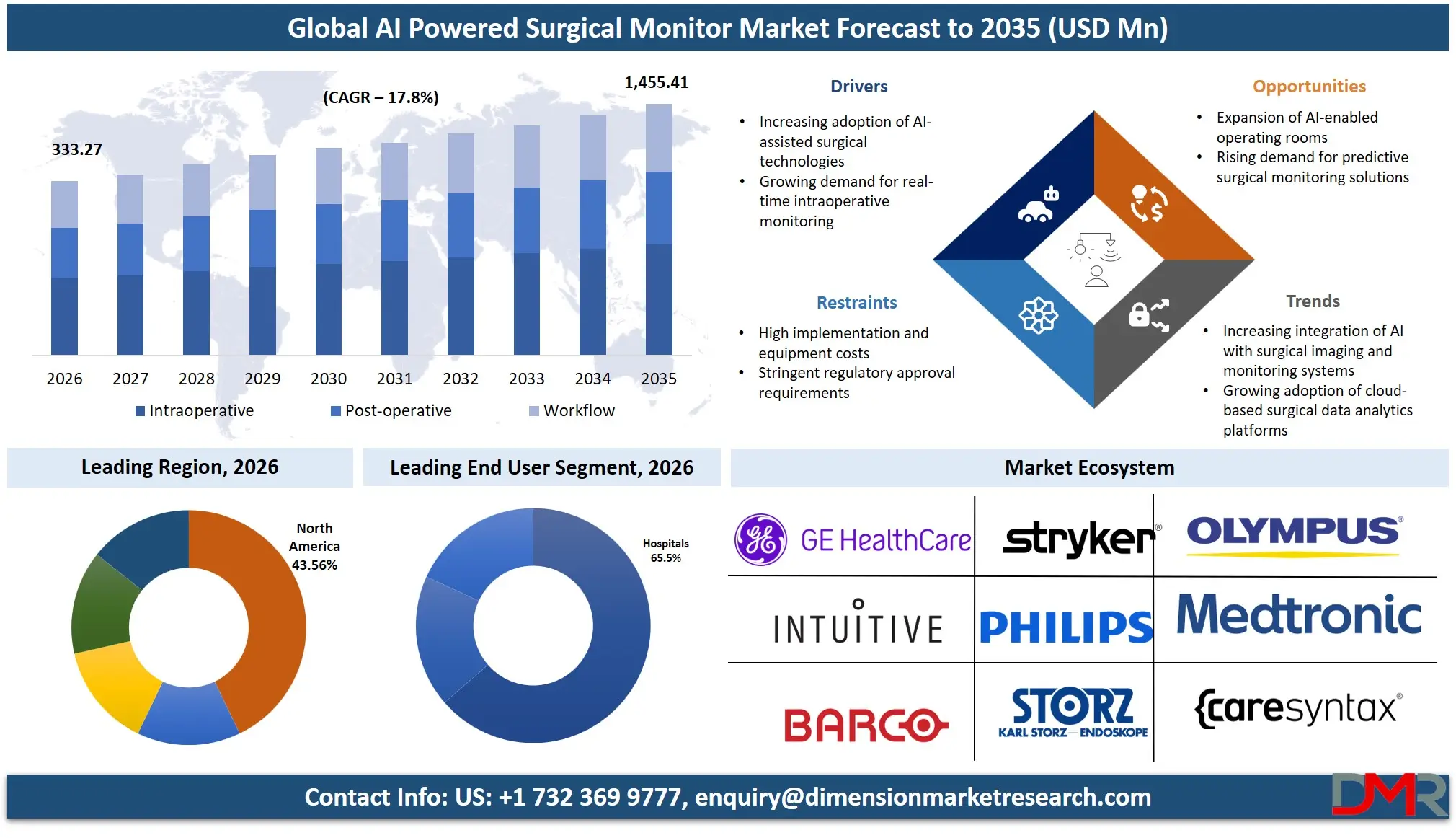
- The market size is USD 282.81 Million in 2025, reached USD 333.27 Million in 2026, and is projected to hit USD 1,455.41 Million by 2035 at a CAGR of 17.8%.
- Integrated AI Visualization Systems / Integrated OR Platforms led the product type segment with a 68.24% share.
- LED-backlit LCD led the display technology segment with a 58.27% share.
- Full HD led the resolution segment with a 48.74% share.
- Laparoscopy led the application segment with a 34.28% share.
- Hospitals led the end user segment with a 64.51% share.
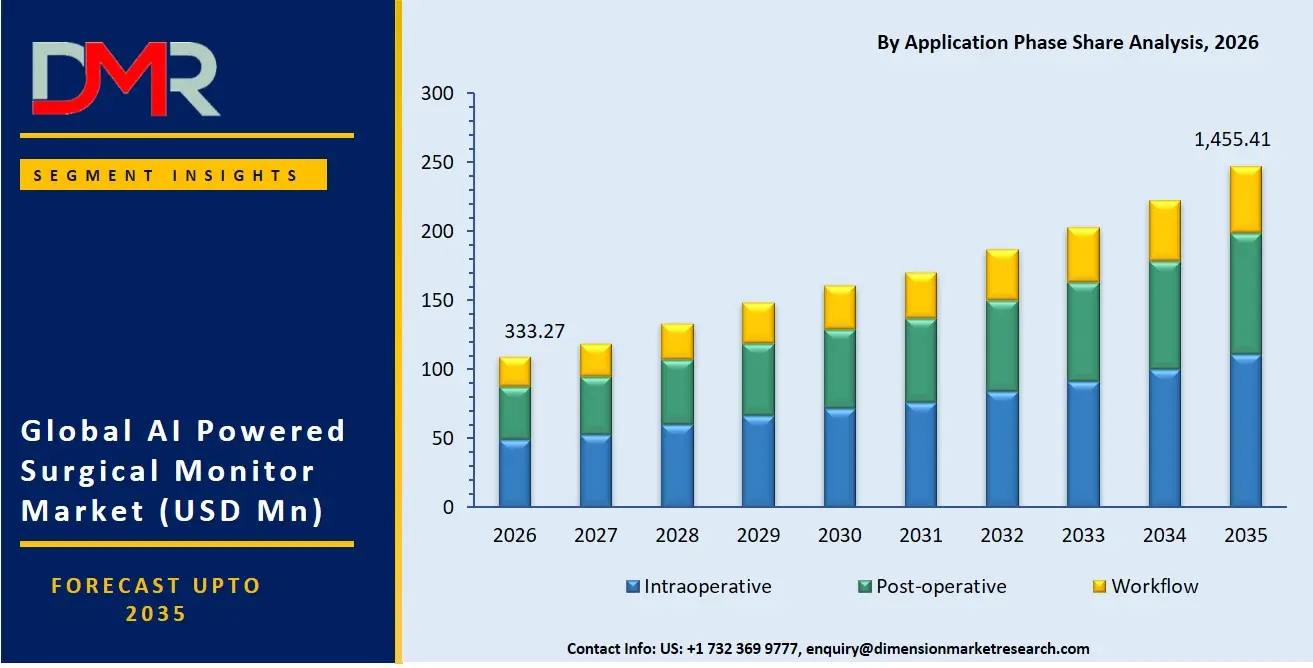
- Intraoperative led the application phase segment with a 62.8% share.
- North America led the regional market with a 43.56% share.
Market Overview
The AI powered surgical monitor market covers display systems and integration platforms that process camera feeds from laparoscopic, endoscopic, and robotic tools and overlay AI-generated guidance directly on the screen. Standalone displays without processing capability sit outside AI Powered Surgical Monitor Market. Surgical robots, imaging scanners, and sterilization equipment also fall outside its scope, even though they share the same operating room.
ℹ
To learn more about this report –
Download Your Free Sample Report Here
AI Powered Surgical Monitor Market sits inside the wider surgical visualization and operating room integration industry. Hospitals upgrading legacy monitors increasingly pair the purchase with OR integration platforms, pulling display demand into a broader digital operating room build-out. Proximie partnered with NVIDIA in April 2026 through Project Rheo to build smart operating room intelligence tools, a signal that chipmakers now see surgical displays as an AI deployment surface rather than a passive screen.
Ambient sensing adds a layer most buyers have not budgeted for yet. Apella's platform delivered a 24% improvement in scheduling accuracy across operating rooms tracked at the 2025 OR Manager Conference. Hospitals running tight OR schedules can treat this as evidence that monitoring software pays for itself through better room utilization, not just better images.
Market Size and Forecast
The Global AI Powered Surgical Monitor Market size is estimated at USD 333.27 Million in 2026 from USD 282.81 Million in 2025, and is projected to reach USD 1,455.41 Million by 2035, exhibiting a CAGR of 17.8% during the forecast period.
The United States anchors current demand. Market Glass places the US market at USD 72.8 Million in 2025, growing at 15.8% annually, a pace close to the global rate despite the country's already mature hospital base. Replacement cycles in large hospital networks explain much of this. Operating rooms built five to seven years ago carry monitors that cannot run AI overlays, forcing a hardware swap rather than a software update.
Clinical evidence supports the swap. A study in the International Journal of Research in Medical Sciences found AI assistance cut general surgery time from 150 minutes to 120 minutes, a 30-minute reduction per case. Medtronic moved quickly on this signal. In April 2024, the company added 14 new AI-powered Performance Insights algorithms to its Touch Surgery ecosystem, expanding workflow analysis well beyond basic video capture.
Product Type Analysis
Integrated AI Visualization Systems / Integrated OR Platforms captured 68.24% of the product type segment, ahead of all rivals.
Hospitals buying new OR equipment now choose integrated platforms over standalone monitors because a single system can pull camera feeds, AI overlays, and recording into one display. Surgeons avoid switching attention between separate screens during laparoscopic and robotic procedures. Vendors bundling visualization with workflow software lock in hospitals for longer replacement cycles, raising the entry cost for competitors selling displays alone.
Standalone AI-enabled monitors still serve smaller surgical centers that cannot justify a full platform purchase. OR integration display platforms and AI-guidance displays sit between these two options, often added as a mid-tier upgrade. Ambulatory centers expanding their procedure mix tend to start with standalone units before migrating to integrated platforms once case volume justifies the larger investment. This staged adoption gives mid-market vendors a window before hospitals consolidate purchases with platform leaders.
Display Technology Analysis
With a 58.27% share, LED-backlit LCD outpaced all other display technology categories.
LED-backlit LCD remains the default choice because hospitals already stock replacement parts and staff know the calibration routines. Procurement teams favor proven technology when budgets tie monitor purchases to broader OR renovation projects. Switching display technology mid-renovation adds risk that most hospital IT departments choose to avoid.
OLED panels deliver sharper contrast for tissue differentiation during microsurgery, pushing adoption in neurosurgery and ENT suites first. Mini-LED and MicroLED remain niche, limited mostly to flagship academic medical centers testing next-generation displays. EIZO introduced a 27-inch 4K UHD surgical monitor in December 2025, built specifically for space-constrained ORs running AI-assisted procedures. As hospitals replace aging LCD units, OLED and Mini-LED options will compete directly for that replacement spend rather than for new installations.
Resolution Analysis
Full HD accounted for 48.74% of resolution demand, the highest of any category.
Full HD still meets the bandwidth and storage requirements most hospital networks can support without infrastructure upgrades. Surgical video archiving systems built around Full HD streams avoid the storage cost spike that 4K recording brings. Budget-conscious hospitals in price-sensitive regions extend the life of Full HD systems by pairing them with AI overlay software rather than replacing the display itself.
4K Ultra HD adoption concentrates in procedures where fine detail changes surgical decisions, particularly cardiovascular and neurosurgery cases. HD remains common in older facilities still working through earlier upgrade cycles. 8K Ultra HD exists mostly in pilot programs at research hospitals, too costly for routine deployment. Hospitals planning AI integration now specify 4K minimum for new purchases, since lower resolutions limit the accuracy of automated tissue and instrument detection.
Application Analysis
A 34.28% share made Laparoscopy the clear leader across application categories.
ℹ
To learn more about this report –
Download Your Free Sample Report Here
Laparoscopic procedures generate the highest case volume across general surgery departments, making them the natural first deployment point for AI-powered monitors. Surgeons performing laparoscopic cholecystectomy and hernia repair benefit most from real-time guidance overlays, since limited depth perception increases reliance on the screen. Vendors targeting laparoscopy first build a reference base they later extend into other procedure types.
Robotic-assisted surgery shows the fastest growth among applications, as robotic platform makers integrate AI monitoring directly into their consoles. Endoscopy, arthroscopy, and ENT surgery follow similar adoption patterns to laparoscopy but at smaller case volumes. Neurosurgery and cardiovascular surgery demand the highest display precision, pushing these specialties toward 4K and OLED upgrades ahead of general surgery departments. Orthopedic surgery remains a steady but slower-growing application, tied to existing arthroscopy tower replacement cycles.
End User Analysis
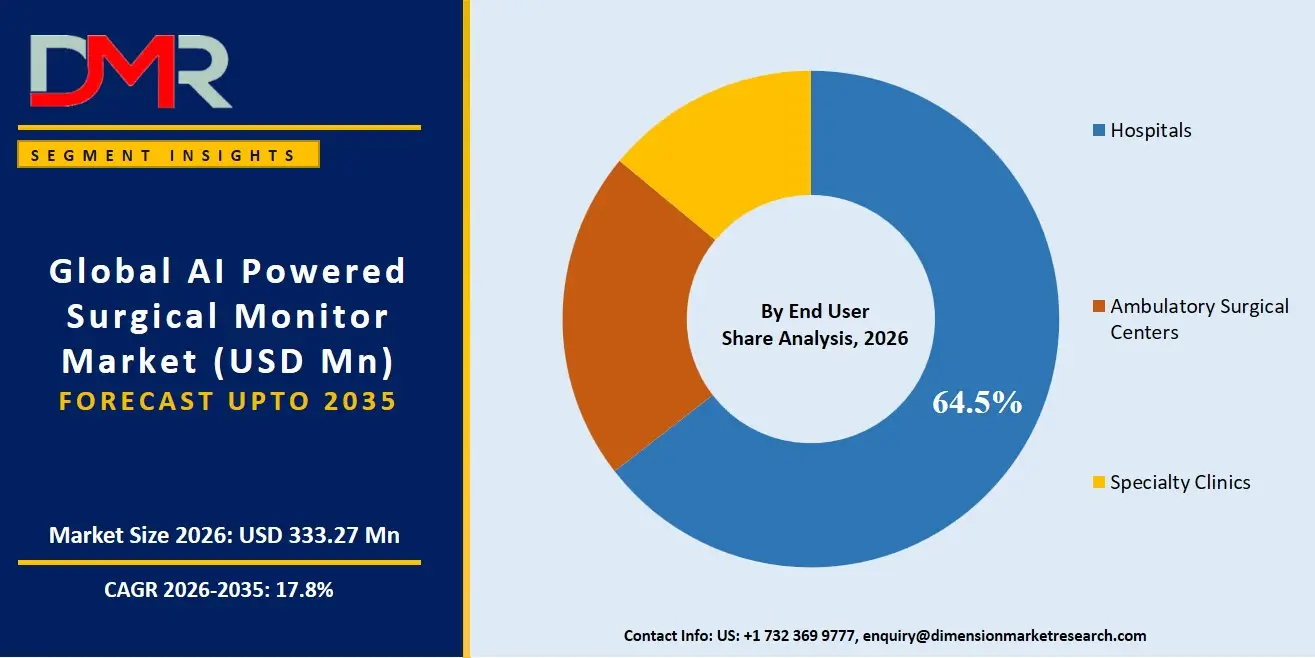
Hospitals captured 64.51% of the end user segment in 2026, ahead of all rivals.
ℹ
To learn more about this report –
Download Your Free Sample Report Here
Hospitals run the highest surgical case volumes and operate the capital budgets needed for integrated AI platforms. Multi-specialty hospital networks negotiate enterprise-wide contracts, giving platform vendors predictable, large-scale deployments. Healthcare ranks as the largest single vertical in enterprise vision AI spending at 27.3%, a figure that reflects how fast hospital procurement teams have moved compared to other industries.
Ambulatory Surgical Centers grow faster than hospitals as outpatient procedure volumes rise and reimbursement shifts toward lower-cost settings. Specialty clinics adopt AI monitors selectively, usually tied to a single high-value procedure type such as ophthalmology or ENT. Vendors that price entry-level integrated systems for smaller facilities open a path into the ambulatory segment before hospital budgets even enter the conversation.
Application Phase Analysis
Intraoperative use accounted for 62.8% of application phase demand in 2026, the highest of any category.
Surgeons depend on intraoperative AI guidance because decisions made mid-procedure carry the highest clinical stakes. Real-time overlays showing instrument position, tissue boundaries, or risk zones directly influence outcomes as they happen. This immediacy justifies premium pricing for intraoperative-grade displays compared to monitors used only for review.
Post-operative use grows as hospitals adopt AI tools for outcome review and surgeon training, often using recorded footage from the same monitors. Workflow applications, covering scheduling and OR utilization tracking, represent the smallest phase today but show strong upside. Apella's AI-powered OR platform achieved a 69-minute average reduction in surgical delays per case across partnering institutions in 2025, a result that turns workflow monitoring from a back-office tool into a direct revenue lever for hospital administrators.
Key Market Segments
By Product Type
- Integrated AI Visualization Systems / Integrated OR Platforms
- AI-enabled Standalone Surgical Monitors
- AI-enabled OR Integration Display Platforms
- AI-guidance Display Platforms
By Display Technology
- LED-backlit LCD
- OLED
- Mini-LED and MicroLED
By Resolution
- Full HD
- HD
- 4K Ultra HD
- 8K Ultra HD
By Application
- Laparoscopy
- Endoscopy
- Arthroscopy
- ENT Surgery
- Neurosurgery
- Orthopedic Surgery
- Cardiovascular Surgery
- Robotic-assisted Surgery
By End User
- Hospitals
- Ambulatory Surgical Centers
- Specialty Clinics
By Application Phase
- Intraoperative
- Post-operative
- Workflow
Regional Analysis
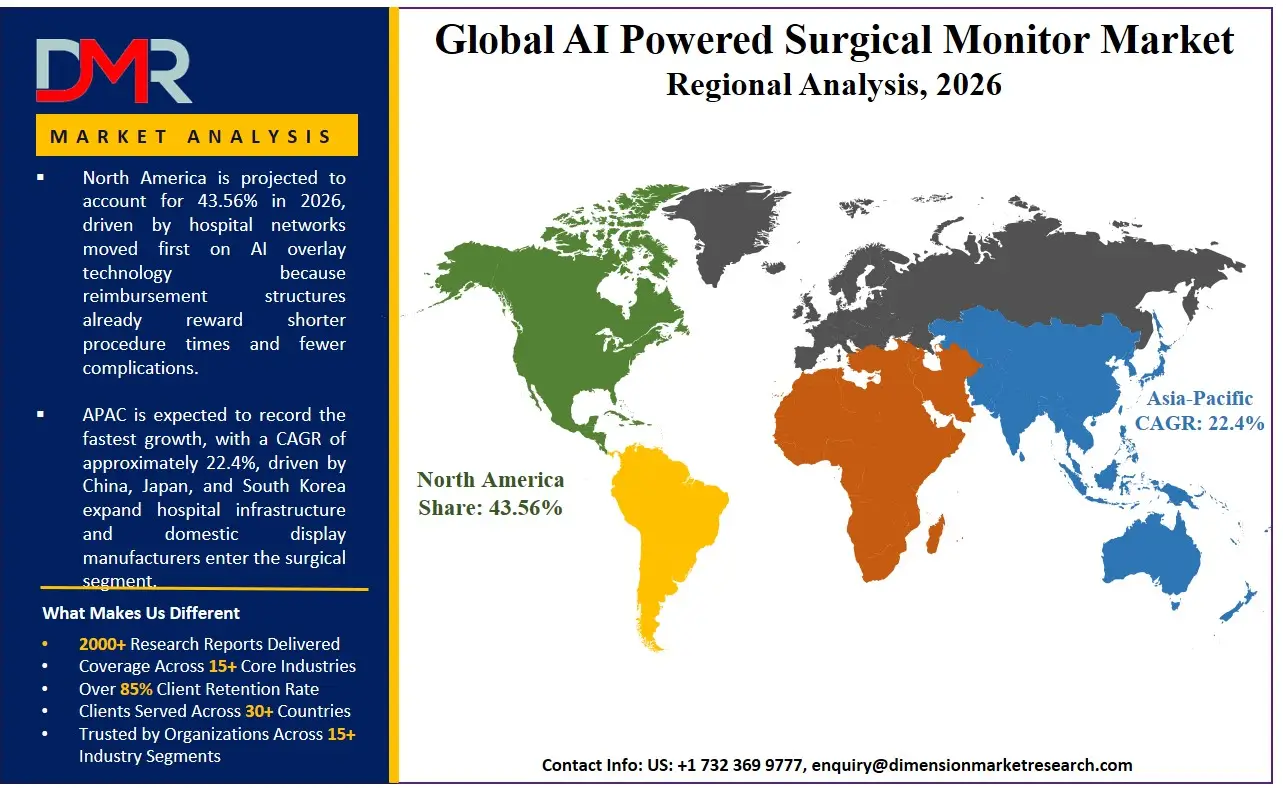
North America led the regional market with a 43.56% share, representing approximately USD 123.20 Million in 2026.
ℹ
To learn more about this report –
Download Your Free Sample Report Here
North America's hospital networks moved first on AI overlay technology because reimbursement structures already reward shorter procedure times and fewer complications. An AI surgical video assessment tool distinguished resident from attending surgeon skill levels with 87% accuracy, a capability that US teaching hospitals value for training programs at scale. Large group purchasing organizations also negotiate platform-wide AI monitor contracts, accelerating rollout across hundreds of facilities at once.
Asia Pacific grows fastest as China, Japan, and South Korea expand hospital infrastructure and domestic display manufacturers enter the surgical segment. Europe follows a steadier path, with Germany and France upgrading OR equipment under national digital health programs. Latin America and the Middle East and Africa remain early-stage markets, where private hospital chains in Brazil and the GCC act as the main adoption points before broader public health systems follow.
Key Regions and Countries
North America
Europe
- Germany
- France
- The UK
- Spain
- Italy
- Rest of Europe
Asia Pacific
- China
- Japan
- South Korea
- India
- Australia
- Rest of APAC
Latin America
- Brazil
- Mexico
- Rest of Latin America
Middle East & Africa
- GCC
- South Africa
- Rest of MEA
Market Dynamics
Clinical Outcomes Push Hospitals Toward AI Displays
Hospitals replace standard monitors once clinical data shows a direct link between AI guidance and patient outcomes. AI improved complication prediction accuracy by 25% over traditional methods in general surgery, giving surgical directors a measurable basis for budget requests. Faster procedures also free OR time for additional cases, turning a display upgrade into a throughput investment rather than a cosmetic one.
Caresyntax raised $180 million in August 2024 through a Series C extension and growth debt round to expand its surgical intelligence platform. Investors backing this round signal confidence that AI monitoring software, not just hardware, drives the next wave of OR spending. Competitors without a software layer risk losing ground to platforms that combine displays with analytics.
Integration Costs Slow Smaller Facility Adoption
Smaller hospitals and specialty clinics often run older network infrastructure that cannot support the data loads AI-enabled monitors generate. Replacing a single monitor rarely solves the problem alone. Facilities must also upgrade network switches, storage, and sometimes electrical capacity, pushing total project costs well beyond the display price tag.
AI reduced intraoperative errors by 18% compared to non-AI-assisted procedures, a result strong enough to justify the spend for large hospitals. Smaller facilities cannot always capture the same return without the case volume to offset integration costs. This gap keeps AI-powered monitors concentrated in high-volume centers while smaller buyers wait for prices to fall.
Hyperspectral and Ambient Tools Open New Revenue Lines
Vendors moving beyond standard video display now build tools that analyze tissue composition and OR activity in real time. Hypervision Surgical raised £17 million in Series A funding in April 2026 to expand its hyperspectral intelligence platform for tissue assessment, a sign that investors see value beyond simple image display.
UHN researchers demonstrated in February 2026 that an AI-based digital ruler tool produced less measurement variability than human estimates during surgical video analysis, particularly over longer distances, when paired with human oversight. Vendors that package measurement and tissue-assessment tools alongside displays can charge for software subscriptions long after the initial hardware sale, creating recurring revenue that pure display makers currently miss.
Market Trends
Workflow Analytics Becomes a Standard Display Feature
Surgical monitors increasingly ship with workflow analytics built in rather than sold as a separate add-on. Apella's system generated 56 additional block hours per operating room per month for partnering institutions, turning the display into a scheduling tool as much as a visualization one. Meril's September 2025 launch of the Mizzo Endo 4000 robotic platform paired AI-assisted planning with integrated OR monitoring, following the same pattern. Vendors entering the market now without a workflow layer compete on hardware alone, a position that gets harder to defend as analytics becomes standard.
Market Competition Overview
The market remains fragmented across 22 named competitors, ranging from large medical device makers to specialized display and software firms. No single company holds a dominant share, since hospital purchasing decisions often bundle monitors with existing surgical platforms from incumbent suppliers. Companies with established OR equipment relationships convert those relationships into monitor sales more easily than display-only entrants.
Display specialists and software-only AI firms are gaining share by partnering with platform makers rather than competing directly. Large device makers protect their position by expanding software ecosystems around existing hardware, making it harder for competitors to win on display quality alone. Funding rounds for smaller AI surgical intelligence firms suggest investors expect further consolidation as platform makers acquire software capability rather than build it internally.
Company Profiles
Medtronic plc expanded its Touch Surgery ecosystem aggressively through 2024 and 2026, adding 14 new AI-powered Performance Insights algorithms and later a live-streaming feature for remote surgical observation. In March 2026, the company received FDA clearance to expand its Stealth AXiS system into cranial and ENT procedures with AI-generated brain mapping. This steady cadence of regulatory clearances gives Medtronic a software moat that hardware-only competitors cannot easily replicate.
Hypervision Surgical Ltd. raised £17 million in Series A funding in April 2026 to scale its hyperspectral intelligence platform for real-time tissue assessment. As a smaller specialist, Hypervision competes by offering a capability, tissue-level analysis, that larger display makers do not yet provide. This positioning makes the company an acquisition target for platform vendors looking to add hyperspectral data to existing display ecosystems.
Key Players
- Stryker Corporation
- GE HealthCare Technologies, Inc.
- Koninklijke Philips N.V.
- Medtronic plc
- KARL STORZ SE & Co. KG
- Olympus Corporation
- Intuitive Surgical, Inc.
- Barco NV
- Brainlab AG
- Caresyntax Corp.
- CONMED Corporation
- EIZO Corporation
- FSN Medical Technologies
- FUJIFILM Holdings Corporation
- Getinge AB
- Hypervision Surgical Ltd.
- LG Electronics Inc.
- Aetina Corporation
- Becton, Dickinson and Company
- Johnson & Johnson
- Shenzhen JLD Display Technology Co., Ltd (Reshin)
- Proprio
Recent Developments
- January 2024 Activ Surgical completed its first international procedure using ActivSight Intelligent Light, an AI-enhanced visualization platform providing real-time surgical insights.
- April 2024 Medtronic introduced Touch Surgery Live Stream, enabling real-time surgical observation, remote collaboration, and advanced surgical monitoring capabilities.
- March 2026 Medtronic received FDA clearance for expanded use of its Stealth AXiS surgical system in cranial and ENT procedures, incorporating AI-generated brain mapping and advanced surgical navigation capabilities.
Report Details
| Report Characteristics |
| Market Value (2025) |
USD 282.81 Million |
| Market Value (2026) |
USD 333.27 Million |
| Forecast Revenue (2035) |
USD 1,455.41 Million |
| CAGR (2026 to 2035) |
17.8% |
| Base Year for Estimation |
2025 |
| Historic Period |
2020 to 2024 |
| Forecast Period |
2026 to 2035 |
| Report Coverage |
Revenue Forecast, Market Dynamics, Competitive Landscape, Recent Developments |
| Segments Covered |
By Product Type (Integrated AI Visualization Systems / Integrated OR Platforms, AI-enabled Standalone Surgical Monitors, AI-enabled OR Integration Display Platforms, AI-guidance Display Platforms), By Display Technology (LED-backlit LCD, OLED, Mini-LED and MicroLED), By Resolution (Full HD, HD, 4K Ultra HD, 8K Ultra HD), By Application (Laparoscopy, Endoscopy, Arthroscopy, ENT Surgery, Neurosurgery, Orthopedic Surgery, Cardiovascular Surgery, Robotic-assisted Surgery), By End User (Hospitals, Ambulatory Surgical Centers, Specialty Clinics), By Application Phase (Intraoperative, Post-operative, Workflow) |
| Regional Analysis |
North America – US and Canada; Europe – Germany, France, The UK, Spain, Italy, and Rest of Europe; Asia Pacific – China, Japan, South Korea, India, Australia, and Rest of APAC; Latin America – Brazil, Mexico, and Rest of Latin America; Middle East & Africa – GCC, South Africa, and Rest of MEA |
| Competitive Landscape |
Stryker Corporation, GE HealthCare Technologies, Koninklijke Philips, Medtronic, KARL STORZ, Olympus, Intuitive Surgical, Barco, Brainlab, Caresyntax, CONMED, EIZO, FSN Medical Technologies, FUJIFILM Holdings, Getinge, Hypervision Surgical, LG Electronics, Aetina, Becton Dickinson, Johnson & Johnson, Shenzhen JLD Display Technology (Reshin), Proprio |
| Customization Scope |
Customization for segments and region or country level will be provided. Additional customization can be done based on requirements. |
| Purchase Options |
Three license options: Single User License, Multi-User License (Up to 5 Users), Corporate Use License (Unlimited Users and Printable PDF) |
Frequently Asked Questions
What is the biggest investment opportunity in AI Powered Surgical Monitor Market?
▾ Workflow analytics and hyperspectral tissue assessment represent the strongest opportunities, since vendors can layer recurring software revenue onto display sales. Hypervision Surgical's £17 million Series A round shows investors backing this shift toward intelligence-driven monitoring.
Who are the top companies in AI Powered Surgical Monitor Market?
▾ Medtronic, Stryker, GE HealthCare, Philips, and Intuitive Surgical lead through established OR equipment relationships. Caresyntax and Hypervision Surgical compete as specialized AI software providers backed by recent funding rounds.
Which segment is growing fastest in AI Powered Surgical Monitor Market and why?
▾ Robotic-assisted surgery applications and workflow-phase tools grow fastest, as robotic platform makers build AI monitoring directly into their consoles. Hospitals adopting these systems gain throughput gains beyond image quality alone.
Which region is growing fastest in AI Powered Surgical Monitor Market and why?
▾ Asia Pacific grows fastest as China, Japan, and South Korea expand hospital infrastructure and domestic display manufacturers enter surgical monitoring. North America still leads overall with a 43.56% share, but its growth rate trails the region's expansion pace.
What is the biggest challenge holding AI Powered Surgical Monitor Market back?
▾ Integration costs beyond the display itself, including network and storage upgrades, slow adoption at smaller facilities. AI reduced intraoperative errors by 18% in large centers, but smaller hospitals lack the case volume to justify the full infrastructure spend.