Market Overview
The AI robotic piece picking market covers autonomous and semi-autonomous robotic systems that identify, grasp, and transfer individual items within warehouses, distribution centers, and fulfillment hubs. These systems combine robotic arms or mobile manipulators with AI-powered vision, grasp-planning software, and end-effector hardware. The market excludes pallet-level automation, conveyor sortation without robotic manipulation, and goods-to-person systems that rely solely on human picking at the final stage.
Piece picking sits at the highest-complexity node of warehouse automation. Manual picking still dominates most facilities globally, making AI Robotic Piece Picking Market the primary target for operators seeking labor cost relief without full greenfield investment. The broader intralogistics automation sector feeds into piece picking through upstream storage, conveyor, and AMR deployment, but the picking step itself commands a price premium because it requires AI inference at each individual grasp cycle.
In August 2024, Amazon completed a landmark transaction with AI startup Covariant, hiring the company's founders and roughly one-quarter of its workforce while securing a non-exclusive license to Covariant's foundational robotic models. That single move compressed years of competitive development for Amazon and signaled to the rest of the market that proprietary AI models for manipulation are now a core strategic asset, not a commodity procurement item.
Key Takeaways
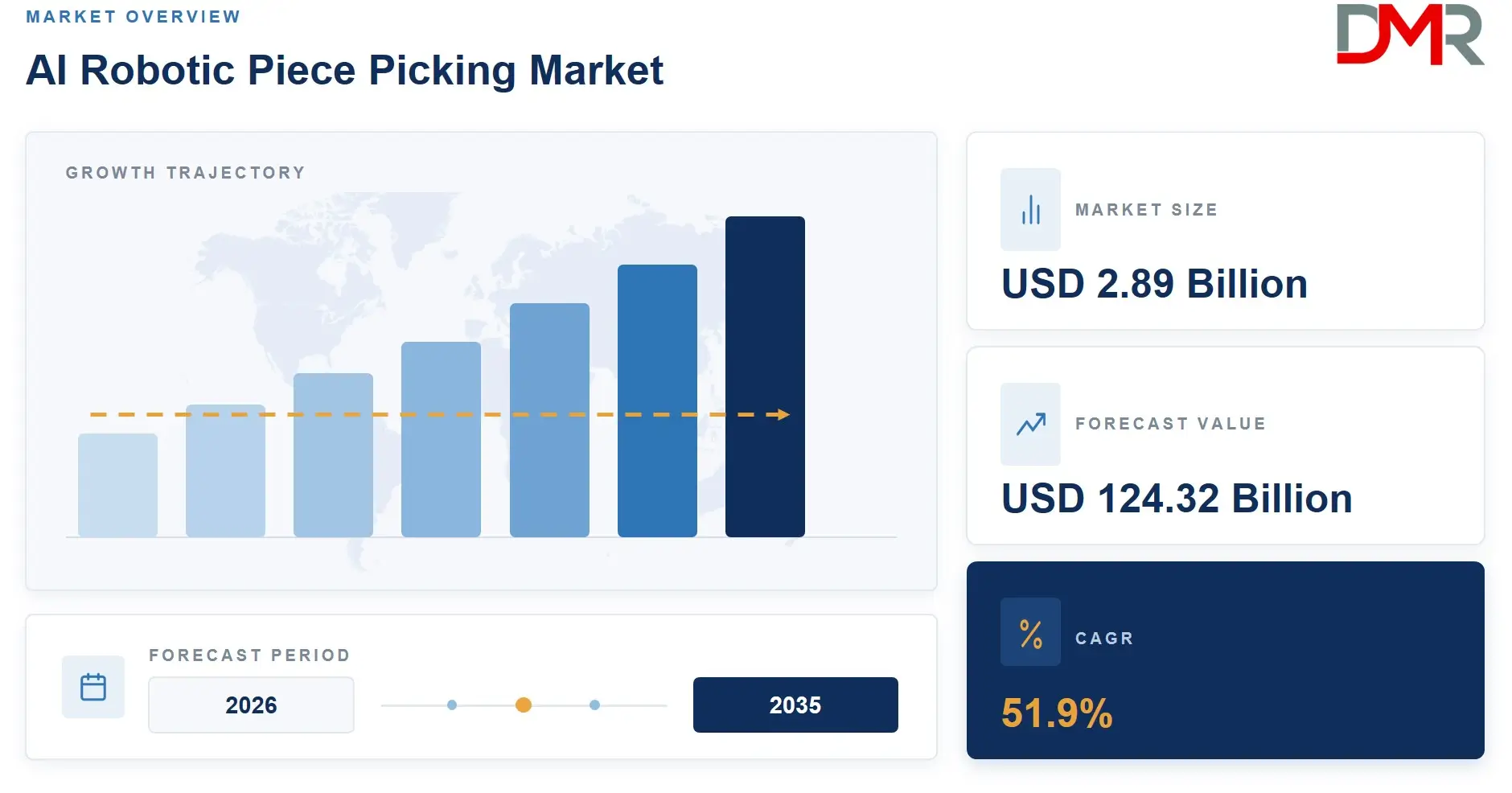
- The market size is USD 2.89 Billion in 2026, and is projected to hit USD 124.32 Billion by 2035 at a CAGR of 51.9%.
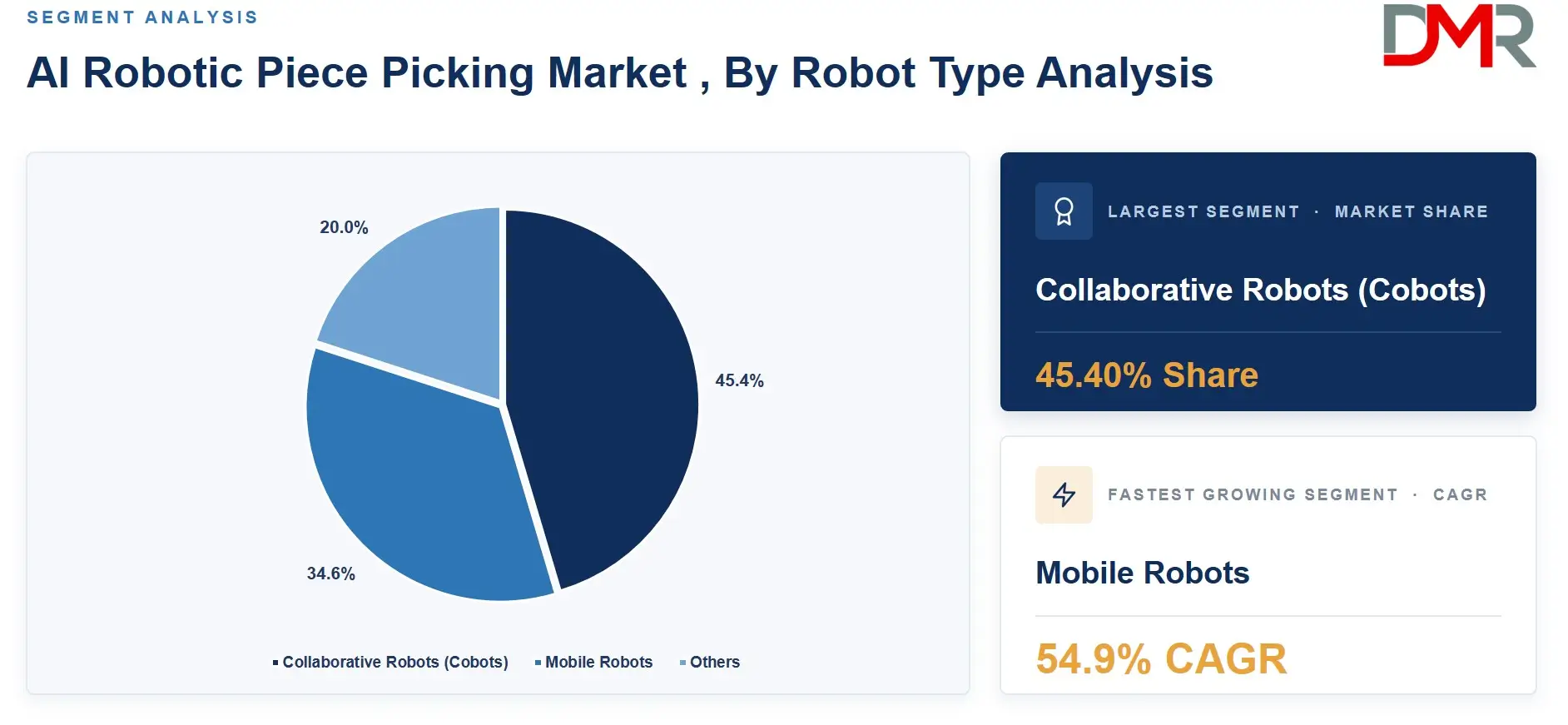
- By Robot Type: Collaborative Robots (Cobots) led with a 45.40% share in 2026.
- By End User Application: Retail / Warehousing / Distribution Centers / Logistics Centers led as the largest category in 2026.
- By Payload Capacity: ≤ 5 kg led with a 48.60% share in 2026.
- By Deployment Model: RaaS (Robots-as-a-Service) led with a 60.30% share in 2026.
- By Component: Hardware led with a 45.3% share in 2026.
- By Throughput Capacity: Below 1,000 picks/hour led as the largest category in 2026.
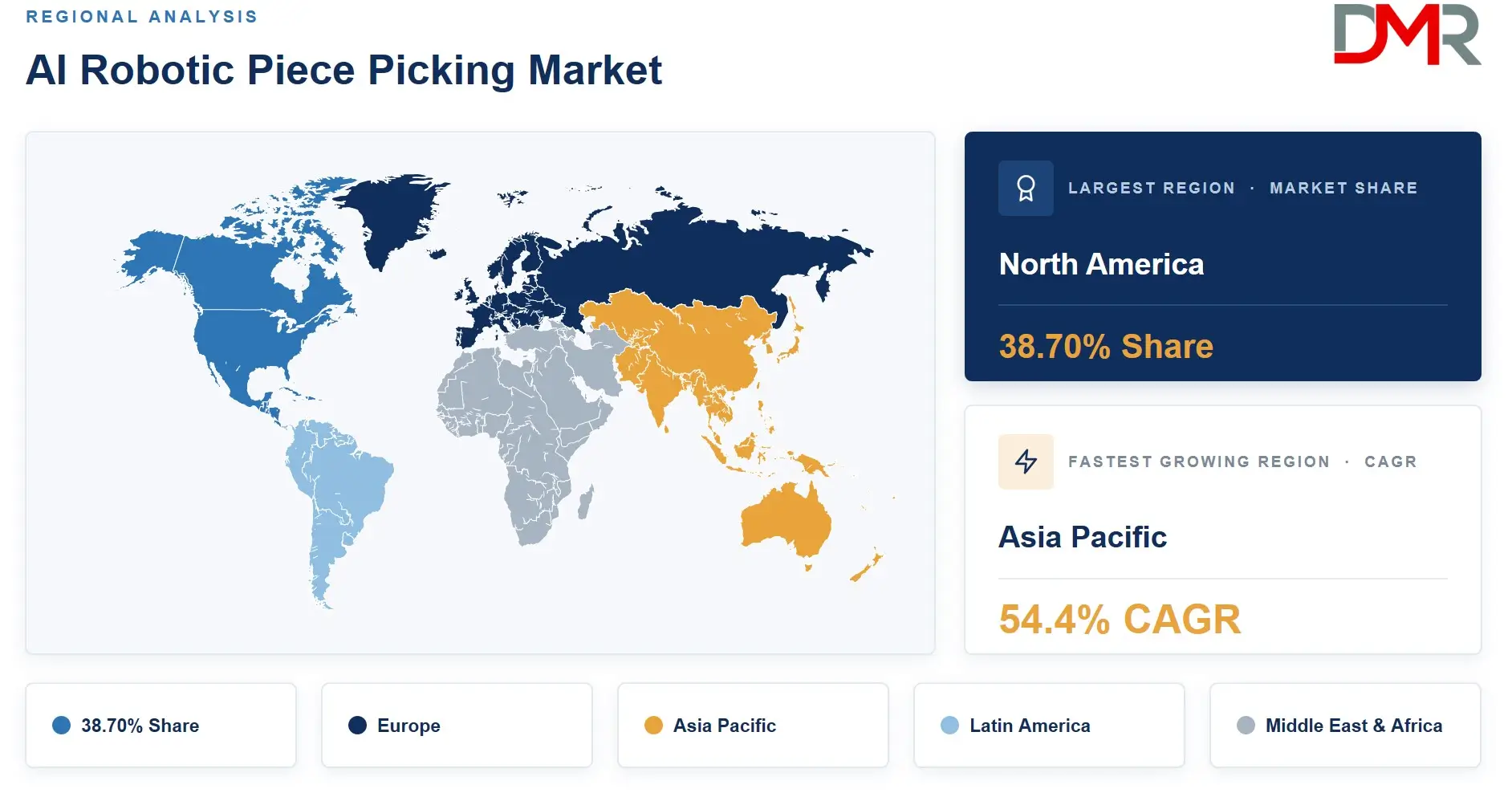
- By Region: North America led with a 38.70% share in 2026.
- Asia-Pacific is the fastest growing region with a CAGR of 54.4% through 2031, reflecting accelerating warehouse automation investment across China, Japan, and India.
Market Size and Forecast
The Global AI Robotic Piece Picking Market size is estimated at USD 2.89 Billion in 2026, and is projected to reach USD 124.32 Billion by 2035, exhibiting a CAGR of 51.9% during the forecast period.
A 2025 peer-reviewed warehouse study published in Springer evaluated AI-based order picking across 29 traditional single-order pick rounds and 25 AI-optimized batch-picking rounds, measuring travel time and distance directly in a live warehouse environment. The study found statistically significant non-normality in picking data for both travel time (p=0.036) and travel distance (p=0.000), confirming that AI-batched routing produces distribution patterns that differ fundamentally from manual workflows. Buyers interpreting vendor ROI projections must account for this variance when modeling payback periods against their own order profiles.
ℹ
To learn more about this report –
Download Your Free Sample Report Here
Mujin's December 2025 close of a USD 233 million Series D first close reflects the scale of private capital now targeting AI manipulation software rather than hardware alone. A forecast CAGR of 51.9% assumes continued AI model improvement, expanding RaaS adoption, and incremental penetration of mid-market operators who have so far deferred automation investment.
Robot Type Analysis
Collaborative Robots (Cobots) led the Robot Type segment with a 45.40% share in 2026.
Cobots hold nearly half of robot type demand because they operate safely alongside human workers without full safety fencing, reducing facility reconfiguration costs. A live kitting deployment by Productiv in August 2025 scaled to 13 collaborative robots, completing over 10,000 kits and logging more than 100,000 pick-and-place cycles in production. Cobots also carry a lower per-unit acquisition cost than industrial arms, making them the default choice for operators entering piece picking automation for the first time.
Mobile Robots represent the fastest growing sub-segment within robot type, as operators seek systems that move between pick stations rather than staying fixed at one location. Cobots' 62.4% CAGR reflects the dual pull of expanding AI capabilities and the RaaS commercial model, which lets buyers add cobots incrementally without large upfront hardware commitments. The Others category, which includes specialized gantry and delta-style pickers, addresses high-speed single-SKU applications but faces displacement as cobot throughput continues to improve.
ℹ
To learn more about this report –
Download Your Free Sample Report Here
End User Application Analysis
Retail / Warehousing / Distribution Centers / Logistics Centers led the End User Application segment as the largest category in 2026.
Retail and logistics operators face the highest pick volume density and the greatest same-day fulfillment pressure, making them the earliest and most consistent buyers of piece picking systems. E-commerce is the fastest growing end user sub-segment, driven by order fragmentation and return volume that manual teams cannot absorb profitably at scale. Pharmaceutical and healthcare operators adopt piece picking for unit-dose dispensing and kit assembly, where accuracy compliance requirements make robotic consistency a regulatory asset rather than just an efficiency play.
Payload Capacity Analysis
A 48.60% share made ≤ 5 kg the clear leader across Payload Capacity categories in 2026.
The ≤ 5 kg segment dominates because the majority of e-commerce and retail SKUs fall within that weight range, and lighter items match the gripper capabilities of current cobot and lightweight robotic arm designs. A 52.9% CAGR for this tier signals that AI grasp planning is improving faster for light consumer goods than for heavier industrial products. The 5–10 kg and above 10 kg tiers are growing as end-effector diversity and AI grasp models expand reliable handling into bulkier product categories, but neither tier will displace the sub-5 kg segment within the forecast window.
Deployment Model Analysis
With a 60.30% share in 2026, RaaS (Robots-as-a-Service) outpaced all other Deployment Model categories.
RaaS converts piece picking automation from a capital purchase into a variable operating cost, eliminating the approval barriers that block many mid-market operators from committing to CapEx-funded projects. A 52.6% CAGR for RaaS confirms that operators favor subscription access over asset ownership, especially when throughput requirements vary seasonally. CapEx (Capital Purchase) retains relevance for large 3PLs and retailers building purpose-designed greenfield facilities, where per-unit economics at high volume justify full asset ownership.
Component Analysis
Hardware accounted for 45.3% of Component demand in 2026, the highest of any category.
Hardware holds the largest share because physical robotic arms, end-effectors, cameras, and mounting infrastructure represent the bulk of per-system spend at the point of purchase or installation. Software is the fastest growing component with a 16.7% CAGR, as AI model updates, orchestration layers, and grasp-planning subscriptions generate recurring revenue streams that hardware sales cannot match. Vendors that build proprietary software stacks on top of commodity hardware are creating the stickiest long-term customer relationships in the market.
Throughput Capacity Analysis
Below 1,000 picks/hour led the Throughput Capacity segment as the largest category in 2026.
Most deployed systems today operate below 1,000 picks per hour because current AI grasp cycle times and end-effector changeover speeds cap throughput at mid-range volumes. The Above 1,000 picks/hour tier is gaining share as AI inference speeds improve and multi-arm cell designs allow parallel picking without proportional labor additions. Operators in high-volume e-commerce fulfillment are the primary buyers in the upper throughput tier, where per-pick economics justify premium system pricing.
Key Market Segments
By Robot Type
- Collaborative Robots (Cobots)
- Mobile Robots
- Others
By End User Application
- Retail / Warehousing / Distribution Centers / Logistics Centers
- Pharmaceutical & Healthcare
- E-commerce
- Others
By Payload Capacity
- ≤ 5 kg
- 5–10 kg
- Above 10 kg
By Deployment Model
- RaaS (Robots-as-a-Service)
- CapEx (Capital Purchase)
By Component
By Throughput Capacity
- Below 1,000 picks/hour
- Above 1,000 picks/hour
Regional Analysis
North America led the AI Robotic Piece Picking market with a 38.70% share in 2026, the highest of any region globally.
North America
North America's leadership reflects the concentration of large 3PLs, e-commerce mega-distributors, and grocery chains that face the most acute same-day fulfillment pressure and the steepest warehouse wage growth. U.S. operators have moved faster than any other region from pilot deployments to multi-site fleet contracts, pulling forward commercial scale that vendors had projected for 2027 and beyond. Canada's smaller but high-growth logistics sector follows U.S. investment patterns with a 12–18 month lag, creating a secondary opportunity for vendors already established south of the border.
Asia-Pacific
Asia-Pacific is the fastest growing region with a 54.4% CAGR through 2031, as Chinese e-commerce platforms, Japanese automotive suppliers, and Indian third-party logistics operators each pursue automation along distinct cost and throughput rationales. China's domestic robot manufacturers compete directly with Western vendors on price, creating a two-tier market where local systems dominate volume deployments while international platforms capture premium, high-accuracy applications. Japan's aging warehouse workforce makes automation adoption structurally inevitable rather than economically optional.
ℹ
To learn more about this report –
Download Your Free Sample Report Here
Europe
European operators face a dual constraint of high labor costs and strict worker protection regulations that limit shift flexibility, making the automation payback case structurally stronger than in lower-wage markets. Germany and the UK anchor demand, with German automotive and industrial logistics operators investing in high-payload configurations and UK grocery and e-commerce operators prioritizing throughput speed. EU regulations on autonomous systems are tightening, which raises compliance costs for new entrants but strengthens the position of certified vendors already operating in-region.
Latin America
Latin America remains an early-stage market where piece picking adoption is concentrated in Brazilian and Mexican e-commerce and retail operators with cross-border supply chains. Currency volatility and import duties on hardware components extend payback periods relative to North America, slowing the RaaS conversion that is accelerating elsewhere. Brazil's growing domestic e-commerce volume is the primary demand anchor, and vendors entering the region typically lead with RaaS contracts to remove the upfront capital barrier entirely.
Middle East & Africa
GCC countries, particularly the UAE and Saudi Arabia, are investing in warehouse automation as part of broader supply chain modernization programs tied to national economic diversification strategies. Greenfield logistics park development in the region gives vendors an advantage because new facilities can be designed for robotic integration from the outset rather than retrofitted around legacy infrastructure. Sub-Saharan Africa remains pre-commercial for piece picking, with adoption dependent on logistics infrastructure development that is still a decade away from supporting large-scale automation.
Key Regions and Countries
North America
Europe
- Germany
- France
- The UK
- Spain
- Italy
- Rest of Europe
Asia Pacific
- China
- Japan
- South Korea
- India
- Australia
- Rest of APAC
Latin America
- Brazil
- Mexico
- Rest of Latin America
Middle East & Africa
- GCC
- South Africa
- Rest of MEA
Macroeconomic Impact
Wage inflation in North American and European logistics hubs compresses operator margins at a rate that piece picking automation offsets directly, making robotics spend counter-cyclical to labor cost increases. A 2025 academic study evaluated AI-based order picking in a warehouse spanning 7,000 m² with 14 m ceiling height, 500-pallet racking, and capacity for simultaneous operations involving up to 8 trucks. That scale represents the class of facility where automation ROI is most defensible against interest rate headwinds, because high throughput density dilutes fixed system costs across a larger pick volume.
Rising interest rates between 2022 and 2024 slowed greenfield capital projects in North America and Europe but accelerated RaaS adoption as operators avoided balance-sheet commitments. Trade policy uncertainty, particularly around U.S.-China tariffs on electronics and robotic components, creates input cost pressure for hardware-heavy system configurations. Asia-Pacific operators benefit from lower hardware import costs and domestic manufacturing scale, which partially insulates regional ROI calculations from the dollar-denominated component pricing that affects Western buyers.
Market Dynamics
Driver: Labor Scarcity and AI Accuracy Gains Justify Automation Payback
Persistent warehouse labor shortages across North American and European logistics hubs have pushed hourly wages to levels where robotic piece picking achieves payback within 18–24 months for high-volume operators. Berkshire Grey reports that facilities replacing manual picking can reduce labor requirements by up to 60% while simultaneously increasing throughput and SKU coverage. That combination of cost removal and capacity addition is what converts hesitant buyers into signed contracts.
AI accuracy improvements directly support the economic case. In Productiv's live kitting deployment, robotic pick-and-place accuracy climbed from below 80% at launch to consistently in the high 90s, with some production runs above 99%, within six months. A parallel gain in cycle speed, with takt time falling from 12–15 seconds per pick to 6 seconds, shows that AI model maturation compresses the performance gap between robotic and human pickers faster than most operators modeled at the point of purchase.
Restraint: Integration Complexity and SKU Coverage Gaps Slow Full Deployment
WMS and WES integration across heterogeneous conveyor, storage, and material-handling environments extends commissioning timelines well beyond vendor estimates for most brownfield facilities. Berkshire Grey acknowledges that even a modular system designed for rapid deployment typically requires three months from contract to operational status in a brownfield setting. Operators with irregular order profiles, seasonal SKU swaps, and legacy warehouse management platforms face longer commissioning cycles that delay payback and erode internal support for automation programs.
SKU coverage limits create a second structural restraint. In Productiv's live deployment, robots had validated reliable picking for only 5% of the facility's total SKU universe, which can exceed 100,000 item types in a year. Reaching the operator's next operational milestone of 25% validated SKU coverage requires sustained AI model training and physical grasp testing across hundreds of additional item geometries. Buyers entering automation with diverse product catalogs must plan for an extended coverage ramp that does not appear in vendor pitch decks.
Opportunity: RaaS Contracts and Micro-Fulfillment Unlock Mid-Market and Specialty Operators
RaaS contracts convert piece picking from a capital commitment into a monthly operating expense, removing the primary approval barrier for mid-market 3PLs and regional distributors that cannot justify a multi-million-dollar CapEx request in a single budget cycle. In January 2025, RightHand Robotics solidified a deployment agreement with Swedish online pharmacy Apotea, integrating RightPick item-handling systems into a new heavily automated logistics facility in Varberg, Sweden. A pharmacy operator choosing robotic piece picking signals that the technology has reached reliability thresholds acceptable in regulated, accuracy-critical environments.
Micro-fulfillment for grocery, pharmacy, and convenience retail creates a structurally different demand pool than large-scale 3PL automation. High-mix single-item handling in compact footprints requires modular robotic cells rather than warehouse-scale conveyor systems, and returns processing automation adds a second use case within the same facility. Together, these applications extend the addressable market well beyond the mega-warehouse operators who defined first-generation adoption.
Porter's Five Forces
Competitive rivalry in the AI robotic piece picking market is intense among the top 10 vendors, but the market remains fragmented enough that no single player holds a dominant share across all deployment types and regions. Barriers to new entry are high because proprietary AI grasp models, certified safety integrations, and WMS connector libraries require years of customer deployment data to build, limiting new entrants to niche applications or geographic white space. Supplier power is moderate, concentrated in vision sensor manufacturers, end-effector specialists, and AI chip producers whose components sit at the core of every system. Berkshire Grey's modular architecture, which maintains 98%–99% of throughput even when one module is offline, illustrates how leading vendors use reliability engineering to reduce buyer concern about downtime risk and strengthen contract retention. Buyer power is growing as enterprises now have multiple certified vendor options, driving competitive pricing on RaaS contracts and requiring vendors to differentiate on software performance rather than hardware specifications alone. Substitutes such as goods-to-person systems and manual picking with pick-to-light guidance remain viable for low-mix, high-volume operations, but the performance gap between robotic and manual approaches narrows every quarter as AI cycle speeds improve.
AI and Gen AI Impact
Vision-language-action AI models are the central technical forcing function in piece picking. Exotec's 2025 technical guide reports that modern robotic pick-and-place systems achieve placement precision of approximately ±0.1 mm, enabled by computer vision, motion-planning algorithms, and end-effector control working in closed-loop coordination. That precision level brings robotic systems within tolerance for pharmaceutical unit-dose dispensing and electronics assembly pick tasks that manual grippers previously handled exclusively.
Synthetic data generation and digital twin simulation are reducing the training data gap for rare items and edge-case grasping scenarios. Early movers that build proprietary training datasets from live deployments accumulate a compounding model accuracy advantage that vendors relying on public datasets cannot replicate quickly. Laggards that defer AI model investment risk losing high-accuracy contract opportunities to vendors whose systems have already validated performance across broader SKU ranges in live production.
Market Trends
Mobile Manipulation and AI Orchestration Reshape Warehouse Picking Architecture
Modern robotic pick-and-place systems now regularly exceed 200 items picked per hour with accuracy above 99.9%, as reported by Exotec in 2025, setting a throughput benchmark that mobile manipulators combining AMRs with robotic arms must meet to compete with fixed-cell designs. In June 2026, Brightpick partnered with automation manufacturer Trew LLC to embed its mobile manipulation robots into Trew's broader material-handling ecosystem, extending market reach across the U.S. AI-orchestrated warehouse control layers that coordinate piece pickers, AMRs, sortation, storage, and human workstations as one integrated system represent the structural shift separating early architecture choices from long-term competitive positioning.
Market Competition Overview
The AI robotic piece picking market is fragmented across 20 or more active vendors, with no single provider holding dominant share across all segments, regions, and deployment types. A 2025 Springer peer-reviewed study comparing 29 traditional single-order pick rounds against 25 AI-optimized batch-picking rounds confirms that AI routing produces measurably distinct performance outcomes, a finding that vendors use to differentiate software capabilities against competitors offering similar hardware configurations. Vendors compete on AI model performance, SKU coverage breadth, commissioning speed, and RaaS contract terms rather than on hardware specifications alone.
Market consolidation is accelerating through acquisition, minority investment, and talent transactions. Larger automation and technology platforms are acquiring or investing in pure-play piece picking specialists to gain AI model libraries and customer deployment data. Vendors that built modular, interoperable systems with open WMS connectors are gaining share over proprietary closed architectures as enterprise buyers prioritize flexibility over per-unit performance maximums.
Pricing Analysis
Piece picking system pricing varies across three primary structures: CapEx purchase, RaaS subscription, and hybrid arrangements where hardware is purchased and software is licensed annually. RaaS monthly pricing typically ranges from throughput-based fees per thousand picks to flat monthly access fees per robotic cell, with contract terms of three to five years. Productiv's deployment experience, where end-of-line quality targets of 99.5%–99.9% accuracy required human workers to handle exceptions until robot performance reached that tier, illustrates why performance-based pricing benchmarks are emerging as a differentiator in vendor negotiations.
Downward pricing pressure on hardware is intensifying as Chinese domestic manufacturers compete on component costs in Asia-Pacific deployments. Software subscription pricing is moving upward as AI model performance improves and vendors attach recurring training, update, and orchestration fees to multi-year contracts. Leaders maintain pricing power through SKU coverage breadth and certified integrations. Challengers compete primarily on RaaS entry pricing to displace incumbent systems at contract renewal.
Company Profiles
RightHand Robotics Inc. positions itself as an AI-first piece picking specialist, building its commercial strategy around a combination of hardware systems and a proprietary software layer that improves model accuracy through cumulative deployment data. In November 2025, the company introduced RightPick One, a compact, rack-mounted system designed to bring core AI picking capabilities to a lower price point and smaller footprint, directly targeting mid-market operators and brownfield retrofit opportunities that its earlier larger-format systems could not address economically. The March 2025 minority investment by Rockwell Automation further extended its integration pathway into Rockwell's global supply chain automation customer base.
Berkshire Grey Inc. competes on system-level reliability and modular scalability, targeting large-scale 3PL and retail operators that require guaranteed throughput continuity across multi-shift operations. Its commercial positioning centers on demonstrated uptime performance, rapid brownfield installation timelines, and a portfolio that spans piece picking, sortation, and bulk handling within a single integrated platform. Berkshire Grey's strategy of offering a full automation stack rather than a standalone picking solution creates cross-sell opportunities that single-product vendors cannot match at contract renewal.
Key Players
- RightHand Robotics Inc.
- Berkshire Grey Inc.
- Covariant
- Plus One Robotics Inc.
- Kindred Systems Inc. (Ocado Group)
- Universal Robots A/S (Teradyne Inc.)
- XYZ Robotics Inc.
- Nimble Robotics Inc.
- KNAPP AG
- Dematic Group (KION Group AG)
- Swisslog Holding AG (KUKA AG)
- Mujin Inc.
- Nomagic Inc.
- OSARO Inc.
- Fizyr B.V.
- Grey Orange Pte. Ltd.
- HandPlus Robotics Pte. Ltd.
- Lyro Robotics Pty Ltd.
- Robomotive BV
- SSI Schaefer Group
Supply Chain and Value Chain Analysis
The AI robotic piece picking value chain begins with semiconductor and vision sensor manufacturers, moves through robotic arm and end-effector producers, and converges at system integrators who combine hardware, AI software, and WMS connectivity into deployable solutions. Maximum value creation occurs at the AI software and model layer, where vendors with proprietary grasp-planning algorithms and large SKU training datasets command recurring revenue through software subscriptions and model update agreements. Hardware margins are compressing as component manufacturing scales globally, concentrating margin further toward the software and integration tiers.
The largest supply chain risk sits in vision sensor and AI accelerator chip supply, where lead times have extended sharply since 2022. End-effector supply is a secondary constraint, particularly for specialized soft grippers and multi-fingered hands used in high-mix applications. System integrators that maintain dual-sourced hardware configurations and modular end-effector compatibility reduce delivery risk for enterprise buyers operating on fixed commissioning timelines.
Regulatory Landscape
The EU Machinery Regulation, which replaced the Machinery Directive and entered application in 2023, sets updated conformity assessment requirements for autonomous robotic systems operating alongside humans. Vendors selling collaborative robot systems into European markets must document safety function performance levels, AI model validation procedures, and human detection protocols under CE marking requirements. Compliance certification timelines of 6–12 months create a structural advantage for vendors already certified in Europe versus those entering the market from outside the region.
U.S. OSHA standards for robotic workplace safety apply to piece picking deployments through existing machinery guarding and lockout-tagout frameworks, without AI-specific federal regulations yet in force. Several U.S. states are advancing autonomous workplace equipment legislation that may impose additional disclosure and safety audit requirements on robotic system operators. Vendors that build compliance documentation into their standard deployment package reduce buyer procurement friction and accelerate site approval timelines.
Investment and White Space Analysis
Private capital is concentrating in vendors with proprietary AI model stacks and proven multi-site deployment records. In March 2025, Rockwell Automation made a strategic minority investment in RightHand Robotics to co-develop and commercialize smart autonomous robotic piece-picking software for global supply chain ecosystems, signaling that industrial automation incumbents are acquiring AI picking capabilities through investment rather than internal development.
White space is largest in mid-market 3PLs, regional distributors, and specialty retail operators that lack the volume density to justify full greenfield automation but represent an aggregate addressable market larger than the enterprise tier already served. Returns processing automation and pharmacy micro-fulfillment remain underserved by current commercial offerings, with no vendor yet establishing a dominant position in either vertical. Vendors that package modular robotic cells with RaaS contracts and pre-certified WMS integrations for these sub-markets hold the clearest path to incremental share through 2028.
Recent Developments
- January 2024: RightHand Robotics officially launched the RightPick 4 system, featuring upgraded sensors, enhanced machine learning algorithms, and optimized hardware. The new system handled items up to 25% larger and 50% heavier than previous models.
- August 2024: RightHand Robotics secured fresh funding and appointed co-founder Yaro Tenzer as CEO to accelerate commercial scaling of its autonomous piece-picking technologies.
- November 2024: Brightpick secured USD 12 million in combined equity and venture debt financing, pushing total lifetime funding to USD 47 million to scale U.S. deployments of its AI warehouse robots.
- December 2024: Zebra Technologies entered a definitive agreement to acquire 3D vision specialist Photoneo from the Photoneo Brightpick Group, expanding its machine vision portfolio while carving out Brightpick to operate independently.
- June 2025: Brightpick rolled out Autopicker 2.0, featuring its "Picking in Motion" technology. The upgraded multi-purpose warehouse robot was engineered to reach human-level picking and fulfillment throughput speeds.
- November 2025: Brightpick announced that its Autopicker fleet achieved fully autonomous lights-out overnight fulfillment, with robots using 3D vision to pick and buffer orders in complete darkness without human intervention.
- February 2026: Brightpick signed a strategic partnership with NAPA Auto Parts to deploy more than 100 AI picking robots across U.S. automotive parts distribution hubs, marking its entry into automotive distribution.
- March 2026: Brightpick debuted Gridpicker, an ultra-high-density grid-based storage and automated retrieval system. Mobile AI manipulators pick items directly from totes on shelves, making it the company's highest-throughput system to date.
- April 2026: Brightpick formed a distribution partnership with intralogistics provider MotionTech to manage the launch and scaling of Gridpicker systems across continental Europe and the UK.
- June 2026: Brightpick teamed up with automation manufacturer Trew LLC, embedding its mobile manipulation robots into the Trew material-handling ecosystem to extend collective market reach across the U.S.
Report Details
| Report Characteristics |
| Market Value (2026) |
USD 2.89 Billion |
| Forecast Revenue (2035) |
USD 124.32 Billion |
| CAGR (2026–2035) |
51.9% |
| Base Year for Estimation |
2025 |
| Historic Period |
2020 – 2024 |
| Forecast Period |
2026 – 2035 |
| Report Coverage |
Revenue Forecast, Market Dynamics, Competitive Landscape, Recent Developments |
| Segments Covered |
By Robot Type (Collaborative Robots/Cobots, Mobile Robots, Others); By End User Application (Retail/Warehousing/Distribution/Logistics, Pharmaceutical & Healthcare, E-commerce, Others); By Payload Capacity (≤ 5 kg, 5–10 kg, Above 10 kg); By Deployment Model (RaaS, CapEx); By Component (Hardware, Software); By Throughput Capacity (Below 1,000 picks/hour, Above 1,000 picks/hour) |
| Regional Analysis |
North America – US and Canada; Europe – Germany, France, The UK, Spain, Italy, and Rest of Europe; Asia Pacific – China, Japan, South Korea, India, Australia, and Rest of APAC; Latin America – Brazil, Mexico, and Rest of Latin America; Middle East & Africa – GCC, South Africa, and Rest of MEA |
| Competitive Landscape |
RightHand Robotics Inc., Berkshire Grey Inc., Covariant, Plus One Robotics Inc., Kindred Systems Inc. (Ocado Group), Universal Robots A/S (Teradyne Inc.), XYZ Robotics Inc., Nimble Robotics Inc., KNAPP AG, Dematic Group (KION Group AG), Swisslog Holding AG (KUKA AG), Mujin Inc., Nomagic Inc., OSARO Inc., Fizyr B.V., Grey Orange Pte. Ltd., HandPlus Robotics Pte. Ltd., Lyro Robotics Pty Ltd., Robomotive BV, SSI Schaefer Group |
| Customization Scope |
Customization for segments and region or country level will be provided. Additional customization can be done based on requirements. |
| Purchase Options |
Three license options: Single User License, Multi-User License (Up to 5 Users), and Corporate Use License (Unlimited Users and Printable PDF) |
Frequently Asked Questions
What is the biggest investment opportunity in the AI Robotic Piece Picking market?
▾ The largest investment opportunity lies in mid-market 3PL and regional distributor automation, where RaaS contract structures convert piece picking from a capital commitment into an operating expense. Returns processing and pharmacy micro-fulfillment represent underserved verticals with no dominant vendor yet established, offering clear entry points through 2028.
Who are the top companies in the AI Robotic Piece Picking market?
▾ Leading vendors include RightHand Robotics Inc., Berkshire Grey Inc., Covariant, Mujin Inc., KNAPP AG, Dematic Group, Swisslog Holding AG, Grey Orange Pte. Ltd., Nimble Robotics Inc., and Universal Robots A/S among others. These players compete on AI model performance, SKU coverage, commissioning speed, and RaaS contract terms rather than hardware specifications alone.
Which segment is growing fastest in the AI Robotic Piece Picking market and why?
▾ Collaborative Robots (Cobots) is the fastest growing robot type with a CAGR of 62.4%, driven by their ability to operate safely alongside human workers without full safety fencing and their compatibility with RaaS commercial models. E-commerce is the fastest growing end user sub-segment, as order fragmentation and return volumes exceed what manual teams can handle profitably at the margins required.
Which region is growing fastest in the AI Robotic Piece Picking market and why?
▾ Asia-Pacific is growing fastest with a CAGR of 54.4% through 2031, driven by Chinese e-commerce platform automation, Japan's structurally aging warehouse workforce, and rapid third-party logistics investment in India. Domestic robot manufacturers in China compete on price for volume deployments, creating a two-tier market that draws international vendor investment into premium, high-accuracy applications.
What is the biggest challenge holding AI Robotic Piece Picking Market back?
▾ WMS and WES integration complexity across heterogeneous warehouse environments extends commissioning cycles and erodes operator confidence in projected payback timelines. Limited SKU coverage, with live deployments often validating reliable grasping for only a small fraction of a facility's total item universe, means human pickers remain necessary for exceptions, reducing the labor cost savings that vendors project in pre-sale ROI models.