What is the AI Smart Glasses Market Size?
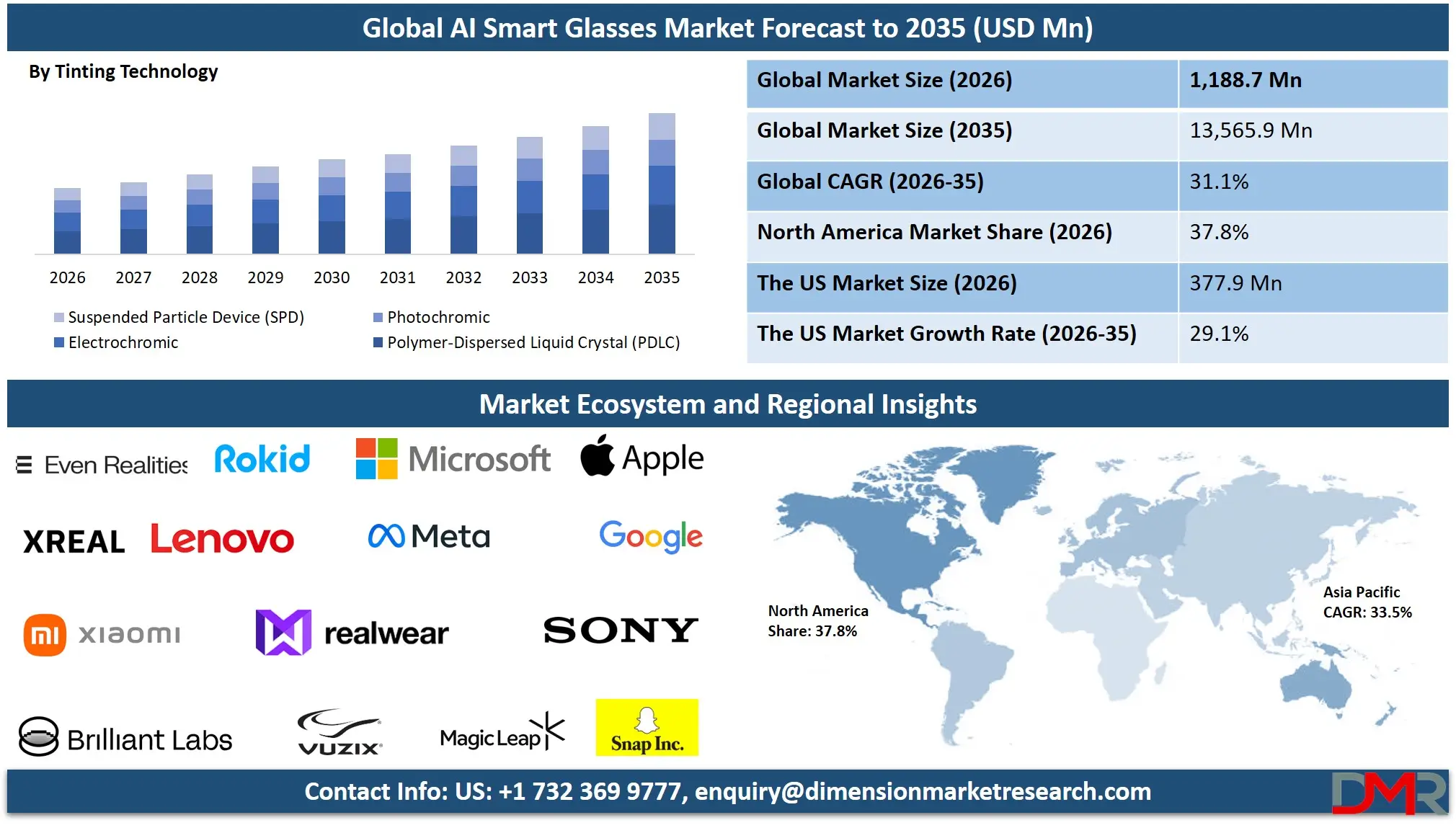
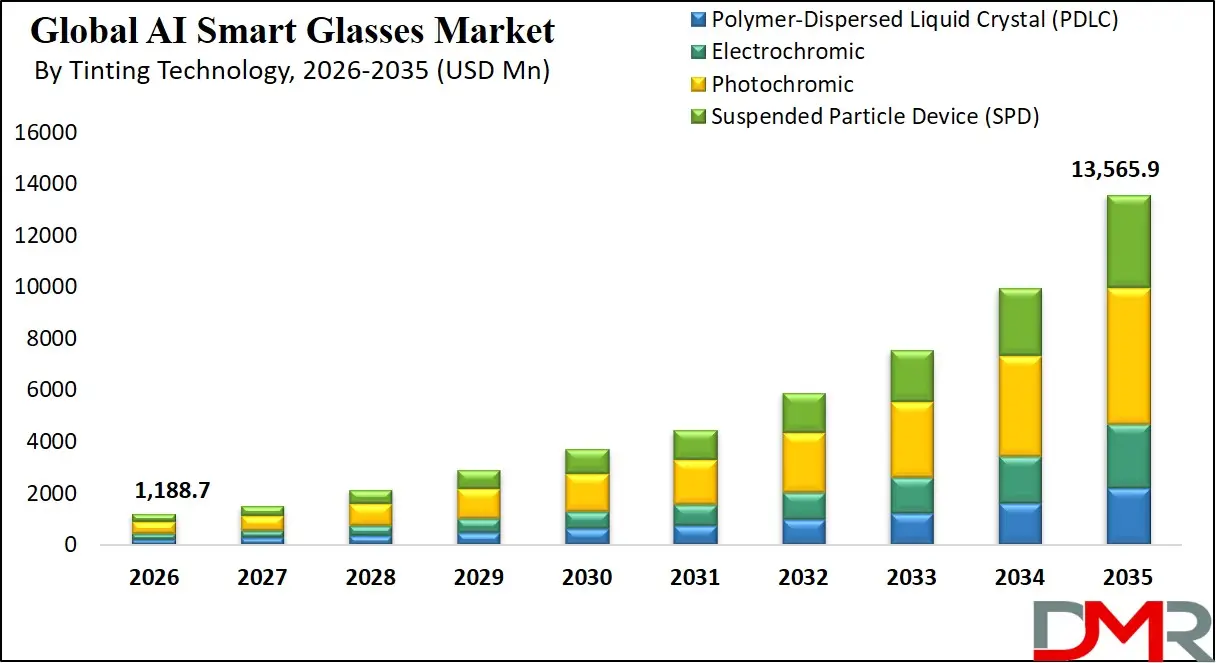
The Global AI Smart Glasses Market is expected to reach a value of USD 1,188.7 million in 2026, and it is further anticipated to reach USD 13,565.9 million by 2035, growing at a CAGR of 31.1% during the forecast period.
ℹ
To learn more about this report –
Download Your Free Sample Report Here
The demand in the AI Smart Glasses Market has been increasing exponentially as companies and individuals switch to wearable computing to gain hands-free productivity and experience. The market comprises monocular, binocular, audio, and immersive AR/VR-enabled smart glasses that superimpose digital information on the real-life of the user. The growing need to apply augmented reality to remote collaboration, spatial computing, and AI-enhanced visual assistance is causing the need of special optical and hardware units. The most common adopters are the enterprises and Android operating system and Wi-Fi connectivity are the most adopted given their flexibility as open-source and high bandwidth. Healthcare, manufacturing, and logistics are among the major players since they need rugged, compliant, and highly precise heads-up display ecosystems.
ℹ
To learn more about this report –
Download Your Free Sample Report Here
The US AI Smart Glasses Market
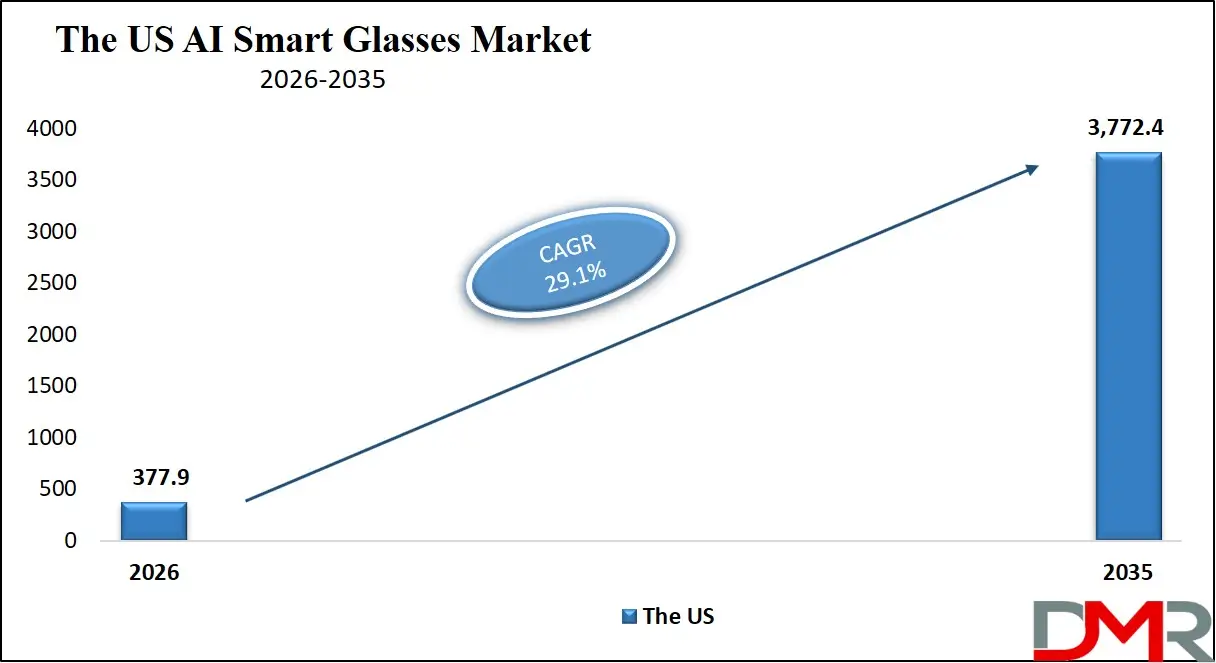
The US AI Smart Glasses Market is projected to reach USD 377.9 million in 2026 at a compound annual growth rate of 29.1% over its forecast period which is further forecasted to reach a value of USD 3,772.4 million by 2035. The US is the most mature and largest market for smart glasses because of the concerted efforts of the aerospace, defense and logistics industries to modernise, and the availability of high-speed 5G networks.
ℹ
To learn more about this report –
Download Your Free Sample Report Here
The market has been defined by the high need for Immersive (AR/VR-based) Smart Glasses as companies are looking to evolve from 2D displays to 3D spatial computing platforms for design prototyping and training. Likewise, the use of Generative AI assistants in heads-up displays is generating a similar demand for Advanced Smart Glasses with powerful processing and sensor capabilities to cope with data governance and AI ethics in augmented vision.
The Europe AI Smart Glasses Market
The Europe AI Smart Glasses Market is estimated to be valued at USD 342.2 million in 2026 and is further anticipated to reach USD 3,583.4 million by 2035 at a CAGR of 29.8%. Regulations such as GDPR and the future EU AI Act have a profound effect on the European market, resulting in the need to use glasses with privacy-by-design features such as manual control of cameras and edge-processed biometric data. There is also a rapid expansion of Remote Inspection services in the region as German and French manufacturing and automotive companies are attempting to balance operational technology (OT) security with cloud-based wearables for remote diagnostics. Also, the need to minimise travel is driving service providers to build 3D Visualization & Prototyping solutions tailored to ensure data sovereignty and high-quality renderings in the European manufacturing ecosystem.
The Japan AI Smart Glasses Market
The Japan AI Smart Glasses Market is projected to be valued at USD 131.1 million in 2026. It is further expected to witness robust growth, holding USD 1,346.5 million in 2035 at a CAGR of 29.5%. The Japanese market is distinctive with a corporate movement towards Digital Transformation (DX) due to an ageing and shrinking workforce in skilled trades and field service. A major part of investment is in the immersive (AR/VR-enabled) Smart Glasses and Remote Inspection apps as large conglomerates are using wearable devices for real-time knowledge transfer to young workers. There is also a need to embed into the market to connect the legacy industrial equipment with IoT networks, which is a niche in dust-proof wearable devices and edge computing for low-latency transmission.
Key Takeaways
- Market Size & Forecast: The Global AI Smart Glasses Market is projected to reach USD 1,188.7 million in 2026, expanding dramatically to USD 13,565.9 million by 2035, fueled by the dual drivers of enterprise spatial computing and the miniaturization of micro-LED and waveguide optic components.
- Growth Rate & Outlook: Global market growth is expected at a CAGR of 31.1%, driven by a severe lack of internal AR developers and increasing complexity of 3D content management and integration within manufacturing processes.
- Primary Growth Drivers: Major drivers include the shift from paper-based manuals and 2D checklists to hands-free operational instructions, the need for 3D Visualization & Prototyping to reduce product development lifecycles and the integration of IoT sensor data, requiring advanced Binocular Smart Glasses for complex data overlay.
- Key Market Trends: Primary trends include the emergence of industry-specific smart glasses, the integration of AI-driven video analysis in Remote Inspection apps to automatically detect anomalies and automatically switch between Photochromic or Electrochromic lenses as users want seamless transitioning from indoors to outdoors.
- By Type Analysis: Immersive AR/VR-enabled smart glasses are poised to dominate this segment because of the enhanced features that offer an immersive experience, real-time visualisation and hands-free functionality. Their popularity in gaming, health-care and manufacturing, and advances in display, sensing and processing technologies, are still contributing to their dominance.
- By Operating System Analysis: Android is poised to dominate this segment due to its open-source nature, developer support, and hardware compatibility. This allows affordable customisation for various use-cases, easy device compatibility and constant optimisation for better performance, making it the operating system of choice for smart glasses worldwide.
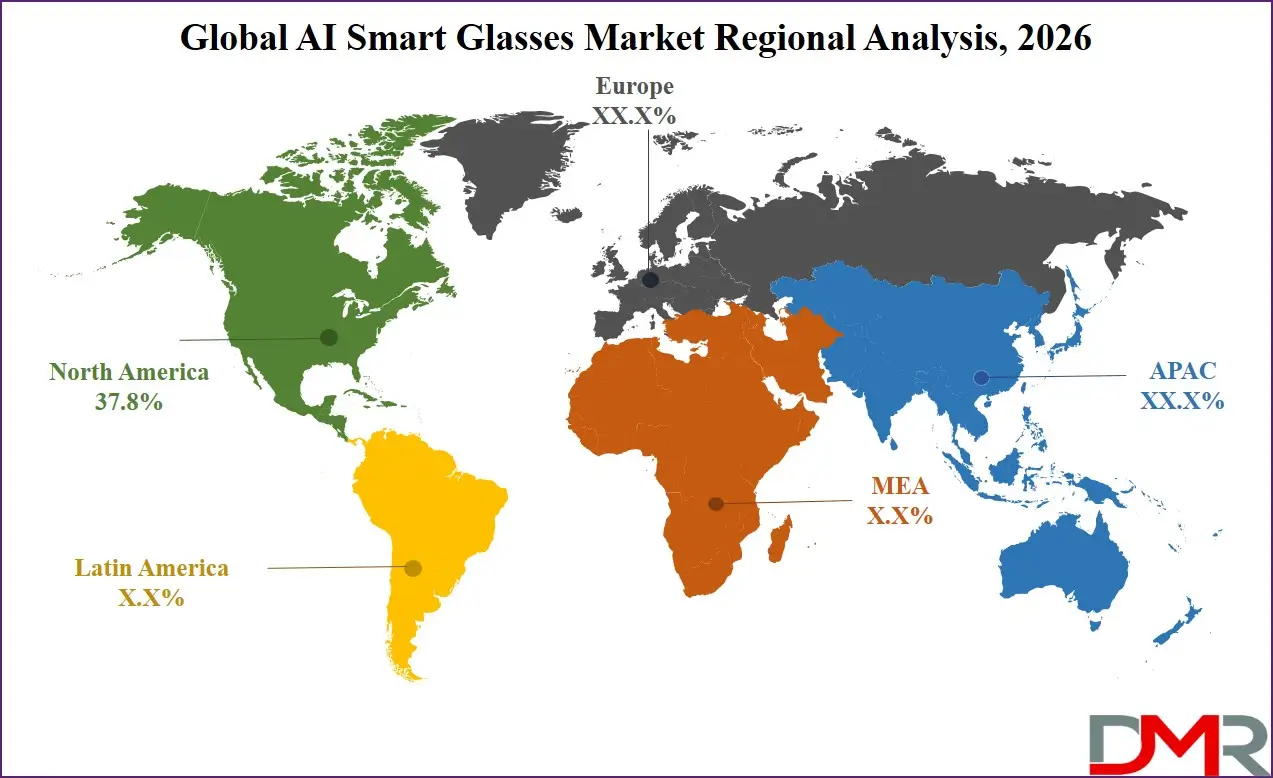
- Regional Leadership: North America is poised to dominate this market with 37.8% of the market share in 2026 due to advanced technology infrastructure that fully harnesses the power of this technology and makes it a market leader in this category.
What is the AI Smart Glasses?
AI Smart Glasses are wearable devices that integrate artificial intelligence with augmented reality (AR), sensors, and connectivity to enhance real-world interactions. These glasses use cameras, microphones, and onboard processors to analyze surroundings in real time, enabling features such as object recognition, language translation, navigation assistance, and voice-controlled digital assistants. Unlike traditional smart glasses, AI-powered versions learn user preferences and provide contextual information, improving productivity and convenience. They can support applications across industries, including healthcare, manufacturing, logistics, and consumer use. With integration into cloud platforms and smartphones, AI smart glasses deliver hands-free access to data, immersive experiences, and intelligent decision support, making them a key component of next-generation wearable technology.
Use Cases
- Surgical Telementoring in Healthcare: Hospital groups use Binocular Smart Glasses for Telemedicine to enable remote surgeons to view exactly what a local surgeon sees and make annotations during complicated surgeries, which saves time and costs while delivering better outcomes for patients.
- Assembly and QA in Automotive: Car manufacturers use advanced smart glasses for 3D Visualization & Prototyping which displays torque settings and part placement details to the wearer's field of view and reducing errors and speeding up quality assurance.
- Order Picking in Warehousing: Warehousing companies use monocular smart glasses with bar code scanning and Wi-Fi to assist pickers with the shortest routes, showing locations and quantities of products to be picked, resulting in faster and more accurate order picking.
- Remote Field Services: Power & Utilities use rugged Immersive (AR/VR) smart glasses for remote inspection, linking field service workers to central engineering teams to overlay design schematics onto a turbine or transformer, allowing problem diagnosis and repair without having an expert onsite.
How AI is Transforming the AI Smart Glasses Market?
The AI Smart Glasses Market is evolving with the help of AI by driving the perception capabilities of the device, and increasing the relevance of the information being presented. With advanced smart glasses, computer vision software using AI has the potential to identify objects and text, as well as the surrounding environment, translating contextual information into context-relevant overlay graphics and reducing the need for user interaction. In terms of Audio Smart Glasses, AI-based noise reduction and real-time language translation capabilities, help companies to communicate more effectively with distributed teams by filtering noise and translating text in real-time, supporting hands-free communication techniques.
AI is also at the forefront of product design and development. In 3D Visualization, generative AI is used to generate prototypes and designers use spatial interfaces to identify regions of a model that are at odds with structural integrity, thus ensuring companies stay compliant with engineering design principles. In addition, AI assistants are supporting remote inspection by processing video data streams to compare physical builds with their digital twins, thus providing a real-time visual representation of any anomalies before the assembly is built.
Market Dynamics
Key Drivers in the Global AI Smart Glasses Market
The Global Spatial Computing Skills Gap
Multinational companies are struggling to hire talent with expertise in spatial computing, Unity/Unreal 3D for AR, computer vision and wearable UX design. The demand for these skills is growing faster than the supply of skills, creating a gap in the market. This is resulting in businesses outsourcing hardware integration and app development to business services providers instead of employing in-house professionals. These enterprises help in key areas such as deployment of applications, integration with enterprise resource planning (ERP) systems and managed device services. This approach enables firms to accelerate digital transformation programs and avoid the possibility of bottlenecks and delays caused by a lack of in-house capabilities.
Complexity of Enterprise-Grade Hardware Deployment
Large enterprises typically also have diverse fleets of devices from multiple OEMs to ensure they are not locked into a single vendor, but instead offer device-specific capabilities. However, maintaining a fleet of such smart glasses from multiple vendors is complex. Enterprises must ensure that device management, software security patches, connectivity and data privacy policies are consistent across multiple platforms with different proprietary Operating Systems. This can lead to inefficiencies, security issues and potential unnecessary costs without expert advice. Therefore, there's an increasing demand for managed service providers to support businesses in such environments.
Restraints in the Global AI Smart Glasses Market
Inertia of Physical Process Technical Debt
The majority of business operations still rely on physical processes and paper-based systems that have evolved over time and are entrenched in the culture. These physical processes are an impediment to innovation, even though there is potential for wearable interfaces to increase efficiency and quality. It may be costly and risky to replace paper-based clipboards, binders and mobile computer systems with vision and voice interfaces. To redesign a physically complex assembly workflow for a spatial interface requires extensive planning, process re-engineering and change management. Companies fear a shift in workflows, employee backlash, and unexpected costs. As a result, process inertia slows down the introduction of smart glasses and often hinders even bigger digital transformation initiatives.
Upfront Hardware Cost and ROI Scrutiny
Increasing economic uncertainty and volatile business cycles have led to organizations being more reluctant to invest in expensive devices and device-specific application development. Despite front-line digitalization being a priority, business leaders are being asked to validate the high upfront hardware costs and fast return on investment. The hardware-centric and long-term subscription-based engagement models of Advanced Smart Glasses are likely to be questioned. To get quick operational advantage or cost savings from a specific department, businesses are more likely to pursue pilot programs. The roll out of a large-scale, long-term engagement is likely to remain on hold until the OEMs can show a short-term return on investment. This is driving the wearable ecosystem to focus more on performance and outcomes.
Growth Opportunities in the Global AI Smart Glasses Market
AI-Ready Platform Design for Frontline Workers
A major growth opportunity with smart glasses is helping companies develop their own secure, tailored, wearable-AI environments. Many businesses have experimented with generative AI systems (such as ChatGPT) on their desktop, but they now want their own personal assistants that cater to their data, compliance and workflow needs on their wearables. The creation of these complex spatial environments requires expertise in edge deployment of AI, large-action models and AI orchestrators for wearables. Platform-ready Advanced Smart Glasses vendors can help companies build personal AI systems that help in complex assembly, analytics and decision making. This space is likely to drive a high demand for highly technical consultancy and application development for the hardware.
Vertical-Specific Solution Implementation
The requirement to combine both technical and industry-specific knowledge is fuelling growth in the AI Smart Glasses Market as OEMs develop industry-specific solutions. These include medical-grade smart glasses, intrinsically safe smart glasses for the oil and gas industry, and smart glasses for logistics and vision picking. Heath care and automotive companies must comply with regulatory requirements and unique work flow requirements. This means they need implementation partners who understand the optical hardware and compliance framework of the industry. Value can be added by integrating vertical solutions with Electronic Health Records (EHR) or Product Lifecycle Management (PLM) software systems, adherence to standards such as Health Insurance Portability and Accountability Act (HIPAA) or Atmosphere Explosible (ATEX), and customization of spatial user interface/user experience (UI/UX) workflows.
Trends in the Global AI Smart Glasses Market
The Rise of "Bring Your Own Device" (BYOD) for Wearables
The use of wearable computing is on the rise in enterprises as a replacement for the shared-shift devices. Organizations are building individual (persistent) workspaces for the field rather than shared devices, like tablets and terminals, where a user would have to log in and out again, and having a personal, persistent, always-on display is more effective. This allows the persistent placement of user preferences, work flow and security tokens. In response, smart glasses OEMs are offering expertise in biometric (iris scanning) security, personalised tinting using Electrochromic technology and task automation.
Sustainability and Power Efficiency as a Differentiator
Sustainability is also becoming a critical consideration in the wearables market as firms are looking to meet ESG targets and minimise waste of components. Companies now seek device strategies that improve the end-user experience and cost as well as reduce the environmental burden by reducing the number of device replacements. This has resulted in the trend for upgradable smart glasses design. Service providers help companies choose low-power designs, adjust the brightness of the device screen with Photochromic and Electrochromic tints to conserve battery life, and provision devices to avoid waste from under-utilised assets.
Research Scope and Analysis
The market is analyzed across type, OS, connectivity, tinting technology, features, application, and industry verticals, highlighting dominance of AR/VR smart glasses, Android OS, Bluetooth connectivity, electrochromic tinting, advanced features, gaming applications, and consumer usage driving overall growth.
ℹ
To learn more about this report –
Download Your Free Sample Report Here
By Type Analysis
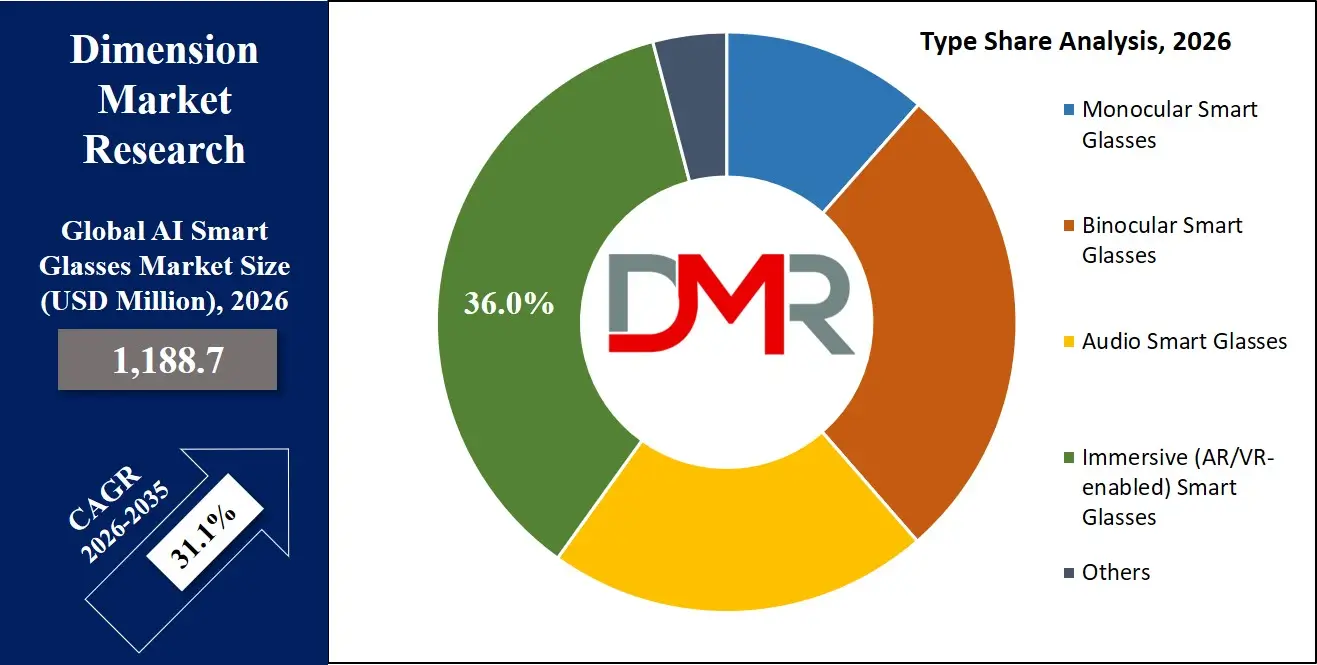
Immersive (AR/VR-enabled) smart glasses is projected to dominate the type segment as they offer more advanced features in providing interactive and highly engaging user experiences. These gadgets combine both augmented and virtual reality to add the digital information to the physical world, which is invaluable in gaming, medical, manufacturing, and training industries. They are more productive and make decisions better as they can be used to support complex simulations, real-time data visualization, and hands-free operations. Their position gets further enhanced by augmenting use in enterprise applications such as remote assistance and industrial maintenance. Moreover, the fast development of display technologies, sensors, and processing capacity also contributes to the performance and comfort of users. With the rising demand of immersive digital experiences in consumer and enterprise markets, smart glasses powered by AR/VR are set to dominate the category.
By Operating System Analysis
Android has is poised to dominate the operating system segment owing to its open-source platform, versatility and popularity among developers. It allows manufacturers to tailor smart glasses solutions to fit the requirements of a certain industry, which makes it very appropriate in consumer and business use. Its usability and ability to integrate with other devices are improved by the large Android applications ecosystem and integration features. Moreover, Android can be used with a broad spectrum of hardware, which enables low-cost manufacturing, which many manufacturers would like to participate in. The strength of its domination is also justified by the substantial support of big technology companies and recurrent updates that enhance performance, security and user experience. Android is the operating system of choice in the world as smart glasses are becoming more and more in need of seamless integration and connectivity to apps.
By Connectivity Analysis
The Bluetooth is expected to dominate the connectivity segment because of low power consumption, ease of use, and the high level of compatibility with smartphones and other wearable devices. It allows the transfer of data, audio streaming and pairing its devices without necessarily having complex network infrastructure. This renders it especially applicable to consumer-oriented smart glasses like the audio-enabled and fitness-oriented smart glasses. The ability of Bluetooth to sustain connections over a short range stably makes the use of Bluetooth convenient to the user, particularly in the common usage. Also, new innovations in Bluetooth technology, such as faster data speeds and energy efficiency enhance its use further. Whereas Wi-Fi is necessary in high-bandwidth applications, due to the simplicity and reliability of Bluetooth, it is the preferred solution in most smart glasses, particularly in portable and battery-sensitive designs.
By Tinting Technology Analysis
Electrochromic technology is projected to lead the tinting segment because it can dynamically regulate the transmission of light by electrical means. This aspect improves on the functionality of the user as they can adjust according to the changes in lighting settings, which makes it very applicable in outdoor and industrial environments. The automotive, construction and field service sectors with visibility and eye protection being the main concern, are some of the industries where the electrochromic smart glasses are mostly utilized. Durability, energy efficiency, and the ability to control the tint level precisely is a big plus the technology has over other systems such as photochromic systems and PDLC systems. Also, with more integration with smart sensors and automation systems, real-time adjustments can be made, making it easier to use. Electrochromic technology remains a leader in this segment as the demand in adaptive and intelligent wearables is rising.
By Feature Analysis
Advanced smart glasses are poised to dominate the feature segment that have more advanced features such as augmented reality, voice control, gesture recognition and real-time data processing. These capabilities allow advanced applications like remote work, industrial training, and medical diagnostics. Businesses are more inclined towards sophisticated models due to their capability to enhance efficiency, minimize errors, and facilitate hands-free activities. Also, artificial intelligence and IoT integration complement their functionality and can be valuable tools in various industries. Even though simple smart glasses are widespread due to their simpler functionality usage, the increasing need of more powerful, multifunctional specimens encourages the use of more sophisticated versions. Their lead in the consumer and enterprise markets is also enhanced by continuous technological innovation.
By Application Analysis
The application segment is projected to be dominated by gaming and entertainment as more people demand to be immersed in user experiences and have interactive experiences. Smart glasses allow users to interact with augmented and virtual reality content, improve gaming, media consumption, and experiences of live events. The development of the gaming industry and the development of AR/VR technologies are key factors that contribute to this dominance. Also, the creators of content and entertainment firms are putting a lot of money in the development of compatible applications and experiences, which further increases adoption. The market is also growing due to consumer interest in wearable entertainment devices. Although enterprise applications are gaining momentum, the sheer number of users and level of interaction in the gaming and entertainment segment makes it the most popular segment in terms of market demand.
By Industry Vertical Analysis
The consumer sector is poised to dominates the industry vertical segment since most people have adopted smart glasses in entertainment, communication, and lifestyle use. Other products like audio smart glasses and AR-enabled devices have become popular among the general users to perform activities like gaming, navigation, and media consumption. Growing interest in wearable technology, rising disposable income, and constant innovation in products are driving growth in this segment. Also, aggressive marketing by the big technology firms and low-cost devices are some of the factors that lead to wide-spread adoption. Although other sectors like the healthcare and manufacturing are adopting the use of smart glasses, consumer demand has been so high that this segment can be considered as the largest contributor to market growth globally.
The Global AI Smart Glasses Market Report is segmented on the basis of the following:
By Type
- Monocular Smart Glasses
- Binocular Smart Glasses
- Audio Smart Glasses
- Immersive (AR/VR-enabled) Smart Glasses
- Others
By Operating System
- Android
- iOS
- Windows
- Other Proprietary Operating Systems
By Connectivity
- Wi-Fi
- Bluetooth
- Other Connectivity Technologies
By Tinting Technology
- Polymer-Dispersed Liquid Crystal (PDLC)
- Electrochromic
- Photochromic
- Suspended Particle Device (SPD)
By Feature
- Basic Smart Glasses
- Advanced Smart Glasses
By Application
- Gaming & Entertainment
- Remote Inspection
- Telemedicine
- Product Design & Development
- 3D Visualization & Prototyping
- Other Applications
By Industry Vertical
- Education & Research
- Healthcare
- Consumer
- Automotive
- Manufacturing
- Warehousing
- Other Industries
Regional Analysis
Leading Region by Market Share
North America is poised to dominate the global AI Smart Glasses Market as it is projected to hold 37.8% of the market share by the end of 2026. The AI Smart Glasses Market is concentrated most in the United States, the dominant player in North America, due to unmatched concentration of leading technology firms, huge military investment in augmented reality to support warfighters, and ambitious front-line digitalization plans of Fortune 500 logistics and field service firms.
ℹ
To learn more about this report –
Download Your Free Sample Report Here
It has also a well-established spatial computing and interaction design talent pool, ecosystem of world platform holders and specialized optical foundries. The ongoing need of Immersive (AR/VR-enabled) and Advanced Smart Glasses and highly-connected solutions is due to enterprise investment in virtual prototyping, remote expertise systems, and the overall retirement of paper-based workflows. In addition, a positive venture capital atmosphere continues to fund future spatial computing AI projects that require professional integration solutions to gain quick scaling and privacy standards.
Fastest-Growing Regional Market
Asia-Pacific region is projected to be the fastest-growing AI Smart Glasses Market owing to the manufacturing power and the sweeping digital factory programs initiated by governments in India, China, Japan and South Korea. The accelerated implementation of 5G, the emergence of the shortage of skilled labor and the dynamism of the consumer electronics ecosystem are forcing established conglomerates and state-owned heavy industries to abandon inefficient manual processes. There is a high demand in Remote Inspection and 3D Visualization applications to enable these large organizations to work towards the direction of spatially guided operating models. Qualified wearable computing talent in the region is also very deficient and solution design, application development and managed services have to be outsourced to overcome the skills gap and allow quicker investments into hands-free operations.
By Region
North America
Europe
- Germany
- The U.K.
- France
- Italy
- Russia
- Spain
- Benelux
- Nordic
- Rest of Europe
Asia-Pacific
- China
- Japan
- South Korea
- India
- ANZ
- ASEAN
- Rest of Asia-Pacific
Latin America
- Brazil
- Mexico
- Argentina
- Colombia
- Rest of Latin America
Middle East & Africa
- Saudi Arabia
- UAE
- South Africa
- Israel
- Egypt
- Rest of MEA
Competitive Landscape
The global AI smart glasses competitive landscape is now quite dynamic with a diversified mix of multinational consumer electronics giants, industrial wearable OEMs and software platform divisions of the large hyperscalers. The strategy of deep strategic partnerships with leaders of enterprise ecosystems such as Microsoft, Google or Apple will be the key to success, as they will provide the needed way to market to the spatial computing applications and early access to the next-generation sensor and AI-capabilities. The trend of market consolidation is also advancing fast with the conventional industrial technology firms buying out the boutique optics and waveguide design houses to survive. Proprietary intellectual property, such as automated prescription-inset calibration systems, industry-specific safety-rated form factors, etc., are gaining greater significance as a source of competitive differentiation than its consumer brand recognition or generic step-by-step documentation applications.
Some of the prominent players in the Global AI Smart Glasses Market are:
- Apple Inc.
- Microsoft Corporation
- Meta Platforms Inc.
- Google LLC
- Vuzix Corporation
- Magic Leap Inc.
- Sony Group Corporation
- Lenovo Group Limited
- Xiaomi Corporation
- Rokid Corporation Ltd.
- RealWear Inc.
- XREAL
- Snap Inc.
- VITURE
- RayNeo
- Brilliant Labs
- Even Realities
- EssilorLuxottica
- Huawei Technologies Co., Ltd.
- OPPO
- Other Key Players
Recent Developments
- January 2026: Microsoft Corporation declared that it was expanding its spatial computing platform, a professional services program to assist clients in Healthcare and Manufacturing to develop proprietary AI-supported virtual assistants using its most recent waveguide-supported Smart glasses and its expertise in 3D Visualization and Prototyping.
- November 2025: PTC Inc. enhanced its collaboration with Volkswagen Group and presented a particular practice known as Remote Inspection and Quality Assurance Integration, which was to help engineers transfer complex assembly workflow to a spatial canvas without compromising the automotive engineering standards.
- October 2025: Apple Inc. bought ChromoGenics AB to develop its immersive (AR/VR-enabled) smart glasses and tinting technologies, especially in sovereign and defense markets that need dynamic display contrast in challenging situations.
Report Details
| Report Characteristics |
| Market Size (2026) |
USD 1,188.7 Mn |
| Forecast Value (2035) |
USD 13,565.9 Mn |
| CAGR (2026–2035) |
31.1% |
| The US Market Size (2026) |
USD 377.9 Mn |
| Historical Data |
2021 – 2025 |
| Forecast Data |
2027 – 2035 |
| Base Year |
2025 |
| Estimate Year |
2026 |
| Segments Covered |
By Type (Monocular Smart Glasses, Binocular Smart Glasses, Audio Smart Glasses, Immersive (AR/VR-enabled) Smart Glasses, Others), By Operating System (Android, iOS, Windows, Other Proprietary Operating Systems), By Connectivity (Wi-Fi, Bluetooth, Other Connectivity Technologies), By Tinting Technology (Polymer-Dispersed Liquid Crystal (PDLC), Electrochromic, Photochromic, Suspended Particle Device (SPD)), By Feature (Basic Smart Glasses, Advanced Smart Glasses), By Application (Gaming & Entertainment, Remote Inspection, Telemedicine, Product Design & Development, 3D Visualization & Prototyping, Other Applications), By Industry Vertical (Education & Research, Healthcare, Consumer, Automotive, Manufacturing, Warehousing, Other Industries) |
| Regional Coverage |
North America – The US and Canada; Europe – Germany, The UK, France, Russia, Spain, Italy, Benelux, Nordic, & Rest of Europe; Asia-Pacific – China, Japan, South Korea, India, ANZ, ASEAN, Rest of APAC; Latin America – Brazil, Mexico, Argentina, Colombia, Rest of Latin America; Middle East & Africa – Saudi Arabia, UAE, South Africa, Turkey, Egypt, Israel, & Rest of MEA |
Frequently Asked Questions
How big is the Global AI Smart Glasses Market?
▾ The Global AI Smart Glasses Market is poised to be valued at USD 1,188.7 million in 2026 and is projected to reach USD 13,565.9 million by 2035, driven by the universal need for specialized skills in AR deployment, industrial-grade hardware, and spatial computing integration.
What is the CAGR of the Global AI Smart Glasses Market from 2026 to 2035?
▾ The market is expected to grow at a CAGR of 31.1% from 2026 to 2035, reflecting the accelerating miniaturization of optical components and the persistent push for hands-free worker efficiency.
What factors are driving the growth of the Global AI Smart Glasses Market?
▾ Key drivers include the global spatial computing skills gap, the imperative to digitalize manual frontline processes, the management complexity of deploying wearable fleets, and the surge in demand for remote collaboration amid a distributed workforce.
Which region held the largest share of the AI Smart Glasses Market in 2026?
▾ North America is poised to dominate this market as it holds 37.8% of the market share in 2026, driven by a mature technology ecosystem and aggressive enterprise investment in Immersive (AR/VR-enabled) Smart Glasses and AI-driven spatial capabilities.
Which region is expected to grow the fastest in the AI Smart Glasses Market?
▾ The Asia-Pacific region is expected to grow the fastest, fueled by rapid digital factory transformation in China, Japan, and South Korea, where Remote Inspection and 3D Visualization is critical for transitioning large manufacturing bases to hands-free operations.
What are the major trends in the Global AI Smart Glasses Market?
▾ Major trends include the integration of Generative AI interfaces into heads-up displays, the rise of modular and sustainable hardware design, the demand for industry-specific safety certifications, and the focus on automatic tinting technologies like Electrochromic for mixed indoor-outdoor use.
Who are the key players in the Global AI Smart Glasses Market?
▾ Key players include spatial computing pioneers like Microsoft and Magic Leap, enterprise-focused industrial device makers like RealWear and Vuzix, as well as consumer giants like Apple and Google, alongside specialized waveguide and optics manufacturers.
How is the Global AI Smart Glasses Market segmented?
▾ The market is segmented by Type, By Operating System, By Connectivity, By Tinting, By Feature, By Application, and By Industry Vertical.