What is the AI Supercomputing Platform Market Size?
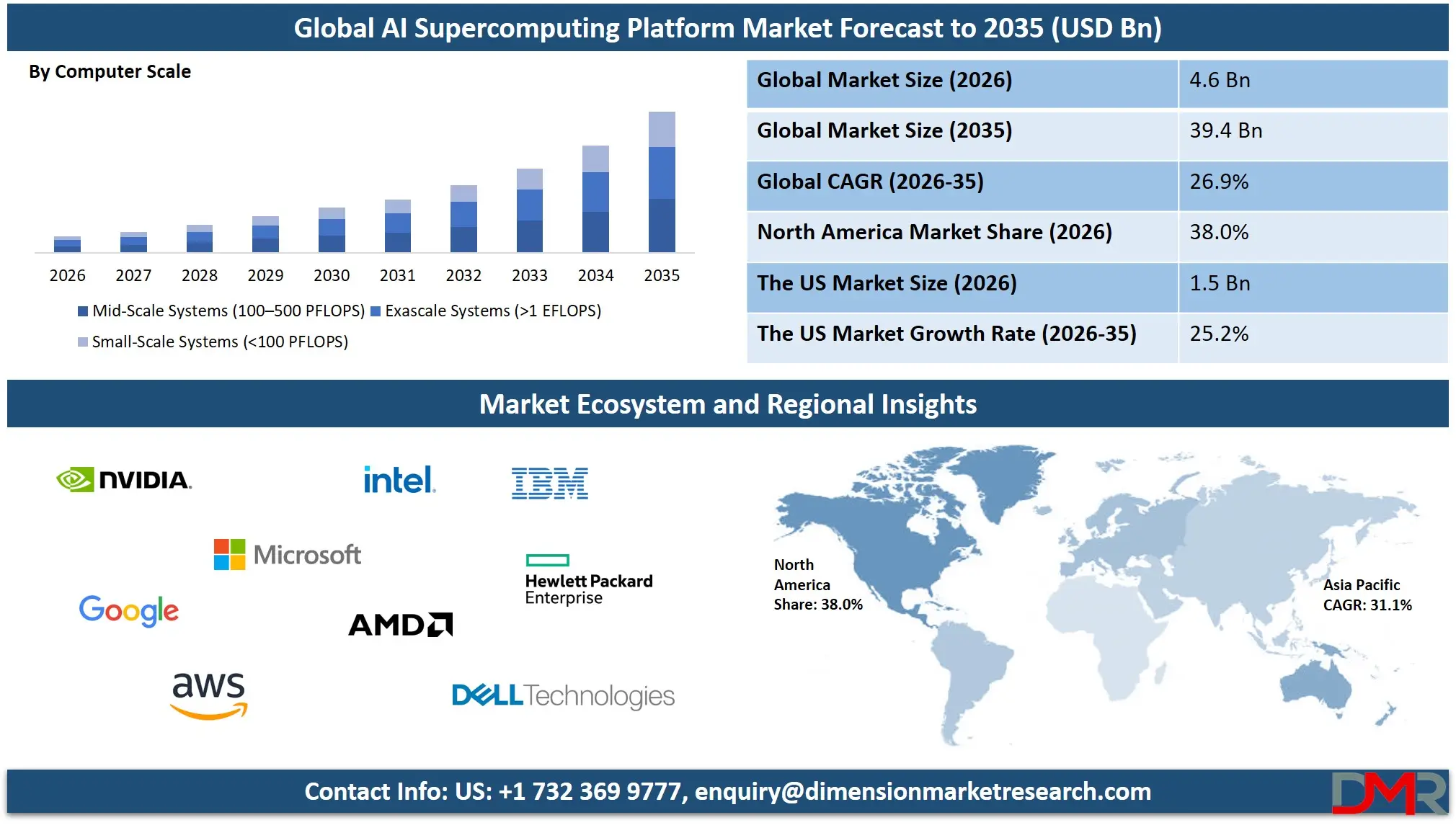
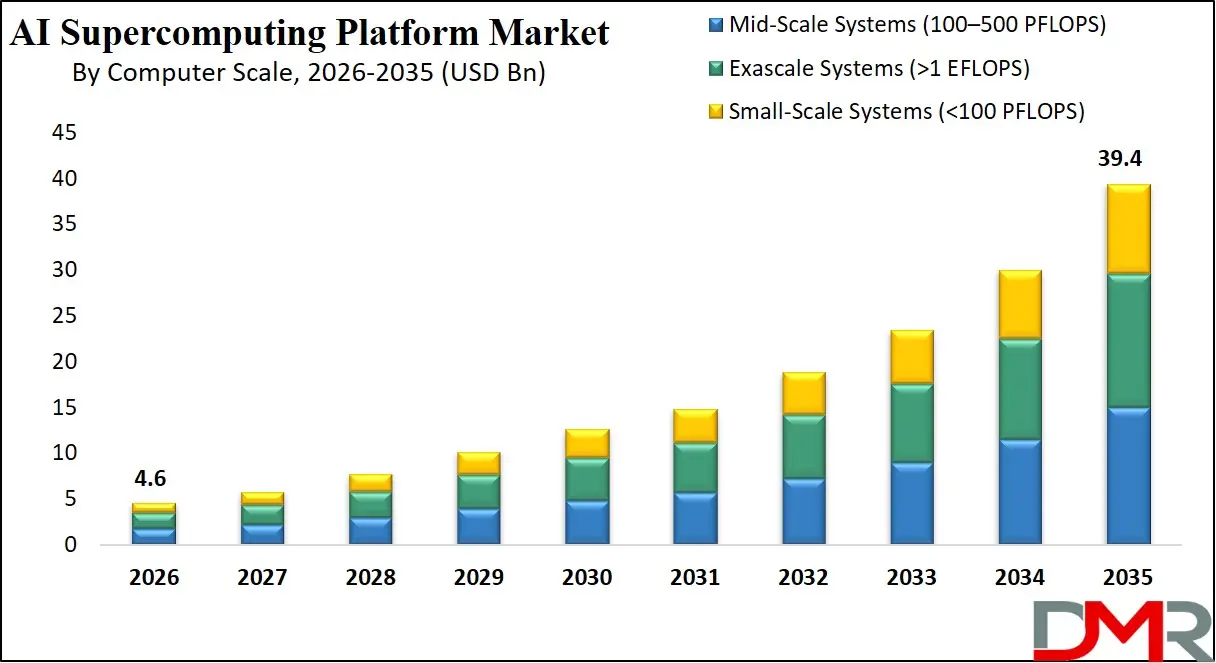
The Global AI Supercomputing Platform Market is projected to reach USD 4.6 billion in 2026 and USD 39.4 billion by 2035, growing at a CAGR of 26.9%, driven by HPC systems, GPU AI clusters, and exascale infrastructure supporting generative AI and cloud-based model training ecosystems.
ℹ
To learn more about this report –
Download Your Free Sample Report Here
The AI Supercomputing Platform Market comprises highly sophisticated HPC platforms built on GPU, AI accelerator, and fast interconnection technologies utilized for massive AI training and simulations. This market is booming as a result of an exponential rise in computing requirements from generative AI and scientific simulation models. Programs by government agencies such as the exascale program by U.S. Department of Energy (DOE) and EuroHPC in Europe are fueling infrastructure investments at a national level.
These supercomputers support trillion-parameter models and real-time inference applications within fields like health care, defense, and climate studies. The DOE of the United States reports that an exascale computer can process over a quintillion calculations every second, signifying massive computing power. Looking ahead, energy efficiency, sovereignty, and cloud supercomputing will lead future growth.
ℹ
To learn more about this report –
Download Your Free Sample Report Here
US AI Supercomputing Platform Market
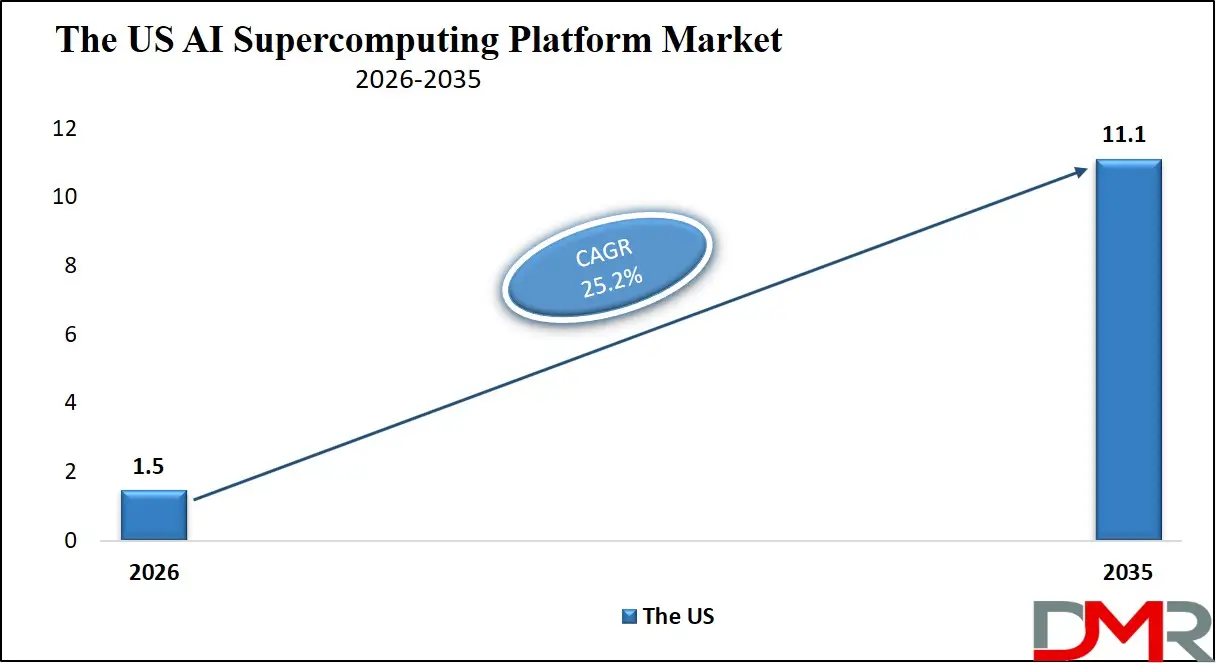
The US AI Supercomputing Platform Market is projected to reach USD 1.5 billion in 2026 and USD 11.1 billion by 2035, growing at a CAGR of 25.2%.
ℹ
To learn more about this report –
Download Your Free Sample Report Here
The United States AI Supercomputing Platform market leads the world owing to its robust hyperscaler base, highly evolved semiconductor industry, and widespread deployment of exascale HPC platforms backed by federal programs run by organizations such as the Department of Energy and the National Science Foundation. Market growth is being propelled by increasing requirements for generative AI, GPU-based data centers, and advanced AI training platforms.
Europe AI Supercomputing Platform Market
Europe AI Supercomputing Platform Market is anticipated to reach USD 1.2 billion in 2026, expanding with a CAGR of 25.2%. The growth is driven by strong investments in sovereign AI infrastructure, HPC modernization, and EU-backed supercomputing initiatives. Increasing adoption of AI workloads across automotive, manufacturing, and research sectors is further accelerating demand. Expansion of energy-efficient and liquid-cooled data centers is also supporting regional market growth.
Japan AI Supercomputing Platform Market
Japan AI Supercomputing Platform Market is anticipated to reach USD 460 million in 2026, expanding with a CAGR of 26.6%. Growth is driven by strong government focus on advanced supercomputing programs and AI-driven digital transformation initiatives. Increasing adoption of robotics, autonomous systems, and industrial AI is further boosting demand for high-performance computing infrastructure. Additionally, rising investments in semiconductor innovation and next-generation data centers are strengthening Japan's position in the global AI supercomputing ecosystem.
Key Takeaways
- Market Size: The Global AI Supercomputing Platform Market is projected at USD 4.6 billion in 2026, reaching USD 39.4 billion by 2035.
- Growth Rate and Outlook: The market is expected to grow at a CAGR of 26.9%, driven by rapid expansion of AI workloads and exascale computing infrastructure.
- Primary Growth Drivers: Growth is fueled by rising demand for generative AI, large language model training, GPU-accelerated computing, and hyperscale cloud adoption.
- By Component Analysis: Hardware dominates with 68.0% share, reflecting strong compute infrastructure demand.
- By Deployment Model Analysis: Cloud-based HPC leads with 58% share due to scalable AI training platforms and hyperscaler-driven infrastructure expansion.
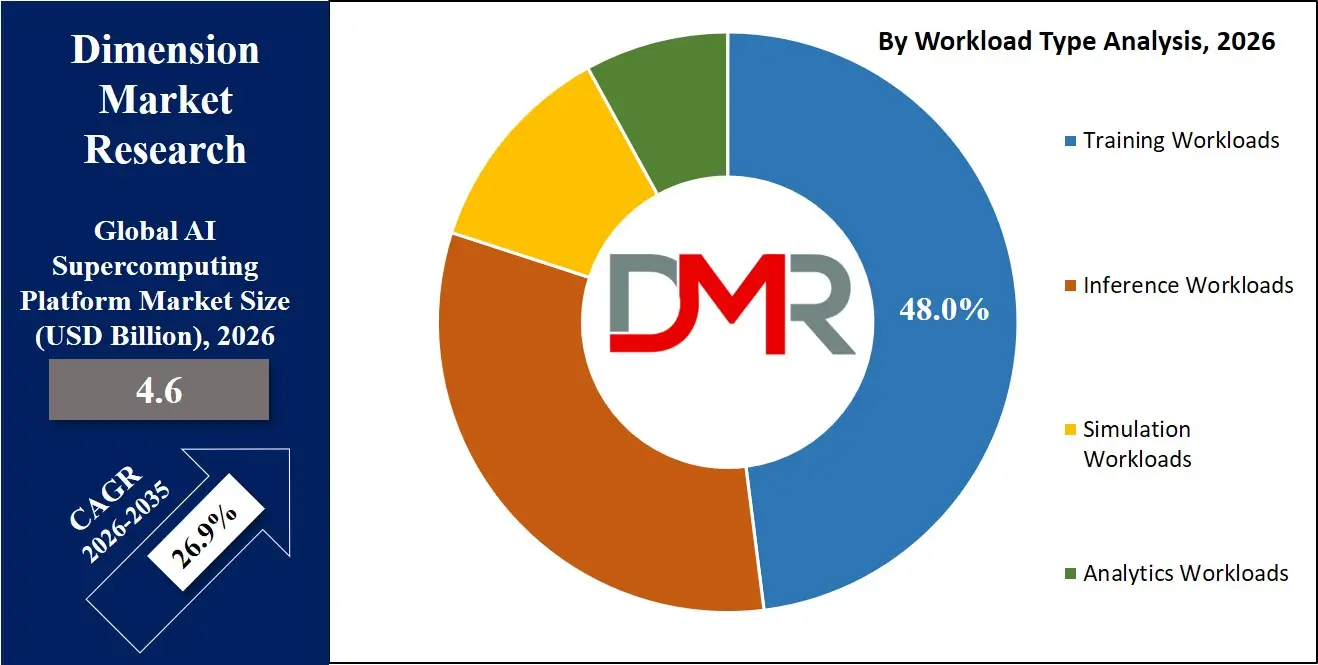
- By Workload Type Analysis: Training workloads dominate with 48% share, driven by large-scale AI model development and generative AI systems.
- Regional Leadership: North America leads the market with 38% share in 2026, supported by strong hyperscaler presence and advanced AI supercomputing infrastructure.
What is AI Supercomputing Platform?
AI Supercomputing Platform refers to an advanced supercomputing platform which utilizes GPU, AI chips, and parallel computation to train and deploy large-scale AI models. These supercomputers facilitate highly sophisticated research and applications in science and AI. This includes generative AI, deep learning, and big data processing, among others. The United States Department of Energy utilizes HPC in simulations related to climate change, energy, and national security. Such systems are used in exascale and cloud-based data centers.
Use Cases
- Training AI Models: These platforms train AI models such as LLMs and deep learning models through massive parallelization on GPUs to reduce training time for large-scale AI models.
- Scientific Simulations: Advanced scientific simulations are carried out on these platforms in areas of climate change, physics, and energy. Government agencies such as the U.S. Department of Energy utilize them to carry out highly accurate simulations that involve solving highly complex equations.
- Life Sciences Research: Genomics, protein analysis, and drug discovery simulations are performed through AI supercomputing in life sciences. These operations aid researchers in discovering potential treatment options through large-scale simulation of biological models.
- Autonomous Systems: The training of AI models used in autonomous vehicles, robotics, and unmanned aerial vehicles is accomplished through these platforms.
Market Dynamics
Key Drivers in the Global AI Supercomputing Platform Market
Rising demand for generative AI and LLMs
The rapid adoption of generative AI, large language models, and multimodal AI applications is increasing demand for high-performance AI supercomputing platforms. Training sophisticated models requires extensive GPU clusters, high-bandwidth memory, fast interconnects, and parallel processing capabilities to handle enormous datasets and complex computations. Enterprises, hyperscale cloud providers, and research institutions are investing in advanced computing infrastructure to accelerate model development, improve processing performance, and support increasingly demanding AI workloads. The expansion of AI-powered applications across healthcare, financial services, manufacturing, scientific research, and autonomous systems is further strengthening demand. As model sizes and computational requirements increase, organizations are prioritizing scalable platforms that can support both intensive training and high-volume inference workloads.
Expansion of hyperscale cloud infrastructure
Hyperscale cloud providers are expanding AI-optimized data centers to accommodate growing demand for model training, inference, and advanced computational workloads. These facilities integrate GPUs, specialized accelerators, high-speed networking, and scalable storage to deliver substantial computing capacity. Cloud-based supercomputing allows enterprises to access advanced infrastructure without bearing the full upfront costs of purchasing and maintaining dedicated systems. Flexible provisioning also enables organizations to scale resources according to project requirements and manage fluctuating workloads more efficiently. Continued investment in AI infrastructure by cloud service providers is strengthening platform availability, supporting enterprise AI adoption, and encouraging the development of integrated computing environments that combine hardware, software, and orchestration capabilities.
Restraints in the Global AI Supercomputing Platform Market
High infrastructure and operational costs
AI supercomputing platforms require substantial capital investment in GPUs, specialized processors, high-speed networking, storage infrastructure, and advanced cooling systems. Additional expenses arise from facility construction, power distribution, software licensing, system integration, and ongoing maintenance. As computing requirements increase, organizations may need frequent hardware upgrades to maintain competitive performance and support new AI workloads. These financial commitments can create significant barriers for small and medium-sized enterprises, academic institutions, and organizations with limited technology budgets. Although cloud-based access can reduce upfront expenditure, recurring usage charges for intensive computing workloads may still be considerable. Consequently, buyers increasingly evaluate performance efficiency, infrastructure utilization, and total cost of ownership before investing in AI supercomputing platforms.
Energy consumption and cooling challenges
The growing density of AI accelerators and processors is increasing electricity demand and heat generation across supercomputing facilities. Maintaining stable operating temperatures requires sophisticated thermal management, including direct-to-chip liquid cooling, advanced power distribution, and optimized airflow systems. These requirements increase infrastructure complexity and may raise operating costs, particularly in regions facing electricity constraints or high energy prices. Large-scale installations must also address power availability, cooling capacity, and sustainability objectives when planning expansion. Inefficient energy utilization can reduce the economic viability of supercomputing deployments, while inadequate thermal management can affect system reliability and performance. These challenges are encouraging platform developers and data center operators to prioritize energy-efficient processors, improved cooling architectures, and more effective resource utilization.
Growth Opportunities in the Global AI Supercomputing Platform Market
Development of sovereign AI systems
Governments are increasingly investing in domestic AI infrastructure to strengthen technological independence, protect sensitive data, and develop national capabilities in advanced computing. Sovereign AI supercomputing platforms enable countries to train and operate AI models using infrastructure subject to local governance, security, and data-handling requirements. These initiatives create opportunities for supercomputer manufacturers, semiconductor suppliers, infrastructure integrators, and domestic cloud providers. Public investment in national research facilities and AI computing programs can also support collaboration among universities, research laboratories, and private enterprises. As countries seek greater control over critical digital infrastructure, demand for locally operated, secure, and scalable AI supercomputing systems is expected to create additional opportunities for platform developers.
AI accelerator developments
Continuous improvements in GPUs, application-specific integrated circuits, high-bandwidth memory, and specialized AI processors are creating opportunities to improve supercomputing performance. Advanced accelerators can increase computational throughput, support parallel processing, and reduce the time required to train complex models. Improvements in processor architecture, memory bandwidth, and interconnect technologies also help minimize bottlenecks when thousands of processors operate together. Manufacturers developing energy-efficient accelerators and integrated computing platforms can address demand for higher performance within constrained power and cooling environments. These advancements may broaden the range of commercially viable AI applications while enabling enterprises, cloud providers, and research institutions to scale their computing capabilities more efficiently.
Trends in the Global AI Supercomputing Platform Market
Shift toward exascale and distributed systems
The market is moving toward exascale computing and distributed AI architectures capable of processing increasingly complex workloads across interconnected computing resources. Exascale systems provide exceptionally high computational capacity for advanced AI training, scientific simulations, and data-intensive research. Meanwhile, distributed architectures allow workloads to be divided across multiple processors, servers, and computing clusters, improving scalability and supporting parallel execution. Cloud-native high-performance computing is also gaining importance by enabling organizations to access computing resources across distributed environments. These developments are encouraging vendors to integrate high-speed interconnects, advanced workload scheduling, and optimized software frameworks to improve performance, reliability, and flexibility across large-scale AI infrastructure.
Adoption of advanced cooling technologies
The increasing power density of AI supercomputing systems is accelerating the adoption of liquid cooling and other advanced thermal management technologies. Direct-to-chip liquid cooling and immersion cooling can remove heat more effectively than conventional air-based approaches in suitable system designs, helping data centers support densely packed accelerators. Improved thermal management can also support stable performance and more efficient use of available facility capacity. As organizations expand AI infrastructure, cooling technologies are becoming an important consideration in system design, energy planning, and operational cost management. This trend is encouraging collaboration between supercomputer manufacturers, cooling technology providers, and data center operators to develop infrastructure capable of supporting demanding AI workloads while improving energy efficiency and long-term scalability.
Research Scope and Analysis
By Component Analysis
The hardware component is anticipated to be the market leader, accounting for nearly 68% in 2026 owing to rising demand for GPUs, AI accelerators, and high-performance computing components for AI model training and exascale computing. The software layer complements the above scenario through providing support for the development of AI frameworks, workload management, and performance optimization in distributed computing clusters. The software layer helps in optimizing resource use and faster model training.
By Deployment Model Analysis
Cloud-based HPC will take the lead with a market share of almost 58% in 2026 because of the need for scalable and on-demand computing resources for training machine learning models and generative AI. Cloud-based HPC can provide scalability, reduced capital expenditure, and accessibility to GPU technology. On-premise HPC serves governments and companies requiring maximum security and complete control over their data. But its expensive and complex nature restricts its usage.
By Workload Type Analysis
ℹ
To learn more about this report –
Download Your Free Sample Report Here
The training workload category is projected to take a leading role, with around a 48% market share in 2026 because of a strong requirement for training huge AI models like LLMs and generative AI that require large amounts of GPU compute power. The inference workload category deals with running already trained models and generating immediate output in areas like prediction and decision-making.
By Computer Scale Analysis
Mid-Scale Systems (100 to 500 PFLOPS) will dominate the compute scale market space, contributing up to 38% market share in 2026 owing to their excellent balance of speed, cost efficiency, and scalability for enterprise AI applications and cloud training clusters. Mid-scale systems are mainly deployed for the training of big models and AI deployments in industry. The Exascale category (>1 EFLOPS) comprises the highest compute scale systems and is built for extreme-scale training and simulation, including scientific simulation and research programs for the nation. Exascale provides unmatched processing capabilities for advanced Generative AI applications and simulations.
By Cooling Technology Analysis
The air cooling method will lead the way in terms of cooling technologies with approximately 42% market share in 2026 owing to its prevalent use in current data centers because of cost effectiveness, ease of implementation, and infrastructure available for handling heat management in HPC systems. On the other hand, the liquid cooling method is witnessing a fast rise in popularity among AI supercomputers because it performs more efficiently in handling dense GPU clusters and exascale computers. Moreover, rising adoption of direct chip and immersion cooling methods is boosting its adoption rate in future data centers.
By End-User Industry Analysis
It is estimated that Cloud Service Providers will be the leading segment in the consumer market segment, with nearly 42% market share in 2026, owing to hyperscalers' AI supercomputer infrastructure for high-end model training, inference, and GPU as a service platforms. These companies have invested heavily in building huge data centers and are witnessing high demand for cloud AI computing power. On the other hand, enterprises are deploying AI supercomputer platforms to gain an edge in terms of improving analysis and decision-making capabilities. Their usage among BFSI, manufacturing, retail, and health care sectors is growing because of their digital transformation and operational efficiency.
The Global AI Supercomputing Platform Market Report is segmented on the basis of the following:
By Component
- Hardware
- GPU Compute Systems
- AI Accelerators (ASIC, TPU, FPGA)
- CPU Compute Nodes
- Memory & Storage Systems
- High-Speed Interconnect Systems
- Software
- AI Framework Stack
- Cluster Orchestration Platforms
- Optimization & Compiler Tools
- Services
- Integration & Deployment Services
- Managed Supercomputing Services
- Consulting & Support Services
By Deployment Model
- Cloud-Based High Performance Computing (HPC)
- Hyperscaler AI Infrastructure
- GPU-as-a-Service Platforms
- AI Training Cloud Clusters
- On-Premise High Performance Computing (HPC)
- Government Supercomputing Systems
- Enterprise Private AI Clusters
- Defense & Security Systems
- Hybrid High Performance Computing (HPC)
- Cloud Burst Architectures
- Edge-Integrated HPC Systems
By Workload Type
- Training Workloads
- Large Language Model Training
- Computer Vision Training
- Multimodal Model Training
- Reinforcement Learning Systems
- Inference Workloads
- Edge AI Inference
- Recommendation Engines
- Autonomous Systems Processing
- Simulation Workloads
- Climate & Weather Simulation
- Drug Discovery Simulation
- Engineering & Physics Simulation
- Analytics Workloads
- Predictive Analytics Systems
- Enterprise Intelligence Platforms
By Computer Scale
- Mid-Scale Systems (100–500 PFLOPS)
- Exascale Systems (>1 EFLOPS)
- Small-Scale Systems (<100 PFLOPS)
By Cooling Technology
- Air Cooling
- Rack-Level Air Systems
- Data Center Airflow Systems
- Liquid Cooling
- Direct-to-Chip Cooling
- Immersion Cooling Systems
- Hybrid Cooling
- Mixed Thermal Cooling
- Adaptive Cooling Architectures
By End-User Industry
- Cloud Service Providers
- Enterprises
- Government & Defense
- Research Institutions
- Life Sciences
Regional Analysis
Leading Region by Market Share
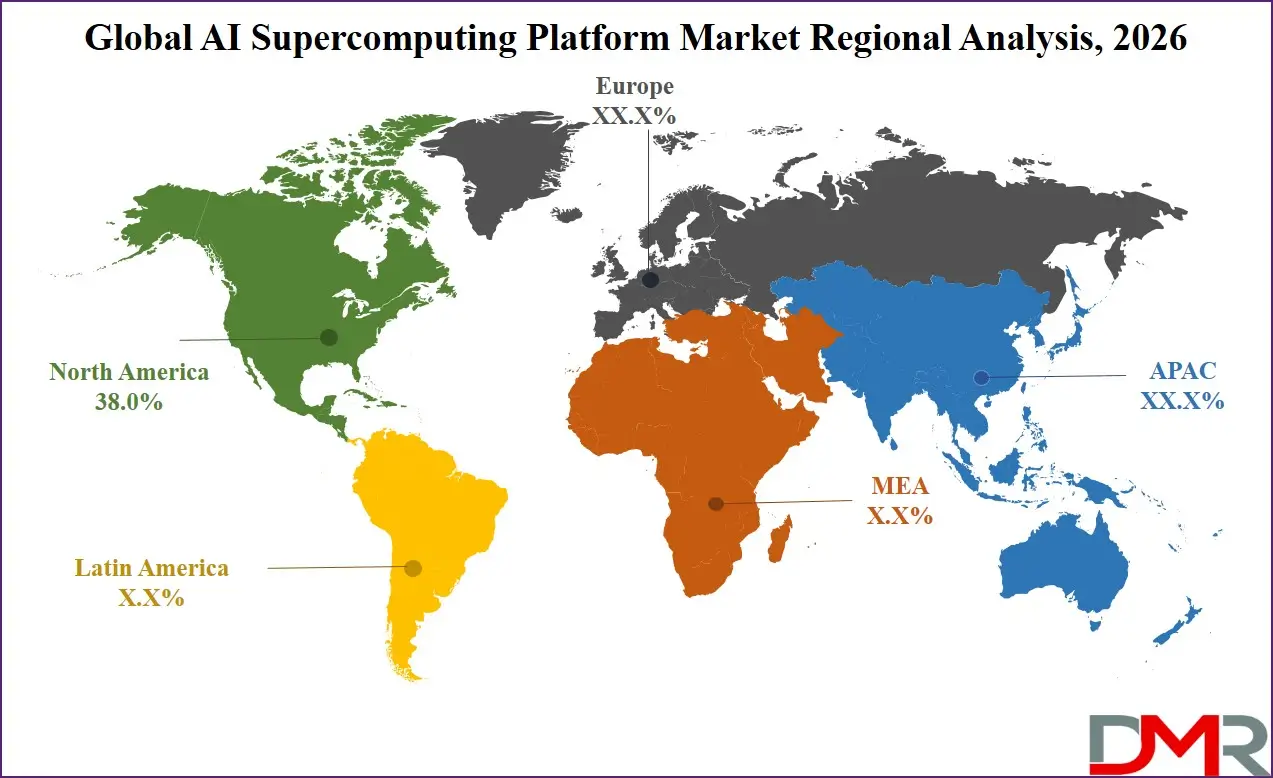
The North American region will dominate the market for AI supercomputing platforms in 2026, accounting for nearly 38.0% of the market, due to its high presence of hyperscalers, robust semiconductor industry, and initial implementation of exascale HPC systems. Funding by government organizations such as the U.S. Department of Energy aids in the building of infrastructure. High levels of AI development, cloud computing, and enterprise deployment enhance its leading position in the market.
ℹ
To learn more about this report –
Download Your Free Sample Report Here
Fastest-Growing Regional Market
The Asia-Pacific region will be the fastest-growing regional market due to the quick expansion of AI infrastructure, semiconductors, and cloud supercomputing in countries like China, India, Japan, and South Korea. The increasing usage of generative AI and national HPC initiatives boosts regional growth.
By Region
North America
Europe
- Germany
- The U.K.
- France
- Italy
- Russia
- Spain
- Benelux
- Nordic
- Rest of Europe
Asia-Pacific
- China
- Japan
- South Korea
- India
- ANZ
- ASEAN
- Rest of Asia-Pacific
Latin America
- Brazil
- Mexico
- Argentina
- Colombia
- Rest of Latin America
Middle East & Africa
- Saudi Arabia
- UAE
- South Africa
- Israel
- Egypt
- Rest of MEA
Competitive Landscape
High levels of concentration characterize the competitive environment due to dominance by the tech leaders with regard to AI hardware, cloud-based computing, and supercomputing systems. There are rapid innovations fueled by developments in GPUs, AI accelerators, and exascale computer systems. The development of the industry will be facilitated by strategic collaboration among cloud companies, semiconductor companies, and research institutions. Competition is largely centered around efficient computation using energy.
Some of the prominent players in the Global AI Supercomputing Platform Market are:
- NVIDIA
- Hewlett Packard Enterprise (HPE)
- Dell Technologies
- Super Micro Computer (Supermicro)
- Lenovo
- IBM
- Fujitsu
- NEC Corporation
- AMD
- Intel
- Atos
- Eviden
- Inspur
- GIGABYTE
- ASUS
- Quanta Cloud Technology (QCT)
- Foxconn
- Wiwynn
- Penguin Solutions
- Cerebras Systems
- Other Key Players
Recent Developments
- In August 2026, Cerebras Systems unveiled its CS-4 AI supercomputing system, the first platform built on its next-generation Cerebras Nexus rack-scale architecture. The company stated that CS-4 delivers up to twice the speed of its predecessor and up to 10 times the throughput per watt, targeting large-scale AI inference and data center workloads.
- In July 2026, AMD and Cerebras Systems announced a partnership to combine AMD Helios rack-scale systems with Cerebras Wafer-Scale Engine technology. The integrated platform is designed to deliver high-throughput processing and ultra-low-latency AI inference, with deployment planned through Cerebras Cloud in the second half of 2026.
- In June 2026, NVIDIA announced its Vera Rubin platform for scientific supercomputing, combining accelerated computing, high-performance networking, and specialized software. The platform is designed to support demanding workloads such as climate modeling, computational fluid dynamics, energy exploration, and AI-driven scientific research, with global system manufacturers developing compatible supercomputing systems.
- In March 2026, Hewlett Packard Enterprise (HPE) announced new AI factory and supercomputing solutions in collaboration with NVIDIA, integrating compute, GPUs, networking, liquid cooling, and software. The developments include next-generation HPE Cray supercomputing systems and rack-scale AI infrastructure designed to support large-scale model training, inference, and sovereign AI deployments.
Report Details
| Report Characteristics |
| Market Size (2026) |
USD 4.6 Bn |
| Forecast Value (2035) |
USD 39.4 Bn |
| CAGR (2026–2035) |
26.9% |
| Historical Data |
2021 – 2025 |
| Forecast Data |
2027 – 2035 |
| Base Year |
2025 |
| Estimate Year |
2026 |
| Segments Covered |
By Component (Hardware, Software, Services), By Deployment Model (Cloud-Based High Performance Computing HPC, On-Premise High Performance Computing HPC, Hybrid High Performance Computing HPC), By Workload Type (Training Workloads, Inference Workloads, Simulation Workloads, Analytics Workloads), By Computer Scale (Mid-Scale Systems 100–500 PFLOPS, Exascale Systems >1 EFLOPS, Small-Scale Systems <100 PFLOPS), By Cooling Technology (Air Cooling, Liquid Cooling, Hybrid Cooling), By End-User Industry (Cloud Service Providers, Enterprises, Government & Defense, Research Institutions, Life Sciences) |
| Regional Coverage |
North America – The US and Canada; Europe – Germany, The UK, France, Russia, Spain, Italy, Benelux, Nordic, & Rest of Europe; Asia-Pacific – China, Japan, South Korea, India, ANZ, ASEAN, Rest of APAC; Latin America – Brazil, Mexico, Argentina, Colombia, Rest of Latin America; Middle East & Africa – Saudi Arabia, UAE, South Africa, Turkey, Egypt, Israel, & Rest of MEA |
Frequently Asked Questions
How big is the AI Supercomputing Platform Market?
▾ The AI Supercomputing Platform Market is expected to be valued at USD 4.6 billion in 2026 and is projected to reach USD 39.4 billion by 2035.
What is the CAGR of the AI Supercomputing Platform Market from 2026 to 2035?
▾ The market is expected to grow at a CAGR of 26.9% during the forecast period 2026–2035.
What factors are driving the growth of the AI Supercomputing Platform Market?
▾ Growth is driven by rising demand for generative AI, large language models, HPC infrastructure, GPU-accelerated computing, and exascale systems, along with increasing cloud adoption and government investments in AI supercomputing.
What are the major trends in the AI Supercomputing Platform Market?
▾ Key trends include the shift toward exascale computing, cloud-native AI supercomputing, liquid-cooled data centers, AI accelerator integration, and distributed training architectures for large-scale AI models.
Which region held the largest share of the AI Supercomputing Platform Market in 2026?
▾ North America held the largest share in 2026 with 38.0%, driven by hyperscaler dominance and advanced AI infrastructure.
Which region is expected to grow the fastest in the AI Supercomputing Platform Market?
▾ Asia Pacific is the fastest-growing region, supported by rapid AI infrastructure expansion, semiconductor growth, and national supercomputing programs.
Who are the key players in the AI Supercomputing Platform Market?
▾ Key players include NVIDIA, Microsoft, Google, Amazon Web Services, Intel, AMD, IBM, HPE, Dell Technologies, Lenovo, Oracle, Meta, Apple, Huawei, Samsung, Fujitsu, NEC, Supermicro, Cerebras Systems, and Atos.
How is the AI Supercomputing Platform Market segmented?
▾ The market is segmented by Component, Deployment Model, Workload Type, Compute Scale, Cooling Technology, and End-User Industry.