What is the AI Test Automation Market Size?
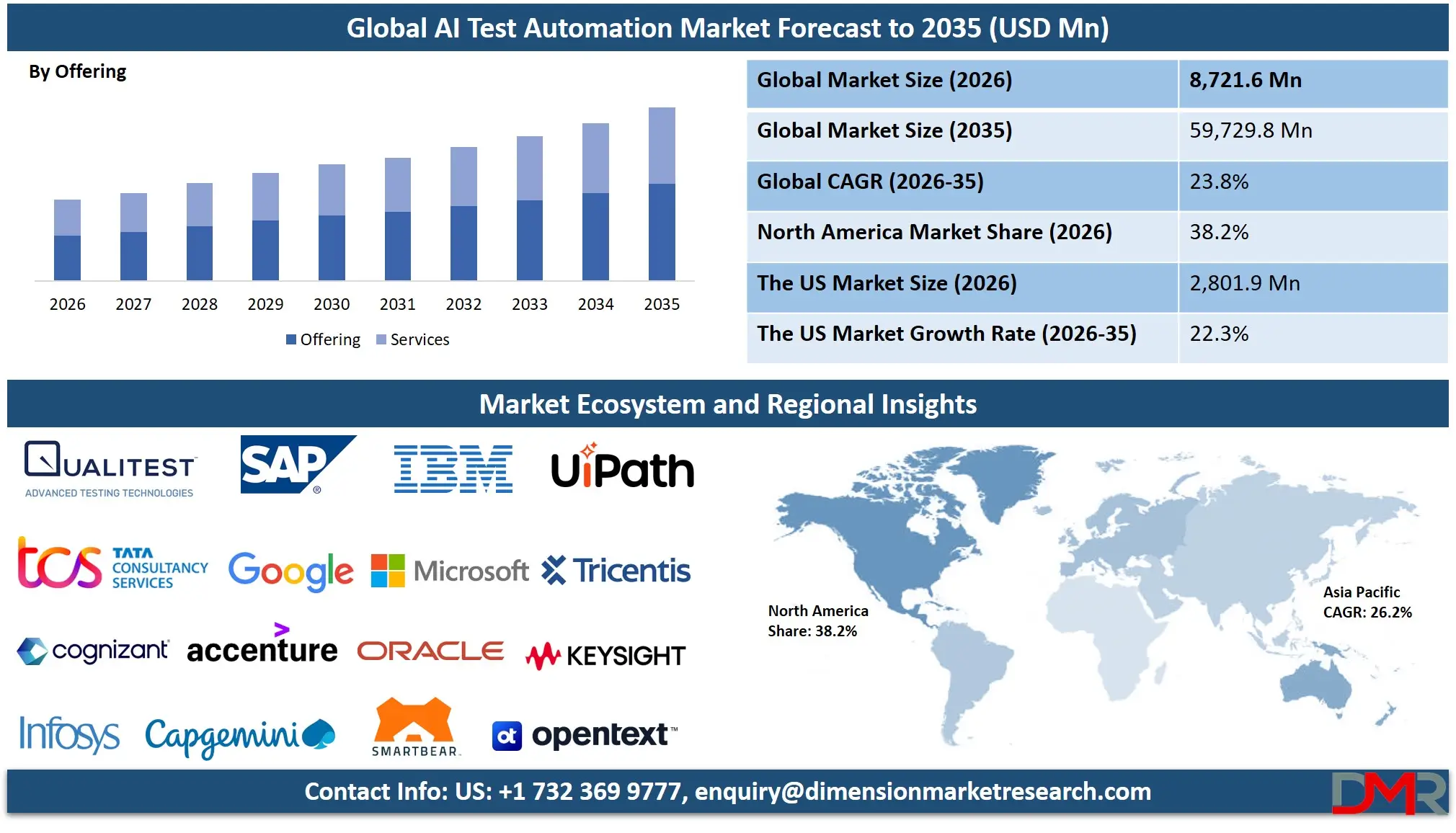
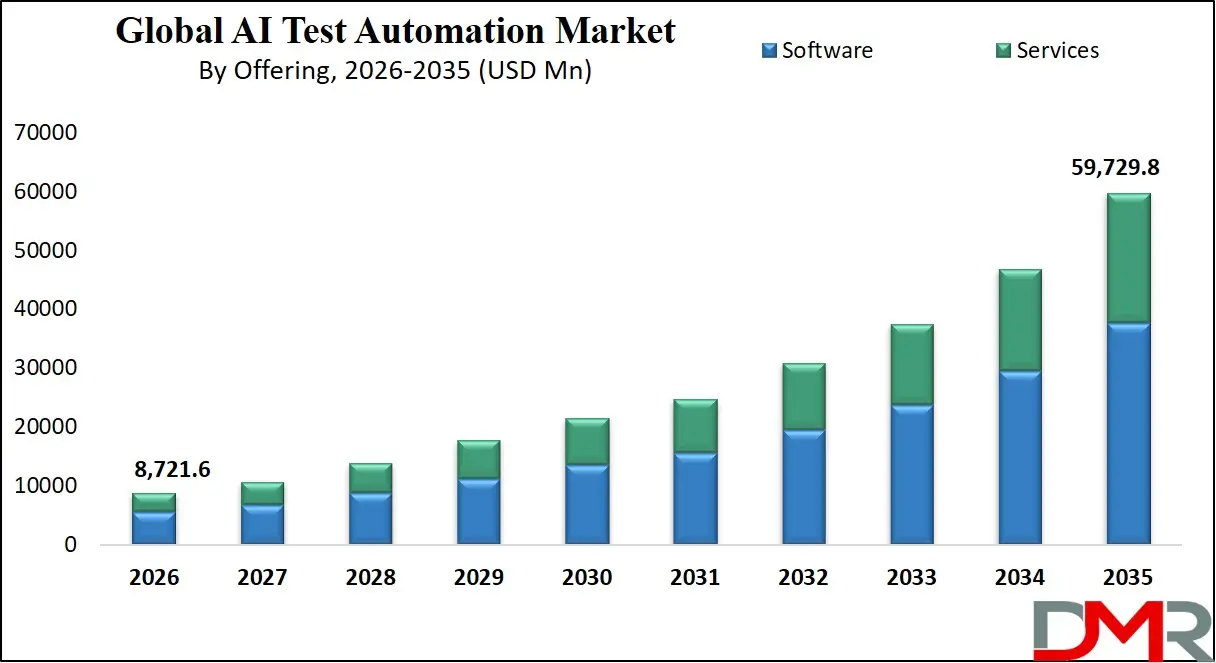
The Global AI Test Automation Market is expected to reach a value of USD 8,721.6 million in 2026, and it is further anticipated to reach USD 59,729.8 million by 2035, growing at a CAGR of 23.8% during the forecast period.
ℹ
To learn more about this report –
Download Your Free Sample Report Here
The AI test automation market has grown exponentially as companies strive to speed up their software development lifecycle and move from manual, brittle script-based testing to autonomous, self-healing automation frameworks. The market includes autonomous testing, model-based testing, test data generation, and implementation, consulting, and managed testing services that help enterprises deliver quality in web, mobile, API and legacy application testing. As software ecosystems grow more complex with multi-cloud, microservices, IoT and AI-powered applications, the need for AI-specific testing solutions is growing.
Adoption is most common amongst enterprises, with machine learning (ML) and generative AI being the most disruptive technologies as they can predict defects and automatically generate test cases. The banking, financial services and insurance (BFSI), healthcare, IT & telecommunications, and retail & e-commerce sectors are major consumers as they need secure, compliant and highly stable software systems.
ℹ
To learn more about this report –
Download Your Free Sample Report Here
The US AI Test Automation Market
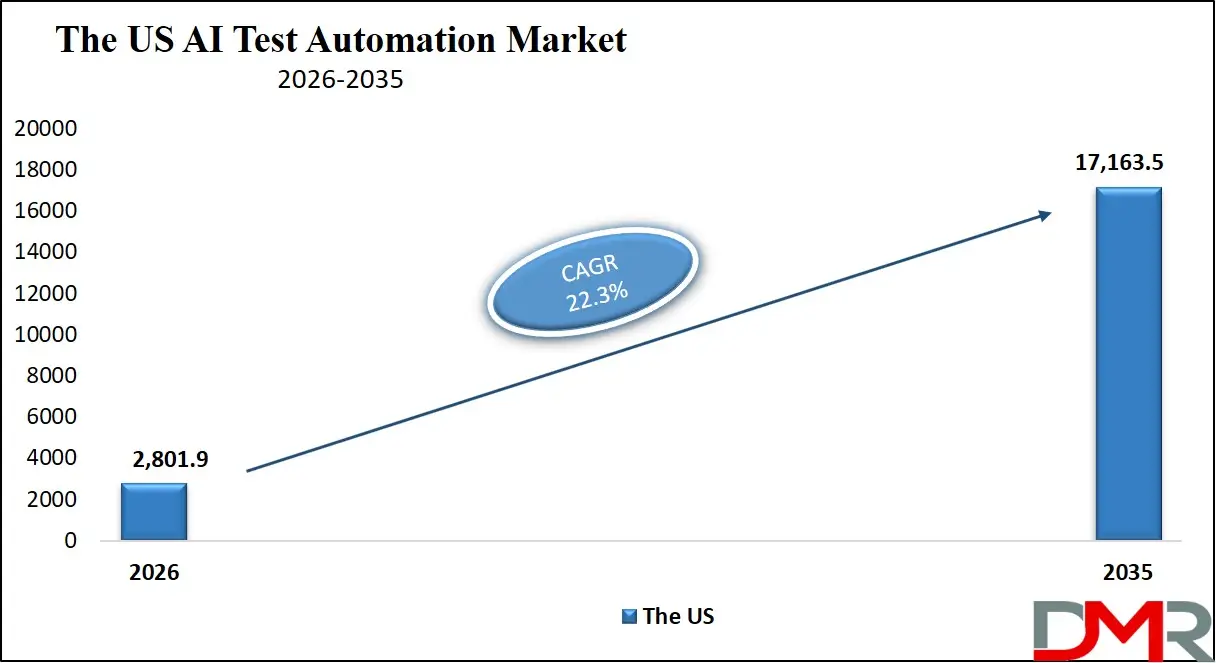
The US AI Test Automation Market is projected to reach USD 2,801.9 million in 2026 at a compound annual growth rate of 22.3% over its forecast period, which is further expected to reach a market value of USD 17,163.5 million by 2035. The US remains the biggest and most mature market for AI in test automation on account of the fierce DevOps and continuous delivery initiatives of the Fortune 500 firms and the sheer volume of cloud-native application development.
ℹ
To learn more about this report –
Download Your Free Sample Report Here
The market has been characterised by a strong need for self-healing tools for test automation, where companies seek to automate regression testing without human intervention by deploying test scripts that can heal themselves as UI changes are made in real-time. Moreover, the deployment of generative AI technologies to create tests from natural language is also creating a demand for test analytics and observability platforms to manage model drift and ensure the quality of AI test suites.
The Europe AI Test Automation Market
The Europe AI Test Automation Market is estimated to be valued at USD 2,517.3 million in 2026 and is further anticipated to reach USD 16,751.0 million by 2035 at a CAGR of 23.4%. The regulatory landscape (GDPR, EU AI Act, and rigorous privacy standards) in Europe has a great impact on the market and creates a demand for code scanning and QA security tools and GDPR-compliant test data generation tools. The region is also witnessing rapid growth in model-based testing tools as Germany and France's automotive and manufacturing sectors strive to verify complex embedded and IoT systems for safety requirements. Furthermore, the drive towards digital sovereignty is pushing service providers to build managed testing services that cater to data residency and interoperability in European cloud and application environments.
The Japan AI Test Automation Market
The Japan AI Test Automation Market is projected to be valued at USD 908.5 million in 2026. It is further expected to witness robust growth, holding USD 5,737.8 million in 2035 at a CAGR of 22.7%. The Japanese market is different, with a critical corporate need to upgrade legacy systems due to a shrinking workforce and the "2025 Digital Cliff" of ageing IT systems. Functional testing and legacy application modernization services comprise a significant portion of this investment as large conglomerates restructure monolithic mainframe applications for migration to cloud native applications. There is also a significant demand for naturally integrated testing platforms to connect legacy electronic medical record (EMR) systems and industrial control systems, requiring advanced computer vision-based user interface anomaly detection and API testing as services.
Key Takeaways
- Market Size & Forecast: The Global AI Test Automation market is projected to reach USD 8,721.6 million in 2026, expanding to USD 59,729.8 million by 2035, fueled by the dual drivers of enterprise AI implementation and the untenable nature of the conventional script-based test suites.
- Growth Rate & Outlook: Global market growth is expected at a CAGR of 23.8%, owing to the critical shortage of software development engineers in test (SDETs) and the increasing complexity of microservice and API mesh architecture testing.
- Primary Growth Drivers: Key forces include the widespread migration from waterfall to continuous integration/continuous delivery (CI/CD) pipelines, the need for autonomous testing to reduce release cycle times, and the integration of generative AI to transform natural language requirements directly into executable test scripts.
- Key Market Trends: Major trends encompass the emergence of generative AI to generate synthetic test data to overcome data privacy limitations, reinforcement learning to run autonomous testing to auto-remediate failed test steps, and the adoption of test analytics and observability platforms as organizations focus on quality engineering dashboards.
- By Offering Analysis: Software is poised to dominate this segment because of scalable AI-powered tools that allow autonomous testing, analytics, and continuous integration in DevOps pipelines. Companies are drawn to software due to cost-effectiveness, less manual labor, and long-term productivity advantages in both complicated and cloud-native settings.
- By Testing Type: Functional testing is expected to dominates testing type segment since it makes sure that the applications are met in terms of specifications and functionality. This is improved by AI with automatic test generation and self-healing scripts, which are crucial to ensuring quality and reliability of software and stable user experience during rapid release cycles.
- Regional Leadership: North America is poised to dominate this market with 38.2% of market share in 2026 as it has the highest DevOps maturity, concentration of AI-first startups, and the most aggressive cloud-native transformation among the enterprises.
What is the AI Test Automation?
AI Test Automation is a category of software tools and services that use artificial intelligence (AI) technologies such as machine learning, natural language processing, computer vision, and generative AI to automate the design, execution and maintenance of software tests with reduced human involvement. These services, as opposed to conventional test automation solutions based on scripts, focus on the "smartness" of testing. This includes self-healing test tools that adapt to changes in the UIs of applications, model-based test tools that automatically generate test paths from behavior models, and test data tools that synthesise new data while preserving privacy. As enterprises seek continuous testing at DevOps pace, AI-based professional services are required to execute integration strategies, test environment management, and quality governance to ensure software investments deliver release velocity and resiliency, rather than quality bottlenecks.
Use Cases
- Self-Healing Regression Testing in Banking: Financial institutions use self-testing tools to automatically adjust to UI changes in online banking apps, removing a 40% regression testing maintenance burden (shrinking) from flaky locator-driven scripts and achieving zero-defect releases.
- Synthetic Data Compliance in Healthcare: Hospital networks employ generative AI-based test data tools to generate compliant de-identified, synthetic patient data with similar characteristics as production, that can be used to test the performance of EHRs without breaching HIPAA.
- Voice and Visual Validation in Automotive: Multinational automotive manufacturers use computer vision and natural language processing (NLP)-based test generation to validate infotainment systems, automatically detecting rendering issues on the screen and interpreting the response of voice commands in multiple languages.
- API Contract Testing in IT & Telecom: Telecom companies use model-based testing frameworks to ensure the complete complexity of API interactions between OSS/BSS stacks, automatically creating corner-case scenarios for API-driven billing and network provisioning systems to work seamlessly under load.
Market Dynamics
Key Drivers in the Global AI Test Automation Market
The Fragility of Traditional Script-Based Testing
International bodies are struggling with the unsustainability of older test automation systems that are based on fragile locators such as XPath and CSS selectors. These scripts tend to break as rapidly as development teams can iterate on user interfaces, and a maintenance cost that can absorb 60% of QA capacity. This maintenance tax is eradicated by AI-based autonomous testing tools that detect elements visually and contextually with the help of computer vision and machine learning. As a result, companies are engaging outsourcing services of the implementation and integration of AI testing companies to quickly migrate their legacy suites to self-healing, resilient models.
Complexity of Microservices and API Meshes
The vast majority of developed organizations are heavily rooted in manual testing and old-fashioned tools such as Selenium or UFT, which are highly modified throughout the ten years of development. Changing to AI-first testing is not only a change in tooling but a total cultural shift to quality engineering. Translating current logics based on keywords and the large test repositories to AI models can be expensive and necessitates major organizational buy-in. The black box aspect of the AI decisions in test authoring and defect classification is a common fear of quality assurance leaders, which slows down adoption and continues to run parallel, postponing investment reusability and pure AI-driven testing commitments.
Restraints in the Global AI Test Automation Market
Inertia of Legacy Testing Processes and Culture
The vast majority of developed organizations are heavily rooted in manual testing and old-fashioned tools such as Selenium or UFT, which are highly modified throughout the ten years of development. Changing to AI-first testing is not only a change in tooling but a total cultural shift to quality engineering. Translating current logics based on keywords and the large test repositories to AI models can be expensive and necessitates major organizational buy-in. The black box aspect of the AI decisions in test authoring and defect classification is a common fear of quality assurance leaders, which slows down adoption and continues to run parallel, postponing investment reusability and pure AI-driven testing commitments.
Economic Uncertainty and Budget Scrutiny
Unstable macroeconomic environments have made organizations to question technology budgets, insisting on showing them ROI before investing in new testing paradigms. Although AI test automation is projected to deliver productivity in the long term, the initial expenditure of the high-quality AI tools, the licensing of platforms, and specialized training and enablement is under strict financial scrutiny. Executives are pushing QA leaders to pay back the investment by closer-term reductions in test cycle time or rates of defect escape. This causes preference to short implementation-oriented projects to accelerate continuous testing rather than longer and multi-year autonomous testing transformations until providers can demonstrate a short payback period through saving of labor costs.
Growth Opportunities in the Global AI Test Automation Market
Generative AI for Enterprise-Wide Test Creation
The most notable growth opportunity is helping organizations implement secure, controlled deployments of generative AI assistants that enable business analysts and manual testers to write automated tests in plain English. Numerous business types have tried generic ChatGPT, but are now exploring walled-garden applications that comply with their security policies and proprietary domain language. These environments need special implementation of large language models that have been fine-tuned on internal test patterns, requirements documents and API specifications. The service providers of AI test automation are poised to create scalable ecosystems that democratize testing throughout the enterprise and provide in-demand consulting and integration services to bridge generative AI to the current Jira and test management tools.
Security and Compliance-Driven Testing in Regulated Industries
The rise of legal requirements such as GDPR, CCPA, and industry-specific regulations is providing AI with a specific growth channel in non-functional testing, i.e. security and compliance testing. The requirement is that industries such as healthcare, finance, and government should demonstrate that applications are secure-by-design. Code scanning and QA security tools powered by AI and capable of detecting OWASP vulnerabilities, anticipating insecure code, and producing PCI-DSS audit trail are becoming a must-have. Professional service providers can contribute considerable value by providing support and maintenance services to AI-driven security testing suites and integrating those tools with regulatory confidence into the regular compliance processes, matching release velocity with regulatory confidence.
Trends in the Global AI Test Automation Market
The Rise of Autonomous Testing Platforms
Instead of maintaining large suites of explicit scripts, teams are deploying tools that use reinforcement learning to explore, learn, and test applications autonomously, generating and healing tests in real-time. This makes it possible to fully automate regression and smoke testing without human intervention. In response to this development, the cloud AI test automation vendors are offering expertise in training reinforcement learning test models in a specific area of application, and offer a step-change in coverage and resilience that cannot be achieved with deterministic automation.
Observability-Driven Quality Engineering
Software observability is becoming a prominent companion to test automation as businesses are under pressure to move beyond mere detection of defects to anticipation and mitigation of defects. This has led to the necessity of quality intelligence consulting services that are based on AI. Professional service providers help organizations deploy observability platforms to correlate automated test outcomes with production telemetry to select test execution in a predictive manner, maximizing pipeline speed and narrowing execution to where defects are most apt to be detected.
Research Scope and Analysis
The AI test automation market is driven by growing demand for intelligent software testing solutions, with software, functional testing, web platforms, machine learning, test automation applications, and IT & telecommunications emerging as the leading market segments.
ℹ
To learn more about this report –
Download Your Free Sample Report Here
By Offering Analysis
Software is expected to dominate the AI test automation market as companies shift their preference away from resource-heavy service models to scalable, smart and adaptive testing tools. AI technologies like self-healing testing, test analysis, and performance testing software help accelerate delivery, enhance defect detection and minimize human effort. Software is preferred as it fits into DevOps and CI/CD workflows to provide continuous testing and feedback. Moreover, the adoption of cloud-native apps and microservices has spiked the need for reusable and modular testing. Although services like consulting and managed testing play a key role in setup and tuning, the majority of revenue goes to software solutions due to their recurring revenue streams, automation capabilities, and its potential to drive long-term cost reduction and efficiency gains within large digital ecosystems.
By Testing Type Analysis
Functional testing is the expected to dominate the testing type segment as it is the cornerstone of software quality assurance, ensuring applications meet specified functional requirements. Functional testing is made efficient and scalable by AI due to its ability to generate smart test cases, self-heal scripts, and adapt execution. Functional testing is a top priority for enterprises as any defect in basic application functionality affects user satisfaction and business processes. As applications grow in complexity and are released frequently, automated functional testing guarantees thorough testing across all releases. While non-functional testing types like performance and security are becoming more prevalent, functional testing remains dominant because of its key role in ensuring software correctness, compliance, and user satisfaction. AI-powered functional testing solutions reinforce the dominance by enhancing test efficiency and effectiveness.
By Platform Analysis
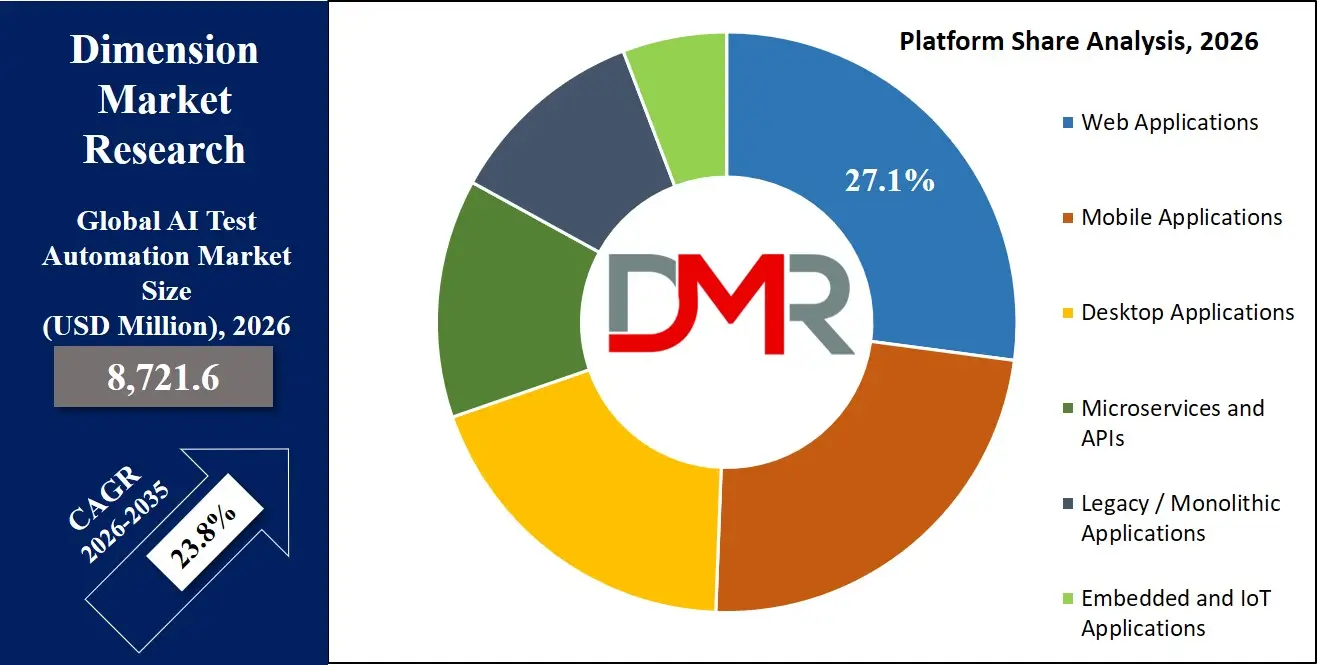
The web platform is the most significant platform segment due to its widespread use across all industries and critical importance for digital transformation. Web platforms are increasingly used by organisations for customer interaction, online retail, business processes and service delivery, and as such are the key target for automated testing. AI-powered testing platforms are widely employed to test web interfaces, browser compatibility, and dynamic content rendering. The relentless release of web applications through agile and DevOps strategies also creates a need for automated and smart testing. Mobile, microservices and IoT technologies are rapidly evolving, but web applications are still prevalent due to their ubiquity, deployment flexibility and large user base. AI improves web testing by making defect prediction and detection, visual verification, and executing tests in complex scenarios quicker and more effective.
By Technology Analysis
Machine learning is anticipated to the lead in the technology category because it underpins AI-powered test automation. ML delivers predictive analysis, smart test case prioritization, defect prediction, and self-healing test scripts for enhanced testing. Machine learning techniques like supervised and reinforcement learning enable systems to learn from past experiences and improve over time. Companies use ML to minimise false negatives, increase test coverage, and speed up manual tasks. Although natural language processing (NLP), computer vision, and generative AI are emerging, machine learning is the foundation of smart automation capabilities. Its capacity for handling big data, pattern recognition and data-driven decision-making guarantees its reign. As companies are embracing an AI-first approach to testing, ML remains a key component of scalability, precision, and innovation.
By Application Analysis
The application sector is poised to be dominated by test automation as this is the core use case for AI in software testing. Companies are increasingly transitioning from manual to automated testing to speed up development, lower expenses and enhance quality. Self-healing scripts, test generation, and test execution are powered by AI to improve test automation. This dramatically lowers maintenance costs and enhances efficiency. Test automation is already widely used in organisations for its impact on efficiency and speed to market. Although autonomous testing and continuous testing are increasingly finding new applications, they are built on test automation. So, test automation is still the most prevalent as the first step in using AI in testing to deliver immediate value and establish a foundation for advanced AI testing.
By End-Use Industry Analysis
The IT & telecommunications industry is expected to lead the AI test automation market as this sector heavily depends on software solutions, has a fast pace of innovation, and operates with sophisticated digital systems. This sector regularly updates systems, operates extensive networks and cloud-native applications, which need well testing. AI-powered test automation ensures quality, scalability and performance in these rapidly evolving systems. The shift to DevOps and agile development practices also drives the use of smart testing tools. Also, complex telecommunication networks incorporating 5G, IoT and edge computing need sophisticated testing and verification, increasing the adoption of AI-driven test automation. Although sectors such as BFSI and healthcare are growing their use, IT & telecommunications sector continues to dominate as an early adopter with a high volume of testing and a strong need to maintain systems to deliver services.
The Global AI Test Automation Market Report is segmented on the basis of the following:
By Offering
- Software
- Autonomous Testing Tools
- Model-Based Testing Tools
- Load and Performance Testing Platforms
- Test Data Generation Tools
- Test Analytics and Observability Platforms
- Code Scanning and QA Security Tools
- Cloud Infrastructure Testing Platforms
- Other Software
- Services
- Implementation and Integration Services
- Consulting Services
- Managed Testing Services
- Training and Enablement Services
- Support and Maintenance Services
By Testing Type
- Functional Testing
- Non-functional Testing
- Performance Testing
- API Testing
- Security Testing
- Load Testing
- Regression testing
- Others
By Platform
- Web Applications
- Mobile Applications
- Desktop Applications
- Microservices and APIs
- Legacy / Monolithic Applications
- Embedded and IoT Applications
By Technology
- Machine Learning
- Supervised Learning Test Models
- Reinforcement Learning for Autonomous Testing
- Defect Classification and Prediction Models
- Natural Language Processing (NLP)
- Conversational Test Generation
- Log Analysis and Root-Cause Inference
- Requirements Interpretation
- Computer Vision
- Visual Validation
- Screenshot Comparison
- UI Anomaly Detection
- Generative AI
- Natural-Language Test Creation
- Synthetic Test Data Generation
- Test Coverage Expansion Model
By Application
- Test Automation
- Autonomous Testing
- Test Data Generation
- Infrastructure Optimization
- Continuous Testing
- Other Application
By End-Use Industry
- IT & Telecommunications
- BFSI
- Healthcare
- Retail & E-commerce
- Manufacturing
- Automotive
- Government & Defense
- Others
Regional Analysis
Leading Region by Market Share
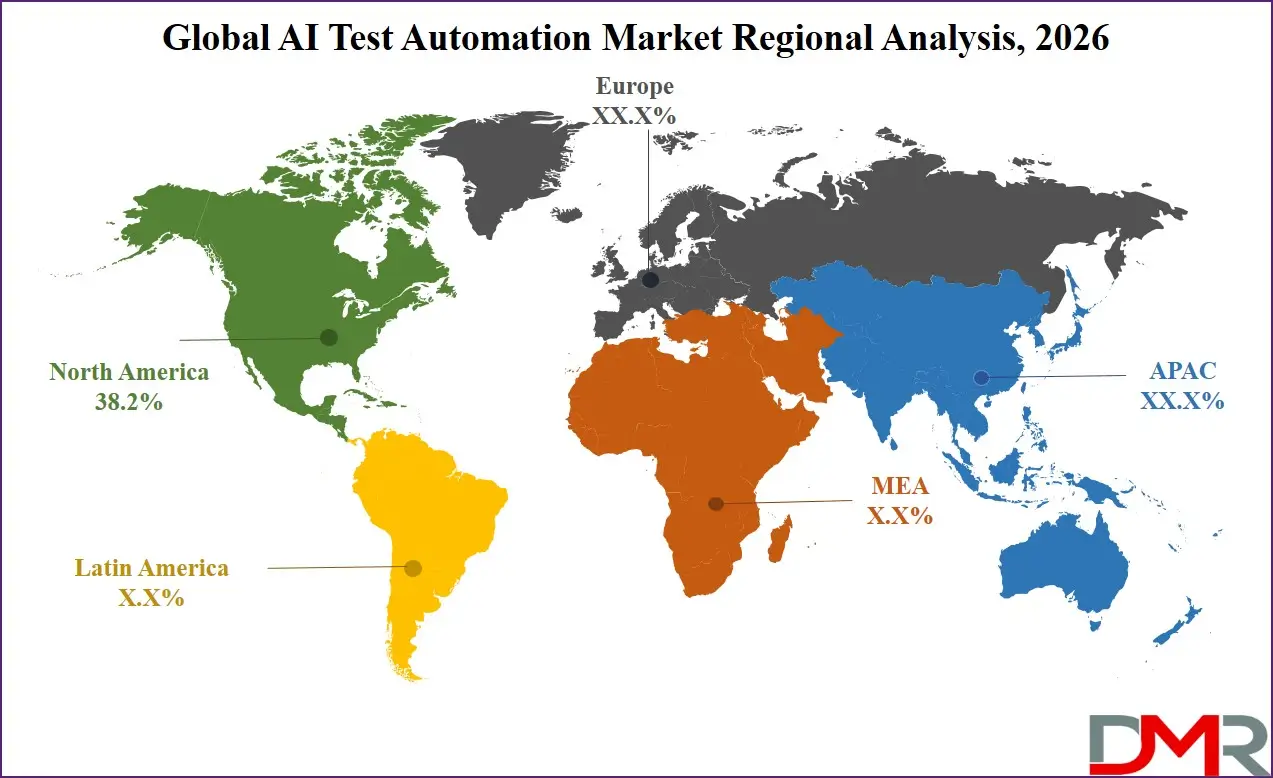
North America is poised to dominate the global AI test automation market, holding a 38.2% of the market share by the end of 2026. North America is led by the US, which has the highest rate of adoption of AI-built testing tools due to the unequalled presence of tech giants and SaaS unicorns that demand sub-second release cycles. It has well-developed communities of DevOps-driven enterprises, deep talent pools of AI/ML developers, and a VC environment that furiously invests in generative AI app and observability startups. Corporate spending on continuous testing in hyperscale cloud ecosystems fuels the ongoing need for autonomous testing tools and services for successful deployment and integration, as enterprises strive to eliminate the costs of delayed delivery and production outages.
ℹ
To learn more about this report –
Download Your Free Sample Report Here
Fastest-Growing Regional Market
The Asia-Pacific market is anticipated to become the fastest-growing AI test automation market, given the rapid growth of digital-native consumers and huge government investment in smart cities and digital economies in India, China and Southeast Asia. The rapid growth of the e-commerce, fintech and mobile-first consumer economies is driving incumbent giants and fast-growing unicorns to adopt rapid CI/CD pipelines that are unsecurable without AI-powered quality gates. Outsourced testing services are in high demand to address the shortage of senior SDETs in the region, offering outsourced expertise to implement and integrate model-based testing and generative AI test generation tools, allowing for quick time to market and ensuring application stability across a wide range of mobile networks and device sizes.
By Region
North America
Europe
- Germany
- The U.K.
- France
- Italy
- Russia
- Spain
- Benelux
- Nordic
- Rest of Europe
Asia-Pacific
- China
- Japan
- South Korea
- India
- ANZ
- ASEAN
- Rest of Asia-Pacific
Latin America
- Brazil
- Mexico
- Argentina
- Colombia
- Rest of Latin America
Middle East & Africa
- Saudi Arabia
- UAE
- South Africa
- Israel
- Egypt
- Rest of MEA
Competitive Landscape
The market for global AI test automation in particular has been transformed into a highly competitive and diverse environment, with a rich mix of global quality engineering conglomerates, independent software vendors (ISVs) dedicated to AI and the built-in testing services departments of cloud hyperscale providers. The magic trick will be close integrations in the DevSecOps stack, acquiring strategic alliances with CI/CD leaders and public cloud to become the preferred quality platform. The consolidation of the market is moving at full steam with test automation incumbents taking over generative AI and computer vision startup boutiques to upgrade their legacy scripting tools. Unique intellectual property, such as self-trained web-UI object recognition neural networks and industry-specific test benchmark generators, is becoming more crucial to differentiation than just tool capabilities or standard consulting services.
Some of the prominent players in the Global AI Test Automation Market are:
- Tricentis
- UiPath
- SmartBear
- OpenText
- Keysight Technologies
- IBM
- Microsoft
- Google
- Oracle
- SAP
- Accenture
- Capgemini
- Cognizant
- Infosys
- Tata Consultancy Services (TCS)
- Qualitest
- TestFort
- Sauce Labs
- Micro Focus
- Parasoft
- Other Key Players
Recent Developments
- January 2026: AI-native test automation platform, Functionize, launched a significant upgrade of its generative AI-powered test generation. The move is aimed at BFSI and Retail & E-commerce industries, and allows the transformation of backlog user stories into self-healing test suites leveraging fine-tuned large language models and custom-built synthetic data generation capabilities.
- November 2025: Global quality engineering and testing company, Capgemini, expanded its partnership with Google Cloud to establish a new advanced practice on code scanning, QA security tools and API testing. The practice aims to help IT & Telecom customers protect 5G network APIs and align to international cybersecurity standards.
- October 2025: A leading test automation ISV, Tricentis, bought Testim (AI-powered test automation and computer vision capabilities) to improve its self-healing test automation and visual testing capabilities. This boosts capabilities for Automotive and Manufacturing, especially in delivering defect-free infotainment and operational technology.
Report Details
| Report Characteristics |
| Market Size (2026) |
USD 8,721.6 Mn |
| Forecast Value (2035) |
USD 59,729.8 Mn |
| CAGR (2026–2035) |
23.8% |
| The US Market Size (2026) |
USD 2,801.9 Mn |
| Historical Data |
2021 – 2025 |
| Forecast Data |
2027 – 2035 |
| Base Year |
2025 |
| Estimate Year |
2026 |
| Segments Covered |
By Offering (Software, and Services), By Testing Type (Functional Testing, and Non-functional Testing), By Platform (Web Applications, Mobile Applications, Desktop Applications, Microservices and APIs, Legacy/Monolithic Applications, and Embedded and IoT Applications), By Technology (Machine Learning, Natural Language Processing (NLP), Computer Vision, and Generative AI), By Application (Test Automation, Autonomous Testing, Test Data Generation, Infrastructure Optimization, Continuous Testing, and Other Applications), By End-Use Industry (IT & Telecommunications, BFSI, Healthcare, Retail & E-commerce, Manufacturing, Automotive, Government & Defense, and Others) |
| Regional Coverage |
North America – The US and Canada; Europe – Germany, The UK, France, Russia, Spain, Italy, Benelux, Nordic, & Rest of Europe; Asia-Pacific – China, Japan, South Korea, India, ANZ, ASEAN, Rest of APAC; Latin America – Brazil, Mexico, Argentina, Colombia, Rest of Latin America; Middle East & Africa – Saudi Arabia, UAE, South Africa, Turkey, Egypt, Israel, & Rest of MEA |
Frequently Asked Questions
How big is the Global AI Test Automation Market?
▾ The Global AI Test Automation market is poised to be valued at USD 8,721.6 million in 2026 and is projected to reach USD 59,729.8 million by 2035, driven by the universal need to eliminate test maintenance overhead and achieve true continuous delivery.
What is the CAGR of the Global AI Test Automation Market from 2026 to 2035?
▾ The market is expected to grow at a CAGR of 23.8% from 2026 to 2035, reflecting the accelerating shift from traditional script-based automation to autonomous and generative AI-powered testing.
What factors are driving the growth of the Global AI Test Automation Market?
▾ Key drivers include the fragility and high maintenance cost of traditional Selenium/UFT scripts, the complexity explosion of microservices and API testing, the critical global shortage of software development engineers in test (SDETs), and the demand for synthetic test data to meet privacy regulations.
Which region held the largest share of the AI Test Automation Market in 2026?
▾ North America is poised to dominate this market with 38.2% of market share in 2026, driven by its hyperscale cloud-native economy and aggressive enterprise investment in autonomous testing and AI-driven quality observability.
Which region is expected to grow the fastest in the AI Test Automation Market?
▾ The Asia-Pacific region is expected to grow the fastest, fueled by explosive digital adoption in India and China, where managed testing services are critical for enabling high-velocity mobile and fintech application release cadences.
What are the major trends in the Global AI Test Automation Market?
▾ Major trends include the rise of generative AI for natural-language test creation, the shift toward fully hands-free autonomous testing platforms, and the integration of test analytics and observability for predictive quality engineering and root-cause inference.
Who are the key players in the Global AI Test Automation Market?
▾ Key players include AI-native tools vendors like Applitools and Functionize, traditional test platform leaders like Tricentis and SmartBear, quality engineering service giants like TCS and Capgemini, and DevOps platform providers integrating AI testing capabilities.
How is the Global AI Test Automation Market segmented?
▾ The market is segmented by Offering, Testing Type, Platform, Technology, Application, and End-Use Industry.