Global AI TRISM Market Snapshot
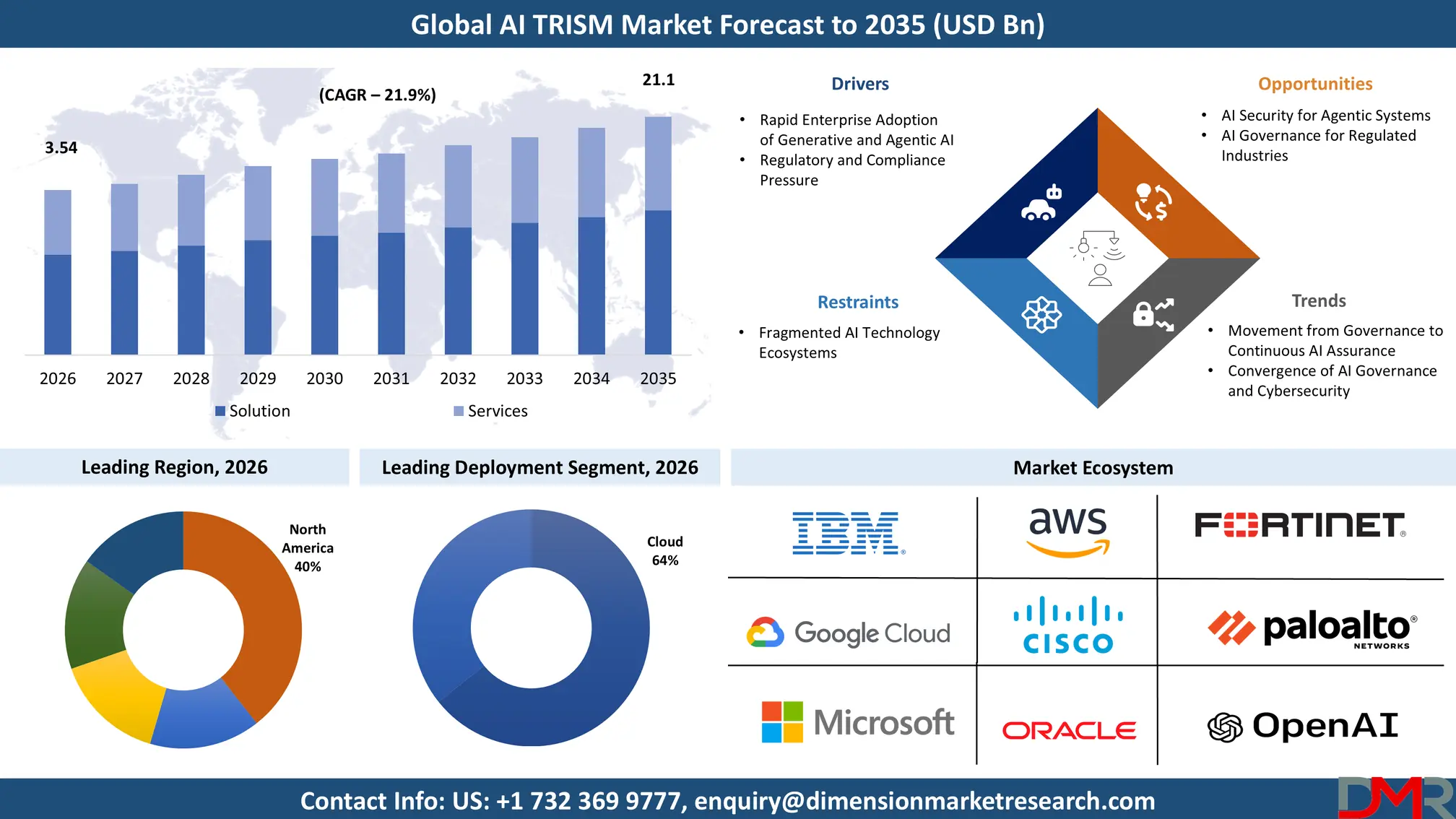
- Global AI TRiSM Market Size, 2026: USD 3.54 Billion
- Global AI TRiSM Market Size, 2035: USD 21.1 Billion
- Global CAGR, 2026-2035: 21.9%
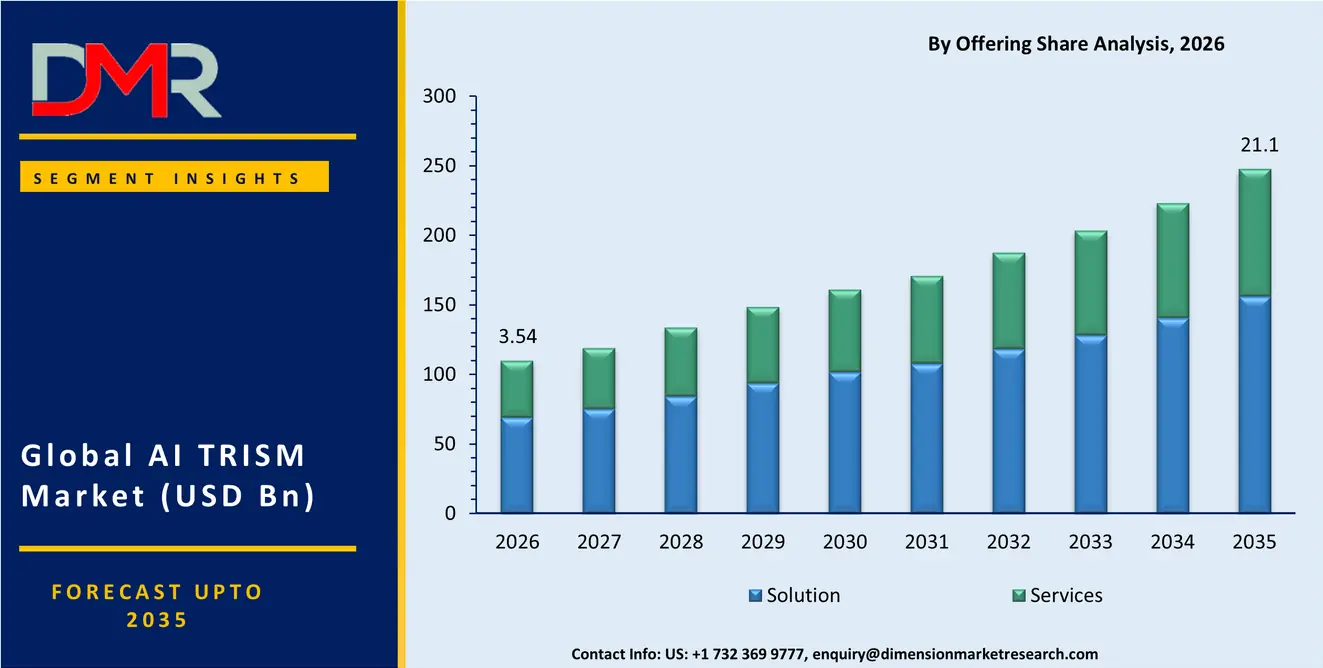
- Leading Offering Segment, 2026 Solutions, 72%
- Leading Type Segment, 2026: Explainability, 27%
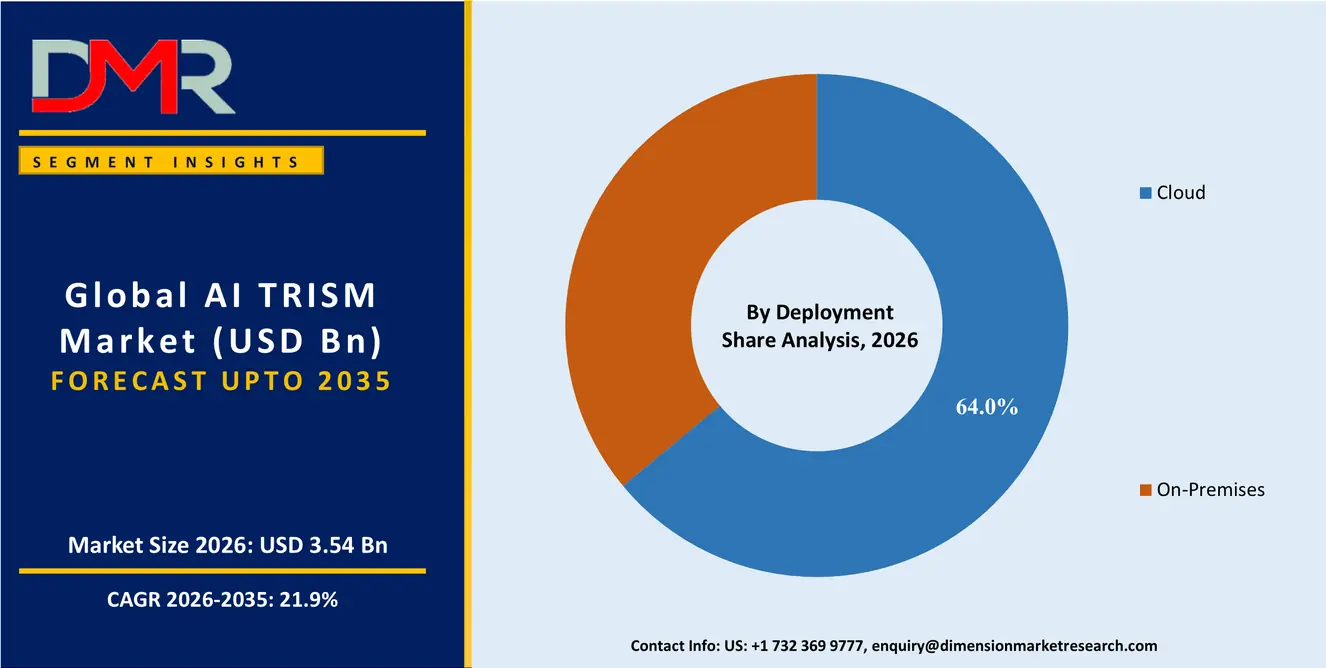
- Leading Deployment Segment, 2026: Cloud, 64%
- Leading Application Segment, 2026: Compliance Management, 29%
- Fastest-Growing Segment: AI Application Security, 25.0% CAGR
- Leading Region, 2026: North America, 40% share
What is the Global AI TRISM and its Market Size?
The Global AI TRISM Market is projected to reach USD 3.54 billion in 2026 and grow at a compound annual growth rate of 21.9% from there until 2035 to reach a value of USD 21.1 billion.
ℹ
To learn more about this report –
Download Your Free Sample Report Here
Growth is being driven by rapid enterprise adoption of generative and agentic AI, increasing regulatory scrutiny, rising AI-related cybersecurity threats, growing demand for explainability and model assurance, and the need to control sensitive data flowing through AI applications. As AI TRiSM increasingly emphasizes runtime inspection, enforcement and continuous governance as AI systems become more autonomous.
Use Cases
- Fraud Detection & Prevention: Detect anomalous AI-assisted transactions, synthetic identities and suspicious behavioral patterns.
- Cybersecurity: Protect AI applications against prompt injection, jailbreaks, model manipulation and adversarial attacks.
- Compliance Management: Map AI systems to regulatory obligations and automate evidence, documentation and audit processes.
- Data Privacy Management: Identify sensitive information entering or leaving AI models and enforce data-handling policies.
- Model Monitoring: Continuously evaluate accuracy, drift, bias, hallucinations and operational performance.
- AI Application Security: Secure LLM applications, AI agents, APIs, plugins and tool-use workflows against emerging threats.
Key Takeaways
- Market Size: AI TRiSM is estimated at USD 3.54 billion in 2026 and could reach approximately USD 21.1 billion by 2035.
- Growth: The market is expected to expand at approximately 21.9% CAGR through 2035.
- Growth Drivers: Enterprise AI adoption, agentic AI, regulatory requirements, cybersecurity threats and demand for responsible AI are the principal growth catalysts.
- Segment Leadership: AI TRiSM solutions are expected to account for the majority of revenue, while cloud deployment leads due to scalability and integration advantages.
- Fastest Growth: AI application security is expected to be among the fastest-growing categories as LLMs and autonomous AI agents create new attack surfaces.
- Regional Leadership: North America is expected to remain the largest market because of its concentration of AI developers, cloud providers, technology companies and early enterprise adopters.
How AI/Gen AI is Transforming the AI TRISM Market?
AI TRiSM is itself being reshaped by generative AI, large language models and agentic AI. Traditional governance focused primarily on model documentation, bias assessment and periodic reviews. Modern TRiSM increasingly requires real-time inspection of prompts, responses, tool calls, agents, model behavior and data flows. Also it identifies runtime inspection and enforcement as an increasingly important layer of AI governance.
Generative and agentic AI increase both the addressable market and the complexity of AI risk. Organizations need automated testing, red teaming, prompt-injection detection, data-loss prevention, model monitoring and continuous policy enforcement. AI therefore creates demand for AI-native security products rather than simply extending conventional cybersecurity tools.
Key Drivers in the Global AI TRISM Market
Rapid Enterprise Adoption of Generative and Agentic AI
Enterprise AI adoption is creating a structural requirement for governance and security infrastructure. Organizations are moving beyond isolated AI experiments toward AI embedded in customer service, software development, financial decision-making, healthcare, manufacturing and internal workflows. As AI systems gain access to enterprise data and business applications, the potential consequences of inaccurate, biased, manipulated or insecure outputs increase.
Agentic AI further strengthens the requirement because autonomous systems can invoke tools, access information and take actions with limited human intervention. Academic research on agentic AI TRiSM highlights governance, explainability, ModelOps, privacy and security as critical pillars for trustworthy autonomous systems.
Regulatory and Compliance Pressure
Regulation is transforming AI governance from a voluntary best practice into an operational requirement. The EU AI Act represents the most significant regulatory catalyst, while NIST AI RMF, ISO/IEC 42001 and emerging national AI governance frameworks provide additional structures for responsible AI management.
The European Commission states that the AI Act becomes broadly applicable from August 2026, while certain high-risk AI provisions are scheduled for later application. ISO/IEC 42001 provides an international management-system framework for establishing, implementing and continually improving organizational AI governance.
Restraints in the Global AI TRISM Market
Fragmented AI Technology Ecosystems
AI systems are increasingly distributed across cloud platforms, SaaS applications, open-source models, proprietary models, APIs, enterprise data stores and autonomous agents. This makes it difficult for organizations to maintain a complete inventory and consistent governance policy.
The problem becomes more complicated when enterprises use multiple cloud providers or combine internally developed models with third-party foundation models. Different platforms expose different telemetry, controls and evaluation mechanisms, increasing integration costs.
Growth Opportunities in the Global AI TRISM Market
AI Security for Agentic Systems
The rapid expansion of autonomous AI agents represents one of the largest new opportunities for AI TRiSM vendors. Agents can interact with enterprise applications, databases, APIs and external tools, producing attack surfaces that conventional model governance does not fully address. AI security platforms can provide agent identity, permission controls, runtime inspection, tool-use monitoring, prompt-injection protection, behavioral analysis and automated policy enforcement.
AI Governance for Regulated Industries
Financial services, healthcare, insurance, government and defense have unusually strong requirements for traceability, explainability, privacy, auditability and risk management. These industries can therefore support higher-value AI TRiSM deployments. Organizations increasingly need systems that can connect AI inventories with business risk, regulatory requirements, controls and audit evidence.
Trends in the Global AI TRISM Market
Movement from Governance to Continuous AI Assurance
The market is shifting from static policies and documentation toward continuous monitoring and enforceable controls. As there is a major emphasizes operational governance, runtime inspection, validation and enforcement.
Convergence of AI Governance and Cybersecurity
AI security, data security, identity, GRC and model governance are converging. Microsoft's AI governance architecture, for example, connects model development and evaluation with Purview data controls, Entra identity and Defender security capabilities.
Research Scope and Analysis
The global AI TRiSM market is analyzed by Offering, Type, Deployment, Application and End User. The analysis evaluates the relative market contribution of solutions and services, core TRiSM capabilities, cloud versus on-premises deployment, major business applications and industries adopting AI governance and security.
ℹ
To learn more about this report –
Download Your Free Sample Report Here
By Offering Analysis
Solutions are expected to dominate the AI TRiSM market in 2026 with an estimated 72% share, reflecting the need for continuous AI monitoring, governance, security, data protection and compliance platforms. Solution demand is supported by enterprises seeking integrated control over increasingly complex AI estates.
ℹ
To learn more about this report –
Download Your Free Sample Report Here
Services represent approximately 28% of the market and include consulting, implementation, integration, managed services, assessment and compliance support. Services remain important because AI TRiSM often requires integration with existing GRC, cybersecurity, cloud and data-management infrastructure. Within solutions, integrated platforms are expected to grow faster than point products as enterprises seek unified visibility across traditional ML, generative AI and agentic AI. Services should nevertheless remain resilient as regulatory requirements evolve and organizations require specialized expertise to build governance programs. The fastest-growing service opportunities are expected to involve AI risk assessments, regulatory readiness, AI red teaming and managed AI security.
By Type Analysis
Explainability is estimated to represent approximately 27% of the 2026 market, making it the leading capability category. Enterprises require model transparency, documentation, explainability and policy controls to satisfy regulators and internal risk functions. AI Application Security is expected to be the fastest-growing category, with an estimated 25.0% CAGR, driven by prompt injection, jailbreaks, malicious tool use and agentic-AI threats. Data Protection represents roughly 22% of the market, supported by concerns over confidential information being exposed through AI applications. ModelOps accounts for approximately 17%, while Data Anomaly Detection represents about 12%. The remaining market includes emerging capabilities and integrated functions. The market is expected to progressively move toward convergence, with vendors combining explainability, ModelOps, data protection and security into unified AI control planes.
By Deployment Analysis
Cloud deployment is estimated to hold approximately 64% of the AI TRiSM market in 2026, supported by rapid adoption of cloud-based AI models, SaaS applications and generative AI platforms. Cloud deployment provides scalability, faster implementation and easier integration with hyperscaler AI services. It is particularly attractive for organizations deploying AI across multiple business units and geographies. On-premises deployment accounts for approximately 36%, with comparatively strong demand from highly regulated enterprises, government agencies, defense organizations and companies with sensitive intellectual property or strict data-residency requirements. Hybrid deployment is increasingly important because enterprises often combine cloud-based foundation models with private data and on-premises systems. The fastest-growing opportunity is therefore expected to be cloud and hybrid AI governance platforms capable of maintaining consistent policies across heterogeneous environments.
By Organization Size Analysis
Large Enterprises are expected to dominate the AI TRiSM market in 2026, accounting for approximately 68% of the global market, owing to their extensive AI deployments, larger cybersecurity budgets, complex regulatory requirements and greater exposure to AI-related operational and compliance risks. Large organizations typically operate multiple AI models, cloud environments and third-party AI applications, creating strong demand for centralized AI governance, model monitoring, data protection, explainability and AI application security. Small and Medium-sized Enterprises (SMEs) are estimated to account for approximately 32% of the market in 2026. However, SMEs are expected to register the faster growth rate, at approximately 24.5% CAGR, as cloud-based and SaaS AI TRiSM platforms lower implementation costs and reduce the need for specialized in-house expertise. SMEs are increasingly adopting managed AI governance, automated compliance and cloud-native AI security solutions. The growing use of generative AI and AI agents among smaller businesses is expected to further accelerate adoption. As vendors introduce simplified, subscription-based and managed offerings, AI TRiSM is expected to become increasingly accessible beyond large enterprises.
By Application Analysis
Compliance Management is estimated to lead the application segment with approximately 29% share in 2026, as organizations seek to operationalize AI regulations, standards and internal policies. Cybersecurity is expected to represent approximately 25%, driven by AI-specific attacks and vulnerabilities. Data Privacy Management contributes around 20%, while Fraud Detection & Prevention accounts for roughly 16%. Other applications represent approximately 10%. AI application security is increasingly embedded across these use cases rather than operating as a standalone capability. Financial institutions are particularly important adopters because they simultaneously require fraud prevention, model risk management, privacy and regulatory compliance. Healthcare, government and telecommunications are also expected to generate substantial demand as AI becomes embedded into sensitive workflows.
By End User Analysis
IT & Telecommunications is expected to remain the largest end-user category, accounting for approximately 27% of 2026 market demand, because technology companies operate large numbers of models, APIs and AI applications. BFSI follows at approximately 23%, supported by financial-model governance, fraud detection and stringent regulatory requirements. Retail and e-commerce account for around 14%, healthcare 12%, manufacturing 10%, government and defense 8%, and other sectors approximately 6%. BFSI and healthcare are expected to grow particularly quickly because AI adoption is expanding while regulatory and privacy risks remain high. Manufacturing is another emerging opportunity as AI becomes embedded in industrial automation, quality control and predictive maintenance. Government and defense are likely to prioritize sovereign AI, secure model deployment and auditability.
The Global AI TRISM Market Report is segmented on the basis of the following:
By Offering
By Type
- Explainability
- ModelOps
- Data Protection
- Data Anomaly Detection
- AI Application Security
By Deployment
By Organization Size
By Application
- Fraud Detection & Prevention
- Cybersecurity
- Compliance Management
- Data Privacy Management
- Others
By End User
- IT & Telecom
- BFSI
- Retail & E-commerce
- Healthcare
- Manufacturing
- Government & Defense
- Others
Regional Analysis
North America is the Leading Region in the Global AI TRISM Market
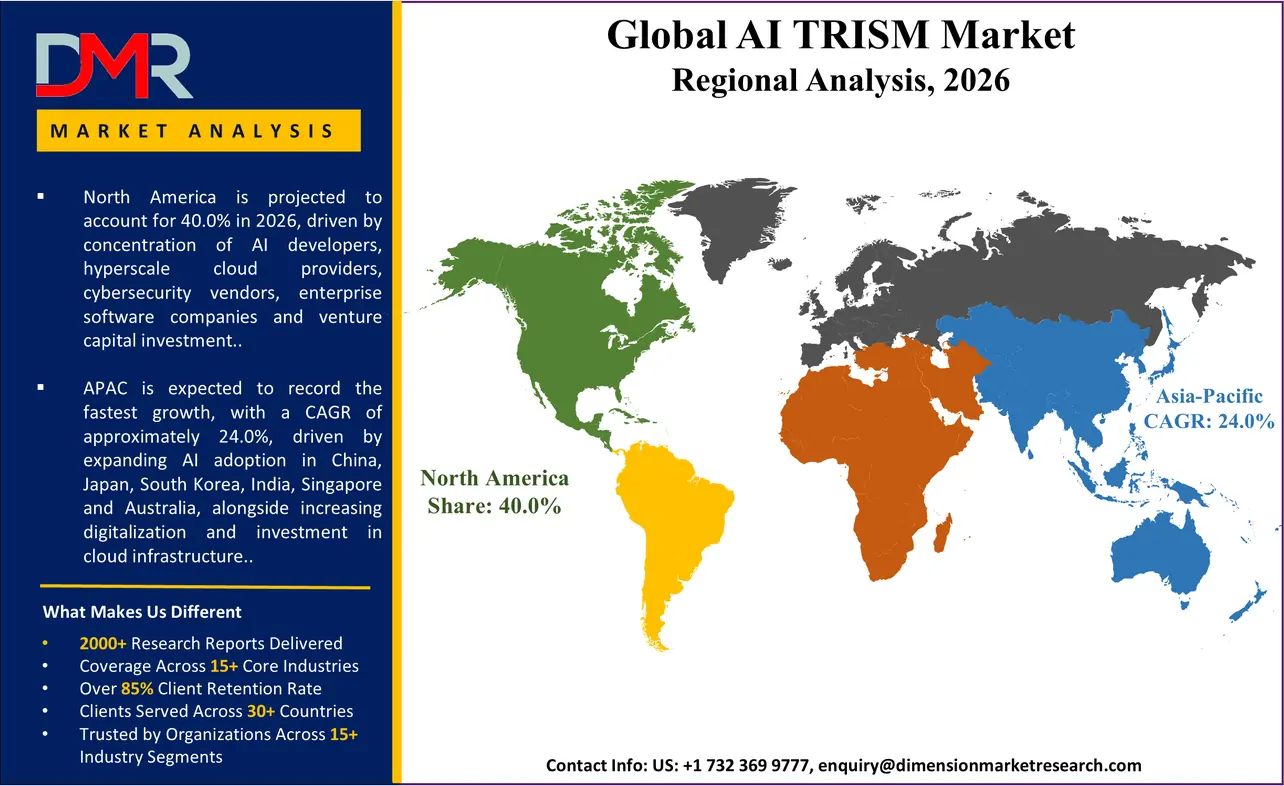
North America is expected to remain the leading regional AI TRiSM market in 2026, with approximately 40% market share. The region benefits from a concentration of AI developers, hyperscale cloud providers, cybersecurity vendors, enterprise software companies and venture capital investment. The United States is particularly important because of its strong adoption of foundation models, cloud AI services and enterprise generative AI.
ℹ
To learn more about this report –
Download Your Free Sample Report Here
The region also has a mature cybersecurity and GRC ecosystem, allowing AI TRiSM technologies to integrate with established security and compliance infrastructure. NIST's AI Risk Management Framework provides an important reference point for U.S. organizations, while NIST continues developing additional profiles for specialized AI-risk environments.
Asia Pacific is the Fastest-Growing Region in the Global AI TRISM Market
Asia-Pacific is projected to be the fastest-growing regional market, with an estimated CAGR of approximately 24.0% through 2035. Growth is supported by expanding AI adoption in China, Japan, South Korea, India, Singapore and Australia, alongside increasing digitalization and investment in cloud infrastructure.
Japan, Singapore, South Korea and Australia are particularly attractive for AI governance vendors because enterprises increasingly require data residency, security and compliance controls. Google's expansion of Model Armor's regional availability, including Japan, South Korea, Singapore and India, illustrates the growing importance of regional AI security and data-residency capabilities.
The Europe AI TRISM Market
The European AI TRiSM market is estimated at approximately USD 0.78 billion in 2026 and could reach about USD 2.45 billion by 2032, representing an estimated 21.0% CAGR. Europe's growth is strongly influenced by the EU AI Act, GDPR, data-governance requirements and demand for explainable and auditable AI. The European Commission states that the AI Act becomes broadly applicable on 2 August 2026, although different provisions have different implementation dates. ISO/IEC 42001 is also relevant as enterprises establish formal AI management systems.
Latin America AI TRISM Market
Latin America is estimated at approximately USD 0.18 billion in 2026 and is projected to reach approximately USD 0.55 billion by 2032, representing an estimated 20.5% CAGR. Brazil and Mexico are expected to account for the majority of regional demand. Growth is supported by cloud adoption, digital banking, e-commerce, cybersecurity investment and increasing use of AI in customer service and fraud prevention. The region remains comparatively underpenetrated, creating opportunities for cloud-native vendors and managed AI governance services.
MEA AI TRISM Market
The Middle East and Africa market is estimated at approximately USD 0.16 billion in 2026 and could reach USD 0.52 billion by 2032, representing an estimated 21.5% CAGR. Saudi Arabia and the UAE are expected to lead demand due to national AI strategies, digital-government initiatives, smart-city investments and large-scale cloud infrastructure projects. Financial services, government, telecommunications and energy are expected to be major AI TRiSM adopters.
Major Countries Analysis
United States AI TRISM Market
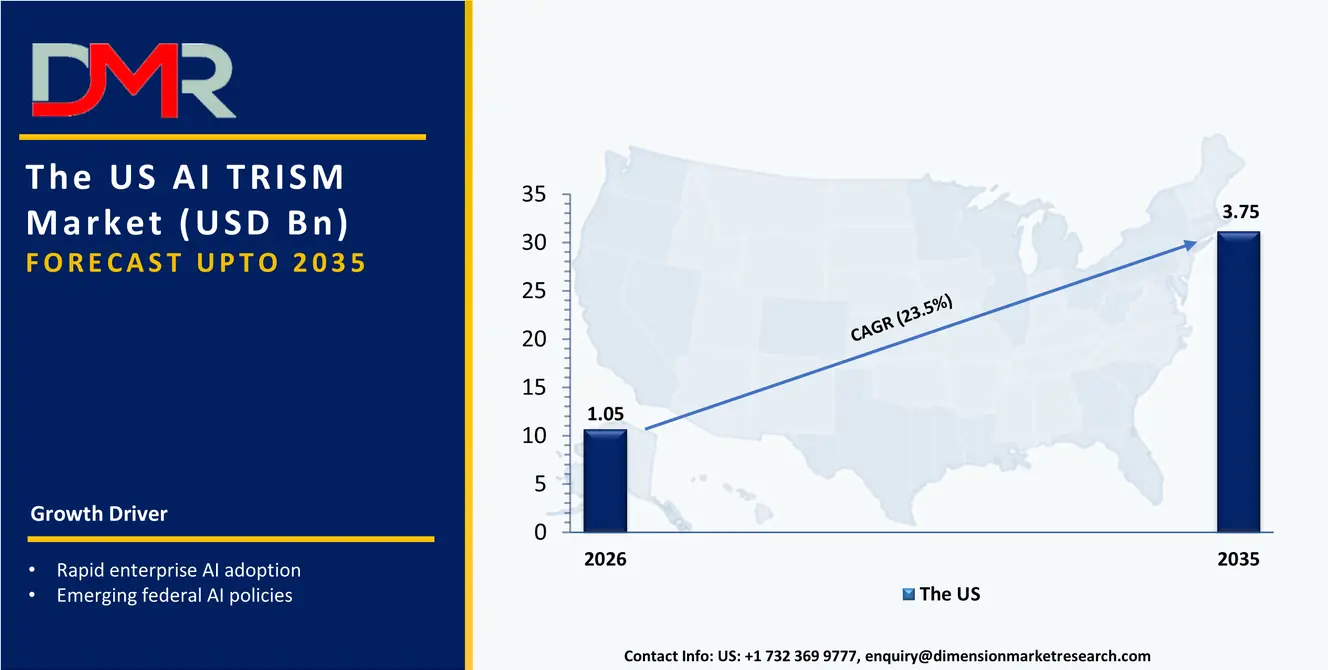
The U.S. market is estimated at approximately USD 1.05 billion in 2026 and could reach around USD 3.75 billion by 2032, representing an estimated 23.5% CAGR. Demand is driven by rapid enterprise AI adoption, cybersecurity threats, cloud AI deployment and the need for auditable AI governance. NIST AI RMF and emerging federal AI policies provide important reference points. The U.S. also hosts many of the largest AI, cybersecurity and enterprise software vendors.
ℹ
To learn more about this report –
Download Your Free Sample Report Here
Japan AI TRISM Market
Japan's AI TRiSM market is estimated at approximately USD 0.28 billion in 2026 and could reach around USD 0.79 billion by 2032, representing an estimated 18.9% CAGR. Manufacturing, financial services, telecommunications and healthcare are major application areas. Data-residency and enterprise security requirements are encouraging deployment of regional AI security capabilities. Google's expansion of Model Armor into Japan illustrates the increasing availability of AI security infrastructure in the country.
Saudi Arabia AI TRISM Market
Saudi Arabia's AI TRiSM market is estimated at approximately USD 0.10 billion in 2026 and could reach around USD 0.34 billion by 2032, representing an estimated 22.7% CAGR. Vision 2030-driven digital transformation, smart-government programs, financial-sector modernization and investment in AI infrastructure are expected to support demand. Sovereign data, cybersecurity and responsible AI requirements are likely to become increasingly important as AI is deployed across government and strategic industries.
Regulatory Landscape
AI TRiSM is increasingly influenced by a combination of mandatory regulations, voluntary frameworks and management standards. The EU AI Act is the most significant dedicated AI regulation, with broad applicability beginning from August 2026 and different requirements entering into force on different dates.
In the United States, NIST AI RMF provides a widely used voluntary framework for identifying and managing AI risks, while NIST is expanding the framework through additional profiles. ISO/IEC 42001:2023 provides an international AI management-system standard covering responsible AI governance, risk management, transparency and continual improvement.
Sector-specific privacy, cybersecurity, financial and consumer-protection regulations also affect AI deployments. Collectively, these requirements increase demand for AI inventories, risk classification, explainability, documentation, monitoring, data controls and audit evidence.
Investment and White Space Analysis
The strongest investment opportunities are expected in AI application security, agentic-AI governance, runtime inspection, AI data security, automated compliance and cross-cloud AI governance. AI agents represent a particularly attractive white space because enterprises require controls covering identity, tool permissions, prompt injection, data access and autonomous actions. Another opportunity lies in verticalized TRiSM platforms for BFSI, healthcare, government and defense.
Managed AI governance services can address the skills gap among SMEs. Cross-platform governance is also promising because enterprises increasingly operate AI workloads across multiple clouds and third-party models. Google's regional AI security expansion and Microsoft's cross-cloud Purview approach illustrate the market's movement toward geographically distributed and multicloud governance.
By Region
North America
Europe
- Germany
- France
- The U.K.
- Italy
- Spain
- Rest of Europe
Asia-Pacific
- China
- Japan
- India
- Australia
- South Korea
- Rest of APAC
Latin America
- Mexico
- Brazil
- Rest of LATAM
Middle East & Africa
- Saudi Arabia
- The UAE
- South Africa
- Rest of MEA
Competitive Landscape
The AI TRiSM market is highly dynamic and increasingly convergent, with competition between dedicated AI governance startups, cybersecurity companies, cloud hyperscalers, enterprise software vendors and established GRC providers. Major vendors compete through platform integration, AI-security innovation, partnerships, acquisitions and geographic expansion. Differentiation is increasingly based on runtime protection, breadth of AI asset discovery, model evaluation, data security, explainability, compliance automation and integration with existing enterprise security stacks.
Large technology companies have an advantage because they can integrate AI TRiSM into cloud, identity, data, security and developer platforms. Meanwhile, specialized vendors can differentiate through deeper AI testing, red teaming, model security and agentic-AI controls. The competitive structure is therefore likely to evolve toward a combination of large integrated platforms and specialized best-of-breed technologies.
Some of the prominent players in the Global AI TRISM Market are:
- IBM
- Microsoft Corporation
- Accenture
- Palo Alto Networks
- Deloitte
- Cisco Systems
- ServiceNow
- PricewaterhouseCoopers (PwC)
- Ernst & Young (EY)
- Veeam Software
- Cyera
- OneTrust
- BigID
- Credo AI
- Arize AI
- Fiddler AI
- ModelOp
- HiddenLayer
- AIShield
- NeuralTrust
- Other Key Players
Recent Developments
- In July 2026, IBM introduced Use Case Onboarding Optimization, using natural-language interaction and automated governance workflows to accelerate AI risk review and responsible-AI adoption.
- In July 2026, IBM introduced AI Asset Discovery in watsonx.governance to identify unmanaged AI agents, tools, MCP servers and foundation models, addressing the growing problem of shadow AI.
- In July 2026, Google Cloud enhanced Model Armor's responsible-AI filters and expanded capabilities for streaming text sanitization, multimodal screening and regional data-residency requirements.
- In May 2026, Palo Alto Networks announced the acquisition of Portkey to integrate AI Gateway capabilities into Prisma AIRS, strengthening its strategy for securing and governing autonomous AI agents.
- In April 2026, Google Cloud expanded Model Armor integration with agent platforms and regional availability, reinforcing its focus on runtime security and governance for generative and agentic AI.
- In February 2026, IBM released a new watsonx.governance version with record-level custom metrics, strengthening monitoring capabilities for security and compliance use cases.
- In January 2026, Microsoft highlighted its position in unified AI governance, combining Microsoft Foundry with Purview, Entra and Defender to provide model, data, identity, security and compliance controls across enterprise AI.
Report Details
| Report Characteristics |
| Market Size (2026) |
USD 3.54 Bn |
| Forecast Value (2035) |
USD 21.1 Bn |
| CAGR (2026–2035) |
21.9% |
| Historical Period |
2021 – 2025 |
| Forecast Period |
2027 – 2035 |
| Base Year |
2025 |
| Estimate Year |
2026 |
| Segments Covered |
By Offering, By Type, By Deployment, By Organization Size, By Application, By End User |
| Regional Coverage |
North America – The US and Canada; Europe – Germany, The UK, France, Spain, Italy, & Rest of Europe; Asia-Pacific – China, Japan, South Korea, India, Australia, Rest of APAC; Latin America – Brazil, Mexico, Rest of Latin America; Middle East & Africa – Saudi Arabia, The UAE, South Africa, & Rest of MEA |
Frequently Asked Questions
What is the AI TRiSM market size in 2026?
▾ The global AI TRiSM market is estimated at approximately USD 3.54 billion in 2026, based on current published market forecasts.
What CAGR is expected for AI TRiSM?
▾ The market is expected to expand at approximately 21.9% CAGR from 2026 through 2035, supported by enterprise AI adoption and regulatory requirements.
What is driving AI TRiSM market growth?
▾ Major drivers include generative AI adoption, agentic AI, cybersecurity threats, AI regulations, privacy requirements, model-risk management and demand for trustworthy AI.
Which AI TRiSM segment is growing fastest?
▾ AI application security is expected to be among the fastest-growing categories, supported by prompt injection, jailbreak, agent and AI application threats.
Which region leads the AI TRiSM market?
▾ North America is expected to lead with approximately 40% share in 2026, supported by strong AI, cloud, cybersecurity and enterprise software ecosystems.
Which region is growing fastest?
▾ Asia-Pacific is projected to be the fastest-growing region, with an estimated CAGR of approximately 24%, driven by rapid AI and digital transformation.
Who are the major AI TRiSM players?
▾ The competitive landscape includes Microsoft, IBM, Google Cloud, Palo Alto Networks and specialist AI governance and security providers.
How is the market segmented in AI TRiSM market?
▾ The market is analyzed by offering, type, deployment, application, end user and geography, covering solutions, services, governance, security, privacy and ModelOps.