Market Overview
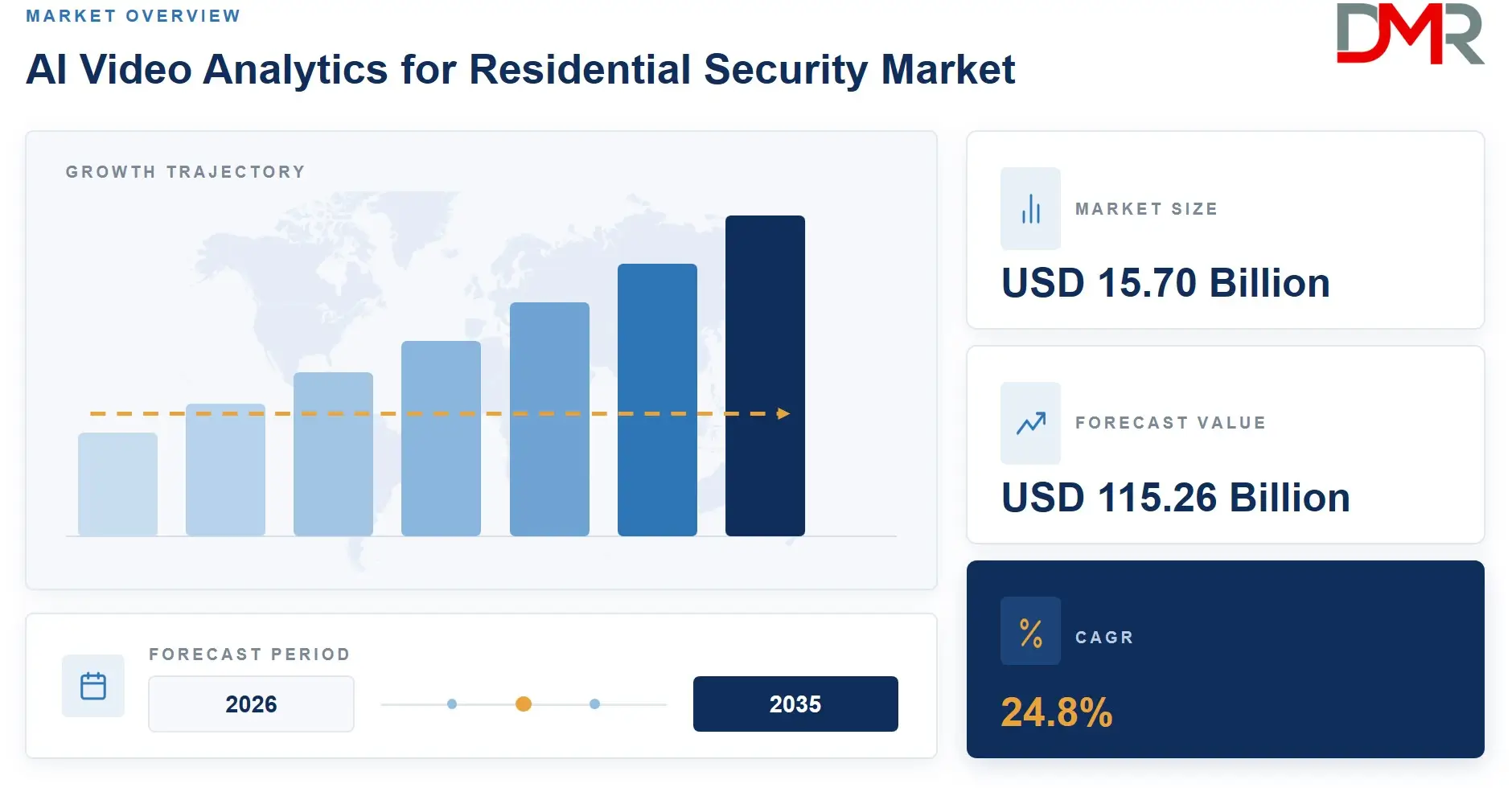
The Global AI Video Analytics for Residential Security Market size is estimated at USD 15.70 Billion in 2026, and is projected to reach USD 115.26 Billion by 2035, exhibiting a CAGR of 24.8% during the forecast period. As reported by the ITU, in 2025, 6.0 billion people used the internet worldwide, creating a global residential base technically capable of supporting cloud-connected security systems. Broad broadband penetration in North America, Europe, and Asia Pacific removed the connectivity barrier that historically constrained AI-enhanced camera adoption. Forecasters anchor the 24.8% CAGR on three structural assumptions: continued hardware-to-software monetization shifts, subscription platform stickiness once AI detection features are experienced, and ongoing migration from passive recording to proactive alert delivery. ADT confirmed its Nest Aware subscriber base surpassed 1 million customers by the second quarter of 2025, illustrating how incumbent security companies now compete directly on AI software retention rather than hardware installation alone. Vendors bundling AI analytics into existing camera ecosystems face less resistance than those requiring hardware replacement. AI Security Camera platforms that overlay intelligence on installed devices hold a structural cost advantage over greenfield deployment models. On October 1, 2025, Google launched three wired Nest security devices with 2K HDR video, including the Nest Cam Indoor at $99.99, the Nest Cam Outdoor at $149.99, and the Nest Doorbell at $179.99, signaling that premium hardware price points are now expected to include embedded AI at no additional subscription cost. The market scope covers residential end points only. Commercial and enterprise surveillance systems fall outside this boundary. Home Security Systems serving single-family homes, multi-unit dwellings, and residential communities form the addressable universe this report quantifies.
ℹ
To learn more about this report –
Download Your Free Sample Report Here
Key Takeaways
- The market size is USD 15.70 Billion in 2026, and is projected to hit USD 115.26 Billion by 2035 at a CAGR of 24.8%.
- By Residential Analytics Function: Person & Intruder Detection led with a 39.00% share in 2026.
- By Security Device Environment: Indoor Smart Cameras led with a 59.7% share in 2026.
- By AI Processing Architecture: Cloud-Based Video Intelligence led with a 59.80% share in 2026.
- By Residential Security Use Case: Intrusion & Perimeter Protection led with a 40.20% share in 2026.
- By Service & Revenue Model: Device-Embedded Analytics led with a 66.70% share in 2026.
- By Sales Channel: Online Retail led with a 69.90% share in 2026.
- By Region: North America led with a 42.60% share in 2026.
- Top 5 key players: Amazon (Ring), Google (Nest), Arlo Technologies, Inc., Alarm.com Holdings, Inc., Anker Innovations (eufy).
Residential Analytics Function Analysis
Person & Intruder Detection accounted for 39.00% of Residential Analytics Function demand in 2026, the highest of any category. Homeowners prioritize threat identification above all other analytics functions, and vendors have built detection models accordingly. Arlo Smart detection, as confirmed by Arlo, supports people, packages, vehicles, animals, and smoke or carbon-monoxide alarms within a single subscription tier, demonstrating how the leading category expands by absorbing adjacent functions rather than competing with them. Video Analytics platforms built around person detection hold the broadest commercial appeal because they address the foundational security question every homeowner articulates: who is at my door or in my yard. Behavioral & Anomaly Detection is the fastest-growing sub-segment, fed by senior independent living applications and the expansion of passive monitoring use cases that person detection alone cannot serve. Ring Pan-Tilt Indoor Cam, offering 360-degree pan and 169-degree tilt coverage as noted by Ring, illustrates how hardware now embeds the physical coverage needed to power behavioral scene analysis across an entire room. Package & Delivery Recognition and Familiar-Face Identification remain high-utility categories, but their growth is constrained by biometric privacy regulation in key markets.
Security Device Environment Analysis
Indoor Smart Cameras led the Security Device Environment segment with a 59.7% share in 2026. Indoor cameras command majority share because they serve the broadest residential use case — monitoring interior spaces without weatherproofing complexity or installation costs. In October 2025, Hikvision launched its first 16 MP network cameras targeting small and medium-sized businesses, with resolution specifications that set a new benchmark for AI inference quality at the edge. Indoor camera buyers now expect sub-second alert delivery and local storage fallback as standard features. AI Video Doorbells represent the fastest-growing device category, converting the existing doorbell location into a high-value AI sensor point without requiring a dedicated camera installation. Outdoor Security Cameras and Multi-Camera Home Surveillance Systems follow, with the latter accelerating as eufy launched the S4 Max NVR system in October 2025, offering 2 TB of built-in storage expandable to 16 TB with support for up to 16 cameras, lowering the cost barrier for whole-home multi-sensor deployments.
AI Processing Architecture Analysis
With a 59.80% share in 2026, Cloud-Based Video Intelligence outpaced all other AI Processing Architecture categories. Cloud processing dominates because vendors built subscription revenue models around it, and most residential cameras shipped before 2024 lack the onboard compute to run full AI inference locally. Providers offering cloud storage with analytics bundled — such as rolling detection histories — retain subscribers who have already accepted data-upload tradeoffs. Hybrid Edge-Cloud Analytics is the fastest-growing architecture as homeowners seek the privacy benefits of local processing without sacrificing cloud accessibility. On-Device Edge AI addresses the data sovereignty concerns that cloud models cannot resolve through policy alone. Vendors who embed capable silicon in new hardware eliminate the upload dependency entirely, removing the friction point that drives subscription churn on legacy platforms.
.webp)
ℹ
To learn more about this report –
Download Your Free Sample Report Here
Residential Security Use Case Analysis
Intrusion & Perimeter Protection captured 40.20% of the Residential Security Use Case segment in 2026, ahead of all rivals. Perimeter protection addresses the threat scenario homeowners rank highest, and vendors build their primary marketing around it. Visitor & Access Monitoring and Package Theft Prevention follow as the second and third use cases by adoption volume. Child & Elderly Monitoring and Emergency Event Detection represent smaller current shares but carry higher willingness-to-pay signals, particularly in aging household demographics where passive behavioral monitoring commands a premium.
Service & Revenue Model Analysis
A 66.70% share made Device-Embedded Analytics the clear leader across Service & Revenue Model categories in 2026. Device-embedded analytics require no recurring payment, making them the default choice for cost-sensitive buyers entering the AI security category for the first time. Subscription Video Analytics is the fastest-growing model because vendors discovered that hardware margin alone cannot sustain R&D investment in detection model improvements. Cloud Video Storage & Intelligence and Professionally Monitored AI Security serve the upper end of the market, where buyers accept recurring costs in exchange for verification and response guarantees.
Sales Channel Analysis
Online Retail led the Sales Channel segment with a 69.90% share in 2026. Online retail dominates because AI security cameras are considered research-driven purchases. Buyers compare specifications, read AI detection performance reviews, and complete transactions without physical store interaction. Consumer Electronics Retail captures buyers who want hands-on evaluation of camera form factors before committing. Security Dealers & Installers retain share among buyers who want professional-grade systems with guaranteed configuration, while Telecom & Smart-Home Service Providers bundle cameras into broadband and home automation packages.
Key Market Segments
By Residential Analytics Function
- Person & Intruder Detection
- Package & Delivery Recognition
- Familiar-Face Identification
- Behavioral & Anomaly Detection
- Vehicle & Perimeter Analytics
- Pet & Object Classification
By Security Device Environment
- Indoor Smart Cameras
- Outdoor Security Cameras
- AI Video Doorbells
- Multi-Camera Home Surveillance Systems
- Smart Intercom & Entry Cameras
By AI Processing Architecture
- On-Device Edge AI
- Cloud-Based Video Intelligence
- Hybrid Edge-Cloud Analytics
By Residential Security Use Case
- Intrusion & Perimeter Protection
- Visitor & Access Monitoring
- Package Theft Prevention
- Child & Elderly Monitoring
- Property & Vehicle Surveillance
- Emergency Event Detection
By Service & Revenue Model
- Device-Embedded Analytics
- Subscription Video Analytics
- Cloud Video Storage & Intelligence
- Professionally Monitored AI Security
By Sales Channel
- Online Retail
- Consumer Electronics Retail
- Security Dealers & Installers
- Telecom & Smart-Home Service Providers
Regional Analysis
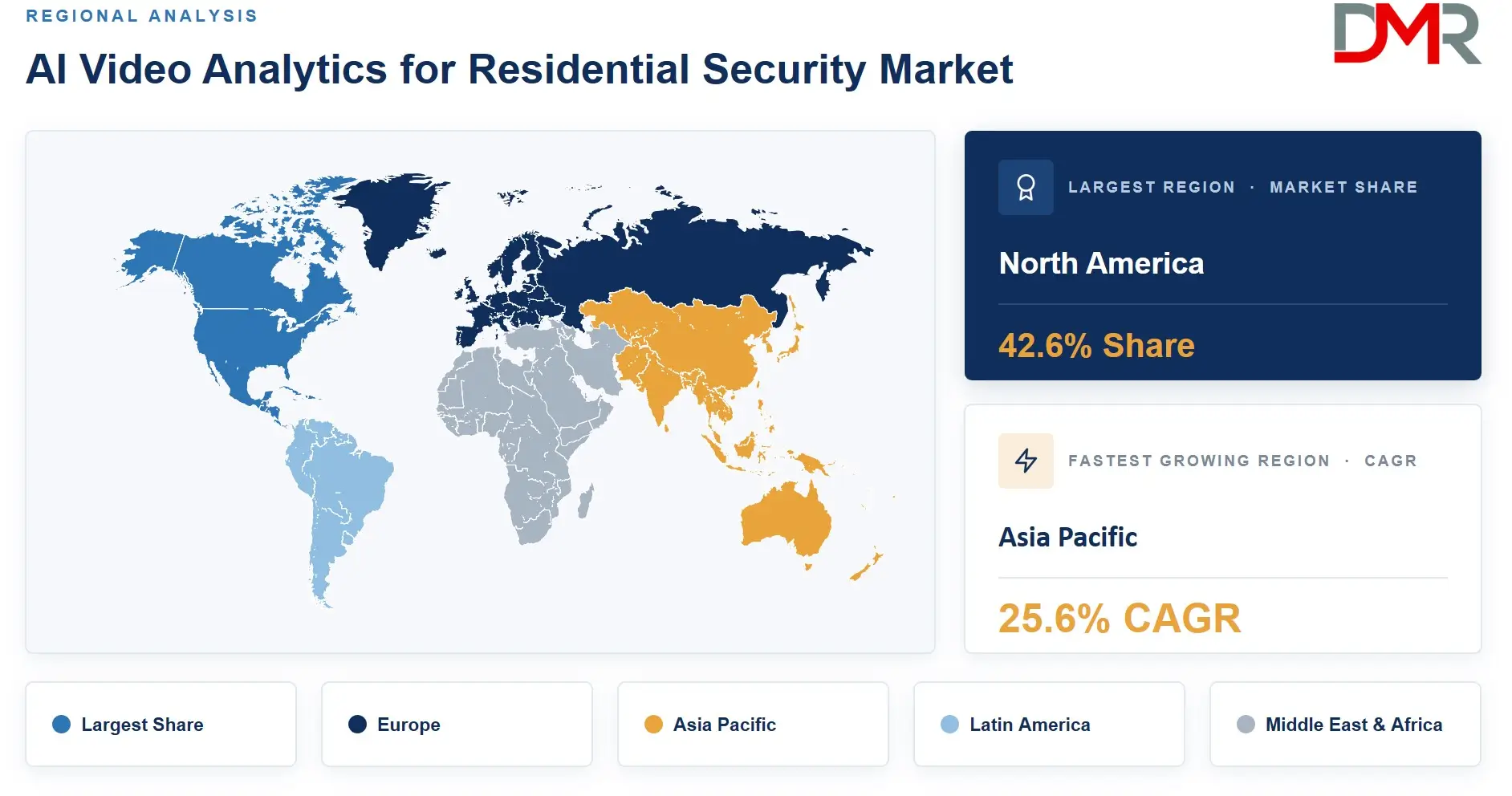
North America led the AI Video Analytics for Residential Security Market with a 42.60% share in 2026, valued at USD 6.69 Billion.
North America
According to U.S. Census Bureau data, 91.0% of U.S. households held a broadband internet subscription between 2020 and 2024, providing the infrastructure base that AI cloud-connected cameras require to function at full detection accuracy. North American buyers demonstrate above-average willingness to pay for subscription analytics tiers, making the region the most profitable market per installed unit. Municipal false alarm ordinances in major U.S. cities create a regulatory tailwind that pushes professional monitoring providers toward AI-verified alert platforms.
Asia Pacific
Asia Pacific is the fastest-growing region, powered by rapid residential construction rates in China, India, and Southeast Asian urban centers. The ITU confirmed that internet use reached 77% of the Asia-Pacific population in 2025, surpassing the global average of 74%, creating an addressable base for cloud-dependent AI security services that did not exist at meaningful scale five years earlier. Low average hardware price sensitivity relative to Western markets makes the region attractive for entry-level AI camera platforms with embedded analytics at no subscription cost.
ℹ
To learn more about this report –
Download Your Free Sample Report Here
Europe
Eurostat data shows 70.9% of EU residents used an internet-connected device in 2024, but only 11.8% used internet-connected home-security devices in the same year, revealing a penetration gap that represents the region's largest near-term growth lever. EU residential burglaries totaled 721,876 in 2024, representing 60.3% of all recorded burglaries across EU member states, as reported by Eurostat. The crime burden creates demand for AI-verified detection, but GDPR and emerging biometric data restrictions constrain facial recognition feature deployment in ways that narrow the addressable product set.
Latin America
Latin America shows strong urban security concern scores in consumer surveys, creating organic demand for residential monitoring. Brazil and Mexico lead regional adoption, driven by elevated residential crime rates and a growing middle class investing in property protection. Price sensitivity limits subscription adoption, making device-embedded analytics the dominant commercial model across the region.
Middle East & Africa
GCC countries drive Middle East adoption through high-income households and government smart-city investments that extend AI surveillance infrastructure into residential zones. South Africa represents the highest residential security spend per household on the African continent, supported by long-standing private security culture. AI camera platforms that integrate with existing alarm system infrastructure capture share without requiring buyers to replace installed hardware.
Key Regions and Countries
North America
Europe
- Germany
- France
- The UK
- Spain
- Italy
- Rest of Europe
Asia Pacific
- China
- Japan
- South Korea
- India
- Australia
- Rest of APAC
Latin America
- Brazil
- Mexico
- Rest of Latin America
Middle East & Africa
- GCC
- South Africa
- Rest of MEA
Macroeconomic Impact
The World Bank estimated global GDP growth at 2.7% in 2025 and projected 2.6% in 2026, a modest deceleration that limits discretionary consumer spending upgrades but does not materially suppress demand for residential security systems. U.S. retail sales climbed 8.0% from $6.52 trillion in 2021 to $7.04 trillion in 2022, per U.S. Census Bureau figures, establishing the consumer spending environment that enabled AI camera market expansion in North America's highest-value segment. WTO projections show global merchandise trade growth slowing from 4.6% in 2025 to 1.9% in 2026, signaling potential hardware cost pressures as component supply chains face lower volume throughput. UNCTAD data confirms global goods trade totaled approximately $13.7 trillion in the first half of 2026, rising 12.5% year over year, suggesting continued electronics export flow despite slower growth rate forecasts. Currency volatility in emerging markets compounds import cost risk for vendors dependent on Asian manufacturing for residential camera hardware.
Market Dynamics
Driver: Installed Camera Base Enables AI Overlay Without Hardware Replacement
Millions of residential properties across North America and Europe already carry smart doorbells and outdoor cameras from the 2018–2023 hardware expansion cycle. U.S. broadband household penetration rose from 85% in 2018 to 90% in 2021, per U.S. Census Bureau data, building the connectivity infrastructure that makes software-delivered AI detection commercially viable at scale. Vendors offering AI analytics as a firmware update or app layer on existing hardware unlock a conversion funnel that does not require buyer capital expenditure. Municipal law enforcement agencies across the U.S. and Europe have issued false alarm reduction mandates that compel security providers to replace motion-trigger systems with AI-verified alert platforms. Eurostat confirmed EU police recorded 721,876 burglaries of private residential premises in 2024, representing 60.3% of all recorded burglaries. High crime visibility sustains homeowner willingness to pay for detection upgrades that reduce false positive rates and improve law enforcement response reliability. Municipal law enforcement agencies across the U.S. and Europe have issued false alarm reduction mandates that compel security providers to replace motion-trigger systems with AI-verified alert platforms. Homeowner insurance carriers in the U.S. offer premium discounts for certified AI security system adoption, directly reducing price sensitivity among middle-income buyers who would otherwise resist subscription analytics costs. A narrower upfront cost gap between AI-enabled and passive systems makes the upgrade decision straightforward for households already paying annual premiums.
Restraint: Biometric Privacy Regulation Limits Facial Recognition Deployment
GDPR, CCPA, and emerging U.S. state biometric privacy laws restrict how vendors can collect, store, and process facial recognition data at residential endpoints. Facial Recognition Technology features — the highest-value differentiators in premium camera platforms — face legal exposure in the EU, California, Illinois, and a growing list of U.S. jurisdictions. Vendors operating across multiple markets must maintain separate model configurations by jurisdiction, raising compliance costs that compress margins on mid-tier product lines. EU residential burglaries declined 38.1% between 2014 and 2024, from 1.17 million recorded cases to 721,876 in 2024, as reported by Eurostat. The sustained crime reduction diminishes the urgency argument vendors use to justify premium subscription pricing for AI-verified alerts in the EU. Buyers in low-crime suburban European markets show lower willingness to pay for advanced detection features compared with North American counterparts operating in higher-crime-rate urban environments.
Opportunity: Off-Grid and Underserved Residential Segments Create Untapped Channels
Senior independent living represents an underserved residential segment where passive behavioral anomaly detection — fall recognition, inactivity alerts — addresses a high-stakes care need without requiring active monitoring consent friction. Hikvision launched its AOV SolarVu 4G camera series in November 2025 for continuous 24-hour off-grid recording, demonstrating that vendors now target properties where power and network infrastructure constrain traditional AI camera deployment. Properties in rural areas, HOA-governed communities, and gated residential developments represent a B2B2C channel sitting between individual consumer and commercial security tiers. AI-powered package theft detection directly addresses the highest-frequency residential security complaint among U.S. homeowners. Porch piracy alert systems convert a high-emotion event into a high-visibility marketing use case, making AI camera value tangible to buyers who have never purchased a subscription monitoring service. Integration with smart home automation hubs — triggering lighting, locks, and alarms based on AI scene classification — creates stickiness that passive recording cameras cannot replicate.
Porter's Five Forces
The competitive structure of the AI video analytics for residential security market reflects moderate-to-high intensity across all five forces. Threat of new entrants is low at the platform tier, where Amazon, Google, and Arlo hold deep distribution, brand trust, and proprietary AI model training data that require years to replicate. Hardware manufacturing barriers are lower, enabling Chinese OEMs to enter on price, but software and ecosystem lock-in constrain their ability to capture subscription revenue. Supplier bargaining power sits at moderate levels, as image sensor and AI chip supply chains involve concentrated manufacturers, but camera vendors increasingly dual-source components to reduce single-supplier risk. Buyer power is rising as product parity across mid-tier brands increases, pushing vendors toward differentiated AI features to justify price gaps. Arlo Secure's rolling 60-day cloud-video history for active subscribers, as confirmed by Arlo, illustrates how feature differentiation replaces hardware differentiation as the primary buyer retention tool. Substitutes, including professional security monitoring services and community policing apps, exist but lack the always-on, AI-verified immediacy that residential camera platforms deliver. Rivalry among incumbent vendors is high, with Ring, Google Nest, Arlo, and Hikvision competing simultaneously on hardware specification, AI detection accuracy, subscription price, and ecosystem integration breadth.
AI and Gen AI Impact
Artificial Intelligence in Security now reshapes every layer of the residential camera value chain, from inference hardware selection to subscription pricing strategy. TP-Link cameras, per company specifications, support microSD cards up to 512 GB, providing approximately 384 hours of recording at 8 MP and 15 fps, enabling on-device AI inference without continuous cloud upload. Vendors who embed capable edge AI chips in new hardware eliminate the subscription dependency that drives churn among privacy-conscious buyers. Early movers in on-device AI inference command a structural advantage as consumers increasingly select cameras based on data sovereignty assurances, not resolution specifications alone. Large vision-language models now enable natural language security event querying, allowing homeowners to retrieve specific events without scrubbing through recorded footage manually. Laggards relying on motion-trigger clip delivery face accelerating churn as AI-native platforms demonstrate detection specificity that passive systems cannot approach. Vendors who delay generative AI integration into their query and alert interfaces cede premium subscription tier positioning to competitors who move first.
Market Trends
On-Device AI and DIY Culture Reshape Monetization Models
On-device AI inference removes cloud upload dependency and directly answers the data sovereignty concerns that drive churn on legacy subscription platforms. TP-Link launched the Tapo C615F Kit in October 2025 at a $99.99 MSRP with an $89.99 introductory price, featuring 2K resolution, 360-degree rotation, and an 800-lumen floodlight, illustrating how DIY-oriented hardware bundles now ship with embedded AI at consumer-accessible price points. DIY installation culture displaces professional monitoring subscriptions, pushing revenue model emphasis toward software intelligence tiers over hardware margins. Insurance carrier partnerships with AI security vendors create real-time risk score adjustment capabilities tied to verified surveillance event histories, opening a monetization channel outside traditional subscription models.
Market Competition Overview
The AI video analytics for residential security market is moderately consolidated at the platform tier and fragmented in hardware manufacturing. Amazon and Google control the largest share of the North American consumer mindshare through Ring and Nest ecosystems respectively, sustained by retail distribution scale and smart home platform integration advantages that mid-tier vendors cannot replicate on equivalent budgets. Arlo's AI-powered subscription service surpassed 4 million paid accounts in July 2024, per Arlo investor data, establishing subscription volume as the metric that separates platform leaders from hardware-focused competitors. Alarm.com operates through thousands of service-provider partners supporting millions of properties and tens of millions of devices, per company disclosures, demonstrating that the B2B2C channel through professional security dealers commands a distinct competitive tier that direct-to-consumer brands do not fully contest. Arlo's rolling 60-day cloud history and Alarm.com's partner network illustrate two different competitive moats — consumer retention through data depth versus installer loyalty through platform stickiness. Chinese hardware manufacturers including Hikvision and Dahua compete aggressively on resolution and price but face procurement restrictions in North American government-adjacent residential markets that limit their ceiling in the highest-value geography.
Pricing Analysis
Residential AI camera pricing spans a wide entry-to-premium range, with meaningful differentiation tied to resolution tier and AI processing location. Ring Indoor Cam lists at $59.99 for a 1080p cloud-dependent device, as confirmed by Ring, while Ring Wired Doorbell Plus with Retinal 2K video carries a $179.99 price point, per Amazon data. Google Nest Cam Indoor wired launched at $99.99 with 2K HDR, per Google product data, establishing the mid-tier price band where AI-embedded cameras compete directly against subscription-optional models. System-level pricing scales the entry cost further. TP-Link's Tapo C420S2 two-camera 2K QHD system with AI detection carries a $199.99 MSRP, as reported by TP-Link, representing the entry point for whole-home AI coverage rather than single-point monitoring. Market leaders price subscription analytics tiers at a premium over device-embedded analytics, using feature gating — extended cloud history, AI notification granularity, professional monitoring integration — to justify recurring cost. Challengers compete on device price, accepting lower hardware margins in exchange for subscriber acquisition volume.
Company Profiles
Amazon (Ring) holds the largest single-brand installed base in the North American residential AI camera market, built through years of below-cost hardware pricing designed to lock homeowners into the Ring ecosystem and associated Alexa integration. Amazon reported net sales of $716.9 billion in 2025, a 12% increase over the prior year, per Amazon earnings data, providing the financial scale to sustain hardware subsidization strategies that standalone security vendors cannot replicate. Ring's September 2025 launch of seven Retinal 2K and 4K cameras and doorbells, priced from $59.99 to $499.99, confirms a deliberate resolution upgrade cycle designed to migrate the installed base toward higher-tier AI features without platform switching. Amazon's Q2 2025 net sales reached $167.7 billion, up 13% year over year, per company data, underscoring the parent platform's capacity to cross-subsidize Ring's competitive pricing. Arlo Technologies has built its competitive position on subscription-first monetization rather than hardware volume, a differentiated model that Verisure's 32% contribution to Arlo's 2025 revenue and a year-end backlog of $46.3 million, per SEC filings, confirm generates durable recurring revenue. In August 2025, Arlo introduced its sixth-generation Pro camera featuring 2K HDR video and a 160-degree field of view, reinforcing detection breadth as the core product narrative. The Vivint Outdoor Camera Pro Gen 3 carries a 4K sensor that streams and records at up to 1080p, per Vivint specifications, illustrating how premium hardware vendors now differentiate on sensor quality and continuous recording capability rather than AI software alone. SimpliSafe launched Active Guard Outdoor Protection in October 2024 with a $199.99 Outdoor Security Camera Series 2 and monitoring plans priced at $49.99 or $79.99 per month, positioning professionally monitored AI security as a premium tier above self-monitored device analytics.
Key Players
- Amazon (Ring)
- Google (Nest)
- Arlo Technologies, Inc.
- Alarm.com Holdings, Inc.
- Anker Innovations (eufy)
- Hangzhou Hikvision Digital Technology Co., Ltd.
- Dahua Technology Co., Ltd.
- SimpliSafe, Inc.
- Vivint Smart Home, Inc.
- ADT Inc.
- Wyze Labs, Inc.
- TP-Link (Tapo)
- Resideo Technologies, Inc.
- Honeywell International, Inc.
- Johnson Controls
- Brinks Home Security
- Axis Communications AB
- Avigilon Corporation
- Comcast Corporation (Xfinity)
- Milestone Systems A/S
Supply Chain and Value Chain Analysis
The residential AI camera value chain flows from image sensor and AI chip manufacturers through camera assembly, firmware and model development, cloud platform provisioning, retail or dealer distribution, and residential installation. Maximum value creation occurs at the software and subscription layer, where cloud analytics platforms generate recurring revenue at margins unavailable in hardware manufacturing. The primary bottleneck sits at the AI chip tier, where a small number of semiconductor manufacturers supply the edge inference processors that enable on-device AI without cloud dependency. Vendors dependent on a single chip supplier face delivery risk during periods of semiconductor supply tightening, a structural vulnerability that hardware-focused competitors with multi-supplier sourcing arrangements avoid.
Regulatory Landscape
EU AI Act Article 14 requires that specified high-risk remote biometric identification systems be verified by at least two competent natural persons, subject to stated exceptions, as confirmed by the EU AI Act service desk. The provision directly affects vendors offering real-time facial recognition as a residential security feature in EU markets. Facial Recognition Technology deployments that process biometric data continuously face compliance costs that effectively price the feature out of consumer-grade product tiers in the European Union. CCPA in California and emerging state-level biometric privacy laws in Illinois, Texas, and Washington impose consent and deletion requirements that make facial data retention a legal liability for vendors without jurisdiction-specific data handling architectures. Vendors operating globally must maintain parallel product configurations to meet divergent regulatory requirements by market. Regulatory fragmentation raises compliance costs most severely for mid-tier vendors lacking the legal and engineering infrastructure of platform-scale competitors.
Investment and White Space Analysis
Investment flows most heavily toward subscription analytics platform development, AI model training infrastructure, and smart home ecosystem integration capabilities. The senior independent living segment remains structurally underserved, with no dominant platform having built a purpose-designed passive behavioral monitoring product for aging-in-place households at scale. HOA and gated community perimeter monitoring sits between consumer and commercial security tiers, representing a B2B2C channel where neither incumbent group competes effectively. Asia Pacific carries the highest combination of residential construction growth and addressable broadband penetration expansion, making it the region with the largest white space for subscription platform entry at acceptable customer acquisition costs.
Recent Developments
- November 2025: Vivint announced the Outdoor Camera Pro Gen 3 with a 4K sensor, 5.3-times live zoom, and continuous recording, priced at $399.99 for its February 2026 launch.
- September 2025: Ring announced seven Retinal 2K and Retinal 4K cameras and doorbells priced from $59.99 to $499.99, covering the full consumer price spectrum in a single product cycle refresh.
- September 2025: Ring introduced the Indoor Cam Plus with Retinal 2K video at $59.99, lowering the entry price for high-resolution indoor AI monitoring.
- September 2025: Ring introduced the Wired Doorbell Pro with Retinal 4K video, 10-times zoom, and a $249.99 price, establishing a new premium tier for AI-enabled doorbell cameras.
- September 2025: Ring announced Search Party for Dogs following more than 1 million lost-or-found pet posts shared through the Neighbors platform in the preceding year, extending AI detection toward pet-specific residential monitoring use cases.
- March 2026: Axis announced the AXIS M2048-LE AI-powered bullet camera with 8 MP imaging and 4K video at 15 fps.
- January 2026: Axis announced the AXIS Q6086-E AI-powered PTZ camera with 4 MP video at 60 fps and 34-times optical zoom.
- January 2026: Axis announced the AXIS M1075-L Mk II AI-powered box camera with 2 MP imaging and a 103-degree field of view.
- March 2026: Axis announced two P34-series outdoor dome cameras offering resolutions of 5 MP and 8 MP.
- March 2026: Axis announced six AI-powered fisheye cameras offering 6 MP or 12 MP resolution, with planned availability by the second quarter of 2026.
- March 2025: Axis announced four AI-powered dome cameras offering resolutions of 4 MP or 8 MP.
- November 2024: Axis announced two multidirectional cameras with four channels and resolutions of 5 MP or 8 MP per channel.
Report Scope
| Report Characteristics |
| Market Value (2026) |
USD 15.70 Billion |
| Forecast Revenue (2035) |
USD 115.26 Billion |
| CAGR (2026 to 2035) |
24.8% |
| Base Year for Estimation |
2025 |
| Historic Period |
2020 to 2024 |
| Forecast Period |
2026 to 2035 |
| Report Coverage |
Revenue Forecast, Market Dynamics, Competitive Landscape, Recent Developments |
| Segments Covered |
By Residential Analytics Function (Person & Intruder Detection, Package & Delivery Recognition, Familiar-Face Identification, Behavioral & Anomaly Detection, Vehicle & Perimeter Analytics, Pet & Object Classification), By Security Device Environment (Indoor Smart Cameras, Outdoor Security Cameras, AI Video Doorbells, Multi-Camera Home Surveillance Systems, Smart Intercom & Entry Cameras), By AI Processing Architecture (On-Device Edge AI, Cloud-Based Video Intelligence, Hybrid Edge-Cloud Analytics), By Residential Security Use Case (Intrusion & Perimeter Protection, Visitor & Access Monitoring, Package Theft Prevention, Child & Elderly Monitoring, Property & Vehicle Surveillance, Emergency Event Detection), By Service & Revenue Model (Device-Embedded Analytics, Subscription Video Analytics, Cloud Video Storage & Intelligence, Professionally Monitored AI Security), By Sales Channel (Online Retail, Consumer Electronics Retail, Security Dealers & Installers, Telecom & Smart-Home Service Providers) |
| Regional Analysis |
North America (US and Canada), Europe (Germany, France, The UK, Spain, Italy, and Rest of Europe), Asia Pacific (China, Japan, South Korea, India, Australia, and Rest of APAC), Latin America (Brazil, Mexico, and Rest of Latin America), Middle East & Africa (GCC, South Africa, and Rest of MEA) |
| Competitive Landscape |
Amazon (Ring), Google (Nest), Arlo Technologies, Inc., Alarm.com Holdings, Inc., Anker Innovations (eufy), Hangzhou Hikvision Digital Technology Co., Ltd., Dahua Technology Co., Ltd., SimpliSafe, Inc., Vivint Smart Home, Inc., ADT Inc., Wyze Labs, Inc., TP-Link (Tapo), Resideo Technologies, Inc., Honeywell International, Inc., Johnson Controls, Brinks Home Security, Axis Communications AB, Avigilon Corporation, Comcast Corporation (Xfinity), Milestone Systems A/S |
| Customization Scope |
Customization for segments and region or country level will be provided. Additional customization can be done based on requirements. |
| Purchase Options |
Three license options: Single User License, Multi-User License (Up to 5 Users), Corporate Use License (Unlimited Users and Printable PDF) |
Frequently Asked Questions
What is the biggest investment opportunity in the AI Video Analytics for Residential Security Market?
▾ The senior independent living segment represents the most underpenetrated high-value opportunity. Passive behavioral anomaly detection — covering fall recognition and inactivity alerts — addresses a care need with high willingness to pay and no dominant platform incumbent. HOA and gated community perimeter monitoring offers a parallel B2B2C channel where AI camera vendors can achieve multi-unit deployments without the customer acquisition costs of one-by-one household sales.
Who are the top companies in the AI Video Analytics for Residential Security Market?
▾ The top five companies by platform scale and market presence are Amazon (Ring), Google (Nest), Arlo Technologies, Alarm.com Holdings, and Anker Innovations (eufy). Amazon and Google lead through retail distribution and smart home ecosystem integration. Arlo holds the strongest subscription monetization record among pure-play residential AI security vendors.
Which segment is growing fastest in the AI Video Analytics for Residential Security Market and why?
▾ Behavioral & Anomaly Detection is the fastest-growing analytics function segment. Fall detection, inactivity monitoring, and passive anomaly classification serve aging household demographics that conventional motion-trigger cameras cannot address. Among device types, AI Video Doorbells grow fastest because they convert an existing installation point into a high-value AI sensor without additional hardware mounting.
Which region is growing fastest in the AI Video Analytics for Residential Security Market and why?
▾ Asia Pacific is the fastest-growing region, driven by rapid residential construction in China, India, and Southeast Asian urban markets. Internet penetration in the Asia-Pacific region reached 77% of the population in 2025, surpassing the 74% global average, creating a newly addressable base for cloud-dependent AI security platforms. Low hardware price sensitivity compared with North America makes the region attractive for entry-level AI camera vendors.
What is the biggest challenge holding in the AI Video Analytics for Residential Security Market back?
▾ Biometric privacy regulation poses the most immediate structural constraint. GDPR, CCPA, and emerging U.S. state biometric laws restrict facial recognition deployment in the markets where AI security subscription pricing is highest. Vendors must maintain separate product configurations by jurisdiction, raising compliance costs that reduce the addressable feature set available to consumer buyers in regulated regions.