Market Overview
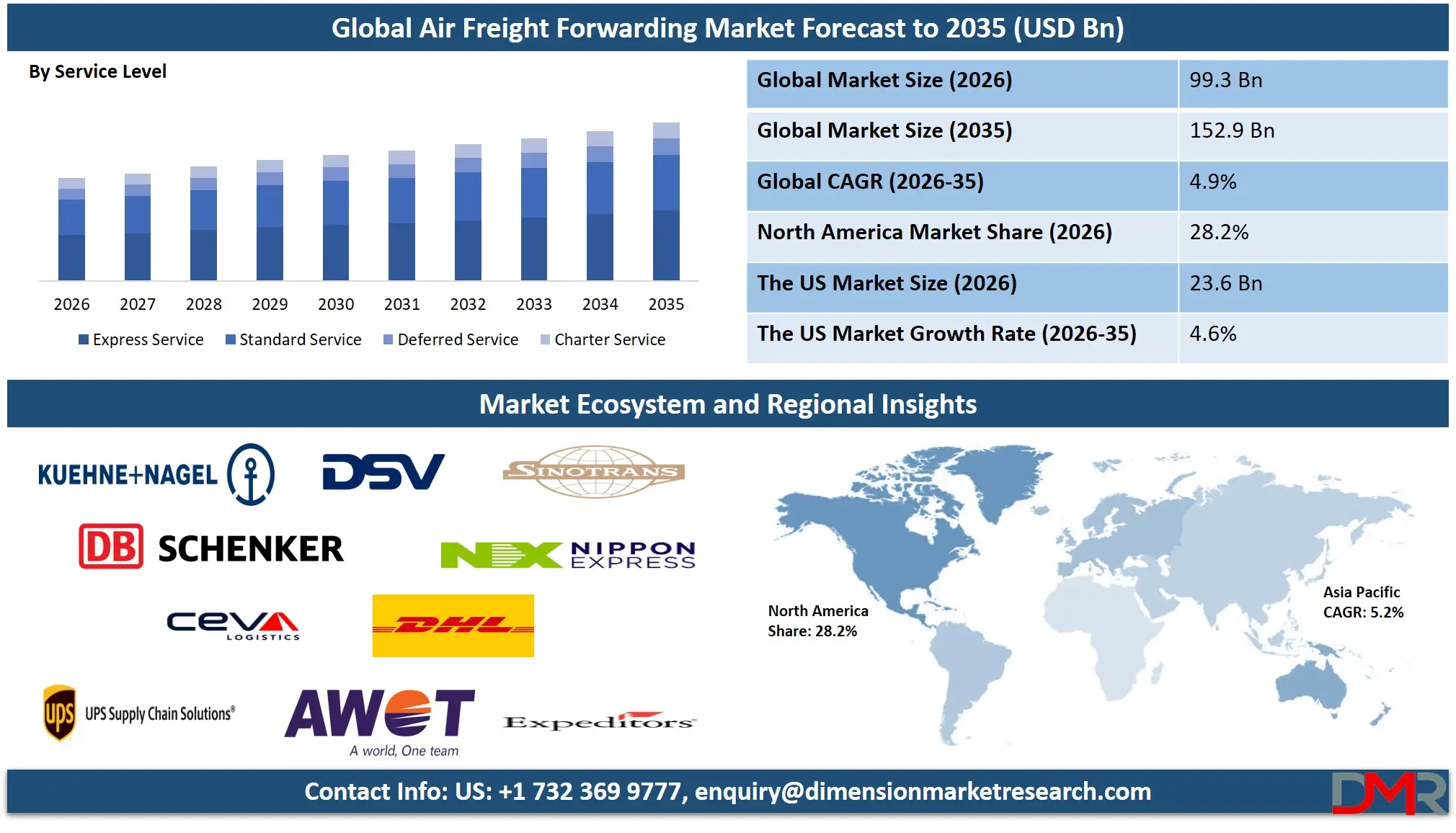
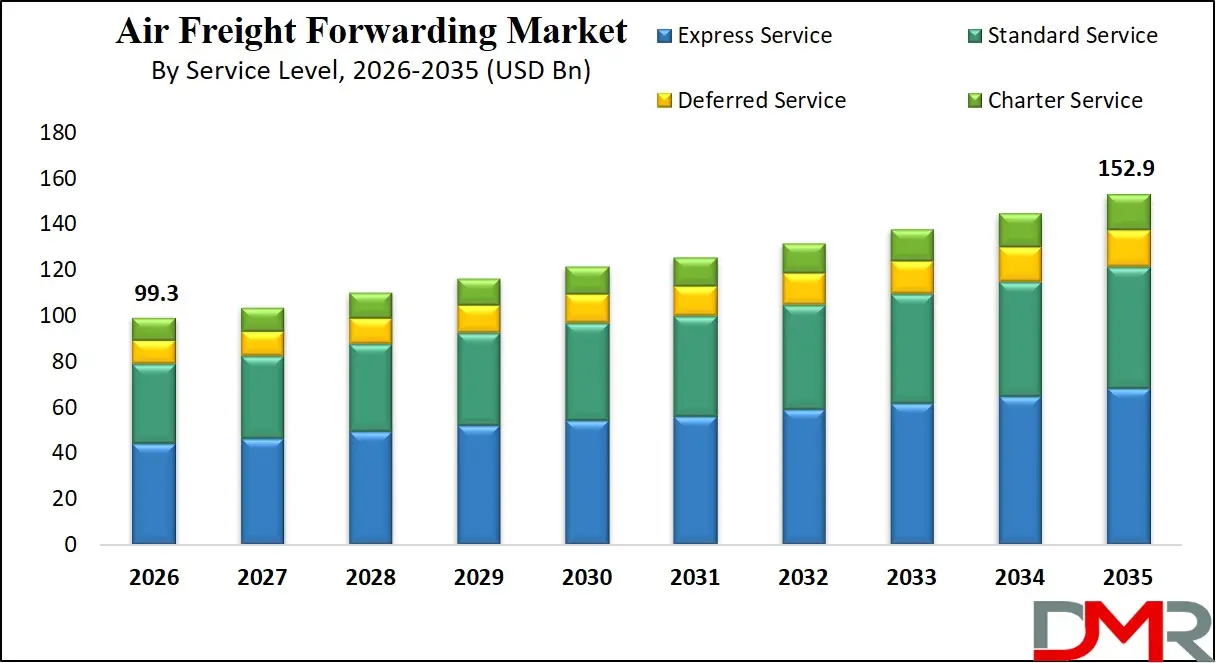
The Global Air Freight Forwarding Market is projected to reach USD 99.3 billion in 2026 and grow at a compound annual growth rate of 4.9 % from there until 2035 to reach a value of USD 152.9 billion, driven by rising globalization of trade, e-commerce expansion, time-sensitive logistics demand and integrated supply chain management platforms.
ℹ
To learn more about this report –
Download Your Free Sample Report Here
Air Freight Forwarding refers to specialized logistics services that manage the end-to-end transportation of goods by air across domestic and international routes. These services encompass cargo booking, route optimization, customs clearance, warehousing and real-time shipment tracking to create a seamless flow of goods from origin to destination. By coordinating with airlines, ground handlers, customs authorities and last-mile delivery providers, air freight forwarders enable businesses to move high-value, perishable or time-critical cargo efficiently while reducing transit times, minimizing supply chain disruptions and ensuring regulatory compliance across borders.
The global Air Freight Forwarding Market represents the worldwide demand and supply of these logistics services across manufacturers, retailers, e-commerce platforms, pharmaceutical companies and other industries that increasingly rely on air transport to manage fast-moving inventory and meet customer expectations. Growth in this market is driven by the increasing volume of cross-border e-commerce, the need for just-in-time manufacturing support, the expansion of cold chain logistics and the growing use of integrated freight platforms for shipment visibility and supply chain optimization. Businesses across developed and emerging economies are investing in advanced air freight solutions to improve delivery speed, enhance supply chain resilience and meet service level agreements.
ℹ
To learn more about this report –
Download Your Free Sample Report Here
In addition, the global Air Freight Forwarding Market is shaped by the rapid shift toward digital booking platforms, interoperability with transportation management systems and the use of analytics to track shipment performance and operational efficiency. Vendors in this market are focusing on scalable solutions that support general cargo, special cargo and complex logistics requirements while enabling secure data sharing across supply chain partners. As digital transformation accelerates in logistics, air freight forwarding is becoming a core component of modern supply chain infrastructure, supporting time-definite delivery, perishable goods transport and global trade programs worldwide.
The US Air Freight Forwarding Market
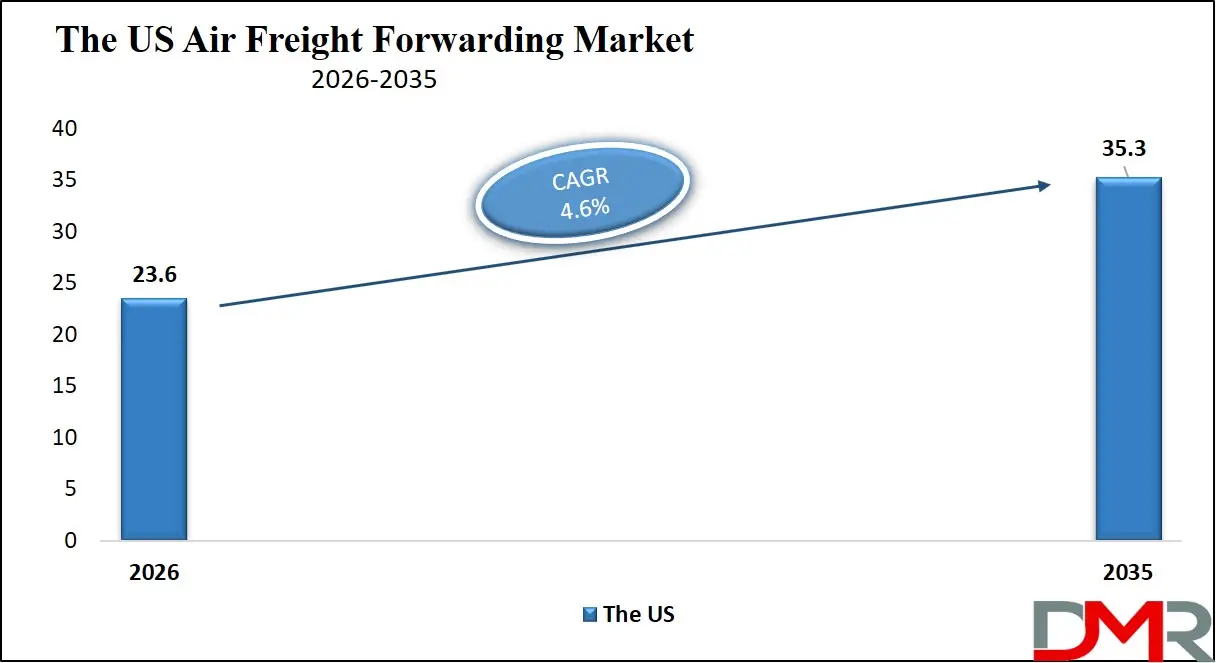
The U.S. Air Freight Forwarding Market size is expected to reach at USD 23.6 billion in 2026. It is further expected to witness subsequent growth in the upcoming period, holding USD 35.3 billion in 2035 at a CAGR of 4.6%.
The US Air Freight Forwarding Market is driven by the country's advanced logistics infrastructure and the high volume of air cargo movements across domestic and international trade lanes. Manufacturers, retailers and e-commerce companies are increasingly adopting integrated freight forwarding services to manage complex supply chains, shipment tracking, customs documentation and inventory positioning. Strong regulatory requirements for cargo security, trade compliance and hazardous materials handling are accelerating the use of digital freight platforms and visibility tools. The growing focus on expedited shipping, temperature-controlled logistics and value-added services is further increasing demand for specialized air freight solutions.
ℹ
To learn more about this report –
Download Your Free Sample Report Here
In addition, the US market benefits from high investments in logistics technology, widespread adoption of cloud-based transportation management systems and strong participation from leading freight forwarding providers. Integration of artificial intelligence, analytics and shipment optimization tools into air freight platforms is improving operational efficiency and delivery accuracy. Interoperability with warehouse management systems, customs databases and last-mile delivery networks enables seamless data flow across supply chain partners. As businesses focus on improving customer satisfaction and reducing inventory carrying costs, the demand for advanced air freight forwarding solutions in the United States continues to expand steadily.
The Europe Air Freight Forwarding Market
The Europe Air Freight Forwarding Market is projected to reach a value of USD 26.4 billion in 2026, supported by steady growth at a compound annual growth rate of 4.9%, reflecting the region's strong position in global trade and advanced logistics infrastructure across major economies. Countries such as Germany, the United Kingdom, France and the Netherlands are at the forefront of implementing digital freight platforms, multimodal connectivity and specialized cargo handling capabilities to improve supply chain efficiency. The growing volume of intra-European and intercontinental trade, along with government initiatives to modernize transport infrastructure, is driving steady investments in advanced air freight solutions and customs brokerage services across the region.
The European market is expected to expand steadily as logistics providers continue to prioritize digitization, sustainability and supply chain visibility. The increasing use of cloud-based freight platforms, integration of warehousing and distribution networks, and adoption of analytics to track shipment performance are further strengthening market growth. In addition, regulatory emphasis on border security, customs compliance and environmental standards is encouraging manufacturers and retailers to upgrade their air freight capabilities, supporting long-term expansion of the market.
The Japan Air Freight Forwarding Market
Japan’s Air Freight Forwarding Market is projected to reach a value of USD 6.5 billion in 2026, growing at a compound annual growth rate of 5.0%. This expansion is being driven by the country's strong manufacturing base and advanced logistics infrastructure supporting international trade. Japan has one of the most sophisticated supply chain networks among developed nations, which is driving automotive, electronics and pharmaceutical companies to adopt integrated freight forwarding services for shipment management, customs clearance and inventory optimization. The country's emphasis on precision manufacturing and just-in-time delivery further supports the use of air freight solutions to improve supply chain reliability and speed.
Japan's market is projected to grow more rapidly than many established regions as companies ramp up investments in digital freight platforms and data-driven logistics solutions. The rising use of transportation management systems, combined with the integration of warehousing and distribution functions and the application of analytics to track shipment performance, is boosting the efficiency of air cargo operations. Additionally, government efforts to modernize trade infrastructure and strengthen supply chain resilience are supporting continued growth in Japan's air freight forwarding sector.
Global Air Freight Forwarding Market: Key Takeaways
- Digital freight platforms are becoming core logistics infrastructure: Air freight forwarding solutions are no longer support tools but foundational platforms that integrate booking, tracking, customs clearance and analytics into a single supply chain ecosystem, making them essential for delivering efficient, time-definite logistics services.
- Cloud and AI are redefining how air cargo is managed: The rapid shift toward cloud-based platforms and AI-enabled analytics is transforming freight forwarding operations by enabling real-time shipment visibility, predictive route optimization and automated documentation processing across global supply chains.
- E-commerce is the primary demand engine: The dominance of cross-border online retail and business-to-consumer shipping is driving sustained demand for air freight services that manage expedited deliveries, returns processing and last-mile integration.
- Manufacturers remain the largest adopters but retail is accelerating: While industrial and automotive sectors lead freight forwarding adoption, the expansion of e-commerce and omnichannel retail is creating new demand for scalable, technology-enabled air cargo solutions.
- Asia Pacific represents the fastest future growth opportunity: Rising manufacturing output, expanding consumer markets and growing trade volumes in countries such as China, India and Vietnam position Asia Pacific as the most dynamic region for long-term market expansion.
Global Air Freight Forwarding Market: Use Cases
- Cross-Border E-Commerce Fulfillment: Air Freight Forwarding services are widely used to manage international e-commerce shipments, covering order consolidation, customs clearance and last-mile delivery. Retailers and online marketplaces rely on freight forwarders to streamline cross-border logistics, reduce transit times and improve customer experience. This use case supports faster delivery, better tracking and improved satisfaction for global online shoppers.
- Pharmaceutical Cold Chain Logistics: Healthcare companies use air freight forwarding to manage temperature-sensitive pharmaceutical shipments, including vaccines, biologics and clinical trial materials. These services connect cold chain packaging, temperature monitoring devices and customs clearance to ensure product integrity throughout transit. This improves patient safety, reduces spoilage and enhances regulatory compliance in pharmaceutical logistics.
- Automotive Just-in-Time Parts Delivery: Automotive manufacturers use air freight forwarding to manage time-critical parts shipments, production line coordination and inventory optimization. The services help suppliers follow just-in-time manufacturing requirements, avoid production delays and monitor shipment status in real time. This use case supports efficient automotive production and improves supply chain reliability in high-volume manufacturing.
- Supply Chain Analytics and Performance Optimization: Air freight forwarding platforms support advanced data analytics by collecting and organizing large volumes of shipment-related information from multiple sources. Logistics providers and manufacturers use these systems for route optimization, carrier performance analysis and supply chain studies. This enables better understanding of logistics efficiency, supports cost reduction and drives continuous improvement in freight operations.
Global Air Freight Forwarding Market: Stats & Facts
- IATA / World Bank / WTO / Global Trade Data
- In 2023, global air cargo volumes reached 61.5 million metric tons, representing approximately 35% of global trade by value.
- Air freight accounts for less than 1% of global trade by volume but over 35% by value.
- The average load factor for global air cargo was 52% in 2023.
- Cross-border e-commerce shipments grew by 22% annually between 2020 and 2024.
- Only 45% of air freight forwarders have fully digitized their booking and tracking processes.
- Pharmaceuticals represent 15% of specialized air cargo movements globally.
- Perishable goods account for approximately 18% of air freight volumes worldwide.
- Automotive parts represented 12% of global air freight forwarding revenue in 2023.
- High-tech electronics accounted for 22% of air cargo by value in 2023.
- Aerospace and defense shipments grew by 8.5% annually in the air freight sector.
- Global air freight yields averaged USD 2.45 per kilogram in 2023.
- Air freight forwarding market concentration remains high, with top 10 players controlling 42% of global revenue.
- Global air cargo capacity is projected to reach 78 million metric tons by 2035.
- Average transit times for international air freight improved by 18% between 2020 and 2025.
- 67% of air freight forwarders now offer real-time shipment tracking to customers.
- Emerging markets accounted for 48% of air freight volume growth in 2023.
- 73% of air freight shipments in 2023 were general cargo, with special cargo representing 27%.
- OECD International Transport Forum Data
- Air freight accounted for 0.8% of total freight tonnage but 28% of freight value in OECD countries in 2023.
- Time-sensitive shipments represented 34% of all air freight movements across OECD nations.
- Express service adoption grew by 15% annually among OECD businesses between 2020 and 2024.
- Customs clearance efficiency improved by 22% with digitization in OECD countries.
- Average air freight rates across OECD trade lanes decreased by 4.2% annually due to capacity expansion.
- US Government (Bureau of Transportation Statistics)
- The United States handled 42.1 million metric tons of air freight in 2023.
- US air freight exports were valued at USD 892 billion in 2023.
- Imports by air freight to the United States reached USD 1.1 trillion in 2023.
- Express shipments accounted for 31% of US domestic air freight revenue.
- The top three US air cargo gateways handled 47% of total international air freight volume.
Global Air Freight Forwarding Market: Market Dynamic
Driving Factors in the Global Air Freight Forwarding Market
Global Trade Expansion and Supply Chain Complexity
The increase in cross-border trade volumes has escalated demand for freight forwarding solutions that streamline international logistics and support comprehensive shipment management. Air Freight Forwarding enables businesses to consolidate cargo, manage documentation, clear customs and coordinate last-mile delivery, improving supply chain efficiency and reducing administrative burden. Manufacturers and retailers are adopting these services to manage complex trade lanes effectively and support time-definite delivery requirements across global markets.
Adoption of Digital Logistics and Visibility Platforms
Accelerated adoption of transportation management systems, cloud-based booking platforms and interoperable supply chain solutions is driving Air Freight Forwarding uptake. Integration with warehouse management systems, customs platforms and carrier networks enhances data sharing and operational continuity. The shift toward integrated freight solutions improves shipment visibility, reduces errors and supports coordinated logistics across manufacturers, distributors and retail partners.
Restraints in the Global Air Freight Forwarding Market
Capacity Constraints and Rate Volatility
The variability in air cargo capacity and freight rates can create challenges for businesses relying on consistent air freight services. Seasonal demand fluctuations, fuel price changes and capacity allocation decisions by airlines impact shipping costs and service reliability. These factors complicate budgeting and supply chain planning, particularly for small and medium-sized enterprises.
Regulatory Complexity and Trade Compliance
Air freight forwarding involves navigating complex customs regulations, trade agreements and security requirements across multiple jurisdictions. Concerns about documentation errors, shipment delays and compliance with evolving trade policies create challenges for logistics providers. Ensuring accurate customs declarations and secure data exchange adds complexity and cost to freight forwarding operations.
Opportunities in the Global Air Freight Forwarding Market
Integration of Artificial Intelligence and Predictive Analytics
Incorporating artificial intelligence (AI), machine learning and predictive analytics into air freight forwarding platforms presents a significant market growth opportunity. These technologies can enhance route optimization, identify patterns in shipment flows and support dynamic pricing models. Freight analytics tools help logistics providers make data-driven decisions and improve overall operational efficiency.
Growth in Emerging Trade Markets
Expanding manufacturing bases and increased investments in logistics infrastructure across Asia Pacific, Latin America, the Middle East and Africa create opportunities for air freight forwarding providers. As businesses in these regions participate in global trade, demand for affordable, scalable, digitally-enabled freight solutions is likely to grow, enabling broader access to international markets.
Trends in the Global Air Freight Forwarding Market
Shift Toward Digital Freight Platforms
Logistics providers are increasingly adopting cloud-based freight forwarding platforms due to their scalability, lower upfront costs, real-time visibility and simplified operations. Digital solutions support instant rate comparisons, automated documentation, shipment tracking and carrier management, making them attractive for both large logistics firms and smaller forwarders.
Focus on Sustainability and Carbon Tracking
There is a growing emphasis on sustainable logistics that integrates carbon footprint measurement, fuel-efficient routing and eco-friendly packaging options. Air freight forwarding platforms with built-in sustainability analytics support continuous monitoring of environmental impact, enabling logistics providers to optimize operations and meet corporate sustainability goals.
Global Air Freight Forwarding Market: Research Scope and Analysis
By Cargo Type Analysis
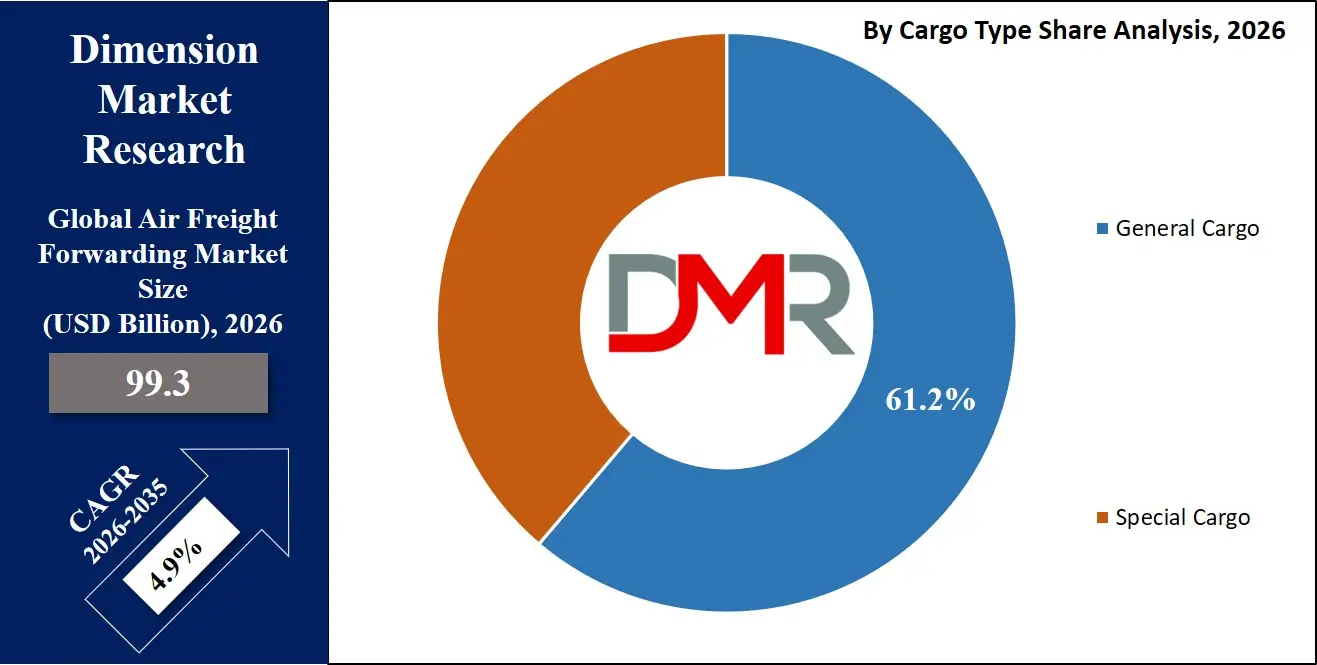
General cargo is expected to lead the cargo type segment of the Air Freight Forwarding market with a 61.2% share in 2026 because it forms the core of air freight operations across manufacturing, retail and industrial sectors. These shipments include finished goods, components, machinery and consumer products that require reliable, time-definite transportation. The growing need for efficient, cost-effective movement of general merchandise, along with increasing volumes of cross-border trade, is pushing manufacturers and retailers to invest more in comprehensive freight forwarding services. Integration with warehouse networks, customs brokerage platforms and last-mile delivery further strengthens the demand for integrated general cargo solutions.
ℹ
To learn more about this report –
Download Your Free Sample Report Here
Special cargo also plays a vital role in this market segment, supporting the transport of goods requiring specialized handling and equipment. These include perishables, pharmaceuticals, hazardous materials, live animals and high-value items requiring temperature control or security protocols. As supply chains become more sophisticated and customer requirements more demanding, businesses increasingly rely on freight forwarders to ensure regulatory compliance, product integrity and specialized handling. Special cargo services are especially important for healthcare, aerospace and perishable goods industries, where continuous monitoring, temperature management and security protocols are essential to maintain product quality and safety.
By Destination Analysis
International air freight forwarding is expected to dominate the destination segment with a 67.4% market share in 2026 due to the continued growth of global trade and cross-border commerce. These services allow manufacturers, retailers and e-commerce companies to access suppliers and customers across different countries, supporting complex international supply chains and market expansion strategies. International freight forwarding also enables businesses to leverage global sourcing opportunities, manage inventory across multiple markets and meet customer demand for imported goods, making it well suited for modern globalized trade and omnichannel retail models.
Domestic air freight forwarding continues to be used by businesses requiring rapid movement of goods within national borders, particularly for time-sensitive shipments and e-commerce fulfillment. These services allow companies to maintain direct control over their domestic supply chains, which is particularly important for industries handling perishable goods, urgent medical supplies or just-in-time manufacturing components. While domestic forwarding involves different route structures and regulatory requirements, it remains attractive for organizations focused on same-day or next-day delivery within their home markets, ensuring reliable performance and high levels of customer satisfaction.
By Customer Type Analysis
Business-to-Business (B2B) freight forwarding is expected to dominate the customer type segment with a 58.1% share in 2026 because it covers the largest volume of commercial shipments worldwide, particularly raw materials, components, finished goods and industrial equipment. Air freight forwarding plays a critical role in managing complex B2B supply chains, production scheduling, inventory positioning and vendor compliance, which are central to manufacturing and distribution operations. The increasing use of just-in-time manufacturing and global sourcing strategies is further driving demand for freight platforms that support supply chain visibility, improve delivery reliability and enhance operational efficiency across industries.
Business-to-Consumer (B2C) freight forwarding also represents a growing portion of the market, as e-commerce and direct-to-consumer shipping continue to expand rapidly. These services help retailers and online marketplaces manage parcel deliveries, returns processing and last-mile coordination. As the adoption of cross-border e-commerce and omnichannel retail grows, the need for integrated freight solutions to manage complex consumer logistics and improve delivery experience continues to expand within this customer segment.
By Service Level Analysis
Express service is expected to lead the service level segment with a 44.5% market share in 2026 because it addresses the growing demand for time-definite, expedited shipping across e-commerce, healthcare and high-tech industries. These services guarantee fast transit times, often with same-day or next-day delivery, making them essential for urgent shipments, perishable goods and time-sensitive manufacturing components. The presence of advanced tracking capabilities and dedicated air networks further drives the adoption of express services to improve customer satisfaction and supply chain responsiveness.
Standard service also plays an important role in this market as it provides cost-effective transportation for shipments with less time sensitivity. These services follow regular scheduled flights and consolidated routing, making them suitable for general cargo, retail replenishment and non-urgent B2B shipments. The growing volume of regular trade and inventory movements is increasing the demand for reliable standard service options that help businesses maintain efficient supply chains while managing transportation costs and delivery expectations.
By Core Service Offering Analysis
Freight transportation is expected to lead the core service offering segment with a 38.7% market share in 2026 because it represents the fundamental activity of moving goods by air from origin to destination. Freight forwarders coordinate with airlines, manage booking and routing, and ensure timely delivery across domestic and international networks. The presence of diverse trade lanes and the need for reliable air cargo capacity further drives the adoption of comprehensive transportation services to meet varying shipment requirements and customer expectations.
Warehousing and distribution also represent a significant portion of the market, as air freight forwarders increasingly provide integrated logistics solutions that include storage, inventory management and order fulfillment. These services help businesses position inventory closer to end markets, manage seasonal demand fluctuations and support omnichannel distribution strategies. Customs brokerage continues to be essential for international shipments, ensuring compliance with trade regulations and smooth border clearance. Freight consolidation enables cost optimization by combining multiple shipments, while value-added logistics services such as packaging, labeling and quality inspection provide additional support for complex supply chain requirements.
By End-Use Industry Analysis
E-commerce & retail is expected to lead the end-use industry segment with a 27.9% market share in 2026 because this sector relies heavily on air freight for fast, time-sensitive deliveries and efficient management of cross-border shipments. These shipments require reliable transit times, careful handling, and real-time visibility to support inventory replenishment, last-mile delivery, and customer satisfaction. The rapid expansion of global e-commerce platforms and omnichannel retail further drives the adoption of specialized air freight solutions to improve supply chain efficiency and responsiveness.
Healthcare also plays a vital role in this market as pharmaceutical companies, medical device manufacturers, and healthcare providers increasingly depend on air freight for temperature-sensitive shipments, emergency supplies, and clinical trial materials. High-tech and electronics continue to expand their use of air freight for time-sensitive, high-value components and finished products. Automotive, aerospace, food and beverage, industrial manufacturing, and agriculture sectors each contribute significantly to air freight volumes, with specialized requirements for parts, perishables, and time-critical shipments driving demand for tailored forwarding solutions.
The Global Air Freight Forwarding Market Report is segmented on the basis of the following:
By Cargo Type
- General Cargo
- Special Cargo
By Destination
By Customer Type
- Business-to-Business (B2B)
- Business-to-Consumer (B2C)
By Service Level
- Standard Service
- Express Service
- Deferred Service
- Charter Service
By Core Service Offering
- Freight Transportation
- Warehousing & Distribution
- Customs Brokerage
- Freight Consolidation
- Value-Added Logistics Services
By End-Use Industry
- Healthcare
- Food & Beverage
- High-Tech & Electronics
- Automotive
- Retail & E-commerce
- Aerospace & Defense
- Agriculture
- Industrial Manufacturing
Impact of Artificial Intelligence in the Global Air Freight Forwarding Market
Artificial intelligence is reshaping the global air freight forwarding market by enhancing the way shipment data is collected, analyzed and applied in logistics decision making. AI integrated within freight forwarding platforms can rapidly process large volumes of shipment records, route options and carrier performance data to identify patterns that might not be apparent through manual analysis. This accelerates route optimization, improves cost forecasting and supports dynamic pricing strategies, enabling logistics providers to tailor services based on predictive insights rather than solely on historical data. The use of machine learning algorithms for demand forecasting and capacity planning also helps forwarders allocate resources efficiently and optimize network performance.
Moreover, artificial intelligence is enabling automation of routine tasks such as documentation processing, customs classification and shipment tracking, which reduces administrative burden and frees up logistics professionals to spend more time on strategic customer engagement. Natural language processing helps structure unstructured shipment instructions and customs documentation, making supply chain data more actionable within freight platforms. AI powered analytics tools enhance real-time monitoring of shipment status and potential disruptions, providing feedback loops that improve long-term logistics strategies. As a result, air freight forwarding platforms embedded with intelligent analytics are becoming essential for modern supply chain management, driving better operational efficiency, cost optimization and service reliability across global logistics networks.
Global Air Freight Forwarding Market: Regional Analysis
Region with the Largest Revenue Share
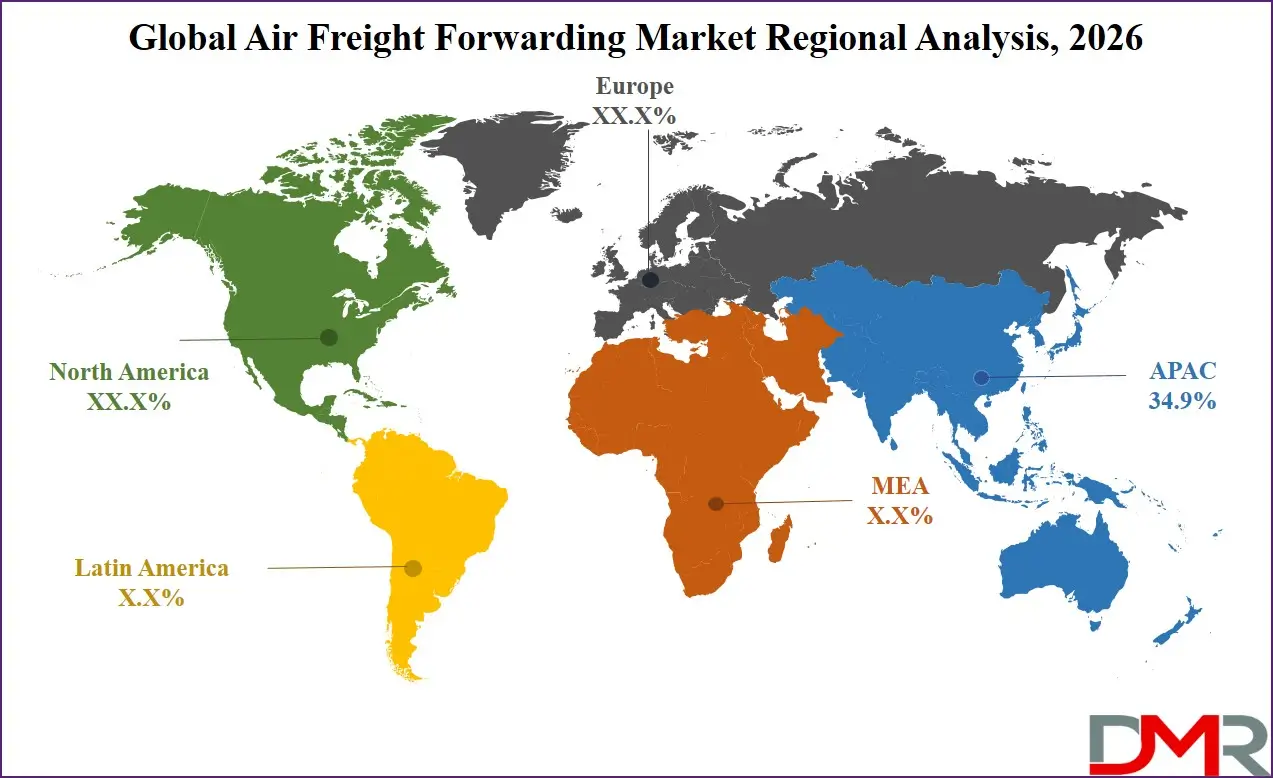
Asia-Pacific is expected to dominate the global air freight forwarding market in 2025, capturing approximately 34.6% of total market revenue. This leadership is driven by the region’s strong manufacturing and export hubs, booming e-commerce sector, and extensive intra-Asia and intercontinental trade networks. Investments in logistics infrastructure, including airport expansions and cargo handling facilities, along with the rising demand for specialized shipments such as pharmaceuticals, electronics, and high-value goods, further support market growth. Moreover, rapid adoption of digital freight management, real-time tracking solutions, and integrated supply chain platforms enhances operational efficiency, reinforcing APAC’s position as the largest regional market globally.
ℹ
To learn more about this report –
Download Your Free Sample Report Here
Region with the Highest CAGR
Among all regions, Asia-Pacific is also expected to register the highest compound annual growth rate, driven by growing international trade, e-commerce logistics, and increasing demand for time-sensitive and temperature-controlled cargo. Countries such as China, India, Japan, South Korea, and Southeast Asian nations are seeing rapid growth in air freight volumes due to manufacturing exports, just-in-time delivery requirements, and expanding cold chain capabilities. Investments in digital freight platforms, cloud-based logistics management, and modernization of cargo infrastructure further accelerate regional growth compared with other global markets.
By Region
North America
Europe
- Germany
- The U.K.
- France
- Italy
- Russia
- Spain
- Benelux
- Nordic
- Rest of Europe
Asia-Pacific
- China
- Japan
- South Korea
- India
- ANZ
- ASEAN
- Rest of Asia-Pacific
Latin America
- Brazil
- Mexico
- Argentina
- Colombia
- Rest of Latin America
Middle East & Africa
- Saudi Arabia
- UAE
- South Africa
- Israel
- Egypt
- Rest of MEA
Global Air Freight Forwarding Market: Competitive Landscape
The competitive landscape of the global Air Freight Forwarding market is characterized by intense innovation, strategic partnerships, service enhancements and a strong focus on digitization and supply chain visibility. Vendors are investing in the development of integrated platforms that combine freight booking, tracking, customs clearance and analytics to meet evolving logistics and customer requirements. There is an increasing emphasis on cloud-based deployments, artificial intelligence, predictive analytics and sustainability to differentiate offerings and improve operational performance. Competition is also driven by the expansion of service portfolios, regional market expansion and the ability to deliver scalable solutions that support complex supply chain requirements across manufacturers, retailers and e-commerce companies worldwide.
Some of the prominent players in the Global Air Freight Forwarding Market are:
- Kuehne + Nagel
- DHL Supply Chain & Global Forwarding
- DSV A/S
- DB Schenker
- Sinotrans Ltd.
- Nippon Express
- Expeditors International of Washington
- UPS Supply Chain Solutions
- AWOT Global Logistics Group
- CEVA Logistics
- Kerry Logistics
- Hellmann Worldwide Logistics
- Kintetsu World Express
- CTS International Logistics
- Maersk Logistics
- Best Services International Freight
- Morrison Express
- C.H. Robinson
- Crane Worldwide Logistics
- GEODIS
- Other Key Players
Recent Developments in the Global Air Freight Forwarding Market
- February 2026: DHL Express achieved TAPA Facility Security Requirements (FSR) certification for its Treviso, Italy service centre, enhancing security, operational reliability, and compliance for global air cargo shipments, while supporting more efficient handling and monitoring of time-sensitive freight.
- February 2026: Kuehne + Nagel leased a 7,600 m² air cargo facility at Frankfurt Airport, enhancing connectivity, improving turnaround efficiency, and expanding its global air logistics network, while supporting increased handling capacity for time-sensitive shipments and advanced supply chain services.
- January 2026: Nippon Express inaugurated the Tainan NEXT11 Warehouse in southern Taiwan to enhance logistics capacity near semiconductor and industrial clusters, improving lead times and air freight handling performance for tech supply chains.
- September 2025: UPS Supply Chain Solutions expanded its intra‑Asia air cargo network by increasing flight frequencies and capacity on key routes such as between Shenzhen, China and Sydney, Australia, supporting growing demand from healthcare, technology, and manufacturing sectors while improving transit times and reliability across the region.
- April 2025: DSV A/S formally completed its approximately USD 16.87 billion acquisition of DB Schenker’s global freight forwarding and contract logistics business on 30 April 2025 after fulfilling all regulatory conditions.
Report Details
| Report Characteristics |
| Market Size (2026) |
USD 99.3 Bn |
| Forecast Value (2035) |
USD 152.9 Bn |
| CAGR (2026–2035) |
4.9% |
| The US Market Size (2026) |
USD 23.6 Bn |
| Historical Data |
2020 – 2025 |
| Forecast Data |
2027 – 2035 |
| Base Year |
2025 |
| Estimate Year |
2026 |
| Report Coverage |
Market Revenue Estimation, Market Dynamics, Competitive Landscape, Growth Factors and etc. |
| Segments Covered |
By Cargo Type (General Cargo and Special Cargo), By Destination (Domestic and International), By Customer Type (Business-to-Business (B2B) and Business-to-Consumer (B2C)), By Service Level (Standard Service, Express Service, Deferred Service, Charter Service), By Core Service Offering (Freight Transportation, Warehousing & Distribution, Customs Brokerage, Freight Consolidation, and Value-Added Logistics Services), By End-Use Industry (Healthcare, Food & Beverage, High-Tech & Electronics, Automotive, Retail & E-commerce, Aerospace & Defense, Agriculture, and Industrial Manufacturing) |
| Regional Coverage |
North America – The US and Canada; Europe – Germany, The UK, France, Russia, Spain, Italy, Benelux, Nordic, & Rest of Europe; Asia-Pacific – China, Japan, South Korea, India, ANZ, ASEAN, Rest of APAC; Latin America – Brazil, Mexico, Argentina, Colombia, Rest of Latin America; Middle East & Africa – Saudi Arabia, UAE, South Africa, Turkey, Egypt, Israel, & Rest of MEA |
| Prominent Players |
Saudi Logistics Services (SAL), Bahri Logistics, DHL Global Forwarding, Kuehne + Nagel, DB Schenker, DSV A/S, Aramex, Agility Logistics, CEVA Logistics, GEODIS, Expeditors International, UPS Supply Chain Solutions, FedEx Logistics, Almajdouie Logistics, Nesma Logistics, Globe Marine Services, Al-Futtaim Logistics, Kanoo Logistics, Mosanada Logistics Services, SMSA Express, and Other Key Players |
| Purchase Options |
We have three licenses to opt for: Single User License (Limited to 1 user), Multi-User License (Up to 5 Users) and Corporate Use License (Unlimited User) along with free report customization equivalent to 0 analyst working days, 3 analysts working days and 5 analysts working days respectively. |
Frequently Asked Questions
How big is the Global Air Freight Forwarding Market?
▾ The Global Air Freight Forwarding Market size is estimated to have a value of USD 99.3 billion in 2026 and is expected to reach USD 152.9 billion by the end of 2035.
What is the growth rate in the Global Air Freight Forwarding Market in 2026?
▾ The market is growing at a CAGR of 4.9% over the forecasted period of 2026.
What is the size of the US Air Freight Forwarding Market?
▾ The US Air Freight Forwarding Market is projected to be valued at USD 23.6 billion in 2026. It is expected to witness subsequent growth in the upcoming period as it holds USD 35.3 billion in 2035 at a CAGR of 4.6%.
Which region accounted for the largest Global Air Freight Forwarding Market?
▾ Asia Pacific is expected to have the largest market share in the Global Air Freight Forwarding Market with a share of about 34.9% in 2026.
Who are the key players in the Global Air Freight Forwarding Market?
▾ Some of the major key players in the Global Air Freight Forwarding Market are Kuehne + Nagel, DHL Supply Chain & Global Forwarding, DSV A/S, DB Schenker, Inc., Expeditors International of Washington, and many others.