What is the Global Ambulance Services Market Size?
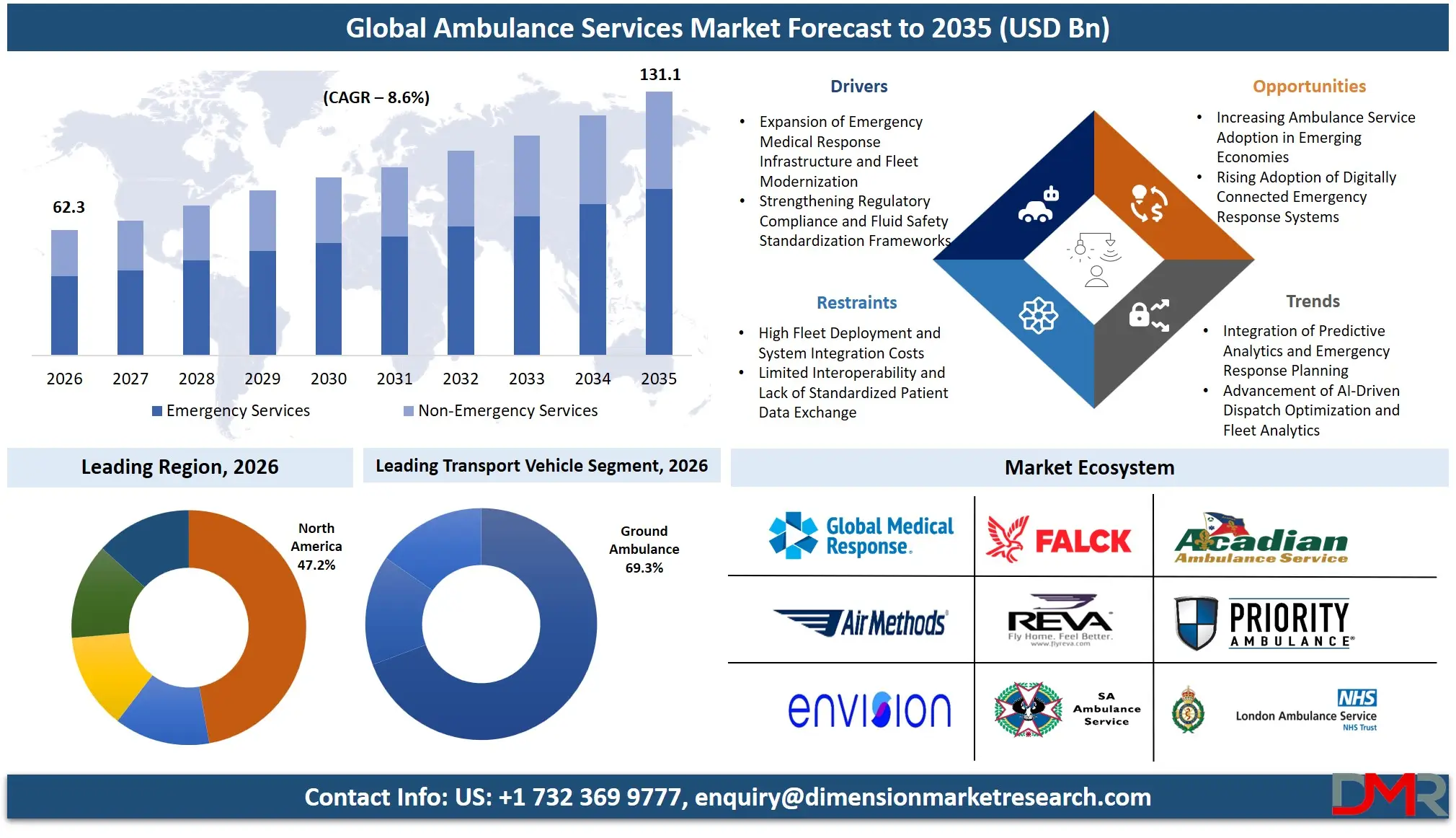
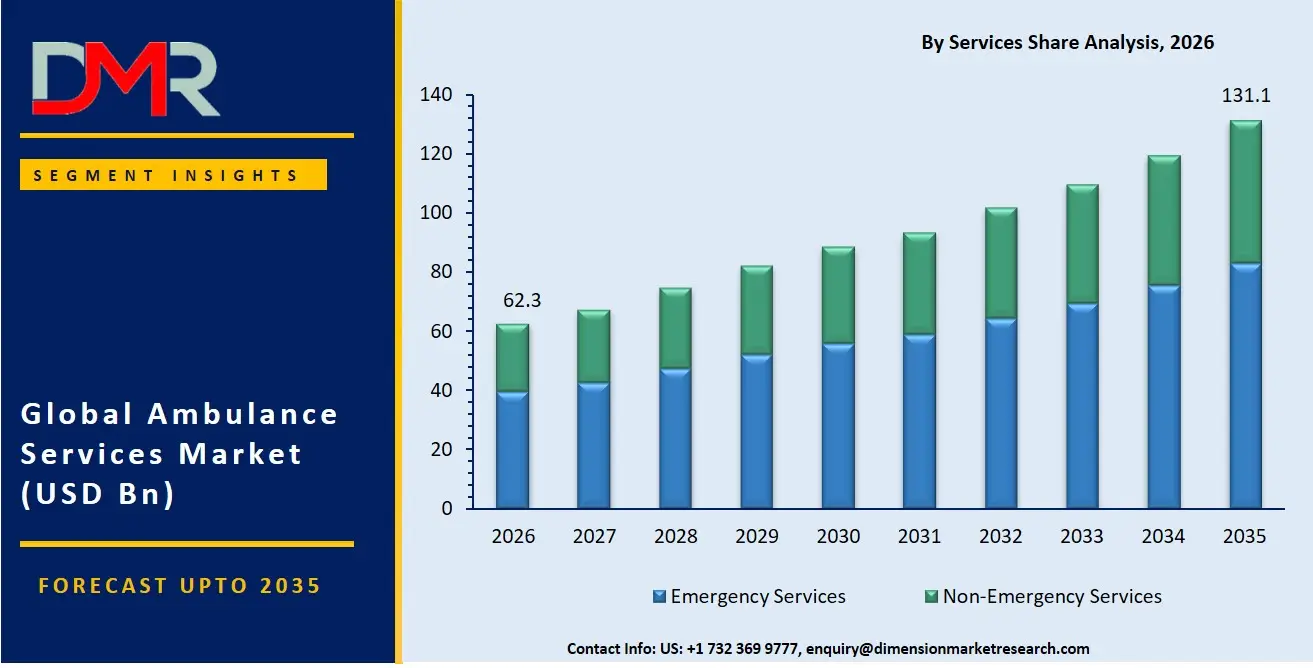
The Global Ambulance Services Market size is estimated at USD 62.3 billion in 2026 and is projected to reach USD 131.1 billion by 2035, exhibiting a CAGR of 8.6% during the forecast period, driven by the rising use of real-time patient vital monitoring and advanced emergency dispatch coordination systems, decentralized emergency response deployment patterns across expanding fleet networks, and connected digital patient management and compliance reporting systems.
ℹ
To learn more about this report –
Download Your Free Sample Report Here
The global ambulance services market is expanding because of increasing use of high-acuity patient assessment and prehospital triage systems in detecting and analyzing critical emergency conditions, increasing regulatory mandates, which reduce the chance of clinical errors during prehospital care and speed up compliance audits for new service providers, and more funding for modernizing emergency medical response infrastructure. Some other reasons for expansion in this market include new technologies in fleet optimization management, predictive vehicle maintenance through operational analytics, automated patient handling systems, high-volume emergency response platforms, and improved coordination across healthcare providers. The digital shift in specialty patient transport and centralized dispatching has helped speed up service development and make sensitive patient transfer management easier. This includes real-time cardiac monitoring and emergency care analytics. In addition, government plans focusing on preventing road traffic accidents and strengthening emergency healthcare systems have ensured steady investment in ambulance service networks.
ℹ
To learn more about this report –
Download Your Free Sample Report Here
The US Ambulance Services Market
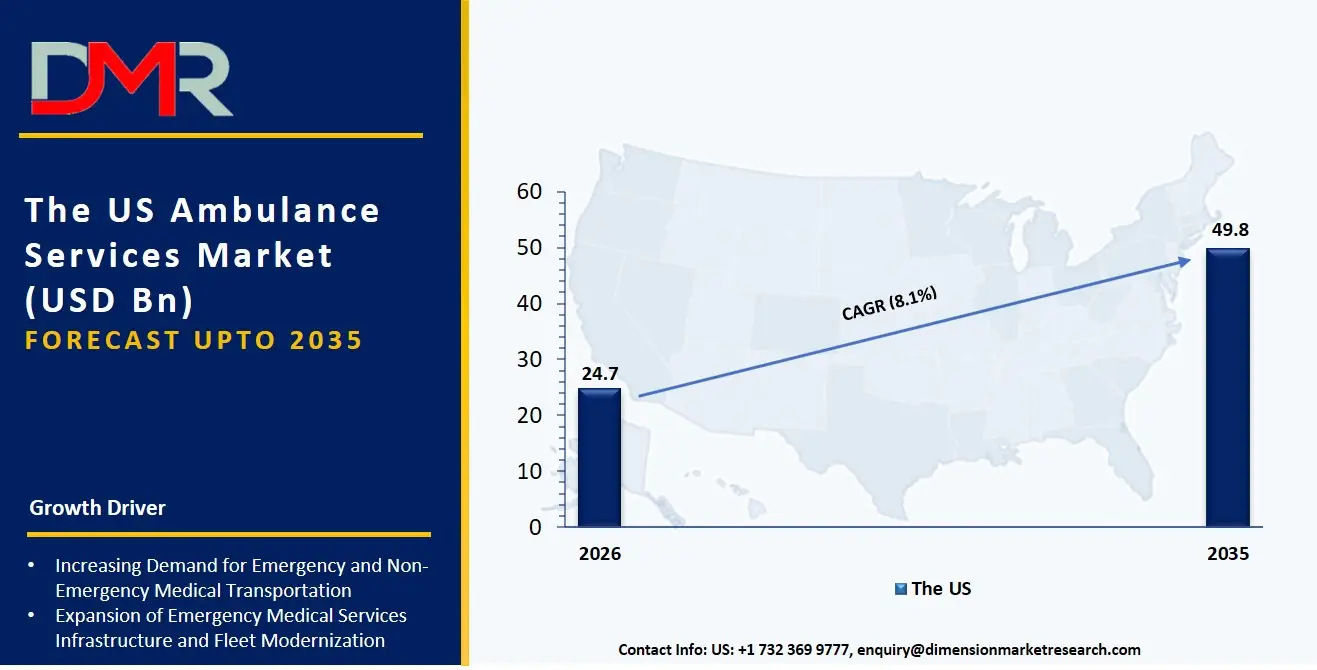
The US Ambulance Services Market is estimated to grow to USD 24.7 billion in 2026 with a compound annual growth rate of 8.1% during the forecast period.
The US market is shaped by major federal and state-level programs promoting resilient emergency response networks, secure digital adoption supported by DOT and NHTSA, and HHS-led prehospital care modernization initiatives. These programs encourage the use of high-acuity patient management, real-time critical condition monitoring, and predictive operational software for emergency dispatch. Advanced patient safety platforms are being rapidly adopted, and the US continues to invest in better coordination between trauma centers, secure patient record systems, and reliable cardiac arrest detection tools for ambulance operations. Service providers are also influenced by laws like EMTALA, HIPAA, and national digital health strategies to offer services that ensure patient safety, regulatory compliance, and smooth integration across emergency care environments.
ℹ
To learn more about this report –
Download Your Free Sample Report Here
Europe Ambulance Services Market
The European Ambulance Services Market is estimated to be valued at USD 14.9 billion in 2026, witnessing growth at a CAGR of 7.1%, during the forecast period.
Europe's ambulance services market is well-established, shaped by EU-wide policies such as the Emergency Services Action Plan, the Cross-Border Healthcare Directive, and national policies to support sustainable emergency healthcare systems. Countries are also making emergency response management more flexible to align service providers and patient needs and enable the sharing of critical healthcare information across borders. The market grows due to new tools such as software for real-time vehicle routing optimization and systems for improving patient safety during transport. Use is made easier by cooperation between public and private organizations and shared healthcare standards. Service providers have access to technologies such as AI-based dispatch optimization, patient condition monitoring, and secure operational audit systems, and Europe remains at the forefront of the digitization of safe and efficient emergency medical operations.
Japan Ambulance Services Market
The Japan Ambulance Services Market is projected to be valued at USD 2.4 billion in 2026, progressing at a CAGR of 8.4%, during the period spanning from 2026 to 2035.
Japan's ambulance services market is well developed, with advanced emergency response platforms, connected fleet management systems, and a wide range of patient monitoring technologies. National focus on automation, efficiency, and operational reliability is supported through emergency healthcare modernization programs and smart response initiatives. Growth opportunities are aided by government measures under long-term healthcare development strategies and continued investment in emergency medical services modernization. AI-driven dispatch research, integrated emergency response analytics, and advanced prehospital care technologies all require effective ambulance service systems to keep pace with growing emergency healthcare needs. Higher costs for upgrading ambulance fleets and integrating new technologies with existing infrastructure remain significant, but opportunities continue to emerge from expanding emergency care capabilities and healthcare system modernization.
Key Takeaways
- Market Size & Forecast: The Global Ambulance Services Market is estimated to be valued at USD 62.3 billion in 2026 and is expected to grow to USD 131.1 billion by 2035.
- Growth Rate & Outlook: The market is expected to witness growth at a compound annual growth rate of 8.6% in the forecast period.
- Primary Growth Drivers: The availability of new emergency technologies that use real-time patient deterioration detection, the need to speed up compliance results and improve success rates of patient data sharing, and more government investment in a national secure medical infrastructure are key growth drivers.
- Key Market Trends: The real-time profiling of patient thermal stability risks, cardiac arrest handling, and the shift to AI-driven dispatch formulation platforms and automated digital asset inventory management are key market trends.
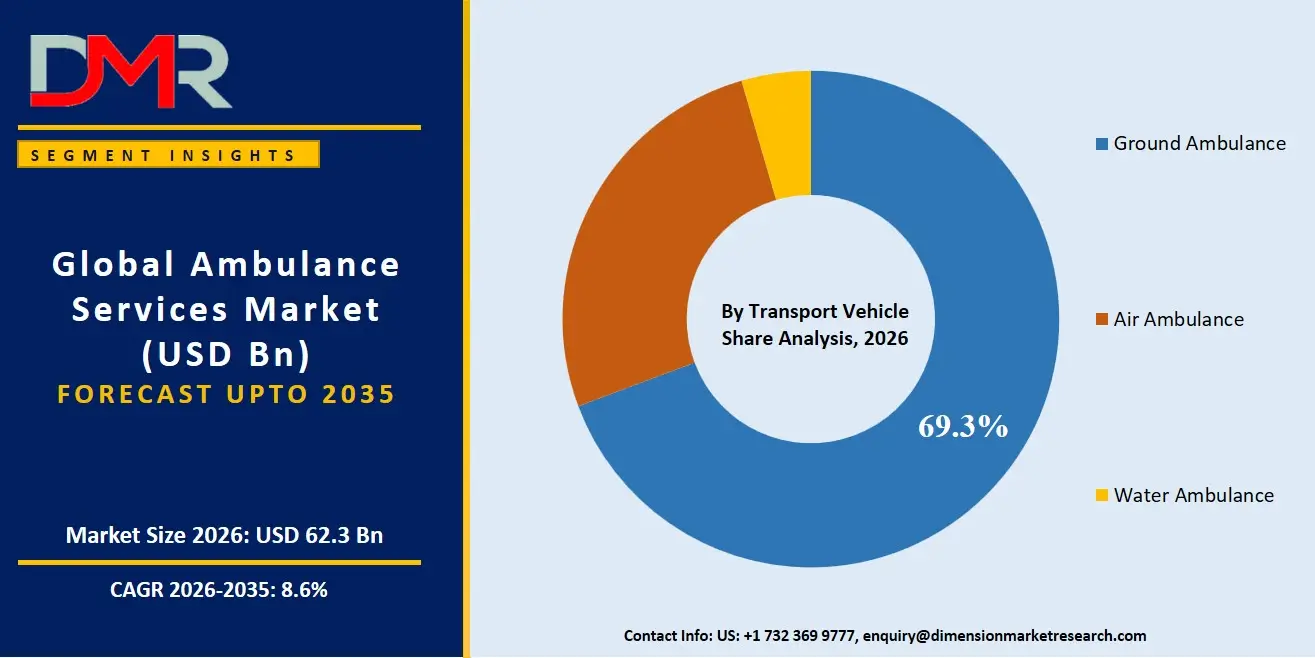
- By Transport Vehicle: The Ground Ambulance segment, particularly Vans, is expected to take the largest revenue share in the global ambulance services market in 2026.
- By Services: Emergency Services is expected to take the largest revenue share in 2026 in the ambulance services market.
- By End User: Hospitals & Clinics segment is estimated to take the lead in 2026 with the largest share in the ambulance services market.
- Regional Leadership: North America is estimated to take the lead in 2026 with 47.2% share in the ambulance services market.
What are Ambulance Services?
Ambulance Services refer to a combination of emergency medical transportation and prehospital care solutions that provide first responders, healthcare providers, and emergency response agencies with enhanced capabilities beyond basic patient transport, including helping to protect patient care protocols during transport, preventing clinical errors through advanced medical equipment and trained personnel, and enabling secure coordination of patient information. They include emergency response services, non-emergency patient transport, critical care transport solutions, and dispatch coordination systems. These services use modern systems such as real-time vital sign monitoring, digital patient record management, and remote medical consultation support to manage, verify, and track sensitive emergency events and outcomes. To improve clinical safety outcomes, manage patient variability and application-specific requirements, and expand protection into customized care delivery to support individual transport needs and promote the development of safe emergency medical services.
Use Cases
- Emergency Response for Daily Operations: Ambulance services can provide critical emergency response benefits through trained personnel, advanced medical equipment, and coordination systems to reduce clinical error risk and support rapid delivery of safe patient transport and prehospital care, compared to delays that may occur with limited emergency response resources.
- Long-Term Healthcare Transport Management: Long-term data on ongoing operational challenges, including equipment intermittency, medical supply availability, or vehicle degradation, are studied to better understand service performance and to help plan long-term emergency and non-emergency medical transport operations.
- Workload Load Balancing: Patient care demands are handled through ambulance services and coordinated response networks in municipal and healthcare settings to support service capacity balance for high-volume emergency workloads.
- Government & Regulated Programs: Faster ambulance service development helps healthcare innovation and development of targeted emergency response programs; government programs, through smart monitoring of national emergency medical systems, advance national patient protection strategies and help the adoption of operational standards.
How AI Is Transforming the Global Ambulance Services Market?
Artificial intelligence (AI) is being used progressively more often in ambulance service operations to improve emergency demand forecasting, find safety quality trends in patient acuity patterns, and automatically spot unusual patient deterioration patterns in emergency response data. It also allows faster patient condition assessment because it can handle emergency healthcare information on a large scale. Electronic patient records are easier to study and help providers find operational issues, reduce mistakes, and improve the overall accuracy of patient care decisions. This has resulted in operations being cost-effective, quicker, and more efficient than the old manual review method.
AI is also strengthening research and development by improving patient risk assessment and enabling more accurate capacity planning for emergency response. It helps EMS providers predict how many emergency response resources will be needed, find possible dispatch delays, and monitor the performance of response networks more effectively. In addition, automation of routine compliance checks and performance tracking is reducing operational workload, lowering administrative costs, and improving overall efficiency. This is leading to better financial results and more stable operations across the ambulance service value chain.
Market Dynamics
Key Drivers of the Global Ambulance Services Market
Expansion of Emergency Medical Response Infrastructure and Fleet Modernization
The market is growing with the rise of advanced technologies for EMS fleets, better management of critical patient transport operations, and a closer connection between operational performance monitoring and secure fleet integration. Ambulance service providers utilize real-time data that allows monitoring of vehicle health, helping to spot degradation early, and checking patient safety performance much faster. This has improved operational efficiency and reduced human errors and transport costs. At the same time, demand for more automated operational planning is being helped by more activity in predictive analytics for the assessment of individual patient risks, as healthcare systems further digitize emergency response protocols and dispatch tasks.
Strengthening Regulatory Compliance and Fluid Safety Standardization Frameworks
There is increasing emphasis on patient safety, care quality, and rule-following within the ambulance service system. Rules and frameworks such as the EU Emergency Services Action Plan, HIPAA, and emergency medical modernization efforts in key markets are encouraging better transport handling practices and more structured emergency safety processes. These advances are supporting the need for systems that can offer steady monitoring of sensitive patient data and standardized reporting. At the same time, active work to improve the sharing of operational performance data and reduce verification issues is strengthening the need for more effective management systems in both government and private market participants.
Restraints in the Global Ambulance Services Market
High Fleet Deployment and System Integration Costs
The rollout of ambulance service systems remains costly, requiring significant investment in ambulance fleets, emergency response technologies, system integration, testing, and alignment with existing dispatch workflows. In addition, following healthcare regulations such as HIPAA and other regional laws adds to setup complexity. These factors increase upfront costs and can limit adoption, especially among smaller ambulance providers and new companies entering the market.
Limited Interoperability and Lack of Standardized Patient Data Exchange
There is still fragmentation in the market in terms of digital patient record formats and data handling procedures. Although some areas have put in place organized digital management systems, many EMS fleets continue to work with both legacy dispatch control and modern emergency response systems. Lack of standardized patient data exchange protocols limits the ability to share operational performance data between ambulance providers and healthcare organizations and results in inefficiencies in service delivery, deployment, and system integration.
Growth Opportunities in the Global Ambulance Services Market
Increasing Ambulance Service Adoption in Emerging Economies
Newly developing economies such as Brazil, Indonesia, Nigeria, the UAE, and Vietnam are slowly building their emergency medical and ambulance service systems. These regions have long-term growth possibilities, with more people adopting advanced emergency care, and with more companies becoming aware of patient safety programs and slowly modernizing digital transport infrastructure. These markets have few older dispatch systems and can be used with new, technology-driven ambulance platforms that can grow over time.
Rising Adoption of Digitally Connected Emergency Response Systems
The move to safer emergency response systems, decentralized transport networks, and real-time operational performance checks is creating the adoption of advanced ambulance systems. These systems allow centralized patient data access, better coordination between EMS providers and healthcare facilities, and faster fleet and equipment management. Advanced digital setups are increasingly becoming a trend among modern ambulance providers as operational efficiency becomes one of the competitive factors.
Global Ambulance Services Market Trends
Integration of Predictive Analytics and Emergency Response Planning
Ambulance service platforms are gradually adding data-driven technology to find patient deterioration trends and improve accuracy in fleet and resource management. These systems allow EMS providers and fleet operators to study their vehicle units' emergency response behavior better, simplify the management of their operational resources, and improve their overall operational performance. This move is slowly turning the industry more proactive and data-driven in-patient safety instead of being purely reactive in emergency response operations.
Advancement of AI-Driven Dispatch Optimization and Fleet Analytics
The use of AI-based dispatch optimization systems is currently becoming a basic part of today's emergency medical operations. These systems allow real-time fleet stability monitoring, centralized operational administration, and better network coordination among market participants. Advanced ambulance platforms are improving the efficiency and responsiveness of service providers that operate in different regions by reducing dependence on manual dispatch processes and allowing operations to grow more easily.
Research Scope and Analysis
The global ambulance services market is witnessing strong growth driven by rising adoption of advanced emergency technologies, batch transport optimization, and increasing demand for high-safety and high-efficiency EMS processes. The market is segmented based on transport vehicle, services, equipment, operating type, application, and end user.
ℹ
To learn more about this report –
Download Your Free Sample Report Here
By Transport Vehicle Analysis
The Ground Ambulance segment, particularly Vans, is likely to continue dominating the market in 2026, accounting for approximately 69.3% of the global ambulance services market share. This is due to its key role in enabling high-fidelity patient transport, a wide operating parameter range, and long-term fleet stability, and its usefulness in various emergency settings where operational efficiency is needed. Within Ground Ambulance, the Vans sub-segment holds the largest share, driven by high deployment volumes, automated demand for stable patient care, and compliance requirements. The Air Ambulance segment is driven by its key role in enabling rapid long-distance transport, with Rotary-Wing (Helicopters) leading, followed by Fixed-Wing Aircraft. Water Ambulance is the fastest-growing segment, supported by increasing coastal emergency mandates and island medical access needs.
By Services Analysis
The Emergency Services segment is likely to continue holding the lead in 2026, accounting for approximately 72.4% of the global ambulance services market share, driven by strong demand for rapid trauma response, regulatory mandates on response times, and flexible dispatch across technologies. This segment reflects the continued shift toward agile and data-driven emergency operations. The Non-Emergency Services segment is the second-largest and fastest-growing, supported by aging populations, hospital discharge needs, and government incentives for scheduled medical transport.
By Equipment Analysis
The Advanced Life Support (ALS) segment is expected to dominate with around 64.7% market share in 2026, driven by its irreplaceable role in critical patient care, enabling real-time vital sign monitoring and medication administration. ALS supports customized prehospital treatment plans because it can offer multiple levels of parameter tuning, capacity amounts, and yearly stability plans, delivering fast results while keeping patient data within secure registry systems. The Basic Life Support (BLS) segment is the second-largest, driven by demand for non-critical transport and first-response stabilization.
By Operating Type Analysis
The Private segment is the largest in 2026, accounting for 48.2% share, driven by the need for enterprise-wide digital transformation, multi-fleet standardization, and significant capital budgets. Large-scale private providers are adopting digital dispatch platforms to optimize global response networks and ensure operational excellence. The Government segment is the fastest-growing, supported by public safety funding, technology modernization requirements, and lower entry costs for emerging EMS technologies.
By Application Analysis
The Trauma & Accident Cases segment is the largest application in 2026, accounting for approximately 41.3% share, driven by the need for consistent, rapid response, patient outcome optimization, and prehospital care unit performance. This segment reflects the continued shift toward the digitalization of large-scale continuous emergency services. The Cardiac Emergencies segment is the second-largest and fastest-growing, supported by rising cardiovascular disease rates, high-acuity protocols, and traceability requirements. Respiratory Emergencies and Obstetric & Neonatal Transport represent specialized segments with dedicated ambulance requirements for regulatory compliance and quality assurance.
By End User Analysis
The Hospitals & Clinics segment is the largest end user in 2026, accounting for approximately 68.5% share, driven by the need for reliable patient handoffs, bed management integration, and emergency department coordination. This segment reflects the continued shift toward digitalization of hospital-based emergency networks. The Nursing Homes & Assisted Living Centers segment is the second-largest and fastest-growing, supported by aging demographics, scheduled medical transport needs, and regulatory oversight.
The Global Ambulance Services Market Report is segmented based on the following:
By Transport Vehicle
- Ground Ambulance
- Air Ambulance
- Rotary-Wing (Helicopters)
- Fixed-Wing Aircraft
- Water Ambulance
- Rescue Boats
- Medical Transport Vessels
By Services
- Emergency Services
- Non-Emergency Services
By Equipment
- Advanced Life Support (ALS) Ambulance Services
- Basic Life Support (BLS) Ambulance Services
By Operating Type
- Government
- Private
- Public-Private Partnership
- Others
By Application
- Trauma & Accident Cases
- Cardiac Emergencies
- Respiratory Emergencies
- Obstetric & Neonatal Transport
- Others
By End User
- Hospitals & Clinics
- Nursing Homes & Assisted Living Centers
- Others
Regional Analysis
Largest Region in the Ambulance Services Market
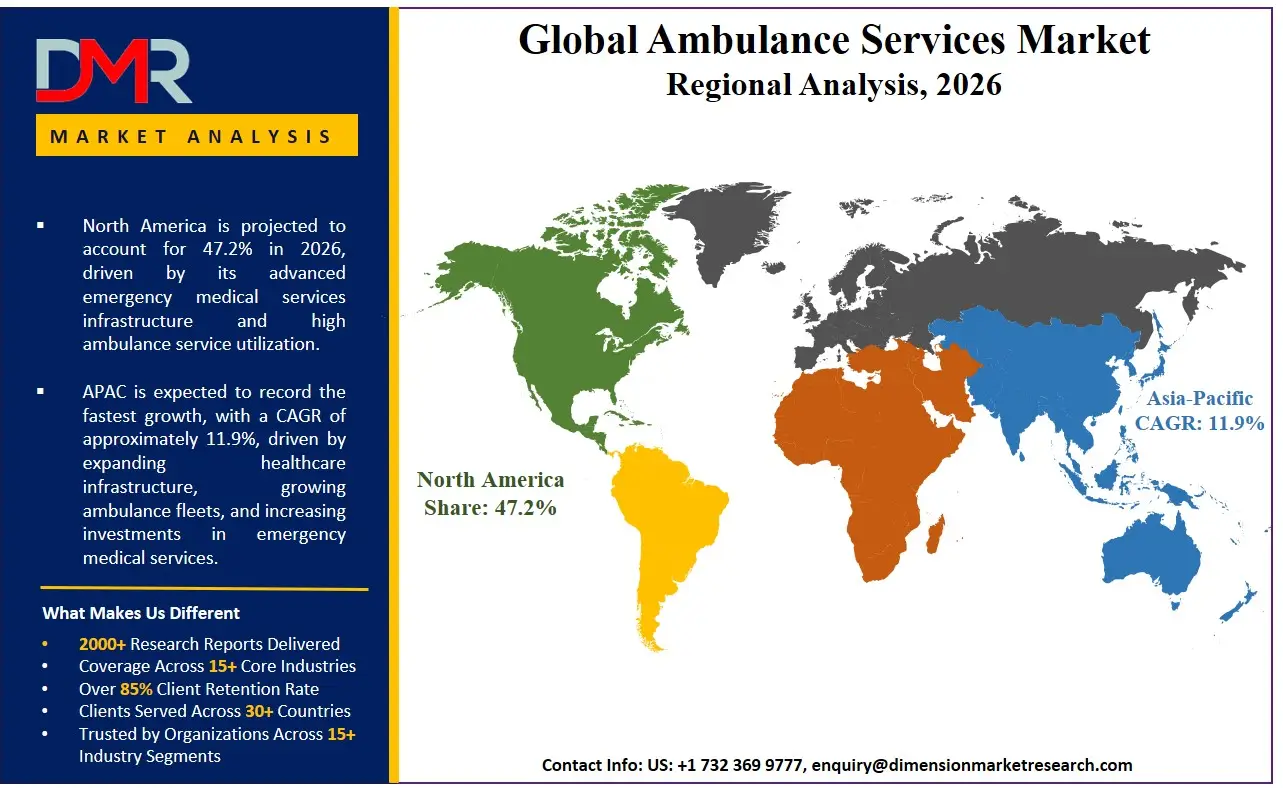
It is projected that North America will take the lead in the global ambulance services market, covering a market share of about 47.2% in the year 2026. The region's dominance is driven by the presence of major EMS technology vendors, strong regulatory frameworks such as HIPAA and state-level emergency response mandates, and early adoption of AI-driven dispatch and predictive maintenance technologies across ground and air ambulance sectors. North America benefits from significant investment in fleet digitalization, the highest concentration of fleet modernization projects in the US, and strong government support through DOT funding for emergency response modernization. The region is also home to major EMS providers and engineering firms, enabling rapid deployment of fleet-wide digital twins. Additionally, ongoing investments in workforce training using AR/VR and operator training simulators further strengthen North America's leading position. The widespread adoption of advanced digital twins for emergency dispatch, patient care optimization, and ambulance fleet management continues to reinforce the region's market leadership.
ℹ
To learn more about this report –
Download Your Free Sample Report Here
Fastest-Growing Region in the Ambulance Services Market
Asia-Pacific is the fastest-growing region, supported by aggressive domestic EMS expansion in China and India, substantial government funding for smart city and Industry 4.0 initiatives, and increasing investments in greenfield ambulance complexes that integrate digital twins from the initial design phase. The region is witnessing rapid growth in modular fleet construction, driving demand for cloud-based dispatch and patient simulation software. Asia-Pacific is also at the forefront of AI-driven dispatch deployment in high-growth sectors like trauma response and cardiac care. The region benefits from lower labor costs, driving faster ROI on automation, along with rising corporate commitments to operational excellence and safety compliance. Growing focus on patient traceability for international standards further accelerates market expansion. Moreover, increasing road traffic accidents and the need to reduce prehospital deaths in rapidly industrializing economies are expected to keep Asia-Pacific's growth momentum as the highest CAGR region during the forecast period.
By Region
North America
Europe
- Germany
- The U.K.
- France
- Italy
- Russia
- Spain
- Benelux
- Nordic
- Rest of Europe
Asia-Pacific
- China
- Japan
- South Korea
- India
- ANZ
- ASEAN
- Rest of Asia-Pacific
Latin America
- Brazil
- Mexico
- Argentina
- Colombia
- Rest of Latin America
Middle East & Africa
- Saudi Arabia
- UAE
- South Africa
- Israel
- Egypt
- Rest of MEA
Competitive Landscape
The ambulance services market is highly competitive, with new service models and strategic partnerships shaping the competitive environment. To gain an advantage, companies and providers are focused on developing better emergency response capabilities, advanced dispatch systems, integrated patient monitoring solutions, and efficient fleet management programs. There are high barriers to entering the market due to the large amount of money needed for regulatory approval, specialized prehospital care knowledge, and the need for mature operational systems and compliance frameworks.
Strategic approaches to increase market presence include partnerships with hospitals, healthcare providers, and emergency response organizations, mergers between ambulance operators and healthcare service providers, and long-term support contracts with customers and government institutions. Additionally, research and development in patient data management practices and flexible emergency response models are important for staying competitive and meeting the changing needs of the ambulance services community.
Some of the prominent players in the Global Ambulance Services Market are:
- Global Medical Response, Inc.
- Falck A/S
- Acadian Ambulance Service, Inc.
- Air Methods Corporation
- Priority Ambulance, LLC
- PHI, Inc. (PHI Air Medical)
- REVA, Inc.
- Babcock Scandinavian Air Ambulance AB
- Envision Healthcare Corporation
- Ziqitza Health Care Limited
- GVK Emergency Management and Research Institute
- BVG India Limited
- London Ambulance Service NHS Trust
- St John Ambulance Australia Ltd
- Medivic Aviation Private Limited
- Dutch Health B.V.
- Medavie Health Services New Brunswick
- SA Ambulance Service
- Ambulance Victoria
- Response Plus Medical Services LLC
- Other Key Players
Recent Developments
- May 2026: Global Medical Response, Inc. completed its U.S. initial public offering, raising approximately USD 478.7 million and securing a valuation of about USD 3.4 billion. The IPO marked one of the largest recent listings in the emergency medical services sector and is expected to support the company's air and ground ambulance service expansion initiatives.
- February 2026: Falck A/S announced improved 2026 earnings expectations following multiple newly awarded ambulance service contracts across Europe and increased demand for healthcare services in Scandinavia. The company highlighted continued growth in its emergency medical services operations and organizational streamlining efforts.
- March 2026: PHI, Inc., expanded its PHI Cares emergency medical service program through new and renewed agreements with five municipalities in Arizona, strengthening access to emergency air medical transportation and expanding its community-based coverage network across rural regions of the state.
- September 2025: Babcock International Group PLC secured a contract extension with the London Ambulance Service NHS Trust to continue providing and maintaining its emergency response vehicle fleet. The agreement strengthens Babcock's role in supporting frontline ambulance operations and emergency medical response infrastructure across the UK healthcare system.
Report Details
| Report Characteristics |
| Market Size (2026) |
USD 62.3 Bn |
| Forecast Value (2035) |
USD 131.1 Bn |
| CAGR (2026–2035) |
8.6% |
| The US Market Size (2026) |
USD 24.7 Bn |
| Historical Period |
2021 – 2025 |
| Forecast Period |
2027 – 2035 |
| Base Year |
2025 |
| Estimated Year |
2026 |
| Segments Covered |
By Transport Vehicle, By Services, By Equipment, By Operating Type, By Application, By End User |
| Regional Coverage |
North America – The US and Canada; Europe – Germany, The UK, France, Russia, Spain, Italy, Benelux, Nordic, & Rest of Europe; Asia-Pacific – China, Japan, South Korea, India, ANZ, ASEAN, Rest of APAC; Latin America – Brazil, Mexico, Argentina, Colombia, Rest of Latin America; Middle East & Africa – Saudi Arabia, UAE, South Africa, Turkey, Egypt, Israel, & Rest of MEA |
Frequently Asked Questions
How big is the Global Ambulance Services Market?
▾ The Global Ambulance Services Market is estimated to be valued at USD 62.3 billion in 2026 and is expected to reach USD 131.1 billion by the end of 2035.
What is the CAGR of the Global Ambulance Services Market from 2026 to 2035?
▾ The market is growing at a CAGR of 8.6% over the forecasted period.
What factors are driving the growth of the Global Ambulance Services Market?
▾ The market is driven by advances in real-time patient deterioration detection and automated safety enforcement, regulatory pressure to speed up emergency response compliance results and reduce clinical error mistakes, and increased government investment in national safe medical infrastructure.
What are the major trends in the Global Ambulance Services Market?
▾ The key market trends include the adoption of real-time patient thermal stability tracking and cardiac arrest analysis, along with a growing shift toward AI-driven dispatch formulation platforms and data-enabled digital asset inventory management systems.
Which region held the largest share of the Global Ambulance Services Market in 2026?
▾ North America is expected to account for the largest market share in 2026, with a share of about 47.2%.
Which region is expected to grow the fastest in the Global Ambulance Services Market?
▾ Asia Pacific is the fastest-growing region in the market during the forecast period.
Who are the key players in the Global Ambulance Services Market?
▾ Some of the major key players in the Global Ambulance Services Market are Acadian Ambulance Service, Inc., Global Medical Response, Inc., Air Methods Corporation, American Medical Response (AMR), Falck A/S, PHI Air Medical, and many others.
How is the Global Ambulance Services Market segmented?
▾ The market is segmented by transport vehicle, services, equipment, operating type, application, and end user.