America Blood Glucose Monitoring Market Snapshot
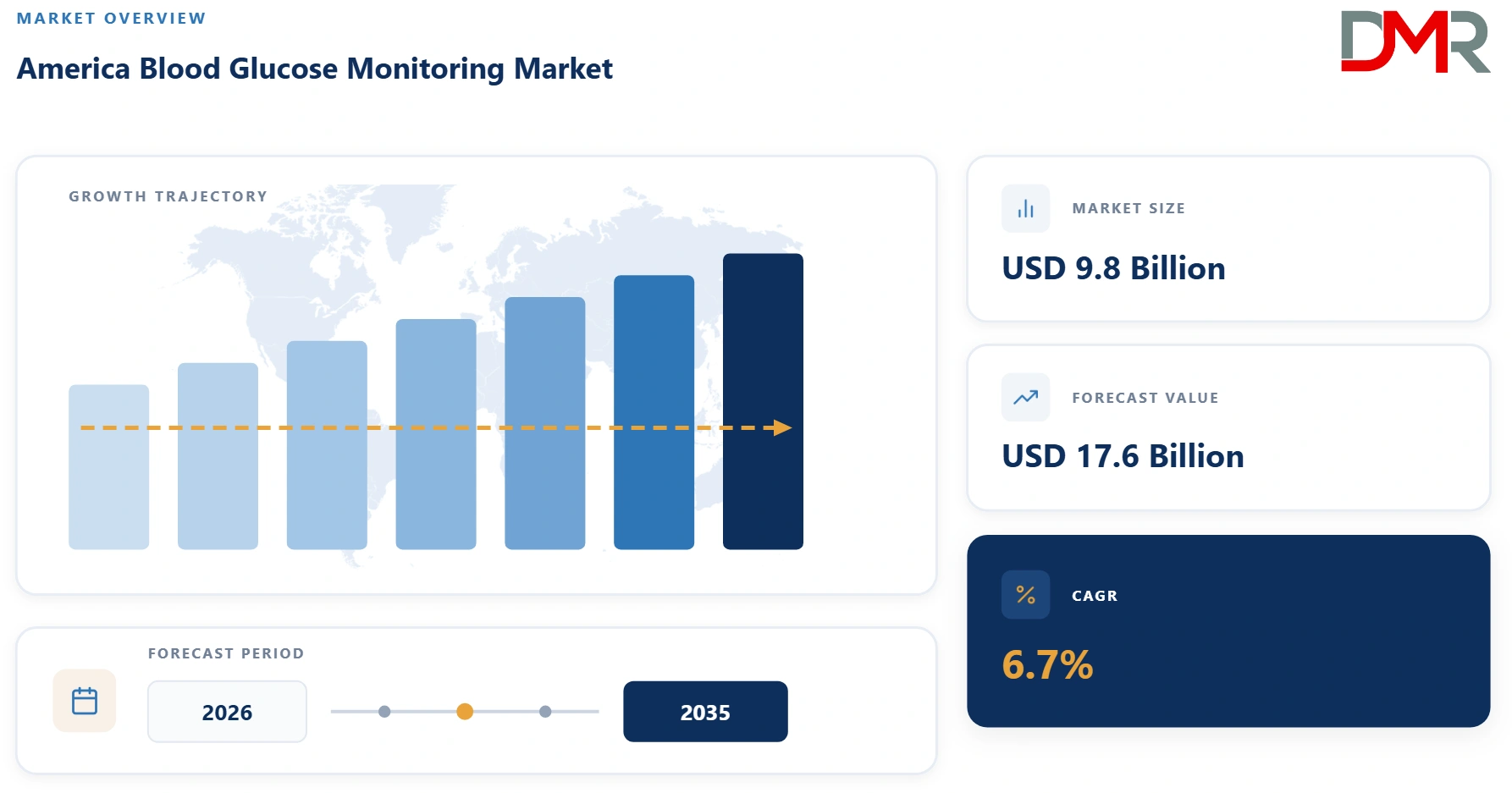
- Market Size, 2026: USD 9.8 Billion
- Market Size, 2035: USD 17.6 Billion
- CAGR, 2026-2035: 6.7%
- Leading Product Segment: Continuous Glucose Monitoring Systems, 45.0%
- Leading Application Segment: Type 2 Diabetes, 55.0%
- Leading End-User Segment: Home Care, 48.0%
- Fastest-Growing Segment: CGM Systems, 10.8% CAGR
- Leading Region: North America, 81.5%
What is the America Blood Glucose Monitoring and its Market Size?
The Americas market is estimated at USD 9.8 billion in 2026 and projected to reach USD 17.6 billion by 2035, representing a 6.7% CAGR.
ℹ
To learn more about this report –
Download Your Free Sample Report Here
The Americas blood glucose monitoring market comprises devices, sensors, consumables, software and connected platforms used to measure, track and interpret glucose levels for diabetes management and related health applications. It encompasses traditional self-monitoring blood glucose (SMBG) meters, test strips and lancets, as well as continuous glucose monitoring (CGM) systems incorporating wearable sensors, mobile applications, cloud analytics and connected insulin-delivery ecosystems. FDA describes conventional blood glucose monitoring systems as handheld meters used with test strips to analyze glucose from a blood sample, while modern CGMs increasingly provide continuous or near-continuous readings and alerts.
Use Cases
- Diabetes self-management: Enables patients to monitor glucose and adjust diet, medication and insulin according to readings.
- Continuous glucose management: Provides real-time trends and alerts for hyperglycemia, hypoglycemia and glucose variability.
- Hospital glucose monitoring: Supports inpatient monitoring, medication decisions and management of critically ill patients.
- Gestational diabetes monitoring: Helps pregnant patients track glucose and maintain recommended glycemic ranges.
- Remote patient monitoring: Connects glucose data with clinicians for virtual follow-up and chronic-care management.
- Health and wellness monitoring: OTC biosensors provide metabolic insights to consumers without diagnosed diabetes.
Key Takeaways
- Market Size and Growth: The Americas market is estimated at USD 9.8 billion in 2026 and is forecast to reach USD 17.6 billion by 2035, at a 6.7% CAGR.
- Growth Drivers: Diabetes prevalence, obesity, aging, reimbursement expansion, connected healthcare and growing consumer awareness are the principal demand catalysts.
- Segment Dominance: CGM systems are estimated to represent the largest product category in 2026 as sensor-based monitoring increasingly supplements or replaces conventional SMBG.
- Fastest Growth: CGM systems are projected to expand at approximately 10.8% CAGR, materially above the overall market.
- Regional Leadership: North America accounts for approximately 81.5% of Americas revenue, while Latin America offers stronger percentage growth from a smaller installed base.
How AI, IoT and Cloud Connectivity are Transforming the Market?
AI, IoT and cloud connectivity are turning glucose monitors into connected digital-care platforms. CGMs continuously transmit readings to smartphones, cloud platforms and clinician dashboards, while algorithms identify glucose patterns, predict excursions and increasingly personalize recommendations. Dexcom, for example, introduced AI-powered meal logging that uses smartphone food images to identify ingredients and populate meal information within its glucose applications.
Connected monitoring reduces manual logging, improves visibility between clinical appointments and enables earlier identification of glucose excursions. AI can automate pattern recognition, meal analysis and personalized feedback, while cloud platforms facilitate remote monitoring and population-level diabetes management. The result is improved convenience, potentially better adherence and more efficient clinician workflows.
Key Drivers in the America Blood Glucose Monitoring Market
Rising diabetes prevalence and growing need for regular glucose monitoring
The increasing prevalence of diabetes across the Americas is creating a sustained requirement for blood glucose monitoring products. The United States remains the principal demand center, while Brazil, Mexico, and other Latin American countries are also experiencing increasing diabetes burdens. Growing awareness of the importance of glycemic control is encouraging patients to monitor glucose more frequently and supporting adoption across both home-care and clinical settings.
Rapid adoption of continuous glucose monitoring and connected technologies
CGM is becoming a major growth engine for the Americas blood glucose monitoring market as patients and healthcare professionals increasingly value real-time glucose trends, alerts, and remote data access. Improvements in sensor accuracy, wearability, smartphone connectivity, and integration with insulin-delivery systems are making CGM more convenient and clinically useful. Expanded reimbursement, broader eligibility, and the emergence of over-the-counter CGM products are also extending access beyond traditionally intensive insulin users.
Restraints in the America Blood Glucose Monitoring Market
High cost and unequal reimbursement
The relatively high acquisition and recurring costs of CGM systems remain a major barrier, particularly for uninsured, underinsured, and price-sensitive patients. Unlike traditional meters, CGM typically requires recurring sensor purchases, creating an ongoing financial commitment. Although reimbursement has improved in the United States, eligibility and coverage conditions can vary by insurer, treatment status, and patient category. Latin American markets face additional affordability challenges because healthcare budgets and private insurance penetration are generally lower than in the United States and Canada. These conditions encourage many cost-conscious patients to continue using conventional meters and test strips.
Regulatory, accuracy, interoperability, and data-security challenges
Blood glucose monitoring devices require high levels of accuracy because readings can directly influence medication and insulin decisions. Regulatory requirements can lengthen product-development and commercialization timelines, while concerns surrounding sensor accuracy, false alerts, device reliability, and connectivity can affect patient confidence. The increasing integration of CGMs with smartphones, cloud platforms, insulin pumps, and digital-health applications also introduces interoperability and cybersecurity considerations.
Growth Opportunities in the America Blood Glucose Monitoring Market
Expansion of OTC CGM and monitoring among non-insulin users
Over-the-counter CGM is creating an important opportunity to expand the addressable market beyond patients who require intensive insulin therapy. Easier access allows manufacturers to target people with type 2 diabetes, prediabetes, metabolic-risk factors, and consumers interested in preventive health and lifestyle management. Retail pharmacies, e-commerce, direct-to-consumer channels, and subscription models can further increase accessibility. The opportunity is particularly significant because CGM adoption among insulin-treated type 2 diabetes patients in primary care remains below its potential, leaving substantial room for penetration.
Trends in the America Blood Glucose Monitoring Market
Shift from SMBG toward continuous and connected monitoring
The Americas market is gradually transitioning from traditional finger-stick testing toward CGM and digitally connected monitoring. SMBG remains important because of its affordability, established installed base, and role as a backup measurement method, but CGM is increasingly preferred where continuous visibility and real-time alerts provide greater clinical value. Longer-wear sensors, smaller form factors, smartphone connectivity, and simplified insertion are reducing user burden and encouraging sustained adoption.
Personalization and consumerization of diabetes monitoring
Blood glucose monitoring is increasingly becoming a consumer-oriented digital-health experience rather than a standalone medical-device function. Manufacturers are adding AI-supported insights, meal tracking, activity monitoring, remote sharing, and personalized recommendations to differentiate their platforms. At the same time, OTC products and retail distribution are bringing glucose monitoring closer to mainstream wellness channels. This is broadening the competitive landscape and encouraging companies to compete on software, user experience, ecosystem integration, affordability, and accessibility alongside traditional measures such as sensor accuracy and reliability.
Research Scope and Analysis
The Americas blood glucose monitoring market is segmented by Product, Application, End User and Technology. The analysis covers CGM systems, blood glucose meters and consumables; major diabetes applications; home and institutional users; and electrochemical, optical and connected monitoring technologies.
ℹ
To learn more about this report –
Download Your Free Sample Report Here
By Product Analysis
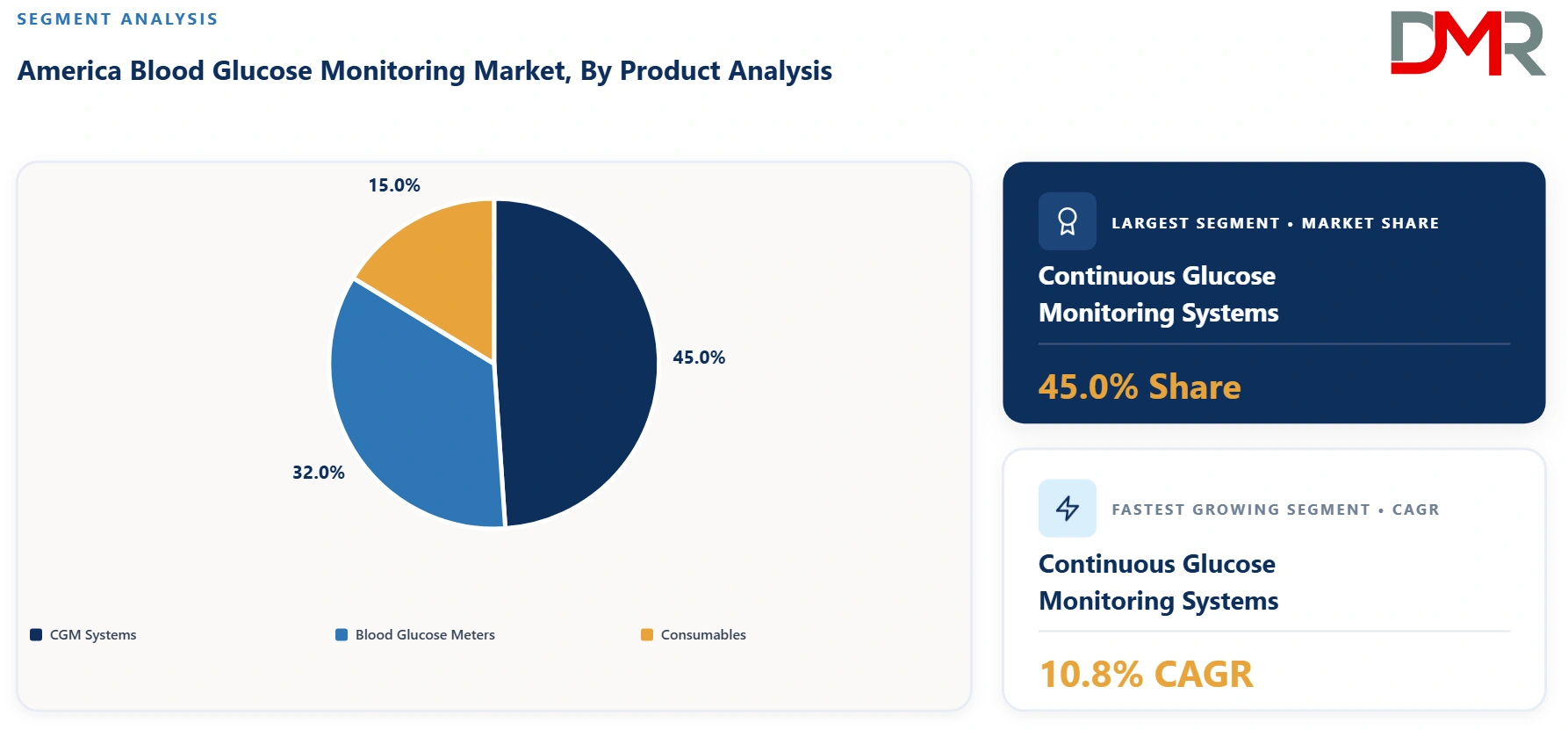
Continuous Glucose Monitoring (CGM) Systems are estimated to represent the dominant product category in 2026, with approximately 45.0% market share, reflecting rapid adoption of wearable sensors, real-time alerts, smartphone connectivity and increasingly broad reimbursement. Blood Glucose Meters represent approximately 32.0%, retaining substantial demand because of low acquisition cost, established clinical workflows and continued use as a backup or complementary testing method for CGM users. Consumables, including test strips, lancets and related components, account for approximately 23.0%. CGM is also the fastest-growing product segment, with an estimated 10.8% CAGR through 2035, supported by OTC expansion, longer-wear sensors and broader type 2 diabetes adoption. Long-duration technology is becoming a key differentiator, exemplified by Eversense 365's one-year sensor. While traditional meters are mature, their recurring strip requirements preserve a sizable revenue base across Latin America and cost-sensitive patient populations.
By Application Analysis
Type 2 Diabetes dominates the application landscape, accounting for an estimated 55.0% share in 2026, reflecting its substantially larger patient population and increasing movement toward earlier and more intensive glucose monitoring. Type 1 Diabetes represents approximately 31.0%, but remains disproportionately important in CGM and automated insulin delivery because continuous monitoring is deeply embedded in intensive insulin-management pathways. Gestational Diabetes accounts for roughly 7.0%, while other applications, including prediabetes, hypoglycemia monitoring and metabolic-health use, contribute approximately 7.0%. The Other Applications category is estimated to be the fastest-growing at approximately 12.2% CAGR, driven by OTC CGM, metabolic wellness and preventive monitoring. The introduction of consumer-oriented platforms by Abbott and Dexcom is expanding monitoring beyond conventional diabetes-management populations.
By End User Analysis
Home Care is estimated to lead with approximately 48.0% share in 2026, reflecting the increasing decentralization of diabetes management and the widespread use of meters, CGMs and smartphone applications outside clinical settings. Hospitals & Clinics account for approximately 37.0%, supported by inpatient glucose monitoring, endocrinology, diabetes education and specialist management. Diagnostic Laboratories represent approximately 15.0%, primarily serving confirmatory testing, clinical diagnostics and specialized monitoring. Home care is also expected to be the fastest-growing end-user segment at approximately 8.5% CAGR, supported by remote patient monitoring, telehealth and consumer-accessible CGM. Connected systems allow glucose information to move directly from patients to caregivers and clinicians, making home-based monitoring increasingly integrated with formal care pathways. FDA-approved CGM systems already support smartphone-based trend monitoring and treatment decisions.
The America Blood Glucose Monitoring Market Report is segmented on the basis of the following:
By Product
- CGM Systems
- Blood Glucose Meters
- Consumables
By Application
- Type 1 Diabetes
- Type 2 Diabetes
- Gestational Diabetes
- Other Applications
By End User
- Home Care
- Hospitals & Clinics
- Diagnostic Laboratories
Regional Analysis
North America dominates the Americas blood glucose monitoring market, accounting for an estimated 81.5% of 2026 revenue, equivalent to approximately USD 8.0 billion. The United States represents the principal market, supported by a large diabetic population, advanced healthcare infrastructure, strong CGM penetration, broad payer participation and rapid adoption of connected devices. North American blood glucose monitoring was estimated at USD 17.55 billion in 2025 by one major market study, although methodologies vary substantially depending on whether associated consumables and digital services are included. Latin America accounts for approximately 18.5%, with Brazil and Mexico representing the largest demand pools. Latin America's market is projected to grow faster from its smaller base, supported by diabetes prevalence, urbanization, healthcare modernization and increasing availability of lower-cost monitoring technologies. Published estimates place Latin America's blood glucose monitoring market around USD 1.05 billion in 2025. Mexico is expected to be among the faster-growing markets, while Brazil remains the region's largest opportunity by installed patient base.
Regulatory Landscape
Regulation is a critical competitive variable because blood glucose monitoring devices directly influence clinical decisions. In the U.S., FDA clearance determines market access, while Canada, Brazil, Mexico and other Latin American markets impose separate registration and quality requirements. The regulatory environment increasingly distinguishes conventional meters, integrated CGMs, OTC biosensors and software-enabled systems. The FDA database currently lists dozens of CGM clearances, including recent Dexcom G7 configurations and Abbott OTC clearance is strategically significant because it allows manufacturers to bypass traditional prescription pathways for appropriate populations. However, recalls can materially affect brand trust, reimbursement discussions and regulatory scrutiny, as demonstrated by the 2026 Abbott Libre 3/3 Plus Class I recall.
Investment and White Space Analysis
The greatest investment opportunity lies at the intersection of CGM, AI, consumer health and automated diabetes management. North America offers scale, reimbursement and technology adoption, whereas Latin America provides higher incremental growth potential from lower penetration. White spaces include affordable CGM for non-insulin-treated type 2 diabetes, longer-duration sensors, lower-cost distribution models, localized digital coaching and remote patient monitoring. OTC products can unlock consumer channels, while integrated CGM-insulin ecosystems create recurring revenue and higher patient lifetime value. Manufacturers should also prioritize reliability, cybersecurity and manufacturing resilience because sensor recalls can produce substantial reputational and financial consequences. Investment in Brazil and Mexico is particularly attractive for companies able to localize pricing and distribution while maintaining regulatory compliance.
By Region
North America
Latin America
- Mexico
- Brazil
- Argentina
- Colombia
- Rest of Latin America
Competitive Landscape
The Americas blood glucose monitoring market is moderately concentrated, with Abbott, Dexcom and Medtronic occupying major positions in advanced CGM while Roche, LifeScan, Ascensia/Senseonics, B. Braun and other companies maintain positions in meters, strips or specialized monitoring technologies. Competitive intensity is increasingly centered on sensor accuracy, wear duration, device size, smartphone integration, reimbursement access and ecosystem interoperability rather than meter hardware alone. Major players are pursuing product launches, regulatory clearances, partnerships with insulin-pump companies, consumer-health expansion and software innovation. Abbott and Dexcom are particularly important in the shift toward OTC glucose biosensing, while Senseonics differentiates through long-duration implantable CGM technology.
Some of the prominent players in the America Blood Glucose Monitoring Market are:
- Abbott Laboratories
- Dexcom
- Medtronic
- Roche Diagnostics
- Ascensia Diabetes Care
- LifeScan
- Senseonics
- B. Braun
- ACON Laboratories
- ARKRAY
- i-SENS
- Nipro
- Terumo
- Sinocare
- SD Biosensor
- AgaMatrix
- Trividia Health
- Nova Biomedical
- Prodigy Diabetes Care
- Bionime
- TaiDoc Technology
- OK Biotech
- Beurer
- Rossmax International
- Menarini Group
- Ypsomed
- Insulet
- Tandem Diabetes Care
- Biolinq
- Nemaura Medical
- LifePlus
- DarioHealth
- Glooko
- One Drop
- Tidepool
- Know Labs
- Movano Health
- Rockley Photonics
- DiaMonTech
- E3D
- Other Key Players
Recent Developments
- July 2026 - Dexcom: Dexcom raised its full-year revenue forecast after reporting stronger-than-expected demand for its continuous glucose monitoring systems, highlighting continued expansion of the U.S. CGM market. R Reuters
- February 2026 - Medtronic MiniMed: Medtronic’s diabetes business, MiniMed, announced plans for a U.S. IPO targeting a valuation of up to approximately USD 7.86 billion, supporting its transition toward becoming a standalone diabetes-technology company. R Reuters
- January 2026 - Medtronic: Medtronic secured expanded U.S. pharmacy-formulary access for its MiniMed 780G system and associated CGMs, strengthening retail distribution and improving access for eligible diabetes patients.
- December 2025 - Medtronic and Abbott: Medtronic expanded the U.S. commercial availability of the MiniMed 780G system integrated with Abbott’s Instinct sensor, strengthening competition through interoperable CGM and automated insulin-delivery technologies.
- September 2025 - Medtronic and Abbott: The FDA cleared integration of Abbott’s Instinct sensor with the MiniMed 780G system and approved the system for insulin-requiring type 2 diabetes, expanding its addressable patient population.
Report Details
| Report Characteristics |
| Market Size (2026) |
USD 9.8 Bn |
| Forecast Value (2035) |
USD 17.6 Bn |
| CAGR (2026–2035) |
6.7% |
| Historical Data |
2021 – 2025 |
| Forecast Data |
2026 – 2035 |
| Base Year |
2025 |
| Segments Covered |
By Product, By Application, By End User |
| Regional Coverage |
North America – The US and Canada; Latin America – Mexico, Brazil, Colombia, Argentina, Rest of LATAM |
Frequently Asked Questions
What is the America Blood Glucose Monitoring Market size in 2026?
▾ The America Blood Glucose Monitoring Market is estimated at USD 9.8 billion in 2026, covering CGM systems, blood glucose meters and consumables.
What will the America Blood Glucose Monitoring Market be worth in 2035?
▾ The America Blood Glucose Monitoring Market is projected to reach approximately USD 17.6 billion by 2035, supported by rising diabetes prevalence and technology adoption.
What is the CAGR of the America Blood Glucose Monitoring Market?
▾ The America Blood Glucose Monitoring Market is expected to expand at approximately 6.7% CAGR from 2026 to 2035.
What are the key drivers of the America Blood Glucose Monitoring Market?
▾ Key America Blood Glucose Monitoring Market drivers include diabetes prevalence, CGM adoption, reimbursement expansion, OTC availability and connected healthcare.
Which segment leads the America Blood Glucose Monitoring Market?
▾ CGM Systems lead the America Blood Glucose Monitoring Market by product, while Type 2 Diabetes leads by application and Home Care leads by end user.
Which region dominates the America Blood Glucose Monitoring Market?
▾ North America dominates the America Blood Glucose Monitoring Market with an estimated 81.5% share in 2026, led by the United States.
Which companies are key players in the America Blood Glucose Monitoring Market?
▾ Major America Blood Glucose Monitoring Market players include Abbott, Dexcom, Medtronic, Roche, Senseonics, LifeScan, Ascensia and B. Braun.
How is the America Blood Glucose Monitoring Market segmented?
▾ The America Blood Glucose Monitoring Market is segmented by Product, Application, End User and Technology, with additional analysis by region and country.