Americas Blood Glucose Test Strip Market Snapshot
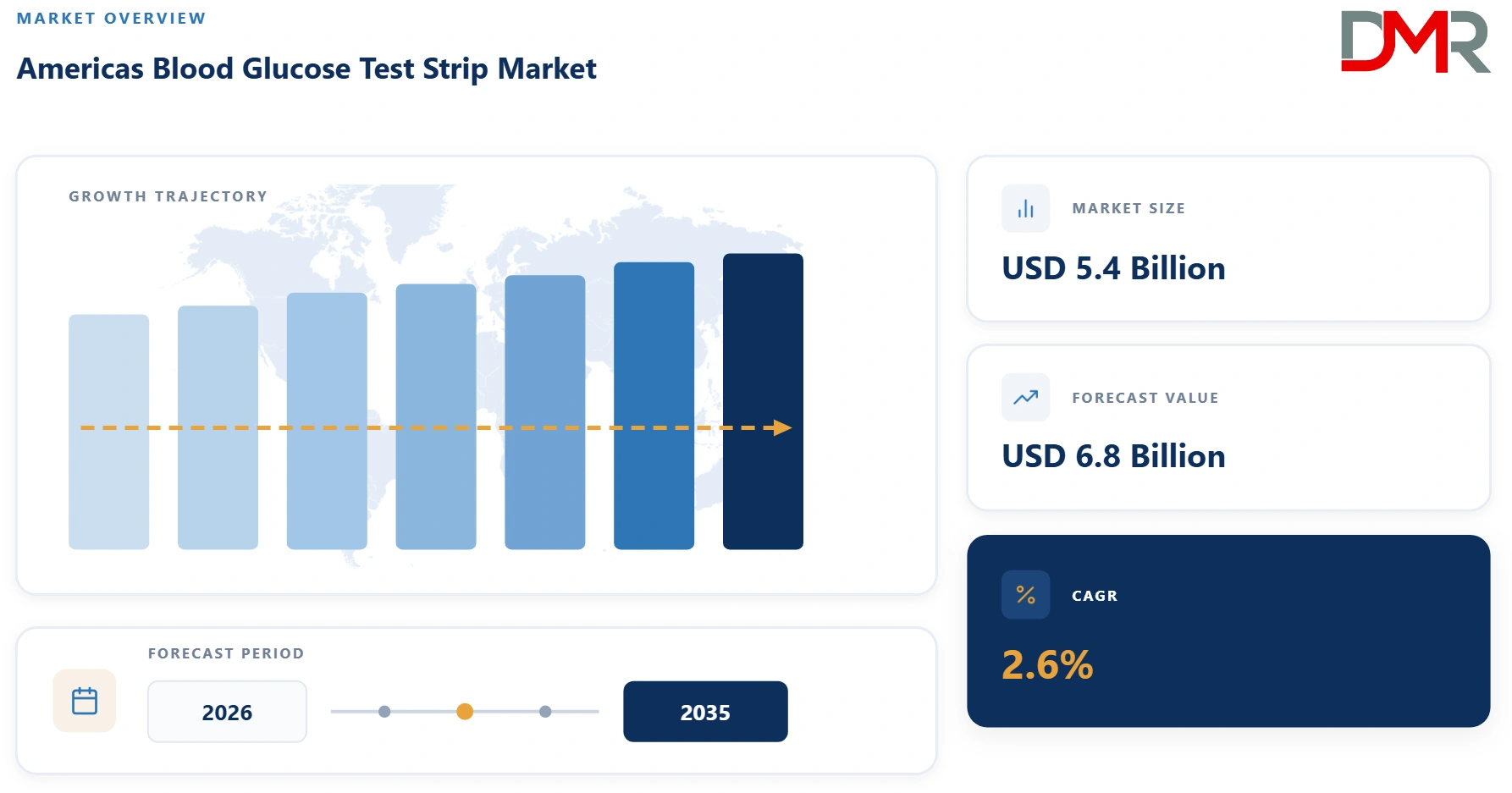
- Americas Blood Glucose Test Strip Market Size in 2026: USD 5.4 Billion
- Americas Blood Glucose Test Strip Market Size in 2035: USD 6.8 Billion
- Americas CAGR from 2026 to 2035: 2.6%
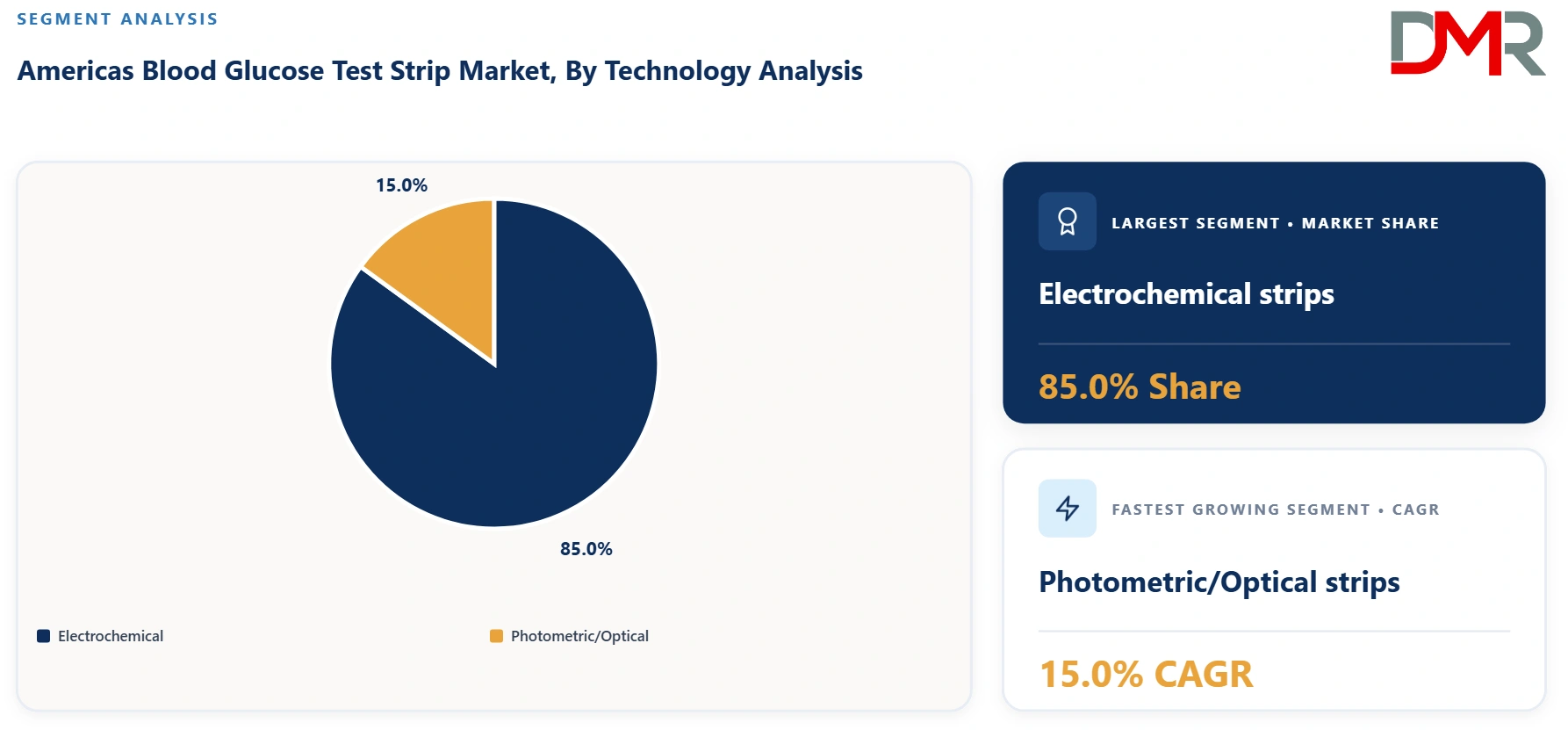
- Electrochemical is the leading technology segment in 2026: 85.0%
- Home Care/Self-Testing is the leading end-user segment in 2026: 78.0%
- Retail Pharmacy is the leading distribution channel segment in 2026: 40.0%
- Manufacturer-Specific/Proprietary is the leading compatibility segment in 2026: 62.0%
What is the Americas Blood Glucose Test Strip Market and its Market Size?
The Americas Blood Glucose Test Strip Market is projected to reach USD 5.4 Billion in 2026 and is projected to reach USD 6.8 Billion by 2035, expanding at a CAGR of 2.6% during the forecast period.
ℹ
To learn more about this report –
Download Your Free Sample Report Here
The market covers disposable electrochemical and photometric/optical test strips used with blood glucose meters for self-monitoring blood glucose (SMBG) across the United States, Canada, Brazil, Mexico, and the rest of Latin America, sold through retail pharmacy, hospital/institutional, online/direct-to-consumer, and mail-order diabetic supply channels, and used by home-care patients, hospitals and clinics, and diagnostic laboratories. Growth in this market is shaped by two offsetting forces that also frame the companion packaging analysis: sustained and rising strip-based testing volumes in Latin America, where affordability keeps strips as the dominant glucose-testing modality, against continued erosion of strip demand among insulin-intensive users in the United States and Canada as continuous glucose monitoring (CGM) adoption grows. A second structural dynamic specific to this market — largely absent from the packaging analysis — is price: growth of generic and universal/generic-compatible strips, competitive payer/PBM bidding, and reimbursement pressure are projected to be steadily compressing average selling price per strip even where unit volumes hold up, muting overall value growth relative to volume growth.
Use Cases
- Home Self-Monitoring for Non-Insulin Type 2 Diabetes: The largest single use case by volume: Type 2 patients not on intensive insulin therapy testing once daily or a few times weekly to guide diet, activity, and medication adherence.
- Hospital and Clinic Point-of-Care Glucose Testing: Inpatient and outpatient care settings use professional-use test strips and meters for rapid bedside glucose checks, including in emergency departments and intensive care units.
- Public Health and Payer-Sponsored Screening Programs: Latin American public health systems and, increasingly, private payers in the United States distribute test strips as part of diabetes screening and chronic disease management programs, sustaining volume among price-sensitive populations.
- Private-Label and Generic-Compatible Retail Testing: Retail pharmacy chains and online diabetic-supply retailers market universal/generic-compatible strips as a lower-cost alternative to manufacturer-specific proprietary strips, particularly for older, off-patent meter platforms.
Key Takeaway
- Market Size: The Americas Blood Glucose Test Strip Market is projected to reach USD 5.4 Billion in 2026 and forecast to reach USD 6.8 Billion by 2035, expanding at a CAGR of 2.6%.
- Growth Outlook: Value growth is projected to trail volume growth, as rising Latin American strip consumption is partly offset by CGM-driven volume erosion in the United States and Canada and by continued average selling price compression from generic competition and payer bidding.
- Primary Growth Drivers: Rising diagnosed diabetes prevalence and continued strip-based testing in Latin America, and growth of generic/universal-compatible strips expanding affordability and volume among price-sensitive Type 2 patients.
- By Technology Analysis: Electrochemical strips are projected to lead with an 85.0% share in 2026, given their accuracy, small sample-size requirements, and near-universal adoption in modern meters, with Photometric/Optical strips projected to account for 15.0%, concentrated in legacy and lower-cost meter platforms.
- By End User Analysis: Home Care/Self-Testing is projected to account for 78.0% of 2026 value, reflecting the scale of the self-monitoring Type 2 population, with Hospitals & Clinics at 15.0% and Diagnostic Laboratories at 7.0%.
- By Distribution Channel Analysis: Retail Pharmacy is projected to lead with 40.0% share in 2026, followed by Hospital/Institutional at 22.0%, Online/Direct-to-Consumer at 20.0%, and Mail-Order Diabetic Supply at 18.0%.
- By Compatibility Analysis: Manufacturer-Specific/Proprietary strips are projected to hold a 62.0% share in 2026, with Universal/Generic-Compatible strips at 38.0% and projected to be the faster-growing of the two segments.
- By Country Analysis: The United States is projected to dominate with a 65.0% share in 2026, followed by Brazil at 11.0%, Canada at 8.0%, Mexico at 7.0%, and the Rest of Latin America at 9.0%.
Key Drivers in the Americas Blood Glucose Test Strip Market
Rising Diagnosed Diabetes Prevalence and Sustained Strip-Based Testing in Latin America
As in the companion packaging analysis, rising diagnosed diabetes prevalence across Brazil, Mexico, and the rest of Latin America, combined with limited affordability of continuous glucose monitoring for most of the diagnosed population, is projected to keep strip-based SMBG as the dominant testing modality in these markets and a primary source of volume growth for the overall Americas market over the forecast period.
Growth of Generic and Universal-Compatible Test Strips
Expiry of patents on older meter platforms and streamlined regulatory pathways for generic/high-quality low-cost strips are projected to expand the universal/generic-compatible segment, lowering the effective cost of testing for price-sensitive patients and payers. This is projected to support continued volume growth even as it compresses average selling price and, in turn, overall market value growth.
Restraints in the Americas Blood Glucose Test Strip Market
Continuous Glucose Monitoring Adoption and Average Selling Price Compression
Two compounding restraints are projected to weigh on this market. First, continuing CGM adoption among insulin-intensive patients in the United States and Canada is reducing strip volumes in the largest and most valuable national markets. Second, competitive payer and pharmacy-benefit-manager bidding, alongside generic strip competition, is projected to be steadily compressing average selling price per strip across the region. Together, these dynamics are projected to hold overall Americas market value growth well below underlying diabetic-population growth.
Growth Opportunities in the Americas Blood Glucose Test Strip Market
Expansion of Affordable Generic-Compatible Strips in Price-Sensitive Segments
Continued growth of universal/generic-compatible strips presents an opportunity for manufacturers and retailers to capture volume among price-sensitive Type 2 patients and Latin American public procurement programs that would otherwise underuse testing supplies due to cost.
Online and Subscription-Based Diabetic Supply Distribution
Growth of online and direct-to-consumer diabetic supply retailers, including subscription-based reorder models, presents an opportunity to capture share from traditional retail pharmacy distribution, particularly among digitally engaged and newly diagnosed patients across the United States and Canada.
Trends in the Americas Blood Glucose Test Strip Market
Continued Average Selling Price Erosion Alongside Resilient Volumes
Average selling price per strip is projected to continue a gradual downward trend across the region, driven by generic competition, payer/PBM bidding, and reimbursement policy, even as total strip volumes remain resilient or grow modestly in Latin America. This price/volume divergence is projected to be the defining value dynamic in the market over the forecast period.
Growing Bluetooth-Enabled and Connected Meter-Strip Ecosystems
Test strips are increasingly projected to be sold as part of connected meter ecosystems that transmit readings to smartphone apps and telehealth platforms, particularly in the United States retail and direct-to-consumer channels, gradually repositioning strips from a stand-alone consumable to a data-generating component of broader diabetes management programs.
Research Scope and Analysis
This Americas Blood Glucose Test Strip Market analysis covers electrochemical and photometric/optical test strips used for self-monitoring blood glucose across home-care, hospital/clinic, and diagnostic laboratory end users, distributed through retail pharmacy, hospital/institutional, online/direct-to-consumer, and mail-order diabetic supply channels, and spanning manufacturer-specific/proprietary and universal/generic-compatible strip formats across the United States, Canada, Brazil, Mexico, and the rest of Latin America. All figures presented are first-principles guesstimates; see the Market Sizing Methodology section for the full assumption chain.
ℹ
To learn more about this report –
Download Your Free Sample Report Here
By Technology Analysis
Electrochemical strips are projected to dominate the Americas Blood Glucose Test Strip Market, accounting for 85.0% share in 2026, reflecting their superior accuracy, smaller required blood sample size, and near-universal use in modern meter platforms across both branded and generic strips. Photometric/Optical strips are projected to account for 15.0%, concentrated in older, lower-cost meter platforms still in circulation in parts of Latin America and among long-tenured users in the United States and Canada who have not migrated to newer meters. Electrochemical share is projected to inch higher over the forecast period as legacy photometric platforms are gradually retired.
By End User Analysis
Home Care/Self-Testing is projected to account for the large majority of market value, at 78.0% share in 2026, reflecting the sheer scale of the Type 2 non-insulin self-monitoring population relative to hospital and laboratory testing volumes. Hospitals & Clinics are projected to account for 15.0%, tied to inpatient and outpatient point-of-care testing, while Diagnostic Laboratories account for an estimated 7.0%, reflecting a smaller role for strip-based testing relative to automated laboratory glucose analyzers in centralized settings.
The table below summarizes the projected end-user value split for 2026 and 2035; totals may not sum precisely due to rounding.
By Distribution Channel Analysis
Retail Pharmacy is projected to remain the leading distribution channel, accounting for a 40.0% share in 2026, reflecting its role as the primary purchase point for self-pay and insured patients across the Americas. Hospital/Institutional channels are projected to account for 22.0%, tied to inpatient procurement, while Online/Direct-to-Consumer channels are projected to account for 20.0% and are expected to grow above the category average as e-commerce diabetic-supply purchasing expands. Mail-Order Diabetic Supply channels are projected to account for the remaining 18.0%.
By Compatibility Analysis
Manufacturer-Specific/Proprietary strips are projected to hold 62.0% share in 2026, reflecting continued brand loyalty, meter-strip bundling by manufacturers, and payer preferred-brand formulary requirements. Universal/Generic-Compatible strips are projected to reach 38.0% and are projected to be the faster-growing compatibility segment over the forecast period as streamlined regulatory pathways and price-sensitive demand, particularly in Latin American retail and public-procurement channels, expand generic adoption.
The Americas Blood Glucose Test Strip Market Report is segmented based on the following:
By Technology
- Electrochemical
- Photometric/Optical
By End User
- Home Care/Self-Testing
- Hospitals & Clinics
- Diagnostic Laboratories
By Distribution Channel
- Retail Pharmacy
- Hospital/Institutional
- Online/Direct-to-Consumer
- Mail-Order Diabetic Supply
By Compatibility
- Manufacturer-Specific/Proprietary
- Universal/Generic-Compatible
Country Analysis
The United States is projected to dominate the Americas Blood Glucose Test Strip Market with a 65.0% share in 2026, reflecting its scale of diagnosed diabetes, mature retail pharmacy and payer-reimbursement infrastructure, and the concentration of leading manufacturer strip brands. United States growth is projected to be the slowest in the region given CGM-driven volume erosion among insulin-intensive patients and continued average-selling-price compression from generic competition and PBM bidding. Brazil is projected to be at 11.0% share, supported by a large and rising diagnosed diabetic population and expanding local strip manufacturing capacity. Canada is projected to be at 8.0%, reflecting a smaller, stable strip-testing base. Mexico is projected to grow at 7.0%, and the Rest of Latin America together at 9.0%, with both projected to grow faster than the United States and Canada as diagnosis rates rise and affordability of strip-based testing remains favorable relative to CGM.
By Region
North America
· The U.S.
· Canada
Latin America
· Brazil
· Mexico
· Argentina
· Colombia
· Rest of Latin America
Technology Analysis
Technology development in the Americas Blood Glucose Test Strip Market is projected to center on continued refinement of electrochemical biosensor chemistry for smaller sample size and faster read time, growing Bluetooth/wireless connectivity linking meters and strips to smartphone apps and telehealth platforms, and regulatory-driven consolidation of accuracy standards that is projected to gradually favor established manufacturers with deep clinical-validation capability over smaller generic entrants lacking equivalent quality systems. Photometric/optical strip technology is projected to continue a slow secular decline as legacy meter platforms are retired.
Investment and White Space Analysis
Investment opportunities in the Americas Blood Glucose Test Strip Market are projected to concentrate in universal/generic-compatible strip manufacturing capacity targeting price-sensitive Latin American and United States retail segments, and in connected/Bluetooth-enabled meter-strip ecosystems targeting online and direct-to-consumer distribution. Meaningful white space is projected to exist in localized strip manufacturing in Brazil and Mexico that reduces import dependence, and in subscription-based diabetic supply distribution models. Manufacturers combining clinical-grade accuracy with generic-competitive pricing are projected to be best positioned to defend share as payer and PBM bidding intensifies, while smaller proprietary-only manufacturers lacking scale are projected to face continued margin pressure.
Competitive Landscape
The Americas Blood Glucose Test Strip Market is projected to be moderately consolidated among a small number of large global manufacturers with established meter-strip ecosystems and payer/retail relationships, alongside a growing base of generic/universal-compatible strip manufacturers competing primarily on price. Competition is projected to center on clinical accuracy and regulatory compliance, payer formulary and preferred-brand positioning, retail pharmacy and PBM relationships, and, increasingly, connected-device/app ecosystem features.
Some of the prominent participants in the Americas Blood Glucose Test Strip Market include:
- Abbott Laboratories
- F. Hoffmann-La Roche Ltd.
- LifeScan IP Holdings LLC
- Ascensia Diabetes Care Holdings AG
- ARKRAY Inc.
- Trividia Health Inc.
- AgaMatrix Inc.
- Nova Biomedical
- B. Braun Melsungen AG
- Nipro Corporation
- i-SENS Inc.
- TaiDoc Technology Corporation
- Sinocare Inc.
- ACON Laboratories Inc.
- Terumo Corporation
- Omnis Health LLC
- Universal Biosensors Inc.
- Bionime Corporation
- HMD Biomedical Inc.
- All Medicus Co., Ltd.
- 77 Elektronika Kft.
- Infopia Co., Ltd.
- SD Biosensor Inc.
- Yuwell (Jiangsu Yuyue Medical Equipment)
- Beijing Yicheng Bioelectronics Technology Co., Ltd.
- Shanghai MicroSense Medical Technology Co., Ltd.
- EDAN Instruments Inc.
- Menarini Diagnostics
- OK Biotech Co., Ltd.
- Prodigy Diabetes Care LLC
- VivaChek Laboratories Inc.
- CareSens (i-SENS Brand)
- ForaCare Inc.
- Medisana AG
- Rossmax International Ltd.
- Panasonic Healthcare (Bayer Legacy Platform)
- UniStrip Technologies LLC
- National Diagnostic Products
- Hainice Medical Inc.
- Cordx Medical Ltd.
- Other Key Player
Recent Developments
- August 2026: The U.S. FDA cleared Ascensia’s CONTOUR PLUS BLUE, CONTOUR NEXT GEN, and CONTOUR NEXT ONE blood glucose monitoring systems, strengthening its presence and supporting continued test-strip utilization across the United States.
- January 2026: Independence Blue Cross Medicare Advantage plans designated Accu-Chek and Contour as preferred diabetic testing brands, potentially strengthening patient access, reimbursement coverage, and demand for compatible blood glucose test strips.
- October 2024: TRUE METRIX blood glucose monitoring systems and compatible test strips achieved preferred status across Florida Managed Medicaid plans, supporting improved product accessibility, affordability, and utilization among eligible diabetes patients across the state.
Report Details
| Report Characteristics |
| Market Size (2026) |
USD 5.4 Bn |
| Forecast Value (2035) |
USD 6.8 Bn |
| CAGR (2026–2035) |
2.6% |
| Historical Data |
2021 – 2025 |
| Forecast Data |
2026 – 2035 |
| Base Year |
2025 |
| Segments Covered |
Market By Technology, By End User, By Distribution Channel, and By Compatibility |
| Regional Coverage |
North America – The US and Canada; Latin America – Mexico, Brazil, Colombia, Argentina, Rest of LATAM |
Frequently Asked Questions
How big is the Americas Blood Glucose Test Strip Market?
▾ The Americas Blood Glucose Test Strip Market is projected to reach USD 5.4 Billion in 2026 and is projected to reach USD 6.8 Billion by 2035.
What is the CAGR of the Americas Blood Glucose Test Strip Market from 2026 to 2035?
▾ The market is projected to expand at a compound annual growth rate (CAGR) of 2.6% between 2026 and 2035.
What factors are driving growth in the Americas Blood Glucose Test Strip Market?
▾ Growth is projected to be driven by rising diagnosed diabetes prevalence and sustained strip-based testing in Latin America, and by growth of generic/universal-compatible strips expanding affordability and volume among price-sensitive patients.
What is restraining growth in the Americas Blood Glucose Test Strip Market?
▾ Continuous glucose monitoring adoption among insulin-intensive patients in the United States and Canada, combined with generic competition and payer/PBM-driven average selling price compression, is projected to hold overall market value growth well below underlying diabetic-population growth.
Which technology leads the Americas Blood Glucose Test Strip Market?
▾ Electrochemical strips are projected to lead with an 85.0% share in 2026, given their accuracy and near-universal use in modern meter platforms.
How is the Americas Blood Glucose Test Strip Market segmented?
▾ The market is segmented by technology, end user, distribution channel, and compatibility, with value concentrated in the United States, followed by Brazil, Canada, and Mexico.