Americas Blood Glucose Test Strip Packaging Market Snapshot
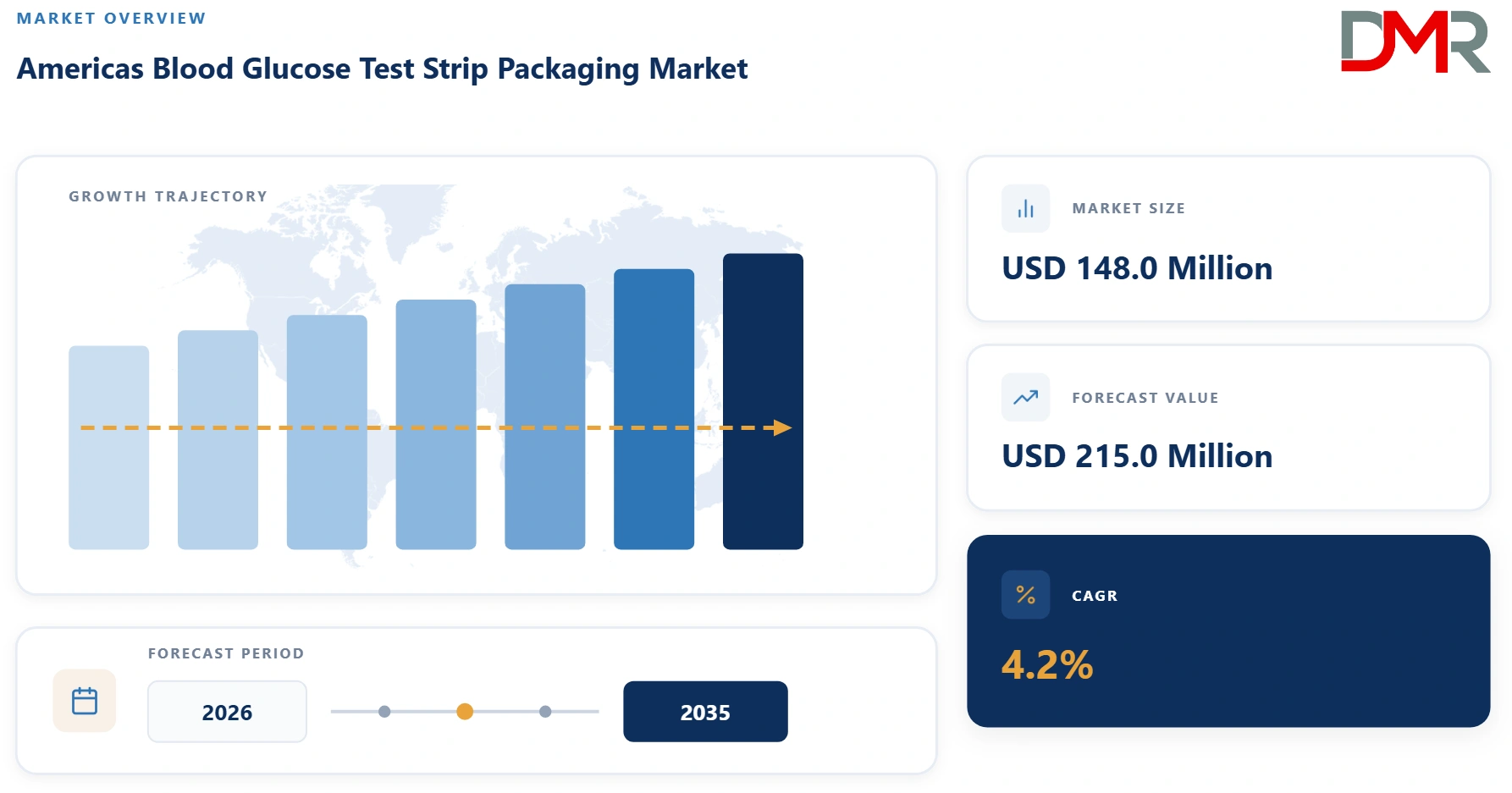
- Americas Blood Glucose Test Strip Packaging Market Size in 2026: USD 148.0 Million
- Americas Blood Glucose Test Strip Packaging Market Size in 2035: USD 215.0 Million
- Americas CAGR from 2026 to 2035: 4.2%
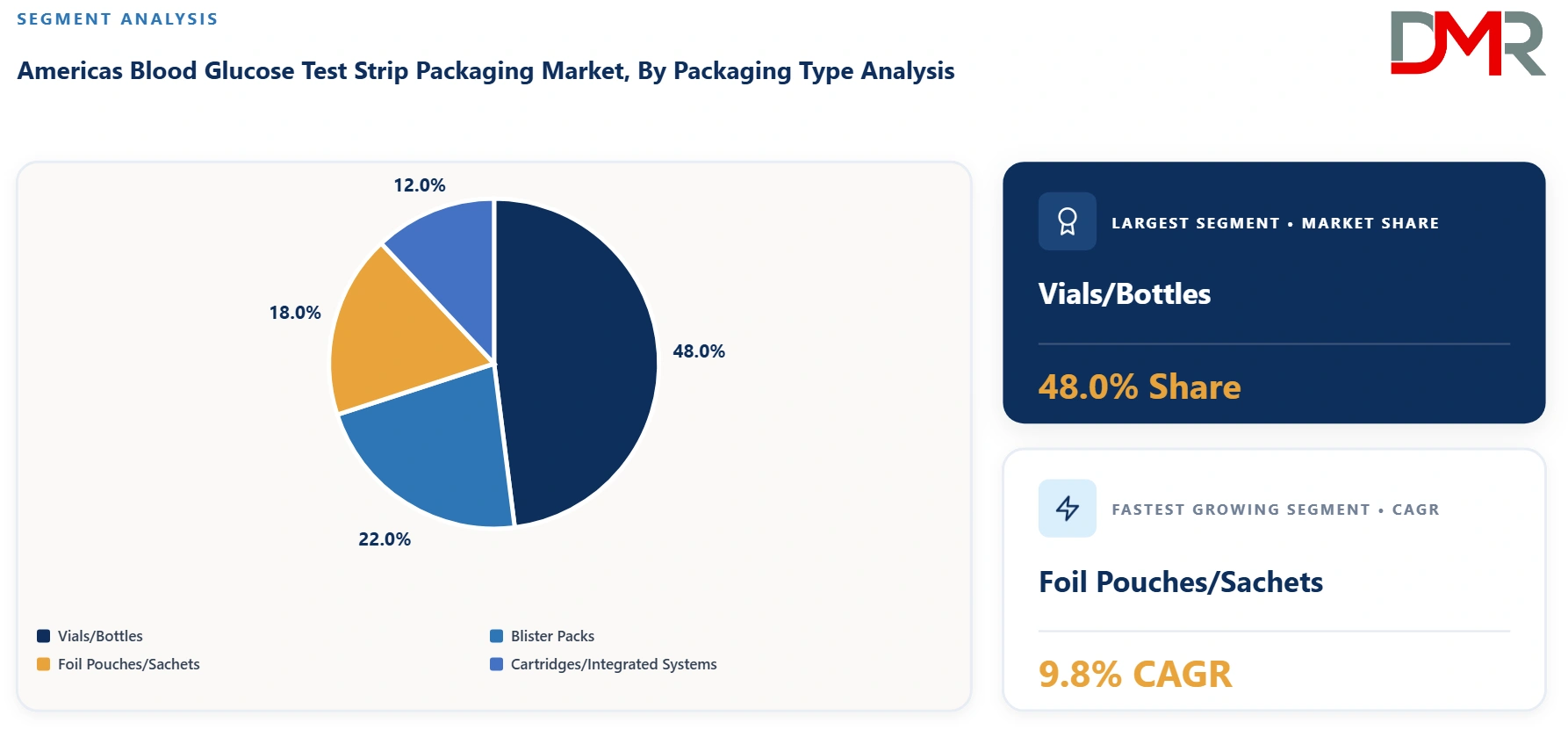
- Vials/Bottles is the leading packaging type segment in 2026: 48.0%
- Plastic is the leading material segment in 2026: 55.0%
- 50-Count is the leading pack size segment in 2026: 40.0%
- Retail Pharmacy is the leading distribution channel segment in 2026: 38.0%
- United States is the leading country segment in 2026: 68.0%
What is the Americas Blood Glucose Test Strip Packaging Market and its Market Size?
The Americas Blood Glucose Test Strip Packaging Market is projected to at USD 148.0 Million in 2026 and is projected to reach USD 215.0 Million by 2035, expanding at a CAGR of 4.2% during the forecast period.
ℹ
To learn more about this report –
Download Your Free Sample Report Here
The market covers the primary, secondary, and tertiary packaging components HDPE/PP vials, snap-caps with integrated desiccant, blister trays, foil pouches and sachets, printed cartons, labels, tamper-evident seals, and shipping cases used to protect, dispense, and brand blood glucose test strips sold across the United States, Canada, Brazil, Mexico, and the rest of Latin America. Because enzymatic reagent strips are hygroscopic and lose accuracy on moisture exposure, packaging in this category performs a functional barrier role in addition to a branding and dispensing role, distinguishing it from generic pharmaceutical or consumer packaging. Growth is being shaped by two offsetting forces: continuing self-monitoring blood glucose (SMBG) strip demand in Latin America, where affordability keeps strips as the dominant glucose-testing modality, against a maturing-to-declining vial-packaging base in the United States and Canada as continuous glucose monitoring (CGM) adoption reduces strip volumes among insulin-intensive users. The packaging mix is gradually shifting from high-volume commodity vials toward smaller, higher-value formats blister packs, individually wrapped foil sachets, and combo travel packs that carry a higher packaging cost per test but better suit retail pharmacy, e-commerce, and private-label distribution.
Use Cases
- Moisture-Barrier Primary Packaging for Reagent Strip Stability: Vial and foil-pouch converters supply desiccant-integrated closures and laminate pouches that keep enzymatic test strips within their validated humidity range from the point of manufacture through the end of a patient's use period, directly protecting reading accuracy.
- Retail Pharmacy Tamper-Evident and Child-Resistant Packaging: Chain and independent pharmacies increasingly require tamper-evident seals and child-resistant closures on over-the-counter diabetic testing supplies, pushing packaging converters toward higher-specification cap and carton designs.
- Contract Packaging for Private-Label and Emerging Regional Strip Brands: Contract packaging organizations (CPOs) provide vial-filling, labeling, and cartoning services to smaller and regional strip manufacturers in Latin America that lack in-house packaging lines, supporting local diagnostic self-sufficiency initiatives.
- Travel and On-the-Go Individually Wrapped Strip Formats: Individually foil-wrapped strip sachets and small combo packs are used by strip brands targeting active, travel-oriented, and newly diagnosed patients who value single-use convenience over bulk vial packs.
Key Takeaways
- Market Size: The Americas Blood Glucose Test Strip Packaging Market is projected to at USD 148.0 Million in 2026 and forecast to reach USD 215.0 Million by 2035, expanding at a CAGR of 4.2%.
- Growth Outlook: Expansion is supported by continued strip-based SMBG demand in Latin America, retail-pharmacy packaging upgrades, and a gradual shift toward higher-value blister and foil-pouch formats, partly offset by CGM-driven strip volume erosion in the United States and Canada.
- Primary Growth Drivers: Rising diagnosed diabetes prevalence in Latin America, tamper-evident and child-resistant packaging requirements at retail pharmacy chains, and growth of private-label and regional strip brands that outsource packaging to contract packagers.
- By Packaging Type Analysis: Vials/Bottles is projected to lead with a 48.0% share in 2026, reflecting the continued dominance of bulk multi-strip formats. Blister Packs hold an estimated 22.0% share and Foil Pouches/Sachets hold 18.0%, with Cartridges/Integrated Systems accounting for the remaining 12.0%.
- By Material Analysis: Plastic (HDPE/PP) is projected to lead the material segment with a 55.0% share in 2026, followed by Paperboard/Cartons at 25.0% and Aluminum Foil/Laminates at 15.0%, with Others (including glass) at 5.0%.
- By Pack Size Analysis: 50-Count packs are projected to lead with a 40.0% share in 2026, followed by 25-Count at 25.0% and 100-Count at 20.0%, with smaller travel packs and bulk 200-count formats together accounting for 15.0%.
- By Distribution Channel Analysis: Retail Pharmacy is expected to lead with a 38.0% share in 2026, followed by Hospital/Institutional at 24.0% and Online/Direct-to-Consumer at 22.0%, with mail-order diabetic supply channels accounting for the remaining 16.0%.
- By Country Analysis: The United States is projected to dominate with a 68.0% share in 2026, followed by Brazil at 10.0%, Canada at 9.0%, Mexico at 6.0%, and the Rest of Latin America at 7.0%.
Key Drivers in the Americas Blood Glucose Test Strip Packaging Market
Rising Diagnosed Diabetes Prevalence and Sustained Strip-Based Testing in Latin America
Diabetes prevalence continues to rise across Latin America, and affordability constraints keep strip-based SMBG as the dominant glucose-testing modality relative to continuous glucose monitoring across most of the diagnosed population. As diagnosis rates improve and public and private healthcare systems expand access to basic diabetic testing supplies, the underlying volume of strips requiring packaging is projected to keep growing in Brazil, Mexico, and other Latin American markets even as growth flattens in the United States and Canada. This regional volume growth is a primary support for overall packaging demand, particularly for cost-efficient vial and blister formats suited to public procurement and retail pharmacy distribution.
Retail Pharmacy and E-Commerce Packaging Specification Upgrades
Retail pharmacy chains and online diabetic-supply retailers across the Americas are tightening packaging specifications for over-the-counter testing supplies, including tamper-evident seals, child-resistant closures, and shelf-ready secondary cartons optimized for planogram and e-commerce fulfillment. These requirements raise the packaging cost per unit relative to legacy plain-vial formats and are projected to be a meaningful contributor to value growth in the market even where underlying strip volumes are flat or declining.
Restraints in the Americas Blood Glucose Test Strip Packaging Market
Continuous Glucose Monitoring Adoption Eroding Strip Volumes in the United States and Canada
Continued adoption of continuous glucose monitoring systems among insulin-intensive patients in the United States and Canada is projected to reduce the underlying volume of strips requiring packaging in these markets over the forecast period, as CGM largely eliminates routine fingerstick SMBG testing for its users. Because the United States alone is projected to represent roughly two-thirds of regional packaging value in 2026, this volume erosion in the largest market structurally caps the overall market's long-run growth rate, even as Latin American volumes continue to expand.
Growth Opportunities in the Americas Blood Glucose Test Strip Packaging Market
Contract Packaging for Regional and Private-Label Strip Manufacturing
Growth of regional and private-label blood glucose test strip brands in Latin America, often produced by manufacturers without in-house packaging capacity, presents an opportunity for contract packaging organizations to provide vial-filling, blister-forming, labeling, and cartoning services. Localization of packaging alongside strip manufacturing also supports government initiatives aimed at reducing import dependence for basic diabetic testing supplies.
Premiumization Through Individually Wrapped and Smart Packaging Formats
Rising interest in individually foil-wrapped strip sachets, small travel combo packs, and packaging carrying QR-code-linked adherence or reorder features presents an opportunity for converters to capture higher value per packaged strip than legacy bulk vial formats, particularly among newly diagnosed and digitally engaged patients purchasing through online and direct-to-consumer channels.
Trends in the Americas Blood Glucose Test Strip Packaging Market
Shift Toward Individually Wrapped and Smaller Combo-Pack Formats
Strip brands are projected to be gradually introducing individually foil-wrapped sachets and smaller combo packs alongside legacy bulk vials, aimed at travel-oriented and newly diagnosed patients who value single-use convenience. This format shift is expected to modestly raise average packaging cost per strip over the forecast period even where total strip volumes are flat.
Integration of Desiccant and Moisture-Barrier Features Directly into Closures
Packaging converters are increasingly integrating desiccant material directly into vial cap liners rather than using separate loose desiccant sachets, simplifying the fill line and reducing the risk of a missing or misplaced desiccant unit. This trend is projected to support incremental value growth in the plastic closures sub-segment of the material category.
Research Scope and Analysis
The Americas Blood Glucose Test Strip Packaging Market covers vials, blisters, foil pouches, and cartridge systems across plastic, paperboard, and aluminum materials. It analyzes 25, 50, and 100-count packs across pharmacy, institutional, online, and mail-order channels in major American countries.
ℹ
To learn more about this report –
Download Your Free Sample Report Here
By Packaging Type Analysis
Vials/Bottles are projected to dominate the Americas Blood Glucose Test Strip Packaging Market with approximately 48.0% market share in 2026. Their leadership is supported by widespread use as the standard primary packaging format for blood glucose test strips, particularly in 25-count, 50-count, and 100-count configurations. These containers provide convenient handling, moisture protection, portability, and compatibility with desiccant systems. Foil Pouches/Sachets are projected to register the highest CAGR over the forecast period, driven by increasing demand for individually protected strips, travel-friendly formats, enhanced barrier properties, improved hygiene, and packaging solutions suitable for online and direct-to-consumer distribution channels across the Americas.
By Material Analysis
Plastic (HDPE/PP) is projected to lead the Americas Blood Glucose Test Strip Packaging Market by material, accounting for approximately 55.0% market share in 2026. Its dominance is primarily attributed to extensive utilization in test-strip vials, bottles, closures, and blister components due to durability, lightweight characteristics, manufacturing scalability, moisture resistance, and cost efficiency. Aluminum Foil/Laminates are projected to record the highest CAGR during the forecast period, supported by growing adoption of individually wrapped test strips and high-barrier packaging. Their ability to provide strong protection against moisture, oxygen, and environmental contamination is expected to strengthen adoption across premium, portable, and e-commerce-oriented glucose testing products.
By Pack Size Analysis
50-Count packs are projected to dominate the Americas Blood Glucose Test Strip Packaging Market by pack size, capturing approximately 40.0% market share in 2026. The segment benefits from its widespread acceptance as a practical dispensing format for routine self-monitoring of blood glucose, particularly among patients purchasing test strips through retail pharmacies and insurance-supported channels. 25-Count packs are projected to register the highest CAGR over the forecast period, supported by increasing demand for affordable, lower-quantity purchases, especially across price-sensitive Latin American markets. Their lower upfront cost, convenient portability, and suitability for occasional testing and newly diagnosed patients are expected to support stronger growth.
By Distribution Channel Analysis
Retail Pharmacy is projected to remain the dominant distribution channel in the Americas Blood Glucose Test Strip Packaging Market, accounting for approximately 38.0% market share in 2026. Its leading position is supported by extensive pharmacy networks, convenient accessibility, prescription fulfillment, insurance reimbursement, and strong consumer preference for purchasing diabetes monitoring supplies through established retail outlets. Online/Direct-to-Consumer is projected to register the highest CAGR during the forecast period, driven by expanding e-commerce penetration, subscription-based diabetic supply services, home delivery, competitive pricing, and growing consumer preference for convenient purchasing. Increasing digital healthcare adoption is further expected to accelerate online distribution across the region.
The Americas Blood Glucose Test Strip Packaging Market Report is segmented based on the following:
By Packaging Type
- Vials/Bottles
- Blister Packs
- Foil Pouches/Sachets
- Cartridges/Integrated Systems
By Material
- Plastic (HDPE/PP)
- Paperboard/Cartons
- Aluminum Foil/Laminates
- Others
By Pack Size
- 25-Count
- 50-Count
- 100-Count
- Others
By Distribution Channel
- Retail Pharmacy
- Hospital/Institutional
- Online/Direct-to-Consumer
- Other
Regional Analysis
The Americas region is projected to be anchored by the United States, which accounts for the large majority of regional packaging value given its scale of diagnosed diabetes, mature retail pharmacy infrastructure, and long-established vial and blister packaging supply base. The United States is projected to hold a 68.0% share in 2026, though its growth is projected to be the slowest in the region given CGM-driven strip volume erosion. Brazil is projected to at approximately 10.0% share, supported by a large and rising diagnosed diabetic population and expanding local strip manufacturing capacity. Canada is projected to at approximately 9.0%, reflecting a smaller but stable strip-testing base and higher per-unit packaging specifications under Health Canada requirements. Mexico is projected to at approximately 6.0%, and the Rest of Latin America together is projected to at approximately 7.0%, with both expected to grow faster than the United States and Canada over the forecast period as diagnosis rates rise and local packaging/converting capacity expands.
By Region
North America
· The U.S.
· Canada
Latin America
· Brazil
· Mexico
· Argentina
· Colombia
· Rest of Latin America
Technology and Innovation Analysis
Packaging innovation in the Americas Blood Glucose Test Strip Packaging Market is projected to center on three areas: integration of desiccant material directly into cap liners and foil laminates rather than as a separate loose component, adoption of tamper-evident and child-resistant closures in response to retail pharmacy chain requirements, and early-stage exploration of smart packaging features such as QR-code-linked reorder and adherence prompts on cartons aimed at online and direct-to-consumer buyers. Sustainability considerations, including recyclable HDPE vial formulations and reduced-plastic blister designs, are also projected to gain gradual traction, particularly among strip brands marketed in the United States and Canada.
Investment and White Space Analysis
Investment opportunities in the Americas Blood Glucose Test Strip Packaging Market are projected to concentrate in contract packaging capacity serving regional and private-label strip manufacturers in Latin America, higher-specification blister and foil-pouch conversion lines serving retail pharmacy and e-commerce channels, and desiccant-integrated closure technology. Meaningful white space is projected to exist in smart/connected packaging and in localized packaging capacity that reduces import dependence for basic diabetic testing supplies in Brazil and Mexico. Converters with flexibility across vial, blister, and pouch formats, combined with retail-pharmacy-grade tamper-evident capability, are projected to be best positioned to capture longer-duration supply agreements, while commodity vial-only converters are projected to face continued margin pressure as United States strip volumes plateau.
Competitive Landscape
The Americas Blood Glucose Test Strip Packaging Market is projected to be fragmented, comprising in-house packaging operations run by major glucose monitoring strip manufacturers, dedicated pharmaceutical and diagnostic contract packaging organizations, and specialized plastics/blister/pouch converters that supply components to strip manufacturers and CPOs. Competition is projected to center on moisture-barrier validation capability, tamper-evident and child-resistant compliance, fill-line flexibility across vial, blister, and pouch formats, and established relationships with strip manufacturers and retail pharmacy chains.
Some of the prominent players in the Americas Blood Glucose Test Strip Packaging Market are:
- Aptar CSP Technologies
- Sanner GmbH
- Multisorb Technologies
- Amcor plc
- IMPAK Corporation
- Flow Dry Technology, Inc.
- LPS Industries, LLC
- Laminatedfilms & Packaging, Inc.
- Wisesorbent Technology LLC
- Airnov Healthcare Packaging
- Sonoco Products Company
- Berry Global Inc.
- TekniPlex Healthcare
- Gerresheimer AG
- Constantia Flexibles
- Oliver Healthcare Packaging
- Nelipak Healthcare Packaging
- Huhtamaki Oyj
- Comar, LLC
- SCHOTT AG
- West Pharmaceutical Services, Inc.
- Abbott Laboratories
- F. Hoffmann-La Roche Ltd
- LifeScan IP Holdings, LLC
- Ascensia Diabetes Care
- ARKRAY, Inc.
- AgaMatrix, Inc.
- Trividia Health, Inc.
- ACON Laboratories, Inc.
- Bionime Corporation
- TaiDoc Technology Corporation
- Rossmax International Ltd.
- i-SENS, Inc.
- Sinocare Inc.
- HMD
- YuHuan KangJia
- Shijiazhuang Xinfuda Medical Packaging Co., Ltd.
- Procurenet Limited
- Avery Dennison Corporation
- Medical Packaging Inc.
- Other Key Player
Recent Developments
- June 2026: Aptar CSP Technologies expanded its active material science portfolio with next-generation moisture-control packaging solutions aimed at improving stability and shelf life for sensitive diagnostic products, including blood glucose test strips.
- September 2025: The company introduced enhanced 3-Phase Activ-Polymer™ technology for in-vitro diagnostic packaging, strengthening moisture management and environmental protection for diagnostic products such as glucose test strips.
- July 2025: Sanner expanded production capacity for desiccant-integrated diagnostic packaging to address increasing demand for point-of-care and test-strip packaging. Its solutions combine plastic tubes with integrated desiccant closures to protect glucose strips against humidity and contamination.
Report Details
| Report Characteristics |
| Market Size (2026) |
USD 148.0 Mn |
| Forecast Value (2035) |
USD 215.0 Mn |
| CAGR (2026–2035) |
4.2% |
| Historical Data |
2021 – 2025 |
| Forecast Data |
2026 – 2035 |
| Base Year |
2025 |
| Segments Covered |
By Component, By Size, By Industry |
| Regional Coverage |
North America – The US and Canada; Latin America – Mexico, Brazil, Colombia, Argentina, Rest of LATAM; |
Frequently Asked Questions
How big is the Americas Blood Glucose Test Strip Packaging Market?
▾ The Americas Blood Glucose Test Strip Packaging Market is projected to at USD 148.0 Million in 2026 and is projected to reach USD 215.0 Million by 2035.
What is the CAGR of the Americas Blood Glucose Test Strip Packaging Market from 2026 to 2035?
▾ The market is projected to expand at a compound annual growth rate (CAGR) of 4.2% between 2026 and 2035.
What factors are driving growth in the Americas Blood Glucose Test Strip Packaging Market?
▾ Growth is projected to be driven by rising diagnosed diabetes prevalence and sustained strip-based testing in Latin America, retail pharmacy and e-commerce packaging specification upgrades, and growth of contract packaging for private-label and regional strip brands.
What is restraining growth in the Americas Blood Glucose Test Strip Packaging Market?
▾ Continuous glucose monitoring adoption among insulin-intensive patients in the United States and Canada is projected to be eroding underlying strip volumes, structurally capping long-run growth in the region's largest packaging market.
Which packaging type leads the Americas Blood Glucose Test Strip Packaging Market?
▾ Vials/Bottles are projected to lead with a 48.0% share in 2026, followed by Blister Packs at 22.0% and Foil Pouches/Sachets at 18.0%.
How is the Americas Blood Glucose Test Strip Packaging Market segmented?
▾ The market is segmented by packaging type, material, pack size, and distribution channel, with value concentrated in the United States, followed by Brazil, Canada, and Mexico.