Market Snapshot
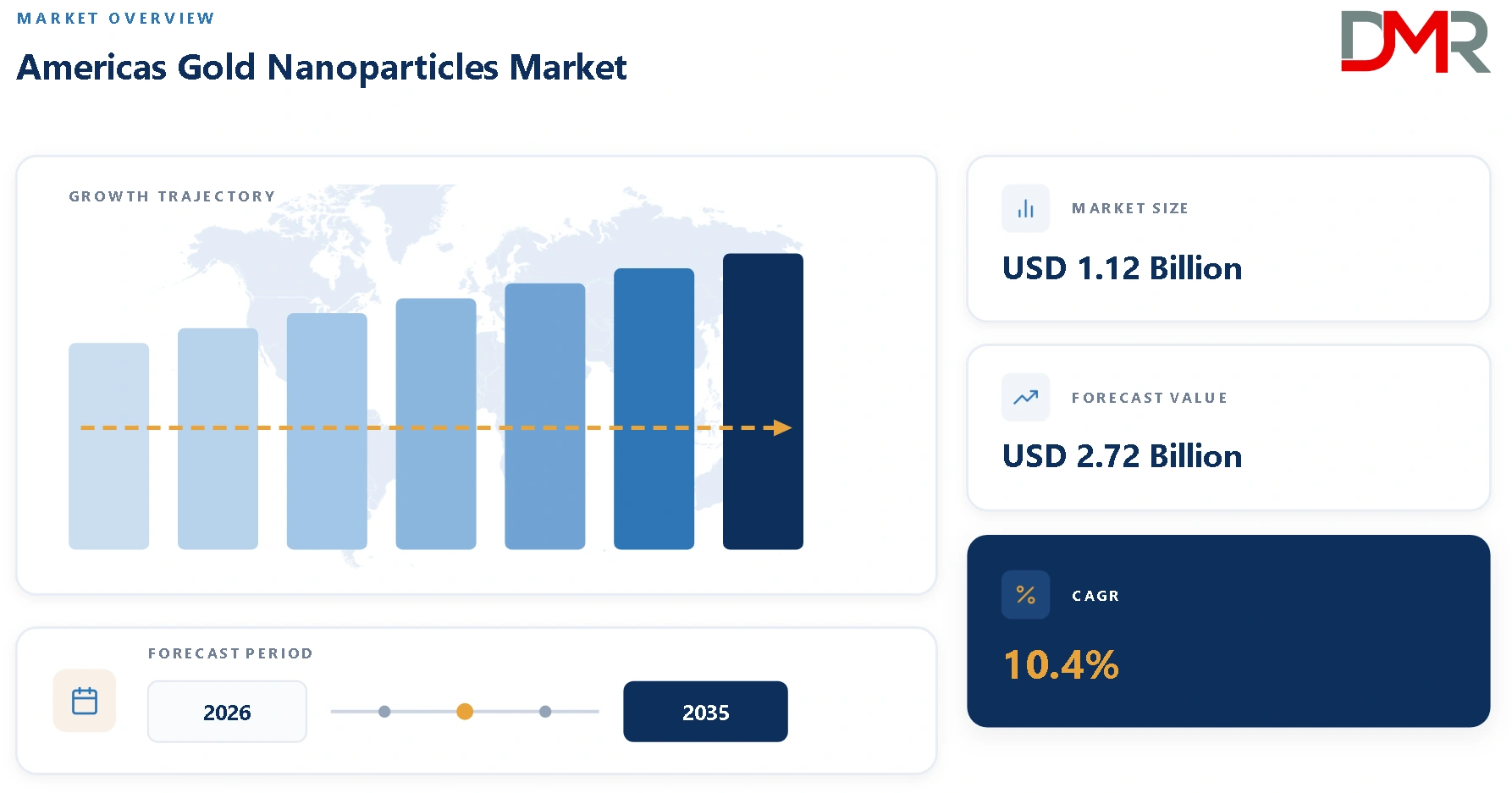
- Market Size (2026): USD 1.12 Bn
- Forecast Value (2035): USD 2.72 Bn
- CAGR (2026-2035): 10.4%
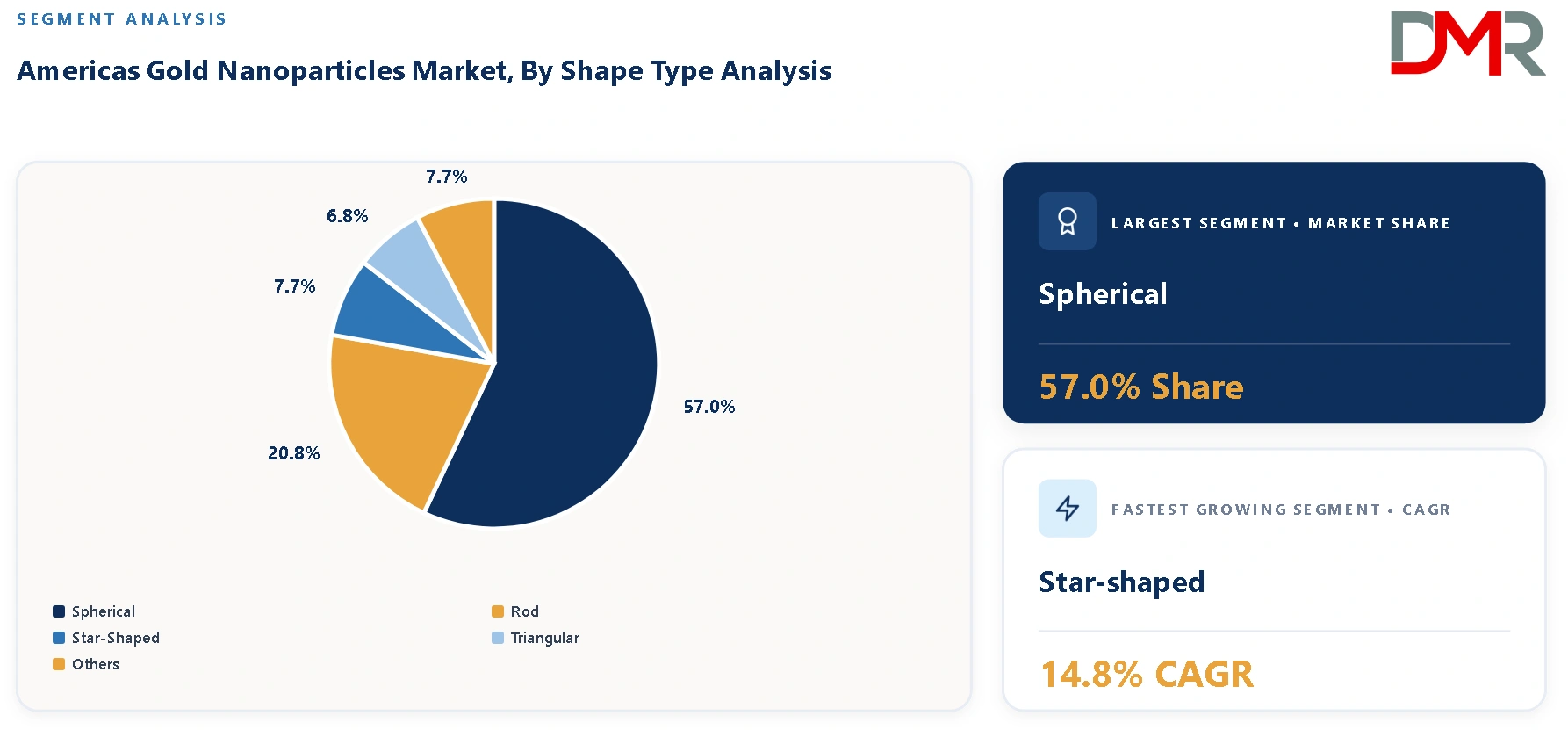
- Leading Shape (2026): Spherical, approximately 57%
- Fastest-Growing Shape: Star-Shaped, at a CAGR of 14.8%
- Leading Particle Size (2026): Less than 10 nm, around 42%
- Leading End User (2026): Pharmaceutical & Biotechnology Companies, close to 35%
- Key Players: Merck KGaA, Cytodiagnostics, nanoComposix, BBI Solutions and others
What is Americas Gold Nanoparticles Market and its Market Size?
The Americas Gold Nanoparticles Market size is estimated to reach USD 1.12 Bn in 2026 and is further anticipated to reach USD 2.72 Bn by 2035, at a CAGR of 10.4%.
ℹ
To learn more about this report –
Download Your Free Sample Report Here
The market covers engineered gold nanoparticles supplied for research, diagnostics, drug delivery, imaging, biosensing and other biomedical or advanced-material applications across the Americas. The scope includes colloidal gold nanoparticles, surface-functionalized particles, conjugated particles, research reagents and application-specific nanoparticle formulations. Revenue from finished medicines or diagnostic tests is excluded unless it directly represents the sale of the gold nanoparticle component or related engineering service.
Gold nanoparticles are valued for their tunable optical, electronic and surface properties. Their localized surface plasmon resonance enables strong light interaction, supporting colorimetric assays, optical biosensors, imaging and photothermal applications. Surface chemistry can also be modified to attach antibodies, nucleic acids, peptides and other targeting molecules, allowing gold nanoparticles to function as signal-enhancement and delivery platforms.
Demand is concentrated in pharmaceutical and biotechnology companies, academic and government research institutes, diagnostics developers, hospitals, contract research organizations and electronics or advanced-material manufacturers. Product selection depends on particle size, morphology, surface chemistry, dispersibility, purity, functionalization and reproducibility. For regulated applications, batch consistency and characterization become as important as nominal particle size.
The Americas market is led by the United States because of its large biomedical research base, strong nanotechnology infrastructure and concentration of pharmaceutical and biotechnology companies. Canada provides additional demand through university research and advanced materials development, while Latin American markets offer longer-term opportunities as diagnostic capacity, research infrastructure and nanotechnology adoption expand.
Use Cases
- Diagnostic Assays: Gold nanoparticles are used as visible labels and signal-enhancement components in immunoassays and nucleic-acid detection workflows. Their optical properties can provide strong signals while surface functionalization enables selective interaction with antibodies or oligonucleotides.
- Drug Delivery Research: Researchers functionalize gold nanoparticles with targeting ligands and therapeutic payloads to study localized delivery. The platform can support investigations into cellular uptake, controlled release and tissue targeting, although clinical translation requires extensive assessment of biodistribution and safety.
- Photothermal Therapy Research: Gold nanostructures with suitable optical absorption can convert light energy into localized heat. Researchers investigate this property for tumor ablation and other therapeutic concepts where nanoparticle accumulation and controlled irradiation can be combined.
- Biosensing and Imaging: Gold nanoparticles support optical and electrochemical biosensors by amplifying measurable signals and enabling molecular recognition. Their use in imaging and sensor development is particularly relevant where high surface area and tunable optical behavior improve assay sensitivity.
Key Takeaways
- Market Size & Share: The market is estimated at USD 1.12 Bn in 2026 and is projected to reach USD 2.72 Bn by 2035.
- Shape Analysis: Spherical particles are expected to account for approximately 57% of 2026 revenue, while star-shaped particles are expanding at a CAGR of 14.8%.
- Particle Size Analysis: Particles smaller than 10 nm are projected to represent around 42% of 2026 demand because of their high surface area and suitability for molecular-scale functionalization.
- Application Analysis: Diagnostics are projected to lead 2026 application demand at approximately 31%, while drug delivery and photothermal applications expand faster.
- End User Analysis: Pharmaceutical and biotechnology companies are expected to account for close to 35% of 2026 demand, supported by drug discovery, nanomedicine and diagnostic development.
- Distribution Channel Analysis: Direct sales are expected to represent around 48% of 2026 revenue, reflecting the technical nature of nanoparticle products and the need for application support.
How AI/Gen AI is Transforming the Americas Gold Nanoparticles Market?
AI is becoming an important tool for nanoparticle design, characterization and application development. Machine learning models can relate synthesis parameters to particle size, morphology, surface chemistry and optical properties, helping researchers narrow experimental conditions before laboratory synthesis. This can reduce trial-and-error cycles in formulation development.
Generative AI is increasingly useful for literature analysis, experimental planning and knowledge management. LLM document processing can structure published synthesis procedures, characterization results and assay conditions, while predictive models can help prioritize nanoparticle formulations for biological testing. The commercial impact is strongest where AI connects synthesis data with downstream performance rather than operating as a standalone analytics layer.
- Nanoparticle Design: Machine learning can predict relationships between synthesis conditions and particle morphology or optical behavior.
- Surface Functionalization: AI can rank ligand or coating combinations for targeted binding and colloidal stability studies.
- LLM Document Processing: AI can organize literature, experimental records and characterization reports for researcher review.
- Image Analysis: Computer vision can assist TEM and microscopy workflows by measuring particle size distribution and morphology.
Key Drivers in the Americas Gold Nanoparticles Market
Demand is being supported by the expansion of nanomedicine research and increasing use of gold nanoparticles in diagnostic and biosensing platforms.
- Growth of Nanomedicine and Targeted Delivery Research: Pharmaceutical and biotechnology researchers are exploring gold nanoparticles as platforms for drug delivery, imaging and combination therapeutic approaches. Their surface can be engineered with targeting molecules, while their optical properties create additional opportunities for photothermal and imaging applications. This broad functionality increases the number of research programs that can use gold nanoparticles even when no single application dominates. Commercial demand therefore grows through a combination of research reagents, customized functionalized particles and specialized development services. Translation into clinical products remains slower because biodistribution, clearance, toxicity and manufacturing consistency require extensive characterization.
- Expansion of Nanoparticle-Based Diagnostics and Biosensing: Gold nanoparticles are widely studied for visible and optical signal generation because their plasmonic properties can produce strong and easily detectable responses. Diagnostic developers can functionalize particles with antibodies or nucleic acids to build selective assays. The move toward rapid and decentralized testing creates opportunities for nanoparticle-enabled formats that simplify instrumentation requirements. As diagnostic platforms become more sensitive and multiplexed, demand increases for highly reproducible particle size, surface chemistry and conjugation performance. This favors suppliers capable of producing application-specific nanoparticles rather than commodity colloidal gold alone.
Restraints in the Americas Gold Nanoparticles Market
Commercialization is constrained by synthesis reproducibility, biological safety questions and the cost of high-quality functionalized materials.
- Reproducibility and Characterization Challenges: Small changes in particle size, morphology, aggregation state and surface chemistry can materially change biological and optical performance. Researchers therefore require extensive characterization using techniques such as electron microscopy, spectroscopy, dynamic light scattering and surface analysis. Batch-to-batch variation can limit the transfer of laboratory findings into scalable products. Suppliers must maintain tight process controls and provide detailed characterization data, increasing manufacturing costs. The issue is particularly important for therapeutic and diagnostic applications, where performance must be demonstrated consistently rather than only in exploratory research.
- Safety and Regulatory Uncertainty: Gold nanoparticles intended for biomedical use can raise questions around biodistribution, cellular uptake, persistence and long-term clearance. The regulatory burden increases when particles are incorporated into therapeutic or diagnostic products because the nanoparticle becomes part of the overall safety and quality assessment. This slows commercialization relative to research-use products. Smaller developers may therefore remain dependent on academic partnerships, CROs and specialized nanoparticle suppliers until sufficient toxicology and manufacturing data are generated.
Growth Opportunities in the Americas Gold Nanoparticles Market
Commercial white space is emerging in functionalized nanoparticles, advanced diagnostics and standardized materials for translational research.
- Functionalized Gold Nanoparticles: Ready-to-use antibody-, DNA-, peptide- and polymer-functionalized particles can reduce development time for customers and generate higher value than unmodified colloids.
- Point-of-Care Diagnostics: Plasmonic colorimetric properties create opportunities for low-instrumentation diagnostic formats, particularly where rapid visual or smartphone-assisted readouts are feasible.
- Translational Nanomedicine: Suppliers that provide reproducible, well-characterized particles under more controlled manufacturing conditions can support the movement of promising academic nanoparticle concepts into preclinical programs.
Trends in the Americas Gold Nanoparticles Market
The market is moving from generic colloidal gold toward engineered, application-specific particles with controlled size, shape and surface chemistry. Buyers increasingly value reproducibility and characterization because nanoparticle properties directly affect assay and biological performance.
- Surface Functionalization: More products are supplied with defined coatings and biological ligands to simplify downstream assay development.
- Plasmonic Biosensing: Gold nanoparticles remain important in optical sensing because aggregation and surface interactions can produce measurable color or spectral changes.
- Shape Engineering: Rods, stars and other anisotropic structures are gaining attention for tunable optical absorption and photothermal applications.
- Standardized Nanomaterials: Research and translational users increasingly request detailed certificates of analysis and tighter particle-size and surface-property specifications.
Research Scope and Analysis
Segment performance is assessed across shape, particle size, application, end user and distribution channel. Each axis identifies the sub-segment carrying the largest share of 2026 revenue and the one expanding fastest through 2035, with the scientific or commercial reason behind each position.
ℹ
To learn more about this report –
Download Your Free Sample Report Here
By Shape
Spherical gold nanoparticles are projected to hold the largest share by shape in 2026, accounting for approximately 57% of revenue because synthesis methods are comparatively mature and spherical particles are compatible with a broad range of diagnostic, biosensing and research workflows. Rods and other anisotropic structures occupy smaller positions but offer differentiated optical behavior. Growth, however, is concentrated in star-shaped particles, expanding at a CAGR of 14.8% between 2026 and 2035 as researchers seek strong electromagnetic field enhancement and tunable plasmonic responses. Their growth is supported by biosensing and photothermal research, although synthesis reproducibility remains more demanding.
By Particle Size
Particles smaller than 10 nm are expected to lead the particle-size axis in 2026, representing around 42% of revenue because small particles provide high surface-area-to-volume ratios and are valuable for molecular conjugation and specialized biological research. The 10-50 nm range remains important for diagnostics and imaging applications. Growth is concentrated in the 51-100 nm range, expanding at a CAGR of 11.9% through 2035 as larger particles and aggregates are explored for stronger optical signals and specialized assay formats. The commercial balance depends on surface chemistry, aggregation control and the target application.
By Application
Diagnostics are projected to lead the application axis in 2026, accounting for approximately 31% of revenue because gold nanoparticles provide strong optical signals and can be functionalized with molecular recognition elements. Biosensing and imaging remain important companion applications, while drug delivery and photothermal therapy have longer translational timelines. Growth is concentrated in drug delivery, expanding at a CAGR of 13.7% from 2026 to 2035 as nanomedicine programs investigate targeted delivery, imaging and combination therapeutic approaches. Clinical translation remains dependent on safety and manufacturing consistency.
By End User
Pharmaceutical and biotechnology companies are projected to account for close to 35% of 2026 revenue because they use gold nanoparticles across drug delivery research, diagnostic development, imaging and nanomedicine programs. Academic and government institutes remain a large research base, while diagnostics companies purchase application-specific particles for assay development. Growth is concentrated in contract research organizations, expanding at a CAGR of 12.5% between 2026 and 2035 as developers outsource nanoparticle synthesis, functionalization, characterization and biological testing to specialized providers.
By Distribution Channel
Direct sales are expected to lead distribution in 2026 at around 48% of revenue because technical nanoparticle products often require application consultation, customization and detailed characterization. Distributors remain important for standardized research-use materials and regional laboratory coverage. Growth is concentrated in online channels, expanding at a CAGR of 13.2% through 2035 as standardized nanoparticle products become easier to compare and order digitally. Customized and regulated materials are expected to remain more dependent on direct technical sales.
The Americas Gold Nanoparticles Market Report is Segmented Based on the Following
By Shape
- Spherical
- Rod
- Star-Shaped
- Triangular
- Others
By Particle Size
- Less than 10 nm
- 10-50 nm
- 51-100 nm
- Above 100 nm
By Application
- Diagnostics
- Biosensing
- Drug Delivery
- Imaging
- Photothermal Therapy
- Electronics & Catalysis
- Others
By End User
- Pharmaceutical & Biotechnology Companies
- Academic & Government Research Institutes
- Diagnostics Companies
- Hospitals & Clinical Laboratories
- Contract Research Organizations
- Others
By Distribution Channel
- Direct Sales
- Distributors
- Online Channels
- Others
Regulatory Landscape
Regulatory requirements vary substantially according to whether gold nanoparticles are sold as research-use materials, incorporated into diagnostic products or developed as components of therapeutic products. In the United States, diagnostic and therapeutic applications can trigger FDA requirements, while research-use-only materials generally follow a different commercial framework. Canada and Latin American countries apply their own product registration, import and medical-device requirements. The commercial opportunity is for suppliers that maintain clear intended-use documentation, characterization data and traceability. The principal restraint is the additional validation required when research-grade nanoparticles transition into regulated diagnostics or therapeutics.
Technology Analysis
Gold nanoparticle technology is evolving through tighter control of size, morphology, surface chemistry and functionalization. Conventional spherical colloids remain the volume foundation, while rods and stars provide more specialized plasmonic properties. The commercial white space lies in reproducible, application-specific particles with defined surface chemistry and certificates of analysis. The principal technical challenge is maintaining particle properties during scale-up and storage. Suppliers that can control aggregation, ligand density and batch-to-batch optical behavior can capture higher-value applications in diagnostics and nanomedicine.
Competitive Landscape
Competition includes specialist nanoparticle manufacturers, diversified life sciences companies, research reagent suppliers and companies developing downstream diagnostic or therapeutic platforms. Specialist suppliers compete through particle customization, characterization and application support, while diversified distributors benefit from broad laboratory reach. Competitive differentiation is increasingly based on reproducibility, functionalization options, technical documentation and the ability to supply application-ready particles rather than commodity gold colloids alone.
Some of the Prominent Players in the Americas Gold Nanoparticles Market Are
- Merck KGaA
- Cytodiagnostics
- nanoComposix
- BBI Solutions
- Nanopartz
- Tanaka Holdings
- Nanophase Technologies
- American Elements
- US Research Nanomaterials
- nanoComposix, a Fortis Life Sciences company
- Ocean NanoTech
- Sigma-Aldrich
- Thermo Fisher Scientific
- Danaher
- Creative Diagnostics
- CD Bioparticles
- NanoHybrids
- NanoSeedz
- Nanocs
- Nanophase Technologies Corporation
- Strem Chemicals
- Hongwu International Group
- Eprui Biotech
- BBInternational
- Nanografi Nano Technology
- PlasmaChem
- Nanogap
- Aurion Biotech
- Advanced Nano Products
- Cline Scientific
- Cytiva
- Bio-Rad Laboratories
- Abcam
- QuidelOrtho
- Fisher Scientific
- US Nano
- American Nano LLC
- Nanocs Inc.
- nanoComposix Inc.
- Nanopartz Inc.
- Other Key Players
Recent Developments
- In 2026, nanoparticle suppliers continued expanding application-specific gold nanoparticle portfolios, including surface-functionalized and specialty morphology products for biosensing, imaging and research workflows.
- In 2026, diagnostic developers continued evaluating plasmonic gold nanoparticle formats for rapid and decentralized testing, increasing demand for particles with controlled surface chemistry and reproducible optical response.
- In 2026, pharmaceutical and biotechnology research organizations increased focus on nanomedicine characterization and translational workflows, strengthening demand for well-characterized gold nanoparticles and specialized engineering services.
- In 2025, advanced materials suppliers continued improving synthesis and characterization workflows for engineered gold nanoparticles, supporting research into biosensing, drug delivery and photothermal applications.
- In 2025, demand for customized and functionalized nanoparticle materials expanded across academic and biotechnology research, increasing the importance of application-specific surface chemistry and technical support.
Report Details
| Report Characteristics |
| Market Size (2026) |
USD 1.12 Bn |
| Forecast Value (2035) |
USD 2.72 Bn |
| CAGR (2026–2035) |
10.4% |
| Historical Data |
2021 – 2025 |
| Forecast Data |
2026 – 2035 |
| Base Year |
2025 |
| Segments Covered |
By Shape, By Particle Size, By Application, By End User, and By Distribution Channel |
| Regional Coverage |
Americas - United States, Canada, Brazil, Mexico, Argentina, Colombia, Chile, and Rest of Latin America |
Frequently Asked Questions
How big is the Americas Gold Nanoparticles Market?
▾ The Americas Gold Nanoparticles Market is estimated at USD 1.12 Bn in 2026 and is projected to reach USD 2.72 Bn by 2035. The scope includes gold nanoparticles supplied for research, diagnostics, biosensing, drug delivery, imaging, photothermal research and selected advanced-material applications.
What is the growth rate of the Americas Gold Nanoparticles Market?
▾ The Americas Gold Nanoparticles Market is projected to expand at a CAGR of 10.4% from 2026 to 2035. Growth is supported by nanomedicine research, diagnostic and biosensing applications, increasing functionalization and greater demand for reproducibly characterized nanomaterials.
Which country holds the largest share in the Americas Gold Nanoparticles Market?
▾ The United States is expected to hold the largest share of the Americas Gold Nanoparticles Market because of its concentration of pharmaceutical and biotechnology companies, nanotechnology research institutions, advanced diagnostic developers and specialized nanoparticle suppliers.
Who are the key players in the Americas Gold Nanoparticles Market?
▾ Key players include Merck KGaA, Cytodiagnostics, nanoComposix, BBI Solutions, Nanopartz, Tanaka Holdings, American Elements, US Research Nanomaterials, Ocean NanoTech, Thermo Fisher Scientific and other specialist nanoparticle suppliers.
What is the leading shape in the Americas Gold Nanoparticles Market?
▾ Spherical gold nanoparticles are expected to remain the leading shape, accounting for approximately 57% of 2026 revenue. Their mature synthesis routes and broad compatibility with diagnostics, biosensing and research applications support their leading position.
Which shape is growing fastest?
▾ Star-shaped gold nanoparticles are projected to be the fastest-growing shape segment, expanding at a CAGR of approximately 14.8% from 2026 to 2035. Their growth is supported by strong plasmonic field enhancement and applications in biosensing and photothermal research.
Which end user represents the largest demand pool in Americas Gold Nanoparticles Market ?
▾ Pharmaceutical and biotechnology companies are expected to represent close to 35% of 2026 demand. These organizations use gold nanoparticles across drug delivery, imaging, diagnostics and nanomedicine research, while CROs are growing as specialized nanoparticle engineering and characterization are increasingly outsourced.