Market Snapshot
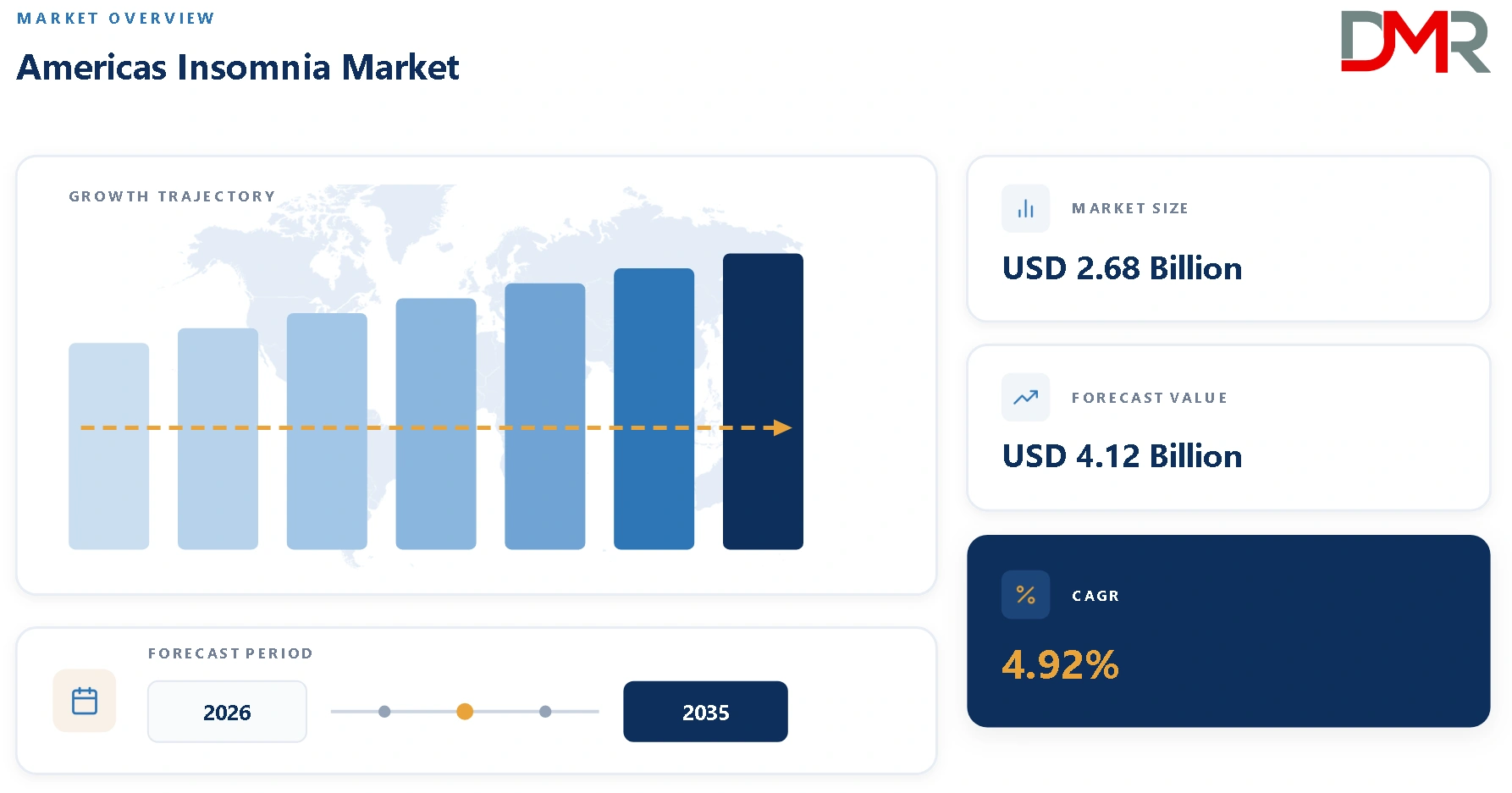
- Market Size (2026): USD 2.68 Bn
- Forecast Value (2035): USD 4.12 Bn
- CAGR (2026-2035): 4.92%
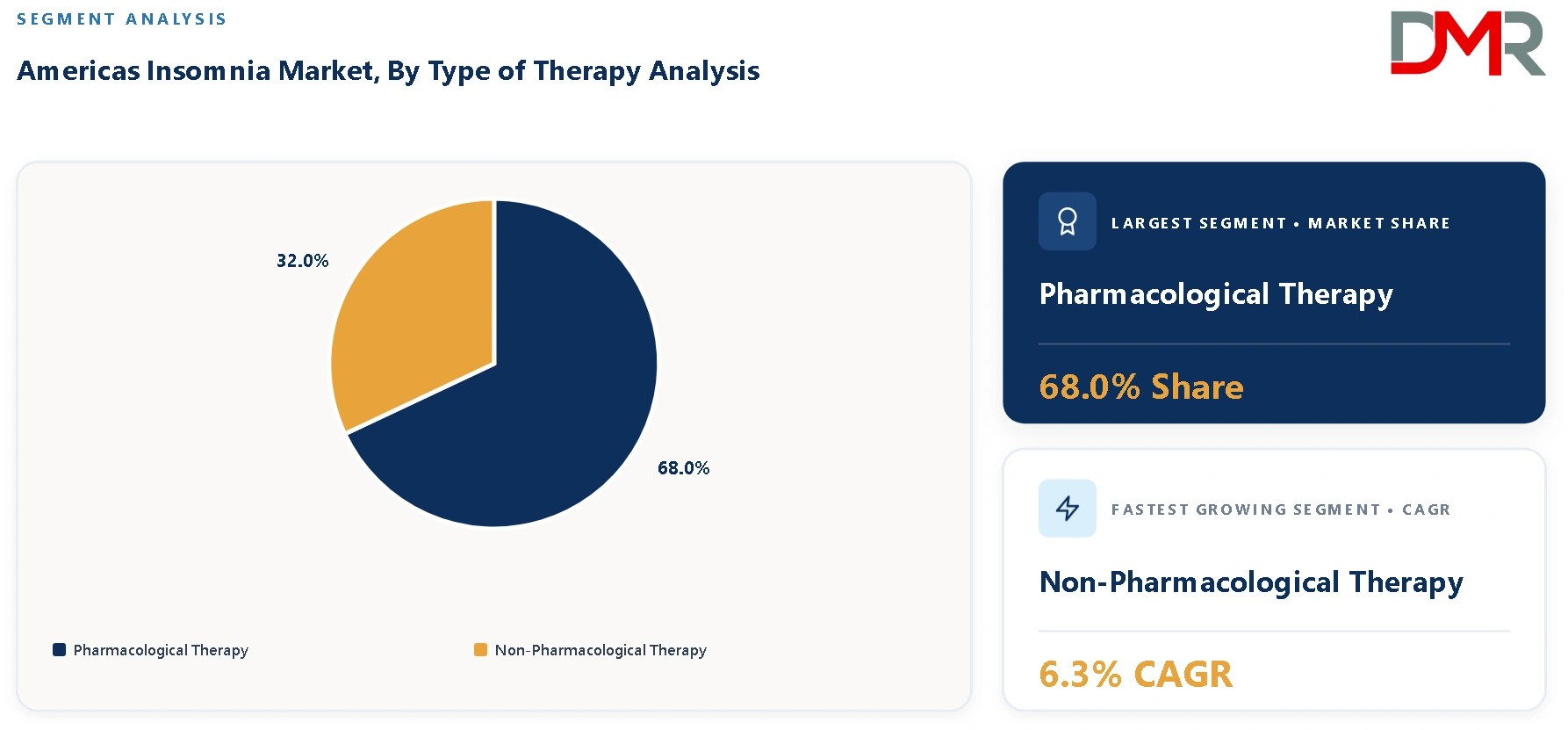
- Leading Therapy (2026): Pharmacological Therapy, approximately 68%
- Fastest-Growing Therapy: Non-Pharmacological Therapy, at approximately 6.3% CAGR
- Leading Drug Formulation: Tablets, around 58% of pharmacological-treatment revenue
- Leading Disease Type: Sleep Maintenance, approximately 45%
- Leading Distribution Channel: Retail Pharmacies, close to 46%
What is Americas Insomnia Market and its Market Size?
The Americas Insomnia Market is estimated to reach USD 2.68 Bn in 2026 and is further anticipated to reach USD 4.12 Bn by 2035, at a CAGR of 4.92%. The published Americas-specific outlook reports USD 2.43 billion in 2024, USD 2.55 billion in 2025 and USD 4.12 billion in 2035, with a 4.92% CAGR. The 2026 estimate in this RD is derived from the published 2025 base and CAGR.
ℹ
To learn more about this report –
Download Your Free Sample Report Here
The market encompasses pharmacological and non-pharmacological approaches used to manage insomnia. Pharmacological therapy includes prescription and non-prescription medicines, while non-pharmacological therapy includes cognitive behavioral therapy for insomnia, behavioral interventions, digital therapeutics and technology-enabled sleep care. Insomnia treatment demand is influenced by symptom pattern, patient characteristics, safety, treatment access and physician preference.
Pharmacological therapy remains the largest treatment component because medicines are widely available and familiar to patients and clinicians. At the same time, the treatment landscape is diversifying toward newer mechanisms such as orexin antagonists and toward behavioral and digital interventions that can support longer-term management. FDA materials list multiple approved insomnia therapies, including suvorexant, lemborexant, daridorexant, zolpidem, eszopiclone, ramelteon and doxepin.
The United States represents the largest country market in the Americas. Published U.S. insomnia therapeutics data estimate USD 998.4 million in 2026 and USD 1.33 billion by 2033, while North America remains the largest regional market in broader insomnia therapeutics research.
Use Cases
- Sleep Initiation Management: Treatment approaches are used to reduce difficulty falling asleep and improve sleep latency.
- Sleep Maintenance Management: Therapies address repeated nighttime awakenings and difficulty returning to sleep.
- Chronic Insomnia Management: CBT-I, digital interventions and appropriately selected medicines can be combined into longer-term treatment pathways.
- Remote and Digital Sleep Care: Telehealth, digital CBT-I and connected sleep monitoring extend insomnia care beyond traditional specialist settings.
Key Takeaways
- Market Size: USD 2.68 Bn in 2026, projected to reach USD 4.12 Bn by 2035.
- Therapy: Pharmacological therapy leads, while non-pharmacological treatment is growing faster.
- Formulation: Tablets are the leading drug formulation.
- Disease Type: Sleep maintenance is the leading disease-type segment.
- Distribution: Retail pharmacies lead, while online channels expand.
- Geography: The United States is the dominant country market.
How AI/Gen AI is Transforming the Americas Insomnia Market?
AI is increasingly used for sleep-pattern analysis, treatment personalization and longitudinal monitoring. Machine learning can evaluate sleep timing, duration and fragmentation from patient-reported or connected-device data. Generative AI can support structured sleep education, summarize sleep diaries and assist digital CBT-I workflows under appropriate clinical governance.
- Sleep Pattern Analysis: AI can identify longitudinal changes in sleep timing and fragmentation.
- Treatment Personalization: Predictive models can help identify characteristics associated with treatment response.
- Digital CBT-I Support: Generative systems can assist with structured behavioral education and adherence support.
- Clinical Documentation: AI can summarize sleep diaries and questionnaires for clinician review.
Key Drivers in the Americas Insomnia Market
- Rising Awareness and Diagnosis: Growing recognition of insomnia as a clinically important condition increases treatment-seeking and expands the addressable patient population. Telehealth and digital screening can further reduce access barriers.
- Shift Toward Newer and Safer Treatment Options: The treatment mix is diversifying beyond traditional hypnotics toward orexin antagonists, melatonin-related therapies, behavioral interventions and digital care. Current FDA materials confirm multiple approved pharmacological options.
Restraints in the Americas Insomnia Market
- Safety and Tolerability Concerns: Dependence, tolerance, next-day impairment and other adverse-effect considerations can restrict the long-term use of some sedative-hypnotic therapies.
- Limited Access to Behavioral Insomnia Care: Access to trained CBT-I providers remains uneven, particularly outside major metropolitan areas, creating a gap between clinical need and available behavioral care.
Growth Opportunities in the Americas Insomnia Market
- Digital CBT-I and Telehealth: Digital delivery can broaden access to evidence-based behavioral insomnia management.
- Orexin-Based Therapies: Dual orexin receptor antagonists provide differentiated pharmacological options for appropriate patients.
- Integrated Sleep Platforms: Combining screening, behavioral interventions, medication management and connected sleep data can create comprehensive care pathways.
Trends in the Americas Insomnia Market
- Growth of Orexin Antagonists: Newer mechanisms are broadening pharmacological treatment choices.
- Digital CBT-I: Digital behavioral treatment is expanding access to structured insomnia care.
- Telehealth-Based Sleep Care: Remote consultation and monitoring are increasing access.
- Personalized Sleep Management: Treatment decisions increasingly incorporate symptom pattern, patient characteristics and longitudinal sleep data.
Research Scope and Analysis
Segment performance is assessed across therapy, drug formulation, disease type, distribution channel and end user.
ℹ
To learn more about this report –
Download Your Free Sample Report Here
By Type of Therapy
Pharmacological therapy is projected to lead in 2026 at approximately 68% because medicines remain broadly available and are a major component of insomnia treatment. Non-pharmacological therapy is expected to expand faster, at approximately 6.3% CAGR, as CBT-I, digital therapeutics and behavioral interventions gain adoption.
By Drug Formulation
Tablets are expected to lead at approximately 58% of pharmacological-treatment revenue because oral tablets are convenient and widely represented across insomnia medicines. Capsules and other formulations serve more product-specific needs.
By Type of Disease
Sleep maintenance is projected to lead at approximately 45% of 2026 demand because difficulty maintaining sleep is a major insomnia presentation. Growth is supported by therapies targeting sleep continuity and nighttime wakefulness.
By Distribution Channel
Retail pharmacies are expected to lead at around 46% of 2026 revenue due to broad geographic access. Online channels are expected to grow faster as e-pharmacy and telehealth become more integrated with insomnia care.
By End User
Hospitals and specialty sleep centers are projected to lead at approximately 34% of 2026 demand, while homecare settings are expected to grow faster as digital CBT-I, telehealth and connected sleep monitoring move care outside traditional facilities.
The Americas Insomnia Market Report is Segmented Based on the Following
By Type of Therapy
- Pharmacological Therapy
- Non-Pharmacological Therapy
By Drug Formulation
By Type of Disease
- Poor Quality of Sleep
- Sleep Maintenance
- Others
By Distribution Channel
- Hospital Pharmacies
- Retail Pharmacies
- Online Channels
- Others
By End User
- Hospitals & Specialty Sleep Centers
- Clinics
- Homecare Settings
- Others
Regional Analysis
North America is the leading part of the Americas market, while Latin America represents a smaller but growing opportunity. Published data place North America as the largest regional insomnia therapeutics market and Latin America at USD 162.3 million in 2024, projected to reach USD 205.3 million by 2030.
United States
The United States is the dominant country market. Published estimates place U.S. insomnia therapeutics revenue at USD 998.4 million in 2026, reaching USD 1.33 billion by 2033.
Canada
Canada is an important secondary market supported by established healthcare infrastructure and growing attention to sleep health. Adoption is influenced by regulatory review, reimbursement and access to specialist and digital care.
Brazil and Mexico
Brazil and Mexico are important Latin American opportunities because of population scale and expanding healthcare infrastructure. Latin America is expected to grow steadily from a smaller base.
Regulatory Landscape
Prescription medicines are regulated by national authorities. In the United States, FDA approval and labeling requirements govern prescription insomnia therapies. Canada applies Health Canada requirements, while Brazil and Mexico use national regulatory agencies including ANVISA and COFEPRIS. Digital therapeutics introduce additional requirements related to software evidence, clinical validation, privacy and medical-device regulation.
Technology Analysis
Insomnia management is moving toward integrated digital and data-enabled care. Wearables, sleep-monitoring devices, smartphone interventions and AI-supported analytics can generate longitudinal data and support personalized treatment. Digital CBT-I can extend structured behavioral treatment to patients who cannot readily access specialist care. Key technology challenges include evidence generation, engagement, privacy and interoperability.
Competitive Landscape
Competition includes large pharmaceutical companies, specialty neuroscience companies, digital therapeutics providers and sleep-technology companies. Pharmaceutical products compete on efficacy, mechanism, tolerability, duration and reimbursement, while digital providers compete on clinical evidence, engagement and integration. Published industry listings include Pfizer, Sanofi, Takeda, Merck, Vanda, Sumitomo Pharma, Big Health and ResMed among other market participants.
Some of the Prominent Players in the Americas Insomnia Market Are
- Pfizer Inc.
- Merck & Co., Inc.
- Eli Lilly and Company
- Teva Pharmaceutical Industries Ltd.
- AstraZeneca PLC
- Sanofi S.A.
- Takeda Pharmaceutical Company Limited
- Eisai Co., Ltd.
- Vanda Pharmaceuticals Inc.
- Sumitomo Pharma Co., Ltd.
- Idorsia Ltd.
- Minerva Neurosciences, Inc.
- Neurim Pharmaceuticals Ltd.
- Ebb Therapeutics
- Biogen Inc.
- AbbVie Inc.
- Johnson & Johnson
- F. Hoffmann-La Roche Ltd
- Novartis AG
- Boehringer Ingelheim
- Otsuka Pharmaceutical Co., Ltd.
- Acadia Pharmaceuticals Inc.
- Jazz Pharmaceuticals plc
- Apnimed
- Cereve Inc.
- Big Health
- ResMed Inc.
- Pear Therapeutics
- Neurovalens
- Electromedical Products International
- SleepScore Labs
- Nox Medical
- Philips
- Fisher & Paykel Healthcare
- Compumedics Limited
- Somnoware
- HST Medical
- Itamar Medical
- Somnowell
- Merck KGaA
- Other Key Players
Recent Developments
- In 2026, the Americas insomnia market continued shifting toward diversified treatment pathways combining pharmacological, behavioral and digital approaches.
- In 2026, newer orexin-based medicines continued strengthening the pharmacological treatment landscape for patients seeking alternatives to older hypnotic approaches.
- In 2026, digital sleep-care providers continued expanding remote CBT-I, sleep tracking and AI-supported patient engagement.
- In 2025, North America remained the leading region in insomnia therapeutics, supported by awareness, healthcare spending and access to established and newer therapies.
- In 2025, the U.S. insomnia therapeutics market was estimated at USD 963.6 million, with benzodiazepines identified as the largest type segment in published market data.
Report Details
| Report Characteristics |
| Market Size (2026) |
USD 2.68 Bn |
| Forecast Value (2035) |
USD 4.12 Bn |
| CAGR (2026–2035) |
4.92% |
| Historical Data |
2021 – 2025 |
| Forecast Data |
2026 – 2035 |
| Base Year |
2025 |
| Segments Covered |
By Therapy, By Drug Formulation, By Disease Type, By Distribution Channel, and By End User |
| Regional Coverage |
Americas - United States, Canada, Brazil, Mexico, Argentina, Colombia, Chile, and Rest of Latin America |
Frequently Asked Questions
How big is the Americas Insomnia Market?
▾ The market is estimated at USD 2.68 Bn in 2026 and projected to reach USD 4.12 Bn by 2035. The 2035 value and 4.92% CAGR align with the published Americas-specific outlook.
What is the growth rate?
▾ The Americas Insomnia Market is projected to expand at approximately 4.92% CAGR through 2035.
Which country holds the largest share?
▾ The United States is expected to hold the largest share of the Americas market.
Who are the key players in Americas Insomnia Market ?
▾ Key players include Pfizer, Merck, Eli Lilly, Teva, AstraZeneca, Sanofi, Takeda, Vanda, Sumitomo Pharma, Idorsia, Big Health and ResMed, among others.
What is the leading therapy in Americas Insomnia Market ?
▾ Pharmacological therapy is expected to remain the leading therapy category because medicines are broadly available and widely used. Broader insomnia-treatment research also identifies drug treatment as the largest component.
Which therapy is growing fastest in Americas Insomnia Market ?
▾ Non-pharmacological therapy is expected to grow faster as CBT-I, digital therapeutics and telehealth-based behavioral care expand.