Americas Orthopedic Biomaterial Market Snapshot
- Americas Orthopedic Biomaterial Market Size in 2026: USD 9.8 Billion
- Americas Orthopedic Biomaterial Market Size in 2035: USD 18.6 Billion
- Americas CAGR from 2026 to 2035: 7.4%
- Metallic Biomaterials is the leading material type segment in 2026: 44.6%
- Joint Reconstruction is the leading application segment in 2026: 41.8%
- Hospitals is the leading end user segment in 2026: 64.2%
- North America is the leading region segment in 2026: 79.3%
What is the Americas Orthopedic Biomaterial Market and its Market Size?
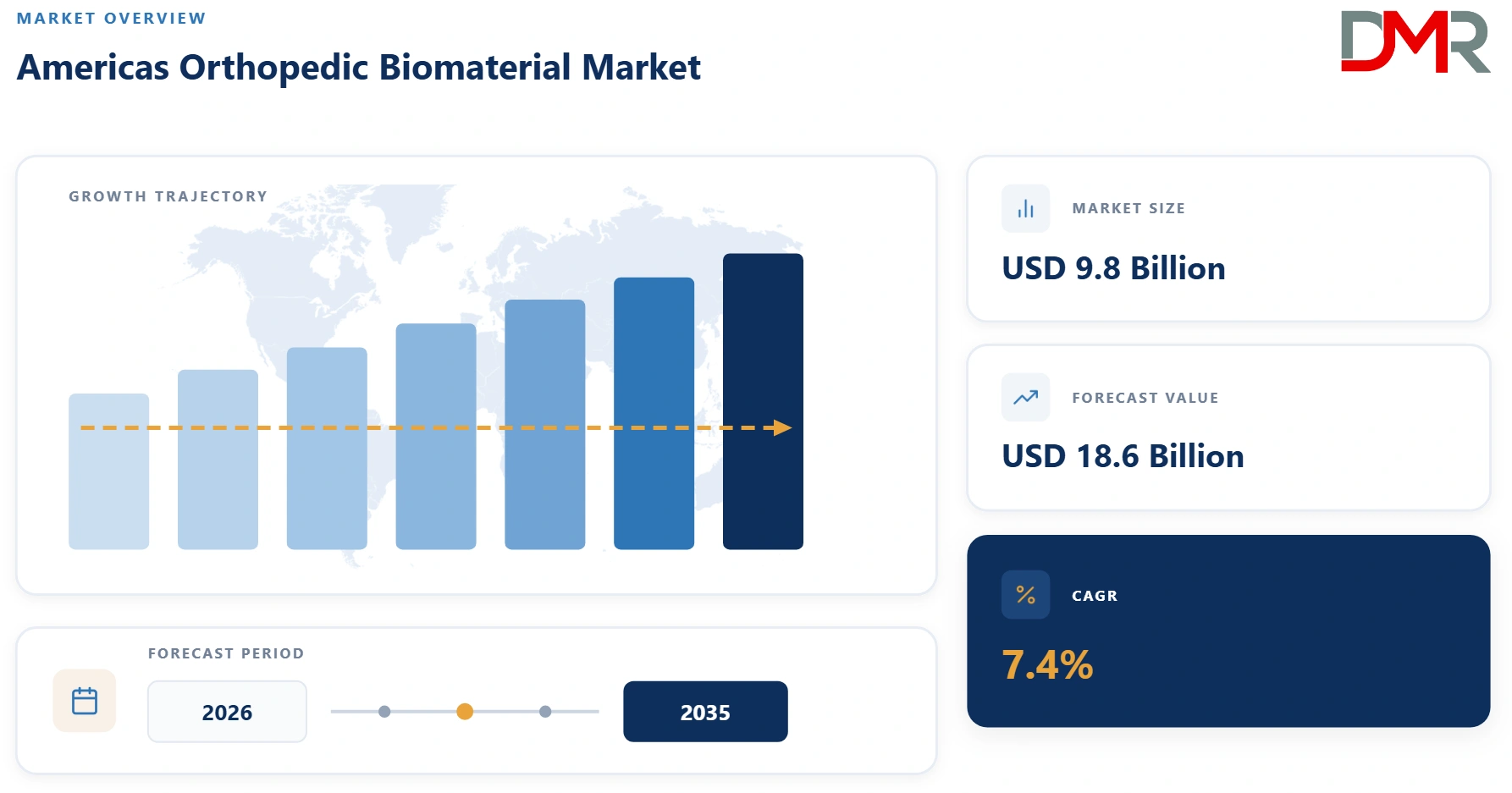
The Americas Orthopedic Biomaterial Market is projected to be valued at USD 9.8 Billion in 2026 and is projected to reach USD 18.6 Billion by 2035, expanding at a CAGR of 7.4% during the forecast period.
ℹ
To learn more about this report –
Download Your Free Sample Report Here
Growth is being propelled by the region's rapidly aging population driving sustained growth in osteoarthritis, osteoporosis-related fracture, and degenerative spinal condition incidence requiring joint reconstruction and spinal fusion procedures, continued innovation in advanced polymeric and ceramic biomaterials offering improved wear resistance, biocompatibility, and bone integration relative to earlier-generation materials, and sustained hospital and ambulatory surgical center investment in orthopedic surgical capacity across both mature North American healthcare systems and rapidly developing Latin American markets. The maturing of advanced PEEK and highly cross-linked polyethylene materials extending implant longevity and reducing revision surgery rates, growing adoption of biological and natural biomaterials including demineralized bone matrix and collagen-based products supporting bone graft substitute applications, and continued expansion of Latin American orthopedic surgical infrastructure and training capacity across Brazil, Mexico, Colombia, and Argentina are reshaping the market from a largely metallic implant-dominated category into an increasingly diversified, materials science-driven orthopedic biomaterial industry. Investment is accelerating as biomaterial manufacturers and healthcare providers expand advanced material adoption across the region's varied and growing orthopedic surgical markets.
Use Cases
- Titanium and Cobalt-Chromium Alloy Implants for Joint Reconstruction: Orthopedic surgeons across the United States, Canada, and leading Latin American hospital systems use titanium and cobalt-chromium alloy components for hip and knee joint replacement procedures, addressing the region's substantial and growing osteoarthritis patient population requiring joint reconstruction.
- PEEK and Advanced Polymer Implants for Spinal Fusion Procedures: Spine surgeons use PEEK and other advanced polymeric interbody devices for spinal fusion procedures, offering favorable radiolucency for post-surgical imaging and biomechanical properties closely matching natural bone compared to traditional metallic spinal implant materials.
- Calcium Phosphate and Hydroxyapatite Ceramic Bone Graft Substitutes: Orthopedic and trauma surgeons use calcium phosphate and hydroxyapatite ceramic bone graft substitute materials to promote bone healing and fusion in spinal, trauma, and reconstructive surgical applications, reducing reliance on autologous bone graft harvesting.
- Demineralized Bone Matrix and Collagen-Based Products for Bone Healing Support: Surgeons use demineralized bone matrix and collagen-based biological biomaterial products to support bone healing across trauma, spinal fusion, and joint reconstruction procedures, leveraging these materials' osteoinductive properties to promote natural bone regeneration.
Key Takeaways
- Market Size: The Americas Orthopedic Biomaterial Market is anticipated to be valued at USD 9.8 Billion in 2026 and is forecast to reach USD 18.6 Billion by 2035, expanding at a CAGR of 7.4%.
- Growth Outlook: Market expansion is sustained by the region's aging population driving joint reconstruction and spinal fusion procedure volume growth, continued advanced biomaterial innovation improving implant longevity and biocompatibility, and expanding orthopedic surgical infrastructure investment across both North America and Latin America.
- Primary Growth Drivers: Rapidly aging populations driving osteoarthritis and degenerative spinal condition incidence growth, continued innovation in advanced polymeric and ceramic biomaterials, growing adoption of biological bone graft substitute materials, and expanding Latin American orthopedic surgical infrastructure investment are accelerating market growth.
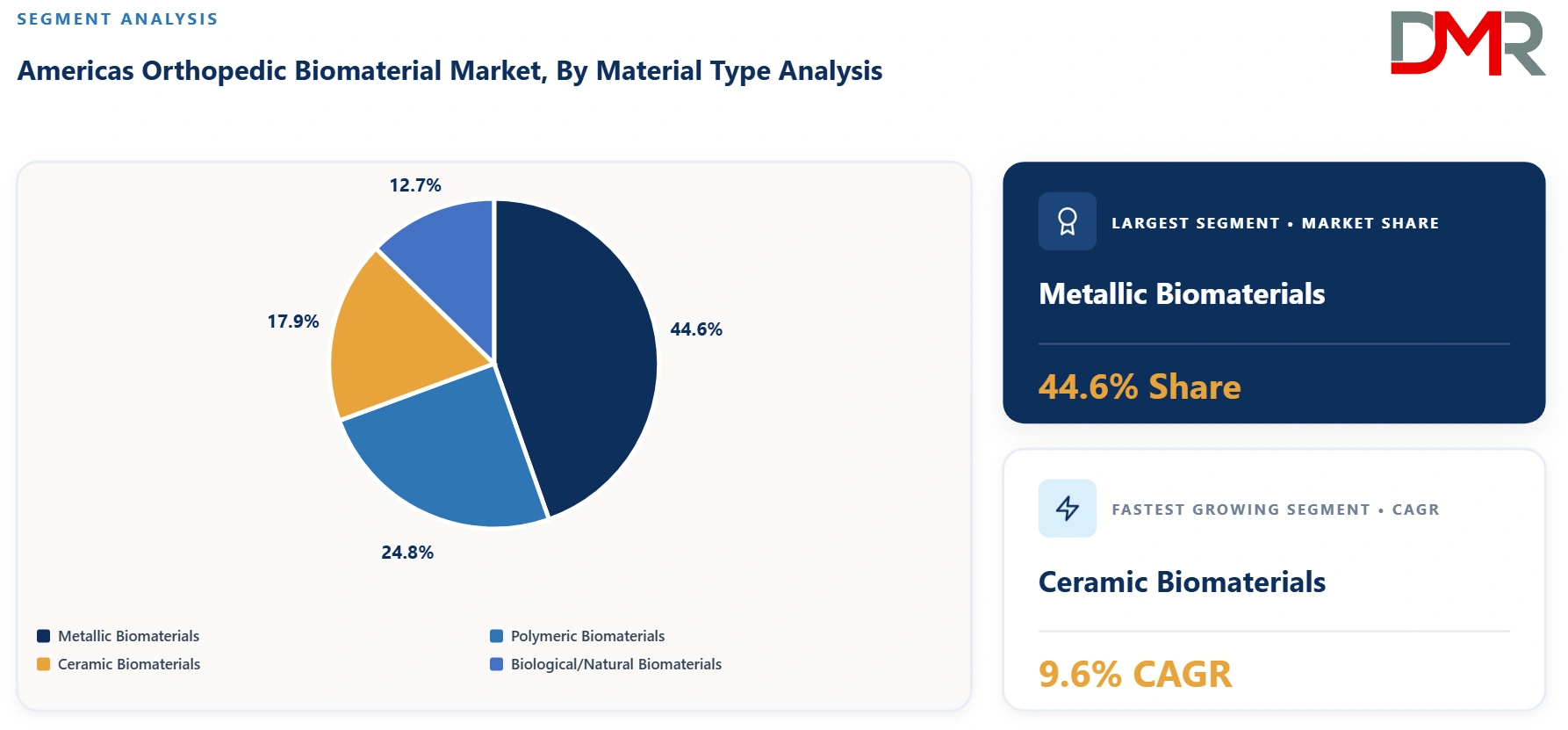
- By Material Type Analysis: Metallic Biomaterials is projected to lead the material type segment with a 44.6% share in 2026, reflecting their established, foundational role across joint reconstruction and trauma fixation applications. Ceramic Biomaterials is the fastest-growing material type segment at 9.6% CAGR, driven by expanding calcium phosphate and hydroxyapatite bone graft substitute adoption.
- By Application Analysis: Joint Reconstruction is expected to dominate with a 41.8% share in 2026, reflecting substantial hip and knee replacement procedure volumes across the region's aging population. Bone Graft Substitutes is the fastest-growing application segment at 9.9% CAGR, driven by growing preference for synthetic and biological graft alternatives to autologous bone harvesting.
- By End User Analysis: Hospitals are projected to dominate with a 64.2% share in 2026, reflecting the complex, procedure-based nature of most orthopedic surgical applications. Ambulatory Surgical Centers is the fastest-growing end user segment at 10.8% CAGR, driven by continued shift of appropriate orthopedic procedures toward efficient outpatient delivery settings.
Key Drivers in the Americas Orthopedic Biomaterial Market
Rapidly Aging Populations Driving Osteoarthritis and Degenerative Spinal Condition Incidence Growth
The United States and Canada, alongside a gradually aging Latin American population base, continue to experience substantial growth in age-related osteoarthritis, osteoporosis-related fracture, and degenerative spinal condition incidence, conditions that frequently require joint reconstruction, spinal fusion, or trauma fixation procedures utilizing orthopedic biomaterial products. This demographic-driven disease burden growth creates a structural, durable demand foundation for orthopedic biomaterials across the Americas, as aging populations generally require substantially higher rates of orthopedic surgical intervention than younger population segments.
Continued Innovation in Advanced Polymeric and Ceramic Biomaterials
Sustained innovation in advanced polymeric materials such as highly cross-linked polyethylene and PEEK, alongside ceramic biomaterials offering improved bone integration properties, is driving continued adoption of next-generation orthopedic biomaterial products offering improved implant longevity, reduced wear-related complications, and lower revision surgery rates compared to earlier-generation materials. This continued materials science innovation is expanding the clinical value proposition of orthopedic biomaterial products, supporting premium product adoption and driving overall market value growth beyond underlying procedure volume growth alone.
Restraints in the Americas Orthopedic Biomaterial Market
Reimbursement and Cost Containment Pressure Affecting Premium Material Adoption
Healthcare payer reimbursement structures and cost containment pressures across the Americas, particularly within value-based care and bundled payment models increasingly common across U.S. healthcare, represent a meaningful restraint on the Orthopedic Biomaterial Market. These reimbursement dynamics can create pressure to favor lower-cost, established biomaterial options over premium next-generation materials unless clear, demonstrable clinical outcome improvements justify additional cost, potentially moderating the pace of premium biomaterial adoption relative to what pure clinical innovation potential would suggest.
Growth Opportunities in the Americas Orthopedic Biomaterial Market
Biological and Natural Biomaterial Innovation for Enhanced Bone Healing Applications
Growing clinical interest in biological and natural biomaterials, including demineralized bone matrix, collagen-based products, and other osteoinductive materials, presents a substantial opportunity for companies developing next-generation bone healing support products across trauma, spinal fusion, and joint reconstruction applications. Companies capable of demonstrating superior bone healing outcomes through advanced biological material formulations can capture premium positioning as surgeons increasingly seek materials that actively promote natural bone regeneration rather than solely providing structural support.
Latin American Orthopedic Surgical Infrastructure and Training Investment
Continued healthcare infrastructure investment across Brazil, Mexico, Colombia, and Argentina, driven by both public healthcare system capacity expansion and growing private hospital sector development, presents a substantial opportunity for orthopedic biomaterial manufacturers to expand regional distribution, surgical training support, and market development presence. Companies establishing strong distribution relationships and surgeon training capability serving Latin American orthopedic surgical markets can capture significant growth as these markets continue expanding surgical capacity.
Trends in the Americas Orthopedic Biomaterial Market
Growing Adoption of 3D-Printed and Patient-Specific Orthopedic Implant Materials
Orthopedic surgeons and manufacturers across the Americas are increasingly adopting 3D-printed titanium and other biomaterial implant components, enabling patient-specific implant geometries and porous structures supporting improved bone ingrowth compared to traditionally manufactured implant designs. This technology adoption trend reflects continued advancement in additive manufacturing capability and growing surgeon interest in personalized implant solutions for complex reconstructive cases.
Continued Shift Toward Outpatient and Ambulatory Orthopedic Surgical Delivery
The Americas Orthopedic Biomaterial Market is experiencing a continued shift in procedure delivery composition toward ambulatory surgical centers and outpatient settings for appropriate joint reconstruction and other orthopedic procedures, reflecting broader healthcare system trends toward cost-effective, efficient surgical care delivery models. This trend is encouraging biomaterial manufacturers to develop products and instrumentation systems specifically suited to efficient ambulatory surgical workflows.
Research Scope and Analysis
The Americas Orthopedic Biomaterial Market is segmented by material type, application, end user, and region, covering metallic, polymeric, ceramic, and biological biomaterials, joint reconstruction, spinal fusion, trauma fixation, and other clinical applications, and North American and Latin American country markets.
ℹ
To learn more about this report –
Download Your Free Sample Report Here
By Material Type Analysis
Metallic Biomaterials is projected to dominate the Americas Orthopedic Biomaterial Market with 44.6% share in 2026, reflecting titanium, cobalt-chromium, and stainless steel alloys' established and foundational role across joint reconstruction and trauma fixation applications throughout the region's orthopedic surgical infrastructure. Ceramic Biomaterials is expected to register the highest CAGR of 9.6% during 2026-2035, driven by expanding calcium phosphate and hydroxyapatite bone graft substitute adoption supporting spinal fusion and reconstructive surgical applications.
By Application Analysis
Joint Reconstruction is anticipated to dominate the Americas Orthopedic Biomaterial Market by application, accounting for 41.8% share in 2026, reflecting substantial hip and knee replacement procedure volumes driven by the region's aging population and growing osteoarthritis disease burden. Bone Graft Substitutes is projected to register the highest CAGR of 9.9% between 2026 and 2035, driven by growing surgeon and patient preference for synthetic and biological graft alternatives that avoid the morbidity associated with autologous bone graft harvesting procedures.
By End User Analysis
Hospitals are projected to lead the Americas Orthopedic Biomaterial Market with an estimated 64.2% share in 2026, reflecting the complex, procedure-based nature of most orthopedic surgical applications requiring comprehensive hospital-based surgical infrastructure. Ambulatory Surgical Centers are expected to register the fastest CAGR of 10.8% through 2035, driven by continued shift of appropriate joint reconstruction and other orthopedic procedures toward efficient, lower-cost outpatient delivery settings across North American healthcare systems.
The Americas Orthopedic Biomaterial Market Report is segmented based on the following:
By Material Type
- Metallic Biomaterials
- Titanium and Titanium Alloys
- Cobalt-Chromium Alloys
- Stainless Steel
- Polymeric Biomaterials
- Polyethylene
- PEEK (Polyether Ether Ketone)
- PMMA Bone Cement
- Ceramic Biomaterials
- Calcium Phosphate
- Hydroxyapatite
- Bioactive Glass
- Biological/Natural Biomaterials
- Collagen
- Demineralized Bone Matrix
- Allografts
By Application
- Joint Reconstruction
- Spinal Fusion and Fixation
- Trauma and Fracture Fixation
- Craniomaxillofacial
- Bone Graft Substitutes
- Others
By End User
- Hospitals
- Ambulatory Surgical Centers
- Orthopedic Specialty Clinics
- Others
Regional Analysis
North America, comprising the United States and Canada, is projected to lead the Americas Orthopedic Biomaterial Market with an estimated 79.3% share in 2026, reflecting the substantial scale of its hospital systems, healthcare expenditure, and established orthopedic surgical infrastructure and workforce relative to Latin America. Latin America, comprising Mexico, Brazil, Colombia, Argentina, and the Rest of LATAM, is expected to register the fastest CAGR of 10.1% through 2035, driven by continued hospital infrastructure investment, growing private healthcare sector development, and expanding orthopedic surgical training capacity across the region's leading economies.
By Region
North America
Latin America
- Mexico
- Brazil
- Colombia
- Argentina
- Rest of LATAM
Technology Analysis
Technology development is central to the trajectory of the Americas Orthopedic Biomaterial Market as companies invest in advanced 3D printing and additive manufacturing technology supporting patient-specific implant design and improved porous structures for bone ingrowth, next-generation highly cross-linked polyethylene and PEEK material formulations extending implant longevity, and advanced ceramic and biological material combinations improving bone graft substitute healing outcomes. Growing use of surgical navigation and robotic-assisted surgery technology is supporting more precise biomaterial implant placement across joint reconstruction and spinal procedures. Opportunities are expanding for companies developing patient-specific 3D-printed implant solutions, advanced biological materials with demonstrated superior bone healing outcomes, and materials and instrumentation systems specifically adapted for efficient ambulatory surgical center workflows. However, achieving consistent clinical outcome data supporting premium material adoption amid healthcare payer cost containment pressure remains an ongoing consideration for manufacturers.
Investment and White Space Analysis
Investment opportunities in the Americas Orthopedic Biomaterial Market are expanding alongside the region's aging population and associated orthopedic disease burden growth, continued advanced biomaterial innovation, and expanding healthcare infrastructure investment across both North America and Latin America. Significant white space exists in biological and natural biomaterial innovation for enhanced bone healing applications, 3D-printed patient-specific implant material development, and Latin American orthopedic surgical infrastructure and training investment. Companies with strong clinical outcomes data generation capability, established relationships with major hospital systems across both North and Latin America, and advanced materials science research and development capability are positioned to capture premium, longer-duration growth opportunities. However, reimbursement and cost containment pressure affecting premium material adoption, along with the capital intensity of continued materials science innovation, can constrain margins and growth pace for smaller or less differentiated manufacturers.
Competitive Landscape
The Americas Orthopedic Biomaterial Market is moderately consolidated and increasingly competitive, comprising large diversified global orthopedic device companies with substantial Americas operations, specialized biomaterial and bone graft substitute manufacturers, and regional Latin American medical device distributors and manufacturers. Competition centers on materials science innovation and clinical outcomes data, established relationships with major North American hospital systems and group purchasing organizations, surgeon training and clinical support capability, and Latin American market distribution and regulatory expertise. Large diversified global companies benefit from substantial research and development resources and broad orthopedic biomaterial portfolios, while specialized manufacturers compete through deep technical expertise in specific material categories such as biological bone graft substitutes. Companies increasingly differentiate through clinical outcomes evidence and Latin American market development capability rather than material portfolio breadth alone.
Some of the prominent players in the Americas Orthopedic Biomaterial Market are:
- Stryker Corporation
- Zimmer Biomet Holdings, Inc.
- DePuy Synthes
- Medtronic plc
- Smith+Nephew plc
- Globus Medical, Inc.
- Arthrex, Inc.
- Enovis Corporation
- Orthofix Medical Inc.
- Exactech, Inc.
- Bioventus Inc.
- Anika Therapeutics, Inc.
- Integra LifeSciences Holdings Corporation
- CONMED Corporation
- Baxter International Inc.
- RTI Surgical, Inc.
- AlloSource
- LifeNet Health
- MTF Biologics
- Cerapedics, Inc.
- Xtant Medical Holdings, Inc.
- Bone Biologics Corporation
- Berkeley Advanced Biomaterials, Inc.
- Acumed LLC
- ATEC (Alphatec Holdings, Inc.)
- NovaBone Products, LLC
- Biocomposites Ltd.
- BONESUPPORT AB
- DSM Biomedical
- Evonik Industries AG
- Invibio Biomaterial Solutions
- Celanese Corporation
- Carpenter Technology Corporation
- Heraeus Holding GmbH
- CAM Bioceramics B.V.
- CeramTec GmbH
- Corbion N.V.
- Regenity Biosciences
- Matexcel
- AdvanSource Biomaterials Corporation
- Other Key Players
Recent Developments
- August 2026: Isto Biologics acquired NovaBone Products, adding proprietary bioactive-glass synthetic bone graft technologies and expanding its orthobiologics portfolio across spine, orthopedic, trauma, extremity, and other bone-regeneration applications.
- January 2026: The U.S. FDA approved expanded indications for Cerapedics’ PearlMatrix P-15 Peptide Enhanced Bone Graft, extending its use across major lumbar interbody fusion approaches and additional cage materials.
- October 2025: Heraeus Medical expanded into resorbable orthopedic biomaterials through INNOTERE and introduced its heracure portfolio, including calcium phosphate-based bone substitutes designed to support bone regeneration and defect treatment.
- March 2025: Globus Medical launched the COHERE ALIF Spacer featuring proprietary porous PEEK technology designed to promote bone ingrowth, strengthening its advanced biomaterials portfolio for anterior lumbar interbody fusion procedures.
Report Details
| Report Characteristics |
| Market Size (2026) |
USD 9.8 Bn |
| Forecast Value (2035) |
USD 18.6 Bn |
| CAGR (2026–2035) |
7.4% |
| Historical Data |
2021 – 2025 |
| Forecast Data |
2026 – 2035 |
| Base Year |
2025 |
| Segments Covered |
By Material Type, By Application, and By End User |
| Regional Coverage |
North America (United States, Canada), Latin America (Mexico, Brazil, Colombia, Argentina, Rest of LATAM) |
Frequently Asked Questions
How big is the Americas Orthopedic Biomaterial Market?
▾ The Americas Orthopedic Biomaterial Market is poised to be valued at USD 9.8 Billion in 2026 and is projected to reach USD 18.6 Billion by 2035, reflecting the region's aging population and continued innovation in advanced orthopedic biomaterial technology.
What is the CAGR of the Americas Orthopedic Biomaterial Market from 2026 to 2035?
▾ The market is projected to expand at a compound annual growth rate (CAGR) of 7.4% between 2026 and 2035, supported by demographic-driven disease burden growth, continued materials science innovation, and expanding Latin American healthcare infrastructure investment.
What factors are driving the growth of the Americas Orthopedic Biomaterial Market?
▾ Growth is driven by rapidly aging populations driving osteoarthritis and degenerative spinal condition incidence growth, continued innovation in advanced polymeric and ceramic biomaterials, growing adoption of biological bone graft substitute materials, and expanding Latin American orthopedic surgical infrastructure investment.
What are the major trends in the Americas Orthopedic Biomaterial Market? b
▾ Major trends include growing adoption of 3D-printed and patient-specific orthopedic implant materials, continued shift toward outpatient and ambulatory orthopedic surgical delivery, and rising investment in advanced biological and natural biomaterial innovation.
Who are the key players in the Americas Orthopedic Biomaterial Market?
▾ Key market participants include Zimmer Biomet, Stryker Corporation, Johnson & Johnson MedTech (DePuy Synthes), Smith+Nephew, and Globus Medical, among other global and regional orthopedic biomaterial manufacturers.
How is the Americas Orthopedic Biomaterial Market segmented?
▾ The market is segmented by material type, application, end user, and region, with North America comprising the United States and Canada, and Latin America comprising Mexico, Brazil, Colombia, Argentina, and the Rest of LATAM.