Americas Suture Needles Market Snapshot
- Market Size in 2026: USD 310.0 million
- Market Size in 2035: USD 480.6 million
- Americas CAGR, 2026-2035: 5.0%
- Leading Needle Type in 2026: Cutting Needles, 52.0%
- Leading Needle Curvature in 2026: 3/8 Circle, 34.0%
- Leading Application in 2026: General Surgery, 35.0%
- Leading End User in 2026: Hospitals, 68.0%
- Fastest-Growing Segment: Blunt Needles, 6.6% CAGR
- Leading Region in 2026: North America, 77.0%
- Fastest-Growing Geographic Market: Latin America, 6.2% CAGR
What is the Americas Suture Needles and its Market Size?
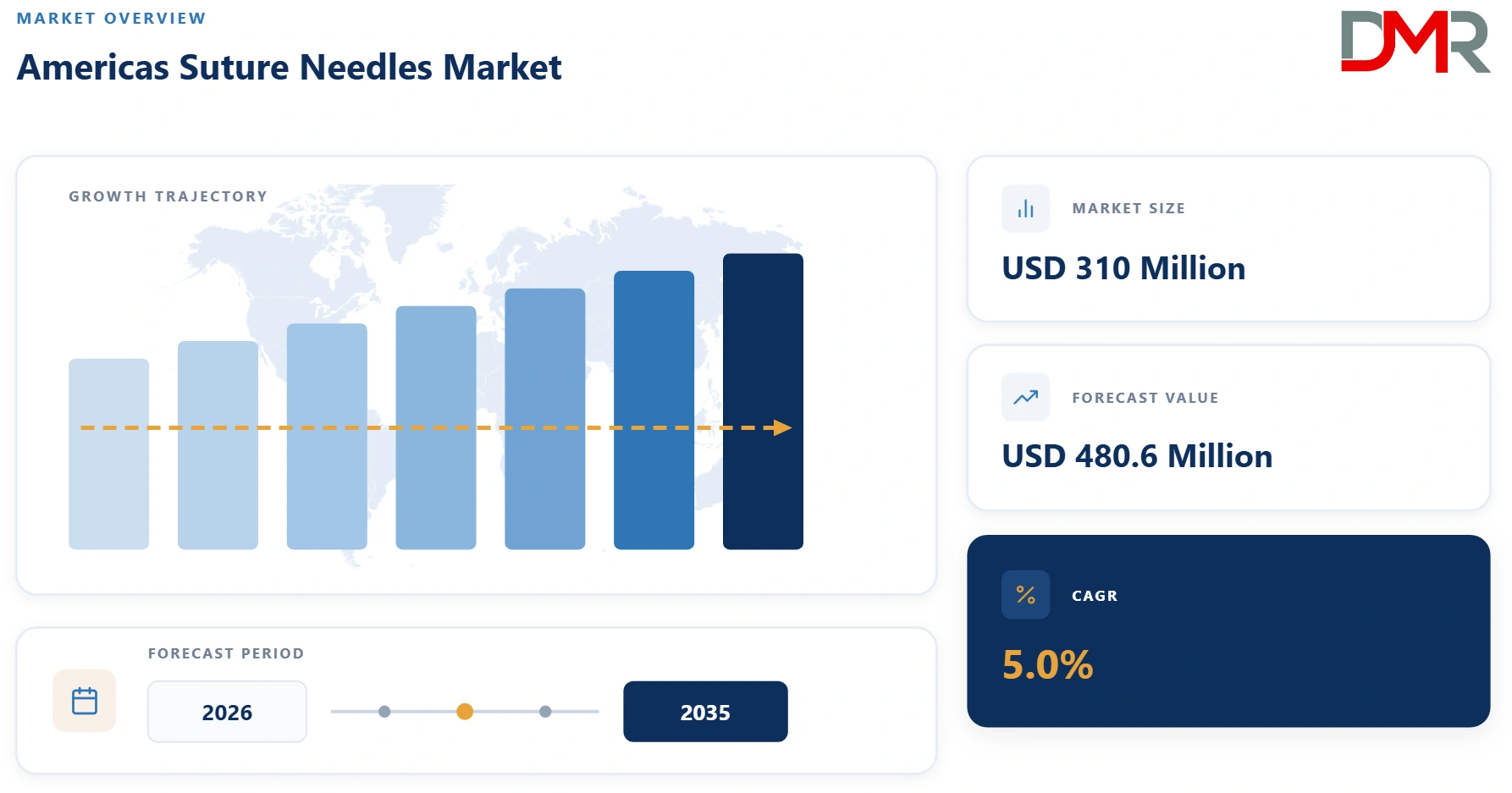
The Americas market is estimated at USD 310.0 million in 2026 and is projected to reach approximately USD 480.6 million by 2035, representing a 5.0% CAGR.
ℹ
To learn more about this report –
Download Your Free Sample Report Here
The Americas suture needles market comprises precision-manufactured surgical needles used with sutures to approximate tissue, close wounds, ligate vessels and support tissue repair during surgical procedures. Products are differentiated by needle point, curvature, diameter, length, material, penetration characteristics and compatibility with absorbable or non-absorbable suture materials.
Use Cases
- General surgery: Used for abdominal, gastrointestinal, soft-tissue and routine wound-closure procedures across hospital operating rooms.
- Cardiovascular surgery: Precision needles support vascular anastomosis, cardiac repair and closure where controlled tissue penetration is critical.
- Orthopedic surgery: Used in tendon, ligament, muscle and joint procedures requiring secure soft-tissue approximation.
- Ophthalmic surgery: Fine-gauge needles enable highly precise suturing of delicate ocular and surrounding tissues.
- Gynecological and obstetric surgery: Used across cesarean delivery, hysterectomy and reconstructive pelvic procedures.
- Plastic and reconstructive surgery: Fine, curved and cutting needles support cosmetic, reconstructive and microsurgical tissue closure.
Key Takeaways
- Market Size: Americas suture needles revenue is estimated at USD 310.0 million in 2026, reaching USD 480.6 million by 2035.
- Growth: The market is projected to expand at a 5.0% CAGR during 2026-2035, driven mainly by procedure growth and replacement demand.
- Key Driver: Increasing surgical volumes across general, cardiovascular, orthopedic, gynecological and reconstructive procedures remain the fundamental demand catalyst.
- Segment Dominance: Cutting needles lead by needle type, while 3/8-circle needles lead by curvature and general surgery leads by application.
- Fastest Growth: Blunt needles are projected to grow at approximately 6.6% CAGR, benefiting from increasing use in specialized procedures where tissue trauma reduction is important.
- Regional Leadership: North Americas accounts for approximately 77% of Americas revenue, while Latin Americas represents the faster-growing geographic opportunity.
How AI and Advanced Automation are Transforming the Suture Needles Market?
AI is increasingly being integrated into precision needle manufacturing through automated optical inspection, machine-vision systems and statistical process control. Manufacturers can inspect needle curvature, point geometry, surface defects, diameter consistency, attachment quality and grind characteristics at production speed. This is particularly important because surgical needles require highly repeatable mechanical and penetration performance.
Automation reduces manufacturing variability, scrap rates and manual inspection requirements while improving batch-to-batch consistency. Advanced grinding, laser processing and automated needle attachment also enable smaller diameters, sharper points and more complex geometries. FDA-recognized standards specifically address surgical needle terminology and bend testing, reinforcing the importance of measurable performance characteristics.
Key Drivers in the Americas Suture Needles Market
Rising Surgical Procedure Volumes
The most important growth driver is the increasing number of surgical interventions across the Americas. Suture needles are consumable, procedure-linked products, meaning demand generally rises with surgical case volumes. General surgery remains the largest consumption base, while cardiovascular, orthopedic, ophthalmic, gynecological, plastic and reconstructive procedures create additional demand for specialty needle configurations. Aging populations in the United States and Canada are increasing the incidence of conditions requiring operative intervention, particularly joint replacement, cardiovascular procedures and cancer surgery. At the same time, Latin American countries are expanding access to private hospitals, specialty clinics and ambulatory surgery.
Shift Toward Precision and Minimally Invasive Surgery
Surgical techniques are becoming more specialized, creating demand for needles optimized for particular tissue types and procedural approaches. Minimally invasive, laparoscopic, robotic and microsurgical procedures require needles with precise geometry, controlled curvature, consistent penetration and predictable bending characteristics. Surgeons increasingly favor products that reduce tissue trauma and improve handling. The growing importance of specialty procedures also supports higher-value needle configurations rather than undifferentiated commodity products.
Restraints in the Americas Suture Needles Market
Pricing Pressure and Procurement Consolidation
Hospital procurement organizations in North Americas increasingly emphasize cost containment, standardization and supplier consolidation. Suture needles are frequently purchased alongside surgical sutures, allowing large health systems and group purchasing organizations to negotiate portfolio-level pricing. This creates pressure on manufacturers selling conventional needles and limits the ability to pass through increases in stainless-steel, energy, labor and logistics costs. Commodity-style products from lower-cost manufacturers can intensify competition, particularly in Latin America.
Regulatory, Quality and Manufacturing Requirements
Surgical needles require consistent mechanical performance because needle breakage, bending, poor penetration or inconsistent geometry can adversely affect surgical procedures. Manufacturers therefore face stringent quality-management, traceability and validation requirements. In the United States, FDA classifications and recognized standards provide a regulatory framework for surgical needle products. Reusable suturing needles, for example, are classified under specific medical-device regulations, while related surgical-suture products may be subject to different requirements.
Growth Opportunities in the Americas Suture Needles Market
Expansion of Latin American Surgical Infrastructure
Latin Americas offers the strongest geographic expansion opportunity within the Americas. Brazil and Mexico provide the largest addressable markets, while Colombia, Argentina and other countries offer smaller but increasingly attractive opportunities. Rising private healthcare investment, hospital modernization and increasing availability of specialty procedures can increase demand for surgical consumables. Local distributors with established hospital relationships remain important because procurement practices and reimbursement systems differ considerably by country. Manufacturers that combine competitive pricing with reliable supply, local technical support and region-specific distribution are positioned to capture incremental demand.
Specialty and Microsurgical Needle Portfolios
Premium specialty needles represent an attractive opportunity because their value is determined more by clinical performance than unit price. Ophthalmic, cardiovascular, reconstructive, microsurgical and robotic procedures require specialized needle geometry and handling characteristics. Fine needles, reverse-cutting configurations, taper-point designs and highly controlled curvature can command premium pricing when they improve surgeon handling and reduce tissue trauma. Suppliers can also create differentiation by integrating needles with advanced absorbable, antimicrobial or barbed suture systems.
Trends in the Americas Suture Needles Market
Premiumization and Procedure-Specific Designs
The market is moving gradually from standardized needles toward procedure-specific configurations. Surgeons increasingly select needle geometry according to tissue density, access angle and desired penetration characteristics. This favors suppliers with broad catalogs covering different points, curvatures, diameters and lengths. Premium products are particularly relevant in cardiovascular, ophthalmic and reconstructive surgery, where needle handling can directly affect procedure efficiency and tissue integrity.
Integration of Needles with Complete Suture Systems
Hospitals increasingly prefer suppliers capable of providing integrated needle-suture combinations rather than sourcing individual components from multiple vendors. This simplifies inventory management, qualification and operating-room preparation. Procurement consolidation is consequently favoring companies with broad portfolios encompassing needle geometries, absorbable and non-absorbable sutures, specialty sutures and complementary wound-closure products. The trend is particularly visible among large healthcare systems seeking standardization across operating rooms.
Research Scope and Analysis
The Americas suture needles market is analyzed by needle type, needle curvature, needle size, material, application and end user. The primary analytical segments are cutting, taper and blunt needles; major curvature configurations; surgical applications; and healthcare end users.
ℹ
To learn more about this report –
Download Your Free Sample Report Here
By Needle Type Analysis
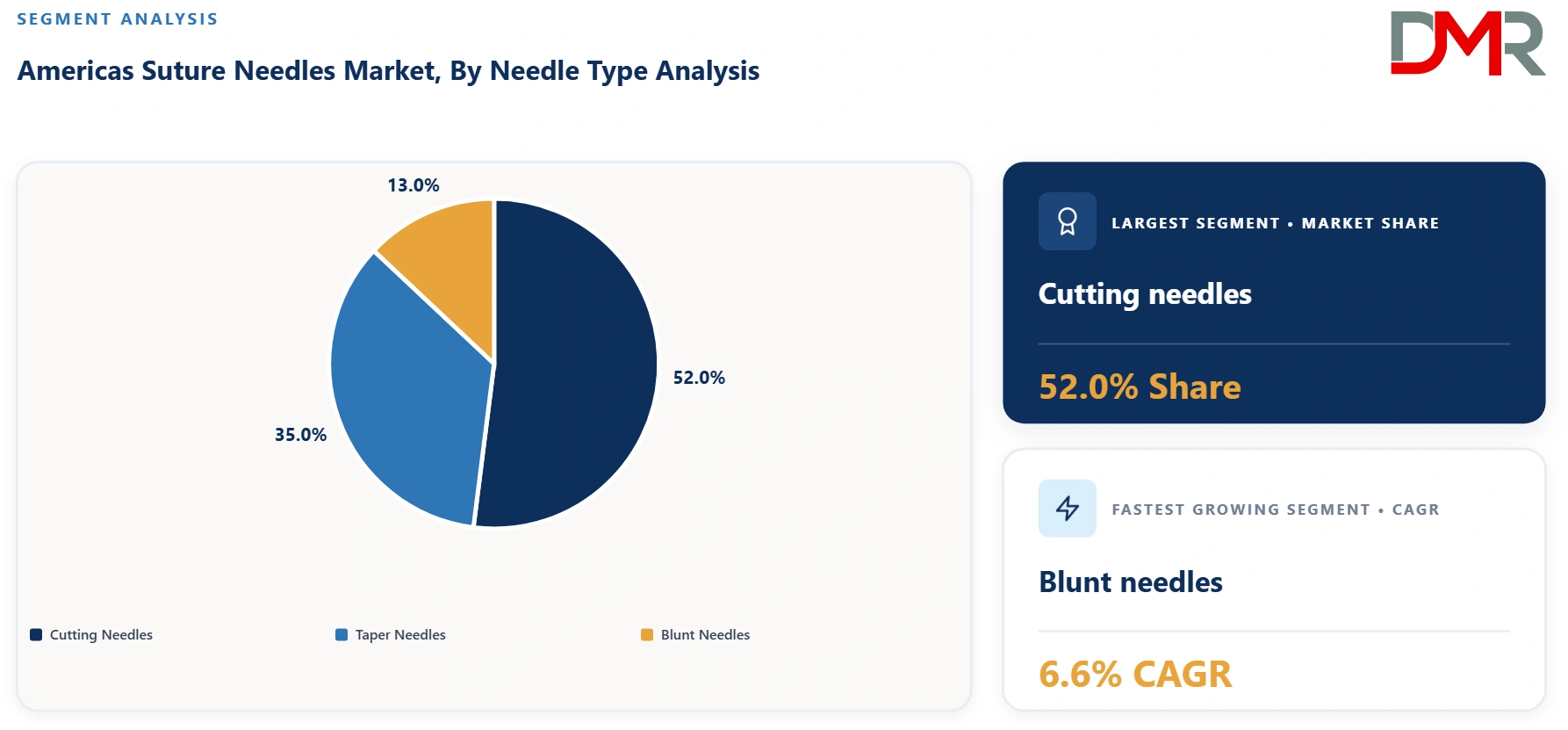
Cutting needles are estimated to dominate the Americas suture needles market in 2026 with approximately 52.0% share, reflecting extensive use in general surgery, skin closure, orthopedic soft-tissue procedures and other applications involving dense or fibrous tissue. Reverse-cutting and conventional cutting configurations provide strong penetration characteristics and remain established choices across high-volume surgical procedures. Taper needles represent the second-largest segment at approximately 35.0%, benefiting from their ability to separate rather than cut tissue and their widespread use in internal soft-tissue, cardiovascular, gastrointestinal and gynecological procedures. Blunt needles, with an estimated 13.0% share, are currently smaller but are expected to be the fastest-growing category at approximately 6.6% CAGR through 2035. Growth is supported by increasing attention to tissue trauma, specialty procedures and applications where reducing inadvertent needle-stick or tissue penetration risk is important. Blunt needles should therefore gain share gradually, although cutting and taper configurations will remain dominant due to their broad procedural applicability.
By Needle Curvature Analysis
The 3/8-circle configuration is estimated to lead the market in 2026 with approximately 34.0% share, supported by its versatility in general surgery and its ability to provide controlled needle rotation within relatively accessible surgical fields. The 1/2-circle needle ranks second with approximately 31.0% share, particularly benefiting from cardiovascular, abdominal, gynecological and deeper tissue procedures where a greater arc improves access and needle handling. 1/4-circle needles account for roughly 15.0%, serving applications where limited curvature and relatively shallow tissue access are advantageous. 5/8-circle needles represent approximately 11.0%, with stronger positioning in deep or restricted surgical fields, while straight needles account for approximately 9.0% and are more concentrated in selected superficial or specialized applications. The 5/8-circle configuration is expected to record comparatively strong growth as minimally invasive and deep-field procedures expand, but 3/8-circle and 1/2-circle designs should remain the dominant configurations because of their broad compatibility across procedure types.
By Needle Size Analysis
Medium needles are estimated to dominate the Americas suture needles market in 2026, accounting for approximately 48.0% share, owing to their broad applicability across general, cardiovascular, orthopedic, gynecological and reconstructive procedures. Their balance between tissue penetration, handling and mechanical strength makes them suitable for a wide range of routine surgical applications. Large needles represent the second-largest segment, with an estimated 32.0% share, and are primarily used for thicker or deeper tissues, including selected orthopedic, abdominal and reconstructive procedures. Small needles account for approximately 20.0% share but are expected to be the fastest-growing size category, at around 6.2% CAGR, driven by increasing ophthalmic, microsurgical, plastic and minimally invasive procedures requiring greater precision and reduced tissue trauma. The shift toward specialty and precision surgery is expected to gradually increase the share of small needles through 2035.
By Material Analysis
Stainless steel needles are estimated to dominate the Americas market in 2026, accounting for approximately 94.0% share, because stainless steel provides the combination of strength, hardness, corrosion resistance, manufacturability and consistent penetration required for surgical applications. Medical-grade stainless steel is particularly well suited to precision grinding and controlled needle-point formation, supporting its widespread adoption across both conventional and specialty procedures. Other materials account for approximately 6.0% share and include specialized alloys and material configurations developed for particular performance requirements. This segment is expected to grow faster, at approximately 6.5% CAGR, as manufacturers pursue improved flexibility, fatigue resistance, surface characteristics and specialized needle performance. Nevertheless, stainless steel is expected to remain overwhelmingly dominant through 2035 because of its established clinical performance, manufacturing infrastructure, regulatory familiarity and relatively competitive cost.
By Application Analysis
General surgery represents the largest application segment, accounting for approximately 35.0% of the Americas market in 2026. Its leadership is attributable to the enormous volume and diversity of abdominal, gastrointestinal, soft-tissue and other procedures performed across hospitals and ambulatory facilities. Cardiovascular surgery is the second-largest application at approximately 17.0%, where highly controlled taper and cutting needles are required for vessel and cardiac-tissue approximation. Orthopedic surgery accounts for around 15.0%, followed by gynecological and obstetric procedures at 11.0%, plastic and reconstructive surgery at 9.0%, ophthalmic surgery at 7.0%, and other surgical applications at approximately 6.0%. Ophthalmic surgery is expected to be among the fastest-growing application categories at approximately 6.4% CAGR, supported by aging populations, cataract procedures and demand for highly precise microsurgical closure. The specialty nature of ophthalmic procedures also provides manufacturers with greater opportunities for premium pricing.
By End User Analysis
Hospitals dominate the Americas market, representing an estimated 68.0% share in 2026. Hospitals perform the largest volume and widest range of surgical procedures and typically maintain substantial inventories of different needle-suture combinations. Large hospital networks also have procurement agreements that favor established suppliers with broad portfolios, regulatory compliance and dependable distribution. Ambulatory surgical centers represent approximately 21.0%, making them the second-largest end-user category and the fastest-growing at an estimated 6.3% CAGR. Their growth reflects migration of appropriate procedures from inpatient hospitals toward outpatient settings, particularly general surgery, ophthalmology, orthopedics and plastic surgery. Specialty clinics account for roughly 7.0%, while other healthcare facilities represent approximately 4.0%. ASC growth should gradually increase the importance of compact, procedure-specific portfolios, smaller inventories and efficient just-in-time distribution models.
The Americas Suture Needles Market Report is segmented on the basis of the following:
By Needle Type
- Cutting Needles
- Taper Needles
- Blunt Needles
By Needle Curvature
- Straight
- 1/4 Circle
- 3/8 Circle
- 1/2 Circle
- 5/8 Circle
By Needle Size
By Material
- Stainless Steel
- Other Materials
By Application
- General Surgery
- Cardiovascular Surgery
- Orthopedic Surgery
- Ophthalmic Surgery
- Gynecological & Obstetric Surgery
- Plastic & Reconstructive Surgery
- Other Surgical Applications
By End User
- Hospitals
- Ambulatory Surgical Centers
- Specialty Clinics
- Other Healthcare Facilities
Regional Analysis
North Americas is expected to account for approximately 77.0% of the Americas suture needles market in 2026, with the United States representing the overwhelming majority of regional revenue and Canada providing a smaller but stable contribution. The United States benefits from high surgical volumes, sophisticated hospital infrastructure, strong adoption of specialty medical devices and the presence of major manufacturers including Ethicon, Medtronic, Corza Medical and other established suppliers. Latin Americas accounts for approximately 23.0% of the Americas market. Brazil and Mexico represent the principal revenue pools, followed by Argentina and Colombia. Latin Americas is expected to grow faster than North America, at approximately 6.2% CAGR, supported by healthcare infrastructure expansion, increasing private-sector investment, rising surgical access and greater availability of specialty procedures. However, currency volatility, reimbursement constraints and uneven procurement systems remain important risks.
Regulatory Landscape
The regulatory environment is a significant competitive factor because surgical needles and associated suture products must meet defined safety, performance, labeling and manufacturing requirements. In the United States, FDA classifications vary by product configuration; reusable suturing needles are classified as Class I devices under 21 CFR 878.4800, while certain surgical suture categories fall under separate classifications and may require 510(k) submissions. FDA guidance identifies mechanical performance, material characteristics and other safety considerations for surgical sutures, while recognized ASTM standards address terminology and bend testing for surgical suture needles. The regulatory environment raises barriers to entry but also favors established suppliers with validated manufacturing, quality systems and regulatory expertise. Latin American markets generally follow national medical-device frameworks, creating additional registration and distributor requirements.
Pricing Analysis
Suture needle pricing varies substantially according to needle size, geometry, material, coating, precision requirements, packaging and whether the needle is supplied independently or attached to a premium suture. Standard stainless-steel needles face considerable price competition and are increasingly subject to hospital procurement standardization. Specialty ophthalmic, cardiovascular and microsurgical needles can achieve significantly higher prices because purchasing decisions emphasize penetration consistency, break resistance and surgeon preference rather than lowest unit cost. Pricing pressure is greatest in large hospital tenders and commodity general-surgery products, while premium pricing opportunities remain strongest in specialty and procedure-specific products. Manufacturers can protect margins through portfolio bundling, custom configurations, OEM supply and integrated needle-suture systems.
By Region
North America
Latin America
- Mexico
- Brazil
- Argentina
- Colombia
- Rest of Latin America
Competitive Landscape
The Americas suture needles market is moderately consolidated at the premium end but fragmented across the broader supplier base. Major participants compete through portfolio breadth, needle precision, surgeon relationships, manufacturing quality, brand reputation, regulatory compliance and distribution capabilities. Leading companies increasingly use portfolio expansion, strategic partnerships, OEM manufacturing, geographic expansion and specialty-product development to differentiate themselves. Large surgical companies such as Ethicon/Johnson & Johnson and Medtronic benefit from established hospital relationships and broad surgical portfolios, while Corza Medical and specialist manufacturers compete through wound-closure specialization and customized products. Cost-focused manufacturers and regional suppliers exert pricing pressure in standard needle categories. The growing importance of specialty surgery is shifting competition toward precision manufacturing, validated performance and procedure-specific designs.
Some of the prominent players in the Americas Suture Needles Market are:
- Ethicon (Johnson & Johnson)
- Medtronic
- B. Braun
- Smith+Nephew
- Stryker
- CONMED
- Teleflex
- Corza Medical
- Boston Scientific
- Zimmer Biomet
- BD
- Integra LifeSciences
- Advanced Medical Solutions
- DemeTECH
- Peters Surgical
- MANI
- Aspen Surgical
- Riverpoint Medical
- Healthium Medtech
- Lotus Surgicals
- Roboz Surgical Instrument
- 3M
- Medline Industries
- Baxter
- Advin Health Care
- Dolphin Sutures
- Kono Seisakusho
- Futura Surgicare
- Sutures India
- Internacional Farmacéutica
- Hu-Friedy
- Anchor Products
- Assut Medical
- Serag-Wiessner
- GPC Medical
- CP Medical
- DSI Dental Solutions
- Sutumed
- Vital Sutures
- Unilene
- Other Key Players
Recent Developments
- In August 2026, Teleflex completed the USD 1.5 billion divestiture of its Medical OEM business to Montagu and Kohlberg, separating the contract-manufacturing operation from Teleflex and enabling the new ownership structure to focus on innovation, capacity and medical-device customers.
- In April 2026, Johnson & Johnson announced CE Mark approval for the ETHICON 4000 Stapler, expanding its availability across European surgical specialties and reinforcing the company's focus on consistent performance across open and minimally invasive procedures.
- In December 2025, Teleflex announced an agreement to sell its Medical OEM business to Montagu and Kohlberg for USD 1.5 billion; the business includes surgical fibers and sutures and operates manufacturing facilities across the U.S., Mexico and Ireland.
- In July 2025, Corza Medical launched an expanded Onatec ophthalmic suture portfolio comprising nearly 130 products and featuring precision-manufactured stainless-steel Onatec needles designed for delicate ophthalmic and oculoplastic procedures.
- In June 2025, Johnson & Johnson launched the ETHICON 4000 Stapler in the United States, reinforcing its broader strategy of technology-driven surgical solutions across open, laparoscopic and future robotic procedures.
Report Details
| Report Characteristics |
| Market Size (2026) |
USD 310.0 Mn |
| Forecast Value (2035) |
USD 480.6 Mn |
| CAGR (2026–2035) |
5.0% |
| Historical Data |
2021 – 2025 |
| Forecast Data |
2026 – 2035 |
| Base Year |
2025 |
| Segments Covered |
By Needle Type, By Needle Curvature, By Needle Size, By Material, By Application, By End User |
| Regional Coverage |
North America – The US and Canada; Latin America – Mexico, Brazil, Colombia, Argentina, Rest of LATAM |
Frequently Asked Questions
How big is the Americas Suture Needles Market?
▾ The Americas Suture Needles Market is estimated at USD 310.0 million in 2026 and is projected to reach USD 480.6 million by 2035, growing at a 5.0% CAGR.
What factors are driving the growth of the Americas Suture Needles Market?
▾ Growth is primarily driven by rising surgical procedure volumes, increasing adoption of minimally invasive surgery, demand for precision needle designs, aging populations, and expansion of ambulatory surgical centers.
What are the major trends in the Americas Suture Needles Market?
▾ Major trends include premiumization, procedure-specific needle designs, specialty and microsurgical needles, integrated needle-suture systems, and increasing automation and machine-vision inspection in manufacturing.
Which needle type held the largest share of the Americas Suture Needles Market in 2026?
▾ Cutting needles held the largest share in 2026, accounting for approximately 52.0% of the market, supported by their extensive use across general, orthopedic and other procedures involving dense tissue.
Which segment is expected to grow the fastest in the Americas Suture Needles Market?
▾ Blunt needles are expected to be the fastest-growing needle type, with an estimated 6.6% CAGR through 2035, driven by increasing demand for controlled penetration and reduced tissue trauma.
Which region held the largest share of the Americas Suture Needles Market in 2026?
▾ North America led the market with approximately 77.0% share in 2026, supported by high surgical volumes, advanced healthcare infrastructure and established medical-device suppliers.
Which region is expected to grow the fastest in the Americas Suture Needles Market?
▾ Latin America is expected to record the fastest growth at approximately 6.2% CAGR through 2035, supported by healthcare infrastructure development, private-sector investment and improving access to surgical procedures.
Who are the key players in the Americas Suture Needles Market?
▾ Key players include Ethicon/Johnson & Johnson, Medtronic, Corza Medical, Teleflex, and other specialized surgical needle and suture manufacturers competing through product precision, portfolio breadth, quality, regulatory compliance and distribution capabilities.