Global Analytical X-ray Instrumentation Market Snapshot
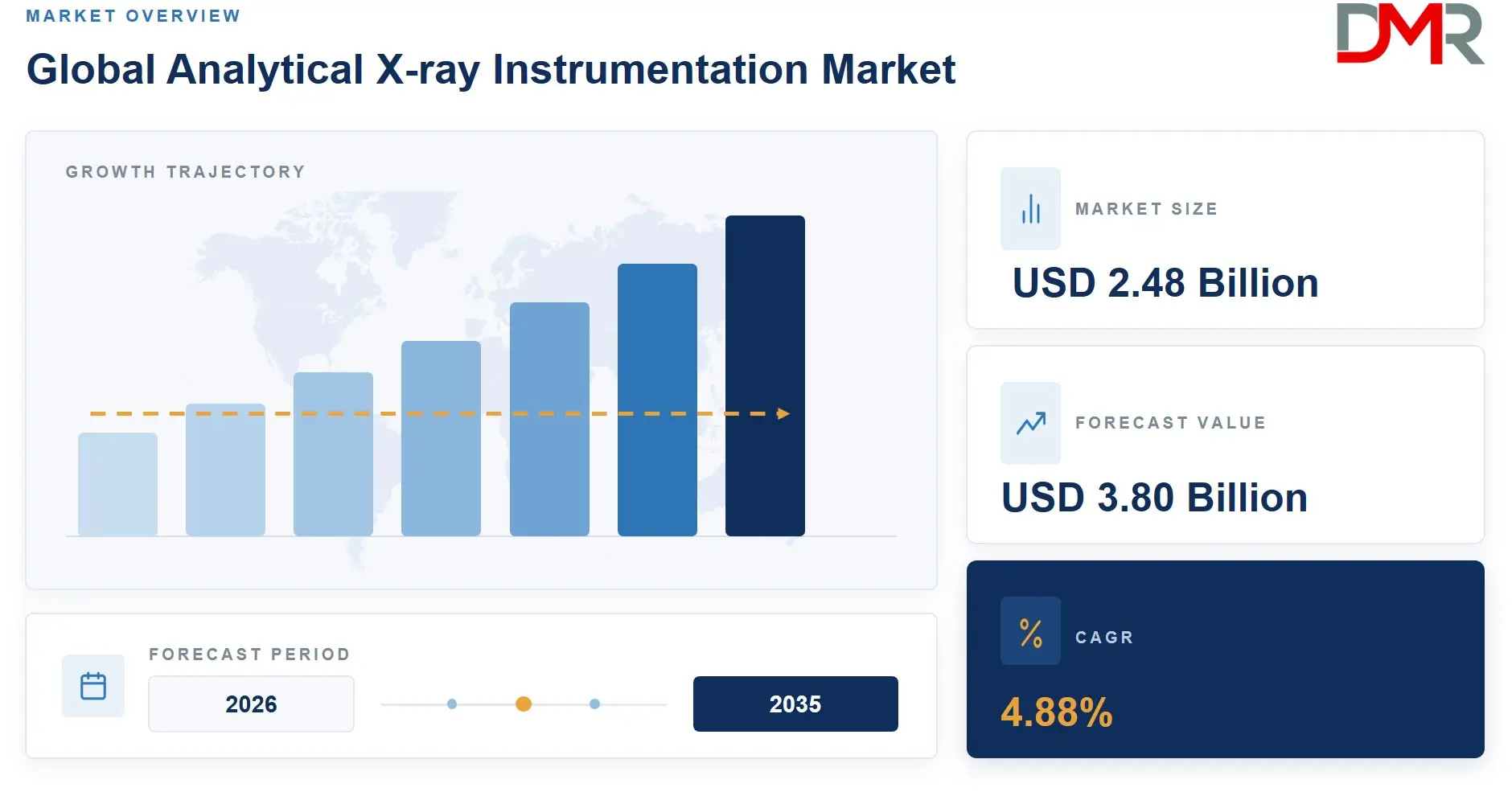
- Market Size in 2026: USD 2.48 billion
- Market Size in 2035: USD 3.80 billion
- Global CAGR, 2026–2035: 4.88%
- Leading Instrument Type: X-ray Diffraction (XRD), 34%
- Leading Technology: Energy-Dispersive, 42%
- Leading Application: Material & Structural Analysis, 27%
- Leading End User: Metals & Mining, 20%
- Fastest-Growing Segment: X-ray Photoelectron Spectroscopy (XPS), 7.2% CAGR
- Leading Region: North America, 38.8% share
- Fastest-Growing Region: Asia-Pacific, 6.2% CAGR
What is the Global Analytical X-ray Instrumentation and its Market Size?
Analytical X-ray instrumentation comprises specialized systems that use X-ray generation, diffraction, fluorescence, absorption, photoelectron emission, imaging, and associated detectors/software to characterize the composition, structure, chemistry, and physical properties of materials. Major platforms include X-ray diffraction (XRD), X-ray fluorescence (XRF), X-ray photoelectron spectroscopy (XPS), X-ray absorption spectroscopy (XAS), and analytical X-ray imaging.
ℹ
To learn more about this report –
Download Your Free Sample Report Here
The global Analytical X-ray instrumentation market is estimated at USD 2.48 billion in 2026 and is projected to reach approximately USD 3.80 billion by 2035, representing a 4.88% CAGR. This forecast reflects increasing demand for non-destructive material characterization, advanced semiconductor and battery development, pharmaceutical quality control, metals and mineral analysis, environmental testing, and research automation. Published estimates confirm the industry's positive trajectory but differ significantly because some reports include medical radiography and imaging, while narrower studies focus on laboratory analytical instruments.
Demand is increasingly shifting from standalone instruments toward integrated analytical workflows combining high-performance X-ray sources, advanced detectors, automated sample handling, software, artificial intelligence, and cloud-enabled data management. Miniaturization is also expanding XRF and related technologies beyond centralized laboratories into mining sites, recycling facilities, manufacturing plants, and field inspection.
Use Cases
- Materials characterization: Determines crystal structures, phases, lattice parameters, residual stress, and microstructural properties of advanced materials.
- Elemental analysis: Measures major, minor, and trace elements in metals, minerals, chemicals, food, environmental samples, and manufactured products.
- Semiconductor analysis: Characterizes thin films, crystal orientation, strain, defects, and nanoscale structures used in advanced semiconductor fabrication.
- Pharmaceutical development: Supports polymorph identification, solid-state characterization, formulation development, and manufacturing quality control.
- Failure analysis: Identifies contaminants, inclusions, corrosion products, structural defects, and material degradation without destroying valuable samples.
- Environmental monitoring: Enables rapid screening of soil, sediment, air particulates, and industrial materials for potentially hazardous elements.
Key Takeaways
- Market size: The market is estimated at USD 2.48 billion in 2026 and could reach USD 3.80 billion by 2035.
- Growth: A modeled 4.88% CAGR reflects sustained demand for advanced non-destructive analysis.
- Primary drivers: Semiconductor complexity, battery research, pharmaceutical development, industrial quality control, and environmental compliance.
- Segment leadership: XRD is estimated to remain the largest instrument category, while energy-dispersive systems lead the technology mix.
- Fastest growth: XPS and advanced surface-analysis platforms should outpace the overall market as semiconductor, catalysis, coatings, and nanomaterial applications expand.
- Regional leadership: North America remains the largest market, while Asia-Pacific is expected to record the fastest growth.
How AI/Gen AI is Transforming the Analytical X-ray Instrumentation Market?
AI and machine learning are increasingly being incorporated into analytical X-ray workflows to automate spectral interpretation, phase identification, peak fitting, anomaly detection, quantitative analysis, and instrument optimization. Automated sample changers and robotics further enable unattended measurements and high-throughput laboratories. The trend is particularly relevant to semiconductor, pharmaceutical, materials, and industrial quality-control laboratories.
The immediate benefits include faster analysis, improved repeatability, lower dependence on highly specialized operators, better utilization of expensive instruments, and more consistent interpretation of complex datasets. Cloud-connected platforms can also centralize analytical results across laboratories and manufacturing locations.
Technology is consequently shifting competition away from instrument hardware alone toward complete analytical ecosystems combining X-ray sources, detectors, automation, software, databases, AI models, service contracts, and application expertise. Recent market research identifies automation, miniaturization, AI/ML, and cloud-based data management as important industry trends.
Key Drivers in the Global Analytical X-ray Instrumentation Market
Increasing Demand for Advanced Materials Characterization
The development of batteries, semiconductors, catalysts, composites, specialty metals, polymers, and nanomaterials requires increasingly precise characterization of crystal structure, elemental composition, phase distribution, strain, defects, and surface chemistry. XRD, XRF, XPS and related techniques provide non-destructive or minimally destructive methods that can address these requirements across both research and production environments.
Expansion of Industrial Quality Control and Non-Destructive Testing
Manufacturers increasingly require rapid analytical verification of incoming raw materials, intermediate products and finished components. XRF provides fast elemental identification, while XRD supports phase and structural analysis without requiring extensive sample destruction. This makes analytical X-ray systems valuable in metals, mining, cement, chemicals, electronics, aerospace and recycling.
Restraints in the Global Analytical X-ray Instrumentation Market
High Capital and Ownership Costs
Advanced analytical X-ray platforms can require substantial capital expenditure, particularly systems incorporating high-performance detectors, monochromators, automation, specialized chambers, environmental controls and sophisticated software. Installation, shielding, maintenance and operator training can increase total cost of ownership. This creates a meaningful barrier for smaller laboratories and emerging-market users.
Growth Opportunities in the Global Analytical X-ray Instrumentation Market
Semiconductor and Advanced Electronics Metrology
The semiconductor industry is becoming a major high-value application area for analytical X-ray technologies. Advanced nodes, 3D architectures, high-bandwidth memory, compound semiconductors and increasingly complex thin-film stacks require sensitive characterization of crystal orientation, strain, phase and structural defects.
Battery, Energy Materials and Electrification
The growth of lithium-ion, sodium-ion and solid-state batteries is increasing demand for characterization of cathodes, anodes, electrolytes, interfaces and degradation mechanisms. XRD is particularly useful for identifying phase transitions and structural changes during cycling.
Trends in the Global Analytical X-ray Instrumentation Market
Miniaturization and Field Deployment
XRF technology is moving beyond centralized laboratories into handheld, portable and process environments. This enables faster decisions in mining, scrap recycling, manufacturing, environmental assessment and inspection. The expansion increases the addressable customer base and changes the purchasing criterion from maximum analytical performance toward portability, ease of use, speed and ruggedness.
Higher Throughput and Autonomous Analysis
Laboratories increasingly demand instruments that can operate with minimal human intervention. Automated sample handling, robotic loading, continuous measurement and AI-assisted interpretation are becoming important differentiators.
Research Scope and Analysis
The market is analyzed across instrument type, technology, application and end user, with regional analysis covering North America, Europe, Asia-Pacific, Latin America, and Middle East & Africa. The following shares are modeled estimates based on the cited market benchmark and industry structure rather than audited company revenue disclosures.
ℹ
To learn more about this report –
Download Your Free Sample Report Here
By Instrument Type Analysis
X-ray Diffraction (XRD) is estimated to remain the dominant instrument category in 2026 with approximately 34% share, supported by broad use in materials science, pharmaceuticals, metals, semiconductors, geology and battery research. XRF follows at approximately 30%, benefiting from high-volume elemental-analysis applications and increasing adoption of portable and process analyzers. XPS, at roughly 12%, is expected to be the fastest-growing category at approximately 7.2% CAGR, driven by semiconductor surfaces, thin films, catalysis and advanced coatings where surface chemistry is critical. XAS represents about 8%, with demand concentrated in research-intensive energy, catalysis and materials laboratories, while analytical X-ray imaging accounts for approximately 16% across microstructural inspection and specialized materials applications. XRD leadership is supported by continuing instrument innovation, including high-energy and microspot platforms. Bruker's 2026 high-energy XRD launches demonstrate the continuing expansion of laboratory XRD capabilities into batteries, catalysts and amorphous materials.
By Technology Analysis
Energy-Dispersive technology is estimated to dominate with approximately 42% share in 2026 because EDXRF systems combine speed, compact hardware, comparatively straightforward operation and broad elemental coverage. Wavelength-Dispersive technology, with around 23%, retains strong positions in high-precision industrial laboratories where resolution and quantitative accuracy are important. Powder X-ray technology represents approximately 17%, supported by pharmaceuticals, minerals, cement, ceramics and battery materials; it remains a core XRD workflow. Single-crystal X-ray systems account for approximately 10%, with strong relevance to crystallography, pharmaceuticals and academic research. Total-reflection X-ray methods represent around 8% but are among the fastest-growing specialized technologies, benefiting from trace analysis of thin films and semiconductor-related materials. The technology mix is increasingly influenced by automation and improved detector performance, while compact EDXRF continues to broaden field and production-line applications. Thermo Fisher's current portfolio illustrates the breadth of EDXRF applications across laboratories, environmental monitoring, mining, food, cement and metals.
By Application Analysis
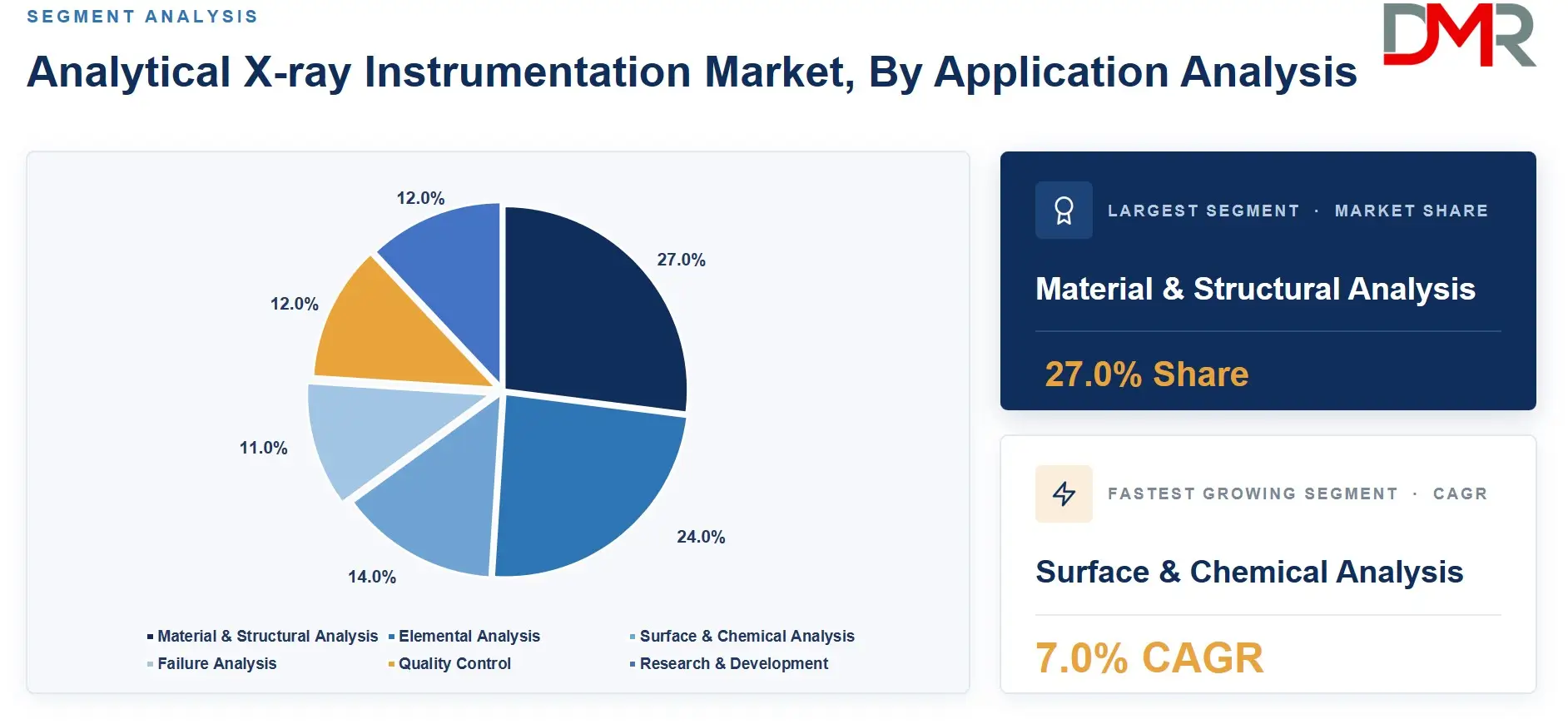
Material & Structural Analysis is estimated to be the largest application at approximately 27% share in 2026, reflecting XRD's widespread use for phase identification, crystallography, residual stress, lattice analysis and advanced-material development. Elemental Analysis follows at roughly 24%, led by XRF applications in mining, metals, chemicals, cement, environmental testing and manufacturing. Surface & Chemical Analysis, approximately 14%, is projected to be the fastest-growing area at around 7.0% CAGR, supported by XPS demand in semiconductors, catalysts, coatings and nanomaterials. Failure Analysis represents approximately 11%, while Quality Control contributes around 12% as industrial users increasingly integrate X-ray analysis into production workflows. Research & Development accounts for approximately 12% and remains strategically important because new batteries, semiconductors, pharmaceutical compounds and advanced materials require detailed characterization before commercialization. Overall, applications are shifting from periodic laboratory characterization toward faster, automated and production-linked measurement.
By End User Analysis
Metals & Mining is estimated to lead with approximately 20% share, reflecting extensive XRF and XRD usage for ore characterization, alloy identification, process control and quality verification. Semiconductor & Electronics follows at approximately 18% and should be the fastest-growing end-user category at roughly 7.2% CAGR, supported by advanced-node manufacturing, compound semiconductors, HBM, 3D architectures and thin-film research. Academic & Research Institutions account for approximately 17%, sustaining demand for flexible XRD, XPS and XAS platforms. Chemicals & Petrochemicals represent around 13%, while Pharmaceutical & Biotechnology account for approximately 12%, particularly in solid-state characterization and quality control. Environmental Testing contributes approximately 8%, Food & Beverage about 7%, and other end users approximately 5%. The broadening of demand across industrial, research and field environments should reduce dependence on any single vertical over the forecast period.
The Global Analytical X-ray Instrumentation Market Report is segmented on the basis of the following:
By Instrument Type
- X-ray Diffraction (XRD) Instruments
- X-ray Fluorescence (XRF) Instruments
- X-ray Photoelectron Spectroscopy (XPS) Instruments
- X-ray Absorption Spectroscopy (XAS) Instruments
- X-ray Imaging Instruments
By Technology
- Energy-Dispersive
- Wavelength-Dispersive
- Powder X-ray
- Single-Crystal X-ray
- Total Reflection X-ray
By Application
- Material & Structural Analysis
- Elemental Analysis
- Surface & Chemical Analysis
- Failure Analysis
- Quality Control
- Research & Development
By End User
- Pharmaceutical & Biotechnology
- Metals & Mining
- Chemicals & Petrochemicals
- Semiconductor & Electronics
- Food & Beverage
- Environmental Testing
- Academic & Research Institutions
- Other End Users
Regional Analysis
North America is the Leading Region in the Global Analytical X-ray Instrumentation Market
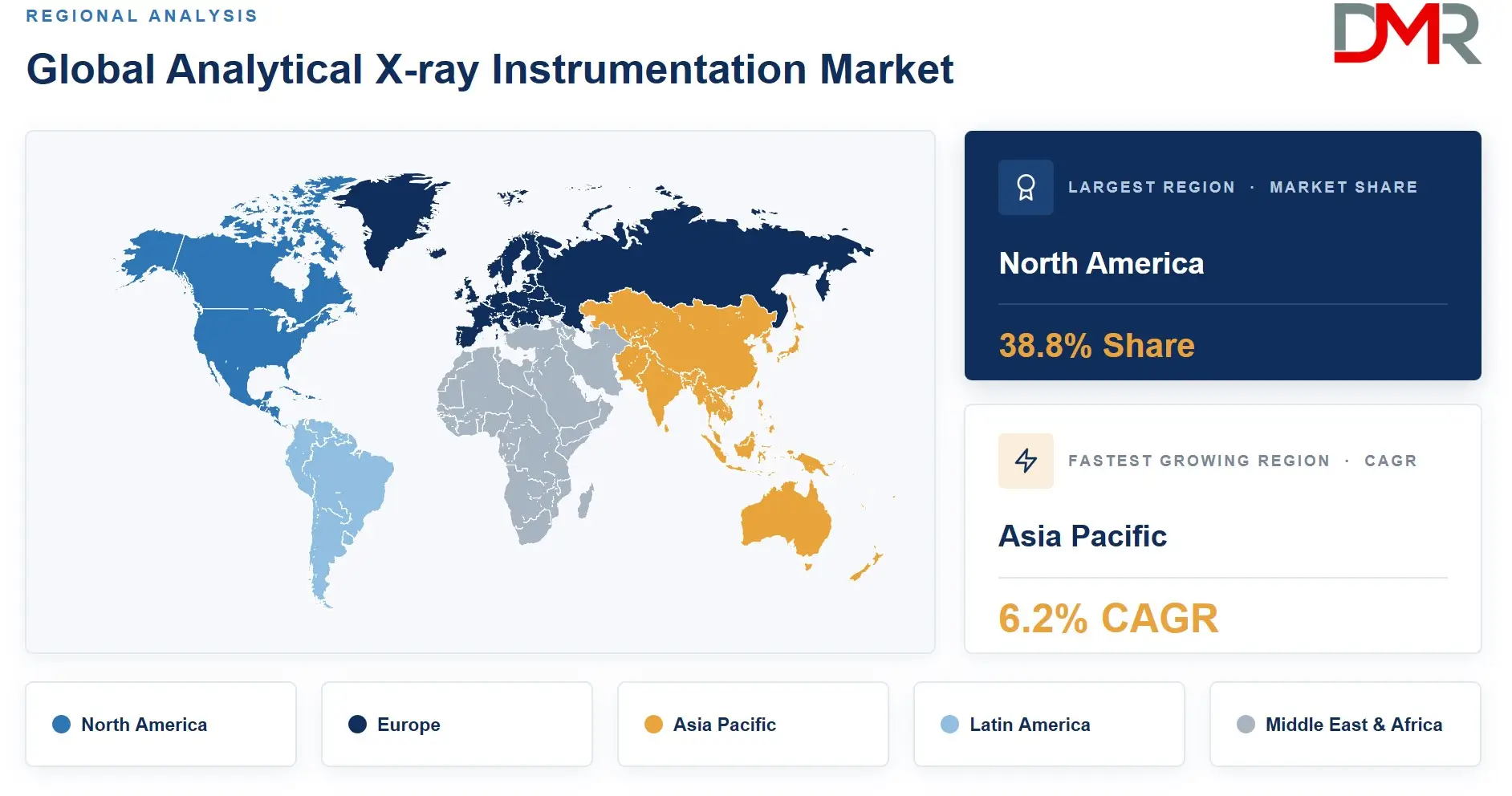
North America is expected to maintain its leadership, accounting for approximately 38.8% of the global market in 2026, consistent with recent market estimates. The region benefits from extensive pharmaceutical and biotechnology R&D, advanced semiconductor activity, aerospace and defense manufacturing, established mining and materials industries, and a dense network of universities and national laboratories. The United States is particularly important because major instrument manufacturers and sophisticated end users coexist with strong demand for high-resolution analytical systems. Federal research infrastructure, industrial automation and stringent quality requirements support continued investment. The region is also well positioned for early adoption of AI-enabled analytical workflows and high-throughput laboratory automation.
ℹ
To learn more about this report –
Download Your Free Sample Report Here
Asia Pacific is the Fastest-Growing Region in the Global Analytical X-ray Instrumentation Market
Asia-Pacific is projected to be the fastest-growing regional market at approximately 6.2% CAGR. Semiconductor manufacturing, battery materials, electronics, pharmaceuticals, mining, metals and advanced manufacturing are creating multiple demand centers across China, Japan, South Korea, India and Southeast Asia. Increasing university and government research investment is also expanding the installed base. Japan remains a major instrument-development hub, while China and South Korea provide large electronics and materials-analysis markets. India is expected to be an important long-term growth market as pharmaceutical manufacturing, research infrastructure, mining and electronics production expand.
The Europe Analytical X-ray Instrumentation Market
Europe is estimated at approximately USD 0.63 billion in 2026 and could reach about USD 0.97 billion by 2035, representing an estimated 4.9% CAGR. Germany, the U.K., France, Italy and the Benelux countries are important centers for automotive, aerospace, pharmaceuticals, chemicals, advanced materials and research. European demand is supported by high-quality manufacturing requirements, environmental standards and strong university and industrial research capabilities. Mature laboratories increasingly prioritize automation, energy efficiency and digital integration. European safety standards for cabinet X-ray systems include IEC 61010-2-091 requirements addressing radiation protection, interlocks and related hazards.
Latin America Analytical X-ray Instrumentation Market
Latin America is estimated at approximately USD 0.12 billion in 2026 and is projected to reach around USD 0.18 billion by 2035, equivalent to roughly 4.6% CAGR. Brazil and Mexico account for most regional demand. Mining, metals, agriculture, food processing, chemicals, environmental monitoring and pharmaceuticals provide the principal application base. Portable XRF is particularly attractive where analytical measurements must be made at mines, recycling facilities or remote industrial locations. Market expansion will depend on laboratory modernization, investment availability, import economics and access to trained technical personnel.
MEA Analytical X-ray Instrumentation Market
The Middle East & Africa market is estimated at approximately USD 0.17 billion in 2026 and could reach USD 0.25 billion by 2035, representing approximately 4.4% CAGR. Saudi Arabia and the UAE are key demand centers because of industrial diversification, mining development, petrochemicals and infrastructure investment. South Africa remains important for mining and mineral analysis. Environmental monitoring and food testing should also contribute. Portable XRF offers a particularly attractive value proposition for mining and field applications, while laboratory XRD/XRF demand should increase alongside industrial R&D investment.
Major Countries Analysis
United States Analytical X-ray Instrumentation Market
The U.S. market is estimated at approximately USD 0.82 billion in 2026 and could reach USD 1.27 billion by 2035, representing about 5.0% CAGR. Demand is driven by pharmaceuticals, semiconductor research, aerospace, defense, advanced materials, mining and academic research. The U.S. also benefits from a large installed base and strong demand for automated laboratory workflows. Separate research covering the broader U.S. analytical X-ray market projects significantly faster growth, illustrating the sensitivity of estimates to market definition.
Japan Analytical X-ray Instrumentation Market
Japan is estimated at approximately USD 0.16 billion in 2026 and approximately USD 0.26 billion by 2035, representing around 5.5% CAGR. Japan's strengths include precision manufacturing, electronics, automotive materials, pharmaceuticals and a deep domestic analytical-instrument ecosystem. Companies such as Rigaku continue to develop specialized XRD systems for semiconductors and polymers, reinforcing the country's role as both a major user and technology supplier.
Saudi Arabia Analytical X-ray Instrumentation Market
Saudi Arabia is estimated at approximately USD 45 million in 2026 and could reach roughly USD 70 million by 2035, representing approximately 5.0% CAGR. Mining diversification, petrochemicals, metals, cement, environmental monitoring and industrial localization programs are expected to support demand. Portable XRF should benefit from field-based mineral exploration and industrial inspection, while laboratory systems should gain from expanding R&D infrastructure.
Regulatory Landscape
Analytical X-ray equipment is subject to radiation-safety, electrical-safety, electromagnetic-compatibility and product-specific requirements that vary by jurisdiction. In the United States, analytical X-ray systems fall under federal radiation regulations, with FDA guidance distinguishing analytical systems such as X-ray spectroscopy, diffraction and fluorescence from medical X-ray equipment. Cabinet systems are also addressed by IEC 61010-2-091, which specifies particular safety requirements including radiation protection and interlocks. Portable handheld XRF equipment is addressed by IEC 62495 for radiological, electrical, environmental and performance-related safety. In India, X-ray equipment is regulated through the Atomic Energy Act framework and AERB requirements; the regulatory environment includes licensing, type approval and radiation-safety provisions.
Investment and White Space Analysis
The strongest investment opportunities are concentrated in semiconductor metrology, battery characterization, portable XRF, automated laboratory workflows, AI-enabled analysis and process-integrated XRF. Semiconductor applications offer particularly attractive economics because analytical requirements become more demanding as device architectures shrink. Battery materials provide another high-growth opportunity through operando and high-energy XRD. In emerging markets, affordable benchtop and handheld systems represent a relatively underserved opportunity where sophisticated centralized equipment may be uneconomic. Software subscriptions, remote diagnostics, application libraries, instrument-as-a-service models and automated sample preparation also offer recurring-revenue opportunities beyond traditional capital-equipment sales.
By Region
North America
Europe
- Germany
- France
- The U.K.
- Italy
- Spain
- Rest of Europe
Asia-Pacific
- China
- Japan
- India
- Australia
- South Korea
- Rest of APAC
Latin America
- Mexico
- Brazil
- Rest of LATAM
Middle East & Africa
- Saudi Arabia
- The UAE
- South Africa
- Rest of MEA
Competitive Landscape
The analytical X-ray instrumentation market is moderately fragmented, with several global specialists competing alongside diversified analytical-instrument companies. Important participants include Bruker, Rigaku, Malvern Panalytical, Thermo Fisher Scientific, Oxford Instruments, HORIBA, Shimadzu and Agilent Technologies, with specialized competitors serving particular XRD, XRF, XPS and materials-analysis niches. Competition is based on analytical sensitivity, resolution, throughput, detector performance, automation, software, application support, service coverage and total cost of ownership. Companies increasingly differentiate through specialized solutions for semiconductors, batteries, pharmaceuticals, mining and environmental applications rather than relying solely on generic instrument platforms.
Some of the prominent players in the Global Analytical X-ray Instrumentation Market are:
- Thermo Fisher Scientific
- Bruker
- Rigaku
- Shimadzu Corporation
- Malvern Panalytical
- Oxford Instruments
- HORIBA
- JEOL
- Agilent Technologies
- Anton Paar
- Hitachi High-Tech
- Leica Microsystems
- Spectris
- XOS
- Hach
- SPECTRO Analytical Instruments
- AMETEK
- Vanta
- Olympus Corporation
- Evident Scientific
- Nikon Metrology
- ZEISS
- PANalytical
- Skyray Instrument
- Xenemetrix
- Seiko Instruments
- Elvatech
- GNR Analytical Instruments
- Bourevestnik
- Oxford Instruments NanoAnalysis
- CAMECA
- EDAX
- IXRF Systems
- Applied Rigaku Technologies
- Dandong Haoyuan Instrument
- Shanghai Jingpu Technology
- Angstrom Advanced
- Inel
- Xenocs
- Dectris
- Other Key Players
Recent Developments
- In July 2026, Rigaku opened the Rigaku Solutions Center Osaka to strengthen global semiconductor metrology service capabilities, supporting customers with advanced analytical and X-ray metrology solutions.
- In June 2026, Bruker launched the D8 ADVANCE HE and D8 DISCOVER HE high-energy XRD systems, introducing CdTe-based LYNXEYE HE detection for battery, amorphous-material and catalyst research.
- In May 2026, Rigaku announced accelerated semiconductor metrology development by leveraging advanced research infrastructure, reinforcing its focus on next-generation semiconductor analytical technologies.
- In April 2026, Rigaku entered a strategic alliance with Onto Innovation to strengthen semiconductor metrology capabilities and support advanced process-control requirements.
- In March 2026, Rigaku launched the NEX QC II Series benchtop XRF analyzers at Pittcon 2026, targeting industrial quality-control applications with compact EDXRF technology.
- In December 2025, Rigaku launched the ONYX 3200 for semiconductor manufacturing, expanding its portfolio of X-ray-based metrology solutions for advanced semiconductor production.
- In October 2025, Malvern Panalytical launched its SDCOM ultra-fast crystal-orientation technology at Thapar University in India, targeting semiconductor materials including SiC, silicon and synthetic diamond.
- In September 2025, Rigaku, JEOL and Kyoto University established the RIGAKU/JEOL-iCeMS Innovation Core, creating a joint research facility focused on advanced structural-analysis technologies and skilled-personnel development.
- In August 2025, Rigaku launched sales of the XHEMIS TX-3000 TXRF analytical system for leading-edge semiconductor processes, expanding its trace-element analysis capabilities for semiconductor manufacturing.
In July 2025, Rigaku began full-scale commercial production of the XTRAIA XD-3300 high-resolution microspot XRD system, targeting next-generation memory and logic semiconductor applications.
Report Details
| Report Characteristics |
| Market Size (2026) |
USD 2.48 Bn |
| Forecast Value (2035) |
USD 3.80 Bn |
| CAGR (2026–2035) |
4.88% |
| The US Market Size (2026) |
USD 0.82 Bn |
| Historical Data |
2021 – 2025 |
| Forecast Data |
2026 – 2035 |
| Base Year |
2025 |
| Segments Covered |
By Instrument Type, By Technology, By Application, By End User |
| Regional Coverage |
North America – The US and Canada; Europe – Germany, France, The UK, Italy, Spain, Rest of Europe; Asia-Pacific – China, Japan, India, Australia, South Korea, Rest of APAC; Latin America – Mexico, Brazil, Colombia, Argentina, Rest of LATAM; Middle East & Africa – Saudi Arabia, The UAE, South Africa, Rest of MEA |
Frequently Asked Questions
What is the size of the Analytical X-ray Instrumentation Market in 2026?
▾ The global Analytical X-ray Instrumentation Market is estimated at approximately USD 2.48 billion in 2026 and is projected to reach USD 3.80 billion by 2035.
What CAGR is expected for the Analytical X-ray Instrumentation Market?
▾ The Analytical X-ray Instrumentation Market is projected to grow at a 4.88% CAGR from 2026 to 2035, driven by increasing demand for advanced material characterization.
What are the key factors driving the Analytical X-ray Instrumentation Market?
▾ Major drivers include semiconductor manufacturing, battery research, pharmaceutical development, industrial quality control, environmental testing, and advanced materials research.
Which segment dominates the Analytical X-ray Instrumentation Market?
▾ X-ray Diffraction (XRD) Instruments are estimated to dominate the Analytical X-ray Instrumentation Market, accounting for approximately 34% share in 2026.
Which region leads the Analytical X-ray Instrumentation Market?
▾ North America is expected to lead the Analytical X-ray Instrumentation Market with approximately 38.8% share in 2026, supported by advanced research and industrial infrastructure.
Which region is growing fastest in the Analytical X-ray Instrumentation Market?
▾ Asia-Pacific is projected to be the fastest-growing region in the Analytical X-ray Instrumentation Market, with an estimated 6.2% CAGR through 2035.
Who are the key players in the Analytical X-ray Instrumentation Market?
▾ Major companies include Bruker, Rigaku, Malvern Panalytical, Thermo Fisher Scientific, Oxford Instruments, HORIBA, Shimadzu, and Agilent Technologies.
How is the Analytical X-ray Instrumentation Market segmented?
▾ The Analytical X-ray Instrumentation Market is segmented by instrument type, technology, application, end user, and region, covering XRD, XRF, XPS, XAS, and X-ray imaging technologies.