What is the Anti-Plagiarism for the Education Sector Market Size in 2026?
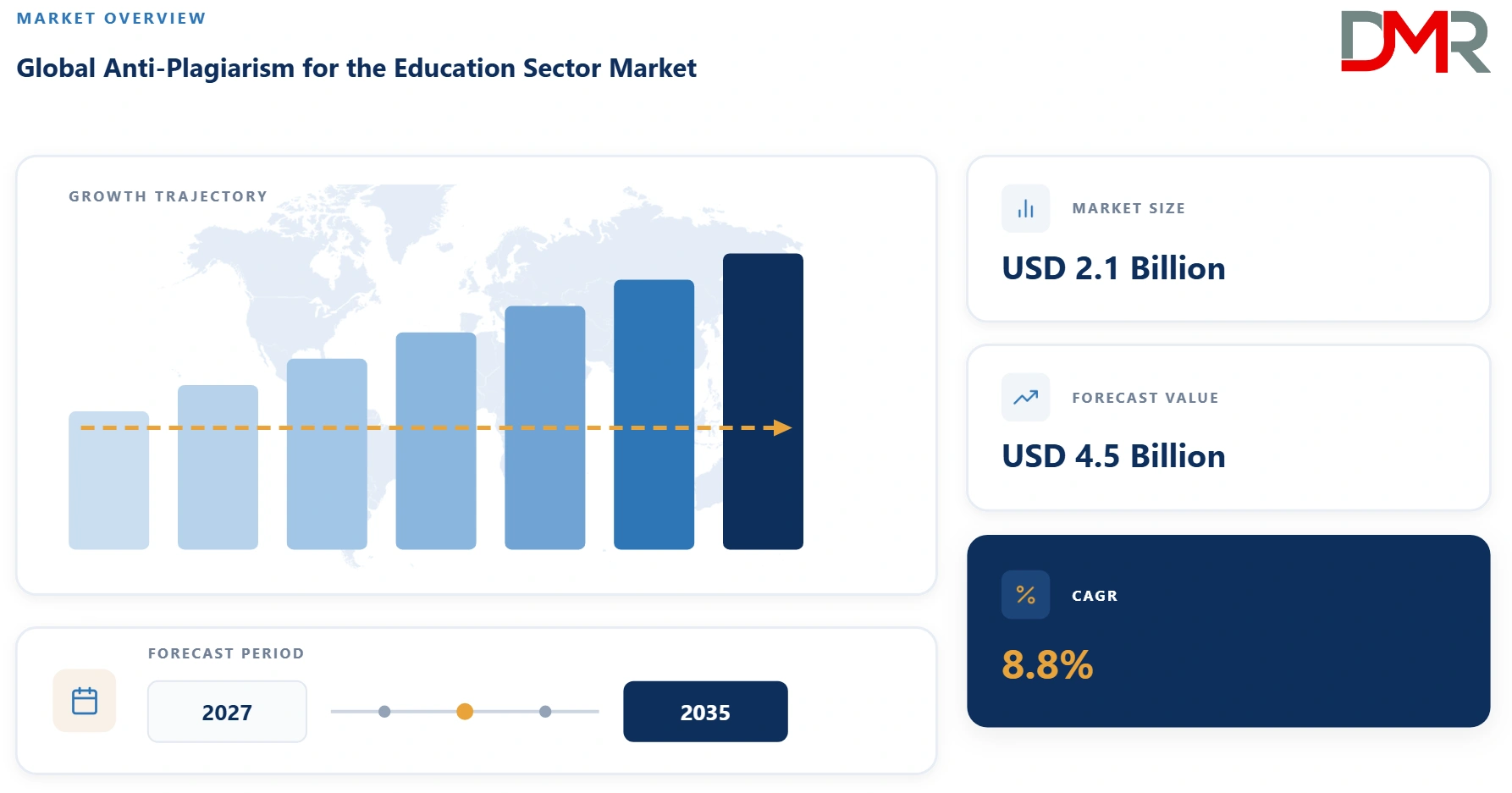
The Global Anti-Plagiarism for the Education Sector Market is valued at USD 2.1 billion in 2026 and is projected to reach USD 4.5 billion by 2035, growing at a CAGR of 8.8% from 2027 to 2035. Growth is driven by increasing academic integrity requirements, expanding digital education, rising concerns regarding AI-generated assignments, growing adoption of cloud-based assessment platforms, and increasing institutional investments in advanced originality verification solutions.
ℹ
To learn more about this report –
Download Your Free Sample Report Here
Anti-plagiarism for the education sector refers to software and services designed to identify potential content duplication, unauthorized textual reproduction, improper citations, and academic originality concerns across educational environments. These solutions compare submitted documents against academic publications, online resources, institutional repositories, and previously submitted assignments. Advanced platforms incorporate artificial intelligence, natural language processing, and source code analysis to identify potential misconduct. Educational institutions utilize anti-plagiarism tools to support academic integrity, originality assessment, and responsible learning.
The Global Anti-Plagiarism for the Education Sector Market covers software and services supporting academic originality assessment and plagiarism identification across educational environments. Market coverage encompasses cloud-based and on-premises deployment models with capabilities for textual similarity analysis, AI-generated content identification, source code comparison, and cross-language plagiarism assessment. The analysis includes higher education institutions, schools, research institutions, and e-learning platforms. Revenue assessment considers software subscriptions, licensing, implementation, integration, training, and technical support services specifically designed for academic integrity management and educational assessment applications.
Anti-Plagiarism for the Education Sector Market Snapshot
Anti-Plagiarism for the Education Sector Market Snapshot, 2026-2035
| Metric |
Value |
| Market Size (2026) |
USD 2.1 Billion |
| Forecast Value (2035) |
USD 4.5 Billion |
| CAGR (2027–2035) |
8.8% |
| Largest Region (2026) |
North America, 43.3% share |
| Fastest-Growing Region (2027–2035) |
Asia Pacific, 9.9% CAGR |
| Leading Offering (2026) |
Software, 76.4% share |
| Leading Deployment (2026) |
Cloud-Based, 72.6% share |
| Key Players |
Turnitin, LLC; Copyleaks, Inc.; Inspera AS; Compilatio; Plagiat.pl Sp. z o.o.; PlagiarismCheck.org; Superhuman; Quetext |
Anti-Plagiarism for the Education Sector Market: Key Takeaways
- Market Growth: The market is valued at USD 2.1 billion in 2026 and is projected to reach USD 4.5 billion by 2035, registering a CAGR of 8.8%.
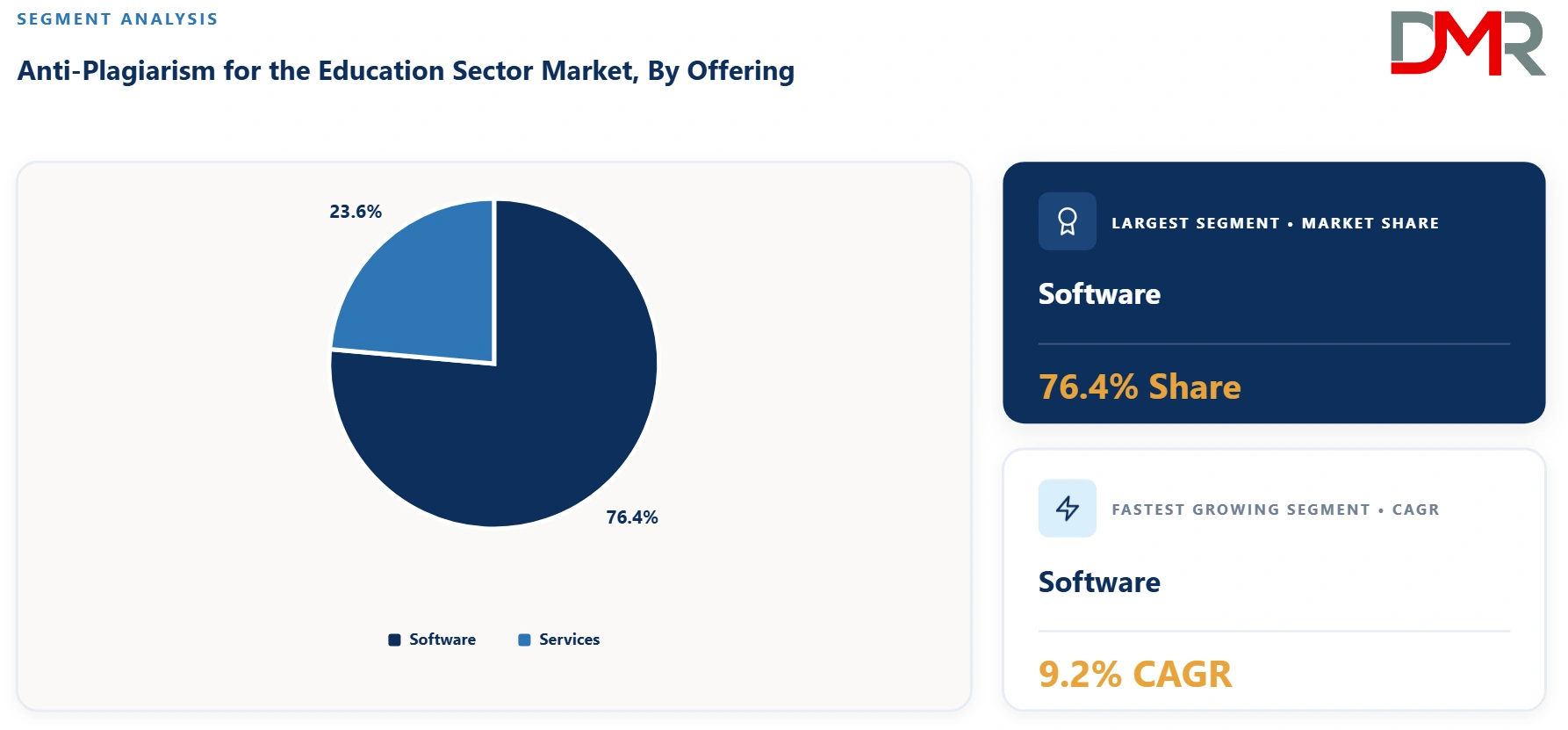
- Offering Leader: Software accounts for 76.4% of market revenue in 2026, supported by extensive adoption of automated academic originality assessment platforms.
- Fastest-Growing Offering: Software is projected to register a CAGR of 9.2%, driven by technological advancements and increasing institutional software subscriptions.
- Deployment Leader: Cloud-Based deployment accounts for 72.6% of market revenue in 2026, supported by scalability, remote accessibility, and centralized academic assessment capabilities.
- Fastest-Growing Deployment: Cloud-Based deployment is projected to register a CAGR of 9.5%, driven by expanding digital education infrastructure.
- Regional Picture: North America leads with a 43.3% market share in 2026, while Asia Pacific is projected to grow at a CAGR of 9.9%.
What are the Key Use Cases of Anti-Plagiarism for the Education Sector?
- Academic Assignment Assessment: Compares student submissions against reference databases to identify potential textual duplication, improper citations, and unauthorized content reproduction.
- AI-Generated Content Identification: Flags potentially AI-generated academic submissions, supporting educator review and responsible artificial intelligence usage within educational environments.
- Source Code Verification: Identifies structural and functional similarities across programming assignments, supporting academic integrity in computer science and software engineering courses.
- Research Originality Assessment: Examines dissertations, theses, and research manuscripts for overlapping content, supporting publication integrity and adherence to institutional research standards.
How are Foundation Models and Generative AI Transforming the Anti-Plagiarism for the Education Sector Market
Foundation models and generative AI are transforming academic originality assessment through advanced semantic analysis, contextual interpretation, and automated content verification. Traditional plagiarism detection primarily identifies matching text, while modern AI-enabled systems evaluate paraphrased content, writing patterns, and linguistic inconsistencies. Large language models support multilingual analysis and improve identification of potentially manipulated academic submissions across diverse educational disciplines and institutional environments.
The increasing availability of generative AI writing tools simultaneously creates requirements for specialized detection capabilities. Educational institutions increasingly explore integrated platforms combining text similarity assessment, AI-generated content identification, and detailed originality reporting. Automated analytical capabilities reduce preliminary review workloads and support academic integrity investigations. Continued technological advancements encourage investment in transparent detection methodologies, responsible AI governance, and educator-led verification processes to maintain fair academic assessment.
Anti-Plagiarism for the Education Sector Market Dynamics at a Glance
Drivers, Restraints, Opportunities and Trends in the Anti-Plagiarism for the Education Sector Market
| Type |
Factor |
Impact |
| Driver |
Increasing Institutional Emphasis on Academic Integrity |
High |
| Driver |
Expansion of Digital Education and Online Assessments |
High |
| Restraint |
Limitations in Detection Accuracy and Reliability |
High |
| Restraint |
High Subscription and Implementation Costs |
Medium |
| Opportunity |
Expansion of Multilingual Academic Integrity Solutions |
Medium |
| Opportunity |
Growing Demand for Source Code Plagiarism Detection |
High |
| Trend |
Increasing Integration of AI-Generated Content Detection |
High |
| Trend |
Growing Adoption of Writing Process Verification |
Medium |
What is Driving the Growth of the Anti-Plagiarism for the Education Sector Market?
Increasing Institutional Emphasis on Academic Integrity
Increasing institutional emphasis on academic integrity is driving demand for anti-plagiarism solutions across educational environments. Universities, schools, and research institutions increasingly implement originality assessment policies to maintain educational standards and protect academic credibility. Growing requirements for authentic assignments, dissertations, and research publications encourage the adoption of automated plagiarism identification platforms. These solutions enable educators to identify potentially duplicated content, evaluate citation practices, and support consistent assessment procedures. Institutional efforts to prevent academic misconduct and strengthen responsible research practices contribute to sustained demand for advanced anti-plagiarism software and associated educational support services.
Expansion of Digital Education and Online Assessments
The expansion of digital education and online assessments is accelerating demand for anti-plagiarism solutions across academic institutions. Increasing adoption of learning management systems, virtual classrooms, and digital assignment submission platforms generates substantial volumes of electronic academic content. Educational organizations require scalable originality assessment tools capable of processing submissions efficiently across distributed learning environments. Integration with existing educational platforms simplifies assessment workflows and improves administrative efficiency. Growing participation in online degree programs, distance learning, and professional education strengthens demand for automated academic integrity solutions. Continued digitalization of educational infrastructure supports market expansion across established and emerging education systems.
What are the Key Restraints in the Anti-Plagiarism for the Education Sector Market?
Limitations in Detection Accuracy and Reliability
Limitations in detection accuracy and reliability present significant challenges for anti-plagiarism solution adoption across educational institutions. Automated systems may incorrectly identify properly cited materials, commonly use academic terminology, or independently develop content as potentially problematic. AI-generated content detection tools also face difficulties distinguishing human-written text from machine-generated or substantially edited materials. Inaccurate classifications can create academic disputes and undermine confidence in automated assessment systems. Educational institutions require additional human verification and contextual analysis to establish reliable findings. These limitations increase administrative workloads and restrict dependence on automated detection technologies for sensitive academic integrity decisions.
High Subscription and Implementation Costs
High subscription and implementation costs restrict the adoption of advanced anti-plagiarism solutions, particularly among educational institutions operating with limited technology budgets. Enterprise-grade platforms require expenditure on institutional licenses, software subscriptions, learning management system integration, and technical support. Additional expenses arise from staff training, repository management, and ongoing platform maintenance. Smaller schools and institutions in developing economies frequently encounter financial constraints when implementing comprehensive academic integrity systems. Budget limitations encourage reliance on basic or freely available alternatives with restricted analytical capabilities. These financial considerations create challenges for premium solution providers seeking broader institutional adoption.
What are the Key Opportunities in the Anti-Plagiarism for the Education Sector Market?
Expansion of Multilingual Academic Integrity Solutions
The expansion of multilingual academic integrity solutions creates opportunities for anti-plagiarism technology providers serving geographically diverse educational markets. Increasing international student mobility, multilingual research publications, and cross-border educational collaborations generate requirements for originality assessment across different languages. Traditional text-matching systems may have limited capabilities when identifying translated or linguistically modified content. Advanced multilingual analysis can improve identification of potential similarities across regional languages and international academic sources. Technology providers can address emerging institutional requirements through localized interfaces, expanded reference databases, and cross-language semantic analysis. Growing demand for inclusive educational technology supports commercial opportunities across emerging markets.
Growing Demand for Source Code Plagiarism Detection
Growing demand for source code plagiarism detection creates opportunities for specialized academic integrity solution providers. Expanding computer science education, software engineering programs, and online coding courses generate increasing volumes of programming assignments requiring originality assessment. Conventional text similarity tools provide limited capabilities for identifying structural similarities within programming code. Specialized platforms evaluate program organization, syntax, and logical relationships to support educator review of potentially duplicated assignments. Integration with coding assessment systems and learning management platforms improves usability across academic environments. Increasing adoption of technology-focused educational programs supports opportunities for scalable, programming language-compatible originality assessment solutions.
What are the Latest Trends in the Anti-Plagiarism for the Education Sector Market?
Increasing Integration of AI-Generated Content Detection
The increasing integration of AI-generated content detection reflects changing academic integrity requirements across educational institutions. Widespread availability of generative AI writing tools creates demand for solutions capable of identifying potentially machine-generated assignments and research materials. Anti-plagiarism providers increasingly combine conventional similarity assessment with AI-generated content analysis within unified platforms. Advanced detection systems evaluate linguistic patterns, contextual characteristics, and writing consistency to support preliminary academic review. Educational institutions increasingly prioritize transparent reporting and responsible interpretation of automated results. Continued advancements in generative AI encourage ongoing investment in detection models, multilingual capabilities, and comprehensive academic integrity management solutions.
Growing Adoption of Writing Process Verification
Growing adoption of writing process verification reflects increasing institutional emphasis on evaluating academic authorship beyond conventional text similarity scores. Educational organizations increasingly explore technologies that document revision histories, writing development, and assignment preparation activities. These capabilities provide additional contextual information when reviewing potentially questionable submissions. Integration with digital writing environments enables educators to assess content development and support constructive academic feedback. Writing process verification complements plagiarism and AI-generated content assessment without relying exclusively on automated classification results. Increasing demand for fair assessment practices encourages technology providers to develop transparent, evidence-based originality verification capabilities.
Research Scope and Analysis
The research covers the Global Anti-Plagiarism for the Education Sector Market across offering, deployment, functionality, end user, and region. The analysis evaluates revenue generated through academic originality assessment software, subscriptions, licensing, and associated services. Market assessment incorporates institutional adoption, technological developments, competitive positioning, regulatory requirements, and commercial growth opportunities across diverse educational environments and geographic markets.
ℹ
To learn more about this report –
Download Your Free Sample Report Here
By Offering Analysis
Software is projected to dominate the offering segment in the Global Anti-Plagiarism for the Education Sector Market, accounting for 76.4% of the total market share in 2026. Dominance is supported by extensive institutional adoption of automated originality assessment and plagiarism identification platforms. Software is also projected to be the fastest-growing segment, registering a CAGR of 9.2% from 2027 to 2035, driven by technological advancements, expanded analytical capabilities, and increasing institutional software subscriptions.
By Deployment Analysis
Cloud-Based deployment is projected to dominate the deployment segment in the Global Anti-Plagiarism for the Education Sector Market, accounting for 72.6% of the total market share in 2026. Dominance is supported by remote accessibility, scalability, centralized administration, and reduced infrastructure requirements. Cloud-Based deployment is also projected to be the fastest-growing segment, registering a CAGR of 9.5% from 2027 to 2035, driven by expanding digital learning infrastructure and increasing adoption of integrated academic assessment platforms.
By Functionality Analysis
Text Similarity is projected to dominate the functionality segment in the Global Anti-Plagiarism for the Education Sector Market, accounting for 43.7% of the total market share in 2026. Dominance is supported by established institutional requirements for identifying textual duplication and improper citations. AI-Generated Content is projected to be the fastest-growing segment, registering a CAGR of 10.0% from 2027 to 2035, driven by expanding generative AI usage and increasing requirements for academic authorship verification.
By End User Analysis
Higher Education Institutions are projected to dominate the end user segment in the Global Anti-Plagiarism for the Education Sector Market, accounting for 46.8% of the total market share in 2026. Dominance is supported by extensive academic research, assignment assessment, and institutional originality requirements. E-Learning Platforms are projected to be the fastest-growing segment, registering a CAGR of 9.8% from 2027 to 2035, driven by expanding online education programs and increasing digital assessment activities.
How is the Anti-Plagiarism for the Education Sector Market Segmented?
By Offering
By Deployment
By Functionality
- Text Similarity
- AI-Generated Content
- Source Code Plagiarism
- Cross-Language Plagiarism
- Others
By End User
- Higher Education Institutions
- K-12 Schools
- Research Institutions
- E-Learning Platforms
- Others
Which Region Leads the Anti-Plagiarism for the Education Sector Market?
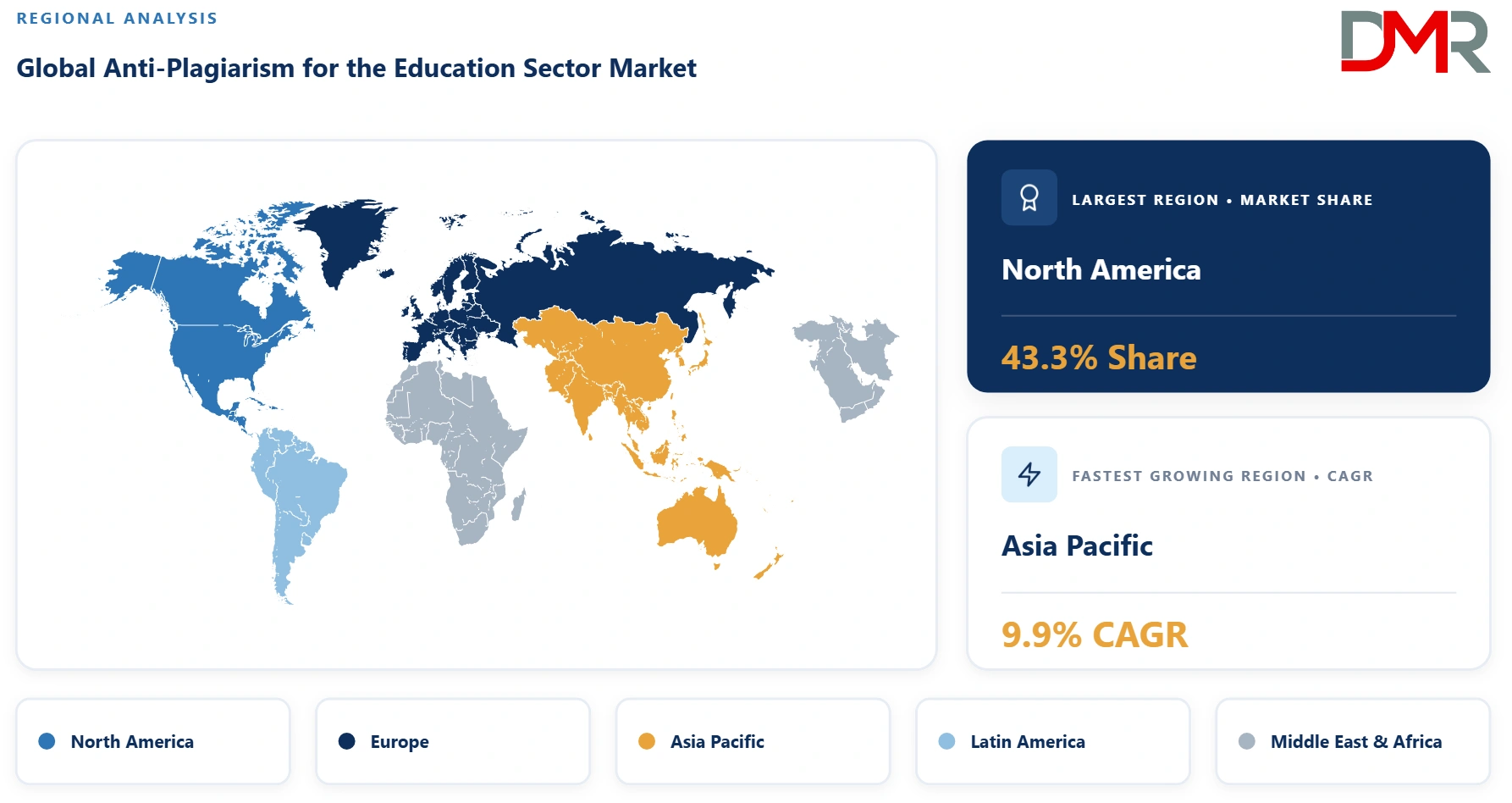
North America leads the Global Anti-Plagiarism for the Education Sector Market with a 43.3% share in 2026, while Asia Pacific is projected to register the highest CAGR of 9.9% from 2027 to 2035.
ℹ
To learn more about this report –
Download Your Free Sample Report Here
Region with the Largest Revenue Share
North America dominates the Global Anti-Plagiarism for the Education Sector Market, accounting for 43.3% of the total market share in 2026. Regional dominance is supported by advanced educational infrastructure, established academic integrity policies, and extensive adoption of digital learning platforms. The U.S. and Canada contribute to market demand through institutional investments in automated originality assessment technologies. The presence of established educational software providers and research universities supports product innovation, while increasing concerns regarding academic authorship encourage adoption of advanced verification solutions.
Region with the Highest CAGR
Asia Pacific is projected to register the highest CAGR of 9.9% in the Global Anti-Plagiarism for the Education Sector Market from 2027 to 2035. Regional growth is supported by expanding higher education infrastructure, increasing digital learning adoption, and strengthening academic integrity requirements. China, Japan, India, Australia, and South Korea contribute through educational modernization and technology investments. Growing demand for multilingual originality assessment, research verification, and affordable cloud-based academic integrity solutions supports market expansion across established and emerging educational institutions.
Regional Analysis
Europe Anti-Plagiarism for the Education Sector Market
The Europe Anti-Plagiarism for the Education Sector Market is supported by established higher education systems, academic research activities, and increasing digital assessment adoption. Germany, France, the U.K., Italy, and Spain contribute to regional demand through institutional academic integrity initiatives and educational technology investments. Organizations increasingly prioritize originality assessment solutions offering multilingual analysis and secure data management. Growing requirements for responsible artificial intelligence usage and student privacy protection encourage the adoption of transparent, reliable, and institutionally integrated plagiarism identification platforms.
Latin America Anti-Plagiarism for the Education Sector Market
The Latin America Anti-Plagiarism for the Education Sector Market is supported by expanding digital education infrastructure, increasing internet accessibility, and growing institutional emphasis on academic integrity. Mexico and Brazil contribute to regional demand through university modernization and expanding online education programs. Educational institutions increasingly adopt cloud-based originality assessment solutions to improve accessibility and reduce infrastructure costs. Growing demand for Spanish and Portuguese language analysis, affordable institutional subscriptions, and integrated academic assessment platforms supports commercial opportunities across regional education systems.
Middle East & Africa Anti-Plagiarism for the Education Sector Market
The Middle East & Africa Anti-Plagiarism for the Education Sector Market is supported by education modernization initiatives, expanding university infrastructure, and increasing adoption of digital learning technologies. Saudi Arabia, the UAE, and South Africa contribute through institutional investments in academic assessment and research quality improvement. Educational organizations increasingly prioritize originality verification to strengthen academic standards and international research credibility. Growing demand for Arabic language assessment, accessible cloud-based platforms, and integrated learning management solutions creates opportunities for specialized academic integrity providers.
By Region
North America
Europe
- Germany
- France
- The U.K.
- Italy
- Spain
- Rest of Europe
Asia-Pacific
- China
- Japan
- India
- Australia
- South Korea
- Rest of APAC
Latin America
- Mexico
- Brazil
- Rest of LATAM
Middle East & Africa
- Saudi Arabia
- The UAE
- South Africa
- Rest of MEA
Regulatory Landscape
The regulatory landscape of the Global Anti-Plagiarism for the Education Sector Market is influenced by academic integrity policies, data protection regulations, intellectual property laws, and educational quality standards. The General Data Protection Regulation and the Family Educational Rights and Privacy Act influence student data handling across relevant jurisdictions. Academic institutions establish originality requirements for assignments, dissertations, and research publications. National initiatives, including India's ShodhShuddhi programme, support institutional access to plagiarism detection software. Increasing regulatory attention toward artificial intelligence usage encourages transparent assessment practices and responsible technology deployment. These requirements create opportunities for providers offering secure data management, configurable institutional policies, and comprehensive academic integrity reporting.
Technology Analysis
Technological advancements in the Global Anti-Plagiarism for the Education Sector Market focus on natural language processing, semantic similarity analysis, machine learning, and automated originality assessment. Advanced algorithms identify textual duplication, paraphrased passages, translated content, and structural similarities across programming assignments. Cloud-based infrastructure supports scalable document processing and centralized institutional administration. Application programming interfaces facilitate integration with learning management systems and digital assessment platforms. Optical character recognition expands assessment capabilities to handwritten academic submissions. Increasing demand for reliable authorship verification encourages investment in advanced analytical models, multilingual reference databases, transparent reporting, and human review capabilities, strengthening technological differentiation across academic integrity solution providers and educational environments.
Who are the Leading Companies in the Anti-Plagiarism for the Education Sector Market?
The Global Anti-Plagiarism for the Education Sector Market is characterized by competition among educational technology providers, academic integrity specialists, and artificial intelligence developers. Major participants include Turnitin, LLC, Copyleaks, Inc., Inspera AS, Compilatio, and Plagiat.pl Sp. z o.o. Competitive differentiation focuses on reference database coverage, detection capabilities, multilingual support, institutional integration, and reporting accuracy. Companies strengthen market positioning through technological innovation, educational partnerships, and expanded software functionality.
- Turnitin, LLC (California, U.S.): Provides academic integrity solutions through Turnitin Similarity, Turnitin Originality, and iThenticate, supporting textual similarity assessment, AI-generated content identification, and academic research verification.
- Copyleaks, Inc. (Connecticut, U.S.): Offers AI-powered plagiarism detection, AI-generated content identification, source code analysis, and multilingual content verification solutions supporting educational institutions and digital learning environments.
- Inspera AS (Oslo, Norway): Provides Inspera Originality, supporting academic similarity assessment, originality reporting, and integrated digital assessment workflows across higher education institutions and other educational environments.
- Compilatio (Chavanod, France): Offers academic integrity solutions through Compilatio Magister, Magister+, and Studium, supporting plagiarism identification, AI-generated content assessment, and educational originality verification.
- Plagiat.pl Sp. z o.o. (Warsaw, Poland): Provides StrikePlagiarism.com, offering multilingual similarity assessment, AI-generated content detection, academic document analysis, and institutional integration capabilities across international education markets.
Some of the prominent players in the Global Anti-Plagiarism for the Education Sector are:
- Turnitin, LLC
- Copyleaks, Inc.
- Inspera AS
- Compilatio
- Plagiat.pl Sp. z o.o.
- DrillBit SoftTech India Private Limited
- PlagiarismCheck.org
- Quetext
- Originality.ai
- PlagiarismSearch
- PlagAware
- Plagiarism Checker X
- Pangram Labs
- MUHAYU Inc.
- China National Knowledge Infrastructure
- Wanfang Data Co., Ltd.
- Chongqing VIP Information Co., Ltd.
- PaperPass
- PaperFree
- PaperYY
- Antiplagiat
- Codequiry
- CodeGrade
- Google LLC
- Anthology Inc.
- D2L Corporation
- Copyscape
- Plagium
- DupliChecker
- Prepostseo
- Small SEO Tools
- Plagiarisma
- Intihal.net
- Superhuman
- Winston AI
- Sapling Intelligence, Inc.
- CorrectEnglish
- LanguageTool
- Smodin
- Other Key Players
Recent Developments in the Anti-Plagiarism for the Education Sector Market
- In November 2026, Inspera AS introduced usability enhancements to Inspera Originality, including improvements to assignment-level reporting and data export functionality. The development supports more efficient academic originality assessment and administrative workflows across educational institutions.
- In November 2026, Superhuman introduced GPTZero 5.0 through its GPTZero business, expanding AI-generated content identification capabilities. The updated detection model supports academic authorship assessment and provides additional analytical capabilities for educational institutions addressing generative AI-related academic integrity concerns.
- In October 2026, Compilatio made its updated AI Detector version 4.6.2 available to Compilatio Magister+ and Compilatio Studium customers. The development strengthens AI-generated content assessment capabilities, supporting academic integrity verification across institutional and student-oriented educational applications.
- In August 2026, Turniti, LLC updated its AI writing report for eligible Turnitin Originality and iThenticate customers. The development introduced simplified reporting for potentially AI-generated and AI-modified text, supporting more accessible interpretation of automated assessment results by educators.
- In June 2026, Compilatio announced optical character recognition capabilities for handwritten document analysis across selected academic integrity products. The development enables educational institutions to examine handwritten assignments for potential plagiarism and AI-generated content, expanding originality assessment beyond conventional digital submissions.
Anti-Plagiarism for the Education Sector Market Report Scope and Research Methodology
Market Definition: The Anti-Plagiarism for the Education Sector Market encompasses software and services supporting academic originality assessment, textual similarity identification, AI-generated content detection, source code comparison, and cross-language plagiarism analysis across educational institutions, research organizations, and digital learning platforms globally.
Methodology: Dimension Market Research's proposed market estimation methodology combines bottom-up analysis of anti-plagiarism solution provider revenues, software subscriptions, institutional licensing, adoption rates, and associated service expenditure with top-down validation against educational technology and academic assessment spending. Primary interviews with technology providers, academic administrators, educators, and institutional end users support validation of pricing and adoption assumptions. Forecasts incorporate segment-level growth expectations for 2027–2035 and periodic assessment of technological advancements, institutional requirements, and market conditions.
Anti-Plagiarism for the Education Sector Market Report Details
| Report Characteristics |
Details |
| Market Size (2026) |
USD 2.1 Billion |
| Market Size (2027) |
USD 2.3 Billion |
| Forecast Value (2035) |
USD 4.5 Billion |
| CAGR (2027–2035) |
8.8% |
| Historical Data |
2021–2026 |
| Forecast Data |
2027–2035 |
| Base Year |
2026 |
| Estimate Year |
2027 |
| Regional Coverage |
North America (The US, Canada); Europe (Germany, France, The UK, Italy, Spain, Rest of Europe); Asia Pacific (China, Japan, India, Australia, South Korea, Rest of APAC); Latin America (Mexico, Brazil, Rest of LATAM); Middle East & Africa (Saudi Arabia, The UAE, South Africa, Rest of MEA) |
Frequently Asked Questions
How big is the Anti-Plagiarism for the Education Sector Market in 2026?
▾ The Global Anti-Plagiarism for the Education Sector Market is valued at USD 2.1 billion in 2026 and is projected to reach USD 4.5 billion by 2035.
What is the growth rate of the Anti-Plagiarism for the Education Sector Market?
▾ The Global Anti-Plagiarism for the Education Sector Market is projected to grow at a CAGR of 8.8% from 2027 to 2035.
Which region leads the Anti-Plagiarism for the Education Sector Market?
▾ North America dominates the Global Anti-Plagiarism for the Education Sector Market, accounting for 43.3% of the total market share in 2026.
Which offering segment dominates the Anti-Plagiarism for the Education Sector Market?
▾ Software dominates the offering segment, accounting for 76.4% of the total market share in 2026.
Which end user is growing fastest in the Anti-Plagiarism for the Education Sector Market?
▾ E-Learning Platforms are projected to be the fastest-growing end user segment, registering a CAGR of 9.8% from 2027 to 2035.
Who are the key players in the Anti-Plagiarism for the Education Sector Market?
▾ Key players include Turnitin, LLC, Copyleaks, Inc., Inspera AS, Compilatio, Plagiat.pl Sp. z o.o., PlagiarismCheck.org, Superhuman, and Quetext.
What are the main challenges facing the Anti-Plagiarism for the Education Sector Market?
▾ Limitations in detection accuracy and reliability, high subscription costs, and institutional implementation expenses represent significant challenges restricting anti-plagiarism technology adoption.