Market Overview
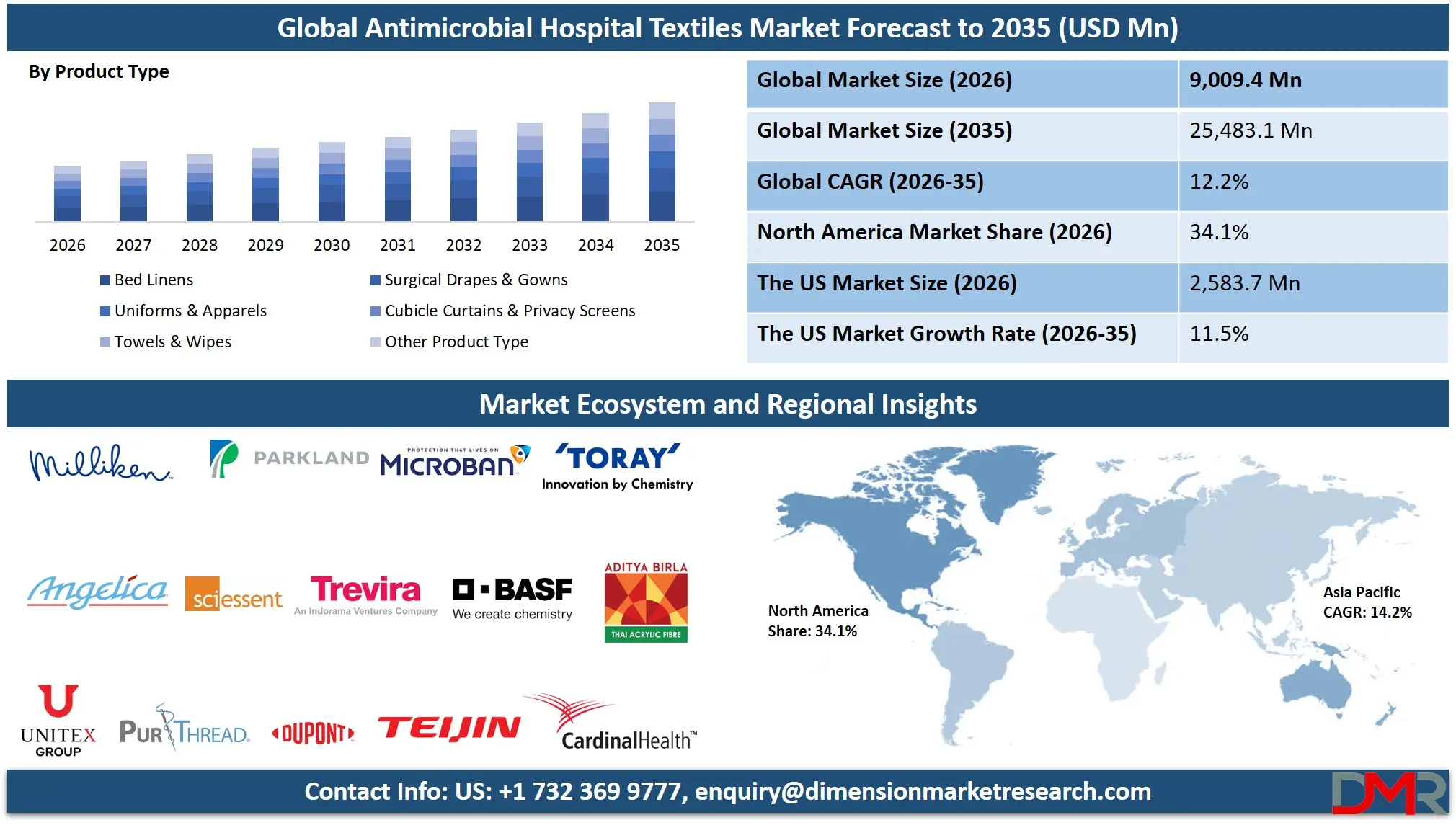
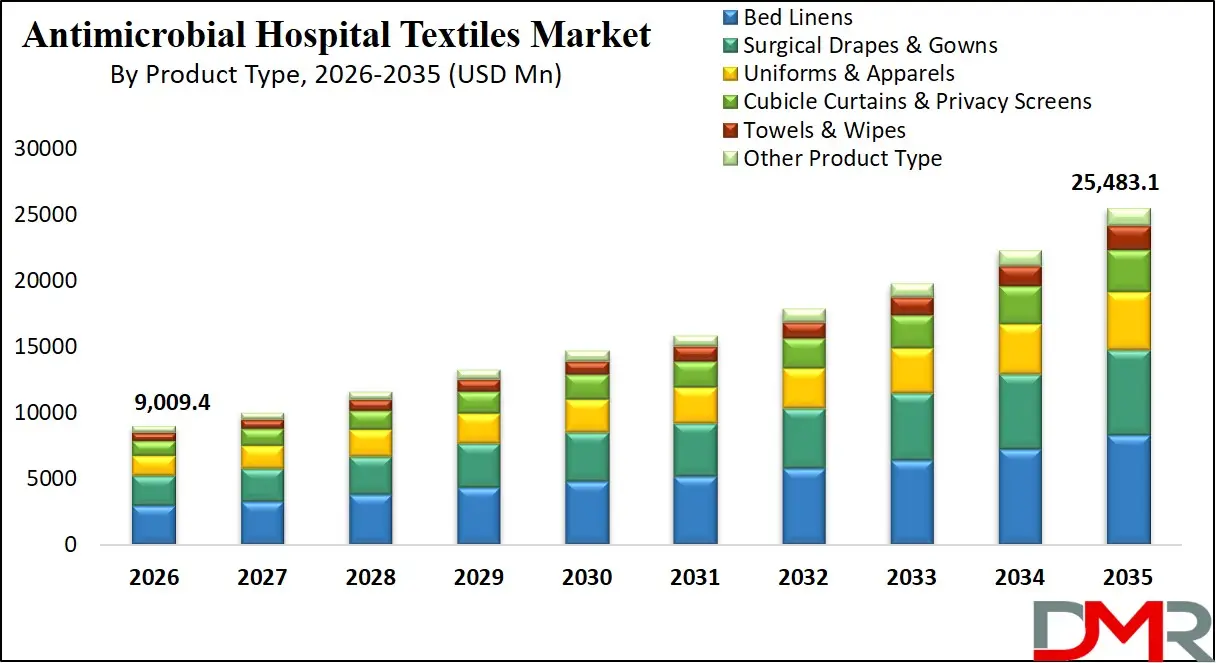
The Global Antimicrobial Hospital Textiles Market is poised for significant expansion, reaching an estimated valuation of USD 9,009.4 million in 2026. Driven by rising concerns around hospital-acquired infections (HAIs), stringent infection prevention protocols, and increasing healthcare infrastructure investments, the market is projected to grow at a robust CAGR of 12.2% between 2026 and 2035, ultimately attaining approximately USD 25,483.1 million by 2035.
ℹ
To learn more about this report –
Download Your Free Sample Report Here
Growth in this market is strongly supported by the accelerating adoption of antimicrobial fabrics, infection-resistant medical linens, treated hospital bedding, antimicrobial curtains, surgical drapes, patient gowns, and protective healthcare apparel. Hospitals and healthcare facilities are increasingly investing in silver-ion treated textiles, copper-infused fabrics, quaternary ammonium-based coatings, and advanced nanotechnology-enabled antimicrobial finishes to minimize microbial contamination and cross-transmission risks.
Rising surgical procedures, expanding inpatient admissions, and heightened awareness of hygiene compliance standards across both developed and emerging economies are further accelerating demand. Additionally, regulatory guidelines from healthcare authorities emphasizing infection control standards are pushing healthcare providers to upgrade conventional textile materials with biocidal, anti-bacterial, anti-fungal, and anti-viral properties.
Technological advancements in durable antimicrobial coatings, washable and reusable treated fabrics, and sustainable bio-based antimicrobial solutions are also contributing to market penetration. Increasing investments in smart healthcare infrastructure and growing adoption of healthcare-grade performance textiles are reinforcing long-term growth prospects.
ℹ
To learn more about this report –
Download Your Free Sample Report Here
Moreover, the shift toward preventive healthcare practices, post-pandemic hygiene consciousness, and expansion of private hospital networks across Asia-Pacific, North America, and Europe are creating strong revenue opportunities for manufacturers and suppliers in this space. Overall, the Antimicrobial Hospital Textiles Market represents a rapidly evolving segment within the broader medical textiles industry, characterized by innovation, regulatory-driven demand, and sustained growth momentum through 2035.
The US Antimicrobial Hospital Textiles Market
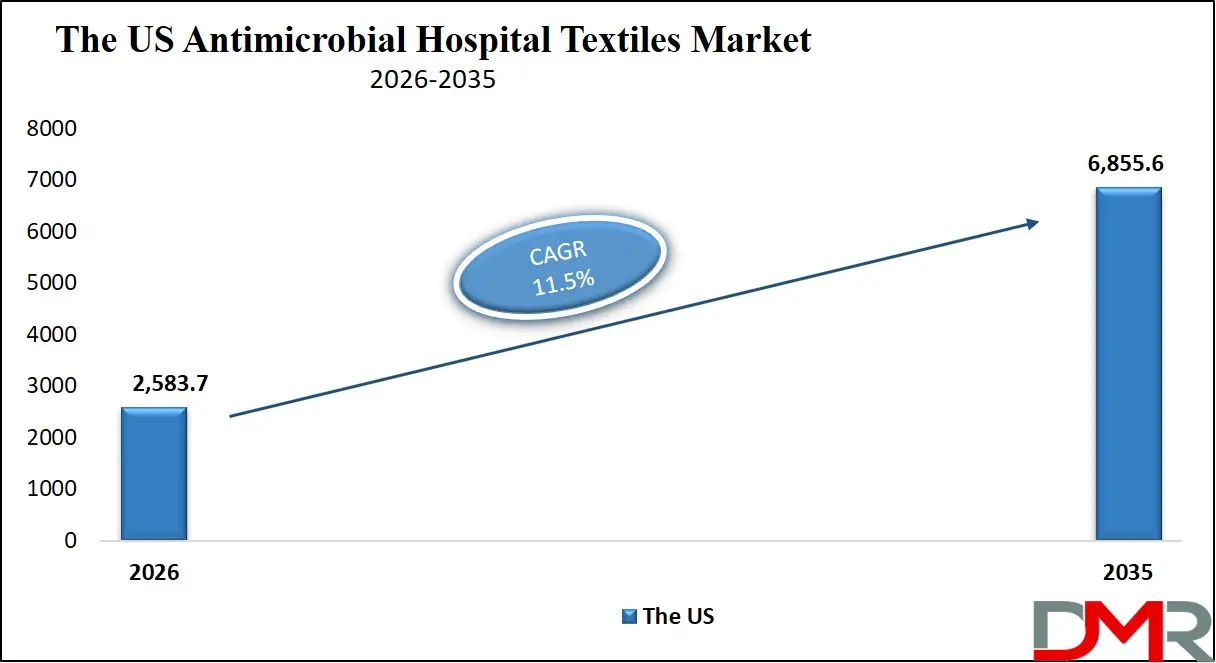
The U.S. Antimicrobial Hospital Textiles Market is projected to reach USD 2,583.7 million in 2026 and grow at a CAGR of 11.5%, reaching USD 6,855.6 million by 2035. The U.S. leads global adoption due to its advanced healthcare infrastructure, stringent infection control regulations, and strong emphasis on patient safety and quality outcomes.
The persistent challenge of hospital-acquired infections affecting over 1.7 million patients annually, coupled with value-based care reimbursement models, fuels demand for antimicrobial textile solutions. Major healthcare systems including HCA Healthcare, Kaiser Permanente, and CommonSpirit Health are standardizing antimicrobial linens and apparel to reduce infection transmission and enhance facility safety profiles.
ℹ
To learn more about this report –
Download Your Free Sample Report Here
U.S. regulatory support for infection prevention innovation, alongside incentives for healthcare technology adoption under CMS quality incentive programs, encourages investment. Training programs and partnerships with textile rental and laundry service providers are emerging to optimize antimicrobial textile lifecycle management and ensure proper handling protocols.
The rapid rise of smart hospital textiles with real-time contamination sensing, sustainable antimicrobial finishes, and integrated RFID tracking for inventory management continues to redefine the U.S. healthcare landscape, positioning the country as a global leader in infection-control textiles.
The Europe Antimicrobial Hospital Textiles Market
The Europe Antimicrobial Hospital Textiles Market is projected to be valued at approximately USD 2,522.6 million in 2026 and is projected to reach around USD 6,553.7 million by 2035, growing at a CAGR of about 11.2% from 2026 to 2035. Europe's leadership is anchored by strong regulatory emphasis on patient safety, infection prevention standards, and sustainable healthcare procurement.
Countries such as Germany, the U.K., France, Italy, and the Nordic region are widely adopting antimicrobial hospital textiles, driven by stringent EU medical device regulations, HAI reduction mandates, and government-backed initiatives like the EU's Healthier Together program. The German healthcare system with its focus on quality and innovation is particularly active in deploying advanced antimicrobial fabrics across hospital networks.
Europe's aging population with increased infection susceptibility, demand for reusable and environmentally responsible textiles, and push for circular economy compliance further drive adoption. Funding through Horizon Europe and national healthcare innovation funds supports R&D in durable antimicrobial coatings, biocide-free alternatives, and textile recycling compatibility.
Major hospital groups and public health systems increasingly deploy silver-ion impregnated linens, copper-infused privacy curtains, and antimicrobial scrubs with enhanced durability. With strong technical standards, lifecycle assessment requirements, and emphasis on patient-centered care, Europe remains one of the most advanced regions in antimicrobial hospital textiles penetration.
The Japan Antimicrobial Hospital Textiles Market
The Japan Antimicrobial Hospital Textiles Market is anticipated to be valued at approximately USD 173.0 million in 2026 and is expected to attain nearly USD 449.5 million by 2035, expanding at a CAGR of about 11.3% during the forecast period. Japan's rapidly aging society and stringent infection control culture drive high demand for advanced antimicrobial textiles across hospitals, long-term care facilities, and rehabilitation centers.
The Ministry of Health, Labour and Welfare (MHLW) actively supports healthcare-associated infection prevention through national guidelines, subsidies for infection control technologies, and integration of antimicrobial textiles into public hospital procurement standards. Japan's leadership in functional textile engineering, fiber science, and quality manufacturing accelerates innovation in lightweight, durable antimicrobial fabrics suitable for various healthcare applications.
Japan's concept of "Healthcare 5.0", driven by companies like Toray Industries, Teijin Limited, and Unitika Ltd., integrates smart textiles, IoT-enabled hygiene monitoring, and advanced material science into seamless hospital workflows. Antimicrobial textile products are being deployed in Tokyo's university hospitals, Osaka's regional medical centers, and long-term care networks nationwide. Japan's cultural emphasis on cleanliness, combined with technological precision, positions the country as a high-growth innovator in healthcare textiles.
Global Antimicrobial Hospital Textiles Market: Key Takeaways
- Strong Global Market Growth Outlook: The Global Antimicrobial Hospital Textiles Market is expected to be valued at USD 9,009.4 million in 2026 and is projected to reach USD 25,483.1 million by 2035, showcasing rapid expansion supported by rising demand for infection prevention and healthcare quality improvement.
- High CAGR Driven by Infection Control Adoption: The market is expected to grow at an impressive CAGR of 12.2% from 2026 to 2035, fueled by accelerating integration of antimicrobial technologies, AI-driven textile management, sustainable healthcare procurement, and increasing global hospital capacity.
- Strong Growth Trajectory in the United States: The U.S. Antimicrobial Hospital Textiles Market stands at USD 2,583.7 million in 2026 and is projected to reach USD 6,855.6 million by 2035, expanding at a CAGR of 11.5% due to robust infection control regulations, value-based care models, and advanced healthcare technology adoption.
- North America Maintains Regional Dominance: North America is expected to capture approximately 34.1% of the global market share in 2026, supported by mature healthcare infrastructure, stringent patient safety standards, significant R&D investment, and early adoption of sustainable antimicrobial textiles.
- Rapid Advancement in Antimicrobial Textile Technologies: Innovations including nano-silver encapsulation, copper-based pathogen reduction, smart fabric contamination sensing, and durable biocompatible finishes are significantly accelerating efficacy, longevity, and sustainability of antimicrobial hospital textiles.
- Growing HAI Prevention Focus Boosts Adoption: Rising global incidence of healthcare-associated infections, coupled with antimicrobial resistance concerns and patient safety mandates, is driving sustained demand for reliable, continuous-action infection control textiles.
Global Antimicrobial Hospital Textiles Market: Use Cases
- Acute Care Hospital Patient Rooms: Antimicrobial bed linens, pillowcases, and patient gowns continuously reduce microbial burden, protecting vulnerable patients and reducing cross-contamination risks.
- Surgical Suites and Operating Theaters: Surgical drapes, gowns, and covers with advanced antimicrobial properties maintain sterile fields throughout procedures, enhancing infection prevention protocols.
- Intensive Care Units (ICUs): High-touch textiles including cubicle curtains, staff uniforms, and patient linens provide continuous pathogen reduction in critical care environments.
- Long-Term Care and Skilled Nursing Facilities: Durable antimicrobial textiles support infection control in communal living settings where elderly residents face heightened infection susceptibility.
- Outpatient and Ambulatory Surgery Centers: Cost-effective antimicrobial textiles ensure consistent hygiene standards across high-throughput procedural environments with rapid patient turnover.
Global Antimicrobial Hospital Textiles Market: Stats & Facts
- The World Health Organization (WHO) reports that healthcare-associated infections affect hundreds of millions of patients annually, with textile surfaces serving as recognized vectors for pathogen transmission in hospital environments.
- The U.S. Centers for Disease Control and Prevention (CDC) estimates that 1 in 31 hospitalized patients acquires at least one HAI daily, reinforcing how antimicrobial textiles through continuous pathogen reduction can supplement infection control protocols, especially in settings where up to 40% of HAIs are considered preventable.
- Infection Control Today data indicates antimicrobial hospital textiles can reduce microbial contamination by up to 99.9% and maintain efficacy through 75+ industrial launderings, validating advanced textiles as essential for sustainable healthcare hygiene.
- The European Centre for Disease Prevention and Control (ECDC) notes that antimicrobial textiles contribute to reduced cross-contamination by minimizing pathogen transfer from high-touch surfaces; contaminated textiles currently account for significant secondary transmission risks.
- According to Global Healthcare Textile Surveys, adoption of silver and copper-based antimicrobial hospital textiles is growing over 28% annually in Asia-Pacific markets, as healthcare systems modernize and infection control awareness increases.
- The International Federation of Hospital Engineering reports over 65% of healthcare facilities are investing in infection prevention technologies; antimicrobial textiles address hygiene gaps by providing passive, continuous protection between cleaning cycles.
Global Antimicrobial Hospital Textiles Market: Market Dynamic
Driving Factors in the Global Antimicrobial Hospital Textiles Market
Growing Burden of Healthcare-Associated Infections
The persistent global challenge of HAIs, affecting patient outcomes and healthcare costs, is a major driver for antimicrobial textile adoption. Increasing pathogen resistance, vulnerable patient populations, and heightened awareness of transmission routes significantly increase reliance on advanced barrier materials. Antimicrobial textiles provide continuous pathogen reduction, supplement standard laundering protocols, and maintain hygienic integrity throughout use. This allows healthcare facilities to strengthen infection control programs, reduce HAI rates, and improve patient safety metrics, especially in high-risk units.
Technology Innovation and Integration
Antimicrobial hospital textiles benefit heavily from rapid progress in nanotechnology, controlled-release mechanisms, biocompatible metal treatments, and durable finishing technologies. Advanced products feature silver-ion encapsulation, copper-infused fibers, organosilane chemistries, and smart sensors indicating microbial load or laundering needs. These innovations enable textiles to provide sustained antimicrobial activity, withstand repeated industrial laundering, and adapt to various healthcare applications. The convergence of textile engineering with infection science and circular economy principles further enhances sustainability and clinical efficacy, making antimicrobial textiles a cornerstone of modern infection prevention.
Restraints in the Global Antimicrobial Hospital Textiles Market
High Initial Product Costs
The significant cost premium of antimicrobial hospital textiles compared to conventional alternatives limits adoption among budget-constrained facilities, particularly in public healthcare systems and developing regions. Many hospitals face procurement challenges and uncertain ROI calculations, especially when antimicrobial efficacy must be balanced against textile durability and replacement cycles. Additionally, transitioning existing inventory and laundry protocols to accommodate specialized textiles can require further investment in staff training and quality monitoring systems, creating adoption friction.
Regulatory and Environmental Compliance Challenges
Medical textile regulations, biocide approvals, and environmental standards vary widely across regions, creating complexity in antimicrobial product development and market access. Issues include registration requirements for antimicrobial agents under biocidal products regulations, restricted substance lists for sustainable procurement, and varying efficacy testing protocols. Furthermore, growing concerns about antimicrobial resistance and environmental persistence of certain treatments create regulatory uncertainty and drive demand for alternative technologies. Variability in laundering infrastructure, water quality, and reprocessing practices across facilities can also impact product performance and lifespan without proper protocols.
Opportunities in the Global Antimicrobial Hospital Textiles Market
Expansion into Emerging Healthcare Markets
Emerging markets represent major growth opportunities due to rapid healthcare infrastructure expansion, rising medical tourism, and increasing government focus on infection control standards. Countries in Asia-Pacific, the Middle East, and Latin America are launching hospital modernization programs where antimicrobial textiles can ensure patient safety and international accreditation readiness. Local manufacturing partnerships, public-private procurement models, and development assistance programs can improve accessibility, driving the next wave of market expansion.
Sustainable and Biobased Antimicrobial Technologies
The integration of biobased antimicrobial agents, recyclable textile platforms, and circular economy-compatible finishes creates new value streams. Natural antimicrobials including chitosan, plant extracts, and bio-sourced silver, combined with textile recycling technologies, address environmental concerns while maintaining infection control efficacy. This transforms antimicrobial textiles from disposable commodities into sustainable healthcare assets that align with green procurement policies and reduce lifecycle environmental impact.
Trends in the Global Antimicrobial Hospital Textiles Market
Multifunctional Healthcare Textiles
The rise of textiles combining antimicrobial properties with fluid repellency, flame resistance, and patient monitoring capabilities is gaining traction. These multifunctional products reduce the need for multiple textile layers, enhance patient comfort, and support comprehensive safety protocols. This integration lowers overall procurement costs, simplifies inventory management, and combines infection control with other critical performance requirements.
Smart Textile and Laundry Management Integration
Connected textile platforms are enabling RFID-tracked inventory, automated laundering compliance monitoring, and predictive replacement analytics for hospital textile fleets. Facilities can monitor usage cycles, antimicrobial efficacy retention, and contamination incidents in real time, optimizing textile lifecycle management and infection prevention protocols. This trend supports the scalable deployment of antimicrobial textiles across large healthcare systems with complex operational requirements.
Global Antimicrobial Hospital Textiles Market: Research Scope and Analysis
By Product Type Analysis
Bed Linens are projected to dominate the Product Type segment of the Global Antimicrobial Hospital Textiles Market. This dominance is driven by the fundamental prevalence and high utilization of sheets, pillowcases, and mattress covers across all healthcare settings acute care hospitals, long-term facilities, and ambulatory centers creating the largest and most consistent addressable market. Patient bedding represents the most intimate and prolonged textile contact point in any healthcare facility, making it the primary target for antimicrobial treatment to reduce infection transmission risks and improve patient outcomes. The technology for antimicrobial bed linens is also the most mature; silver-ion, copper, and quaternary ammonium treatments have been successfully integrated into cotton-polyester blends and tested through repeated industrial laundering, offering proven reliability and clear infection control benefits.
While Surgical Drapes & Gowns address a critical infection control requirement in procedural settings with stringent sterility demands, their adoption represents a specialized, procedure-driven segment. The technical requirements for sterility maintenance, fluid barrier properties, and single-use or limited-reuse patterns have led to distinct product specifications and regulatory pathways. Uniforms & Apparels, including scrubs and staff wear, represent a significant and growing segment driven by recognition that healthcare worker attire can transmit pathogens. However, variable laundering practices and adoption rates across facilities create implementation complexity. Cubicle Curtains, while recognized as high-touch infection risks with frequent contamination, face replacement cycle and procurement prioritization challenges. Therefore, the immediate and widespread need to protect patients through their most constant textile contact surface bed linens coupled with proven technology and strong clinical rationale, secures Bed Linens' leading market position throughout the forecast period.
By Fabric Type Analysis
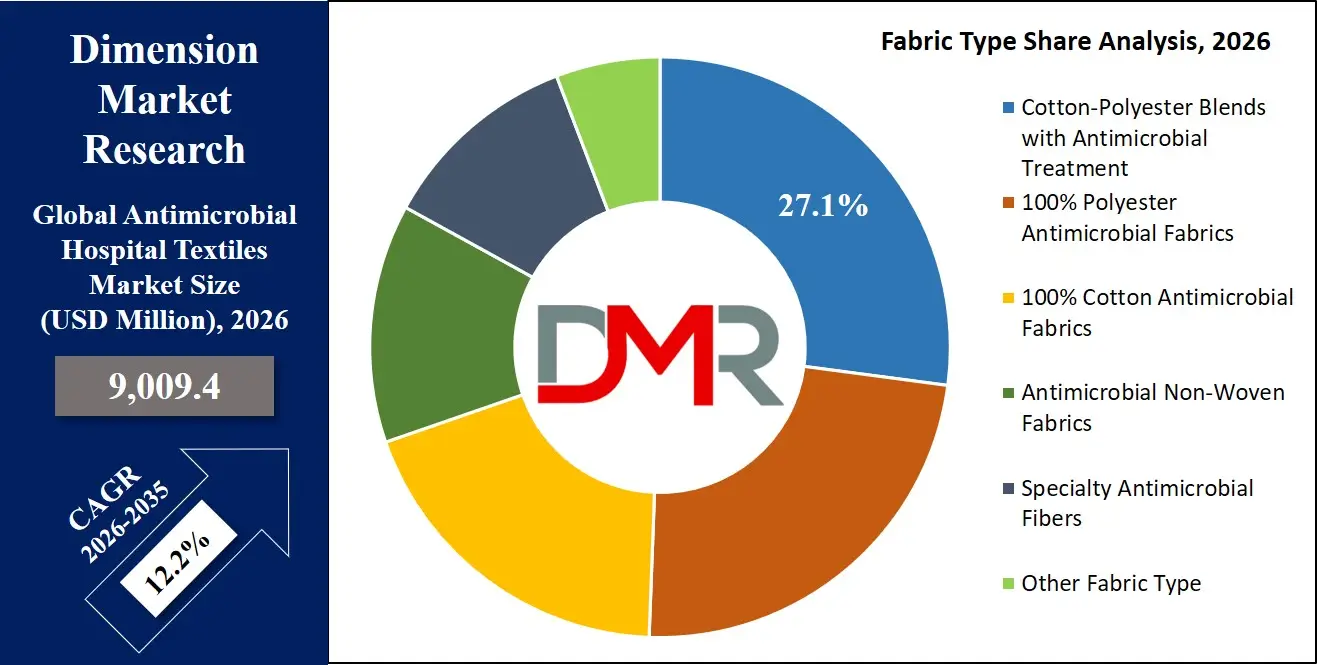
Cotton-Polyester Blends with Antimicrobial Treatment are projected to dominate the global market, fundamentally transforming hospital textiles from basic commodities into engineered infection prevention tools. Their dominance stems from an unparalleled value proposition for high-use, frequently laundered healthcare textiles: optimal patient comfort combined with industrial durability and sustained antimicrobial efficacy. By integrating advanced silver, copper, or organosilane treatments into optimized blend ratios (typically 50/50 to 60/40 cotton-polyester), these fabrics achieve the ideal balance of absorbency, breathability, softness, and resistance to pilling, fraying, and shrinkage through 75+ laundry cycles. The driving forces behind their market leadership are tri-fold: the proven compatibility of antimicrobial agents with polyester fiber chemistry for durable bonding, the cost-effectiveness compared to specialty synthetic fibers, and the growing confidence of hospital procurement managers in lifecycle value. As infection control standards tighten and budget pressures persist, the economic case for durable, effective antimicrobial blends in high-volume categories like linens and uniforms becomes compelling, solidifying these textiles as the cornerstone of healthcare textile programs.
ℹ
To learn more about this report –
Download Your Free Sample Report Here
100% Polyester Antimicrobial Fabrics form the crucial and substantial second-largest segment, excelling in applications requiring maximum durability, fluid resistance, and dimensional stability. These fabrics, typically featuring silver or copper integrated during fiber extrusion for exceptional launderability, cater to specialized needs including surgical gowns, scrub uniforms, and cubicle curtains where barrier properties and long-term performance outweigh cotton's comfort advantages. Their strength lies in superior antimicrobial durability agents embedded throughout the fiber rather than surface-applied enabling efficacy through hundreds of washes and harsh disinfection protocols. By maintaining structural integrity and microbial reduction capabilities over extended lifespans, they reduce replacement frequency and lifecycle costs for high-stress applications. However, lower breathability and comfort perception compared to blends limit broader adoption for patient-direct bedding. As such, 100% polyester antimicrobial fabrics will remain indispensable for specialized healthcare applications where durability and maximum infection control are paramount.
By Application Analysis
Acute Care Hospitals are poised to be the largest and most dominant application segment for antimicrobial hospital textiles, driven by powerful global healthcare trends. The relentless demand for acute medical services, particularly in intensive care, surgical, and medical-surgical units, creates a perfect use case: high-acuity patients with increased infection susceptibility requiring prolonged textile contact. This patient vulnerability is where antimicrobial textiles excel, ensuring continuous microbial reduction on bed linens, patient gowns, and staff uniforms while supplementing rigorous manual disinfection protocols. The sector is also acutely affected by HAI reduction mandates and value-based reimbursement penalties for preventable infections, making antimicrobial textiles a strategic solution to a critical quality and financial challenge. Beyond infection control, antimicrobial textiles offer facilities predictable replacement cycles and reduced laundry-related degradation, directly impacting operational costs and procurement efficiency. From large academic medical centers to regional community hospitals, the clinical and operational pressures in acute care make the adoption of antimicrobial textiles not merely advantageous but increasingly essential for maintaining quality metrics and financial viability.
Long-Term Care Facilities rank as the second-largest application segment, fueled by unique infection control challenges in residential care settings. Facilities such as skilled nursing homes, assisted living communities, and rehabilitation centers feature extended resident stays, communal living environments, and vulnerable elderly populations with compromised immunity. The continuous antimicrobial protection of textiles directly addresses the elevated infection risks in these settings, reducing cross-contamination between residents and supporting outbreak prevention efforts. Furthermore, the scale of long-term care operations with thousands of resident beds across national networks justifies the investment in antimicrobial textiles, as benefits of reduced infection rates and extended textile life are realized across large inventories. While more cost-sensitive than acute hospitals, the growing recognition of infection prevention value in long-term care strongly aligns with the antimicrobial textile proposition, securing its role as a transformative technology for post-acute and chronic care environments.
By End User Analysis
Hospitals & Health Systems are anticipated to dominate the market as the primary drivers and beneficiaries of antimicrobial textile integration. These entities possess the necessary procurement scale for significant product investment, the high-volume patient populations to demonstrate infection reduction ROI, and the clinical infrastructure to support evidence-based product evaluation. For them, the adoption is a strategic move to secure a formidable competitive edge: reduced HAI rates, improved patient satisfaction scores (HCAHPS), and enhanced facility safety reputation. They often serve as crucial innovation partners for textile manufacturers, participating in clinical trials and product validation studies that pave the way for broader industry acceptance. Their focus on systematizing infection prevention aligns perfectly with antimicrobial textiles, allowing them to transform basic linens and uniforms into controlled, evidence-based components of comprehensive patient safety programs. This control over an often-overlooked infection vector enhances their overall quality performance and market positioning.
Laundry & Textile Rental Service Providers represent the vital second-largest end-user segment, for whom antimicrobial textile adoption is a strategic pivot for business growth and differentiation. Faced with intense margin pressure, increasing healthcare customer expectations, and competition from low-cost imports, these specialized service companies are turning to advanced antimicrobial textiles to differentiate their offerings, justify premium pricing, and guarantee performance outcomes for hospital clients. For them, antimicrobial-treated inventory represents a tangible value-add asset that can be marketed across multiple healthcare facilities, offering "infection-protected" textile solutions that command contract premiums. Adoption in this segment is often accelerated by partnerships with antimicrobial technology providers and forward-thinking hospital systems seeking standardized protection across their textile inventories. By mastering antimicrobial textile procurement, processing, and lifecycle management, these specialists future-proof their businesses, transitioning from commodity linen suppliers to technology-enabled healthcare hygiene partners.
The Global Antimicrobial Hospital Textiles Market Report is segmented on the basis of the following:
By Product Type
- Bed Linens
- Sheets
- Pillowcases
- Mattress Covers
- Surgical Drapes & Gowns
- Uniforms & Apparels
- Scrubs
- Lab Coats
- Patient Gowns
- Cubicle Curtains & Privacy Screens
- Towels & Wipes
- Other Product Type
By Fabric Type
- Cotton-Polyester Blends with Antimicrobial Treatment
- 100% Polyester Antimicrobial Fabrics
- 100% Cotton Antimicrobial Fabrics
- Antimicrobial Non-Woven Fabrics
- Specialty Antimicrobial Fibers
- Other Fabric Type
By Application
- Acute Care Hospitals
- Long-Term Care Facilities
- Ambulatory Surgery Centers & Clinics
- Specialty Hospitals
- Rehabilitation Centers
By End User
- Hospitals & Health Systems
- Laundry & Textile Rental Service Providers
- Government & Public Health Facilities
- Surgical Centers & Specialty Clinics
- Long-Term Care Facility Operators
Impact of Artificial Intelligence in the Global Antimicrobial Hospital Textiles Market
- AI for Antimicrobial Efficacy Optimization: AI analyzes laundering data, wear patterns, and microbial reduction test results to optimize treatment formulations and application processes, ensuring maximum durability and sustained efficacy across textile lifecycles.
- AI-Driven Textile Lifecycle Management: Machine learning algorithms predict optimal replacement timing based on usage cycles, antimicrobial retention testing, and wear analysis, reducing premature disposal and extending useful life.
- Smart Laundry Quality Assurance: AI-powered vision and sensor systems inspect textiles after processing, identifying residual stains, treatment degradation, or contamination requiring reprocessing, ensuring only compliant textiles re-enter inventory.
- Predictive Contamination Risk Assessment: AI analyzes patient acuity, unit infection rates, and textile utilization patterns to identify high-risk areas requiring enhanced antimicrobial protocols or more frequent textile changes.
- Supply Chain and Inventory Optimization: AI forecasts demand across healthcare systems, optimizing antimicrobial textile inventory levels, reducing stockouts, and minimizing capital tied up in safety stock.
- Clinical Outcome Correlation Analysis: AI systems aggregate antimicrobial textile deployment data with infection rates and patient outcomes, building evidence-based knowledge that quantifies clinical and financial ROI.
Global Antimicrobial Hospital Textiles Market: Regional Analysis
Region with the Largest Revenue Share
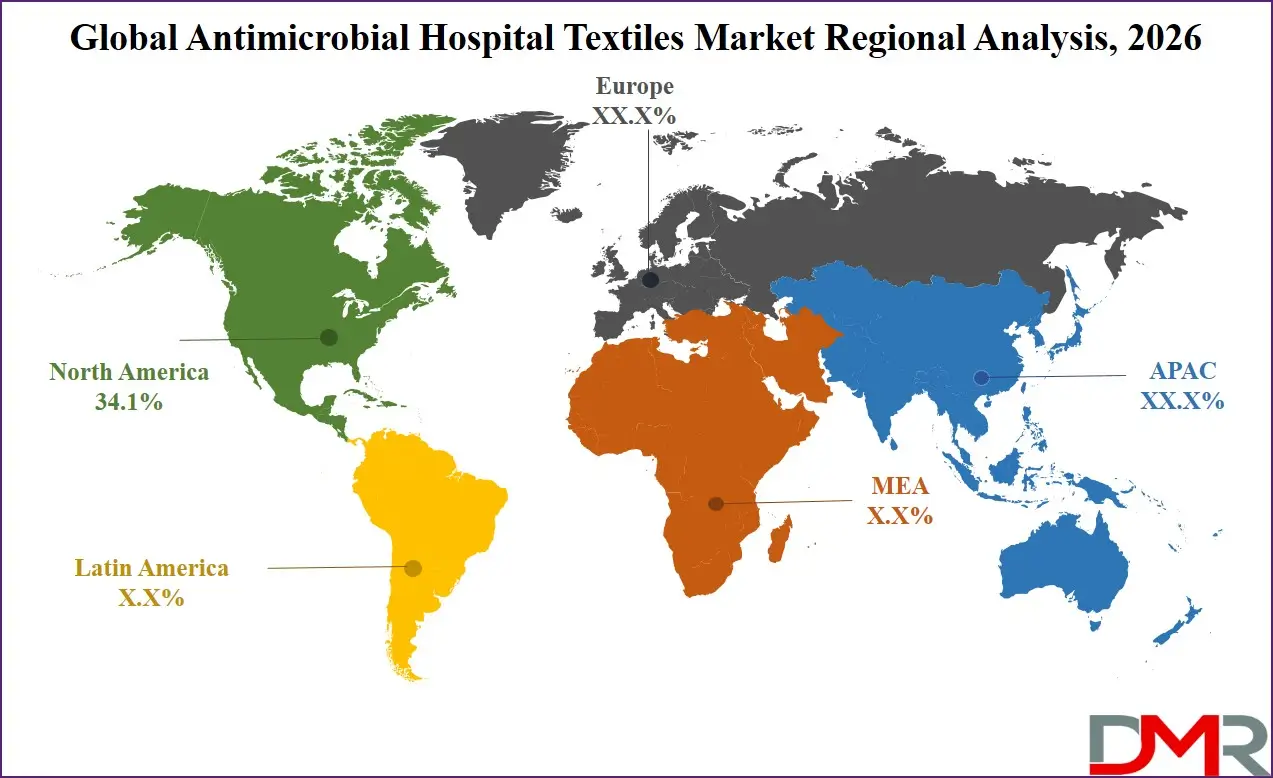
North America is projected to dominates the antimicrobial hospital textiles market, accounting for 34.1% of the global revenue share by the end of 2026. The region's leadership is primarily driven by its advanced healthcare infrastructure and high healthcare spending, particularly in the United States. A large volume of hospital admissions and surgical procedures increases the demand for antimicrobial patient gowns, surgical drapes, bedding, and privacy curtains.
ℹ
To learn more about this report –
Download Your Free Sample Report Here
Strict infection control regulations and accreditation standards compel hospitals to adopt treated textiles that help reduce hospital-acquired infections (HAIs). Additionally, strong awareness regarding hygiene compliance and patient safety further accelerates product adoption. The presence of leading medical textile manufacturers and continuous investment in research and development support innovation in silver-ion, copper-infused, and nanotechnology-based antimicrobial fabrics.
Post-pandemic infection prevention priorities have further strengthened market penetration. With robust reimbursement systems, well-established hospital networks, and early adoption of advanced healthcare technologies, North America continues to maintain the largest revenue share in this expanding global market.
Region with the Highest CAGR
Asia-Pacific holds the highest CAGR and is poised to achieve rapid market share growth due to its massive healthcare infrastructure expansion, rising middle-class demand for quality care, and increasing infection control awareness. Countries like China, India, Japan, and Southeast Asian nations are investing heavily in hospital modernization to meet growing healthcare needs. China's "Healthy China 2030" initiative and India's "Ayushman Bharat" program are creating fertile ground for antimicrobial textile adoption. The region's cost sensitivity is being addressed through local manufacturing partnerships, tiered product strategies, and technology transfer agreements between global antimicrobial suppliers and regional textile producers. This, combined with an immense healthcare project pipeline, positions APAC as the fastest-growing market for antimicrobial hospital textiles.
By Region
North America
Europe
- Germany
- The U.K.
- France
- Italy
- Russia
- Spain
- Benelux
- Nordic
- Rest of Europe
Asia-Pacific
- China
- Japan
- South Korea
- India
- ANZ
- ASEAN
- Rest of Asia-Pacific
Latin America
- Brazil
- Mexico
- Argentina
- Colombia
- Rest of Latin America
Middle East & Africa
- Saudi Arabia
- UAE
- South Africa
- Israel
- Egypt
- Rest of MEA
Global Antimicrobial Hospital Textiles Market: Competitive Landscape
The Global Antimicrobial Hospital Textiles Market is moderately fragmented, featuring a mix of established textile manufacturers, specialty chemical companies, and healthcare linen service providers. Leading textile manufacturers Toray Industries, Teijin Limited, and Parkland Corporation are leveraging their expertise in fiber engineering and finishing technologies to develop advanced antimicrobial healthcare textiles. Pure-play antimicrobial technology innovators such as Microban International, Sciessent, and PurThread are driving market dynamics with specialized treatment formulations and embedded fiber solutions.
Chemical and material science leaders like BASF, DuPont, and Milliken & Company play increasingly influential roles as treatment providers and finishing partners. Healthcare laundry and textile rental consolidators including Angelica Corporation, Elis, and Alsco are entering the space through strategic partnerships and exclusive supplier agreements, aiming to vertically integrate antimicrobial textiles into their service offerings.
Some of the prominent players in the Global Antimicrobial Hospital Textiles Market are:
- Toray Industries, Inc.
- Teijin Limited
- Parkland Corporation
- Microban International (Barrier Group)
- Sciessent LLC
- PurThread Technologies, Inc.
- BASF SE
- DuPont de Nemours, Inc.
- Milliken & Company
- Trevira GmbH
- Thai Acrylic Fiber Co., Ltd. (TCG Group)
- Unitex Group
- Standard Textile Co., Inc.
- Angelica Corporation
- Elis SA
- Alsco Inc.
- Medline Industries, LP
- Cardinal Health, Inc.
- Honeywell International Inc.
- Kimberly-Clark Corporation
- Other Key Players
Recent Developments in the Global Antimicrobial Hospital Textiles Market
- November 2025: Toray Industries introduced its Generation 3 silver-ion antimicrobial healthcare textile, featuring enhanced durability through 100+ industrial laundry cycles and improved biocompatibility. The fabric integrates directly with major healthcare procurement specifications, streamlining hospital adoption.
- October 2025: Microban International presented its new bio-based antimicrobial platform for healthcare textiles at Medica 2025. The demonstration highlighted renewable sourcing, end-of-life recyclability, and equivalent efficacy to traditional metal-based treatments.
- September 2025: PurThread Technologies announced a multi-year agreement with a top-10 U.S. health system to deploy its copper-infused antimicrobial textiles across a national hospital portfolio, signaling mainstream acceptance of advanced infection-control fabrics.
- August 2025: BASF completed the acquisition of a specialist antimicrobial coating firm to enhance its healthcare textile treatment portfolio's efficacy and sustainability profile, accelerating its move towards fully biocompatible finishing solutions.
- July 2025: A Horizon Europe grant was awarded to a consortium developing recyclable antimicrobial healthcare textiles with reduced environmental persistence, linking infection control with circular economy goals in healthcare.
- June 2025: Teijin Limited partnered with a major European laundry services provider to integrate its antimicrobial polyester fibers into rental textile programs across Germany and France, aiming to set new standards for infection control in institutional linens.
Report Details
| Report Characteristics |
| Market Size (2026) |
USD 9,009.4 Mn |
| Forecast Value (2035) |
USD 25,483.1 Mn |
| CAGR (2026–2035) |
12.2% |
| The US Market Size (2026) |
USD 2,583.7 Mn |
| Historical Data |
2020 – 2025 |
| Forecast Data |
2027 – 2035 |
| Base Year |
2025 |
| Estimate Year |
2026 |
| Report Coverage |
Market Revenue Estimation, Market Dynamics, Competitive Landscape, Growth Factors and etc. |
| Segments Covered |
By Product Type (Bed Linens, Surgical Drapes & Gowns, Uniforms & Apparels, Cubicle Curtains & Privacy Screens, Towels & Wipes, Other Product Type) By Fabric Type (Cotton-Polyester Blends with Antimicrobial Treatment, 100% Polyester Antimicrobial Fabrics, 100% Cotton Antimicrobial Fabrics, Antimicrobial Non-Woven Fabrics, Specialty Antimicrobial Fibers, Other Fabric Type) By Application (Acute Care Hospitals, Long-Term Care Facilities, Ambulatory Surgery Centers & Clinics, Specialty Hospitals, Rehabilitation Centers) By End User (Hospitals & Health Systems, Laundry & Textile Rental Service Providers, Government & Public Health Facilities, Surgical Centers & Specialty Clinics, Long-Term Care Facility Operators) |
| Regional Coverage |
North America – The US and Canada; Europe – Germany, The UK, France, Russia, Spain, Italy, Benelux, Nordic, & Rest of Europe; Asia-Pacific – China, Japan, South Korea, India, ANZ, ASEAN, Rest of APAC; Latin America – Brazil, Mexico, Argentina, Colombia, Rest of Latin America; Middle East & Africa – Saudi Arabia, UAE, South Africa, Turkey, Egypt, Israel, & Rest of MEA |
| Prominent Players |
Toray Industries, Inc., Teijin Limited, Parkland Corporation, Microban International (Barrier Group), Sciessent LLC, PurThread Technologies, Inc., BASF SE, DuPont de Nemours, Inc., Milliken & Company, Trevira GmbH, Thai Acrylic Fiber Co., Ltd. (TCG Group), Unitex Group, Standard Textile Co., Inc., Angelica Corporation, Elis SA, Alsco Inc., Medline Industries, LP, Cardinal Health, Inc., Honeywell International Inc., Kimberly-Clark Corporation, and Other Key Players |
| Purchase Options |
We have three licenses to opt for: Single User License (Limited to 1 user), Multi-User License (Up to 5 Users) and Corporate Use License (Unlimited User) along with free report customization equivalent to 0 analyst working days, 3 analysts working days and 5 analysts working days respectively. |
Frequently Asked Questions
How big is the Global Antimicrobial Hospital Textiles Market?
▾ The Global Antimicrobial Hospital Textiles Market size is estimated to have a value of USD 9,009.4 million in 2026 and is expected to reach USD 25,483.1 million by the end of 2035.
What is the growth rate in the Global Antimicrobial Hospital Textiles Market from 2026 to 2035?
▾ The market is growing at a CAGR of 12.2 percent over the forecasted period of 2026 to 2035.
What is the size of the US Antimicrobial Hospital Textiles Market?
▾ The US Antimicrobial Hospital Textiles Market is projected to be valued at USD 2,583.7 million in 2026. It is expected to witness subsequent growth in the upcoming period as it reaches USD 6,855.6 million in 2035 at a CAGR of 11.5%.
Which region accounted for the largest Global Antimicrobial Hospital Textiles Market?
▾ North America is expected to have the largest market share in the Global Antimicrobial Hospital Textiles Market with a share of about 34.1% in 2026.
Who are the key players in the Global Antimicrobial Hospital Textiles Market?
▾ Some of the major key players in the Global Antimicrobial Hospital Textiles Market are Toray Industries, Teijin Limited, Parkland Corporation, Microban International, Sciessent LLC, PurThread Technologies, BASF SE, DuPont, and many others.