Market Overview
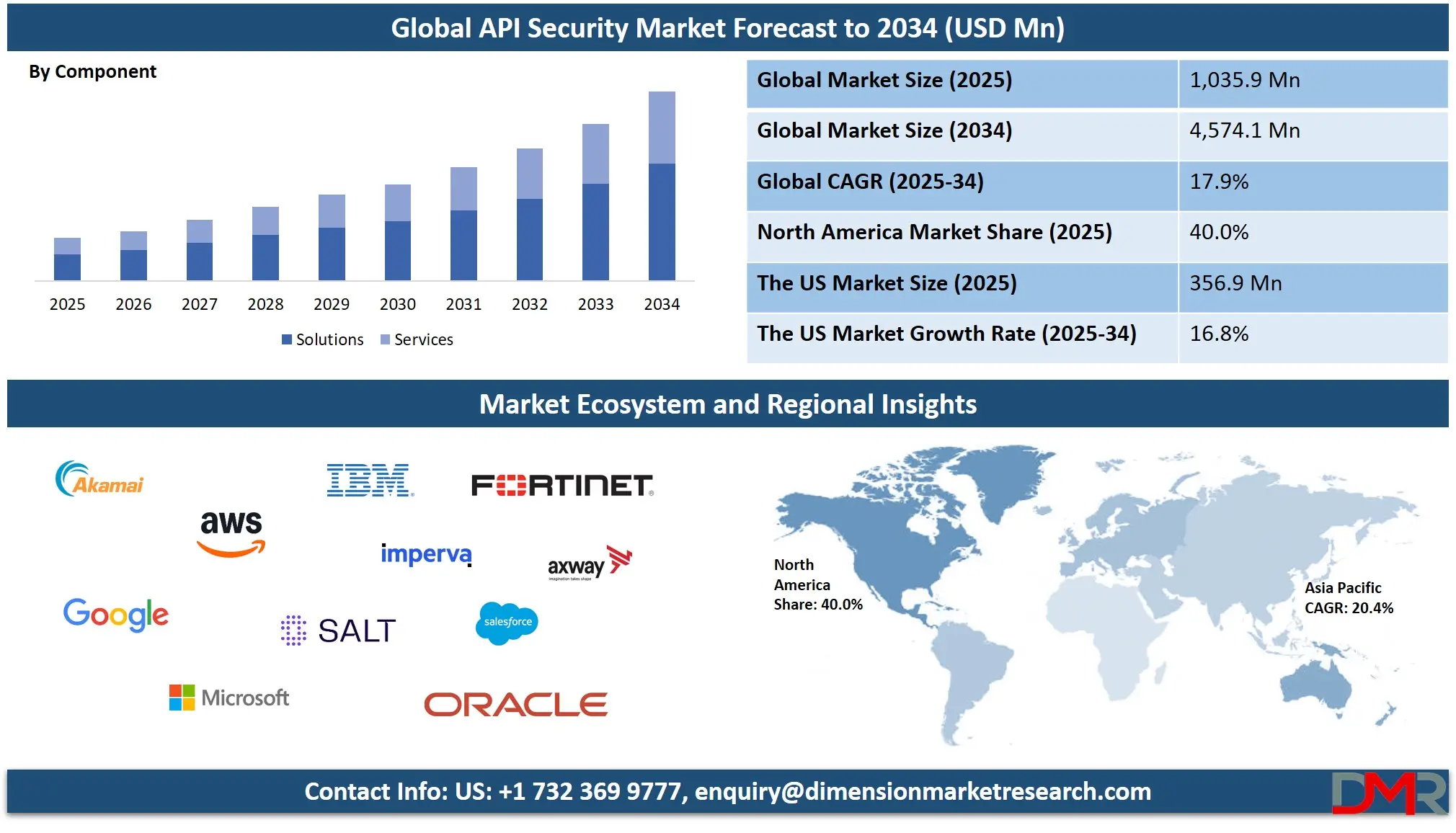
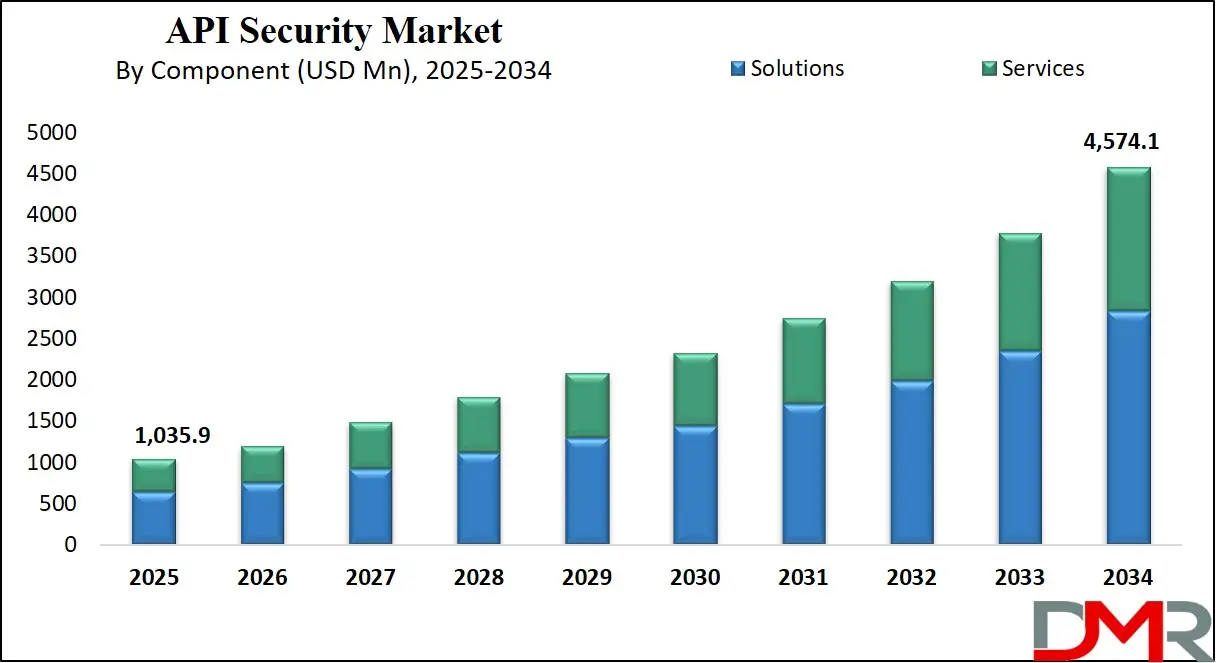
The Global API Security Market is projected to reach USD 1,035.9 million in 2025 and is expected to grow to USD 4,574.1 million by 2034, reflecting a CAGR of 17.9%. This strong growth is driven by rising API vulnerabilities, expanding microservices adoption, increasing cloud integration, and heightened demand for advanced runtime protection, API threat detection, and zero-trust security controls across industries.
API security refers to the collection of protocols, tools, and practices used to protect application programming interfaces from misuse, breaches, and unauthorized access while ensuring the integrity of data exchanged between applications. It focuses on safeguarding endpoints, authentication flows, request validation, encryption practices, traffic inspection, and anomaly detection to prevent threats such as API abuse, injection attacks, bot exploits, data exposure, and session hijacking.
ℹ
To learn more about this report –
Download Your Free Sample Report Here
As modern applications rely heavily on interconnected services, microservices, and cloud environments, API security has become essential for maintaining trust, protecting sensitive information, and ensuring seamless digital interactions across web, mobile, and cloud platforms.
The global API security market encompasses all technologies, products, and services designed to secure API ecosystems across enterprises and digital infrastructures. This market has grown significantly due to rapid adoption of cloud computing, expansion of digital transformation programs, increasing reliance on microservices architectures, and rising volumes of API traffic across sectors such as banking, healthcare, retail, and telecommunications.
Organizations now prioritize real time monitoring, automated API discovery, behavioural analytics, and zero trust validation to manage expanding attack surfaces created by open integration frameworks and multi cloud environments.
ℹ
To learn more about this report –
Download Your Free Sample Report Here
Market demand is further accelerated by growing instances of data breaches linked to insecure APIs, regulatory requirements for safeguarding user data, and the need for advanced runtime protection and posture management solutions. Vendors are focusing on AI driven threat detection, governance tools, testing automation, and fraud prevention to help enterprises manage hidden and unmanaged APIs while strengthening application level resilience.
As digital ecosystems expand globally, the API security market continues to evolve, offering innovative capabilities to secure modern application architectures and ensure reliable connectivity across distributed systems.
The US API Security Market
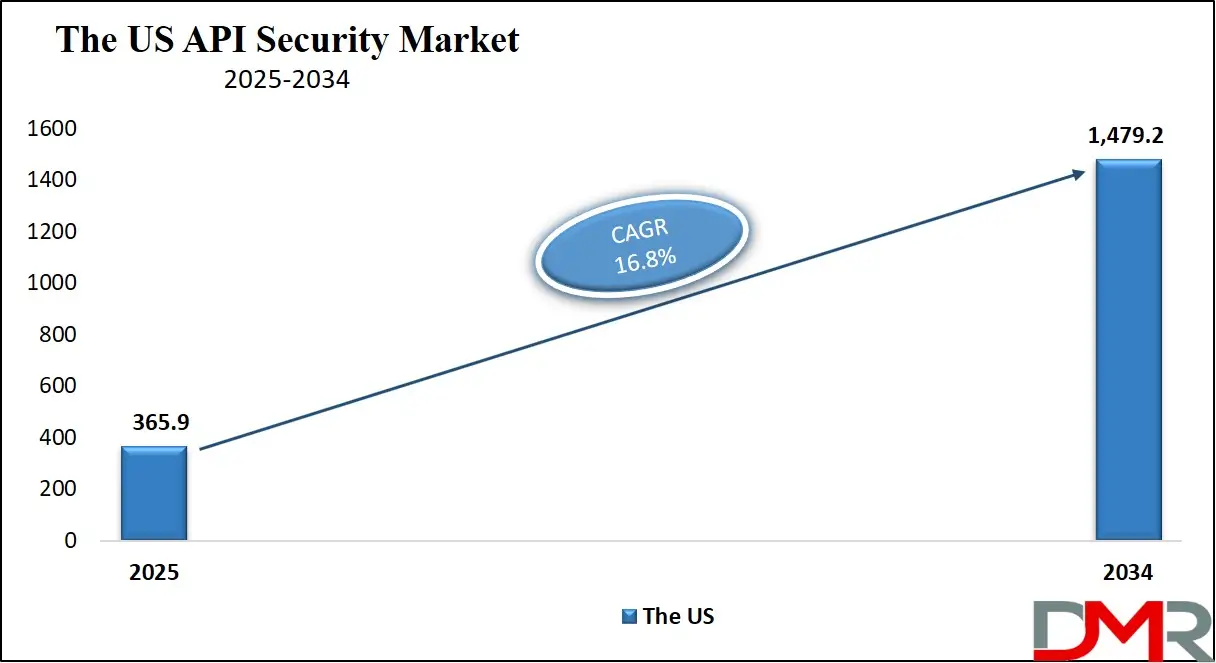
The U.S. API Security market size is projected to be valued at USD 1,035.9 million by 2025. It is further expected to witness subsequent growth in the upcoming period, holding USD 4,574.1 million in 2034 at a CAGR of 16.8%.
The US API security market has emerged as one of the largest and most dynamic regional segments within the global API security landscape. Growth is primarily fueled by extensive adoption of cloud native applications, microservices architectures, and digital transformation initiatives across enterprises. Organizations in banking, financial services, healthcare, retail, and information technology are increasingly investing in API threat detection, runtime protection, and automated API security testing solutions to mitigate vulnerabilities and prevent data breaches.
ℹ
To learn more about this report –
Download Your Free Sample Report Here
The proliferation of APIs for web, mobile, and cloud platforms has heightened the need for robust authentication, access management, and anomaly detection mechanisms to safeguard sensitive data and ensure compliance with regulatory standards such as HIPAA and PCI DSS.
In addition, the US market is witnessing accelerated deployment of AI driven security analytics, API governance frameworks, and zero trust models to address sophisticated cyberattacks targeting exposed endpoints. API security solutions such as posture management, API traffic monitoring, and API vulnerability scanning are increasingly adopted to maintain visibility into complex API ecosystems.
The presence of major technology providers and cybersecurity startups offering innovative tools for API threat intelligence, bot mitigation, and fraud prevention further strengthens market growth. Continuous innovation, combined with heightened awareness of API security risks and stringent compliance requirements, positions the US as a highly lucrative market for advanced API protection solutions.
Europe API Security Market
The Europe API security market is projected to reach approximately USD 279.6 million in 2025, reflecting strong growth driven by increasing digital transformation initiatives, widespread adoption of cloud-native applications, and rising API usage across multiple industries.
Enterprises in banking, healthcare, retail, and technology are increasingly deploying API security solutions to protect sensitive data, ensure compliance with GDPR and other regional regulations, and maintain secure integrations between internal systems and third-party applications. The rising frequency of cyberattacks targeting exposed APIs is also prompting organizations to invest in runtime protection, authentication controls, anomaly detection, and automated threat mitigation tools.
Furthermore, European companies are increasingly adopting AI-powered API security solutions that offer predictive threat detection, real-time traffic monitoring, and automated vulnerability management to address complex attack vectors. The shift toward microservices architectures, hybrid cloud deployments, and multi-cloud strategies further emphasizes the need for scalable and centralized API security platforms.
Vendors are focusing on providing solutions that combine API governance, posture management, and zero trust frameworks to enhance operational efficiency and ensure robust protection of digital assets across the region, supporting a sustained CAGR of 17.5%.
Japan API Security Market
The Japan API security market is estimated to reach approximately USD 31.0 million in 2025, driven by rapid adoption of digital services, cloud-native applications, and API-driven enterprise systems. Organizations across finance, healthcare, and technology sectors are increasingly exposed to sophisticated cyber threats targeting APIs, prompting investments in solutions such as runtime protection, authentication, traffic monitoring, and anomaly detection.
Regulatory compliance requirements, including data protection standards and cybersecurity guidelines, are also encouraging businesses to strengthen their API security posture and ensure safe integration with third-party services.
In addition, the high CAGR of 25.1% reflects Japan’s growing focus on AI-powered and automated API security solutions. Enterprises are adopting machine learning-based threat detection, API discovery, posture management, and zero trust security models to protect sensitive data and maintain seamless operations across cloud and hybrid infrastructures. The market is further fueled by increasing digital transformation initiatives, the rise of microservices architectures, and growing awareness of API vulnerabilities, making Japan a high-growth region for advanced API protection tools and services.
Global API Security Market: Key Takeaways
- Market Value: The global API Security market size is expected to reach a value of USD 4,574.1 million by 2034 from a base value of USD 1,035.9 million in 2025 at a CAGR of 17.9%.
- By Component Segment Analysis: Solutions are anticipated to dominate the component segment, capturing 62.0% of the total market share in 2025.
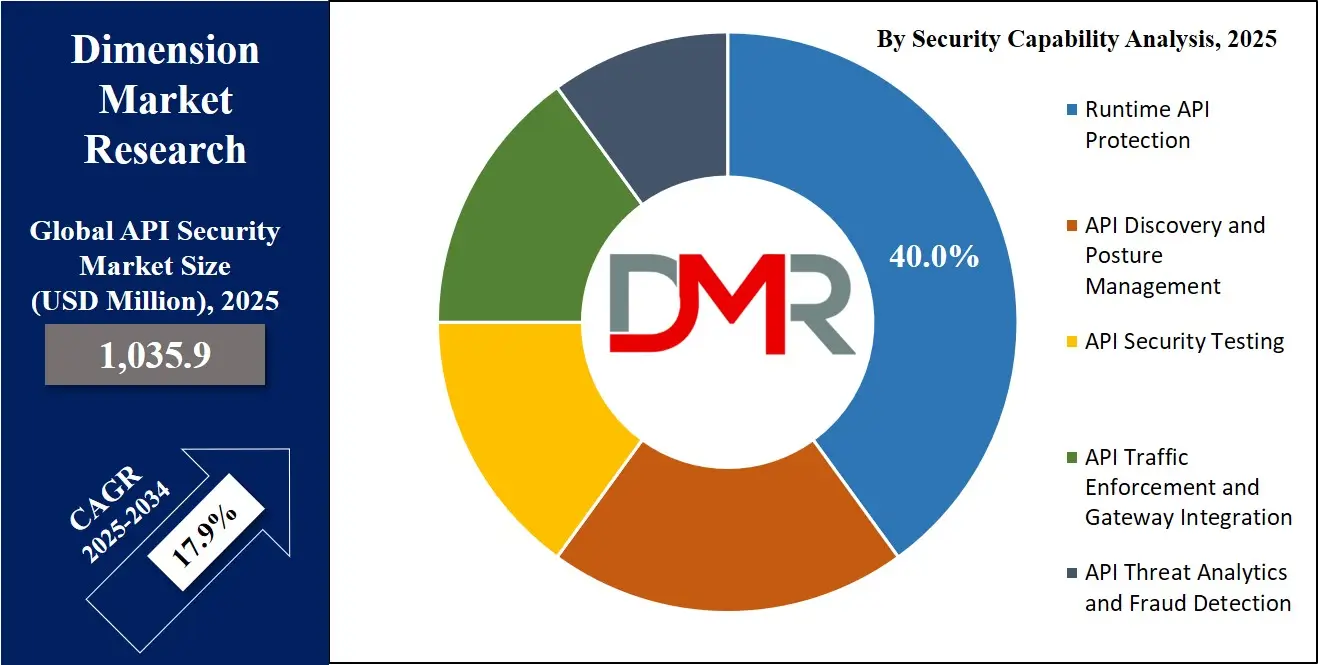
- By Security Capability Segment Analysis: Runtime API Protection is expected to maintain its dominance in the security capability segment, capturing 40.0% of the total market share in 2025.
- By Deployment Model Segment Analysis: Cloud-based deployment will account for the maximum share in the deployment model segment, capturing 68.0% of the total market value.
- By API Type Segment Analysis: REST APIs will dominate the API type segment, capturing 60.0% of the market share in 2025.
- By Organization Size Segment Analysis: Large Enterprises will dominate the organization size segment, capturing 58.0% of the market share in 2025.
- By Industry Vertical Segment Analysis: The BFSI industry will capture the maximum share in the industry vertical segment, capturing 24.0% of the market share in 2025.
- Regional Analysis: North America is anticipated to lead the global API Security market landscape with 40.0% of total global market revenue in 2025.
- Key Players: Some key players in the global API Security market are Akamai Technologies, Amazon Web Services, Google (Apigee), Microsoft Corporation, IBM Corporation, Fortinet, Salt Security, Imperva, Oracle Corporation, Axway, MuleSoft (Salesforce), Data Theorem, F5 Networks, and Others.
Global API Security Market: Use Cases
- Securing Financial Transactions and Sensitive Data: API security plays a crucial role in protecting financial applications and banking systems from unauthorized access, data breaches, and fraud. With the rise of digital wallets, open banking, and mobile banking apps, financial institutions implement API authentication, encryption, and anomaly detection to prevent malicious transactions. Advanced threat detection, bot mitigation, and real-time monitoring ensure sensitive customer information is safeguarded while maintaining seamless digital experiences for online and mobile services.
- Protecting Healthcare Systems and Patient Information: Healthcare organizations rely on APIs to share electronic health records, lab results, and telemedicine data across applications and cloud platforms. API security solutions help prevent exposure of sensitive patient information and ensure compliance with HIPAA and other healthcare regulations. Runtime protection, traffic inspection, and API vulnerability scanning minimize risks from data leakage, injection attacks, and unauthorized integrations, enabling secure interoperability between hospitals, clinics, and telehealth platforms.
- Securing Cloud-Native and Microservices Applications: Enterprises adopting cloud-native architectures and microservices heavily depend on APIs for communication between distributed services. API security ensures these integrations remain safe from misuse, injection attacks, and unauthorized access. Posture management, API monitoring, and automated testing help detect vulnerabilities in real time, allowing organizations to maintain secure and reliable service connectivity across multi-cloud and hybrid deployments while preventing downtime and service disruption.
- Enabling Secure E-Commerce and Retail Integrations: Retailers and e-commerce platforms use APIs to integrate payment gateways, inventory management, customer analytics, and third-party services. API security protects against bot attacks, fraud, and sensitive data exposure while maintaining high availability for online transactions. Threat intelligence, authentication controls, and policy enforcement ensure secure API connections across mobile apps, websites, and cloud-based retail ecosystems, supporting business continuity and enhancing customer trust.
Impact of Artificial Intelligence on the global API Security market
The impact of artificial intelligence on the global API security market is transforming how organizations detect, prevent, and respond to threats across complex digital environments. AI-powered solutions leverage machine learning algorithms and behavioral analytics to monitor API traffic in real time, automatically identifying anomalies, suspicious patterns, and potential attacks that traditional rule-based systems might miss. This enables predictive threat detection, automated vulnerability scanning, and adaptive security policies that evolve with emerging risks, enhancing runtime protection and minimizing false positives.
Artificial intelligence also supports automated API discovery, classification, and posture management, helping organizations maintain visibility into sprawling API ecosystems and mitigate risks from unmanaged or shadow APIs. By integrating AI with API governance and zero trust frameworks, enterprises can achieve faster incident response, improved fraud detection, and better compliance with regulatory requirements such as GDPR, HIPAA, and PCI DSS.
Overall, AI adoption accelerates the efficiency and effectiveness of API security strategies, driving market growth and innovation in the protection of cloud-native, mobile, and enterprise application infrastructures.
Global API Security Market: Stats & Facts
- Cybersecurity and Infrastructure Security Agency (CISA) — Known Exploited Vulnerabilities (KEV) Catalog
- In 2024, CISA added 185 new vulnerabilities to the KEV catalog.
- The cumulative total number of entries in KEV reached 1,238 exploited flaws across software/hardware by the end of 2024.
- Common Vulnerabilities and Exposures (CVE) / National Vulnerability Database (NVD)
- As of November 2024, there are over 240,000 entries recorded in the public vulnerability database.
- In 2024, 40,009 new CVEs were published globally, a 38% increase from 2023.
- On average, each day in 2024 saw approximately 108 new vulnerabilities disclosed globally.
- As of September 2024, 85.9% of newly submitted CVEs had a valid CVSS score; 14.1% remained without a score.
- Severity trends: the average CVSS score of vulnerabilities disclosed in 2024 was 6.67, indicating many medium-to-high severity risks.
Global API Security Market: Market Dynamics
Global API Security Market: Driving Factors
Rising API Adoption across Enterprises
The rapid adoption of APIs in cloud computing, microservices, mobile applications, and digital platforms is a key driver for the API security market. Organizations are increasingly exposing APIs to third-party applications, partners, and internal services, which elevates the risk of data breaches, unauthorized access, and API misuse. API security solutions including authentication mechanisms, encryption, anomaly detection, and traffic monitoring are becoming critical to protect sensitive data, ensure secure integrations, and maintain trust in digital ecosystems.
Increasing Cybersecurity Threats Targeting APIs
The growing frequency and sophistication of cyberattacks such as injection attacks, credential stuffing, bot attacks, and session hijacking drive the demand for robust API security solutions. Enterprises are investing in AI-driven threat detection, runtime protection, vulnerability scanning, and fraud prevention tools to secure their API endpoints. Regulatory compliance requirements across sectors, including finance, healthcare, and e-commerce, further amplify the need for comprehensive API security measures.
Global API Security Market: Restraints
Complexity in Securing Large API Ecosystems
Managing and securing thousands of APIs in large enterprises presents operational and technical challenges. Unmanaged or shadow APIs, multi-cloud environments, and hybrid integrations increase the complexity of deployment and monitoring, potentially delaying adoption of advanced API security solutions. Organizations may face difficulties in maintaining consistent security policies and visibility across all endpoints.
High Cost of Advanced API Security Solutions
Implementing comprehensive API security solutions, especially those integrating AI-driven analytics and runtime protection, requires substantial investment in software, hardware, and skilled personnel. Small and medium-sized enterprises may find the initial costs prohibitive, limiting market penetration in emerging regions despite the growing risk of API-related attacks.
Global API Security Market: Opportunities
Integration of Artificial Intelligence and Machine Learning
AI and machine learning present a major growth opportunity by enabling predictive threat detection, anomaly analysis, automated vulnerability scanning, and adaptive security policies. Vendors offering AI-enabled API security platforms can help enterprises achieve faster incident response, minimize false positives, and strengthen overall API governance, driving adoption across industries such as finance, healthcare, and retail.
Expansion in Emerging Markets
Emerging regions in Asia Pacific, Latin America, and the Middle East offer significant growth potential as enterprises increasingly adopt cloud technologies, mobile applications, and digital platforms. Rising awareness of API vulnerabilities and regulatory requirements in these regions presents opportunities for vendors to provide scalable, cost-effective API security solutions tailored to local market needs.
Global API Security Market: Trends
Shift-Left Security in API Development
Organizations are increasingly integrating API security during the design and development phase rather than only at runtime. API testing, security auditing, and vulnerability scanning at the development stage help reduce attack surfaces, improve application reliability, and lower remediation costs, reflecting a growing trend toward proactive security in DevSecOps practices.
Adoption of Zero Trust and API Governance Models
Zero trust architecture and comprehensive API governance frameworks are becoming standard practices in enterprises to secure sensitive data and ensure proper access control. By continuously verifying every API request, enforcing strict authentication, and monitoring API traffic, organizations can reduce the risk of unauthorized access, data leakage, and malicious activity, aligning with modern cybersecurity strategies and compliance standards.
Global API Security Market: Research Scope and Analysis
By Component Analysis
In the API security market, the solutions segment is expected to lead the component category, accounting for approximately 62% of the total market share in 2025. This dominance is driven by the increasing adoption of standalone API security platforms and integrated software solutions that offer runtime protection, API discovery, threat detection, traffic monitoring, and authentication management. Enterprises are prioritizing investment in these solutions to secure their growing API ecosystems, prevent unauthorized access, and ensure compliance with regulatory standards.
Solutions provide organizations with scalable, automated, and centralized tools that can be deployed across cloud, on-premise, and hybrid environments, making them a critical choice for enterprises aiming to maintain secure and reliable digital services.
ℹ
To learn more about this report –
Download Your Free Sample Report Here
The services segment, although smaller in comparison, plays a vital role in the API security market by complementing solutions through implementation, consulting, managed security, and integration support. Services help organizations customize API security tools according to their specific needs, manage complex deployments, and ensure continuous monitoring and maintenance of API security frameworks.
With growing API adoption and the increasing complexity of modern application architectures, services such as professional consulting, managed detection, and response are essential to help enterprises optimize security strategies, respond to threats efficiently, and enhance the overall resilience of their API ecosystems.
By Security Capability Analysis
In the API security market, runtime API protection is expected to dominate the security capability segment, accounting for approximately 40% of the total market share in 2025. This segment includes solutions that actively monitor API traffic, detect anomalies, prevent unauthorized access, and block malicious requests in real time.
The growing prevalence of cyberattacks targeting exposed APIs, including injection attacks, bot exploitation, and session hijacking, has driven enterprises to invest heavily in runtime protection tools. These solutions ensure continuous monitoring, adaptive threat detection, and automated enforcement of security policies, helping organizations safeguard sensitive data and maintain the reliability of their digital services across cloud, mobile, and web applications.
API discovery and posture management, while slightly smaller in market share, plays a critical role in strengthening overall API security. This segment focuses on identifying, cataloging, and classifying all APIs within an organization, including unmanaged or shadow APIs, to provide complete visibility across complex application environments. Posture management solutions assess the security configuration of APIs, highlight vulnerabilities, and recommend corrective actions to reduce potential attack surfaces.
By maintaining an accurate inventory and continuously monitoring API exposure, enterprises can enforce consistent security policies, ensure compliance with regulatory standards, and improve risk management across their digital infrastructure.
By Deployment Model Analysis
In the API security market, cloud-based deployment is expected to dominate the deployment model segment, accounting for approximately 68% of the total market value. This trend is driven by the increasing adoption of cloud-native applications, multi-cloud environments, and digital transformation initiatives across enterprises. Cloud-based API security solutions offer scalability, flexibility, and ease of management, enabling organizations to secure their API ecosystems without heavy infrastructure investments.
These solutions provide features such as real-time threat monitoring, automated vulnerability scanning, AI-driven anomaly detection, and centralized policy enforcement, which help enterprises protect sensitive data and maintain seamless connectivity across web, mobile, and cloud platforms.
On-premise deployments, while smaller in market share, remain an important option for organizations requiring greater control over their API security infrastructure. Enterprises with strict regulatory compliance requirements or highly sensitive data prefer on-premise solutions to manage API security within their internal networks. These deployments allow for customized configurations, direct integration with legacy systems, and full control over data storage and access.
On-premise API security solutions often include runtime protection, traffic inspection, authentication management, and API posture monitoring, helping organizations maintain robust security while ensuring adherence to internal policies and industry standards.
By API Type Analysis
In the API security market, REST APIs are expected to dominate the API type segment, accounting for approximately 60% of the market share in 2025. REST APIs are widely adopted due to their simplicity, scalability, and compatibility with web, mobile, and cloud-based applications. The extensive use of REST APIs in enterprise applications, e-commerce platforms, banking systems, and cloud services has increased the need for robust security solutions to protect against threats such as injection attacks, unauthorized access, and data breaches.
Security measures for REST APIs include authentication, encryption, runtime protection, traffic monitoring, and anomaly detection, ensuring reliable and secure data exchange across distributed systems.
GraphQL APIs, while smaller in market share, are gaining traction due to their flexibility and efficiency in handling complex queries and data retrieval in modern applications. GraphQL APIs allow clients to request exactly the data they need, reducing bandwidth and improving application performance, but they also introduce unique security challenges such as query complexity attacks, data exposure, and access control vulnerabilities.
API security solutions for GraphQL focus on query depth analysis, authentication, rate limiting, and real-time monitoring to prevent misuse and protect sensitive information. As adoption grows, GraphQL security solutions are becoming increasingly important in securing next-generation API-driven applications.
By Organization Size Analysis
In the API security market, large enterprises are expected to dominate the organization size segment, accounting for approximately 58% of the market share in 2025. Large organizations often operate complex IT environments with extensive API ecosystems, spanning cloud, on-premise, and hybrid deployments. The high volume of sensitive data, critical business applications, and regulatory compliance requirements in sectors such as banking, healthcare, and technology drives substantial investment in API security solutions.
These enterprises adopt advanced tools for runtime protection, threat detection, API discovery, and automated monitoring to safeguard data, maintain service continuity, and ensure secure integrations across multiple applications and third-party services.
Small and medium-sized enterprises, while capturing a smaller market share, are increasingly recognizing the importance of API security as they expand digital operations and adopt cloud-based applications. SMEs face challenges such as limited IT resources, budget constraints, and growing exposure to cyber threats, making managed services and cost-effective security solutions particularly relevant. By implementing API security measures such as authentication, traffic monitoring, and vulnerability scanning, SMEs can protect sensitive information, maintain customer trust, and comply with industry regulations while supporting growth and digital transformation initiatives.
By Industry Vertical Analysis
In the API security market, the banking, financial services, and insurance (BFSI) industry is expected to capture the largest share in the industry vertical segment, accounting for approximately 24% of the market in 2025. BFSI organizations handle vast amounts of sensitive customer data and conduct high-value transactions through APIs, making them prime targets for cyberattacks, data breaches, and fraud.
To mitigate these risks, financial institutions are investing in advanced API security solutions, including runtime protection, anomaly detection, authentication mechanisms, and automated threat monitoring. These measures help maintain secure financial operations, ensure regulatory compliance, and protect customer trust across digital banking, mobile applications, and payment platforms.
The information technology and telecommunications sector, while slightly smaller in market share, is also a major adopter of API security solutions due to its extensive use of cloud services, software integrations, and networked systems. IT and telecom companies rely on APIs for service orchestration, cloud connectivity, and enterprise application integrations, which exposes them to potential data leaks, bot attacks, and unauthorized access. API security solutions such as traffic monitoring, vulnerability scanning, AI-driven threat detection, and API governance frameworks are increasingly deployed to ensure reliable service delivery, secure customer data, and protect critical network infrastructure from evolving cyber threats.
The API Security Market Report is segmented on the basis of the following:
By Component
By Security Capability
- Runtime API Protection
- API Discovery and Posture Management
- API Security Testing
- API Traffic Enforcement and Gateway Integration
- API Threat Analytics and Fraud Detection
By Deployment Model
- Cloud Deployment
- On-Premise Deployment
- Hybrid Deployment
By API Type
- REST APIs
- GraphQL APIs
- SOAP APIs
- gRPC APIs
- Other API Types
By Organization Size
By Industry Vertical
- BFSI
- IT & Telecom
- Healthcare & Life Sciences
- Retail and E-commerce
- Government and Public Sector
- Manufacturing and Industrial
- Other Industries
Global API Security Market: Regional Analysis
Region with the Largest Revenue Share
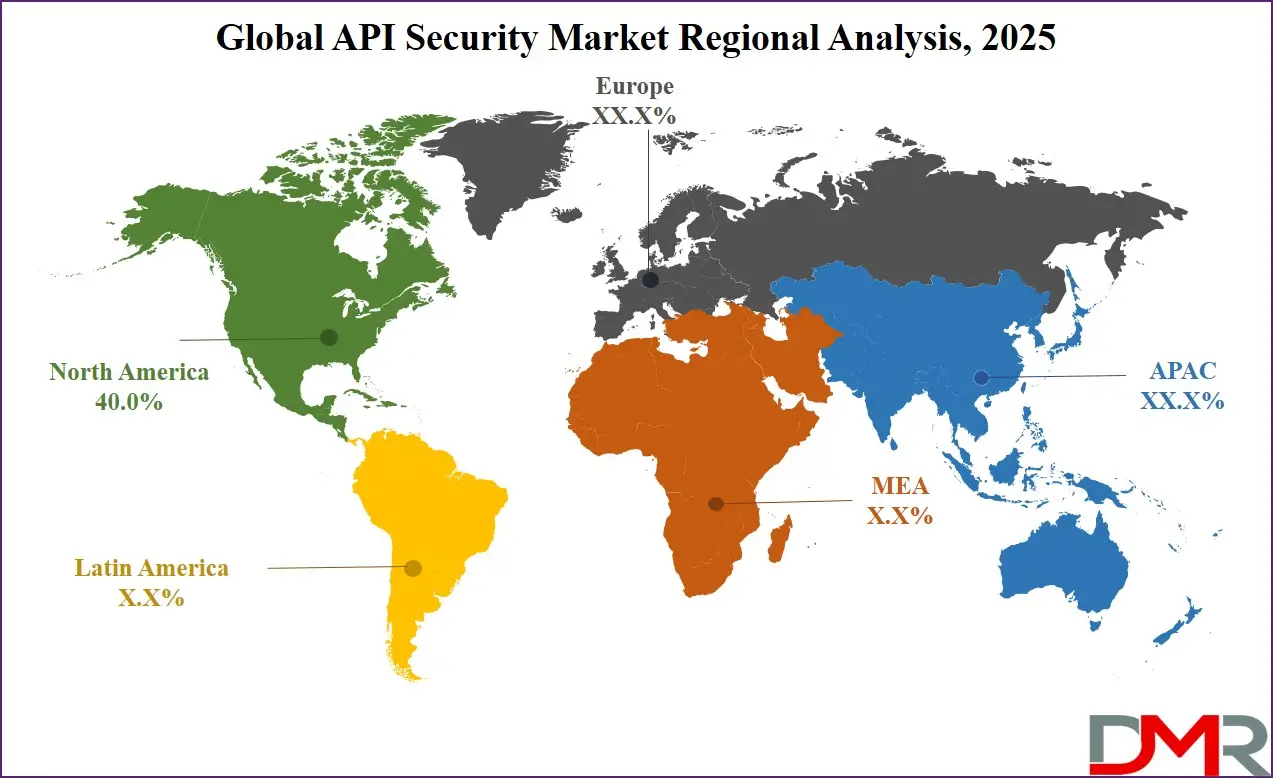
North America is expected to lead the global API security market, accounting for approximately 40% of the total market revenue in 2025. The region’s dominance is driven by widespread adoption of cloud computing, digital transformation initiatives, and extensive deployment of APIs across enterprises in sectors such as banking, healthcare, retail, and information technology.
ℹ
To learn more about this report –
Download Your Free Sample Report Here
High awareness of cybersecurity risks, stringent regulatory compliance requirements, and early adoption of AI-driven threat detection, runtime protection, and API governance solutions further strengthen market growth. The presence of leading technology providers and cybersecurity vendors offering innovative API security platforms also contributes to North America’s leading position in the global market.
Region with significant growth
The Asia Pacific region is expected to witness significant growth in the API security market over the forecast period. Rapid digitalization, increasing adoption of cloud-native applications, and expanding e-commerce and fintech sectors are driving demand for robust API security solutions. Enterprises in countries such as India, China, Japan, and Australia are investing in runtime protection, API discovery, threat monitoring, and AI-driven security analytics to safeguard sensitive data and maintain regulatory compliance. Growing awareness of cybersecurity risks and rising API adoption across industries position the Asia Pacific market as a high-potential region for API security vendors.
By Region
North America
Europe
- Germany
- The U.K.
- France
- Italy
- Russia
- Spain
- Benelux
- Nordic
- Rest of Europe
Asia-Pacific
- China
- Japan
- South Korea
- India
- ANZ
- ASEAN
- Rest of Asia-Pacific
Latin America
- Brazil
- Mexico
- Argentina
- Colombia
- Rest of Latin America
Middle East & Africa
- Saudi Arabia
- UAE
- South Africa
- Israel
- Egypt
- Rest of MEA
Global API Security Market: Competitive Landscape
The global API security market is highly competitive, characterized by rapid innovation and continuous development of advanced solutions to address evolving cyber threats. Vendors are focusing on enhancing capabilities such as runtime protection, AI-driven threat detection, API discovery, posture management, and automated vulnerability scanning to gain a competitive edge.
Strategic initiatives including partnerships, mergers, acquisitions, and geographic expansion are being leveraged to strengthen market presence and deliver integrated security solutions across cloud, on-premise, and hybrid environments. The market is also seeing increased investment in research and development to offer scalable, automated, and cost-effective API security platforms that meet the growing demand across diverse industry verticals.
Some of the prominent players in the global API Security market are
- Akamai Technologies
- Amazon Web Services (AWS)
- Google (Apigee)
- Microsoft Corporation
- IBM Corporation
- Fortinet
- Salt Security
- Imperva
- Oracle Corporation
- Axway
- MuleSoft (Salesforce)
- Data Theorem
- F5 Networks
- Noname Security
- Cequence Security
- NS1
- Sendian
- Spherical Defense
- Traceable AI
- Wallarm
- Other Key Players
Global API Security Market: Recent Developments
- Nov 2025: Clover Security raised USD 36 million to scale its AI‑driven product‑security agent platform, aiming to help enterprises integrate security early into product development rather than reactively, signalling growing investor interest in API and app‑security tools.
- July 2025: A leading API security vendor rolled out a next‑generation edge‑based offering that brings real‑time API traffic visibility, multi‑cloud support, mTLS encryption and high‑performance API protection to teams globally, a response to rising AI‑driven attacks on API infrastructures.
- April 2025: An API security specialist secured a significant funding injection from a major growth‑stage investor, enabling expansion of R&D, international operations, and enhancement of its ML/AI‑powered platform, highlighting continued confidence in API‑protection demand amid rising API abuse and compliance pressures.
- March 2025: Two companies in the DevSecOps and API security space merged to form a unified AI‑native platform that combines software delivery pipelines with API protection, enabling integrated application security across development and runtime phases.
Report Details
| Report Characteristics |
| Market Size (2025) |
USD 1,035.9 Mn |
| Forecast Value (2034) |
USD 4,574.1 Mn |
| CAGR (2025–2034) |
17.9% |
| The US Market Size (2025) |
USD 365.9 Mn |
| Historical Data |
2019 – 2024 |
| Forecast Data |
2026 – 2034 |
| Base Year |
2024 |
| Estimate Year |
2025 |
| Report Coverage |
Market Revenue Estimation, Market Dynamics, Competitive Landscape, Growth Factors and etc. |
| Segments Covered |
By Component (Solutions, Services); By Security Capability (Runtime API Protection, API Discovery and Posture Management, API Security Testing, API Traffic Enforcement and Gateway Integration, API Threat Analytics and Fraud Detection); By Deployment Model (Cloud Deployment, On-Premise Deployment, Hybrid Deployment); By API Type (REST APIs, GraphQL APIs, SOAP APIs, gRPC APIs, Other API Types); By Organization Size (Large Enterprises, SMEs); and By Industry Vertical (BFSI, IT & Telecom, Healthcare & Life Sciences, Retail and E-commerce, Government and Public Sector, Manufacturing and Industrial, Other Industries). |
| Regional Coverage |
North America – The US and Canada; Europe – Germany, The UK, France, Russia, Spain, Italy, Benelux, Nordic, & Rest of Europe; Asia-Pacific – China, Japan, South Korea, India, ANZ, ASEAN, Rest of APAC; Latin America – Brazil, Mexico, Argentina, Colombia, Rest of Latin America; Middle East & Africa – Saudi Arabia, UAE, South Africa, Turkey, Egypt, Israel, & Rest of MEA |
| Prominent Players |
Akamai Technologies, Amazon Web Services, Google (Apigee), Microsoft Corporation, IBM Corporation, Fortinet, Salt Security, Imperva, Oracle Corporation, Axway, MuleSoft (Salesforce), Data Theorem, F5 Networks, and Others. |
| Purchase Options |
We have three licenses to opt for: Single User License (Limited to 1 user), Multi-User License (Up to 5 Users), and Corporate Use License (Unlimited User) along with free report customization equivalent to 0 analyst working days, 3 analyst working days, and 5 analyst working days respectively. |
Frequently Asked Questions
How big is the global API Security market?
▾ The global API Security market size is estimated to have a value of USD 1,035.9 million in 2025 and is expected to reach USD 4,574.1 million by the end of 2034.
What is the size of the US API Security market?
▾ The US API Security market is projected to be valued at USD 365.9 million in 2025. It is expected to witness subsequent growth in the upcoming period as it holds USD 1,479.2 million in 2034 at a CAGR of 16.8%.
Which region accounted for the largest global API Security market?
▾ North America is expected to have the largest market share in the global API Security market, with a share of about 40.0% in 2025.
Who are the key players in the global API Security market?
▾ Some of the major key players in the global API Security market are Akamai Technologies, Amazon Web Services, Google (Apigee), Microsoft Corporation, IBM Corporation, Fortinet, Salt Security, Imperva, Oracle Corporation, Axway, MuleSoft (Salesforce), Data Theorem, F5 Networks, and Others.
What is the growth rate of the global API Security market?
▾ The market is growing at a CAGR of 17.9 percent over the forecasted period.