Market Overview
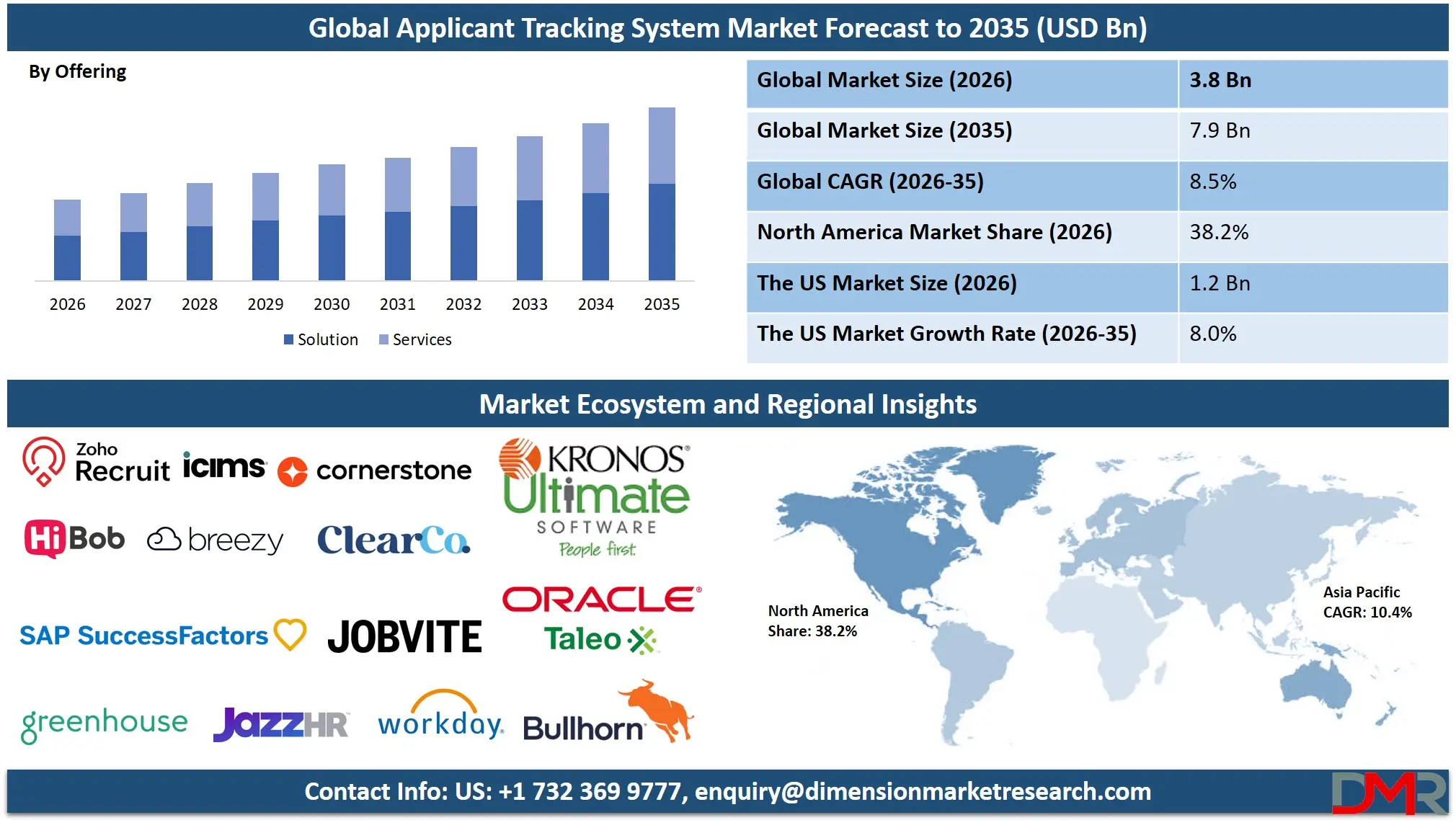
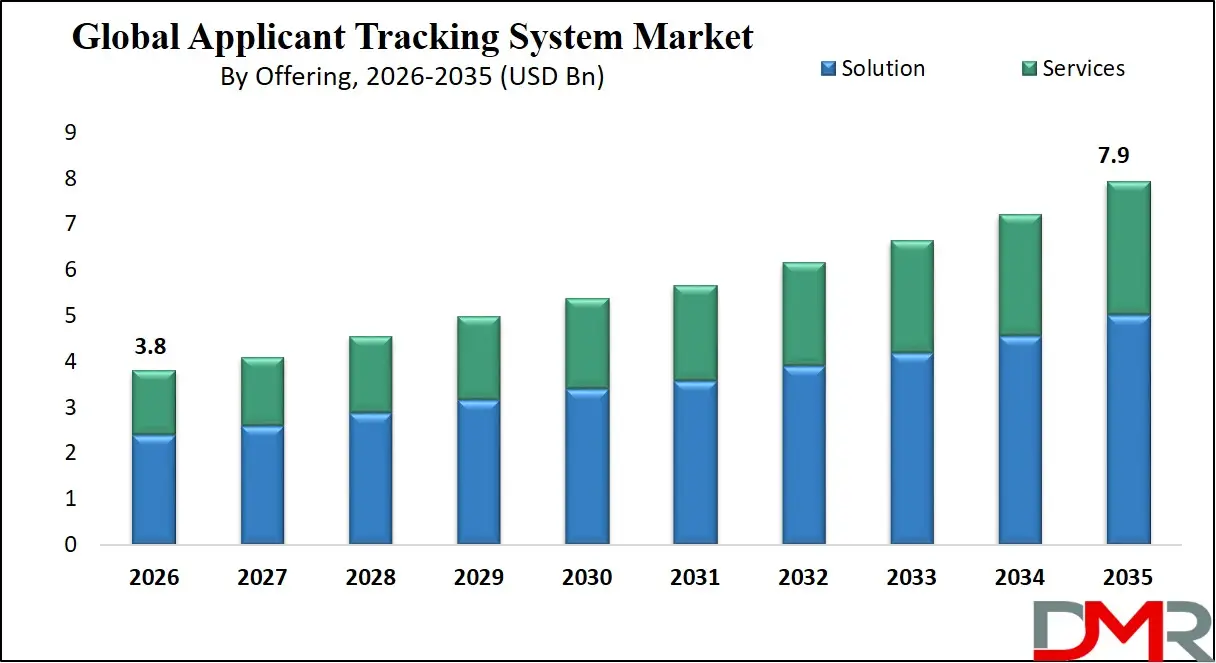
The Global Applicant Tracking System (ATS) Market is set for substantial expansion, reaching an estimated USD 3.8 billion in 2026 and projected to grow at a strong CAGR of 8.5% from 2026 to 2035, to a market value of USD 7.9 billion by 2035. This robust growth trajectory is fueled by the accelerating adoption of digital recruitment solutions, AI-driven candidate screening tools, resume parsing engines, and collaborative hiring platforms across industries.
ℹ
To learn more about this report –
Download Your Free Sample Report Here
Rising volumes of applications per job opening, the increasing complexity of managing talent pools, and a global shift toward remote and hybrid work models are compelling organizations to implement advanced ATS platforms for secure and efficient talent acquisition. The rapid expansion of the gig economy, digital-first companies, and the need for skills-based hiring is significantly increasing demand for reliable applicant tracking and management tools.
Additionally, growing regulatory compliance requirements related to fair hiring practices, data privacy laws, and Equal Employment Opportunity (EEO) reporting are further accelerating market adoption. Businesses are increasingly integrating AI-based screening, automated interview scheduling, diversity analytics, and onboarding tools to enhance the candidate experience and reduce time-to-hire.
Cloud-based deployment models, API-driven integrations with HRIS systems, and scalable SaaS recruitment platforms are enabling enterprises and SMEs to implement cost-effective and globally accessible talent acquisition services. As organizations prioritize talent as a key competitive differentiator and digital transformation reshapes HR functions worldwide, the Applicant Tracking System Market is expected to witness sustained double-digit growth through 2035, driven by the need for efficiency and data-driven hiring decisions.
ℹ
To learn more about this report –
Download Your Free Sample Report Here
Growing government initiatives promoting digital skills development and workforce modernization further accelerate global adoption. However, barriers such as varying data privacy regulations (GDPR, CCPA), integration complexities with existing HR tech stacks, resistance to AI-driven bias mitigation, and the need for high-quality data for analytics remain. Despite these limitations, the convergence of AI, automation, and cloud-based platforms positions the ATS as a central pillar of global talent acquisition strategy through 2035.
The US Applicant Tracking System Market
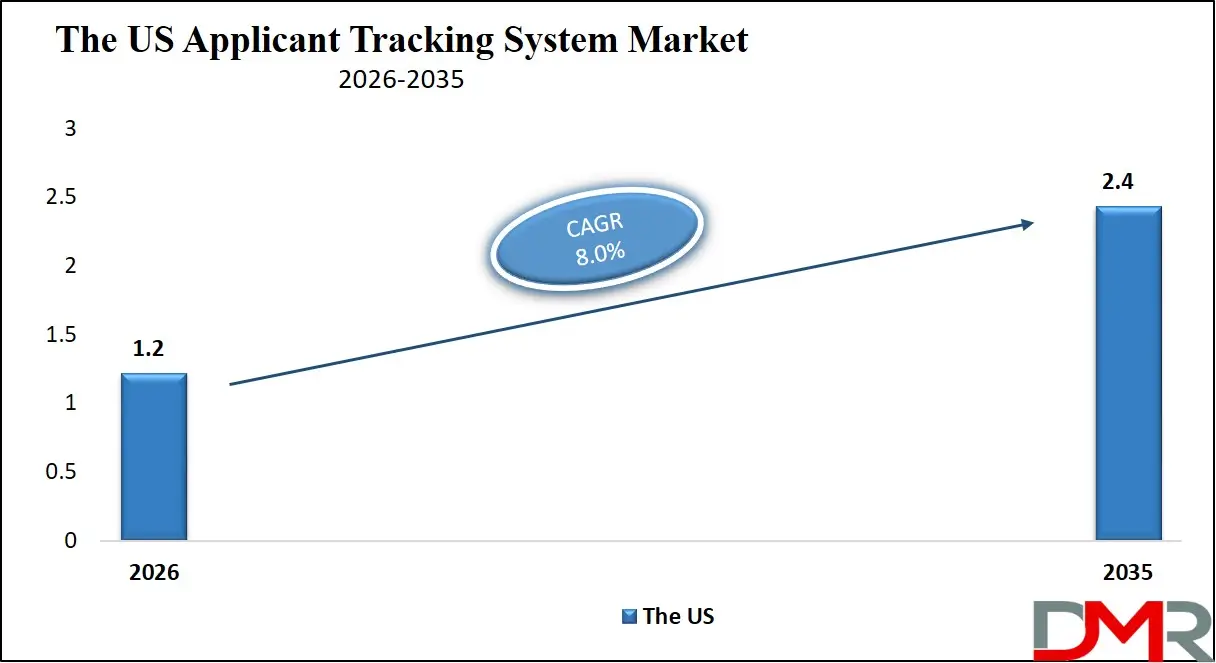
The U.S. Applicant Tracking System Market is projected to reach USD 1.2 billion in 2026 and grow at a CAGR of 8.0%, reaching USD 2.4 billion by 2035. The U.S. leads global adoption due to its mature technology landscape, high volume of white-collar and specialized roles, and a strong focus on diversity, equity, and inclusion (DEI) initiatives.
ℹ
To learn more about this report –
Download Your Free Sample Report Here
The proliferation of digital-first recruiting in sectors like technology, healthcare, and finance, coupled with employers' need to manage high-volume recruitment efficiently, fuels demand for robust ATS solutions. Major enterprises, staffing agencies, and government entities such as those in the federal workforce are integrating advanced ATS platforms to streamline workflows and improve candidate quality.
U.S. regulatory support for fair chance hiring and compliance with OFCCP guidelines encourages investment in ATS technologies that provide robust reporting and audit trails. The market is witnessing a shift toward AI-driven candidate matching and predictive analytics, reducing manual screening efforts and enhancing the quality of hire. The rise of skills-based hiring as a strategic priority has further intensified the focus on sophisticated parsing and matching capabilities, positioning the U.S. as a critical innovator in this space.
The Europe Applicant Tracking System Market
The Europe Applicant Tracking System Market is projected to be valued at approximately USD 1.4 billion in 2026 and is projected to reach around USD 2.1 billion by 2035, growing at a CAGR of about 7.0% from 2026 to 2035. Europe's leadership is anchored by its stringent regulatory environment, particularly the GDPR, which mandates strict controls over candidate data processing and consent management.
Countries such as Germany, the U.K., France, and the Nordic region are widely adopting ATS services, driven by a high emphasis on data privacy and structured hiring processes. The U.K.'s focus on post-Brexit talent acquisition and the EU's emphasis on skills mobility further necessitate robust applicant management systems across various industries.
Europe's high adoption of cloud technologies, cross-border recruitment within the EU, and a mature HR tech ecosystem drive the demand for seamless, compliant ATS solutions. Funding and support for digital skills initiatives encourage the standardization of recruitment APIs and integration with public employment services. With a sophisticated user base and a regulatory landscape that prioritizes data privacy, Europe remains a highly advanced and essential region for applicant tracking services.
The Japan Applicant Tracking System Market
The Japan Applicant Tracking System Market is anticipated to be valued at approximately USD 304.0 million in 2026 and is expected to attain nearly USD 510.0 million by 2035, expanding at a CAGR of about 6.0% during the forecast period. Japan's aging population and a government push for workforce digitalization and improved labor productivity are driving the adoption of efficient and accessible recruitment technologies.
The Ministry of Health, Labour and Welfare (MHLW) actively supports the modernization of hiring practices, promoting the use of digital tools for fair and efficient recruitment. Japan's leadership in technology adoption and high mobile penetration provides a robust foundation for advanced ATS methods, including mobile-optimized application processes and AI-based candidate engagement.
Japan's focus on stable, long-term employment, alongside the gradual shift toward merit-based and skills-based hiring, driven by major corporations, integrates ATS functionality into everything from graduate recruitment to mid-career hiring. Companies are deploying ATS platforms to combat labor shortages and ensure the integrity of their talent pipelines. Japan's cultural emphasis on precision and reliability positions it as a high-growth, quality-focused market for ATS solutions.
Global Applicant Tracking System Market: Key Takeaways
- Strong Global Market Growth Outlook: The Global Applicant Tracking System Market is expected to be valued at USD 3.8 billion in 2026 and is projected to reach USD 7.9 billion by 2035, showcasing rapid expansion supported by rising demand for digital recruitment efficiency and talent intelligence.
- High CAGR Driven by AI Adoption: The market is expected to grow at an impressive CAGR of 8.5% from 2026 to 2035, fueled by accelerating HR digital transformation, AI-driven screening protocols, and increasing need for data-driven hiring decisions worldwide.
- Strong Growth Trajectory in the United States: The U.S. Applicant Tracking System Market stands at USD 1.2 billion in 2026 and is projected to reach USD 2.4 billion by 2035, expanding at a CAGR of 8.0% due to high adoption of advanced HR technologies and a competitive talent market.
- Regional Dominance: North America is expected to capture approximately 38.5% of the global market share in 2026, supported by a mature HR tech ecosystem, high concentration of ATS vendors, and strong focus on recruitment analytics.
- Rapid Advancement in Recruitment Technologies: Innovations including generative AI for job descriptions, conversational AI for candidate engagement, bias detection algorithms, and video interviewing platforms are significantly enhancing the speed, quality, and fairness of recruitment processes.
- Growing Need for Efficiency Boosts Adoption: The rising volume of applications, skills gaps in key industries, and the need for frictionless candidate experiences are driving sustained demand for robust, feature-rich ATS solutions.
Global Applicant Tracking System Market: Use Cases
- High-Volume Graduate Recruitment: Large enterprises use ATS platforms with resume parsing and auto-screening to manage thousands of graduate applications, shortlisting candidates based on predefined skills and criteria.
- Internal Talent Mobility: Organizations leverage ATS databases to identify and match current employees with new internal openings, reducing hiring costs and improving retention.
- Agency & Staffing Firm Management: Recruitment agencies use ATS solutions to manage candidate pipelines, track submissions to multiple clients, and automate timesheet and placement processes.
- Compliance & Diversity Reporting: HR teams use ATS analytics to generate EEO-1 reports, track diversity metrics in hiring funnels, and ensure compliance with fair hiring regulations.
- Collaborative Hiring: Hiring managers and interviewers use ATS platforms to provide feedback, rate candidates, and coordinate interview schedules, centralizing all communication related to a role.
Global Applicant Tracking System Market: Stats & Facts
U.S. Bureau of Labor Statistics (BLS)
- Total U.S. employment reached 167.8 million persons in 2024.
- The U.S. unemployment rate averaged 3.7% in 2023.
- There were over 8.7 million job openings reported in the U.S. (JOLTS data, 2023 average).
- The professional and business services sector employed 22.5 million people in 2024.
- Human Resources Specialists employment totaled about 835,000 jobs in 2023.
- HR Managers employment totaled approximately 198,000 jobs in 2023.
- Employment of HR Specialists is projected to grow 6% from 2022 to 2032.
- Employment of HR Managers is projected to grow 5% from 2022 to 2032.
U.S. Census Bureau
- There were 33.2 million small businesses in the United States (2023).
- Employer firms in the U.S. totaled approximately 6 million.
- Firms with fewer than 500 employees account for 99.9% of U.S. businesses.
- Employer businesses with fewer than 100 employees represent 98% of all employer firms.
Eurostat (European Union Statistical Office)
- In 2023, 58% of EU enterprises purchased cloud computing services.
- Among large enterprises in the EU, 77% used cloud computing services.
- In 2023, 8% of EU enterprises used AI technologies.
- Among large EU enterprises, 30% used AI technologies.
- In 2023, 92% of EU enterprises had internet access.
- 73.8 million people aged 25–64 were employed in science and technology occupations in the EU (2024).
- Large enterprises in the EU showed significantly higher digital intensity levels than SMEs (Digital Intensity Index data).
OECD (Organisation for Economic Co-operation and Development)
- Across OECD countries, over 70% of businesses use broadband internet.
- On average, more than 60% of enterprises use cloud computing in advanced OECD economies.
- AI adoption in enterprises across OECD countries averages around 8–10%, with higher rates among large firms.
- Digital technology adoption is strongly correlated with productivity growth across OECD economies.
International Labour Organization (ILO)
- Global unemployment stood at approximately 5% in 2023, representing about 191 million unemployed persons.
- The global labor force totaled over 3.5 billion people.
- Youth unemployment globally was approximately 13% in 2023.
- Informal employment accounts for around 58% of total global employment.
World Bank
- Small and medium enterprises (SMEs) represent about 90% of businesses worldwide.
- SMEs contribute over 50% of global employment.
- Approximately 600 million jobs will be needed by 2030 to absorb the growing global workforce.
Government of Japan – Statistics Bureau of Japan
- Japan’s labor force totaled about 69 million people in 2023.
- The unemployment rate in Japan averaged 2.6% in 2023.
- Japan had approximately 3.6 million registered job openings (latest labor statistics).
UK Office for National Statistics (ONS)
- The UK employment rate was approximately 75% in 2023.
- UK job vacancies exceeded 900,000 positions in 2023.
- Over 40% of UK businesses reported digital technology adoption improvements post-2020.
Global Applicant Tracking System Market: Market Dynamics
Driving Factors in the Global Applicant Tracking System Market
Escalating Need for Recruitment Efficiency and Speed
The growing volume of applications, particularly for high-demand roles, makes manual screening and coordination unsustainable. ATS platforms automate the most time-consuming tasks—resume collection, candidate communication, interview scheduling, and feedback consolidation. This allows HR teams and recruiters to focus on strategic engagement and quality assessment, directly reducing time-to-fill and improving the candidate experience, which is critical in competitive labor markets.
Data-Driven Hiring and Talent Analytics
Modern ATS platforms are transforming recruitment from a process-driven function into a data-driven strategic advantage. They provide analytics on sourcing channel effectiveness, funnel conversion rates, time-to-hire, and cost-per-hire. Deeper insights include diversity metrics and predictive analytics on candidate success. This empowers organizations to make smarter talent decisions, optimize recruitment marketing spend, and prove the ROI of their hiring activities to leadership.
Restraints in the Global Applicant Tracking System Market
Integration Complexity with HR Tech Stack
An ATS does not operate in isolation; it must seamlessly integrate with an organization's HR Information System (HRIS), payroll, onboarding, and various job boards and assessment tools. Achieving this integration can be complex, costly, and time-consuming, particularly for large enterprises with legacy systems. A lack of seamless data flow can create data silos, lead to manual data entry, and undermine the efficiency gains the ATS was intended to provide.
Data Privacy and Algorithmic Bias Concerns
Data privacy regulations like GDPR impose strict rules on how candidate data is collected, stored, and processed. ATS platforms hold vast amounts of personal data, making them a significant compliance risk. Furthermore, the use of AI in screening has raised concerns about algorithmic bias, where models trained on historical data may inadvertently discriminate against certain groups. This creates a reputational and legal risk, requiring constant monitoring and auditing of AI-driven features.
Opportunities in the Global Applicant Tracking System Market
Expansion of Skills-Based and Internal Talent Marketplaces
The global shift toward skills-based hiring presents a major opportunity for ATS vendors. Moving beyond traditional job titles and degrees to focus on specific competencies requires advanced AI for parsing and matching. Furthermore, the development of internal talent marketplaces within ATS platforms allows large organizations to identify and redeploy existing talent to new roles or projects, a powerful tool for retention and agility that is driving new demand.
AI-Powered Candidate Engagement and Experience
The integration of conversational AI and chatbots offers a significant opportunity to enhance candidate engagement. AI can handle initial queries, schedule interviews, and provide application status updates 24/7, creating a responsive and positive candidate experience. This "always-on" engagement keeps candidates warm, reduces no-show rates for interviews, and frees up recruiters from high-volume administrative communication, adding clear value.
Trends in the Global Applicant Tracking System Market
Generative AI for Recruitment Tasks
The rise of Generative AI is automating the creation of content within the ATS workflow. This includes drafting personalized job descriptions, composing tailored email outreach to candidates, and even summarizing a candidate's profile and key strengths for a hiring manager based on their resume and interview notes. This trend is significantly boosting recruiter productivity.
Video-First and Asynchronous Interviewing
ATS platforms are increasingly integrating native or partnered video interviewing tools. Asynchronous video interviews, where candidates record responses to pre-set questions, are becoming a standard pre-screening step. This trend saves significant time for both recruiters and candidates, provides a richer data point than a resume alone, and is easily managed and scored within the ATS.
Global Applicant Tracking System Market: Research Scope and Analysis
By Offering Analysis
The Solutions segment is projected to dominate the Global Applicant Tracking System Market, accounting for the largest revenue share compared to professional and managed services. This dominance is primarily driven by the growing need for automated, scalable, and intelligent recruitment platforms that can seamlessly integrate into broader HR ecosystems. Businesses across BFSI, IT, healthcare, and manufacturing require sophisticated ATS engines capable of processing high volumes of applicants, parsing diverse resume formats, and providing actionable analytics.
Modern ATS software provides advanced capabilities such as AI-driven candidate screening, resume parsing and semantic search, interview scheduling automation, diversity analytics, and collaborative hiring tools. These features significantly reduce time-to-hire, improve candidate quality, and ensure compliance with hiring regulations. Enterprises prefer customizable and cloud-integrated platforms that offer configurable workflows, reporting dashboards, and robust security features.
Additionally, the shift toward remote and hybrid work models has increased reliance on digital recruitment tools. Subscription-based SaaS models further strengthen the software segment's dominance, as companies can deploy solutions quickly without significant infrastructure investment. While services such as consulting, implementation, and technical support are important, they typically complement software offerings. As talent acquisition strategies become more data-centric globally, the solutions segment is expected to maintain its leadership position due to continuous innovation in AI and automation.
By Deployment Mode Analysis
Cloud-Based deployment is expected to dominate the market due to its flexibility, scalability, and cost efficiency. Organizations increasingly prefer cloud-based ATS solutions because they eliminate heavy capital expenditure on IT infrastructure while offering seamless global accessibility. As businesses expand their talent search across multiple geographies, cloud platforms enable recruiters and hiring managers to collaborate in real-time from anywhere.
Cloud-based solutions allow for rapid updates, easy integration with other cloud HR tools (like HRIS and onboarding platforms), and centralized data management. This is particularly beneficial for enterprises with distributed workforces and remote hiring teams. The pay-per-user or subscription pricing model further supports adoption among SMEs, accelerating overall market penetration.
While on-premise deployment remains relevant for highly regulated industries or government entities requiring complete data control, its adoption is comparatively limited due to higher maintenance costs and lower flexibility. Hybrid models are emerging as a compromise but represent a smaller segment. As cybersecurity standards mature and businesses prioritize agility, cloud-based ATS solutions continue to lead the market and are projected to maintain dominance over the forecast period.
By Organization Size Analysis
Large Enterprises is projected to dominate the organization size segment due to higher recruitment volumes, complex hiring workflows, and substantial HR technology budgets. Multinational corporations in sectors like BFSI, IT, and manufacturing manage thousands of job openings and millions of applications annually, requiring highly scalable and configurable ATS platforms.
These organizations prioritize efficiency gains, talent analytics, compliance management (EEO, OFCCP), and global standardization of hiring processes. Their need to manage internal and external talent pools, support employer branding, and integrate with a suite of other HR tools necessitates investment in robust, enterprise-grade ATS solutions. Large enterprises also have the financial capability to adopt advanced AI-driven screening and predictive analytics modules.
While SMEs are increasingly adopting cloud-based ATS solutions to professionalize their hiring and compete for talent, their spending capacity and feature requirements are generally lower. Consequently, large enterprises continue to generate the majority of market revenue and are expected to sustain their dominant position, though the SME segment is a key growth area.
By User Type Analysis
HR Teams and Recruiters are forecasted to be the dominant user segments, as they are the primary operators and administrators of ATS platforms on a daily basis. Recruiters rely on the system for the core workflow sourcing, screening, communicating with candidates, and managing requisitions. HR Teams depend on the ATS for broader talent acquisition strategy, reporting, compliance, and process optimization.
The ATS serves as their central command center. The efficiency of these users is directly tied to the system's capabilities. Features designed specifically for these personas, such as advanced boolean search, resume parsing, interview scheduling tools, and reporting dashboards, are critical purchase drivers. While Hiring Managers and Candidates interact with the system at key touchpoints (e.g., reviewing candidates, applying for jobs), the sustained, daily usage by HR and recruiting professionals makes them the dominant user group and primary driver of value from the software.
By Functionality Analysis
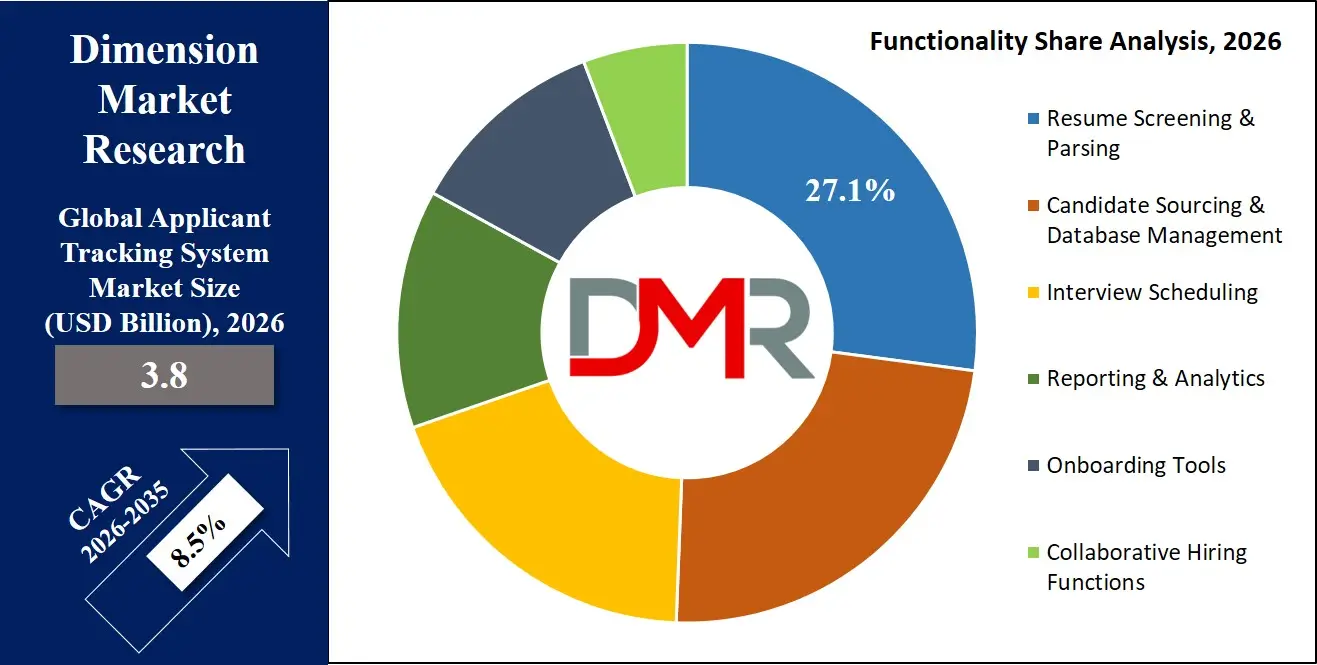
Resume Screening & Parsing is anticipated to dominate the functionality segment. This is the foundational and most utilized feature of any ATS, driven by the sheer volume of applications that organizations must process. The ability to automatically extract key data points (name, contact info, work history, skills, education) from hundreds of diverse resume formats and store them in a searchable database is the core value proposition.
ℹ
To learn more about this report –
Download Your Free Sample Report Here
Advanced functionality now includes AI-driven semantic search and matching, which understands context and synonyms (e.g., "managed" and "led") to rank candidates against job descriptions. This functionality directly addresses the critical pain point of manual screening time. While functionalities like Candidate Sourcing, Interview Scheduling, and Reporting are vital for a complete solution, Resume Screening & Parsing remains the dominant and most indispensable function, serving as the primary filter and efficiency driver in the recruitment workflow.
By End User Type Analysis
The IT & Telecom sector is expected to be a dominant end-user segment due to its high-volume, continuous need for specialized technical talent and its early adoption of digital HR tools. These industries face intense competition for software developers, data scientists, and cybersecurity experts, requiring highly efficient and effective ATS platforms to source and engage passive candidates.
BFSI is another dominant and critical segment, driven by strict regulatory compliance requirements (KYC, AML checks often integrate with hiring) and the need for meticulous record-keeping in audits. The high volume of roles in retail banking, coupled with specialized roles in investment banking and insurance, demands robust ATS functionality. While sectors like Healthcare, Manufacturing, and Government also contribute significantly, IT & Telecom and BFSI remain the largest revenue contributors due to their acute talent needs, regulatory intensity, and high transaction frequency in recruitment.
The Global Applicant Tracking System Market Report is segmented on the basis of the following:
By Offering
- Solutions
- Core ATS Software Platforms
- AI-Driven Candidate Screening Tools
- Resume Parsing & Analytics Engines
- Services
- Integration & Implementation Services
- Consulting Services
- Maintenance & Support Services
By Deployment Mode
- Cloud-Based
- On-Premise
- Hybrid
By Organization Size
- Small & Medium Enterprises (SMEs)
- Large Enterprises
By User Type
- HR Teams
- Recruiters
- Hiring Managers
- Applicants/Candidates
By Functionality
- Resume Screening & Parsing
- Candidate Sourcing & Database Management
- Interview Scheduling
- Reporting & Analytics
- Onboarding Tools
- Collaborative Hiring Functions
By End User Type
- Banking, Financial Services & Insurance (BFSI)
- IT & Telecom
- Manufacturing
- Retail & Consumer Goods
- Healthcare
- Transportation & Logistics
- Government
- Other End Users
Impact of Artificial Intelligence in the Global Applicant Tracking System Market
- AI for Intelligent Resume Parsing & Matching: AI algorithms analyze resume content to understand context, synonyms, and implied skills far beyond simple keyword matching. This allows for semantic search and more accurate matching of candidates to job descriptions, surfacing qualified candidates who might have been missed by traditional keyword filters.
- AI-Driven Candidate Sourcing & Engagement: AI can proactively search external databases and professional networks to build talent pools based on specific criteria. It can also power chatbots and automated email campaigns to engage passive candidates, nurture relationships, and screen initial interest, all without recruiter intervention.
- Predictive Analytics for Quality of Hire: AI models can analyze historical hiring data—including candidate attributes, source, and performance metrics—to predict which candidates are most likely to succeed and stay with the company. This shifts the focus from filling roles quickly to predicting long-term success.
- Bias Detection and Mitigation: AI tools are being used to audit job descriptions for gendered or biased language and to anonymize applications (removing names, photos) during initial screening. Furthermore, AI can analyze hiring funnel data to flag potential bias in selection rates across different demographic groups.
- Automated Interview Scheduling and Assistance: AI-powered scheduling assistants integrated within the ATS can manage the complex logistics of coordinating interviews between multiple candidates and interviewers, dramatically reducing administrative time and preventing scheduling conflicts.
Global Applicant Tracking System Market: Regional Analysis
Region with the Largest Revenue Share
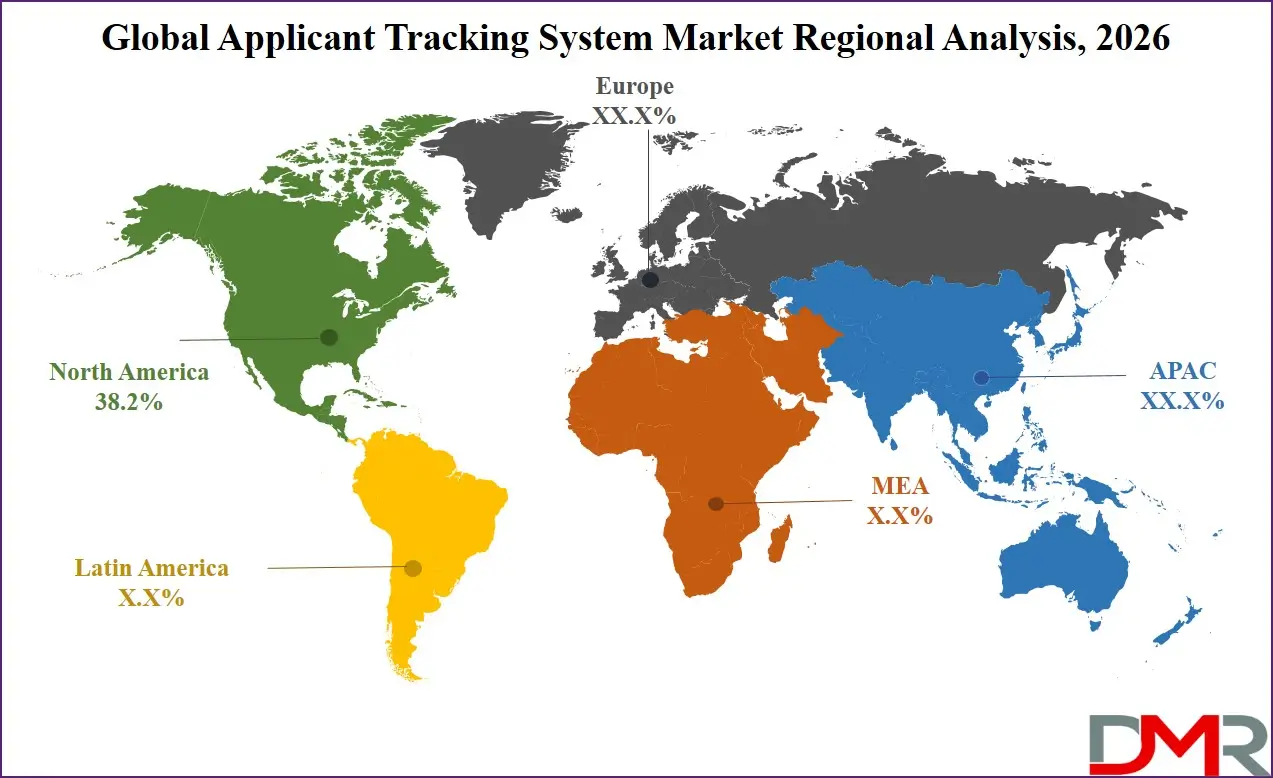
North America is projected to dominate the regional segment with the highest market share, anticipated to hold 38.2% of the total market revenue by the end of 2026. This is due to its advanced digital infrastructure, high concentration of ATS vendors, and widespread adoption of cloud-based HR technologies. The region is home to leading HR tech innovators, driving rapid technological advancements in AI for recruitment. Strong regulatory frameworks regarding EEO compliance and data privacy compel businesses to adopt systems with robust reporting and security features. High corporate awareness of employer branding and candidate experience further strengthens demand.
ℹ
To learn more about this report –
Download Your Free Sample Report Here
The United States, in particular, accounts for the largest share within North America due to its massive corporate sector, high job turnover rates, and sophisticated venture capital ecosystem funding HR tech innovation. Although Asia Pacific is the fastest-growing region, North America continues to hold the largest revenue share due to early adoption of advanced recruitment technologies and substantial corporate HR technology budgets.
Region with the Highest CAGR
Asia-Pacific holds the highest CAGR and is poised to achieve rapid market share growth due to its massive, young workforce, booming digital economy, and rapid formalization of the SME sector. Countries like India, China, and Southeast Asian nations are experiencing a surge in white-collar employment and cross-border hiring. Government initiatives promoting digital skills and the expansion of multinational corporations into the region are creating fertile ground for ATS adoption. The region's price sensitivity is being addressed through localized cloud solutions, mobile-first recruitment features, and partnerships between global ATS providers and regional HR consultancies. This, combined with an immense and growing volume of digital job applications, positions APAC as the fastest-growing market for applicant tracking systems.
By Region
North America
Europe
- Germany
- The U.K.
- France
- Italy
- Russia
- Spain
- Benelux
- Nordic
- Rest of Europe
Asia-Pacific
- China
- Japan
- South Korea
- India
- ANZ
- ASEAN
- Rest of Asia-Pacific
Latin America
- Brazil
- Mexico
- Argentina
- Colombia
- Rest of Latin America
Middle East & Africa
- Saudi Arabia
- UAE
- South Africa
- Israel
- Egypt
- Rest of MEA
Global Applicant Tracking System Market: Competitive Landscape
The Global Applicant Tracking System Market is highly competitive and fragmented, featuring a mix of established HCM giants, specialized ATS vendors, and new AI-focused entrants. Leading players like iCIMS, Jobvite, and Lever dominate the mid-market and enterprise sectors with comprehensive, feature-rich platforms. Pure-play innovators such as SmartRecruiters and Ideal are driving market dynamics with specialized AI-driven candidate matching and engagement features.
HCM suites like Oracle (Taleo), SAP (SuccessFactors), and Ultimate Software (Kronos) offer ATS functionality as a core component of their broader HR ecosystems, appealing to large enterprises seeking integrated solutions. Regional players and niche providers also remain active, catering to specific industries like healthcare or manufacturing.
Some of the prominent players in the Global Applicant Tracking System Market are:
- iCIMS, Inc.
- Jobvite, Inc.
- Lever, Inc.
- SmartRecruiters
- Oracle Corporation (Taleo)
- SAP SE (SuccessFactors)
- Ultimate Software (Kronos Incorporated)
- Workday, Inc.
- Cornerstone OnDemand, Inc.
- Bullhorn, Inc.
- ClearCompany
- JazzHR (Performer Success)
- Breezy HR
- Greenhouse Software, Inc.
- Hibob Inc. (Bob)
- Zoho Corporation (Zoho Recruit)
- Freshteam by Freshworks
- CEIPAL Corp.
- Avature
- Oleeo
- Ideal
- Mya Systems (Mya)
- Other Key Players
Recent Developments in the Global Applicant Tracking System Market
- November 2025: SmartRecruiters launched its "Talent Ecosystem 2.0" platform, featuring enhanced AI-powered marketplace connections for pre-configured integrations with thousands of recruitment tools, streamlining the HR tech stack.
- October 2025: iCIMS demonstrated its new generative AI capabilities for creating personalized job descriptions and candidate outreach emails at the HR Technology Conference 2025, highlighting significant gains in recruiter productivity.
- September 2025: SAP SuccessFactors announced a strategic partnership with a leading background check provider to offer a seamless, integrated pre-employment screening workflow directly within the ATS, accelerating the hiring process.
- August 2025: Workday acquired a specialist AI analytics firm to enhance its workforce and talent intelligence capabilities, aiming to provide deeper predictive insights on internal mobility and candidate success.
- July 2025: A consortium of European ATS vendors and universities was awarded a Horizon Europe grant to develop an open-source framework for ethical and transparent AI in recruitment, focusing on bias mitigation.
- June 2025: Lever partnered with a major global job board to provide real-time diversity analytics on applicant sources, helping clients optimize their sourcing strategies to meet DEI goals.
Report Details
| Report Characteristics |
| Market Size (2026) |
USD 3.8 Bn |
| Forecast Value (2035) |
USD 7.9 Bn |
| CAGR (2026–2035) |
8.5% |
| The US Market Size (2026) |
USD 1.2 Bn |
| Historical Data |
2020 – 2025 |
| Forecast Data |
2027 – 2035 |
| Base Year |
2025 |
| Estimate Year |
2026 |
| Report Coverage |
Market Revenue Estimation, Market Dynamics, Competitive Landscape, Growth Factors and etc. |
| Segments Covered |
By Offering (Solutions, Services), By Deployment Mode (Cloud-Based, On-Premise, Hybrid), By Organization Size (Small & Medium Enterprises (SMEs), Large Enterprises), By User Type (HR Teams, Recruiters, Hiring Managers, Applicants/Candidates), By Functionality (Resume Screening & Parsing, Candidate Sourcing & Database Management, Interview Scheduling, Reporting & Analytics, Onboarding Tools, Collaborative Hiring Functions), By End User Type (Banking, Financial Services & Insurance (BFSI), IT & Telecom, Manufacturing, Retail & Consumer Goods, Healthcare, Transportation & Logistics, Government, Other End Users) |
| Regional Coverage |
North America – The US and Canada; Europe – Germany, The UK, France, Russia, Spain, Italy, Benelux, Nordic, & Rest of Europe; Asia-Pacific – China, Japan, South Korea, India, ANZ, ASEAN, Rest of APAC; Latin America – Brazil, Mexico, Argentina, Colombia, Rest of Latin America; Middle East & Africa – Saudi Arabia, UAE, South Africa, Turkey, Egypt, Israel, & Rest of MEA |
| Prominent Players |
iCIMS, Inc., Jobvite, Inc., Lever, Inc., SmartRecruiters, Oracle Corporation (Taleo), SAP SE (SuccessFactors), Ultimate Software (Kronos Incorporated), Workday, Inc., Cornerstone OnDemand, Inc., Bullhorn, Inc., ClearCompany, JazzHR (Performer Success), Breezy HR, Greenhouse Software, Inc., Hibob Inc. (Bob), Zoho Corporation (Zoho Recruit), Freshteam by Freshworks, CEIPAL Corp., Avature, Oleeo, Ideal, Mya Systems (Mya), and Other Key Players |
Frequently Asked Questions
How big is the Global Applicant Tracking System Market?
▾ The Global Applicant Tracking System Market size is estimated to have a value of USD 3.8 billion in 2026 and is expected to reach USD 7.9 billion by the end of 2035.
What is the growth rate in the Global Applicant Tracking System Market?
▾ The market is growing at a CAGR of 8.5 percent over the forecasted period of 2026-2035.
What is the size of the US Applicant Tracking System Market?
▾ The US Applicant Tracking System Market is projected to be valued at USD 1.2 billion in 2026. It is expected to witness subsequent growth as it reaches USD 2.4 billion in 2035 at a CAGR of 9.2%.
Which region accounted for the largest Global Applicant Tracking System Market?
▾ North America is expected to have the largest market share in the Global Applicant Tracking System Market with a share of about 38.2% in 2026.
Who are the key players in the Global Applicant Tracking System Market?
▾ Some of the major key players in the Global Applicant Tracking System Market are iCIMS, Inc., Jobvite, Inc., Lever, Inc., SmartRecruiters, Oracle Corporation, SAP SE, and many others.