What is the Global Application Performance Management Market Size?
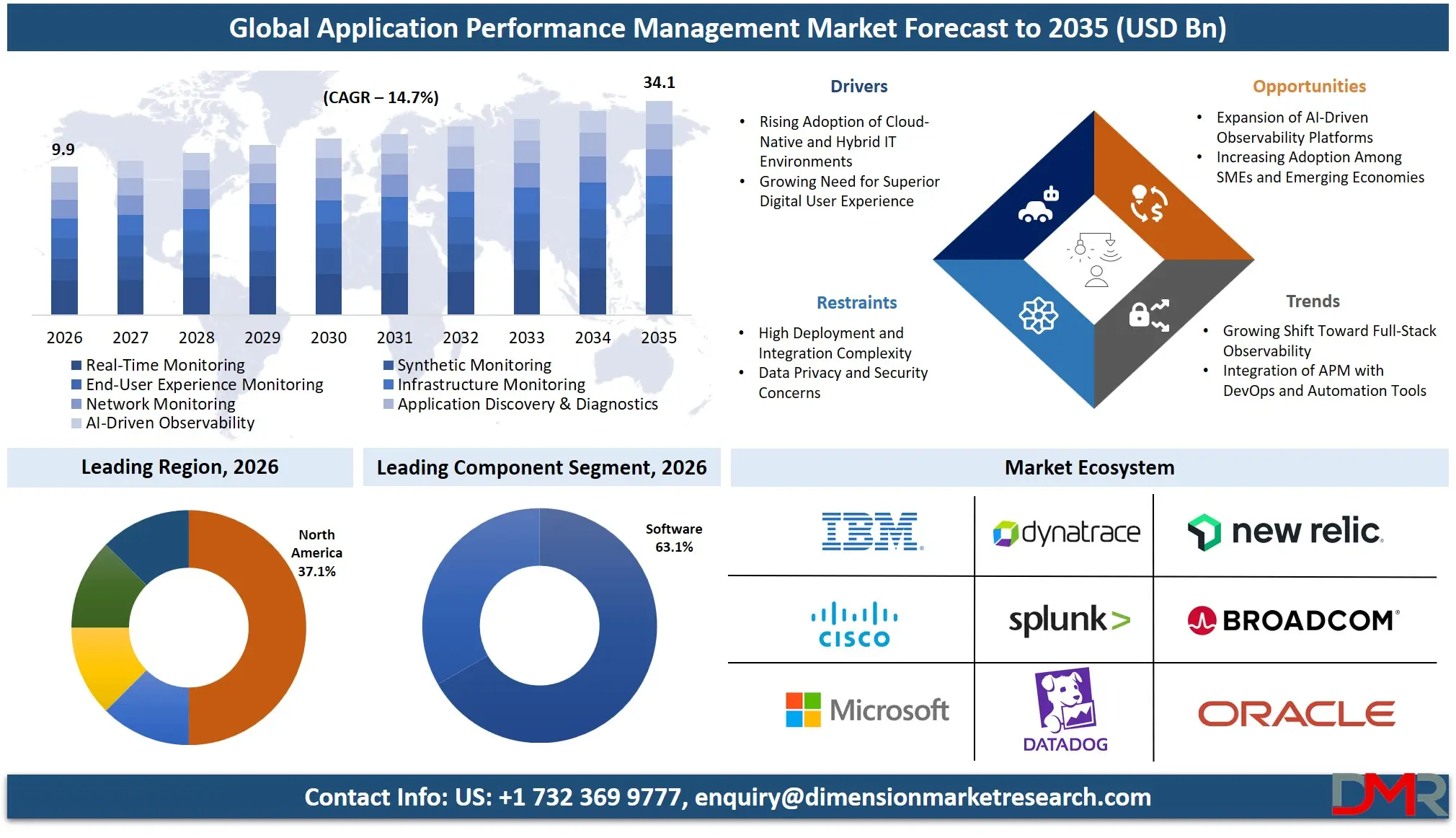
The Global Application Performance Management Market is expected to reach a value of USD 9.9 billion in 2026, and it is further anticipated to reach USD 34.1 billion by 2035, growing at a CAGR of 14.7% during the forecast period.
ℹ
To learn more about this report –
Download Your Free Sample Report Here
The market of application performance management has been experiencing growth at a rapid rate due to the rising dependency of enterprises upon advanced and complicated software systems for performing mission-critical activities. The application performance management comprises of software and services like deployment, integration, training, education, and support, maintenance which aid enterprises in the monitoring, management, and optimization of the performance and availability of applications.
There is an increased requirement to incorporate AI-driven observability, cloud-native architecture, and superior digital experience and hence there is the need for a specific application performance management solution. The most common users are enterprises, whereas cloud and hybrid deployments continue to be the choice due to scalability and monitoring of dynamic and distributed workloads. Key verticals are BFSI, IT & telecommunications, retail & e-commerce, owing to the need for highly performing applications and flawless experience.
ℹ
To learn more about this report –
Download Your Free Sample Report Here
The US Application Performance Management Market
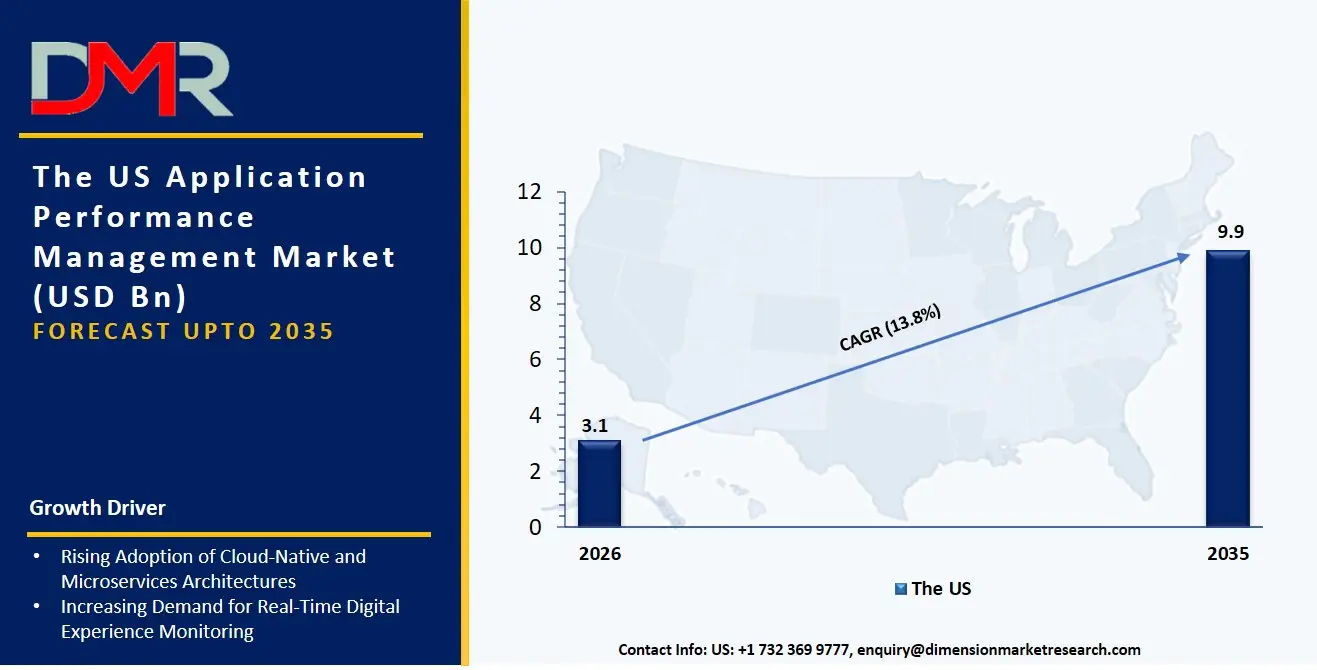
The US Application Performance Management Market is projected to reach USD 3.1 billion in 2026 at a compound annual growth rate of 13.8% over its forecast period, which is further expected to reach a market value of USD 9.9 billion by 2035. The United States maintains its position as the biggest and most developed market for application performance management because of the aggressive growth of digital services among Fortune 500 companies and the increasing complexity of microservice-based applications. Traditionally, the demand in this market has been driven by solutions in the field of AI-Driven Observability because businesses are trying to shift from mere monitoring of their applications to making those applications self-learning and self-healing. Furthermore, the integration of Generative AI software in DevOps processes generates demand for solutions in the area of End-User Experience Monitoring.
ℹ
To learn more about this report –
Download Your Free Sample Report Here
The Europe Application Performance Management Market
The Europe Application Performance Management Market is estimated to be valued at USD 2.9 billion in 2026 and is further anticipated to reach USD 10.1 billion by 2035 at a CAGR of 14.9%. The regulatory landscape, comprising GDPR and future EU AI Act, significantly influences the European market and thus creates the requirement for the implementation of Real-Time Monitoring and Synthetic Monitoring to comply with the regulations and maintain data sovereignty. There has been rapid adoption of Hybrid Deployment Mode solutions because of the attempts by German and French manufacturers and automotives to balance performance of OT networks and cloud analytics applications. Additionally, there have been initiatives like GAIA-X, which are compelling the cloud service providers to develop specific cloud observability and network monitoring solutions to ensure interoperability of European application eco-systems.
The Japan Application Performance Management Market
The Japan Application Performance Management Market is projected to be valued at USD 686.9 million in 2026 at a CAGR of 14.6%. Unique nature of the Japanese market is associated with the company's motivation to conduct digital transformation (DX) in terms of aging population and outdated IT infrastructure. Maintenance and support services along with deployment and integration services account for a major share of expenses while huge conglomerations are upgrading their monolithic applications into cloud-based platforms. The demand for application discovery and diagnostics is driven by the need to fill the gap between EMR systems and industrial control systems and newer SaaS applications. This creates a particular niche in infrastructure monitoring and automation & orchestration.
Key Takeaways
- Market Size & Forecast: The Global Application Performance Management market is projected to reach USD 9.9 billion in 2026, expanding dramatically to USD 34.1 billion by 2035, due to two driving forces which can be increasing adoption of enterprise AI and the required transition to cloud-native application architectures.
- Growth Rate & Outlook: Global market growth is expected at a CAGR of 14.7%, on account of the lack of qualified personnel for IT operations and SREs, as well as the increasing complexity of managing the performance of Kubernetes environments and serverless functions.
- Primary Growth Drivers: Leading growth drivers include the migration of companies from monolith architectures to microservices, the need for timely detection of errors that can lead to downtime of digital services, and the implementation of DevOps/CICD pipelines requiring special application discovery and diagnostics solutions.
- Key Market Trends: Notable trends involve the development of specific observability solutions for Fintech, e-health industries, the deployment of AI-driven observability solutions using automated performance remediation techniques, and the growing demand for end-user experience monitoring due to board-level prioritization of customer experience and retention rates.
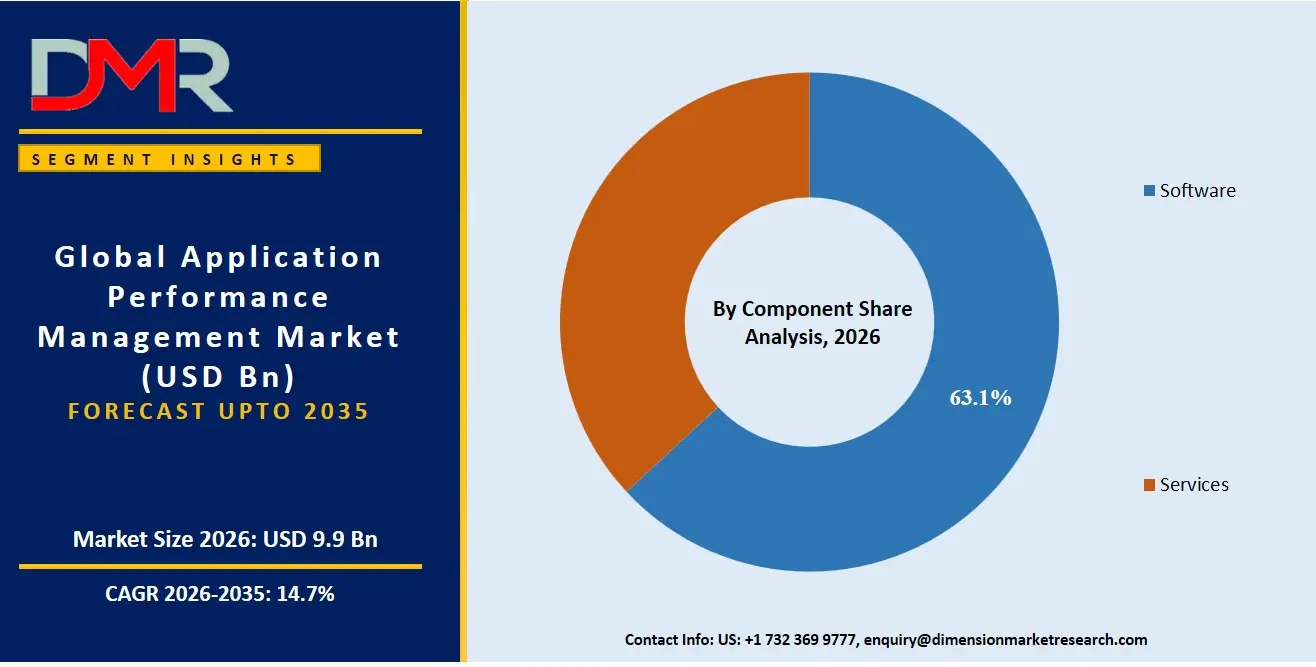
- By Component Analysis: Software is projected to lead this segment because of the increasing use of real-time monitoring tools, analytics based on artificial intelligence, observability, and automated troubleshooting tools. The growth of the software segment can be attributed to cloud-native apps, DevOps, and the adoption of monitoring-as-a-service models.
- By Deployment Analysis: Cloud Deployment is projected to lead the global application performance management market in this segment because of increased enterprise cloud adoption, hybrid IT infrastructures, and the increasing requirement for scalable monitoring solutions. Cloud APMs are flexible, economical, and provide centralized visibility, automatic updates, and AI performance optimizations.
- Regional Leadership: North America will lead the market in terms of market share as it is projected to reach a market value of 37.1% by 2026 because of the advanced technology eco-system available here that fully leverages this eco-system and therefore leads the market.
What is the Application Performance Management?
Application Performance Management refers to the set of specific software and services provided by third-party experts, APM providers, and systems integrators in order to support companies in maintaining high levels of application availability, performance, and user satisfaction throughout all stages of the application's lifecycle. Contrary to cloud consumption (which is the actual software or hardware), Application Performance Management is related to the way in which applications perform and operate successfully. Therefore, this refers to specific software used for monitoring and anomaly detection, services involved in the process of embedding APM software within the existing processes, and training sessions on how to actually work with such solutions. Considering the fact that 90% of organizations utilize distributed and multi-cloud application environments, professional APM software and services are required in order to ensure proper observability, security posture, and performance tuning of their digital assets.
Use Cases
- Core System Modernization in Banking: Financial institutions take advantage of AI-enabled observability and application discovery/diagnostics solutions to mitigate risks during the re-platforming of legacy COBOL core banking applications to Java-based microservices ensuring that the cloud native environment can provide guaranteed transaction performance SLA before customer cutover.
- AI-Powered Digital Experience in Healthcare: Healthcare organizations make use of end user experience monitoring solutions and predictive analytics capabilities to ensure performance of AI-powered diagnostic portals that analyze petabytes of imaging data to prevent any latency problems that could affect telehealth visits.
- Sovereign Application Performance in Government: Federal agencies employ hybrid deployment mode APM tools to perform monitoring of architectures adhering to the strict data residency requirements making sure that citizen-facing digital services operate without latency while no data leaves the country.
- Hybrid Manufacturing Performance Integration: Multinational companies apply network monitoring and infrastructure monitoring solutions to obtain insight into factory floor PLCs integrated with the cloud-based ERP system, making sure that real-time data flows for predictive maintenance and supply chain visibility operate without latency.
How AI is Transforming the Application Performance Management Market?
The emergence of artificial intelligence technologies has made its impact on the application performance management market by speeding up the process of root cause analysis as well as increasing operational efficiency via automation. With the help of machine learning, AI can analyze big volumes of telemetry data and detect patterns and anomalies faster than human specialists do in a matter of minutes thanks to automation which decreases MTTD and MTTR compared to manual threshold-based alerting systems. AI features integrated into DevOps and CI/CD enable organizations to push performance testing left, thereby analyzing performance degradation in code commits automatically.
The field of governance and digital experience monitoring is also increasingly relying on artificial intelligence capabilities. When it comes to digital experience monitoring solutions, intelligent baselining agents are used to understand what a normal digital experience looks like to discover any degradations, sessions, and other aspects that may affect it negatively. Organizations thus remain aligned with their internal SLAs. In addition, the rise of generative AI co-pilot assistants makes it possible for IT Ops and DevOps teams to get instant feedback from performance data by just asking questions in human language.
Market Dynamics
Key Drivers in the Global Application Performance Management Market
Rising Adoption of Cloud-Native and Hybrid IT Environments
Enterprise movement to cloud native architecture, hybrid cloud infrastructure, and application developed using the microservices paradigm is one of the major factors increasing the need for Application Performance Management solutions. Enterprises are now relying heavily on distributed system which needs continuous monitoring of their performance, application behavior, infrastructure health, and end-user experience. APM tools help organizations to ensure high application performance and availability of workloads in different cloud environments such as public cloud, private cloud, and multi-cloud. The adoption of Software as a Service (SaaS) and containerized application development has also resulted in a rising requirement for APM.
Growing Need for Superior Digital User Experience
Organizations within different sectors are giving priority to smooth digital experience to enhance customer retention, employee productivity, and their reputation among customers. With the growing expansion of mobile apps, online shopping websites, and other digital channels by enterprises, any performance problem can result in losses of revenue for the organization. APMs help companies track application responsiveness, performance of transactions, and user interactions on the go. Growing demands of consumers for uninterrupted digital services have motivated organizations to leverage intelligent monitoring tools. In addition to this, BFSI, healthcare, and retail sectors are spending substantially on improving customer experience.
Restraints in the Global Application Performance Management Market
High Deployment and Integration Complexity
The use of APM platforms is typically accompanied by some degree of technical complexity, especially when it comes to large businesses that operate through varying IT environments. Customization and expertise may be needed for successfully integrating APM platforms with legacy systems, cloud platforms, databases, and external software applications. Some businesses struggle with successfully setting up and configuring monitoring tools within their distributed environment. Compatibility with new technology trends like Kubernetes, edge computing, and hybrid clouds is also a major challenge. Small to medium-sized businesses that lack expertise in IT may avoid the use of advanced APM platforms because of the complexities associated with integrating them.
Data Privacy and Security Concerns
APM tools collect vast amounts of application, network, and usage statistics data to gain valuable insights into performance and troubleshooting issues. The huge volume of data poses some issues from the perspectives of cybersecurity, data privacy, and regulatory compliance. Companies in heavily regulated industries like healthcare, finance, and government must adhere to certain privacy rules for their data. In addition, any security lapses in APM tools can make companies' operations vulnerable to cyber attacks, compromising data stored in such operations. Companies may have some reservations about third-party cloud-based APM services because of the access to sensitive business data.
Growth Opportunities in the Global Application Performance Management Market
Expansion of AI-Driven Observability Platforms
The incorporation of artificial intelligence and machine learning technologies into APM products is presenting numerous growth opportunities in the market. With such advanced technologies, automatic anomaly detection, prediction of possible system failure, identifying root cause, and optimizing application performance become possible without much manual effort on part of the users. Intelligent automation systems are being increasingly adopted by companies looking to decrease downtimes and increase efficiencies as well as manage cloud-native environments. Predictive analysis and autonomous IT management would be more sought after in the future due to advancements in digital infrastructures. The vendors offering such capabilities would enjoy a competitive advantage.
Increasing Adoption among SMEs and Emerging Economies
The adoption of digital transformation, cloud computing, and SaaS-based enterprise operations among small and medium enterprises (SMEs) is on the rise, thus presenting a lot of opportunities to APM vendors. The introduction of affordable cloud-based APM systems means that SMEs can benefit from enterprise-level monitoring without having to make significant investments in the IT infrastructure. Furthermore, developing countries in APAC, Latin America, and the Middle East have recorded an impressive increase in the uptake of internet connectivity, applications, and digital commerce activities. Significant investment is being made in the digital transformation of government and enterprise infrastructures.
Trends in the Global Application Performance Management Market
Growing Shift toward Full-Stack Observability
Organizations are increasingly adopting the concept of observability beyond the traditional practice of monitoring by integrating solutions that offer end-to-end observability across applications, infrastructure, network, logging, and end-user experience. Modern businesses need holistic views of their very complex and distributed IT infrastructure in which cloud services, containerization, API and microservices play key roles. End-to-end observability helps IT professionals analyze information across diverse systems and determine the performance issues that could otherwise take more time to discover. End-to-end observability has become especially crucial in DevOps and SRE domains where performance optimization matters the most.
Integration of APM with DevOps and Automation Tools
Due to more widespread use of DevOps approaches and continuous integration/continuous delivery processes, the integration of APM systems with software development and automation is becoming more widespread. The companies are integrating the monitoring directly into the process of creating applications to find problems earlier and speed up the process of delivering applications. Integrations with such tools like Kubernetes, Docker, Jenkins, cloud orchestration services will ensure continuous monitoring and automatic optimization during the deployment process. This leads to increased innovation and reliability of applications. In addition, there is a growing trend of using AI for monitoring purposes.
Research Scope and Analysis
The Global Application Performance Management Market Report is segmented by component, deployment mode, technology, enterprise size, monitoring type, organization function, and end-use industry. The market includes software and services, cloud and hybrid deployments, AI-driven observability technologies, real-time monitoring solutions, and diverse enterprise applications across multiple industries globally.
ℹ
To learn more about this report –
Download Your Free Sample Report Here
By Component Analysis
The software category is projected to be leading the global application performance management market owing to rising requirements for performance management solutions, which include real-time monitoring, observability, analytics, and automation. Enterprises are turning to APM software to monitor cloud-native applications, microservices, databases, and digital experiences. With hybrid cloud architecture and DevOps culture becoming prevalent among enterprises, the use of monitoring solutions that are highly scalable and include machine learning analytics features has gained momentum. Software APM solutions are being preferred by enterprises as they enable continuous visibility, predictability, and troubleshooting capabilities in an efficient manner. In addition, the advent of SaaS APM software platforms is driving the leadership of the software category further.
By Deployment Mode Analysis
Cloud-based deployment is expected to dominate the global application performance management market owing to the rising usage of cloud technology among enterprises, as well as software-as-a-service applications and remote digital operations. Cloud application performance management tools provide greater scalability, more flexibility, reduced initial infrastructure cost, and ease of deployment over legacy on-premise applications. The growing preference among organizations for cloud-native observability platforms that support distributed computing environments, microservices, and hybrid environments in real-time is fueling the adoption of cloud APMs. Furthermore, the rising adoption of multi-cloud and remote workforce management also drives the usage of cloud-based observability platforms.
By Technology Analysis
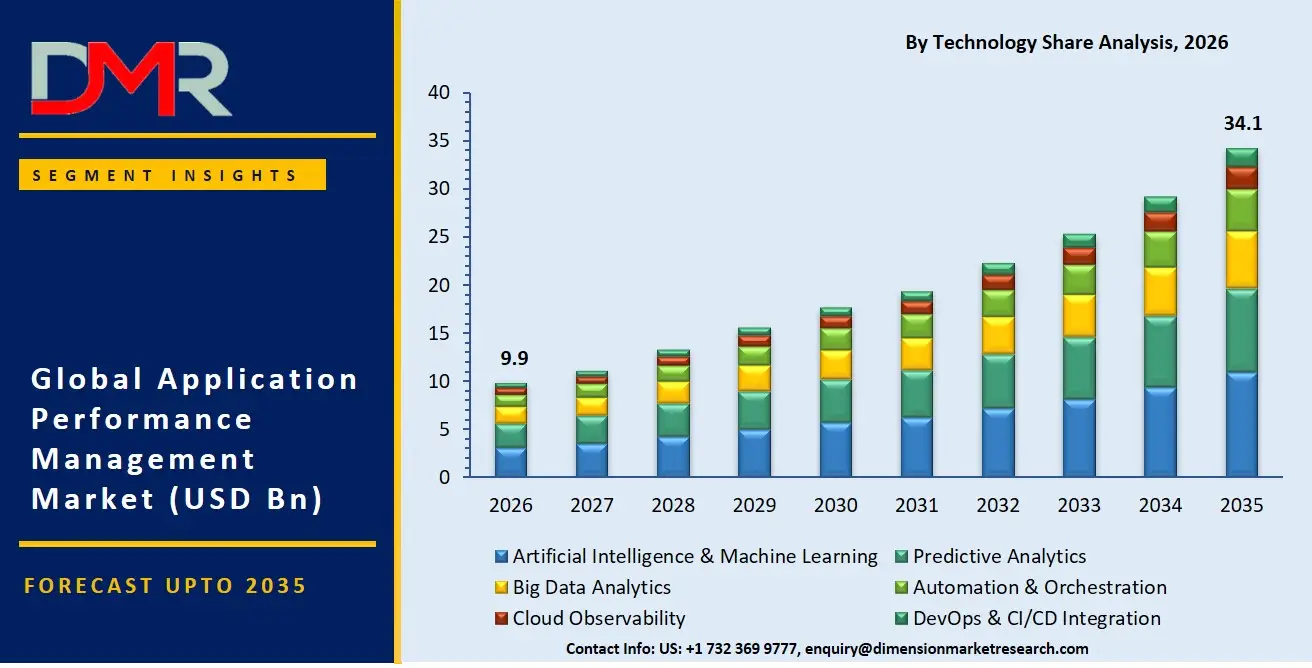
Artificial intelligence & machine learning are expected to dominate the technology category because of the advantages they offer in improving monitoring precision, automating anomaly detection and improving the capabilities of root cause analysis. Artificial intelligence-enabled APM tools have the capability of processing huge amounts of data, detecting failures and optimizing application performance. Intelligent observability solutions are increasingly being used by companies that require handling of highly dynamic cloud-native architectures in order to minimize any chances of failure. Predictive maintenance is also made possible through machine learning algorithms that help in optimizing the operation of APM applications.
By Enterprise Size Analysis
Large enterprises is expected to dominate this segment because they have huge IT infrastructures which include various applications, clouds, databases, and even geographic locations. Such companies need effective monitoring systems in order to keep up with their uptime, cybersecurity measures, customer experience management, and digital transformation process. It is due to the reason that these large companies have sufficient budget for their IT infrastructure and technical teams who can deploy such APM software. The BFSI sector, telecommunication services, healthcare and retail industries greatly depend upon application performance management solutions.
By Monitoring Type Analysis
The real-time monitoring segment is anticipated to lead in this segment because there is an increase in the need by enterprises to monitor the status of applications in real time. Companies are relying increasingly on digital technologies for engaging customers, processing transactions, and ensuring continuity in operations. This means that companies must detect any issues instantly since the failure to do so can have adverse impacts on their business. By using real-time APM tools, companies can be able to detect performance issues, reduce downtimes, and improve service reliability. Real-time analytics also becomes essential.
By Organization Function Analysis
IT operations are poised to dominate the organization function segment owing to their main role of ensuring application uptime, infrastructure stability, and performance in enterprise environments. APM tools find extensive use within IT Operations teams to ensure workload management, anomaly detection, troubleshooting, and optimization of resource usage on a constant basis. The rising complexity associated with hybrid cloud infrastructure and distributed applications is leading to an extended remit for IT operations for ensuring seamless continuity of businesses. The rise in spending on centralization and automation of observability is one such trend being witnessed by enterprises today.
By End-Use Industry Analysis
The IT & Telecommunications industry is projected to hold a commanding position in the global application performance management market owing to its dependency on advanced digital infrastructure, cloud technologies, and real-time network operations. Service providers in telecoms and IT have large volumes of traffic to handle, complex application architectures, and digital platforms catering to customers, all of which need constant monitoring and performance optimization. The solutions provided by APM software allow for better network reliability, lower latency, and improved user experience in digital applications. The quick growth in the adoption of 5G, edge computing, SaaS applications, and cloud-based systems is adding momentum to the dominance.
The Global Application Performance Management Market Report is segmented on the basis of the following:
By Component
- Software
- Services
- Deployment & Integration
- Training & Education
- Support & Maintenance
By Deployment Mode
- On-Premise
- Cloud-Based
- Hybrid
By Technology
- Artificial Intelligence & Machine Learning
- Predictive Analytics
- Big Data Analytics
- Automation & Orchestration
- Cloud Observability
- DevOps & CI/CD Integration
By Enterprise Size
- Small & Medium Enterprises (SMEs)
- Large Enterprises
By Monitoring Type
- Real-Time Monitoring
- Synthetic Monitoring
- End-User Experience Monitoring
- Infrastructure Monitoring
- Network Monitoring
- Application Discovery & Diagnostics
- AI-Driven Observability
By Organization Function
- IT Operations
- DevOps Teams
- Cloud Operations
- Security Operations
- Digital Experience Management
By End-Use Industry
- BFSI
- IT & Telecommunications
- Retail & E-commerce
- Healthcare & Life Sciences
- Manufacturing
- Government & Public Sector
- Media & Entertainment
- Transportation & Logistics
- Energy & Utilities
- Education
- Other End-User Industry
Regional Analysis
Leading Region by Market Share
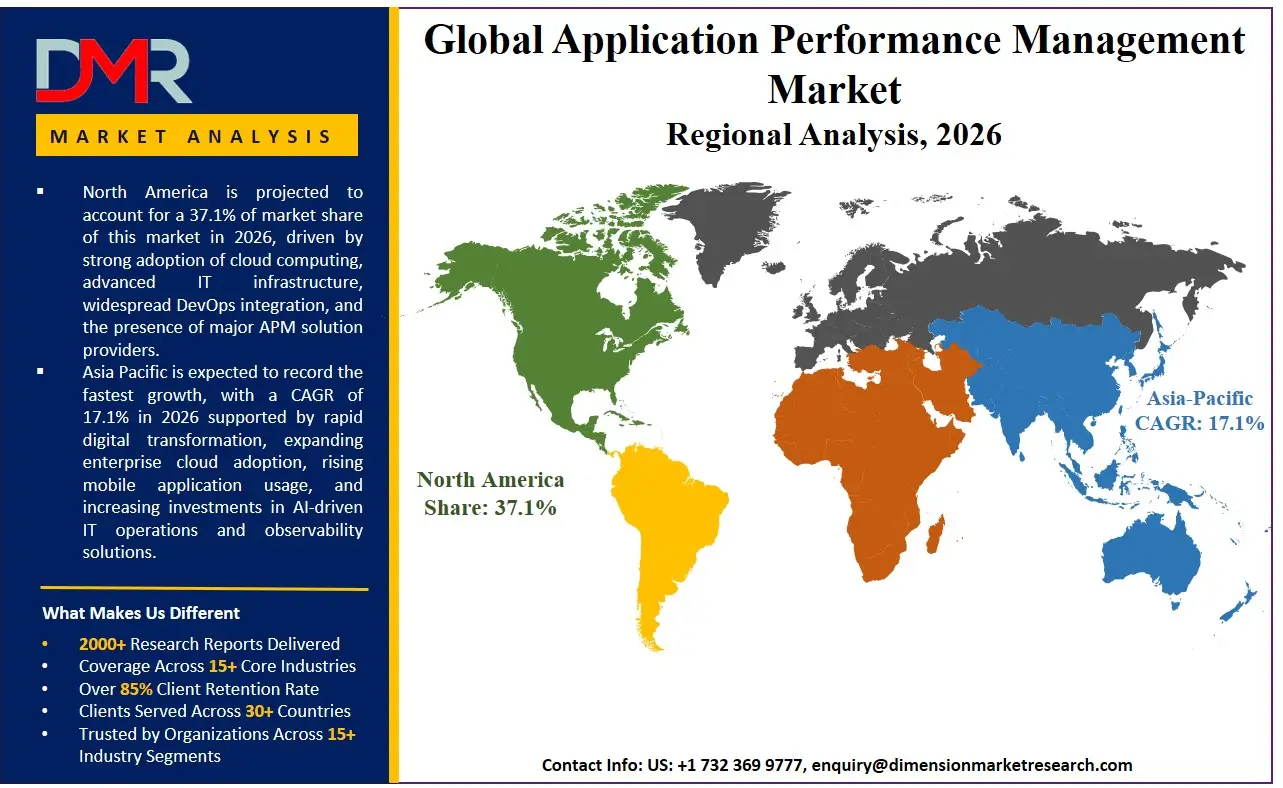
North America is poised to dominate the global application performance management market as it is projected to hold 37.1% of the market share by the end of 2026. As far as geographical distribution is concerned, the U.S., which leads North America, boasts the largest market share in the APM industry due to its unique concentration of hyperscale data centers, highly intricate application environments, and very ambitious plans for digital transformation by the Fortune 500 companies. This region features a well-established ecosystem of global systems integrators, APM software providers, and abundant talent in site reliability engineering and performance architecture. The investments made by corporations into artificial intelligence technology, cloud-native microservices architecture, and retiring monolithic legacy systems ensure the ongoing need for AI-powered monitoring and continuous performance tuning. In addition, venture capital activity in this area ensures that the start-ups with promising tech-native technologies have their needs for professional APM services fulfilled for successful expansion.
ℹ
To learn more about this report –
Download Your Free Sample Report Here
Fastest-Growing Regional Market
Asia-Pacific will witness significant growth due to the widespread digital transformation programs implemented in India, China, Japan, and Southeast Asia with the participation of governments. With the rapid economic development, the emergence of middle class people, and the expansion of the digital economy, with super-apps and major e-commerce applications included, it becomes essential for existing corporations and government organizations to discard their legacy applications that have been operating inefficiently without any monitoring. Training and education services are highly sought after in order to enable these corporations to improve their IT operation and DevOps processes to adopt the culture of performance engineering. There is also an acute shortage of performance engineers in this region, making it imperative to rely on outsourcing deployment, integration, and support services.
By Region
North America
Europe
- Germany
- The U.K.
- France
- Italy
- Russia
- Spain
- Benelux
- Nordic
- Rest of Europe
Asia-Pacific
- China
- Japan
- South Korea
- India
- ANZ
- ASEAN
- Rest of Asia-Pacific
Latin America
- Brazil
- Mexico
- Argentina
- Colombia
- Rest of Latin America
Middle East & Africa
- Saudi Arabia
- UAE
- South Africa
- Israel
- Egypt
- Rest of MEA
Competitive Landscape
Indeed, the competitive landscape of the application performance management market has already been marked by high dynamics with heterogeneous players represented by large international software groups, dedicated pure-play observability solution providers, and performance monitoring departments of hyperscalers. Winning the race will largely depend on a profound integration of the strategy of the company with such standards and platforms as OpenTelemetry and cloud native solutions like Kubernetes because they create access channels for ingesting data that is needed to drive adoption. The process of market consolidation proceeds at a fast pace with traditional IT monitoring companies acquiring boutiques specializing in AI-driven observability and digital experience management in order not to go bankrupt. Intellectual property has become increasingly valuable as a competitive advantage in terms of automated AIOps root cause analysis engines and industry-specific dashboards.
Some of the prominent players in the Global Application Performance Management Market are:
- IBM
- Microsoft
- Oracle
- Cisco Systems
- Dynatrace
- Datadog
- New Relic
- Splunk
- Broadcom
- OpenText
- SolarWinds
- AppDynamics
- Elastic
- BMC Software
- ManageEngine
- ScienceLogic
- Riverbed Technology
- Akamai Technologies
- Grafana Labs
- Nastel Technologies
- Other Key Players
Recent Developments
- January 2026: Dynatrace extended its AI-powered observability solution by adding a specialized Generative AI assistant, which assists IT Operations and DevOps in the healthcare and life sciences, and retail & e-commerce industry verticals, in diagnosing performance problems of their custom-built AI models and LLM endpoints.
- November 2025: Cisco enhanced its partnership with Microsoft and rolled out a dedicated practice for End-User Experience Monitoring and Application Discovery & Diagnostics, specifically targeting BFSI customers who were planning to run their core banking systems on Azure and required tight SLA compliance.
- October 2025: Datadog made an acquisition in the form of a European-based company specializing in real-user monitoring, further enhancing its portfolio of Cloud Observability and Synthetic Monitoring services for use in sovereign clouds catering to Government & Public Sector customers.
Report Details
| Report Characteristics |
| Market Size (2026) |
USD 9.9 Bn |
| Forecast Value (2035) |
USD 34.1 Bn |
| CAGR (2026–2035) |
14.7% |
| The US Market Size (2026) |
USD 3.1 Bn |
| Historical Data |
2021 – 2025 |
| Forecast Data |
2027 – 2035 |
| Base Year |
2025 |
| Estimate Year |
2026 |
| Segments Covered |
By Component, By Deployment Mode, By Technology, By Enterprise Size, By Monitoring Type, By Organization Function, and By End-Use Industry |
| Regional Coverage |
North America – The US and Canada; Europe – Germany, The UK, France, Russia, Spain, Italy, Benelux, Nordic, & Rest of Europe; Asia-Pacific – China, Japan, South Korea, India, ANZ, ASEAN, Rest of APAC; Latin America – Brazil, Mexico, Argentina, Colombia, Rest of Latin America; Middle East & Africa – Saudi Arabia, UAE, South Africa, Turkey, Egypt, Israel, & Rest of MEA |
Frequently Asked Questions
How big is the Global Application Performance Management Market?
▾ The Global Application Performance Management market is poised to be valued at USD 9.9 billion in 2026 and is projected to reach USD 34.1 billion by 2035, driven by the universal need for specialized tools and skills to manage complex, distributed application performance and deliver flawless digital experiences.
What is the CAGR of the Global Application Performance Management Market from 2026 to 2035?
▾ The market is expected to grow at a CAGR of 14.7% from 2026 to 2035, reflecting the accelerating complexity of enterprise application environments and the persistent shortage of internal performance engineering and SRE talent.
What factors are driving the growth of the Global Application Performance Management Market?
▾ Key drivers include the global IT skills gap, the imperative to modernize legacy monolithic applications, the management complexity of multi-cloud and Kubernetes deployments, and the surge in demand for AI-Driven Observability amid escalating user expectations for always-on digital services.
Which region held the largest share of the Application Performance Management Market in 2026?
▾ North America, specifically the United States, is projected to hold a 37.1% market share in 2026, driven by a mature digital enterprise ecosystem and aggressive investment in AI-driven observability, real-time monitoring, and cloud-native application performance capabilities.
Which region is expected to grow the fastest in the Application Performance Management Market?
▾ The Asia-Pacific region is expected to grow the fastest, fueled by rapid digital transformation in India, China, and Japan, where Training & Education and Deployment & Integration services are critical for scaling application performance practices in large conglomerates.
What are the major trends in the Global Application Performance Management Market?
▾ Major trends include the integration of Generative AI into observability workflows, the rise of OpenTelemetry and platform engineering, the demand for digital experience management, and the focus on sustainability and GreenOps in application performance.
Who are the key players in the Global Application Performance Management Market?
▾ Key players include specialized observability leaders like Dynatrace, Datadog, and New Relic, as well as the APM divisions of technology conglomerates like Cisco (AppDynamics), IBM (Instana), and Microsoft, alongside open-source-driven companies like Grafana Labs.
How is the Global Application Performance Management Market segmented?
▾ The market is segmented by Component, Deployment Mode, Technology, Enterprise Size, Monitoring Type, Organization Function, and End-Use Industry.