What is the Application Performance Monitoring Market Size?
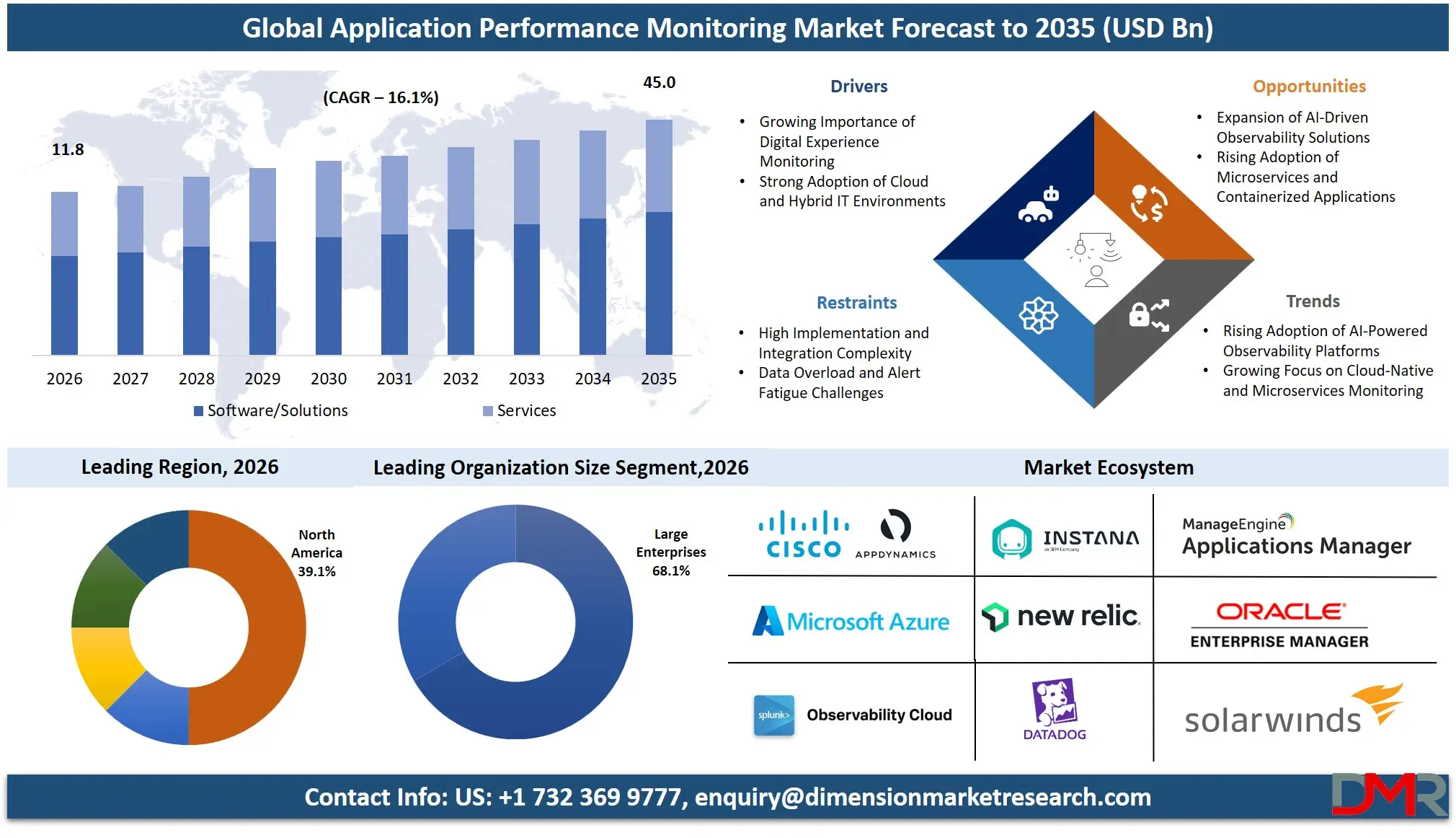
The Global Application Performance Monitoring Market is expected to reach a value of USD 11.8 billion in 2026, and it is further anticipated to reach USD 45.0 billion by 2035, growing at a CAGR of 16.1% during the forecast period.
ℹ
To learn more about this report –
Download Your Free Sample Report Here
The application performance monitoring market has seen exponential growth due to digital transformation by companies and shift towards more modern applications from monolithic legacy applications. The application performance monitoring market includes software products and managed services that provide help to organizations achieve the best application, user, and infrastructure performances in cloud-native, on-premises, or hybrid deployment scenarios.
Complex management of micro services architecture, containerization, and artificial intelligence applications calls for specialized APM technology and knowledge. Large businesses have been adopting APM solutions at an increasing rate, with cloud-based application performance monitoring tools being the favorite choice of the industry as they scale up easily and offer real-time visibility into distributed systems. BFSI, IT & Telecom, and Retail & e-commerce are leading verticals in this regard as they depend heavily on efficient digital delivery to both consumers and internal employees.
ℹ
To learn more about this report –
Download Your Free Sample Report Here
The US Application Performance Monitoring Market
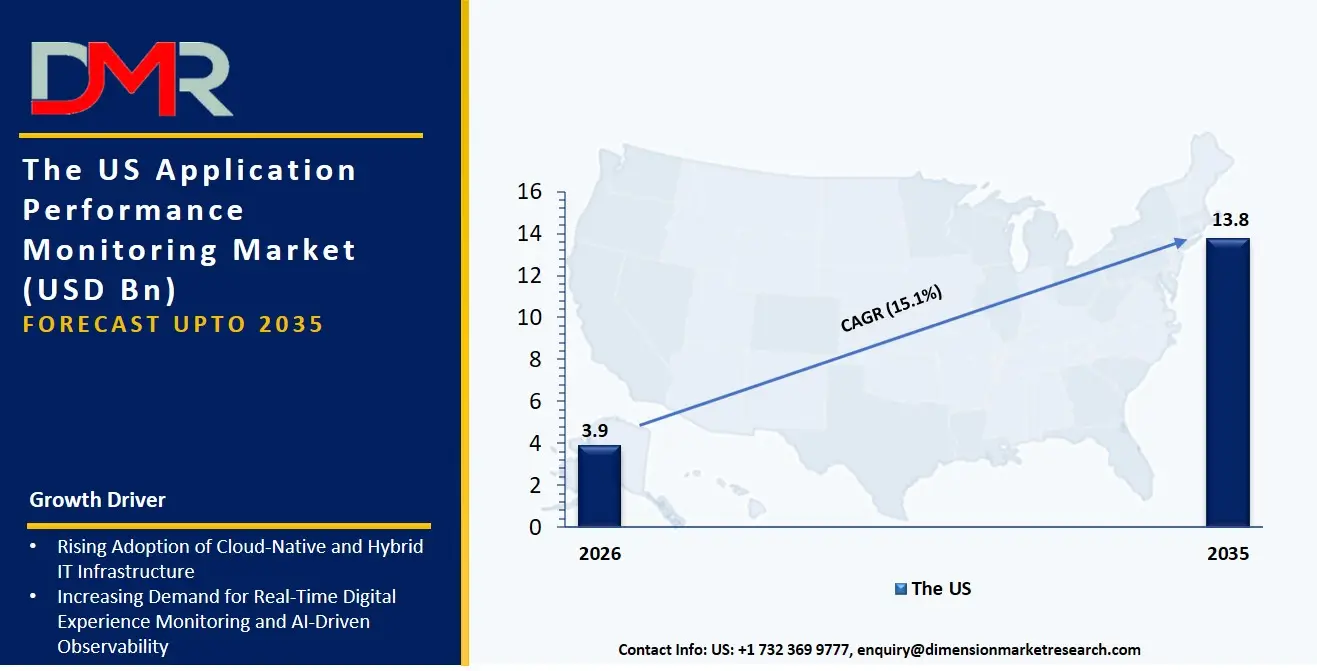
The US Application Performance Monitoring Market is projected to reach USD 3.9 billion in 2026 at a compound annual growth rate of 15.1% over its forecast period, which is further anticipated to be valued at USD 13.8 billion by 2035. It is worth mentioning that US still remains the biggest and the most developed one when it comes to APM market, which can be attributed to such factors as the aggressive implementation of digital service delivery strategies by Fortune 500 companies and cloud-native architecture adoption across the industry. In terms of market dynamics, one might speak about the high need for solutions like Real User Monitoring (RUM) and infrastructure monitoring tools, where companies try to obtain the full visibility related to the user session experience and the whole hybrid cloud environment. Apart from that, the use of Generative AI tools within applications gives rise to another demand for diagnostic solutions.
ℹ
To learn more about this report –
Download Your Free Sample Report Here
The Europe Application Performance Monitoring Market
The Europe Application Performance Monitoring Market is estimated to be valued at USD 3.4 billion in 2026 and is further anticipated to reach USD 12.7 billion by 2035 at a CAGR of 15.7%. The regulatory landscape with respect to GDPR and the upcoming EU AI Act is playing a crucial role in the European market space and thus is creating the requirement for professional consultation and installation services for securing the APM solutions with the strictest data privacy and sovereign monitoring capabilities. The accelerated adoption of hybrid cloud deployment monitoring is another trend that is being witnessed in this region as the manufacturing and automotive sectors in Germany and France try to strike the balance between OT security and cloud-based analytics, resulting in the need for infrastructure monitoring. Another important trend being seen here is the challenge posed by the initiative like GAIA-X for building dedicated log analytics/data residency solutions.
The Japan Application Performance Monitoring Market
The Japan Application Performance Monitoring Market is projected to be valued at USD 793.3 million in 2026 at a CAGR of 14.5%. There are several aspects that set the Japanese market apart: there is a corporate urge to Digital Transformation (DX), caused by labor shortage and old IT infrastructure in Japan. The professional services sector plays an important role in the spend, with huge conglomerates having the need to refactor their monolithic application systems and deploy microservices and container workloads. Moreover, there is a considerable demand for the highly localized APM integration services to link legacy on-prem systems with SaaS apps, thus creating a special niche in APM consulting.
Key Takeaways
- Market Size & Forecast: The Global Application Performance Monitoring market is projected to reach USD 11.8 billion in 2026, expanding dramatically to USD 45.0 billion by 2035, propelled by the convergence of two factors, proliferation of cloud-native application architectures and the requirement for flawless digital user experience.
- Growth Rate & Outlook: Growth for global market is anticipated at CAGR 16.1% owing to a significant shortage of SREs in organizations and growing complexities involved in monitoring the distributed microservices and serverless functions.
- Primary Growth Drivers: Some important drivers in the segment consist of the increasing adoption of migration from monolithic to container and Kubernetes-based architectures, requirement for synthetic monitoring as a method for proactive testing of user journeys, and the necessity of having DevOps tool chains requiring specialized APM products.
- Key Market Trends: Major trends witnessed in this sector are the increased adoption of industry-specific observability platforms (such as healthcare, finance), AI-based tools as part of the Root Cause Analysis and Diagnosis process that automatically remediates issues associated with performance, and full-stack observability driven by users-centric approach.
- By Deployment Mode Analysis: Cloud-Based APM models are expected to dominate enterprise discussions due to the dynamic nature of cloud infrastructure. Professional services are increasingly required to deploy seamless API integration layers that connect on-premise monitoring tools with cloud-based APM platforms for a single source of truth.
- By End-Use Industry Analysis: IT & Telecommunications are the most lucrative verticals due to zero-tolerance for downtime and stringent performance SLAs. Retail & E-Commerce is the fastest-growing sector as transaction-heavy digital platforms require robust real user monitoring to optimize conversion funnels and prevent revenue loss.
- Regional Leadership: North America is poised to dominate this market segment accounting for 39.1% of the total market share in 2026 due to its highly evolved technology ecosystem comprising of Software-as-a-Service vendors and Hyperscale Cloud providers.
What is the Application Performance Monitoring?
APM tools refer to the software that enables organizations to understand and optimize their applications' performance, availability, and user experience. While other kinds of monitoring focus on monitoring infrastructure, APM focuses on understanding why the application behaves the way it does. APM tools use synthetic monitoring to monitor the performance of application by simulating how users interact with the application. APM uses real user monitoring (RUM) to track how actual users use an application. Finally, APM uses infrastructure monitoring for correlating the performance of applications and their underlying infrastructure such as databases, networks, and computing capabilities. With 90% of organizations having application deployed in containers and microservices architecture, there is need for APM tools and professional services in order to achieve full stack observability and performance governance.
Use Cases
- Proactive Digital Experience in BFSI: The banking sector hires professional deployment and integration services to deploy synthetic monitoring for testing complex loan origination paths using digital channels by simulating performance issues before the customers face them.
- Cloud-Native Observability in Retail: E-commerce sites leverage real user monitoring (RUM) and log analysis capabilities to track every session during the holiday rush season and correlate front-end frustrations experienced by users with database latency issues to prevent shopping cart abandonment.
- Compliance-Driven Monitoring in Government: Government bodies make use of APM consulting services to deploy APM solutions on-premise for citizen-facing portals and ensure that application performance monitoring data and user logs never leave their sovereign boundaries while maintaining high availability.
- Hybrid Integration in Manufacturing: Manufacturing firms globally hire APM integration services to connect factory floor IoT apps to the cloud-based analytical capabilities. Infrastructure monitoring capabilities are used to ensure high reliability of predictive maintenance systems operating at the edge.
How AI is Transforming the Application Performance Monitoring Market
AI is revolutionizing the APM space by drastically speeding up incident resolution times and moving IT organizations into a proactive approach. For instance, when it comes to root cause analysis & diagnostics, the adoption of AI enables automatic correlation and analysis of millions of traces, logs, and metrics to automatically detect the exact line of code or infrastructure service that leads to an outage, thereby significantly lowering MTTR (mean time to resolution). With regards to RUM (real user monitoring), AI technologies can baseline regular user activity and detect any slight degradation such as the increase in checkout flows' time by milliseconds, long before customer escalations begin.
Both digital experience and governance initiatives revolve around AI as well. With regards to professional services, AI-based analytic capabilities help to analyze performance data in order to detect security configurations issues within application flow paths. On top of this, with the emergence of AI-based assistants, natural language queries can be made on APM tools to automatically get recommendations on how to optimize infrastructure and code to enhance performance levels.
Market Dynamics
Key Drivers in the Global Application Performance Monitoring Market
Growing Importance of Digital Experience Monitoring
Rising adoption of digital applications in different industries will play a key role in driving growth within the APM market. Organizations are increasingly emphasizing on providing users with smooth experiences in order to ensure customer satisfaction, minimize downtime, and boost efficiency in operations. Through the deployment of APM systems, companies are able to monitor their application performance and detect any challenges so that they can be fixed promptly, particularly in industries such as banking, retailing, healthcare, and telecoms. The rising trend towards using mobile applications, cloud computing, and e-commerce also contributes to boosting demand for such monitoring solutions.
Strong Adoption of Cloud and Hybrid IT Environments
The transition worldwide to cloud computing and the integration of a hybrid environment for companies is one of the strong factors driving the adoption of the APM market. In today's business world, more organizations utilize applications through the use of public cloud, private cloud, as well as on-premises applications, hence the need for solutions that can monitor such complex systems. By offering an extensive view of microservices, containerization, APIs, and virtual networking, the APM solution ensures application performance even in complex infrastructures. Continuous deployment and development methodologies used by firms are another strong factor driving APM.
Restraints in the Global Application Performance Monitoring Market
High Implementation and Integration Complexity
One of the most prominent limitations of the application performance monitoring market is the inherent complexity involved in implementing and integrating an APM platform into their system. Most large businesses have a mix of legacy technology infrastructure and modern cloud-based applications hence, there is always a difficulty with monitoring. Integrating several monitoring platforms through database, network, server, and application could be quite complicated and costly. Additionally, the configuration of the APM platform based on specific workflow and performance metrics will make deployment more challenging. Some smaller businesses that have low IT budgets could find it hard to integrate sophisticated APM platforms owing to the associated cost implications.
Data Overload and Alert Fatigue Challenges
The high volume of performance data and alert signals produced by APM tools can pose problems for IT staffs if such data is not efficiently used. Businesses often experience challenges in identifying whether certain performance-related problems are significant enough for their consideration or whether they should be considered just regular notification messages, resulting in alert fatigue and response delays. Distributed and integrated nature of modern application architecture means that the complexity of data acquired by monitoring systems becomes more and more complicated and demands sophisticated data analytics and experienced specialists for analyzing the collected information. Organizations not having qualified IT experts may lack the capacity to gain meaningful insights.
Growth Opportunities in the Global Application Performance Monitoring Market
Expansion of AI-Driven Observability Solutions
The adoption of artificial intelligence and machine learning technologies by observability systems opens up an incredible prospect of market growth for APM vendors. Artificial intelligence technology can assist in automated detection of abnormal operations and even predict possible future problems in order to advise on preventive measures that must be taken to prevent performance issues before customers face any inconveniences. This will help companies achieve increased efficiency and reduce downtime associated with their operations within the complex information infrastructure. The growing use of automated processes and intelligent analytics among businesses will definitely lead to the increasing popularity of AI-based APM solutions.
Rising Adoption of Microservices and Containerized Applications
The increasing use of microservices and container management technology like Kubernetes and Docker is generating huge opportunities for APM vendors. Today's application architecture comprises components that need to be constantly monitored for proper and effective communications between the components. The conventional application monitoring software is not effective in handling such a scenario. As more companies opt for digital transformation, there will be more adoption of cloud-native application development which creates the demand for real-time monitoring software and container monitoring software. Edge computing, IoT and API ecosystems provide further challenges in application monitoring which generate additional business for APM providers.
Trends in the Global Application Performance Monitoring Market
Rising Adoption of AI-Powered Observability Platforms
The growing use of artificial intelligence and machine learning is another key trend that we see in the global Application Performance Monitoring market due to the need of pro-active and automated application monitoring. With AI-based observability platforms, it is possible to process huge amounts of performance data, detect anomalies, forecast potential outages, and conduct root cause analysis with little to no human interference. This is useful for increasing the uptime of applications, decreasing expenses on operation of applications, and speeding up the issue resolution process. Intelligent monitoring software becomes especially desirable among companies working in cloud-native and hybrid ecosystems.
Growing Focus on Cloud-Native and Microservices Monitoring
One of the trends that will significantly influence the application performance monitoring market is the increasing shift toward cloud-native applications, microservice architecture, and containerization. Companies are updating their IT environment through the use of various modern tools including Kubernetes, Docker, and serverless technology. Such an evolving ecosystem requires advanced APM solutions with the ability to monitor distributed workloads, API calls, and dynamic service dependencies. Traditional APM tools can prove insufficient when dealing with such an IT environment, and companies seek innovative approaches to solving related problems. Another major trend that will affect the market is increased application of DevOps practices and CI/CD process.
Research Scope and Analysis
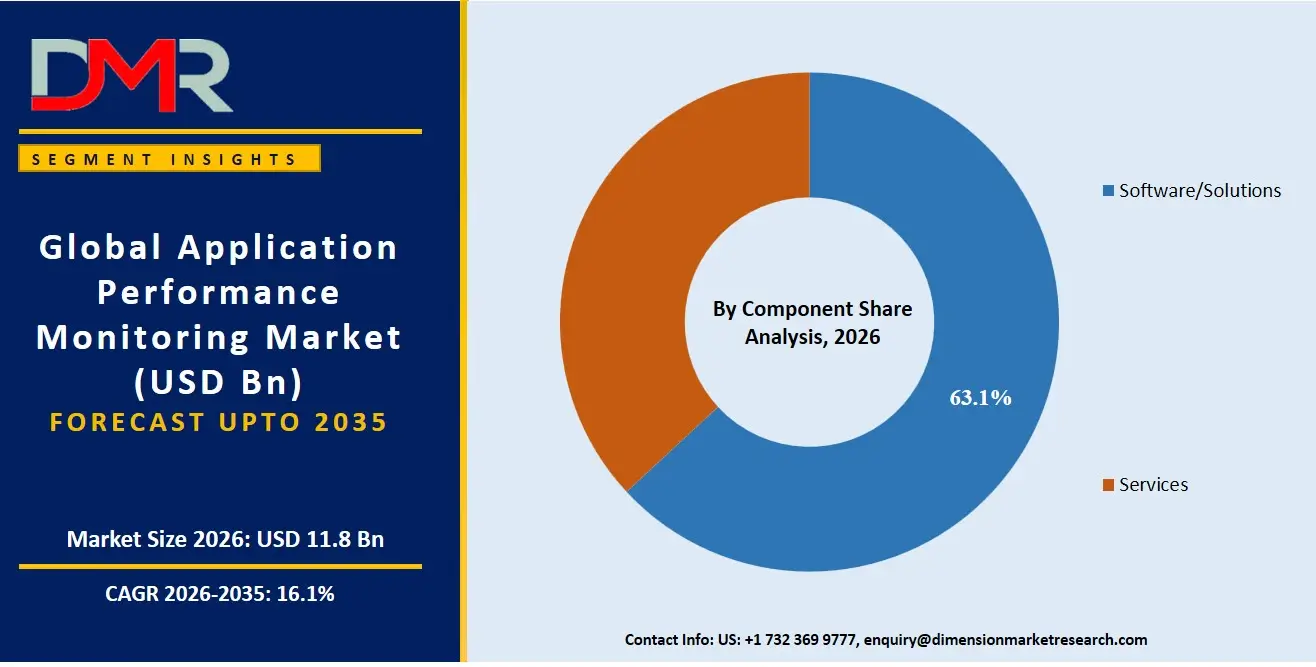
The Global Application Performance Monitoring Market is segmented by component, deployment mode, organization size, access type, monitoring type, and end-use industry. The market includes software solutions and services, cloud and on-premise deployment, SMEs and large enterprises, web and mobile monitoring, various monitoring technologies, and industries including BFSI, IT, healthcare, retail, and manufacturing.
ℹ
To learn more about this report –
Download Your Free Sample Report Here
By Component Analysis
Software/Solutions segment is projected to occupy the largest share in global application performance monitoring market owing to rising demand for visibility into the health status of applications, their performance, and infrastructure efficiency. Companies prefer using sophisticated monitoring software to operate with cloud-native applications, distributed computing platforms, and hybrid IT infrastructures. Products such as real user monitoring (RUM), infrastructure monitoring, log management, and root cause analysis represent highly popular solutions aimed at reducing service downtime and optimizing the performance of application programs. The growing demand for digitization, DevOps operations, and artificial intelligence-based monitoring tools also helps to reinforce the leadership position of Software/Solutions segment in the global market of Application Performance Monitoring.
By Deployment Mode Analysis
Cloud-Based deployment is poised to leading the APM software market due to the rise in the worldwide acceptance of cloud computing and SaaS solutions. This is because companies are favoring cloud-based APM solutions as they provide scalable, flexible, affordable and remotely accessible monitoring solutions. The rise in demand for real-time analytics, observability and end-to-end visibility in hybrid work arrangements, digital transformation strategies and cloud-native applications has led to an increase in demand for cloud-based APM solutions. Moreover, cloud-based deployments make the integration of DevOps pipeline, microservices and containers easier. Cloud APM solutions also allow continuous improvements and AI-driven monitoring capabilities.
By Organization Size Analysis
Large Enterprises is expected to dominate the global application performance monitoring market due to their extensive IT infrastructure, high application workloads, and increasing reliance on digital platforms for business operations. These organizations manage complex ecosystems involving cloud services, enterprise applications, databases, and distributed networks, requiring advanced monitoring solutions to maintain performance and reliability. Large enterprises also possess the financial resources and technical expertise necessary to deploy comprehensive APM platforms with AI-driven analytics and automation capabilities. Industries such as banking, telecommunications, retail, and healthcare heavily invest in application monitoring to ensure uninterrupted services, enhance cybersecurity, and improve customer experience, thereby contributing significantly to the dominance of this segment.
By Access Type Analysis
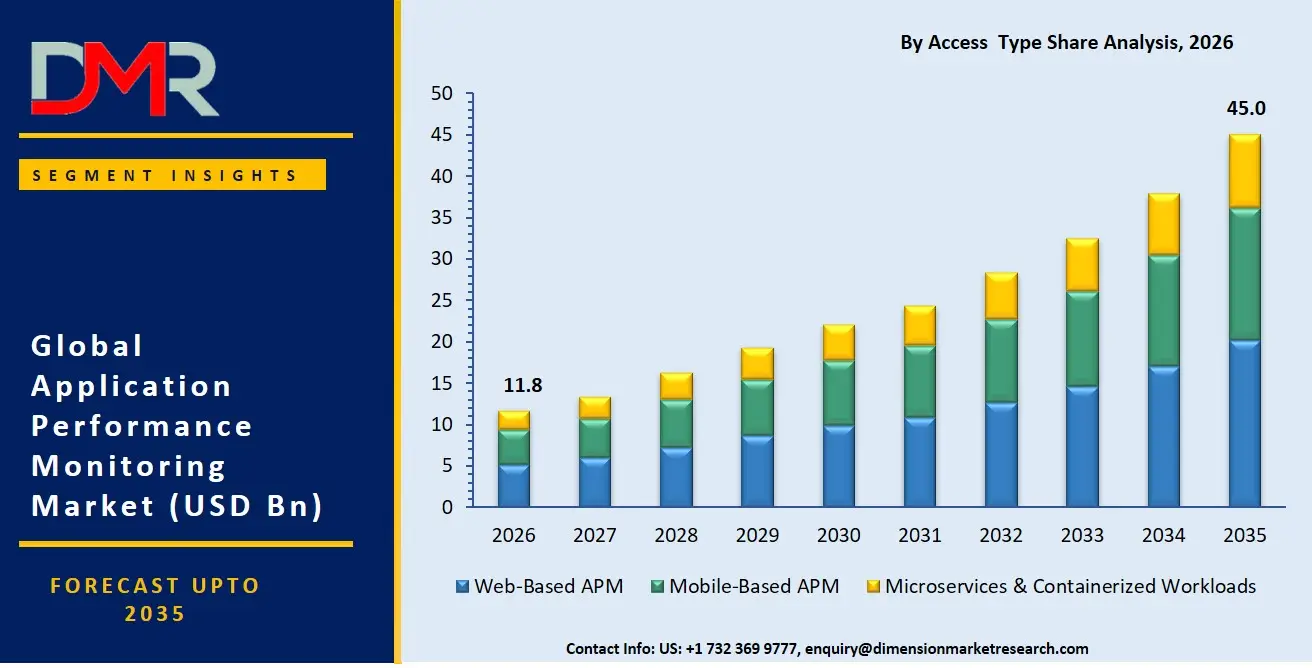
The Web-Based APM is anticipated to lead the market owing to the extensive usage of web applications for conducting business transactions, managing finances, conducting business collaborations, and engaging customers digitally. Companies focus on optimizing web application performance to ensure user satisfaction and lower bounce rates to provide a good experience to the users. The adoption of cloud-based platforms, Software as a Service (SaaS), and other browser-based applications by companies to conduct business will boost the adoption of web-based APM solutions in the future. Companies require web APM tools to monitor response times, performance issues, and user interactions in real-time.
By Monitoring Type Analysis
Real user monitoring is anticipated to lead the application performance monitoring market since it offers insights directly from the real users regarding their experiences with the website, mobile apps, and other digital interfaces. As more firms start focusing on optimizing customer experiences, Real User Monitoring becomes an important tool for finding out issues related to performance that affect real users at the moment of interaction. Using RUM, companies can evaluate factors such as page load time, transaction errors, and latency, among others. Increased focus on customer digital interactions, e-commerce activities, and mobile payment transactions drives RUM further up the demand curve.
By End-Use Industry Analysis
The IT & Telecommunications industry is poised to be the major contributor to the global application performance management market because the IT industry requires high-performing technology infrastructure, along with seamless networking operations. Providers of telecom services and IT services need to monitor the large amount of applications, cloud services, and data flows. With the increase in popularity of the 5G networks, cloud computing, data centers, and edge computing, there is a growing demand for monitoring applications that perform well. Another reason for the high contribution of the IT & Telecommunications industry to the Application Performance Management market is that the providers of IT services use DevOps approach, automation techniques, and microservices architecture.
The Global Application Performance Monitoring Market Report is segmented on the basis of the following:
By Component
- Software/Solutions
- Synthetic Monitoring
- Real User Monitoring (RUM)
- Infrastructure Monitoring
- Log Analytics
- Root Cause Analysis & Diagnostics
- Services
- Professional Services
- Consulting
- Integration
- Deployment
- Managed Services
By Deployment Mode
- Cloud-Based
- On-Premise
- Hybrid Cloud
By Organization Size
- Large Enterprises
- Small & Medium Enterprises (SMEs)
By Access Type
- Web-Based APM
- Mobile-Based APM
- Microservices & Containerized Workloads
By Monitoring Type
- Real User Monitoring (RUM)
- Synthetic Monitoring
- End-User Monitoring
- Infrastructure Monitoring
- Database Monitoring
- Network Performance Monitoring
- Server-Side Monitoring
- Analytics & Diagnostics
By End-Use Industry
- BFSI
- IT & Telecommunications
- Retail & E-Commerce
- Healthcare
- Manufacturing
- Government
- Media & Entertainment
- Education & Academics
- Energy & Utilities
- Transportation & Logistics
- Others
Regional Analysis
Leading Region by Market Share
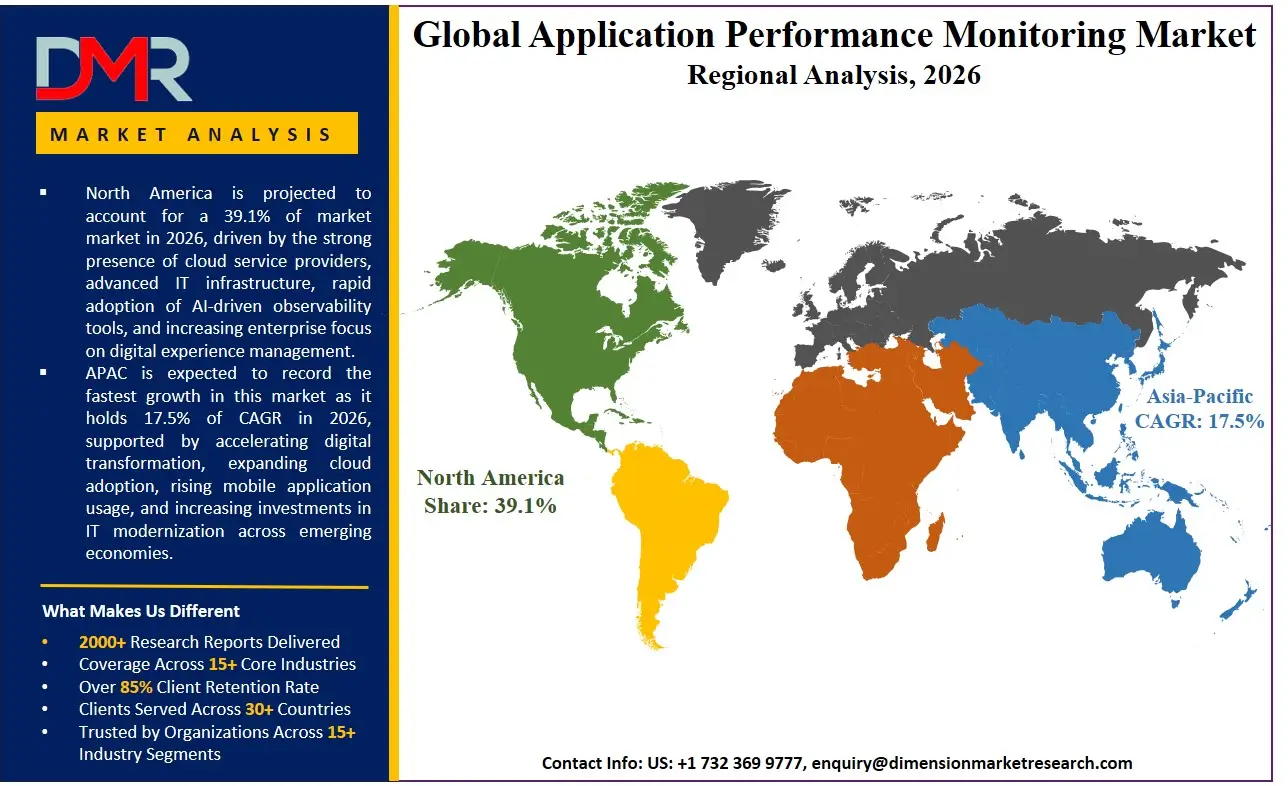
North America is poised to dominate the global application performance monitoring market as it is projected to hold a 39.1% of the market share by the end of 2026. The United States, which leads North America, has the highest APM market share due to its unparalleled aggregation of SaaS innovators, hyperscale cloud providers, and most innovative digital business models from Fortune 500 organizations. There is already a well-established ecosystem of global systems integration companies, observability specialist consultancies, and abundance of talent from SREs and performance engineering experts in the region. Large-scale investments by enterprises into cloud-native transformation, microservices-based applications, and artificial intelligence solutions running in real-time are driving sustained interest in synthetic monitoring tools, distributed tracing, and managed APM services. In addition, the intensely competitive nature of digital services in an environment where milliseconds translate to millions drives the continuous requirement for professional services to optimize application performance and reliability.
ℹ
To learn more about this report –
Download Your Free Sample Report Here
Fastest-Growing Regional Market
The Asia Pacific is projected to have the highest growth rate in the APM market due to the emergence of a huge wave of mobile-first digital economies as well as smart city and DX programs by various governments in India, China, Japan, and Southeast Asia. The rise in adoption of e-commerce, super apps, and digital payment solutions is forcing large corporations and agile start-ups to adopt performance engineering methodologies. There is an immense need for business transformation consultancy in the APM space for enabling these enterprises to transform their approach from break/fix-based IT operations to observability focused on the experience of their customers. There is also a dire shortage of SRE & observability talent in the region, thus there is a need to outsource managed APM services in order to cater to these gaps.
By Region
North America
Europe
- Germany
- The U.K.
- France
- Italy
- Russia
- Spain
- Benelux
- Nordic
- Rest of Europe
Asia-Pacific
- China
- Japan
- South Korea
- India
- ANZ
- ASEAN
- Rest of Asia-Pacific
Latin America
- Brazil
- Mexico
- Argentina
- Colombia
- Rest of Latin America
Middle East & Africa
- Saudi Arabia
- UAE
- South Africa
- Israel
- Egypt
- Rest of MEA
Competitive Landscape
The dynamics of the global application performance monitoring market have become very competitive due to the heterogeneous mix of legacy vendors with specialization in pure-play APM services, the observability wings of cloud hyperscalers, and open-source-oriented consultancy firms. What matters most is providing an integrated perspective covering real user monitoring, metrics, traces, and logs instead of isolated solutions with a focus on observability stacks. Strategic partnership agreements with cloud-native platforms such as Kubernetes and service meshes can play a key role in effective co-marketing campaigns and the flawless deployment of agent software packages. Market consolidation is on the rise because traditional providers of IT operations management solutions are busy purchasing startups with specialized skills in AIOps and log analytics. Intellectual property, based on proprietary approaches to eliminating noise from the analysis process and calculating digital experience scores for various industries, matters more than raw data acquisition.
Some of the prominent players in the Global Application Performance Monitoring Market are:
- Dynatrace
- Datadog
- New Relic
- Cisco AppDynamics
- IBM Instana
- Splunk Observability Cloud
- Microsoft Azure Monitor
- Oracle Enterprise Manager
- SolarWinds
- ManageEngine Applications Manager
- LogicMonitor
- Broadcom DX APM
- BMC Software
- Elastic Observability
- Riverbed Technology
- OpenText Micro Focus
- Sumo Logic
- SmartBear
- Grafana Labs
- Akamai Technologies
- Other Key Players
Recent Developments
- December 2025: Dynatrace announced that it will have an expansion of its AI Observability services, a professional service offering that will enable Dynatrace to help clients in the Healthcare & Life Sciences and Manufacturing industries in measuring the performance and cost of their custom AI models deployed using hyperscalers' infrastructures.
- November 2025: Cisco (AppDynamics) increased its relationship with SAP by developing a new practice known as Business Performance Consulting and API Integration that will help Retail and BFSI companies to monitor end-to-end performance of SAP S/4HANA applications starting with the mobile user click to database response.
- October 2025: Datadog acquired a log analytics Security Company based in Europe to aid in developing APM and IT Operations consulting and deployment offerings for sovereign clouds to help government/public sector organizations in meeting their demanding needs for data residency and performance monitoring across the EU.
Report Details
| Report Characteristics |
| Market Size (2026) |
USD 11.8 Bn |
| Forecast Value (2035) |
USD 45.0 Bn |
| CAGR (2026–2035) |
16.1% |
| The US Market Size (2026) |
USD 3.9 Bn |
| Historical Data |
2021 – 2025 |
| Forecast Data |
2027 – 2035 |
| Base Year |
2025 |
| Estimate Year |
2026 |
| Segments Covered |
By Component, By Deployment Mode, By Organization Size, By Access Type, By Monitoring Type, and By End-Use Industry |
| Regional Coverage |
North America – The US and Canada; Europe – Germany, The UK, France, Russia, Spain, Italy, Benelux, Nordic, & Rest of Europe; Asia-Pacific – China, Japan, South Korea, India, ANZ, ASEAN, Rest of APAC; Latin America – Brazil, Mexico, Argentina, Colombia, Rest of Latin America; Middle East & Africa – Saudi Arabia, UAE, South Africa, Turkey, Egypt, Israel, & Rest of MEA |
Frequently Asked Questions
How big is the Global Application Performance Monitoring Market?
▾ The Global Application Performance Monitoring market is poised to be valued at USD 11.8 billion in 2026 and is projected to reach USD 45.0 billion by 2035, driven by the universal need for full-stack observability, digital user experience optimization, and AI-driven application performance management.
What is the CAGR of the Global Application Performance Monitoring Market from 2026 to 2035?
▾ The market is expected to grow at a CAGR of 16.1% from 2026 to 2035, reflecting the accelerating complexity of microservices architectures and the persistent shortage of internal SRE and performance engineering talent.
What factors are driving the growth of the Global Application Performance Monitoring Market?
▾ Key drivers include the global observability skills gap, the imperative to monitor complex, distributed containerized workloads, the need to shift from reactive to proactive AI-driven operations, and the surge in demand for RUM and synthetic monitoring to guarantee flawless digital customer experiences.
Which region held the largest share of the Application Performance Monitoring Market in 2026?
▾ North America, specifically the United States, is poised to hold 39.1% of the market share in 2026, driven by a mature SaaS and hyperscaler ecosystem and aggressive enterprise investment in cloud-native transformation and AI-driven full-stack observability capabilities.
Which region is expected to grow the fastest in the Application Performance Monitoring Market?
▾ The Asia-Pacific region is expected to grow the fastest, fueled by rapid digitalization and super-app proliferation in India, China, and Southeast Asia, where APM professional and managed services are critical for ensuring stellar performance for billions of mobile-first users.
What are the major trends in the Global Application Performance Monitoring Market?
▾ Major trends include the integration of Generative AI into APM tools for natural language querying and auto-remediation, the rise of OpenTelemetry as a unified standard, the shift toward platform engineering with golden signals, and the focus on correlating application performance with business KPIs and sustainability goals.
Who are the key players in the Global Application Performance Monitoring Market?
▾ Key players include pure-play observability leaders like Dynatrace, Datadog, New Relic, and Cisco (AppDynamics), as well as the application monitoring divisions of hyperscalers like Microsoft and IBM, alongside specialized open-source and cloud-native consultancies.
How is the Global Application Performance Monitoring Market segmented?
▾ The market is segmented by Component, Deployment Mode, Organization Size, Access Type, Monitoring Type, and End-Use Industry.