Market Snapshot
- Global market size reaches USD 14.1 Billion in 2025.
- Forecast value climbs to USD 247.89 Billion by 2035.
- Machine Learning leads AI Technology with a 37.8% share.
- Level 3 automation leads autonomy type with a 34.3% share.
- Navigation and Mapping leads applications with a 36.9% share.
- Passenger Vehicles lead end use with a 57.8% share.
- North America leads all regions with a 42.6% share.
Market Overview
The Applied AI in Autonomous Vehicles Market covers machine learning, computer vision, sensor fusion, and decision making software embedded in vehicles capable of partial to full self-driving operation. It excludes standalone driver assistance hardware sold without an AI decision layer and excludes non-vehicle robotics.
Waymo's fleet recorded a tenfold reduction in serious injury crashes against human drivers across roughly 14 to 15 million trips in 2025. As reported by Waymo's 2025 Year in Review, this performance gap is turning insurers and municipal regulators into active buyers rather than skeptics. In May 2024, Wayve raised USD 1.05 Billion in Series C funding led by SoftBank, with Microsoft and NVIDIA joining the round.
Object detection models built for AV perception now clear 99% accuracy on vehicle classification tasks, according to a 2025 IEEE Xplore study. That baseline turns computer vision from a differentiator into a licensing requirement, pushing competition toward decision layer software and fleet operations instead of raw perception accuracy.
Market Size and Forecast
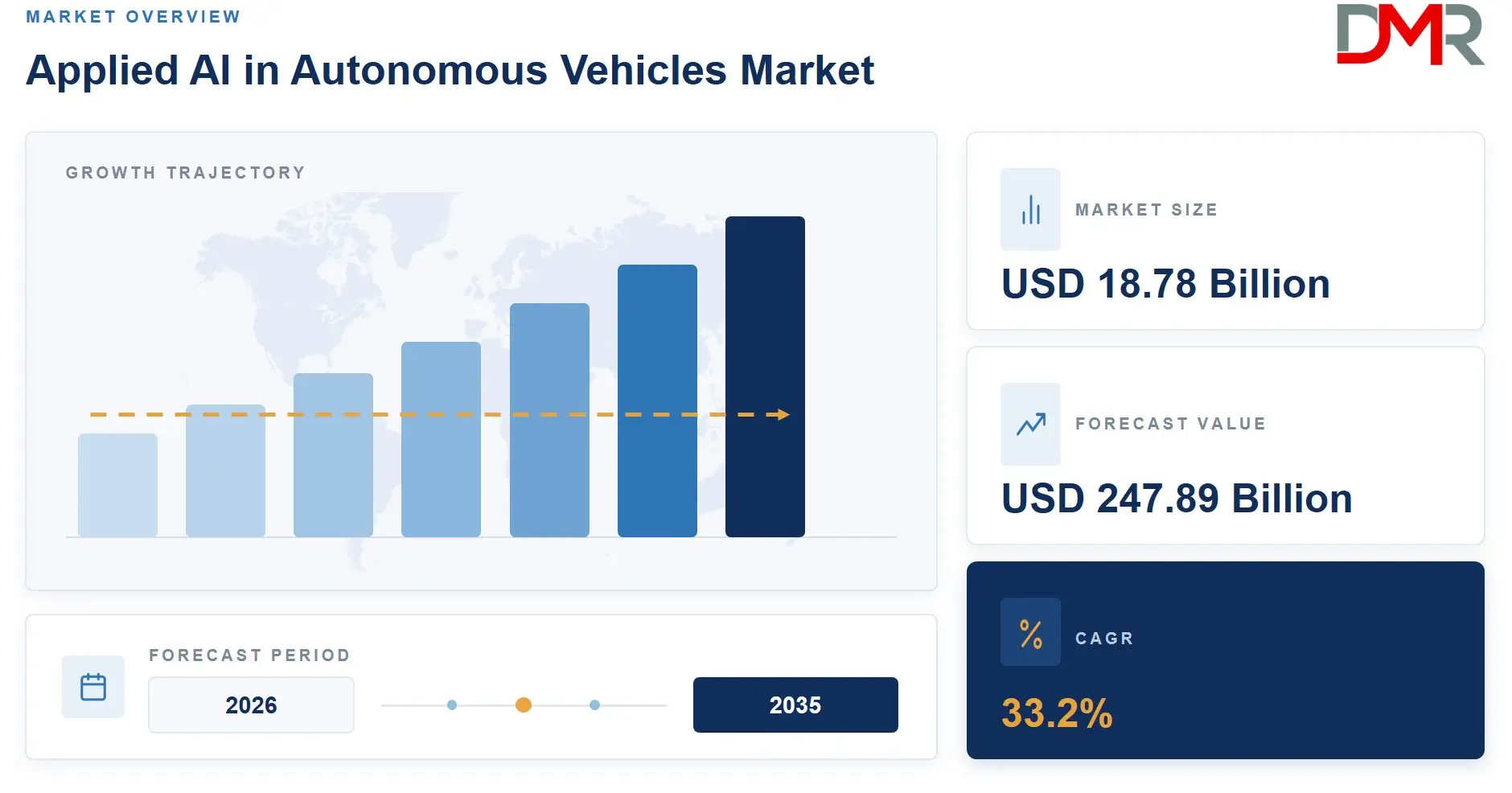
The Global Applied AI in Autonomous Vehicles Market size is estimated at USD 18.78 Billion in 2026 from USD 14.1 Billion in 2025, and is projected to reach USD 247.89 Billion by 2035, exhibiting a CAGR of 33.2% during the forecast period.
Applied Intuition's USD 250 Million Series E round in March 2024 signaled early investor confidence that AI software, not sensors, would capture the largest share of vehicle value. Waymo completed over 14 million fully autonomous trips in 2025 alone, more than tripling its 2024 ride volume. Growth at this pace pulls commercialization timelines forward by several years compared to earlier industry forecasts.
ℹ
To learn more about this report –
Download Your Free Sample Report Here
Freight corridors reinforce the forecast. The Texas to California autonomous corridor cut transit times by 25% against human-driven baselines, based on NACFE's 2025 annual report. Cost savings of this size compound quickly across a fleet, giving logistics operators a faster payback period than passenger robotaxi programs and justifying the steep growth curve built into this forecast.
AI Technology Analysis
Machine Learning led the AI Technology segment with a 37.8% share in 2026.
Machine Learning models retrain continuously on fleet data, giving incumbents like Waymo and Tesla a data advantage that new entrants cannot buy. Camera plus AI vision systems improved accuracy at roughly 420% over comparable benchmark periods, versus 290% for LiDAR, according to a 2025 technical analysis.
Computer Vision, Deep Learning, and Sensor Fusion trail behind but grow fastest where camera costs fall. Quantized inference models running on AV edge hardware now cut latency by 40% and cut energy use by 50%, per 2025 edge computing research. Reinforcement Learning and NLP remain niche today, mainly supporting driver monitoring and voice command systems, but vendors that master low power inference will win the next hardware refresh cycle.
Autonomous Vehicle Type Analysis
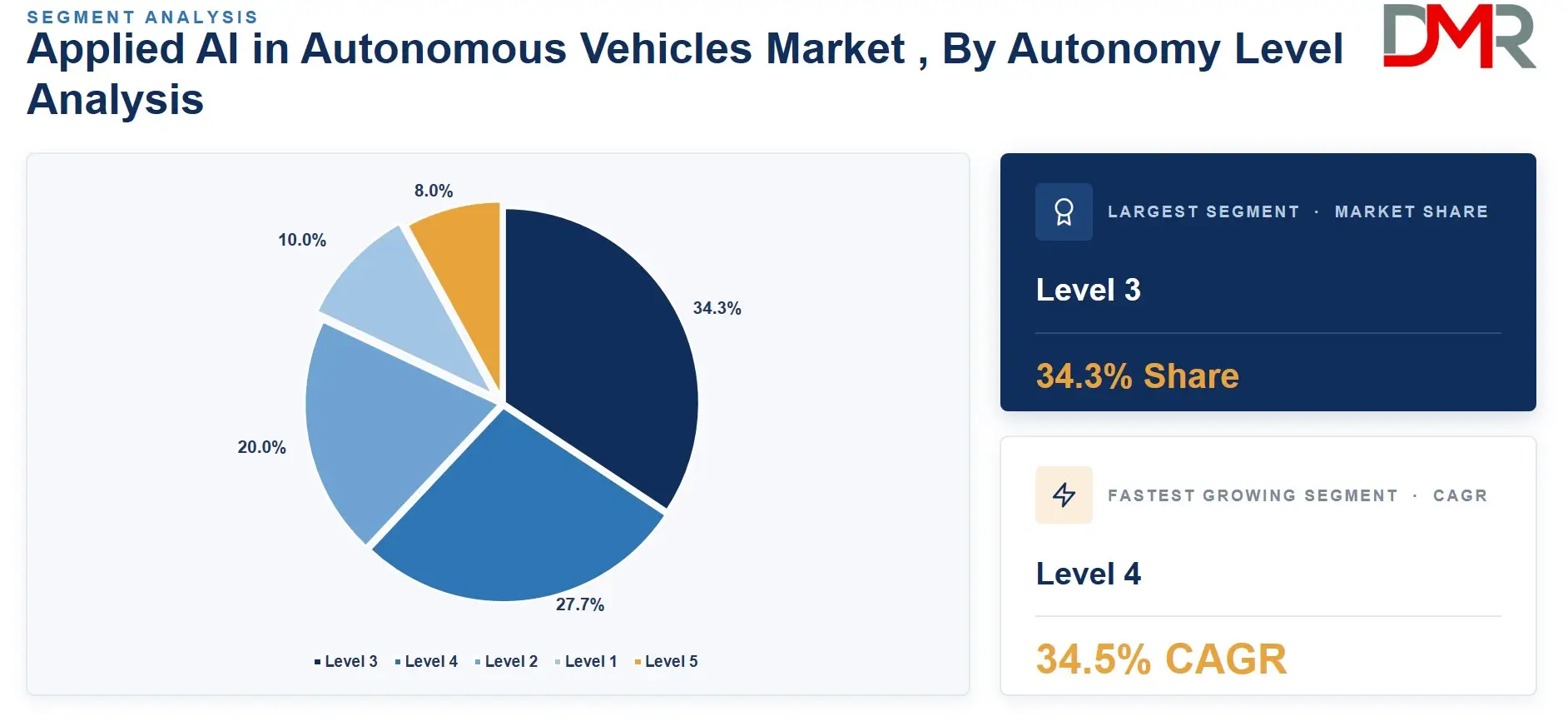
With a 34.3% share in 2026, Level 3 outpaced all other autonomy categories.
ℹ
To learn more about this report –
Download Your Free Sample Report Here
Level 3 systems let drivers disengage under set conditions, a middle ground that regulators approve faster than full autonomy. Independent research found a 91% reduction in airbag deployment events at intersections for AI-driven systems against human benchmarks.
Level 2 remains the volume leader in unit sales, while Level 4 grows fastest in geofenced robotaxi zones. Level 1 and Level 5 sit at opposite ends of the maturity curve. Buyers scaling fleets today are concentrating capital on Level 3 and Level 4 rather than chasing full Level 5 autonomy.
Application Analysis
Navigation and Mapping accounted for 36.9% of application demand in 2026, the highest of any category.
Mapping software anchors every other AI function on board, since path planning and object detection both depend on a live map layer. Kodiak Robotics accumulated over 3 million autonomous trucking miles by September 2025 running on this exact stack.
Object and Pedestrian Detection and Traffic Prediction follow closely, with Driver Monitoring growing fastest as regulators mandate in-cabin attention checks. Path Planning is emerging as the software layer vendors compete over hardest, since it determines ride comfort and route efficiency at scale. Aurora's driverless trucks completed a 1,000 mile freight run in roughly 15 hours, close to double a legally limited human driver's pace.
Component Analysis
Hardware led the Component segment in 2026, ahead of Software and Services, though no discrete share percentage was disclosed.
Compute modules and sensors still absorb most of the bill of materials on every AI-equipped vehicle sold today. Edge computing architectures now process safety commands in 5 to 10 milliseconds, against 30 to 60 milliseconds for cloud-only systems.
Software is the fastest growing component as automakers shift from one-time hardware sales to recurring licensing models. Services trail both but expand wherever fleets need calibration, maintenance, and safety validation support. Vendors that bundle hardware with a software subscription are pulling ahead of pure component suppliers.
End-Use Analysis
Passenger Vehicles captured 57.8% of the End-Use segment in 2026, ahead of all rivals.
Consumer robotaxi and ADAS programs concentrate capital because ride volume scales fastest in dense urban markets. Commercial Vehicles rank second, driven by freight corridors already running driverless pilots at commercial scale.
Freight and Logistics and Special Purpose Vehicles are the categories to watch, since both carry lower regulatory friction than passenger transport. Public Transport remains the smallest category today but offers the clearest procurement path for AI vendors targeting government contracts.
Key Market Segments
By AI Technology
- Machine Learning
- Supervised Learning Models
- Continuous Fleet Retraining Systems
- Computer Vision
- Deep Learning
- Sensor Fusion and Data Analytics
- Natural Language Processing (NLP)
- Reinforcement Learning
By Autonomous Vehicle Type
- Level 3 (Conditional Automation)
- Level 2 (Partial Automation)
- Level 1 (Driver Assistance)
- Level 4 (High Automation)
- Level 5 (Full Automation)
By Application
- Navigation and Mapping
- Vehicle Control and Operation
- Object and Pedestrian Detection
- Traffic Prediction and Traffic Light Recognition
- Driver Monitoring
- Path Planning and Decision Making
By Component
- Hardware
- Software
- Services
By End-Use
- Passenger Vehicles
- Commercial Vehicles
- Special Purpose Vehicles
- Freight and Logistics
- Public Transport
Regional Analysis
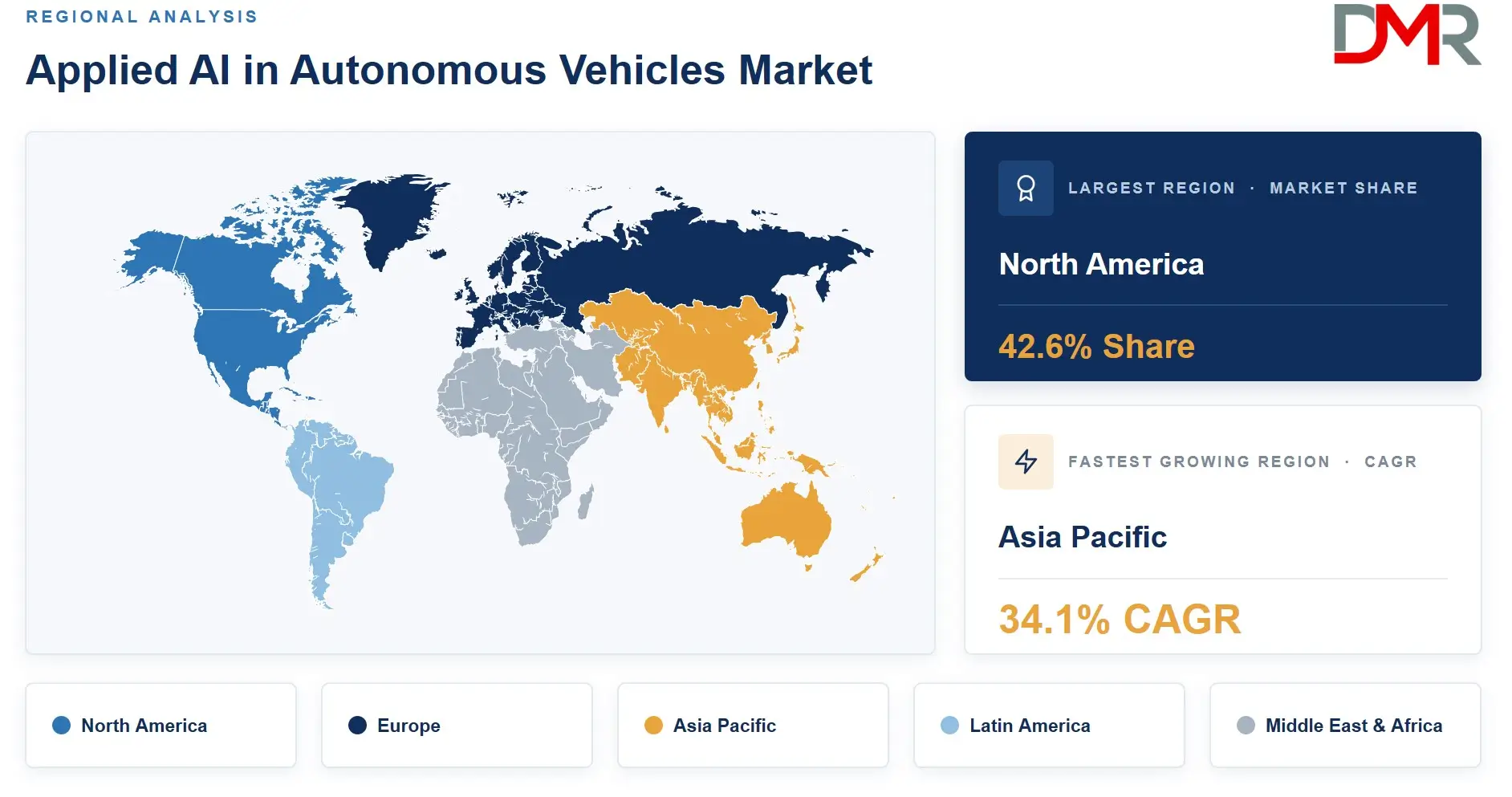
North America led all regions with a 42.6% share in 2026, worth roughly USD 6.01 Billion.
Commercial robotaxi launches across US cities moved the region from pilot testing to paid service faster than any other market. Amazon's autonomous delivery trucks cut delivery times by 20% and cut emissions by 35% against human-driven equivalents, based on NACFE's 2025 recap.
ℹ
To learn more about this report –
Download Your Free Sample Report Here
Asia Pacific is the fastest growing region as China's automakers push private passenger autonomy alongside robotaxi fleets. 5G edge computing trials there now process AI control commands in 13 to 24 milliseconds, well inside the threshold needed for real-time collision avoidance. Europe advances more slowly under stricter compliance rules, while Latin America and the Middle East remain early-stage markets attractive mainly for pilot partnerships.
Key Regions and Countries
North America
Europe
- Germany
- France
- The UK
- Spain
- Italy
- Rest of Europe
Asia Pacific
- China
- Japan
- South Korea
- India
- Australia
- Rest of APAC
Latin America
- Brazil
- Mexico
- Rest of Latin America
Middle East & Africa
- GCC
-
South Africa
- Rest of MEA
Market Dynamics
Compute Costs Fall Below the Mass-Market Threshold
NVIDIA and Qualcomm pushed cost per TOPS below fifty cents, making onboard AI compute viable for mass-market Level 2+ vehicles rather than premium models only. Level 2 and Level 3 systems are projected to capture two-thirds of new vehicle sales, converting driver assistance into the industry's near-term revenue engine.
Independent crash research backs the shift. A 2025 study covering 56.7 million Waymo miles found a 96% reduction in injury-reported intersection crashes against human benchmarks. Separate research recorded a 55% reduction in police-reported crashes across San Francisco and Phoenix combined, giving insurers a data-backed reason to price AI-equipped fleets lower. In June 2025, Applied Intuition raised USD 600 Million in Series F funding at a fifteen billion dollar valuation, confirming investor appetite for the software layer behind these gains.
Liability Law Lags Behind Deployment
The EU AI Act classifies autonomous vehicles as high-risk systems, forcing vendors to prove transparency and human oversight before selling into the bloc. Compliance timelines now determine market entry speed more than the technology itself.
Fifteen US states have not yet legislated autonomy, leaving accident liability unresolved for multi-state fleet operators. NHTSA's final 2024 data recorded 39,254 road fatalities nationwide, a figure regulators cite directly when justifying stricter validation rules. Operators expanding across state lines face a patchwork of standards that slows fleet scaling even where the technology is ready.
Middle Mile Freight Opens a New Front
Passenger robotaxi models dominate headlines, but middle mile freight remains underleveraged relative to its cost savings potential. Waymo's electric fleet avoided over 18 million kilograms of CO2 in 2025, three times its prior year total, giving ESG-focused investors a concrete metric to underwrite.
Fuel efficiency data supports the case further. AI-controlled vehicles consume roughly 8% less fuel and emit 66% fewer pollutants than human-driven equivalents, per a 2025 ASCE Journal study. Synthetic scenario training for rare weather and construction zone failures adds a second underserved opportunity for vendors willing to build narrow, defensible data sets.
Market Trends
Regulators and Software Giants Reset Autonomy Claims
SAE's public reclassification of Tesla's Full Self-Driving as strictly Level 2 reset consumer and regulatory expectations across the industry. Waymo's weekly paid rides grew 125% in eleven months during 2025, climbing from roughly 200,000 to 450,000 per week. Applied Intuition's June 2025 partnership with OpenAI, which brought advanced AI into vehicle dashboard systems, shows how quickly software partnerships are reshaping the cabin experience beyond driving itself.
Market Competition Overview
The market stays fragmented at the software layer but consolidates fast around compute hardware, where a small group of chipmakers supplies most fleets. Capital concentration from automotive OEMs and large technology firms is compressing innovation cycles, forcing smaller sensor fusion specialists to partner rather than compete head-on.
Firms holding the largest share pair proprietary AI models with owned fleet data, a moat that pure hardware sellers cannot replicate quickly. Newer entrants are gaining ground in freight and logistics, where regulatory friction is lower than passenger robotaxi deployment. Expect further consolidation as validated safety data becomes the deciding factor in fleet procurement contracts.
Company Profiles
NVIDIA Corporation supplies the compute hardware and software stack behind most AI-equipped fleets on the road today, positioning it as a near-default infrastructure layer rather than a single competitor among many. In March 2026, NVIDIA extended a collaboration with Applied Intuition to accelerate deployment of AI-powered Level 2+ systems, deepening its reach into mass-market vehicles rather than only premium platforms.
Tesla, Inc. recorded one crash per 6.36 million miles on Autopilot and FSD Supervised in its Q3 2025 Vehicle Safety Report, roughly nine times safer than the US national driving average. Tesla's approach of shipping AI features directly to consumer vehicles gives it unmatched real-world data volume, though its Level 2 classification under SAE's updated guidance limits how the company can market its autonomy claims going forward.
Key Players
- NVIDIA Corporation
- Alphabet Inc.
- Tesla, Inc.
- Intel Corporation
- Microsoft Corporation
- IBM Corporation
- Qualcomm Inc.
- BMW AG
- Micron Technology, Inc.
- Harman International Industries, Inc.
- Volvo Car Corporation
- Audi AG
- General Motors Company
- Ford Motor Company
- Honda Motor Co., Ltd.
- Mobileye
- Baidu, Inc.
- Nuro, Inc.
- Zoox, Inc.
- Pony.ai
- Aeva Inc.
- Aptiv Plc
- Aurora Innovation, Inc.
- AutoX, Inc.
- Comma.ai, Inc.
- DENSO Corporation
- Einride AB
- HERE Global B.V.
- Huawei Technologies Co., Ltd.
- Motional, Inc.
- Velodyne Lidar, Inc.
Regulatory Landscape
The EU AI Act sets the strictest bar globally, classifying autonomous vehicles as high-risk systems subject to transparency and human oversight audits. The UK Autonomous Vehicle Act 2024 and Ireland's Road Traffic Act 2023 replaced ad-hoc test permissions with formal operating law, giving operators a clearer path to commercial launch.
Fifteen US states still lack autonomy legislation, leaving liability frameworks unresolved for cross-border fleet operators. Data privacy and cybersecurity governance are emerging as a deployment gatekeeper in jurisdictions with strict data sovereignty rules, adding a compliance layer beyond safety validation alone.
Investment and White Space Analysis
Capital keeps flowing toward compute hardware and fleet-scale AI software rather than component manufacturing, based on funding rounds raised by Wayve, Waabi, and Applied Intuition since 2024. Middle mile freight remains underserved relative to passenger robotaxi programs, despite carrying lower regulatory friction and faster payback periods.
Asia Pacific offers the clearest high-growth, low-competition entry point outside saturated North American corridors. New entrants with strong synthetic data capabilities for rare weather and construction zone scenarios hold a defensible edge against incumbents still training on limited real-world edge cases.
Recent Developments
- June 2024, Waabi raised USD 200 Million in Series B funding to accelerate commercialization of its AI-powered autonomous trucking platform.
- August 2024, Applied Intuition partnered with Isuzu Motors to develop Level 4 autonomous trucks for commercial deployment.
- March 2025, Applied Intuition partnered with TRATON Group to integrate Vehicle OS and AI software across its commercial vehicle brands.
- March 2026, Applied Intuition announced a collaboration with NVIDIA to accelerate deployment of AI-powered Level 2+ autonomous driving systems.
Report Details
| Report Characteristics |
| Market Value (2025) |
USD 14.1 Billion |
| Market Value (2026) |
USD 18.78 Billion |
| Forecast Revenue (2035) |
USD 247.89 Billion |
| CAGR (2026–2035) |
33.2% |
| Base Year for Estimation |
2025 |
| Historic Period |
2020 – 2024 |
| Forecast Period |
2026 – 2035 |
| Report Coverage |
Revenue Forecast, Market Dynamics, Competitive Landscape, Recent Developments |
| Segments Covered |
By AI Technology (Machine Learning, Computer Vision, Deep Learning, Sensor Fusion and Data Analytics, NLP, Reinforcement Learning), By Autonomy Level (Level 1 to Level 5), By Application (Navigation and Mapping, Vehicle Control, Object and Pedestrian Detection, Traffic Prediction, Driver Monitoring, Path Planning), By Component (Hardware, Software, Services), By End-Use (Passenger Vehicles, Commercial Vehicles, Special Purpose Vehicles, Freight and Logistics, Public Transport) |
| Regional Analysis |
North America – US and Canada; Europe – Germany, France, The UK, Spain, Italy, and Rest of Europe; Asia Pacific – China, Japan, South Korea, India, Australia, and Rest of APAC; Latin America – Brazil, Mexico, and Rest of Latin America; Middle East & Africa – GCC, South Africa, and Rest of MEA |
| Competitive Landscape |
NVIDIA Corporation, Alphabet Inc., Tesla Inc., Intel Corporation, Microsoft Corporation, IBM Corporation, Qualcomm Inc., BMW AG, Micron Technology Inc., Harman International, Volvo Car Corporation, Audi AG, General Motors, Ford Motor Company, Honda Motor Co., Mobileye, Baidu Inc., Nuro Inc., Zoox Inc., Pony.ai, Aeva Inc., Aptiv Plc, Aurora Innovation Inc., AutoX Inc., Comma.ai Inc., DENSO Corporation, Einride AB, HERE Global B.V., Huawei Technologies, Motional Inc., Velodyne Lidar Inc. |
| Customization Scope |
Customization for segments and region or country level will be provided. Additional customization can be done based on requirements. |
| Purchase Options |
Three license options: Single User License, Multi-User License (Up to 5 Users), and Corporate Use License (Unlimited Users and Printable PDF) |
Frequently Asked Questions
What is the biggest investment opportunity in Applied AI Autonomous Vehicles Market ?
▾ Middle mile freight and logistics offer the clearest opening, since driverless corridors already cut operational costs by 30% against human-driven baselines. Investors gain faster payback here than in passenger robotaxi programs.
Who are the top companies in Applied AI Autonomous Vehicles Market ?
▾ NVIDIA Corporation and Tesla, Inc. lead through compute infrastructure and real-world fleet data respectively. Qualcomm, Alphabet, and Aurora Innovation follow closely behind in chip supply and commercial freight operations.
Which segment is growing fastest in Applied AI Autonomous Vehicles Market and why?
▾ Software is growing fastest within the Component segment as automakers shift toward recurring licensing models. Level 4 automation is also expanding quickly wherever geofenced robotaxi zones already operate.
Which region is growing fastest in Applied AI Vehicles Market and why?
▾ Asia Pacific is expanding fastest as China's automakers pursue private passenger autonomy alongside robotaxi fleets. Lower 5G edge latency in the region supports faster real-time collision avoidance processing.
What is the biggest challenge holding Applied AI Autonomous Vehicles Market back?
▾ Unresolved liability law across fifteen US states stalls multi-state fleet rollout even where the technology is ready. Regulatory compliance under frameworks like the EU AI Act adds further delay before commercial launch.