Argentina Dairy Processing Market Snapshot
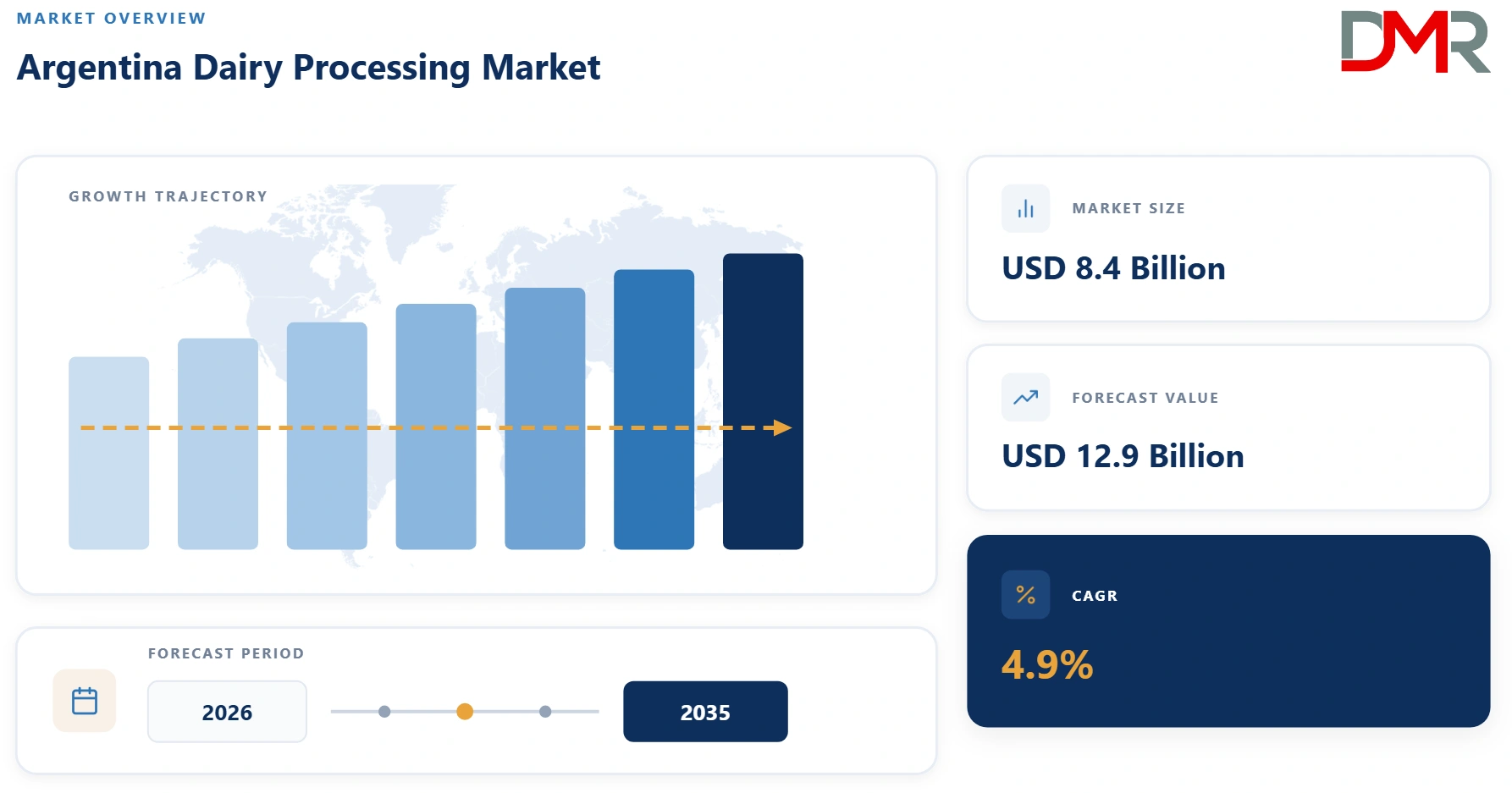
- Market Size in 2026: USD 8.4 Billion
- Market Size in 2035: USD 12.9 Billion
- CAGR, 2026-2035: 4.9%
- Leading Product Type Segment: Milk, 31.5% share
- Leading Processing Type Segment: Pasteurized, 43.0% share
- Leading Packaging Type Segment: Cartons and Tetra Packs, 38.0% share
- Fastest-Growing Segment: Online Retail, 8.2% CAGR
What is the Argentina Dairy Processing and its Market Size?
The Argentina dairy processing market is estimated at USD 8.4 billion in 2026 and is projected to reach approximately USD 12.9 billion by 2035, representing a 4.9% CAGR.
ℹ
To learn more about this report –
Download Your Free Sample Report Here
The Argentina dairy processing market comprises the industrial processing, preservation, packaging, distribution, and commercialization of milk and milk-derived products manufactured from domestically sourced raw milk. It includes fluid milk, cheese, yogurt and other fermented products, butter and cream, milk powders, condensed milk, ice cream and frozen desserts, and related dairy products. The market connects Argentina's large milk-production base with domestic consumers, foodservice operators, retailers, and export markets. Its core value proposition is converting highly perishable raw milk into safer, longer-lasting, higher-value products while improving transportability, product consistency, shelf life, and commercial reach.
Use Cases
- Fluid milk: Everyday household consumption through retail channels, institutional procurement, and foodservice applications.
- Cheese production: Conversion of raw milk into fresh and aged cheeses for domestic consumption and export.
- Fermented dairy: Yogurt and cultured products targeting convenience, nutrition, probiotics, and functional-health preferences.
- Milk ingredients: Powdered and condensed products supplying food manufacturers with stable dairy ingredients.
- Frozen desserts: Ice cream and frozen dairy products serving impulse, household, and foodservice consumption occasions.
- Foodservice applications: Dairy ingredients supporting bakery, confectionery, hospitality, restaurants, cafés, and prepared-food production.
Key Takeaways
- The market is estimated at USD 8.42 billion in 2026, reaching USD 12.96 billion by 2035 at a 4.9% CAGR.
- Milk remains the largest product category, supported by its broad household penetration and established processing infrastructure.
- Pasteurization leads processing technologies because of its suitability for mainstream chilled dairy products and established regulatory requirements.
- Cartons and Tetra Packs represent the largest packaging category because of their convenience, distribution efficiency, and shelf-life advantages.
- Online retail is projected to be the fastest-growing distribution channel at approximately 8.2% CAGR, albeit from a smaller base.
- Product premiumization, functional dairy, processing modernization, exports, and digital retail represent important opportunities for processors.
How AI/Gen AI is Transforming the Argentina Dairy Processing Market?
AI, IoT, industrial automation, sensors, and advanced analytics are increasingly relevant to Argentine dairy processors seeking greater production efficiency and quality control. Connected sensors can monitor temperature, pressure, flow, fat content, microbial indicators, and equipment performance throughout processing. AI-enabled analytics can support predictive maintenance, demand forecasting, inventory optimization, and production scheduling. Automated filling, packaging, cleaning-in-place systems, and robotic material handling further improve consistency while reducing manual intervention.
The principal benefits include lower product losses, improved energy and water efficiency, more consistent quality, reduced unplanned downtime, and better traceability. Technology is also enabling processors to develop differentiated products such as lactose-free, high-protein, probiotic, fortified, and premium dairy offerings.
Key Drivers in the Argentina Dairy Processing Market
Demand for Value-Added and Functional Dairy Products
Consumer demand is gradually shifting from conventional dairy toward products offering additional nutritional, functional, and convenience benefits. Yogurt, probiotic products, high-protein dairy, lactose-free milk, fortified formulations, premium cheeses, and convenient single-serve formats provide processors with opportunities to capture higher margins than basic commodity products. Urbanization and changing lifestyles also favor products requiring less preparation and offering portable consumption. Argentine processors can leverage the country's established dairy supply chain to introduce differentiated formulations while using familiar dairy categories as the foundation. Premiumization is likely to remain uneven because purchasing power varies significantly across households, but innovation in accessible pack sizes and affordable functional products can broaden consumer adoption.
Export Potential and Processing Modernization
Argentina's dairy industry has an important export orientation, particularly in milk powders, cheese, and other processed dairy products. International demand provides processors with an additional revenue channel and encourages investment in quality systems, product standardization, cold-chain infrastructure, and efficient processing. Modernization of plants can increase yields and reduce energy, water, labor, and maintenance costs. Larger processors are particularly positioned to benefit from economies of scale and export certifications. Improvements in logistics and trade access could further increase Argentina's competitiveness in international markets. However, export performance remains sensitive to exchange rates, international commodity prices, freight costs, trade policy, and macroeconomic conditions.
Restraints in the Argentina Dairy Processing Market
Macroeconomic Volatility and Consumer Purchasing Power
Argentina's dairy processors operate in an environment characterized historically by inflation, exchange-rate volatility, changing consumer purchasing power, and periodic economic uncertainty. These conditions complicate long-term pricing decisions and capital-investment planning. Rising costs for packaging materials, energy, transportation, labor, feed-related inputs, and imported equipment can compress processor margins. At the consumer level, economic pressure can shift purchasing toward lower-priced products and smaller package sizes, limiting premiumization. Retailers may also exert greater pressure on suppliers to maintain competitive prices.
Supply-Chain and Raw-Milk Cost Pressures
Dairy processing depends heavily on consistent raw-milk availability, quality, and pricing. Weather conditions, feed costs, farm economics, energy availability, and transportation constraints can influence milk production and procurement costs. Argentina's geographic concentration of dairy activity can create logistical dependencies between producing regions and processing facilities. Maintaining the cold chain is especially important because raw milk and chilled dairy products are highly perishable. Smaller processors may have limited resources to invest in advanced refrigeration, automation, laboratory testing, and wastewater-management infrastructure.
Growth Opportunities in the Argentina Dairy Processing Market
Premium, Functional and Specialized Dairy
Functional and specialized dairy represents a significant opportunity for processors to diversify beyond traditional commodity products. High-protein yogurt, probiotic products, lactose-free milk, fortified dairy, reduced-sugar formulations, premium cheeses, and products positioned around nutrition and wellness can command higher unit values. Manufacturers can also develop products for specific consumer groups and consumption occasions. Packaging innovation, convenient formats, and portion-controlled products can increase penetration among younger urban consumers.
Export Expansion and Processing Efficiency
Expansion into international markets provides Argentine processors with an opportunity to diversify domestic revenue exposure and exploit the country's established dairy-production base. Milk powder, cheese, butter, whey-derived ingredients, and other shelf-stable products are particularly attractive for export because they offer greater logistical flexibility than fresh dairy. Investment in automation, energy-efficient equipment, digital quality management, and modern packaging can simultaneously improve export competitiveness and domestic margins. Processors can also pursue strategic partnerships, contract manufacturing, and regional distribution agreements.
Trends in the Argentina Dairy Processing Market
Premiumization and Health-Oriented Formulations
The Argentine dairy market is gradually broadening from conventional products toward premium, functional, and health-oriented formulations. Lactose-free, high-protein, probiotic, reduced-sugar, fortified, and convenient dairy products are gaining strategic importance. Manufacturers are increasingly using packaging, formulation, and branding to differentiate products in mature categories.
Digitalization and Omnichannel Distribution
Digital commerce is becoming an increasingly important route to consumers, particularly for packaged and shelf-stable dairy products. Processors and retailers are combining physical stores with online ordering, delivery platforms, promotions, and digital loyalty programs. This is encouraging smaller pack formats, improved packaging durability, and more data-driven demand planning.
Research Scope and Analysis
The Argentina dairy processing market is segmented by Product Type, Processing Type, Packaging Type, and Distribution Channel. These dimensions capture differences in product economics, processing requirements, packaging technologies, consumer preferences, retail structures, and routes to market.
ℹ
To learn more about this report –
Download Your Free Sample Report Here
By Product Type Analysis
Milk is estimated to be the dominant product-type segment in 2026, accounting for approximately 31.5% of market revenue, supported by high household penetration, established processing capacity, and its position as a staple food. Cheese represents the second-largest category at around 24.0%, benefiting from Argentina's established cheese-making tradition and broad household and foodservice applications. The fastest-growing product category is yogurt, projected to expand at approximately 6.1% CAGR through 2035, driven by increasing consumer interest in probiotics, protein, digestive health, convenient breakfasts, and portion-controlled formats. Butter and cream remain important ingredients for household and industrial applications, while milk powder and condensed milk benefit from their shelf stability and export potential. Ice cream and frozen desserts are supported by discretionary consumption and product innovation. Growth across categories will increasingly depend on premiumization, formulation innovation, pack-size optimization, and the ability to balance affordability with added nutritional or functional benefits.
By Processing Type Analysis
Pasteurized processing is projected to remain dominant in 2026, representing approximately 43.0% of the market, primarily because conventional chilled milk and several fresh dairy products depend on pasteurization and established refrigerated distribution. UHT/ultra-high-temperature processing is the second-largest category at approximately 32.5%, supported by extended shelf life, reduced refrigeration requirements before opening, and convenience for consumers and retailers. Powdered processing is expected to be the fastest-growing processing category at approximately 5.7% CAGR, supported by export demand, ingredient applications, longer shelf life, and greater logistics flexibility. Fermentation remains strategically important for yogurt and cultured products, where health positioning and product differentiation support innovation. Future technology investments are likely to focus on automated process control, membrane filtration, energy optimization, advanced drying systems, and digital quality monitoring.
By Packaging Type Analysis
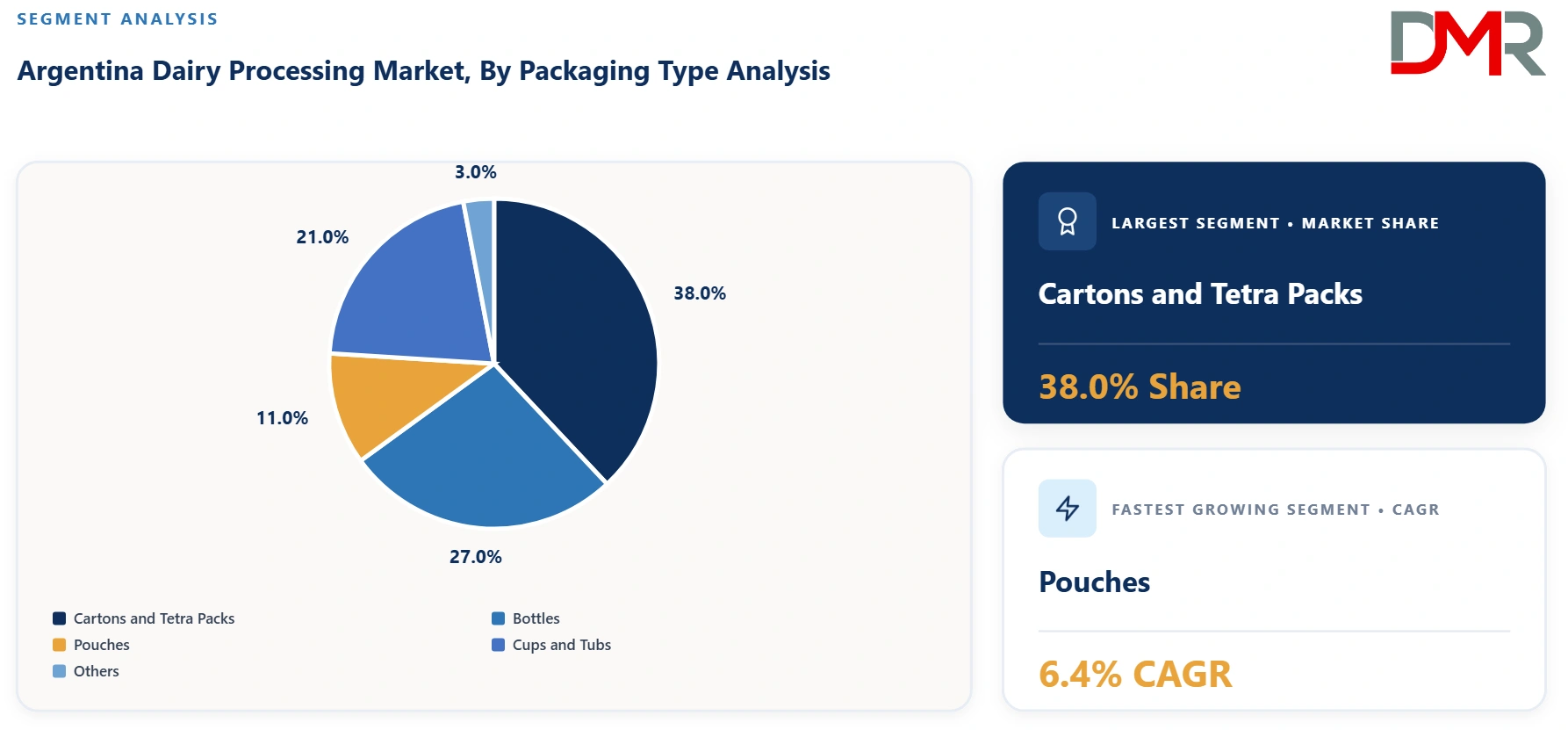
Cartons and Tetra Packs are estimated to hold the leading packaging position in 2026, with approximately 38.0% share, owing to their widespread use for fluid milk, UHT products, convenient handling, and efficient transportation. Bottles account for roughly 27.0%, supported by yogurt drinks, flavored milk, premium dairy beverages, and selected fresh-milk applications. Cups and tubs, representing about 21.0%, are particularly relevant to yogurt, cream, desserts, and ice cream. Pouches are expected to be the fastest-growing packaging format at approximately 6.4% CAGR, driven by lightweight construction, lower material requirements, portability, and potential cost advantages. Packaging suppliers and dairy processors are increasingly emphasizing recyclability, material reduction, product protection, and differentiated shelf presentation. The adoption rate will vary by category because packaging must balance cost, shelf life, mechanical protection, filling-line compatibility, and consumer convenience.
By Distribution Channel Analysis
Supermarkets and hypermarkets remain the leading distribution channel in 2026, estimated at approximately 36.0% share, because they provide extensive product variety, cold-chain infrastructure, promotional visibility, and access to large consumer volumes. Traditional grocery/Baqalas are the second-largest channel at around 25.0%, reflecting their importance in neighborhood shopping and everyday dairy purchases. Foodservice/HoReCa represents approximately 19.0%, supported by restaurants, hotels, cafés, bakeries, and institutional demand. Online retail is the fastest-growing channel, forecast to achieve approximately 8.2% CAGR through 2035 as digital grocery adoption, home delivery, marketplace infrastructure, and omnichannel strategies expand. Convenience stores remain relevant for impulse and immediate-consumption products. Channel strategies are increasingly differentiated by product shelf life, temperature requirements, package size, promotional activity, and consumer purchasing frequency.
The Argentina Dairy Processing Market Report is segmented on the basis of the following:
By Product Type
- Milk
- Cheese
- Yogurt
- Butter and Cream
- Milk Powder and Condensed Milk
- Ice Cream and Frozen Desserts
- Others
By Processing Type
- Pasteurized
- UHT/Ultra-High Temperature
- Fermented
- Powdered
By Packaging Type
- Cartons and Tetra Packs
- Bottles
- Pouches
- Cups and Tubs
- Others
By Distribution Channel
- Supermarkets and Hypermarkets
- Convenience Stores
- Traditional Grocery/Baqalas
- Online Retail
- Foodservice/HoReCa
Regulatory Landscape
Argentina's dairy processors operate under food-safety, labeling, sanitary, quality, environmental, and trade requirements governing milk collection, processing, packaging, storage, transportation, and commercialization. Regulatory compliance is particularly important for export-oriented processors, which must satisfy destination-market requirements in addition to domestic rules. Traceability, microbiological controls, allergen information, nutritional labeling, and packaging compliance remain central operational priorities. Regulatory tightening can increase testing, documentation, and capital requirements, creating challenges for smaller processors while favoring companies with sophisticated quality-management systems. At the same time, stronger standards can improve consumer confidence and export competitiveness. Future regulatory emphasis is likely to include sustainability, waste management, packaging materials, food traceability, and nutritional transparency.
Investment and White Space Analysis
Investment opportunities are concentrated in value-added dairy, processing automation, cold-chain infrastructure, milk-powder capacity, functional products, sustainable packaging, and digital distribution. White spaces exist between low-cost commodity products and expensive premium offerings, creating opportunities for affordable-premium products with measurable nutritional benefits. Smaller and mid-sized processors can also target regional niches rather than competing directly with national brands. Export-oriented investments in shelf-stable products offer an attractive diversification opportunity because they reduce dependence on domestic refrigerated consumption. Capital allocation remains constrained by Argentina's macroeconomic environment, however, making partnerships, phased capacity expansion, local equipment sourcing, and productivity-focused investments particularly relevant strategies.
Competitive Landscape
The Argentina dairy processing market is moderately concentrated, with several large processors and cooperatives competing alongside regional and specialized manufacturers. Major players compete through brand strength, procurement scale, product breadth, distribution reach, processing efficiency, quality assurance, and export capabilities. Large companies benefit from established retail relationships and significant manufacturing infrastructure, while smaller processors increasingly differentiate through specialty cheeses, premium products, regional positioning, and flexible production. Strategic priorities include plant modernization, portfolio diversification, product innovation, private-label manufacturing, digital commerce, and export-market development. Cost control remains critical, particularly given fluctuations in raw-milk prices, packaging costs, energy, logistics, and consumer purchasing power.
Some of the prominent players in the Argentina Dairy Processing Market are:
- Saputo Argentina
- Mastellone Hnos.
- Savencia Fromage & Dairy Argentina
- Williner
- Noal
- Nestlé Argentina
- Verónica
- García Hnos. Agroindustrial
- Adecoagro
- Manfrey
- Lácteos Barraza
- Milkaut
- Lácteos Tregar
- Lácteos La Ramada
- Lácteos Luz Azul
- Lácteos La Serenísima
- SanCor Cooperativas Unidas
- Lácteos Punta del Agua
- Lácteos Cotar
- Lácteos San Ignacio
- Lácteos Capilla del Señor
- Lácteos La Paulina
- Molfino Hermanos
- Lácteos Verónica
- Lácteos La Lácteo
- Lácteos El Puente
- Lácteos Elcor
- Lácteos Tío Pujio
- Lácteos Cosalta
- Lácteos Ramolac
- Lácteos Vacalin
- Lácteos Don Santi
- Lácteos Vidal
- Lácteos Cabaña Santa Brígida
- Lácteos La Suipachense
- Lácteos La Rinconada
- Lácteos SanCor Salud
- Lácteos Capilla
- Lácteos Tonutti
- Lácteos La Varense
- Other Key Players
Recent Developments
- In June 2026, leading dairy brands expanded higher-value product strategies, emphasizing lactose-free, protein-enriched, probiotic, reduced-sugar, and convenient dairy formats to respond to evolving consumer preferences.
- In March 2026, major Argentine dairy processors continued prioritizing production-efficiency programs, with investments focused on automation, refrigeration optimization, packaging productivity, and quality-control capabilities amid persistent cost pressures.
- In February 2026, retailers and dairy suppliers accelerated omnichannel initiatives, integrating physical supermarkets with digital ordering, delivery, promotional personalization, and online product discovery.
- In November 2025, dairy manufacturers increasingly emphasized packaging efficiency and material reduction, targeting lower logistics costs and improved sustainability while maintaining product protection and shelf-life performance.
- In September 2025, processors and dairy cooperatives strengthened export-oriented strategies for milk powder, cheese, and other shelf-stable products as companies sought greater exposure to international markets.
Report Details
| Report Characteristics |
| Market Size (2026) |
USD 8.4 Bn |
| Forecast Value (2035) |
USD 12.9 Bn |
| CAGR (2026–2035) |
4.9% |
| Historical Data |
2021 – 2025 |
| Forecast Data |
2026 – 2035 |
| Base Year |
2025 |
| Segments Covered |
By Product Type, By Processing Type, By Packaging Type, By Distribution Channel |
| Country Coverage |
Argentina |
Frequently Asked Questions
What is the size of the Argentina Dairy Processing Market in 2026?
▾ The Argentina Dairy Processing Market is estimated at approximately USD 8.4 billion in 2026, covering processed dairy products and related commercial processing activities.
What will the Argentina Dairy Processing Market size reach by 2035?
▾ The Argentina Dairy Processing Market is projected to reach approximately USD 12.9 billion by 2035, supported by product innovation, modernization, and export opportunities.
What is the CAGR of the Argentina Dairy Processing Market from 2026 to 2035?
▾ The Argentina Dairy Processing Market is expected to expand at approximately 4.9% CAGR between 2026 and 2035.
Which is the largest segment in the Argentina Dairy Processing Market?
▾ Milk is expected to remain the largest segment in the Argentina Dairy Processing Market, accounting for approximately 31.5% market share in 2026.
What are the key growth drivers of the Argentina Dairy Processing Market?
▾ The Argentina Dairy Processing Market is driven by demand for value-added dairy, functional nutrition, processing modernization, export opportunities, digital retail, and product diversification.
Which segment is growing fastest in the Argentina Dairy Processing Market?
▾ Online Retail is projected to be the fastest-growing segment in the Argentina Dairy Processing Market, recording an estimated 8.2% CAGR during 2026-2035.
What are the major trends in the Argentina Dairy Processing Market?
▾ Major trends shaping the Argentina Dairy Processing Market include functional dairy, premiumization, lactose-free and high-protein products, sustainable packaging, automation, and digital commerce.
How is the Argentina Dairy Processing Market segmented?
▾ The Argentina Dairy Processing Market is segmented by Product Type, Processing Type, Packaging Type, and Distribution Channel, providing a comprehensive view of market opportunities and competitive dynamics.