Argentina Food Packaging Market Snapshot
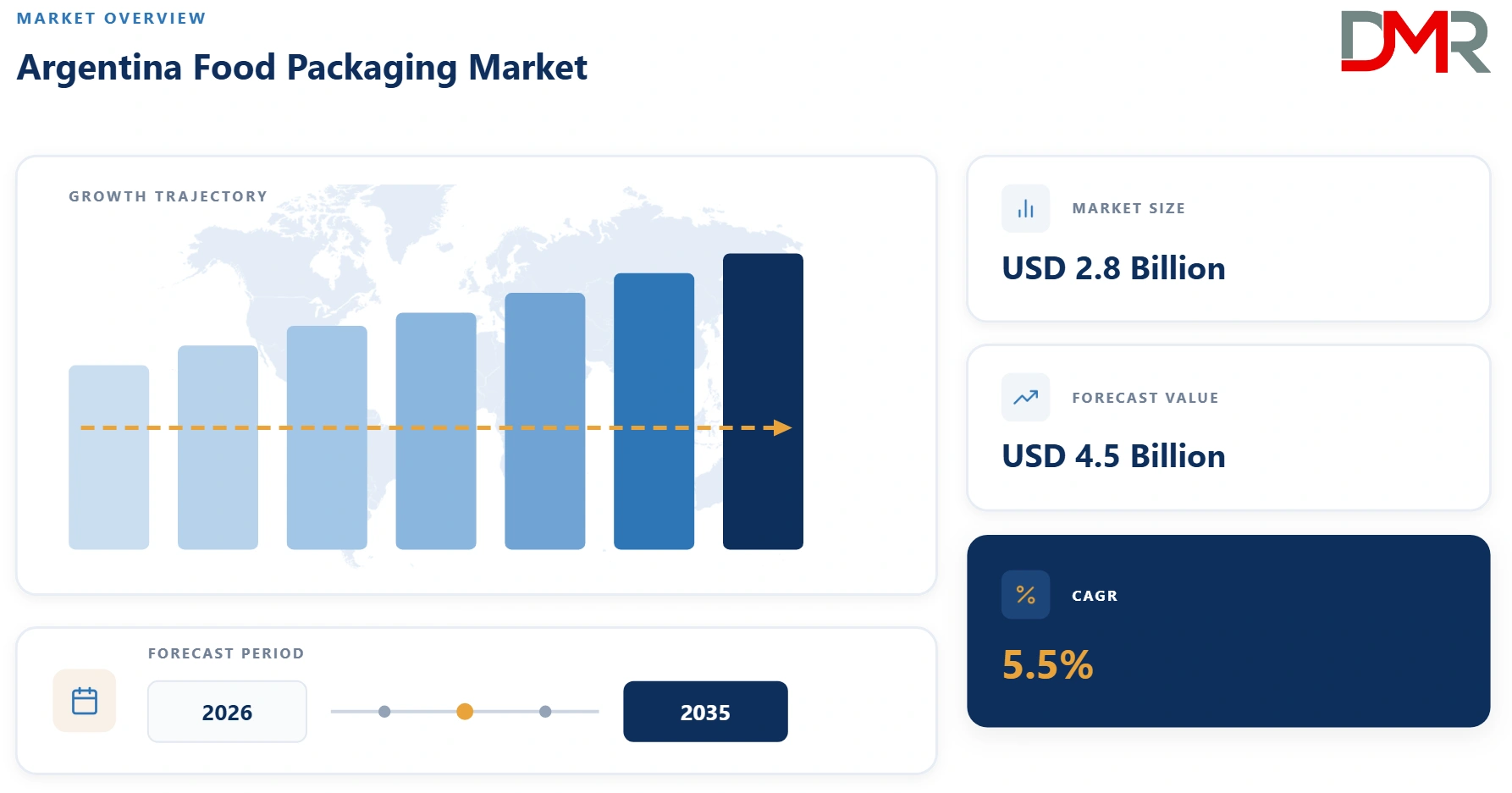
- Market Size, 2026: USD 2.8 billion
- Market Size, 2035: USD 4.5 billion
- CAGR, 2026–2035: 5.5%
- Leading Packaging Type, 2026: Flexible packaging, 44% share
- Leading Application, 2026: Bakery, confectionery, pasta & noodles, 23.5% share
- Fastest-Growing Segment: Convenience foods, 8.1% CAGR
What is the Argentina Food Packaging and its Market Size?
Argentina's food packaging market is estimated at USD 2.8 billion in 2026 and is projected to reach approximately USD 4.5 billion by 2035, representing a 5.5% CAGR.
ℹ
To learn more about this report –
Download Your Free Sample Report Here
The Argentina food packaging market comprises materials, containers, closures, films, trays, cartons, pouches, bags, bottles, cans and related packaging systems used to protect, preserve, transport, display and distribute food products. It encompasses flexible plastic and paper packaging, rigid plastic, paperboard and carton solutions, glass containers, metal packaging and emerging recyclable or bio-based formats. The market serves food manufacturers, processors, retailers, food-service operators and exporters. Its core value proposition is to extend shelf life, maintain food safety and quality, reduce product loss, improve logistics and provide branding and consumer information while controlling packaging costs.
Use Cases
- Bakery and confectionery packaging: Protects baked goods, chocolates, biscuits and pasta against moisture, oxygen, contamination and physical damage.
- Dairy packaging: Provides hygienic, temperature-resistant formats for milk, yoghurt, cheese and other refrigerated or shelf-stable products.
- Meat and seafood packaging: Uses vacuum, modified-atmosphere and high-barrier formats to extend freshness and support export logistics.
- Convenience-food packaging: Enables ready meals, sauces and prepared foods to be transported, stored and reheated efficiently.
- Fresh-produce packaging: Reduces mechanical damage, moisture loss and spoilage during distribution and retail handling.
- Snack packaging: Combines lightweight structures with high barrier protection, resealability and strong shelf presentation.
Key Takeaways
- Market size: The Argentina food packaging market is estimated at USD 2.8 billion in 2026, reaching approximately USD 4.5 billion by 2035.
- Growth: The market is forecast to expand at approximately 5.5% CAGR through 2035.
- Growth drivers: Food exports, convenience food, lightweighting, shelf-life extension, e-commerce and sustainability are the principal demand catalysts.
- Segment dominance: Flexible packaging is expected to remain the leading packaging type, with an estimated 44% value share in 2026.
- Application leadership: Bakery, confectionery, pasta and noodles represent the largest application cluster at approximately 23.5%.
- Fastest growth: Convenience foods and ready meals are expected to be the fastest-growing major application at roughly 8.1% CAGR, reflecting convenience-oriented consumption and packaging innovation.
How AI/Gen AI is Transforming the Argentina Food Packaging Market?
AI and IoT are increasingly influencing packaging through automated inspection, predictive maintenance, machine-vision quality control, demand forecasting and connected packaging. AI-supported production systems can identify printing, sealing and dimensional defects, while sensors can monitor temperature, humidity and other conditions across cold-chain or export logistics. Digital printing is also enabling shorter production runs and greater SKU customization.
The principal benefits are reduced material waste, higher line utilization, fewer defects, improved traceability and more efficient inventory management. Smart labels and QR-enabled packaging can additionally provide consumers and supply-chain participants with product information, authenticity and traceability.
Key Drivers in the Argentina Food Packaging Market
Expansion of the Food and Agro-Industrial Export Base:
The Argentina Food Packaging Market is strongly supported by the country's large agricultural and food-processing industry. Argentina is a major producer and exporter of beef, grains, oilseeds, processed foods, dairy products, fruits and other agricultural commodities, generating consistent demand for primary, secondary and transport packaging. Export-oriented food manufacturers require packaging that can protect products during long-distance transportation, maintain freshness and comply with international food-safety standards. Growing demand for vacuum packaging, high-barrier films, corrugated boxes, cartons and flexible formats is creating opportunities for packaging manufacturers. Rising Demand for Convenience and Shelf-Life Extension:
Increasing consumer preference for convenient, ready-to-eat and easy-to-prepare foods is supporting the Argentina Food Packaging Market. Products such as snacks, ready meals, processed foods, sauces, dairy products and packaged bakery items require packaging that provides convenience, portability, portion control and extended shelf life. Flexible pouches, retort packaging, modified-atmosphere packaging and resealable formats are gaining importance because they combine product protection with efficient material usage. Packaging manufacturers are also developing lightweight structures that reduce transportation and storage costs.
Restraints in the Argentina Food Packaging Market
Macroeconomic Volatility and Raw Material Costs:
The Argentina Food Packaging Market faces significant challenges from inflation, currency fluctuations, changing input prices and economic uncertainty. Packaging manufacturers depend on materials such as polymers, paper, paperboard, aluminum, adhesives, coatings and printing inks, many of which are exposed to international commodity prices and exchange-rate movements. Rising production costs can reduce manufacturer margins and make it difficult for food producers to absorb packaging price increases. Economic uncertainty may also delay investments in advanced packaging machinery, automation and production capacity.
Recycling Infrastructure and Sustainability Challenges:
The Argentina Food Packaging Market is also constrained by limitations in recycling infrastructure and the availability of suitable recycled materials. Flexible packaging structures can provide excellent barrier performance but may be difficult to recycle when they contain multiple polymer layers, coatings or other materials. Food-contact applications create additional requirements because recycled materials must meet stringent safety and quality specifications. Packaging producers therefore face the challenge of developing recyclable solutions without compromising shelf life, sealability, durability, printing quality or production efficiency.
Growth Opportunities in the Argentina Food Packaging Market
Recyclable and Fibre-Based Packaging:
The transition toward recyclable, mono-material and fibre-based packaging represents a significant opportunity for the Argentina Food Packaging Market. Food manufacturers are increasingly seeking packaging solutions that reduce material consumption and improve recyclability while maintaining product protection. Mono-material polyethylene and polypropylene structures can provide an alternative to difficult-to-recycle multilayer films, while paperboard and fibre-based solutions can replace selected plastic formats in secondary and primary applications.
Premium, Export and Convenience Food Packaging:
Growth in premium foods, processed-food exports and convenience products creates opportunities for higher-value packaging solutions in the Argentina Food Packaging Market. Export-oriented producers require packaging that provides stronger protection, extended shelf life, traceability and compliance with international requirements. Vacuum packaging, modified-atmosphere packaging, high-barrier films, aseptic cartons and retort pouches can command higher value than conventional packaging formats. At the same time, ready meals, snacks and prepared foods are increasing demand for microwaveable, resealable, portion-controlled and easy-open formats.
Trends in the Argentina Food Packaging Market
Lightweighting and Material Optimization:
Lightweighting is becoming an important trend in the Argentina Food Packaging Market as manufacturers seek to reduce material consumption, transportation costs and environmental impact. Packaging producers are developing thinner films, optimized paperboard structures, lightweight bottles and more efficient corrugated formats while maintaining required strength and barrier performance. The trend is particularly relevant in a cost-sensitive market because material reduction can lower packaging costs while also improving sustainability.
Sustainability and Circular Packaging:
Sustainability is increasingly influencing packaging design and purchasing decisions in the Argentina Food Packaging Market. Food manufacturers and packaging suppliers are focusing on recyclable structures, recycled content, renewable materials, reduced material consumption and improved end-of-life performance. The market is gradually moving beyond sustainability as a marketing concept toward packaging engineering focused on recyclability and circularity. Mono-material flexible packaging, fibre-based solutions, recyclable paperboard and packaging with reduced plastic content are gaining attention.
Research Scope and Analysis
The market is segmented by Packaging Type, Application. Packaging-type analysis covers flexible, paper and paperboard, rigid plastic, glass, metal and other formats. Application analysis follows major Argentine food categories.
ℹ
To learn more about this report –
Download Your Free Sample Report Here
By Packaging Type Analysis
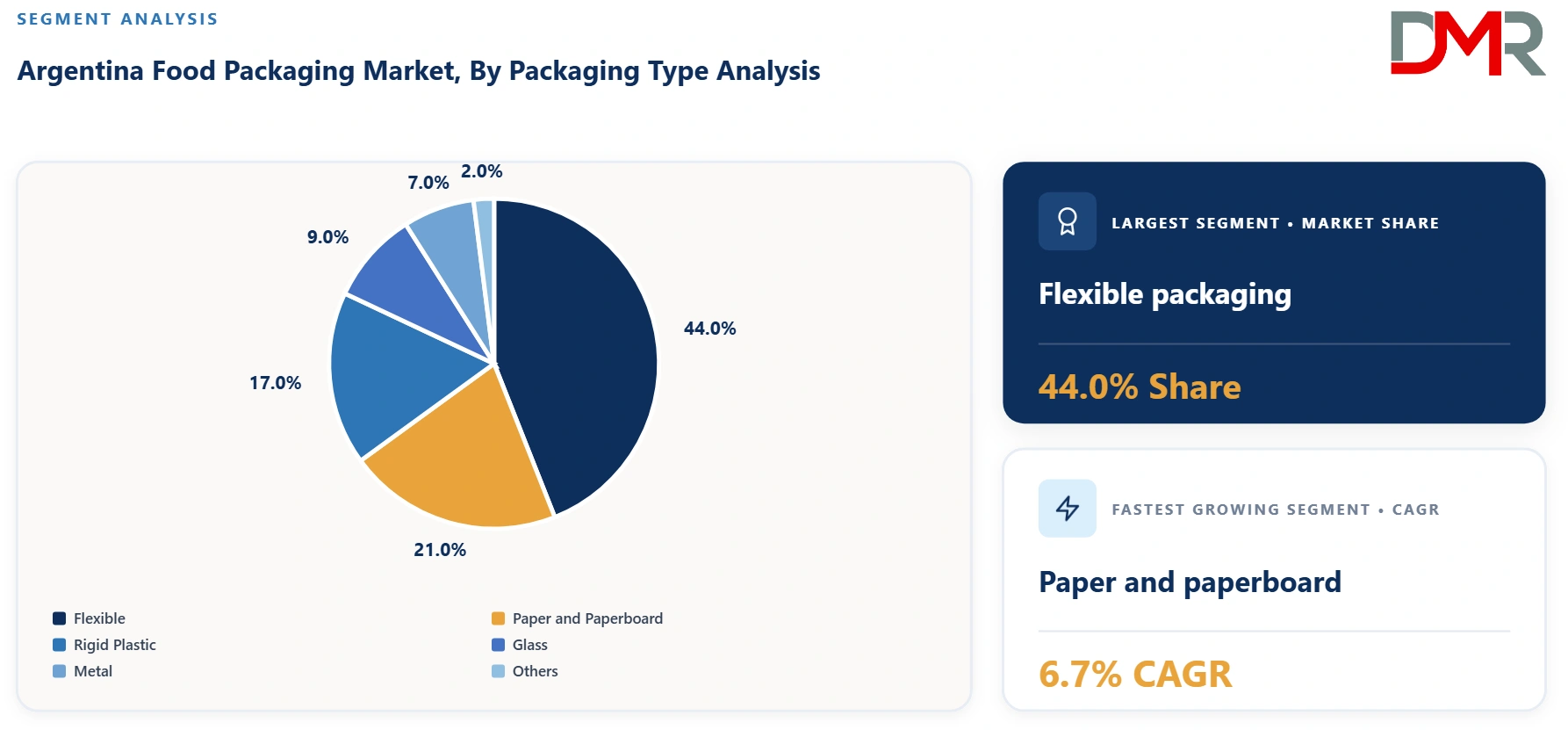
Flexible packaging is estimated to dominate Argentina's food packaging market in 2026 with approximately 44% value share, supported by extensive use in confectionery, bakery, snacks, pasta, sauces, frozen foods and meat. Its combination of low weight, barrier performance, printability and efficient transportation makes it particularly attractive in a cost-sensitive market. Paper and paperboard, estimated at approximately 21%, represent the second-largest category, supported by corrugated secondary packaging, cartons, trays and growing fibre-based alternatives. Rigid plastic accounts for approximately 17%, particularly in dairy, sauces and convenience foods. Glass represents roughly 9%, retaining strong positions in sauces, premium foods and selected beverages, while metal accounts for about 7%, particularly cans for preserved and processed foods. The fastest-growing sub-segment is estimated to be paper and paperboard at approximately 6.7% CAGR, benefiting from sustainability initiatives and substitution of plastic transport formats.
By Application Analysis
Bakery, confectionery, pasta and noodles represent the largest application group, estimated at approximately 23.5% share in 2026. The segment benefits from Argentina's established bakery and confectionery industries and heavy use of flexible films, pouches, wraps, cartons and flow packs. Public market estimates place bakery and confectionery packaging at about USD 652 million in 2026. Meat, fish and poultry represent the second-largest application cluster at approximately 16.8%, supported by Argentina's large meat industry and export requirements. Snacks and side dishes account for approximately 15.7%, followed by dairy products at around 9.5% and fruits and vegetables at approximately 9.1%. The fastest-growing application is convenience foods and ready meals, estimated at approximately 8.1% CAGR, reflecting demand for shelf-stable, microwaveable, portion-controlled and easy-to-handle formats.
The Argentina Food Packaging Market Report is segmented on the basis of the following:
By Packaging Type
- Flexible
- Paper and Paperboard
- Rigid Plastic
- Glass
- Metal
- Others
By Application
- Bakery, Confectionery, Pasta, and Noodles
- Dairy Products
- Sauces, Dressings, and Condiments
- Snacks and Side Dishes
- Convenience Foods
- Meat, Fish, and Poultry
- Fruits and Vegetables
- Others
Regulatory Landscape
Argentina's food packaging industry is directly influenced by food-safety, labeling, material-contact and environmental requirements. The most commercially significant recent development is the implementation of Law 27,642 on Healthy Food Promotion, which requires qualifying packaged foods and non-alcoholic beverages to display prominent warning labels for excessive sugar, sodium, saturated fat, total fat and calories. It also restricts certain promotional elements on affected packaging. The regulation increases packaging redesign requirements and creates recurring demand for compliant printing and artwork changes. For suppliers, the opportunity is strongest in digital printing, shorter production runs and packaging engineering. The principal risk is regulatory fragmentation and the cost of redesigning packaging portfolios when labeling requirements or MERCOSUR rules evolve.
Investment and White Space Analysis
The most attractive investment areas are recyclable flexible packaging, paper-based food packaging, high-barrier films, cold-chain packaging, MAP/vacuum systems, digital printing and automated inspection. Local converters possess meaningful capabilities, while multinational companies bring material science and technology. Cartocor states that its packaging division leads Argentina's paper, cardboard and flexible-packaging market, while Smurfit Westrock operates significant paper and corrugated capabilities in Argentina. White space remains in scalable recycling infrastructure, food-grade recycled materials, advanced mono-material structures and smart-packaging services. Smaller converters can compete by offering rapid customization and local service, while larger players can leverage integrated mills, converters, R&D and multinational customer relationships.
Competitive Landscape
rgentina's food packaging market is moderately fragmented, with large integrated companies competing alongside regional converters and specialized suppliers. Major competitors include Amcor, Mondi, Tetra Pak, Smurfit Westrock and Arcor/Cartocor, together with local and regional converters. Argentina's competition is influenced by vertical integration, local manufacturing footprint, price, technical service, print quality, food-safety certifications, delivery reliability and sustainability. Arcor describes its Cartocor/Converflex operation as a market leader in paper, cardboard and flexible packaging in Argentina.
Some of the prominent players in the Argentina Food Packaging Market are:
- Cartocor
- Converflex
- Zucamor
- Sealed Air Argentina
- Amcor
- Tetra Pak
- SIG
- Smurfit Westrock
- Mondi
- Huhtamaki
- Arcor Packaging
- Envases del Plata
- Ball Corporation
- Crown Holdings
- Verallia
- Cattorini Hnos.
- Rigolleau
- Cristalerías Rosario
- Aluflex
- Plásticos del Plata
- Flexocolor
- Multilabel Argentina
- Interpack
- Conarsa
- Petropack
- Epsilon Packaging
- Norflex
- Lamipack
- Envases Universales
- Bolsapel
- Packall
- Macropol
- Plastar
- Termoformados Argentinos
- Pampa Energía Packaging
- Celulosa Argentina
- Papelera Tucumán
- Ledesma
- Papelera del Plata
- Cartocor Flexibles
- Other Key Players
Recent Developments
- In May 2026, Smurfit Westrock reported new sustainability targets, including a 28% reduction in Scope 1 and 2 emissions by 2030 and further circularity initiatives, reinforcing paper-based packaging's competitive positioning.
- In April 2026, Tetra Pak introduced a 1-litre aseptic carton using a paper-based barrier, increasing renewable content to as much as 90% when combined with plant-based polymers and targeting lower carbon impact.
- In November 2025, Mondi expanded its food-packaging portfolio with additional corrugated and solid-board capabilities following its Schumacher Packaging transaction, strengthening sustainable and digitally printed food-packaging offerings.
- In June 2025, Cartocor launched a Bliss-format corrugated solution for milk and yoghurt sachets in Argentina, replacing conventional plastic-crate approaches while reducing material use and improving logistics efficiency.
- In April 2025, Amcor completed its combination with Berry Global, creating a substantially larger packaging platform and adding scale, material-science capabilities and an expanded innovation portfolio relevant to flexible and rigid food packaging markets.
Report Details
| Report Characteristics |
| Market Size (2026) |
USD 2.8 Bn |
| Forecast Value (2035) |
USD 4.5 Bn |
| CAGR (2026–2035) |
5.5% |
| Historical Data |
2021 – 2025 |
| Forecast Data |
2026 – 2035 |
| Base Year |
2025 |
| Segments Covered |
By Packaging Type, By Application |
| Country Coverage |
Argentina |
Frequently Asked Questions
What is the market size of the Argentina Food Packaging Market?
▾ The Argentina Food Packaging Market is estimated at USD 2.8 billion in 2026 and is projected to reach approximately USD 4.5 billion by 2035.
What CAGR is expected for the Argentina Food Packaging Market from 2026 to 2035?
▾ The Argentina Food Packaging Market is expected to grow at approximately 5.5% CAGR from 2026 to 2035, supported by packaging modernization and food-industry growth.
What are the key growth drivers of the Argentina Food Packaging Market?
▾ The Argentina Food Packaging Market is driven by food exports, convenience foods, shelf-life extension, lightweighting, e-commerce, sustainability and increasing demand for efficient packaging formats.
Which packaging type dominates the Argentina Food Packaging Market?
▾ Flexible packaging dominates the Argentina Food Packaging Market, accounting for an estimated 44% share in 2026 due to its versatility, lightweight properties and cost efficiency.
Which application leads the Argentina Food Packaging Market?
▾ Bakery, confectionery, pasta and noodles lead the Argentina Food Packaging Market, accounting for approximately 23.5% of the market in 2026.
Which segment is growing fastest in the Argentina Food Packaging Market?
▾ Convenience foods and ready meals are among the fastest-growing segments in the Argentina Food Packaging Market, with an estimated CAGR of approximately 8.1%.
Who are the key players in the Argentina Food Packaging Market?
▾ Key players in the Argentina Food Packaging Market include Amcor, Mondi, Tetra Pak, Smurfit Westrock, Arcor/Cartocor, Sealed Air and regional packaging manufacturers.
What are the major trends shaping the Argentina Food Packaging Market?
▾ Major trends shaping the Argentina Food Packaging Market include lightweighting, recyclable mono-material structures, fibre-based packaging, digital printing, automation and smart packaging.