Argentina Food Processing Equipment Market Snapshot
- Market Size, 2026: USD 402.2 million
- Market Size, 2035: USD 589.7 million
- CAGR, 2026–2035: 4.3%
- Leading Equipment Type, 2026: Processing Equipment, 31.5%
- Leading Mode of Operation, 2026: Automatic, 53.0%
- Leading Food Category, 2026: Meat, Poultry & Seafood, 25.0%
- Fastest-Growing Segment: Automatic Equipment, 5.8% CAGR
What is the Argentina Food Processing Equipment and its Market Size?
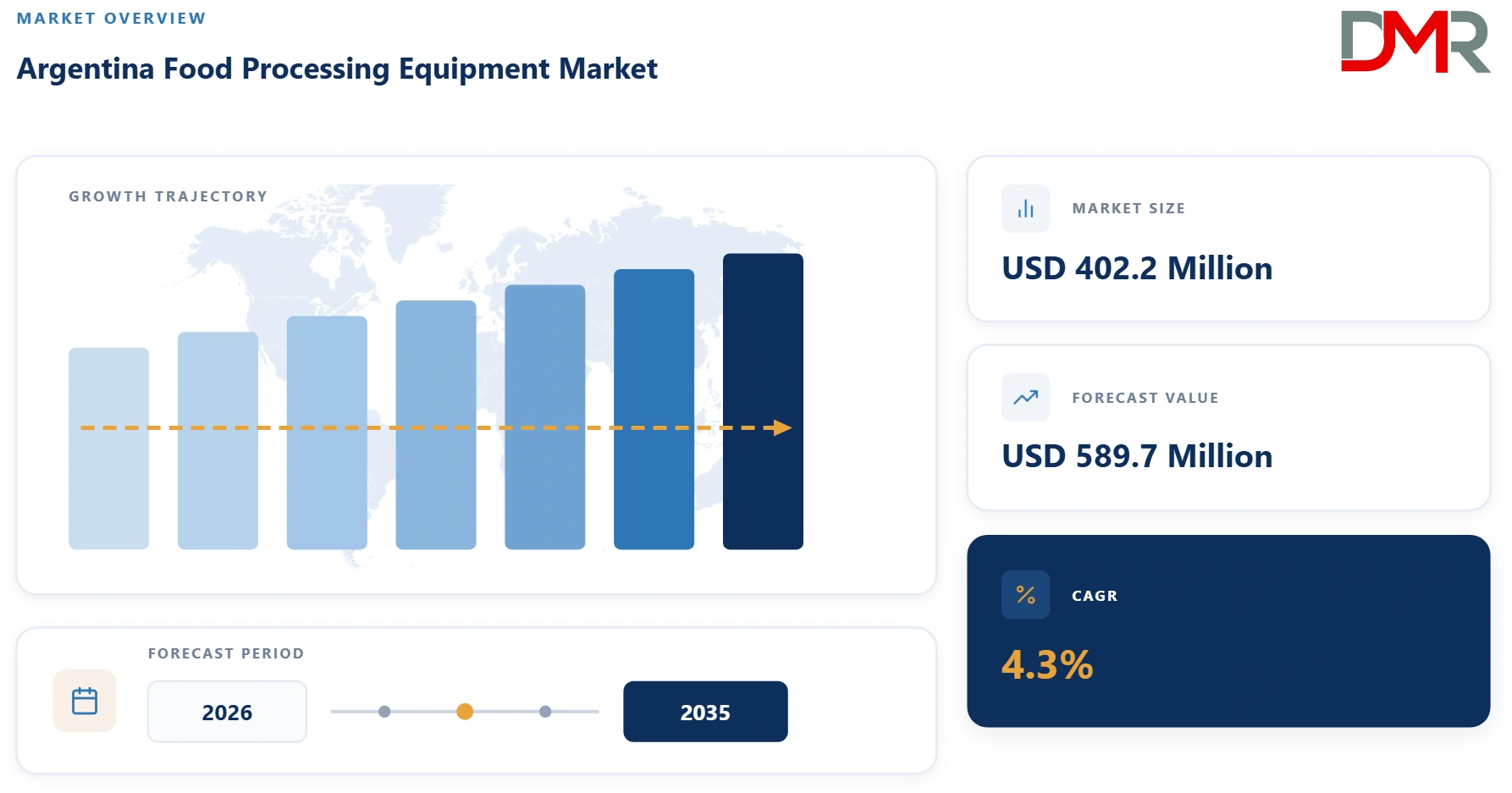
The Argentine market is estimated at USD 402.2 million in 2026, increasing to approximately USD 589.7 million by 2035, representing a 4.3% CAGR.
ℹ
To learn more about this report –
Download Your Free Sample Report Here
Argentina's food processing equipment market comprises machinery, systems and integrated production technologies used to transform agricultural and animal-based raw materials into processed, preserved, packaged and ready-to-market foods and beverages. It includes processing, packaging, material handling, cooking, cooling, cleaning, sanitation, weighing, filling and related automation equipment. The market serves meat and poultry processors, dairies, bakeries, beverage producers, grain processors, fruit and vegetable companies and specialty-food manufacturers. Its fundamental value proposition is to improve throughput, food safety, consistency, shelf life, labor productivity and resource efficiency while enabling processors to add value to Argentina's substantial agricultural production base.
Use Cases
- Meat processing: Automated slaughtering, cutting, deboning, weighing, marinating, cooking, chilling and packing of meat products.
- Dairy processing: Pasteurization, homogenization, separation, cheese production, evaporation, drying and filling for dairy manufacturers.
- Bakery production: Mixing, forming, proofing, baking, cooling, slicing and packaging of bread, biscuits and confectionery.
- Beverage processing: Water treatment, blending, pasteurization, filling, labeling and secondary packaging for beverage producers.
- Grain processing: Cleaning, milling, sorting, grinding, extrusion, weighing and bagging of wheat, maize and other grains.
- Fruit and vegetable processing: Washing, sorting, cutting, blanching, freezing, dehydration and packaging of produce.
Key Takeaways
- Market Size: Argentina's market is estimated at USD 402.2 million in 2026, reaching about USD 589.7 million by 2035.
- Growth: The market is projected to expand at a 4.3% CAGR, reflecting moderate but sustained capital-equipment investment.
- Growth Drivers: Export-oriented agroindustry, plant modernization, automation, food-safety requirements and value-added food production are the principal catalysts.
- Segment Dominance: Processing equipment is expected to remain the largest equipment category, while automatic systems lead by operating mode.
- Application Leadership: Meat, poultry and seafood equipment represents the largest food-category opportunity because of Argentina's globally significant livestock and meat-processing ecosystem.
- Fastest Growth: Automatic equipment is expected to grow fastest as processors seek higher throughput, lower labor dependency, improved traceability and consistent quality.
How AI/Gen AI is Transforming the Argentina Food Processing Equipment Market?
AI, IoT, machine vision, sensors and industrial automation are moving Argentine food-processing plants from standalone machinery toward connected production systems. Equipment increasingly incorporates real-time process monitoring, predictive maintenance, automated inspection, digital recipe management and production analytics. Bühler, for example, launched its SORTEX AI700 optical sorter using deep learning for improved impurity and defect detection.
The principal benefits are higher equipment utilization, lower downtime, reduced material waste, improved yield and more consistent quality. Automated inspection can also strengthen food-safety controls while connected sensors allow maintenance teams to identify equipment deterioration before major failures occur. Tetra Pak's Factory OS initiative illustrates the broader direction toward open, scalable and AI-ready factory architectures.
Key Drivers in the Argentina Food Processing Equipment Market
Expanding Export-Oriented Food Processing Industry:
Argentina's strong agricultural and livestock production base is creating sustained demand for modern food processing equipment. Meat, dairy, grains, fruits, vegetables and beverages require increasingly sophisticated machinery to convert agricultural commodities into higher-value products for domestic consumption and export. Export-oriented processors are investing in advanced equipment to improve production efficiency, product consistency, traceability and compliance with international food-safety requirements.
Automation and Food-Processing Modernization:
Automation is becoming an increasingly important investment priority for Argentine food manufacturers seeking higher productivity, consistent quality and lower dependence on manual operations. Processors are adopting automated production lines, programmable controls, sensors, machine-vision systems and integrated monitoring technologies across processing and packaging operations. Automatic equipment is particularly attractive to larger processors because it supports continuous production, reduces human error and improves hygiene.
Restraints in the Argentina Food Processing Equipment Market
Economic Volatility and Currency Fluctuations:
Economic uncertainty remains a significant constraint on the Argentina Food Processing Equipment Market. Currency fluctuations can increase the local cost of imported machinery, components, spare parts and maintenance services, making investment planning more difficult for food processors. Changes in purchasing power and financing conditions can also cause companies to postpone machinery replacement or expansion projects. Smaller processors are particularly exposed because they generally have fewer financing options and lower capacity to absorb large capital expenditures.
High Capital Requirements and Technology Adoption Challenges:
Advanced food-processing systems require significant upfront investment, particularly when processors purchase complete automated production lines rather than individual machines. High acquisition costs can limit adoption among small and medium-sized manufacturers, many of which continue using semi-automatic or conventional equipment. Technology integration can also be challenging because modern systems require specialized technical skills, employee training and suitable infrastructure.
Growth Opportunities in the Argentina Food Processing Equipment Market
Smart Manufacturing and Digital Equipment:
The increasing adoption of Industry 4.0 technologies presents a significant opportunity for equipment manufacturers. Argentine food processors are showing greater interest in connected machinery capable of monitoring production conditions, detecting quality issues, optimizing resource consumption and supporting predictive maintenance. Equipment incorporating sensors, digital controls, machine vision and analytics can help manufacturers improve productivity while reducing waste and unplanned downtime.
Value-Added Food Production and Processing Capacity Expansion:
Growing emphasis on value-added agricultural products creates opportunities across meat, dairy, grain, bakery, beverage, fruit and vegetable processing. Instead of exporting or selling commodities in relatively unprocessed forms, processors can increase margins through further processing, portioning, freezing, drying, blending and advanced packaging. This creates demand for complete processing lines as well as specialized equipment capable of handling multiple products and flexible production requirements.
Trends in the Argentina Food Processing Equipment Market
Shift Toward Automation and Smart Manufacturing:
The Argentina Food Processing Equipment Market is increasingly moving from conventional machinery toward automated and digitally connected production systems. Processors are prioritizing equipment that improves throughput, reduces manual intervention and provides greater control over production quality. Sensors, automated controls, machine vision and data analytics are gradually becoming important components of modern processing facilities.
Growing Focus on Energy Efficiency and Sustainability:
Food manufacturers are increasingly evaluating equipment according to energy consumption, water use, waste generation and overall operating efficiency. Energy-efficient motors, improved refrigeration, heat recovery, optimized cleaning systems and resource-efficient processing technologies are gaining attention because they can reduce operating expenses while supporting sustainability objectives. This trend is encouraging processors to replace older equipment with more efficient systems.
Research Scope and Analysis
The market is segmented By Equipment Type, By Mode of Operation, By Food Category and By End User. Estimates reflect equipment revenue sold into Argentine food-processing applications and include machinery, integrated lines and associated equipment, while excluding primary agricultural machinery and consumer kitchen appliances.
ℹ
To learn more about this report –
Download Your Free Sample Report Here
By Equipment Type Analysis
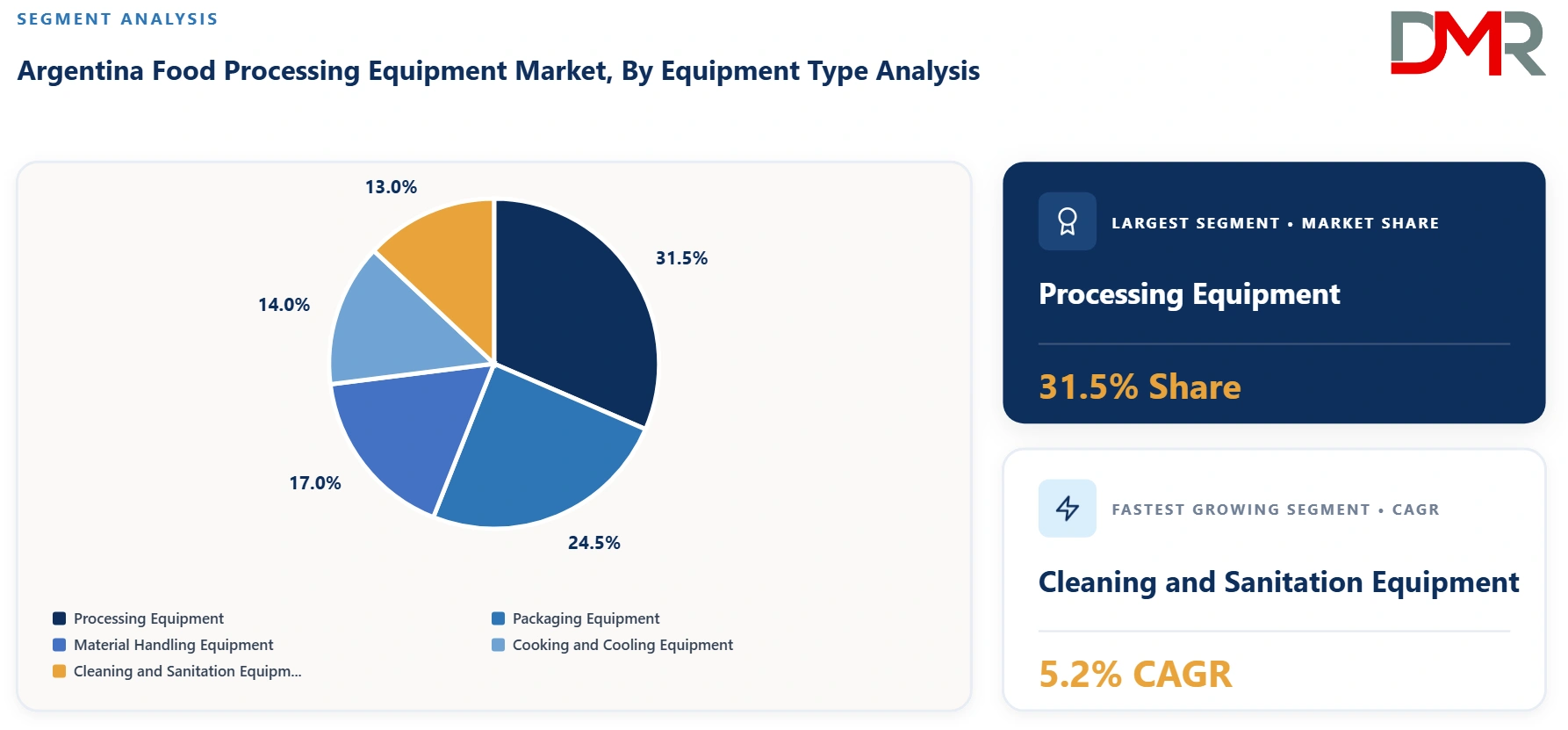
Processing Equipment is estimated to lead Argentina's equipment market in 2026 with approximately 31.5% share, equivalent to about USD 126.7 million. Its leadership reflects the essential role of preparation, grinding, cutting, mixing, separation, extrusion and other core transformation processes across meat, dairy, bakery, beverage and grain facilities. Packaging Equipment is estimated at 24.5%, benefiting from shelf-life requirements, export specifications and demand for portioned and convenience products. Material Handling Equipment represents approximately 17.0%, supported by conveyors, pumps, dosing and automated movement between production stages. Cooking and Cooling Equipment accounts for around 14.0%, particularly important in meat, bakery, dairy and prepared-food applications. Cleaning and Sanitation Equipment represents the remaining 13.0%. The fastest-growing sub-segment is estimated to be Cleaning and Sanitation Equipment at approximately 5.2% CAGR, driven by automated hygiene systems and water-saving requirements. Packaging is expected to remain the second-largest category as processors increase automation and export-oriented packaging sophistication.
By Mode of Operation Analysis
Automatic equipment is estimated to dominate in 2026 with a 53.0% share, reflecting adoption by large-scale meat, dairy, beverage and grain processors seeking throughput, consistency, labor productivity and traceability. Semi-automatic systems account for approximately 32.0%, retaining substantial demand among SMEs that need productivity improvements but cannot justify full-line automation. Manual equipment represents roughly 15.0%, concentrated among artisanal producers, smaller bakeries, specialty-food companies and processors operating at lower volumes. Automatic equipment is also the fastest-growing sub-segment, at an estimated 5.8% CAGR, because sensor-based controls, robotics, machine vision and automated material handling are becoming more economically accessible. Semi-automatic equipment should grow around 3.2%, while manual equipment is expected to remain comparatively flat at approximately 1.4% CAGR. The direction is consistent with published market research identifying automatic equipment as Argentina's leading operating mode because of efficiency, labor-cost and quality advantages.
By Food Category Analysis
Meat, Poultry and Seafood is estimated to represent the largest food-category segment in 2026 at approximately 25.0%, reflecting Argentina's strong beef industry and substantial poultry, pork and seafood-processing activity. Argentina's meat complex is among the country's largest agrofood export engines. Dairy Products are estimated at 17.5%, supported by modernization and investments in processing capacity. Bakery and Confectionery represents approximately 15.5%, while Beverages account for 14.5%. Grain Milling and Processing contributes around 12.0%, reflecting Argentina's enormous wheat, maize and other grain base and the country's established milling infrastructure. Fruits and Vegetables account for approximately 8.0%, with Others at 7.5%. Fruits and vegetables are expected to be the fastest-growing category at roughly 5.5% CAGR, supported by freezing, dehydration, sorting and export-oriented value addition. Dairy is the second-largest segment and should also maintain above-market growth as processors modernize and expand higher-value dairy ingredients and products.
By End User Analysis
Large-Scale Food Processors are estimated to account for 61.0% of 2026 market revenue because multinational and large domestic producers have greater access to financing and stronger incentives to automate high-volume production lines. Small and Medium-Sized Processors represent approximately 29.0%, creating an important market for modular, semi-automatic and retrofit solutions. Artisanal and Specialty Food Producers account for approximately 10.0%, primarily purchasing compact, flexible and lower-capacity equipment. The fastest-growing end-user group is expected to be SMEs, at approximately 5.3% CAGR, as financing availability, digitalization and export opportunities gradually broaden access to modern machinery. Large processors should grow around 4.0%, while artisanal/specialty producers grow around 3.8%. Government-backed modernization initiatives can further support SME equipment purchases; Argentina's technology-modernization programs explicitly target machinery, infrastructure, environmentally efficient technologies and value addition among agricultural SMEs.
The Argentina Food Processing Equipment Market Report is segmented on the basis of the following:
By Equipment Type
- Processing Equipment
- Packaging Equipment
- Material Handling Equipment
- Cooking and Cooling Equipment
- Cleaning and Sanitation Equipment
By Mode of Operation
- Automatic
- Semi-Automatic
- Manual
By Food Category
- Dairy Products
- Meat, Poultry and Seafood
- Bakery and Confectionery
- Beverages
- Fruits and Vegetables
- Grain Milling and Processing
- Others
By End User
- Large-Scale Food Processors
- Small and Medium-Sized Processors
- Artisanal and Specialty Food Producers
Regulatory Landscape
Argentina's food-processing equipment demand is strongly influenced by food-safety, hygiene, traceability, labeling and sanitary requirements under the Código Alimentario Argentino (CAA). The regulatory environment underwent significant change in 2025–2026: Decree 538/2025 restructured the National Food Control System, while Decree 697/2026 transferred registration, inspection, control and import-authorization functions for covered food products, beverages, supplements and food-contact materials to SENASA.
For equipment suppliers, this reinforces demand for hygienic design, cleanability, traceability and documentation. Regulatory simplification could shorten administrative timelines, but suppliers must monitor evolving CAA requirements and provincial implementation. Equipment that facilitates sanitation validation, automated cleaning, allergen control and process documentation should have an advantage over lower-cost machinery lacking compliance-oriented features.
Investment and White Space Analysis
Investment opportunity is strongest where Argentina combines abundant raw materials with underdeveloped downstream value addition. High-potential areas include meat automation, dairy processing, frozen fruit and vegetables, potato processing, grain-based ingredients, bakery automation, beverage filling and specialty foods. Government-backed financing is increasingly supporting food-industry modernization, while the RIMI framework introduced incentives for qualifying medium-sized agroindustrial investments.
The principal white space is therefore not basic machinery alone but integrated, moderately priced automation for SMEs, retrofit kits, energy-efficient thermal equipment, intelligent sanitation systems and locally supported digital controls. Vendors combining imported critical components with Argentine engineering, installation and service could achieve a favorable cost-to-performance proposition while reducing customers' currency and maintenance risks.
Competitive Landscape
Argentina's food-processing-equipment market is fragmented but technologically tiered. Global companies compete with regional manufacturers, local engineering firms, distributors and specialized machinery producers. International suppliers such as Bühler, GEA, Tetra Pak, Krones, Alfa Laval and JBT Marel generally compete through advanced technology, integrated lines, engineering expertise and lifecycle services, while local suppliers frequently compete through price, customization, shorter lead times and after-sales support. Bühler has operated in Argentina since 1928 and supplies grain milling, bakery, pasta, rice, oats, brewing, vegetable-oil, feed, extrusion, chocolate and packaging-related solutions from its Buenos Aires operation.
Some of the prominent players in the Argentina Food Processing Equipment Market are:
- GEA Group
- Tetra Pak
- Bühler Group
- JBT Marel
- Krones
- Alfa Laval
- SPX FLOW
- The Middleby Corporation
- Marel
- FLSmidth
- Heat and Control
- Ishida
- MULTIVAC
- Syntegon Technology
- IMA Group
- KHS
- Sidel
- Hosokawa Micron
- ANDRITZ
- Baker Perkins
- Clextral
- Pavan Group
- Flottweg
- Bucher Unipektin
- GEA Argentina
- Tetra Pak Argentina
- JBT Marel Argentina
- Krones Argentina
- Alfa Laval Argentina
- IMEPA Pantecnica
- CARMAT
- Metalúrgica Frimar
- Chiacchiera
- A.N.E.K.O.
- Asema
- Fimaco
- FAM Argentina
- Maquinaria Cárnica Argentina
- Tecno Meat
- Frigo Equipos
- Other Key Players
Recent Developments
- November 2025: Tetra Pak launched Factory OS, a modular automation and digitalization portfolio designed to provide real-time factory insights and create AI-ready food and beverage production environments.
- May 2025: Bühler launched the SORTEX AI700, using deep learning and optical sorting to improve defect and impurity removal, demonstrating the industry's accelerating shift toward AI-enabled quality control.
- May 2025: GEA presented an upgraded automated One-Line-Concept at IFFA, incorporating improved scanning, slicing and packaging technologies designed to reduce raw-material and packaging use while increasing capacity.
- April 2025: GEA introduced NEXUS, an integrated engineering approach for reducing energy consumption and carbon footprint in food, dairy and beverage plants, with potential energy savings of up to 30% in applicable installations.
- January 2025: JBT completed its takeover of Marel, with JBT Europe subsequently holding approximately 97.5% of Marel's issued share capital, creating a larger global food-processing technology platform with expanded protein-processing capabilities.
Report Details
| Report Characteristics |
| Market Size (2026) |
USD 402.2 Mn |
| Forecast Value (2035) |
USD 589.7 Mn |
| CAGR (2026–2035) |
4.3% |
| Historical Data |
2021 – 2025 |
| Forecast Data |
2026 – 2035 |
| Base Year |
2025 |
| Segments Covered |
By Equipment Type, By Mode Of Operation, By Food Category, By End User |
| Country Coverage |
Argentina |
Frequently Asked Questions
What is the size of the Argentina Food Processing Equipment Market?
▾ The Argentina Food Processing Equipment Market is estimated at USD 402.2 million in 2026, based on the broader food-processing-equipment market scope.
What will the Argentina Food Processing Equipment Market be worth in 2035?
▾ The Argentina Food Processing Equipment Market is projected to reach approximately USD 589.7 million by 2035, supported by sustained equipment modernization.
What is the CAGR of the Argentina Food Processing Equipment Market?
▾ The Argentina Food Processing Equipment Market is expected to grow at approximately 4.3% CAGR from 2026 to 2035.
What are the key factors driving the Argentina Food Processing Equipment Market?
▾ The Argentina Food Processing Equipment Market is driven by food-processing modernization, automation, export growth, food-safety requirements, energy efficiency and value-added production.
Which equipment segment dominates the Argentina Food Processing Equipment Market?
▾ Processing Equipment dominates the Argentina Food Processing Equipment Market, accounting for an estimated 31.5% share in 2026.
Which mode of operation leads the Argentina Food Processing Equipment Market?
▾ Automatic equipment leads the Argentina Food Processing Equipment Market, with an estimated 53.0% market share in 2026.
Which food category holds the largest share of the Argentina Food Processing Equipment Market?
▾ Meat, Poultry and Seafood represents the largest category in the Argentina Food Processing Equipment Market, with approximately 25.0% share in 2026.
Who are the major players in the Argentina Food Processing Equipment Market?
▾ Major companies serving the Argentina Food Processing Equipment Market include Bühler, GEA, Tetra Pak, Krones, Alfa Laval and JBT Marel, alongside regional and local manufacturers.