Argentina Meat Processing Equipment Market Snapshot
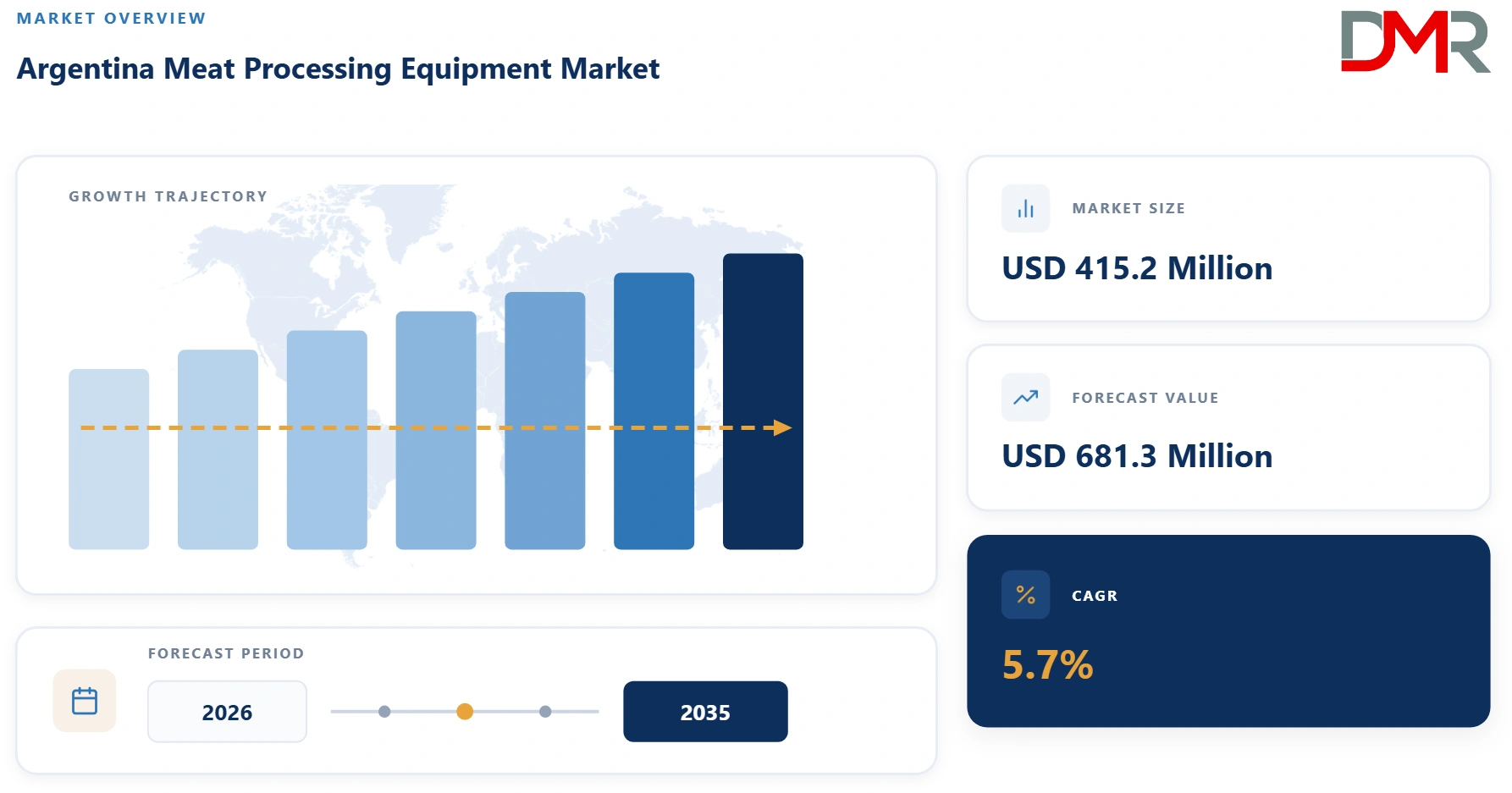
- Market Size in 2026: USD 415.2 million
- Market Size in 2035: USD 681.3 million
- CAGR, 2026–2035: 5.7%
- Leading Equipment Segment, 2026: Cutting & Slicing Equipment, 24%
- Leading Meat Type, 2026: Beef, 51%
- Leading Processing Stage, 2026: Cutting & Deboning, 31%
- Fastest-Growing Segment: Fully Automated Equipment, 8.2% CAGR
What is the Argentina Meat Processing Equipment and its Market Size?
The Argentina meat processing equipment market is estimated at USD 415.2 million in 2026 and is projected to reach approximately USD 681.3 million by 2035, representing a 5.7% CAGR.
ℹ
To learn more about this report –
Download Your Free Sample Report Here
The Argentina meat processing equipment market comprises machinery, integrated production lines, automation systems, software and supporting technologies used to slaughter, cut, debone, grind, mix, form, inject, marinate, cook, smoke, chill and package meat products. The market serves beef, poultry, pork, mutton/goat and other meat processors across slaughterhouses, meatpacking facilities, further-processing plants and commercial food operations. Equipment suppliers increasingly combine mechanical systems with sensors, machine vision, robotics, traceability software and data analytics. The core value proposition is higher processing throughput, improved yield, consistent product quality, food safety, labor productivity and reduced material and energy waste.
Use Cases
- Automated cutting and deboning: Improves yield, throughput and dimensional consistency across high-volume beef and poultry operations.
- Grinding and mixing: Produces standardized minced meat, sausage, burger and prepared-meat formulations.
- Injection and marination: Enables higher-value processed products while improving flavor consistency and moisture retention.
- Forming and portioning: Automates burgers, meatballs, nuggets and other standardized portion-controlled products.
- Cooking and smoking: Provides controlled thermal processing for cooked, cured and ready-to-eat meat products.
- Packaging and end-of-line automation: Improves shelf life, traceability, throughput and labor efficiency.
Key Takeaways
- Market Size and Growth: The market is estimated at USD 415.2 million in 2026 and expected to reach USD 681.3 million by 2035 at a 5.7% CAGR.
- Growth Drivers: Meat exports, rising processed-meat demand, equipment replacement, labor productivity and increasingly stringent food-safety requirements are supporting investment.
- Segment Dominance: Cutting and slicing represents the largest equipment category, while beef accounts for the largest meat-type opportunity.
- Processing Leadership: Cutting and deboning represents the largest processing-stage application because of Argentina's substantial beef-processing footprint.
- Fastest Growth: Fully automated systems are forecast to grow around 8.2% annually as large processors prioritize throughput, traceability, yield optimization and labor reduction.
- Strategic Outlook: The strongest opportunities are expected in automation retrofits, integrated production lines, digital monitoring and value-added meat processing.
How AI/Gen AI is Transforming the Argentina Meat Processing Equipment Market?
AI, machine vision, industrial IoT and advanced automation are increasingly being integrated into meat-processing equipment to automate inspection, cutting, sorting, portioning, weight control and production monitoring. Sensors collect information on product dimensions, temperature, throughput, equipment condition and yield, while software converts the data into operational decisions. Global suppliers such as JBT Marel increasingly position intelligent automation and digital visibility as core components of modern meat-processing solutions.
The technology improves labor productivity, consistency, traceability and equipment utilization while reducing giveaway, waste, downtime and manual handling. For Argentine processors, these benefits are particularly important where export competitiveness depends on yield, quality and reliable production economics. Machine-vision and AI systems can also support more consistent grading and quality control.
Key Drivers in the Argentina Meat Processing Equipment Market
Expansion of Export-Oriented Meat Processing
Argentina's strong position in global beef production and exports continues to encourage processors to modernize facilities and improve processing efficiency. Export-oriented companies require equipment capable of delivering consistent quality, high throughput, hygienic processing and traceability. Access to international markets also increases the importance of meeting destination-country food-safety and sanitary requirements. As processors seek to maximize carcass utilization and improve yields, demand is increasing for advanced cutting, deboning, slicing, grinding and packaging systems. Growing opportunities for poultry and other processed meat exports are further broadening the equipment base. Consequently, investment is increasingly focused on machinery that can increase productivity while maintaining consistent product specifications across high-volume operations.
Modernization and Increasing Automation Adoption
The replacement of aging machinery and gradual transition from manual to automated processing are major growth catalysts. Large Argentine processors are increasingly adopting automated equipment to improve throughput, reduce dependence on manual labor and achieve greater process consistency. Automation is particularly valuable in repetitive activities such as cutting, portioning, weighing, packaging and material handling. Modern systems also incorporate sensors, programmable controls, machine vision and connected monitoring capabilities, enabling processors to identify production inefficiencies and reduce downtime. The broader Argentine food-processing equipment market similarly shows strong movement toward automatic systems because of efficiency, hygiene, quality and labor-productivity benefits.
Restraints in the Argentina Meat Processing Equipment Market
High Capital Investment and Economic Volatility
Advanced meat-processing machinery requires substantial capital expenditure, particularly for automated cutting lines, robotic systems, integrated processing equipment, refrigeration and packaging solutions. Argentina's economic volatility, currency fluctuations and financing constraints can make imported equipment considerably more expensive for local processors. Smaller and medium-sized facilities may therefore postpone machinery replacement or select lower-cost semi-automated alternatives. Imported machinery can also face additional costs associated with logistics, installation, spare parts and technical support. These factors lengthen purchasing cycles and make return-on-investment calculations especially important. As a result, demand is likely to remain strongest among large export-oriented processors with sufficient production volumes to justify advanced automation investments.
Fragmented Processing Infrastructure and Technical Challenges
Argentina's processing industry includes large modern facilities alongside smaller plants operating older and partially manual equipment. This difference in technological maturity creates challenges for suppliers attempting to introduce sophisticated integrated systems across the market. Installing advanced equipment in older facilities can require substantial plant modifications, electrical upgrades and process redesign. There is also a shortage of specialized technical personnel capable of installing, calibrating and maintaining sophisticated automated systems. Compatibility with existing machinery and the availability of replacement components can further influence purchasing decisions. These challenges encourage processors to favor modular upgrades and equipment supported by local distributors and service providers rather than immediately investing in complete automated production lines.
Growth Opportunities in the Argentina Meat Processing Equipment Market
Automation Retrofits and Smart Processing Solutions
Modernization of existing facilities represents a significant opportunity because processors can improve productivity without completely replacing their production infrastructure. Modular automation solutions can be introduced into cutting, weighing, conveying, portioning, inspection and packaging operations individually before being integrated into broader automated lines. Smart sensors and connected equipment can provide real-time production information and support predictive maintenance, helping processors reduce downtime and improve equipment utilization. The growing emphasis on automation and digital technologies across Argentina's food-processing sector supports this opportunity. Suppliers offering scalable systems, retrofit packages, local engineering and after-sales support can therefore address processors that cannot justify large turnkey investments.
Further Processing and Value-Added Meat Products
Increasing demand for convenient and processed meat products is creating opportunities for equipment used in grinding, mixing, forming, stuffing, injecting, marinating, cooking and packaging. Processors can increase margins by moving beyond primary carcass processing into burgers, sausages, marinated cuts, prepared portions and ready-to-cook products. Poultry processing represents another important opportunity, with modernization and export demand encouraging investment in slaughtering, deboning, portioning and packaging equipment. The expansion of further-processing operations also creates demand for integrated production lines that connect processing, quality control and packaging. Equipment suppliers capable of supporting both traditional meat processing and value-added product manufacturing can therefore capture a broader share of processors' capital expenditure.
Trends in the Argentina Meat Processing Equipment Market
Shift Toward Integrated Automation and Digitalization
Argentina's meat processors are increasingly moving from standalone machinery toward connected processing systems that combine mechanical equipment with automation, sensors, digital controls and production monitoring. This transition enables better control over throughput, product consistency, labor utilization and equipment performance. Large processors serving export markets are likely to adopt these technologies faster because their higher production volumes provide stronger economic justification. Machine vision, automated inspection, digital weighing and connected production data are expected to become increasingly important purchasing criteria as processors seek greater operational visibility and traceability.
Growing Focus on Efficiency, Food Safety and Sustainability
Equipment purchasing decisions are increasingly influenced by hygiene, food safety, energy consumption, water usage and waste reduction in addition to throughput. Processors are seeking machinery that minimizes contamination risks, improves process control and reduces resource consumption. Energy-efficient chilling and processing systems, automated sanitation, improved by-product recovery and digital monitoring are consequently gaining importance. Export requirements further reinforce these priorities because processors must maintain consistent sanitary and quality standards across international supply chains. This trend is expected to favor equipment suppliers that combine productivity improvements with hygienic design, resource efficiency and advanced monitoring capabilities.
Research Scope and Analysis
The Argentina meat processing equipment market is analyzed by Equipment Type, Meat Type, Processing Stage, Automation Level and End User. The estimates cover machinery and integrated systems used across primary slaughter, carcass processing, further processing, thermal treatment and packaging.
ℹ
To learn more about this report –
Download Your Free Sample Report Here
By Equipment Type Analysis
Cutting & Slicing Equipment is estimated to be the dominant equipment category in 2026, accounting for approximately 24% of market revenue, supported by Argentina's large beef-processing industry and the economic importance of maximizing carcass yield. Grinding & Mincing Equipment, at approximately 16%, represents the second-largest category because of demand for ground beef, sausage and prepared products. Injecting & Marinating Equipment is estimated to be the fastest-growing category at approximately 7.8% CAGR, reflecting increasing production of value-added and ready-to-cook meat products. Forming and portioning equipment accounts for approximately 12%, mixing and blending 13%, stuffing and filling 11%, cooking and smoking 7%, tenderizing 6%, and other equipment approximately 3%. Demand is increasingly shifting toward machines that combine portion accuracy, digital weighing, automated handling and quality control. As processors seek labor savings without sacrificing yield, integrated cutting and portioning systems should remain the primary investment category, while injecting, marinating and forming equipment benefit from product diversification.
By Meat Type Analysis
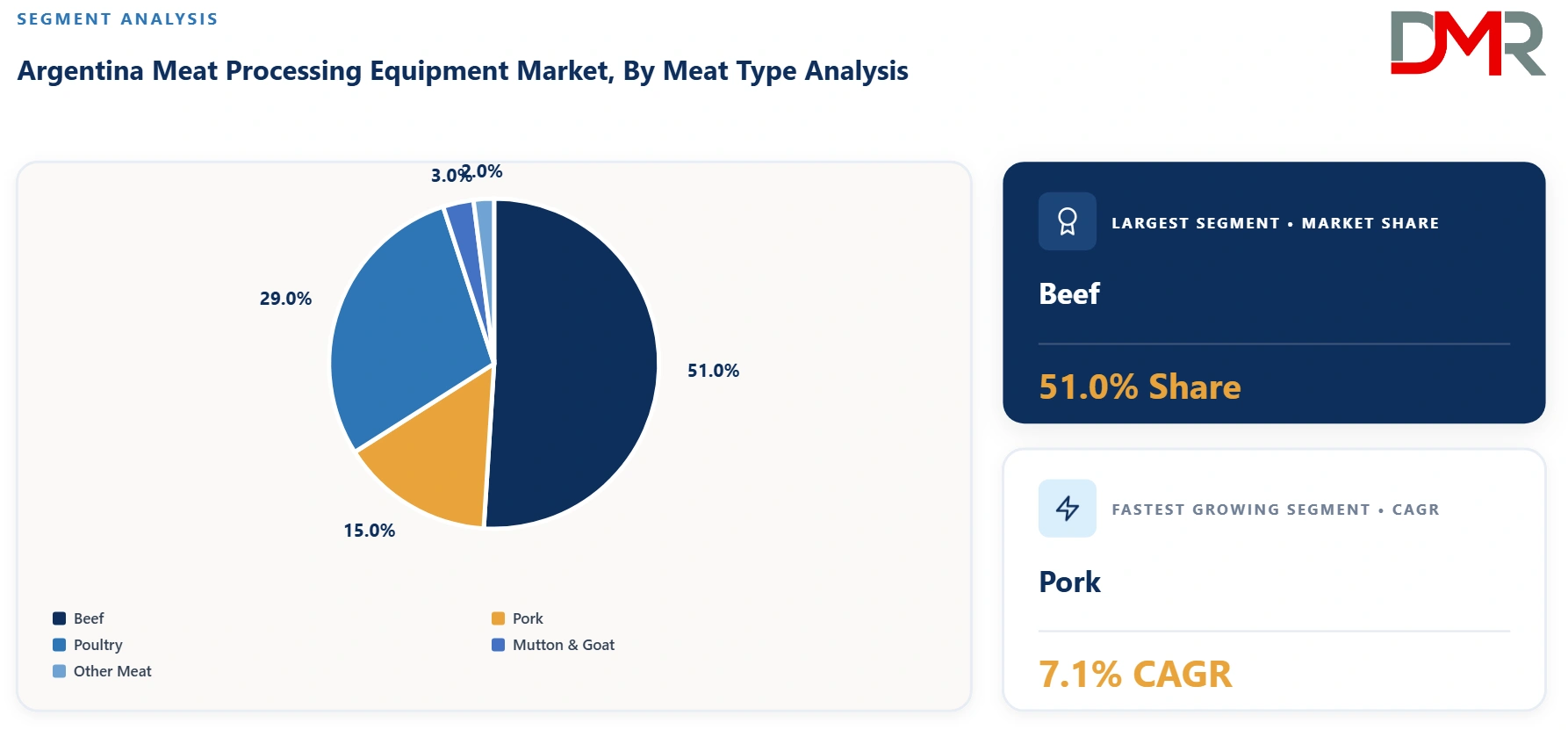
Beef dominates the Argentina meat-processing-equipment market, representing an estimated 51% share in 2026, reflecting the country's large cattle-processing base, export specialization and established beef-processing infrastructure. Argentina processed roughly 13.6 million cattle and produced about 3.14 million tonnes of beef in 2025. Poultry, with approximately 29%, is the second-largest segment and is expected to remain one of the most important sources of incremental equipment demand as poultry consumption and production expand. Pork, estimated at 15%, is the fastest-growing major meat category at approximately 7.1% CAGR, supported by an 8.44% increase in per-capita pork consumption during 2025. Mutton and goat account for roughly 3%, while other meat types represent 2%. Poultry and pork processors have particular potential for automated portioning, deboning, forming and further-processing systems.
By Processing Stage Analysis
Cutting & Deboning is estimated to lead by processing stage with approximately 31% market share in 2026, reflecting the large installed base of beef processing and the high economic importance of carcass yield. Further Processing represents approximately 27%, making it the second-largest category and one of the most attractive growth areas as processors diversify into burgers, sausages, marinated products and ready-to-cook foods. Slaughtering & Primary Processing accounts for approximately 22%, while packaging represents 12% and cooking & curing approximately 8%. Further processing is forecast to be the fastest-growing stage at roughly 7.4% CAGR, driven by product innovation and higher-margin offerings. Equipment suppliers that can connect primary processing with secondary processing and packaging will therefore have an advantage, particularly among larger processors seeking complete line solutions.
By Automation Level Analysis
Semi-Automated equipment currently represents the largest automation category, estimated at 47% share in 2026, because it provides a compromise between capital expenditure, flexibility and labor productivity. Fully Automated systems represent approximately 31% and are the fastest-growing category, with an estimated 8.2% CAGR, as larger processors increasingly prioritize throughput, consistency, digital monitoring, traceability and labor reduction. Manual equipment accounts for approximately 22% and remains relevant among smaller facilities and operations with lower throughput. The transition toward full automation will be gradual because of capital costs and plant-integration challenges, but automation is increasingly becoming a competitive requirement for large export-oriented facilities. Demand is expected to concentrate initially on cutting, deboning, weighing, conveying, packaging and repetitive handling, where automation can produce measurable yield and labor benefits.
By End User Analysis
Meat Processing Plants represent the largest end-user segment at an estimated 31% share in 2026, supported by demand for cutting, grinding, mixing, forming, marinating and packaging machinery. Slaughterhouses & Abattoirs, with approximately 24%, constitute the second-largest segment because Argentina maintains a substantial cattle-slaughtering infrastructure. Poultry processing plants account for approximately 19%, meatpacking facilities 12%, foodservice and commercial operations 8%, and other end users 6%. Poultry processing plants are expected to be the fastest-growing end-user category at approximately 7.6% CAGR, supported by rising poultry consumption and demand for high-speed automated processing. The market opportunity is therefore shifting toward processors requiring complete integrated solutions rather than individual machines. Equipment vendors with strong after-sales service, local installation capabilities and modular automation packages should be well positioned.
The Argentina Meat Processing Equipment Market Report is segmented on the basis of the following:
By Equipment Type
- Cutting & Slicing Equipment
- Grinding & Mincing Equipment
- Mixing & Blending Equipment
- Forming & Portioning Equipment
- Stuffing & Filling Equipment
- Injecting & Marinating Equipment
- Tenderizing Equipment
- Cooking & Smoking Equipment
- Others
By Meat Type
- Beef
- Pork
- Poultry
- Mutton & Goat
- Other Meat
By Processing Stage
- Slaughtering & Primary Processing
- Cutting & Deboning
- Further Processing
- Cooking & Curing
- Packaging
By Automation Level
- Manual
- Semi-Automated
- Fully Automated
By End User
- Slaughterhouses & Abattoirs
- Meat Processing Plants
- Poultry Processing Plants
- Meatpacking Facilities
- Foodservice & Commercial Operations
- Other End Users
Regulatory Landscape
Argentina's meat-processing equipment demand is closely linked to sanitary, food-safety, traceability and export-compliance requirements overseen through the country's agricultural and sanitary authorities, including SENASA. Export growth creates incentives for processors to adopt equipment capable of maintaining hygienic design, controlled processing conditions, traceability and consistent product specifications. The EU, U.S., China and other destination markets can impose different requirements, increasing the value of flexible equipment and automated documentation. Regulatory pressure is therefore more likely to favor technology upgrades than simply increase machinery volumes. The principal risks are compliance costs for smaller processors and uncertainty around import procedures, certification and equipment costs. Suppliers offering hygienic designs, digital traceability, automated cleaning and documentation capabilities should benefit disproportionately.
Investment and White Space Analysis
The principal investment white spaces are automation retrofits, poultry and pork processing, further-processing lines, smart packaging and digital production management. Argentina's record bovine export value demonstrates the industry's capacity to generate investment when international pricing is favorable. However, capital constraints create an opening for modular automation rather than only large turnkey projects. Local distributors and engineering firms can also capture value through installation, integration, maintenance and spare parts. The strongest opportunities are likely to occur where technology produces measurable improvements in yield or labor productivity. Suppliers should prioritize scalable systems that can begin with semi-automation and subsequently integrate machine vision, robotics, IoT monitoring and predictive maintenance.
Competitive Landscape
The Argentina meat-processing equipment market is moderately fragmented at the local level but increasingly influenced by globally integrated technology suppliers. International companies compete through advanced machinery, turnkey processing lines, software, automation and lifecycle services, while Argentine distributors and engineering companies provide localization, installation and technical support. Major differentiation factors include equipment throughput, yield, hygienic design, reliability, automation capability, energy efficiency, service availability and total cost of ownership. JBT Marel, GEA, Middleby and other international suppliers compete alongside regional machinery manufacturers and specialized local integrators. JBT Marel's Argentine distribution ecosystem, for example, provides technologies covering slaughter, deboning and complete processing solutions.
Some of the prominent players in the Argentina Meat Processing Equipment Market are:
- Marel
- GEA Group
- JBT Marel
- BAADER
- Frontmatec
- Handtmann
- Weber Maschinenbau
- Vemag Maschinenbau
- Bizerba
- Seydelmann
- Metalbud NOWICKI
- Provisur Technologies
- Minerva Omega Group
- The Middleby Corporation
- Bettcher Industries
- Risco
- Ross Industries
- FPEC
- Grote Company
- K+G Wetter
- BANSS
- Stephan Machinery
- Hollymatic
- Jarvis Products
- Mepaco
- Magurit
- Tomra
- Meyn
- Meyn Food Processing Technology
- Illinois Tool Works
- Nemco Food Equipment
- Nemco Argentina
- Chiacchiera
- Alberto y Daniel Crippa
- Nowak T.A.
- A.N.E.K.O.
- Asema
- Bandax Argentina
- Metalúrgica Frimar
- Metalúrgica Pini
- Other Key Players
Recent Developments
- In September 2025, JBT Marel inaugurated a Global Production Center in Pune, India, expanding production capabilities for efficient and innovative food-processing solutions across India and Asia-Pacific.
- In August 2025, Middleby acquired Frigomeccanica, expanding its food-processing portfolio into drying, defrosting, fermentation, refrigeration and preservation technologies and strengthening its position in protein processing.
- In May 2025, GEA introduced enhancements to its automated One-Line-Concept at IFFA, integrating scanning, slicing and packaging technologies to improve throughput while reducing raw-material and packaging consumption.
- In February 2025, JBT Marel showcased integrated intelligent-automation solutions at IPPE, emphasizing greater production visibility, productivity, sustainability and the combined capabilities of the newly integrated companies.
- In January 2025, JBT completed its acquisition of Marel, creating a major global food-technology platform combining complementary meat, poultry and fish-processing equipment, software and services.
Report Details
| Report Characteristics |
| Market Size (2026) |
USD 415.2 Mn |
| Forecast Value (2035) |
USD 681.3 Mn |
| CAGR (2026–2035) |
5.7% |
| Historical Data |
2021 – 2025 |
| Forecast Data |
2026 – 2035 |
| Base Year |
2025 |
| Segments Covered |
By Equipment Type, By Meat Type, By Processing Stage, By Automation Level, By End User |
| Country Coverage |
Argentina |
Frequently Asked Questions
What is the size of the Argentina Meat Processing Equipment Market in 2026?
▾ The Argentina Meat Processing Equipment Market is estimated at USD 415.2 million in 2026, supported by processing modernization, exports and equipment replacement.
What will the Argentina Meat Processing Equipment Market size reach by 2035?
▾ The Argentina Meat Processing Equipment Market is projected to reach approximately USD 681.3 million by 2035, reflecting sustained investment across meat-processing facilities.
What is the CAGR of the Argentina Meat Processing Equipment Market from 2026 to 2035?
▾ The Argentina Meat Processing Equipment Market is expected to expand at approximately 5.7% CAGR between 2026 and 2035.
Which equipment segment dominates the Argentina Meat Processing Equipment Market?
▾ Cutting & Slicing Equipment dominates the Argentina Meat Processing Equipment Market, accounting for an estimated 24% share in 2026.
Which meat type holds the largest share of the Argentina Meat Processing Equipment Market?
▾ Beef represents the largest meat-type segment in the Argentina Meat Processing Equipment Market, accounting for approximately 51% share in 2026.
What are the key drivers of the Argentina Meat Processing Equipment Market?
▾ The Argentina Meat Processing Equipment Market is driven by meat exports, processing modernization, labor-productivity requirements, food-safety standards and increasing demand for value-added products.
What are the major technology trends shaping the Argentina Meat Processing Equipment Market?
▾ Automation, machine vision, IoT connectivity, robotics, predictive maintenance and digital traceability are major technology trends transforming the Argentina Meat Processing Equipment Market.
Who are the major players in the Argentina Meat Processing Equipment Market?
▾ Major players in the Argentina Meat Processing Equipment Market include JBT Marel, GEA, Middleby, Metalquimia and specialized local machinery suppliers and system integrators.