Market Snapshot
| Market Snapshot |
| Market Size (2026) |
USD 14.3 Bn |
| Forecast Value (2035) |
USD 94.9 Bn |
| CAGR (2026-2035) |
23.4% |
| Largest Region (2026) |
North America, approximately 34% |
| Fastest-Growing Region |
Asia-Pacific |
| Leading Offering (2026) |
Software Platforms, around 44% |
| Leading Technology (2026) |
Machine Learning and Deep Learning, close to 36% |
| Key Players |
Google LLC, Salesforce, Inc., Adobe Inc., and others |
What is Artificial Intelligence in E-commerce Market and its Market Size?
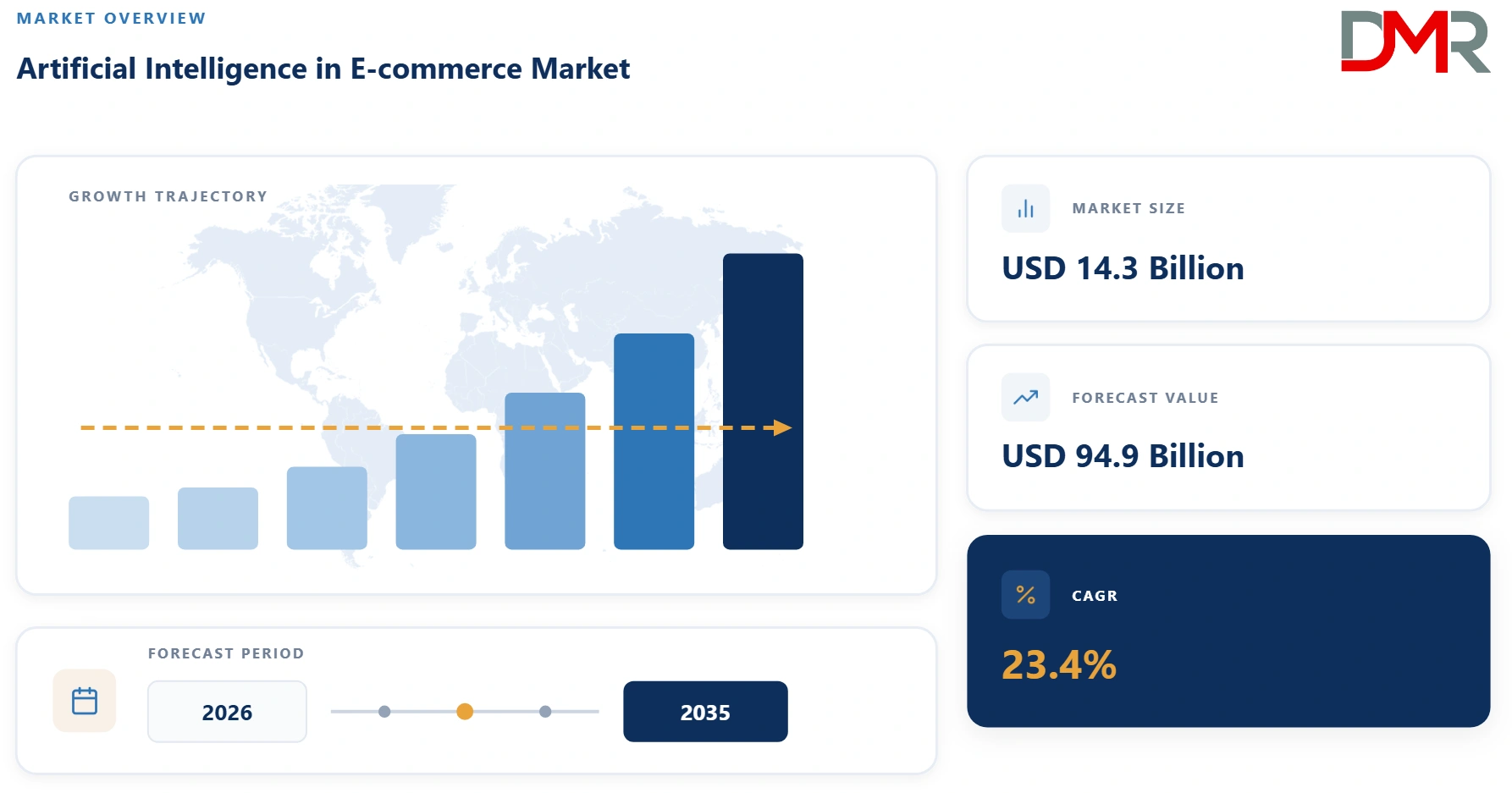
Global Artificial Intelligence in E-commerce Market size is estimated to reach USD 14.3 Bn in 2026 and is further anticipated to reach USD 94.9 Bn by 2035, at a CAGR of 23.4%. Spending is concentrated among retailers and marketplaces large enough to hold their own transaction history, because model quality in this sector depends far more on proprietary behavioural data than on model architecture.
ℹ
To learn more about this report –
Download Your Free Sample Report Here
Scope here covers the software, hosted models and delivery services bought specifically to apply machine learning to online commerce data. That includes ranking and recommendation engines, semantic and visual product search, conversational shopping assistants, promotion and markdown optimisation, transaction fraud scoring, demand sensing tied to fulfilment decisions, and generative systems that draft product copy and enrich catalogue attributes. Excluded from the sizing are general-purpose cloud compute, the underlying commerce platform licence itself, payment processing fees, and store-side retail technology with no online transaction component.
Buyers are rarely data science teams acting alone. Merchandising leaders want more revenue from traffic they have already paid for. Supply chain planners want fewer stockouts without carrying more working capital. Risk teams want chargeback ratios low enough to keep card network fees from stepping up. Each of those groups now holds its own budget line, which is why the market fragments into several distinct application categories rather than consolidating around one flagship product.
What is changing structurally is where discovery happens. For two decades, the product page was the destination and search engine optimisation was the acquisition discipline. Discovery is now moving partly onto conversational surfaces, where an assistant reads structured catalogue data and reasons over it before a shopper ever sees a brand's own site. That shift converts product information management from a housekeeping task into a demand-generation asset, and it pushes retailers to fund attribute enrichment, real-time inventory feeds and machine-readable policy data.
Key Takeaways
- Market Size & Share: Commercial spending is set to expand roughly 6.6 times over the forecast period, adding more than USD 80 Bn of annual revenue between 2026 and 2035 as AI moves from pilot budgets into recurring merchandising and operations spend.
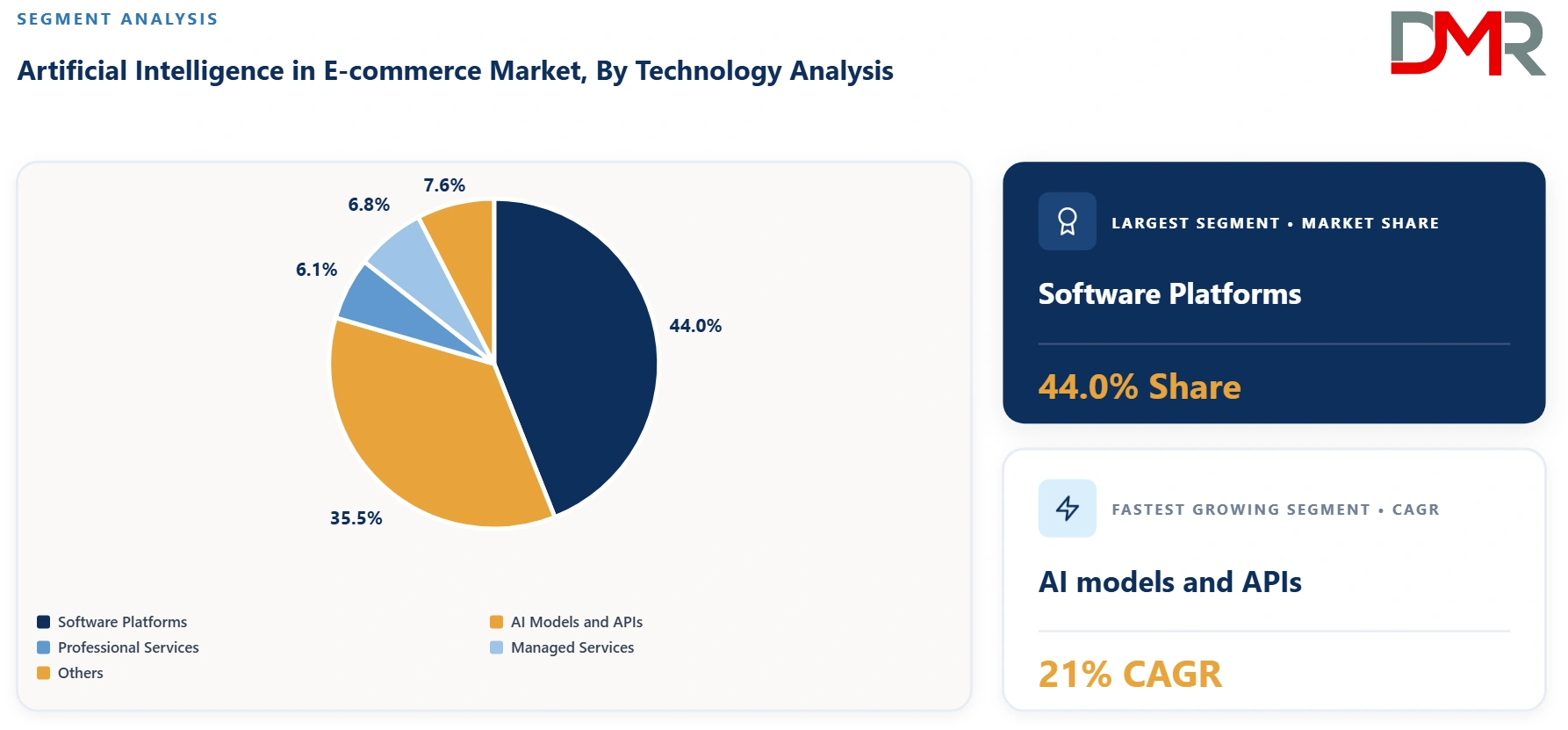
- Offering Analysis: Software platforms are projected to hold a share of around 44% of revenue in 2026, while AI models and APIs consumed directly by merchant engineering teams form the fastest-expanding offering.
- Technology Analysis: Machine learning and deep learning are expected to represent close to 36% of spending in 2026, with natural language processing and generative AI growing quickest as conversational and content workloads scale.
- Regional Analysis: North America is projected to hold approximately 34% of global revenue in 2026, while Asia-Pacific records the highest forecast growth rate at 26.9% for 2026-2035.
- Agentic Discovery Shift: Marketing and catalogue content generation, the fastest-growing application category, is set to represent a share of roughly 9% in 2026, a small base that reflects how recently machine-readable product data became a revenue variable.
- Merchant Economics: Public cloud deployment is expected to account for just over 61% of spending in 2026, keeping entry costs low enough that mid-market retailers can adopt inference-heavy workloads without capital expenditure.
How AI/Gen AI is Transforming the Artificial Intelligence in E-commerce Market?
Generative techniques have changed what the category sells. Earlier systems ranked a fixed catalogue against a query and stopped there. Transformer-based embedding models let a retailer index product attributes, reviews and support transcripts in a single vector space, so a shopper describing a use case in plain language reaches relevant inventory without matching keywords. Retrieval-augmented generation then grounds the answer in live price and stock data rather than in whatever the model absorbed during training, which is the difference between a demonstration and something a merchandiser will sign off on.
Operational impact is quieter but larger in budget terms. Content and catalogue work that previously consumed agency hours now runs as a batch job with human review, and the saving shows up in speed to publish rather than in headcount. Vendors have responded by repackaging capability as agents that hold context across a session and call merchant systems directly.
- Conversational Product Discovery: Language models interpret intent, constraints and budget, then query catalogue indexes to assemble a shortlist with reasoning attached.
- Catalogue Attribute Enrichment: Generative models infer missing structured attributes from images and supplier documents, raising the completeness scores that agent-driven surfaces depend on.
- Computer Vision Merchandising: Visual search, automated background standardisation and returns-image triage reduce manual handling across large SKU counts.
- Demand and Markdown Forecasting: Sequence models blend traffic, promotion and weather signals to set replenishment and price-cut timing at store or fulfilment-node level.
Key Drivers in the Global Artificial Intelligence in E-commerce Market
Two forces account for most of the incremental spending, and they sit on opposite sides of the income statement.
Conversion Pressure on Flat Traffic Economics
Paid acquisition costs have risen faster than online sales in most developed markets, so retailers can no longer buy their way to growth. Personalised ranking, semantic search and tailored promotion sequencing raise revenue per session against traffic that is already paid for, which makes the business case unusually easy to model. A retailer running USD 400 Mn in annual online revenue needs only a low single-digit conversion improvement to fund a full merchandising AI stack several times over. That arithmetic is why software platforms are expected to hold around 44% of 2026 revenue: the buyer wants a managed system, not a research project.
Cost Recovery Across Fraud, Returns and Inventory
Margin leakage after the sale has become the second budget engine. Card-not-present fraud, promotion abuse and serial returns each erode contribution margin in ways that rules-based systems handle poorly, because the patterns shift faster than analysts can rewrite thresholds. Machine learning scoring adapts continuously and, importantly, allows more legitimate transactions through rather than simply blocking more. Fraud detection and payment risk together with supply chain and demand forecasting are projected to absorb close to 31% of application spending in 2026, a share that reflects how directly these workloads defend cash rather than promise upside.
Restraints in the Global Artificial Intelligence in E-commerce Market
Adoption stalls for reasons that have little to do with model capability.
Catalogue Quality and Data Fragmentation
Most retailers hold product data across a commerce platform, a product information management system, a warehouse system and a set of supplier spreadsheets, with conflicting attribute definitions in each. Models trained on that foundation produce recommendations that merchandisers quietly override, and trust rarely recovers after the first bad launch. Remediation is unglamorous and expensive, often consuming six to nine months before any measurable lift appears. Public cloud deployment, expected at just over 61% of the 2026 mix, lowers infrastructure friction but does nothing for the underlying data problem, which is why services still represent a substantial share of total spending.
Regulatory and Liability Exposure
Personalised pricing sits close to several consumer protection regimes, and competition authorities in Europe and North America have opened inquiries into algorithmic price coordination. The EU AI Act adds transparency and documentation duties for systems that profile individuals, while data protection rules constrain the behavioural histories that make recommendation quality possible. Agent-initiated purchases introduce a further unsettled question over who bears the loss when an assistant buys the wrong item. Legal review now routinely delays deployments by a quarter or more, and smaller merchants often defer entirely rather than absorb the compliance overhead.
Growth Opportunities in the Global Artificial Intelligence in E-commerce Market
White space sits where buyer sophistication has outrun vendor packaging.
Mid-Market Retailers in Asia-Pacific
Regional marketplaces in Southeast Asia and India have trained a generation of merchants to expect algorithmic merchandising, yet most independent brands operating outside those marketplaces run on commerce platforms with minimal native intelligence. Localised offerings that handle multilingual catalogues, cash-on-delivery risk scoring and highly promotional pricing cycles address a gap that global vendors have priced themselves out of. Asia-Pacific is projected to grow at 26.9% across 2026-2035, and a disproportionate share of that expansion will come from merchants buying their first packaged system rather than from enterprise renewals.
Grocery and Perishable Assortment
Online grocery carries thin margins, short shelf lives and substitution behaviour that generic recommendation engines handle badly. Vendors that combine shelf-life-aware forecasting, substitution modelling and basket-level promotion optimisation can defend premium pricing because the savings are measurable in shrink and waste. Grocery and consumer packaged goods are expected to account for around 18% of 2026 end-use revenue while ranking as the fastest-growing vertical, which points to an underserved category rather than a saturated one.
Trends in the Global Artificial Intelligence in E-commerce Market
Buying behaviour and product architecture are both shifting, and the two changes reinforce each other.
From Ranked Results to Agent Orchestration
Product design is moving from systems that return a list toward systems that hold a task. An orchestration layer now calls catalogue search, inventory lookup, loyalty status and payment authorisation in sequence, with the language model handling planning rather than retrieval alone. Interoperability standards, including the Model Context Protocol and the newer commerce-specific agent protocols, are pushing vendors to expose their capability as callable tools rather than as a user interface. Retailers increasingly evaluate suppliers on how cleanly they can be invoked by an external agent, a criterion that did not appear in procurement checklists two years ago.
Consumption Pricing Displacing Seat Licences
Commercial models are repricing around inference volume, indexed catalogue size or attributed revenue rather than named users, because the people benefiting from these systems are shoppers rather than employees. Outcome-linked contracts, where part of the fee tracks incremental conversion, are spreading among search and recommendation vendors confident enough to be measured. AI models and APIs, forecast as the fastest-growing offering from a base of nearly 21% in 2026, benefit most from this shift, since consumption billing suits teams that build their own experience layer on top of a supplier's models.
Research Scope and Analysis
Software platforms, machine learning and public cloud deployment are expected to dominate the market in 2026. Product discovery and recommendation remains the leading application, while fashion and apparel represents the largest end-use industry. Generative AI, hybrid deployment, marketing content generation, and grocery applications are projected to record the fastest growth.
ℹ
To learn more about this report –
Download Your Free Sample Report Here
By Offering
Software platforms are projected to lead this axis with approximately 44% of revenue in 2026. Packaged systems for search, recommendation, pricing and fraud dominate because most retailers lack the machine learning staff to assemble equivalent capability, and because platform vendors bundle the connectors, governance tooling and monitoring that make a model usable in production. Buying a platform also transfers accountability, which matters when a ranking change moves revenue within hours. AI models and APIs, expected at close to 21% in 2026, form the fastest-growing offering as larger retailers build differentiated experiences on hosted foundation models and reserve packaged software for commodity workloads. Professional services near 19% reflect the data remediation that precedes most deployments, while managed services around 12% serve merchants who want outcomes without an internal operations team.
By Technology
Machine learning and deep learning are set to represent a share of roughly 36% in 2026, the largest single technology bucket. Gradient-boosted models and neural ranking systems still perform most of the commercially important work in this sector, covering relevance ordering, propensity scoring, fraud classification and lifetime value estimation, and they run cheaply enough to score every session in real time. Natural language processing and generative AI, at nearly 27%, form the fastest-growing technology as conversational assistants, review summarisation and catalogue copy generation move into production. Predictive analytics and forecasting hold close to 19%, tied to demand sensing and replenishment. Computer vision, around 13%, concentrates in visual search, image standardisation and returns inspection, where fashion and home categories generate the clearest payback.
By Deployment
Public cloud deployment is expected to account for just over 61% of the market in 2026. Retail traffic is intensely seasonal, and few merchants can justify owning inference capacity sized for peak trading weeks that pass in days. Cloud delivery also gives access to accelerator hardware that would otherwise require a capital cycle. Hybrid deployment, at close to 22%, grows fastest as larger retailers keep transaction and identity data inside their own boundary for residency reasons while calling external models for language and vision workloads. Private cloud and on-premises installations near 13% persist among banks-adjacent marketplaces and regulated categories where auditors resist third-party processing of payment data.
By Application
Product discovery and recommendation is projected to lead with a share of around 26% in 2026, since ranking quality touches every session and its effect on revenue is measurable within a single test cycle. Conversational commerce and customer service follow at nearly 19%, absorbing both pre-purchase assistance and post-purchase enquiry deflection. Fraud detection and payment risk near 16% and supply chain and demand forecasting close to 15% defend margin rather than build revenue, which makes their budgets unusually stable through downturns. Dynamic pricing and promotion sits at roughly 12%, constrained more by regulatory caution than by technical readiness. Marketing content generation, around 9%, is the fastest-growing application because machine-readable catalogue content has become an acquisition variable in its own right.
By End Use Industry
Fashion and apparel is expected to hold approximately 24% of end-use revenue in 2026. High SKU counts, subjective fit and return rates well above other categories give this vertical the strongest combination of upside and cost recovery, and visual search fits its buying behaviour naturally. Consumer electronics, at nearly 21%, relies on specification-heavy comparison and attribute normalisation across suppliers. Grocery and consumer packaged goods, close to 18%, grows fastest as online penetration rises and perishability makes forecasting accuracy directly cash-relevant. Beauty and personal care around 12% leans on virtual try-on and shade matching, while home and furniture near 11% uses vision models for room visualisation. Automotive parts and accessories, at roughly 7%, depends heavily on fitment data accuracy.
The Global Artificial Intelligence in E-commerce Market Report is Segmented Based on the Following
By Offering
- Software Platforms
- AI Models and APIs
- Professional Services
- Managed Services
- Others
By Technology
- Machine Learning and Deep Learning
- Natural Language Processing and Generative AI
- Predictive Analytics and Forecasting
- Computer Vision
- Others
By Deployment
- Public Cloud
- Hybrid Cloud
- Private Cloud and On-Premises
- Others
By Application
- Product Discovery and Recommendation
- Conversational Commerce and Customer Service
- Fraud Detection and Payment Risk
- Supply Chain and Demand Forecasting
- Dynamic Pricing and Promotion
- Marketing Content Generation
- Others
By End Use Industry
- Fashion and Apparel
- Consumer Electronics
- Grocery and Consumer Packaged Goods
- Beauty and Personal Care
- Home and Furniture
- Automotive Parts and Accessories
- Others
Regional Analysis
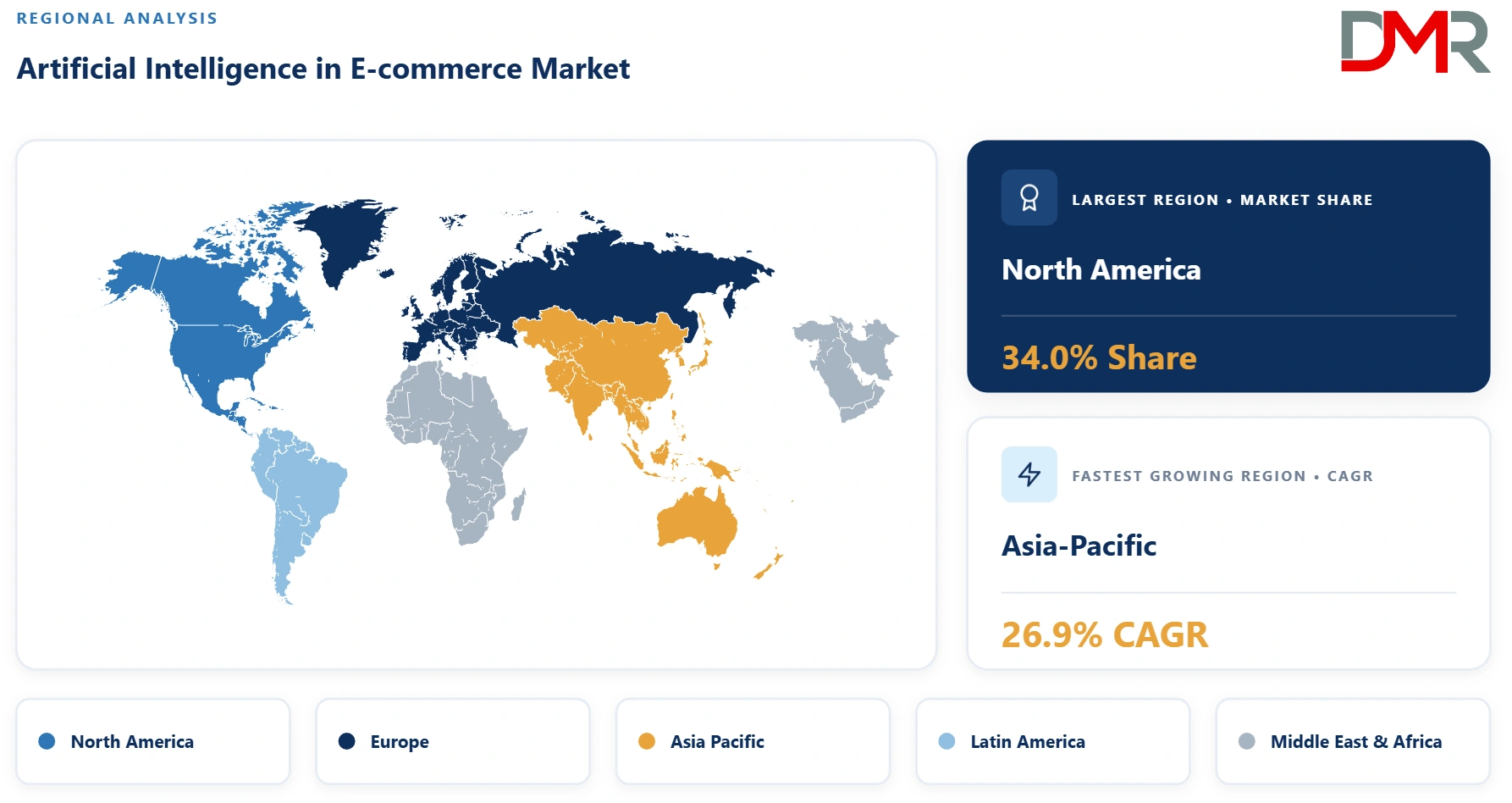
Demand distribution in 2026 follows software purchasing power rather than raw transaction volume, which explains why the ranking differs from any league table of e-commerce turnover. North America is expected to hold approximately 34% of global revenue, supported by high average contract values, mature vendor ecosystems and retailers accustomed to buying merchandising technology as a licensed product. Asia-Pacific follows at around 31%, where enormous transaction volumes are partly captured by marketplaces building in-house rather than buying. Europe, Latin America and the Middle East and Africa account for the balance, with Europe holding the largest of the three on the strength of multi-country retail groups, and the two smaller regions constrained by fragmented payment infrastructure and thinner local vendor presence.
ℹ
To learn more about this report –
Download Your Free Sample Report Here
Region with the Largest Revenue Share
North America is expected to remain the largest regional market for Artificial Intelligence in E-commerce, accounting for approximately 34% of global market share in 2026. Concentration among a small number of very large retailers and marketplaces means procurement decisions are few but substantial, and those buyers renew annually at enterprise price points that lift the region's revenue well above its share of global online transaction volume. Vendor headquarters, model providers and the venture capital that funds specialist suppliers all cluster in the same market, shortening the distance between product roadmap and buyer feedback. Card-not-present fraud exposure is also unusually high, which sustains a large independent budget for risk scoring that sits outside the merchandising conversation entirely.
Region with the Highest CAGR
Asia-Pacific is projected to register the highest growth rate, expanding at 26.9% across 2026-2035. Growth is pulled by three things at once: online penetration still rising quickly across India and Southeast Asia, domestic cloud and model providers cutting the local cost of inference, and a mid-market merchant base moving off spreadsheet-driven merchandising for the first time. Marketplace competition in the region is fierce enough that ranking and pricing capability functions as a survival requirement rather than an optimisation. Government-backed digital commerce initiatives in several markets are additionally standardising catalogue and payment interfaces, which lowers the integration cost that has historically kept smaller merchants out of this category.
By Region
North America
Europe
- Germany
- The U.K.
- France
- Italy
- Russia
- Spain
- Benelux
- Nordic
- Rest of Europe
Asia-Pacific
- China
- Japan
- South Korea
- India
- ANZ
- ASEAN
- Rest of Asia-Pacific
Latin America
- Brazil
- Mexico
- Argentina
- Colombia
- Rest of Latin America
Middle East & Africa
- Saudi Arabia
- UAE
- South Africa
- Israel
- Egypt
- Rest of MEA
Competitive Landscape
Competition splits into two tiers that rarely meet head on. Platform and cloud majors compete on breadth, bundling AI capability into commerce suites and marketing clouds so that the incremental purchase looks like a module rather than a new vendor relationship. Specialists compete on depth in a single workload, most often search relevance, personalisation or risk scoring, and win where measurable performance beats convenience. Consolidation has been steady, with suite vendors acquiring specialists to close capability gaps rather than build them. Differentiation increasingly rests on data access and integration surface rather than on model quality, since comparable foundation models are available to everyone.
Some of the Prominent Players in the Global Artificial Intelligence in E-commerce Market Are
- Google LLC
- Microsoft Corporation
- Amazon Web Services, Inc.
- Salesforce, Inc.
- Adobe Inc.
- SAP SE
- Shopify Inc.
- Alibaba Group Holding Limited
- Bloomreach, Inc.
- Coveo Solutions Inc.
- Other Key Players
Recent Developments
- In May 2026, Google introduced a universal cart capability and a conversational attribute schema for its merchant tooling, letting retailers describe products in the nuanced language shoppers use when briefing an assistant rather than in keyword-optimised copy.
- In April 2026, Microsoft adopted the universal commerce protocol inside its merchant centre and connected Shopify catalogue data to Copilot, giving mid-market retailers a second agent surface without commissioning a separate integration.
- In January 2026, Google published the Universal Commerce Protocol as an open standard for agent-to-agent transactions, co-developed with Shopify and several large retailers, so external assistants can read live pricing and inventory and assemble multi-item carts.
- In December 2025, Stripe released an agentic commerce suite allowing merchants to sell through any compatible assistant, with several apparel, accessories and furniture retailers transacting from launch day.
- In September 2025, OpenAI opened in-chat purchasing to Etsy sellers and more than a million Shopify merchants using an open commerce protocol built jointly with Stripe, moving conversational shopping from recommendation to completed transaction.
- In April 2025, Visa and Mastercard each set out frameworks for authorising verified AI agents to transact on a cardholder's behalf, addressing the authorisation and liability gap that had held autonomous checkout in pilot.
Report Details
| Report Characteristics |
| Market Size (2026) |
USD 14.3 Bn |
| Forecast Value (2035) |
USD 94.9 Bn |
| CAGR (2026-2035) |
23.4% |
| Historical Data |
2021 to 2025 |
| Forecast Data |
2027 to 2035 |
| Base Year |
2025 |
| Estimate Year |
2026 |
| Segments Covered |
By Offering, By Technology, By Deployment, By Application, By End Use Industry, and By Region |
| Regional Coverage |
North America – The US and Canada; Europe – Germany, The UK, France, Russia, Spain, Italy, Benelux, Nordic, & Rest of Europe; Asia-Pacific – China, Japan, South Korea, India, ANZ, ASEAN, Rest of APAC; Latin America – Brazil, Mexico, Argentina, Colombia, Rest of Latin America; Middle East & Africa – Saudi Arabia, UAE, South Africa, Turkey, Egypt, Israel, & Rest of MEA |
Frequently Asked Questions
How big is the Global Artificial Intelligence in E-commerce Market?
▾ Global revenue is estimated at USD 14.3 Bn in 2026 and is anticipated to reach USD 94.9 Bn by 2035. Sizing covers software, hosted models and services bought specifically for commerce workloads, and excludes general-purpose cloud compute and commerce platform licences.
What is the growth rate of the Global Artificial Intelligence in E-commerce Market?
▾ The sector is forecast to grow at a CAGR of 23.4% between 2026 and 2035. Growth is carried by conversion improvement on acquisition traffic that is already paid for, and by margin defence across fraud, returns and inventory, with generative and conversational workloads adding a newer layer of demand on top.
Which region holds the largest share in the Global Artificial Intelligence in E-commerce Market?
▾ North America is projected to hold the largest position, with approximately 34% of global market share in 2026, reflecting concentrated enterprise buyers and high contract values. Asia-Pacific ranks second at around 31% in 2026 and posts the strongest forecast growth rate across the period.
Who are the key players in the Global Artificial Intelligence in E-commerce Market?
▾ Prominent participants include Google LLC, Microsoft Corporation, Amazon Web Services, Inc., Salesforce, Inc., Adobe Inc., SAP SE, Shopify Inc., Alibaba Group Holding Limited, Bloomreach, Inc. and Coveo Solutions Inc. Platform majors compete on suite breadth, while specialists defend narrower workloads such as search relevance, personalisation and transaction risk scoring.
Which application segment leads the Artificial Intelligence in E-commerce Market?
▾ Product discovery and recommendation is expected to lead the Global Artificial Intelligence in E-commerce Market, with a share of roughly 26% in 2026, because ranking quality affects every session and its revenue impact is measurable quickly. Marketing content generation is the fastest-growing application as machine-readable catalogue data becomes an acquisition variable.