Asia Pacific Orthopedic Biomaterial Market Snapshot
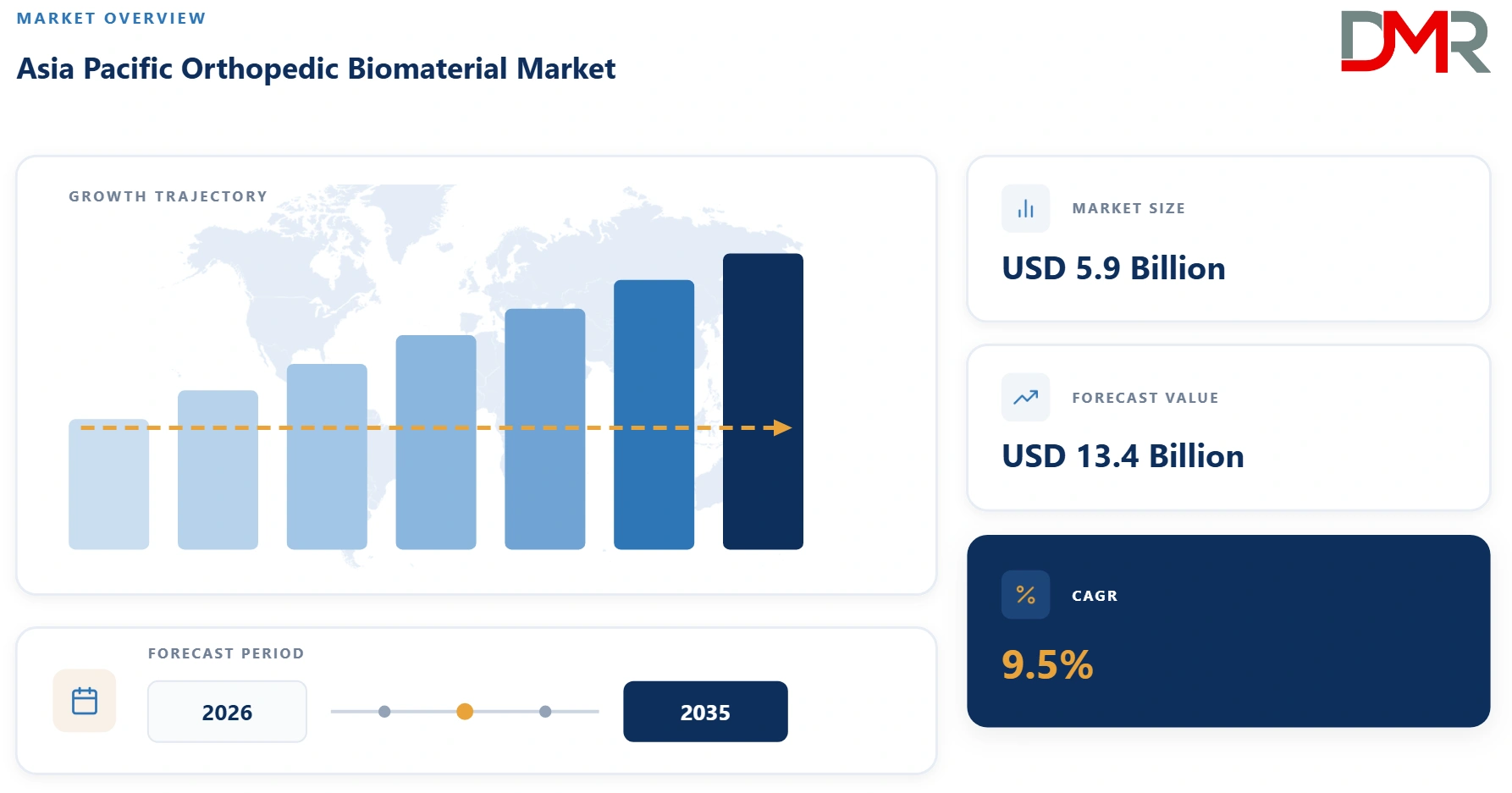
- Market Size, 2026: USD 5.9 billion
- Market Size, 2035: USD 13.4 billion
- CAGR, 2026-2035: 9.5%
- Leading Material Segment, 2026: Metallic Biomaterials, 31.0%
- Leading Application Segment, 2026: Joint Reconstruction, 31.0%
- Leading End-User Segment, 2026: Hospitals, 69.0%
- Fastest-Growing Material Segment: Polymeric Biomaterials, 10.4% CAGR
What is the Asia Pacific Orthopedic Biomaterial and its Market Size?
The Asia Pacific market is estimated at USD 5.9 billion in 2026 and is projected to reach approximately USD 13.4 billion by 2035, representing a 9.5% CAGR.
ℹ
To learn more about this report –
Download Your Free Sample Report Here
Asia Pacific orthopedic biomaterials comprise metals, polymers, ceramics, natural/biological materials and related biomaterial systems used to repair, replace, stabilize or regenerate musculoskeletal structures. The market encompasses materials incorporated into joint-replacement components, spinal implants, trauma-fixation systems, craniomaxillofacial implants, bone-graft substitutes, bone cements, porous structures and regenerative orthopedic products.
Use Cases
- Joint reconstruction: Biomaterials enable durable hip, knee and shoulder replacement components with biocompatibility and mechanical strength.
- Spinal fusion: PEEK cages, titanium implants and bioactive materials support vertebral stabilization and bone fusion.
- Trauma fixation: Metallic plates, screws, nails and polymeric systems stabilize fractures while supporting bone healing.
- Bone-graft substitution: Synthetic ceramics, collagen matrices and demineralized bone materials support bone regeneration.
- Craniomaxillofacial reconstruction: Patient-specific metals, polymers and ceramics restore complex cranial and facial anatomy.
- Minimally invasive orthopedic surgery: Advanced biomaterials enable smaller implants, improved fixation and tissue-preserving surgical techniques.
Key Takeaways
- Market Size: Asia Pacific orthopedic biomaterials are estimated at USD 5.9 billion in 2026 and could reach USD 13.4 billion by 2035.
- Growth: The market is forecast to expand at approximately 9.5% CAGR through 2035, supported by procedure growth and material innovation.
- Key Drivers: Aging populations, osteoarthritis, osteoporosis, trauma incidence, rising healthcare expenditure and expanding surgical capacity remain fundamental growth catalysts.
- Segment Dominance: Metallic biomaterials are estimated to lead material demand, while joint reconstruction leads application demand.
- Fastest Growth: Polymeric biomaterials, particularly PEEK and advanced polymer systems, are expected to grow fastest as surgeons seek lighter, radiolucent and mechanically optimized materials.
- Geographic Opportunity: China is the largest national market, while India represents one of the most attractive high-growth opportunities. Published orthopedic-device data also identify China as the largest Asia-Pacific market and India as a particularly strong growth market.
How AI, 3D Printing and Digital Orthopedics are Transforming the Market?
AI, 3D printing and digital surgical technologies are changing orthopedic biomaterials by connecting material selection with patient anatomy, surgical planning and implant positioning. AI-assisted navigation increasingly helps surgeons identify anatomical landmarks and optimize implant placement, while additive manufacturing enables porous titanium, patient-specific implants and complex lattice geometries. DePuy Synthes, for example, launched VELYS Hip Navigation with AI assistance in June 2026, reporting reduced workflow time in its referenced evaluation.
The benefits extend beyond surgical precision. Advanced manufacturing can reduce material waste, enable anatomically customized components and create porous structures designed to encourage bone ingrowth. Digital workflows can improve reproducibility and reduce operating-room time, while data from robotic and navigation platforms can support postoperative assessment.
Key Drivers in the Asia Pacific Orthopedic Biomaterial Market
Rising Prevalence of Musculoskeletal Disorders
The increasing prevalence of osteoarthritis, osteoporosis, degenerative spine conditions, fractures, and other musculoskeletal disorders is driving demand for orthopedic biomaterials across Asia Pacific. Aging populations, sedentary lifestyles, obesity, sports injuries, and road accidents are increasing the need for joint reconstruction, spinal procedures, fracture fixation, and bone-regeneration treatments. Improved diagnosis and greater access to orthopedic care are encouraging more patients to undergo surgical treatment, supporting demand for metallic implants, polymers, ceramics, bone-graft substitutes, and biological materials.
Expansion of Healthcare Infrastructure and Orthopedic Surgery
Expanding healthcare infrastructure is improving access to advanced orthopedic procedures across Asia Pacific. Investments in hospitals, specialty orthopedic centers, surgical facilities, diagnostic technologies, and medical-device manufacturing are increasing treatment capacity. China and India offer significant opportunities due to their large patient populations and developing healthcare systems, while Japan, South Korea, Singapore, and Australia support demand for sophisticated orthopedic technologies. Increasing medical tourism, insurance coverage, and patient awareness are further encouraging orthopedic surgeries and biomaterial adoption.
Restraints in the Asia Pacific Orthopedic Biomaterial Market
High Cost of Advanced Biomaterials
The high cost of advanced orthopedic biomaterials remains a major challenge, particularly in price-sensitive emerging economies. PEEK, porous titanium, bioactive ceramics, patient-specific implants, and specialized bone-regeneration products require sophisticated manufacturing, extensive testing, and stringent quality controls, increasing overall costs. Hospitals with limited budgets may prioritize conventional materials, while unequal healthcare spending and differences in insurance coverage can restrict adoption. Strong price competition from domestic manufacturers also places pressure on premium biomaterial suppliers.
Regulatory and Clinical Validation Challenges
Regulatory complexity can delay the development and commercialization of orthopedic biomaterials across Asia Pacific. Major markets have different requirements for product registration, clinical evidence, biocompatibility testing, mechanical performance, manufacturing quality, and post-market surveillance. Novel biomaterials and regenerative products may require extensive clinical validation because their long-term biological and mechanical performance must be demonstrated. Companies operating across multiple countries therefore face additional testing, compliance costs, and longer commercialization timelines.
Growth Opportunities in the Asia Pacific Orthopedic Biomaterial Market
3D-Printed and Patient-Specific Orthopedic Implants
Additive manufacturing presents a significant opportunity by enabling customized implants and complex structures that are difficult to produce through conventional manufacturing. Three-dimensional printing can create porous architectures designed to support bone integration while allowing implants to match individual patient anatomy. The technology is particularly relevant for complex trauma, spinal reconstruction, revision surgery, and craniomaxillofacial procedures. Increasing adoption of medical imaging, computer-aided design, and digital surgical planning is creating an integrated pathway from patient imaging to customized implant production.
Advanced Polymers and Regenerative Biomaterials
Advanced polymers, bioactive ceramics, synthetic bone grafts, and biological materials offer strong growth opportunities as orthopedic treatment increasingly focuses on biological outcomes. PEEK is gaining adoption in spinal applications because of its mechanical characteristics and radiolucency, while calcium phosphate, hydroxyapatite, collagen, and other regenerative materials support bone formation and healing. Growing research activity and healthcare investment across China, Japan, India, and South Korea are supporting the development of next-generation biomaterials and expanding their clinical applications.
Trends in the Asia Pacific Orthopedic Biomaterial Market
Increasing Personalization and Digitalization
The orthopedic biomaterials industry is increasingly integrating medical imaging, artificial intelligence, robotics, computer-aided design, and additive manufacturing. These technologies enable implants to be designed around individual patient anatomy rather than relying solely on standardized components. Personalized solutions are particularly valuable for complex orthopedic procedures, while digital workflows improve surgical planning and support customized implant geometries. The convergence of biomaterials and digital technologies is consequently creating new opportunities for patient-specific implants and digitally assisted orthopedic procedures.
Shift Toward Local Manufacturing and Cost-Efficient Solutions
Asia Pacific is experiencing increasing localization of orthopedic biomaterial and implant manufacturing. Domestic manufacturers in China, India, South Korea, and other Asian markets are expanding production capabilities and product portfolios to reduce import dependence and provide more affordable alternatives. Healthcare providers are also placing greater emphasis on cost-effectiveness as orthopedic procedure volumes increase. This trend is intensifying competition between multinational companies and regional manufacturers while encouraging suppliers to combine competitive pricing with improved material performance, clinical evidence, and regulatory compliance.
Research Scope and Analysis
The Asia Pacific orthopedic biomaterial market is segmented By Material Type, By Application, and By End User. The analysis covers conventional and advanced metals, polymers, ceramics, natural/biological biomaterials, major orthopedic procedures and healthcare delivery settings across key Asia-Pacific markets.
ℹ
To learn more about this report –
Download Your Free Sample Report Here
By Material Type Analysis
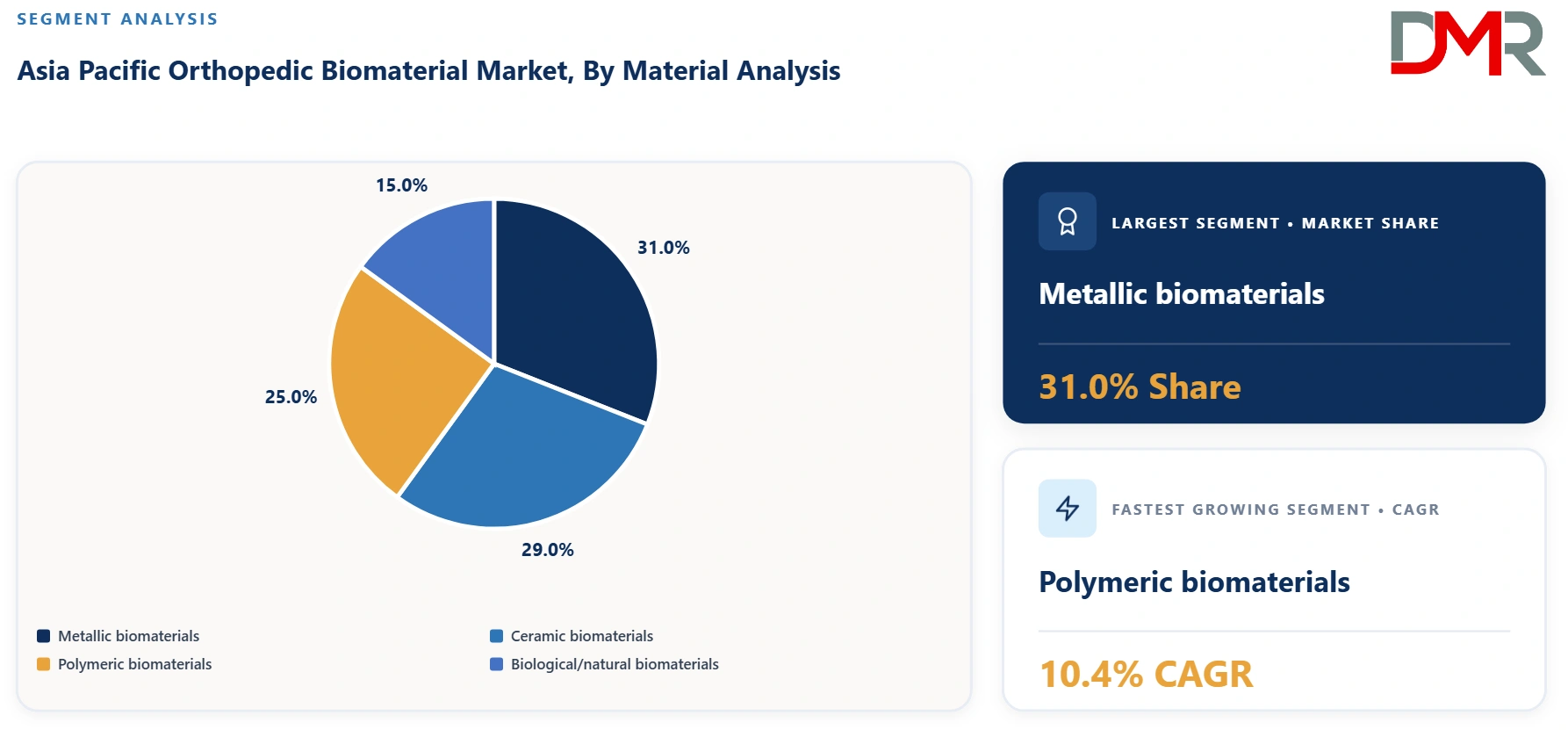
Metallic biomaterials are estimated to represent the dominant material category in 2026, with approximately 31.0% share, supported by extensive use of titanium and titanium alloys in joint, spine and trauma implants and the mature manufacturing ecosystem for metallic orthopedic components. Ceramic biomaterials are estimated to rank second at approximately 29.0%, benefiting from calcium phosphate, hydroxyapatite and bioactive-glass applications in bone regeneration and advanced joint systems. Polymeric biomaterials account for an estimated 25.0%, led by polyethylene, PEEK and PMMA bone cement. Within this category, polymeric biomaterials are projected to be the fastest-growing segment at approximately 10.4% CAGR, driven by PEEK's radiolucency, favorable mechanical characteristics and expanding spinal applications. Biological/natural biomaterials account for the remaining approximately 15.0%, with collagen, demineralized bone matrix and allografts supporting regenerative applications. The category mix reflects the coexistence of mature load-bearing materials with rapidly expanding regenerative and advanced polymer technologies. Grand View Research previously identified ceramics and bioactive glass as the largest material segment, highlighting how market shares vary with taxonomy and product inclusion; its regional research also identifies polymers as the fastest-growing category.
By Application Analysis
Joint reconstruction is estimated to be the leading application in 2026, representing approximately 31.0% of regional demand, driven by growing hip, knee and shoulder replacement volumes associated with aging and osteoarthritis. Spinal fusion and fixation follows at approximately 23.0%, supported by degenerative spine disease, trauma and increasing adoption of advanced PEEK cages and titanium fixation systems. Trauma and fracture fixation represents approximately 21.0%, reflecting the large underlying burden of road traffic injuries, falls, sports injuries and fragility fractures across densely populated Asian markets. Bone-graft substitutes account for roughly 13.0% and are projected to be among the faster-growing applications as surgeons increasingly adopt synthetic and biologically derived alternatives to autograft. Craniomaxillofacial applications contribute approximately 8.0%, with patient-specific implants providing an important premium opportunity, while other applications represent approximately 4.0%. Joint reconstruction remains dominant because it combines high procedure volumes with relatively high material content per procedure; meanwhile, bone-graft and regenerative applications are expected to expand more quickly as biological and bioactive materials mature.
By End User Analysis
Hospitals are estimated to dominate the Asia Pacific orthopedic biomaterials market in 2026 with approximately 69.0% share, reflecting their concentration of complex joint reconstruction, spine, trauma, revision and craniomaxillofacial procedures. Hospitals also have greater access to surgical navigation, robotics, advanced imaging and specialized orthopedic teams, supporting adoption of premium biomaterials. Ambulatory surgical centers account for approximately 18.0%, with their share expected to increase as outpatient orthopedic surgery expands and minimally invasive procedures become more common. Orthopedic specialty clinics contribute approximately 10.0%, particularly in mature markets such as Japan, Australia, South Korea and Singapore, where specialist care infrastructure is well developed. Others, including rehabilitation-linked surgical facilities and smaller private treatment centers, account for approximately 3.0%. ASC demand is expected to grow fastest because healthcare systems increasingly seek lower-cost procedural pathways, shorter hospital stays and improved operating-room utilization. However, complex implant procedures requiring inpatient monitoring will continue to anchor the hospital channel throughout the forecast period.
The Asia Pacific Orthopedic Biomaterial Market Report is segmented on the basis of the following:
By Material Type
- Metallic Biomaterials
- Titanium and Titanium Alloys
- Cobalt-Chromium Alloys
- Stainless Steel
- Polymeric Biomaterials
- Polyethylene
- PEEK (Polyether Ether Ketone)
- PMMA Bone Cement
- Ceramic Biomaterials
- Calcium Phosphate
- Hydroxyapatite
- Bioactive Glass
- Biological/Natural Biomaterials
- Collagen
- Demineralized Bone Matrix
- Allografts
By Application
- Joint Reconstruction
- Spinal Fusion and Fixation
- Trauma and Fracture Fixation
- Craniomaxillofacial
- Bone Graft Substitutes
- Others
By End User
- Hospitals
- Ambulatory Surgical Centers
- Orthopedic Specialty Clinics
- Others
Country Analysis
China is estimated to represent the largest national market, accounting for roughly 35% of regional revenue in 2026, followed by Japan at approximately 21% and India at approximately 19%. This hierarchy is broadly consistent with published regional orthopedic market estimates, which identify China as the largest Asia-Pacific market and Japan and India as the next major markets. South Korea contributes approximately 8%, while Australia and New Zealand together represent approximately 6%; ASEAN and the rest of Asia Pacific account for the balance. India is expected to be the fastest-growing major market, benefiting from expanding healthcare infrastructure, a growing middle class, increasing orthopedic awareness and medical tourism. China offers the greatest absolute revenue opportunity but faces procurement-driven pricing pressure. Japan offers premium-material opportunities due to its aging population and sophisticated healthcare system, while South Korea and Australia provide attractive adoption environments for advanced implants and digital orthopedic technologies.
Regulatory Landscape
The regulatory environment is a critical determinant of market entry, product economics and innovation speed. China regulates orthopedic implants and biomaterials through NMPA, with ongoing updates to standards for orthopedic fixation devices and implants; in March 2026, Chinese authorities announced 26 updated medical-device industry standards, including standards covering metallic bone plates. Japan operates through PMDA/MHLW review processes, with dedicated orthopedic categories covering joint, fixation and spinal devices. India regulates medical devices under the Drugs & Cosmetics Act and Medical Devices Rules 2017, while orthopedic knee implants are subject to government price-control measures. The opportunity is substantial for companies capable of navigating country-specific submissions, but regulatory fragmentation increases launch costs and favors firms with established local regulatory teams.
Investment and White Space Analysis
Investment opportunities are concentrated in advanced polymers, porous titanium, bioactive ceramics, patient-specific 3D printing, bone-graft substitutes and digital orthopedic ecosystems. The strongest white space exists where premium material technologies can be combined with Asian cost structures. India offers particularly attractive expansion potential because procedure volumes and healthcare infrastructure are increasing from a relatively lower base, while China offers scale and increasingly capable domestic manufacturing. ASEAN markets provide opportunities for distributors and premium orthopedic suppliers linked to medical tourism. Risks include pricing pressure, reimbursement uncertainty, lengthy clinical validation and competition from local manufacturers. Strategic investors should prioritize companies with differentiated material IP, regulatory approvals, surgeon networks, local manufacturing and complementary digital technologies rather than undifferentiated commodity implant businesses.
By Region
Asia-Pacific
- China
- Japan
- India
- Australia
- South Korea
- Rest of APAC
Competitive Landscape
The Asia Pacific orthopedic biomaterials market is moderately consolidated at the premium end but fragmented across domestic and regional manufacturers. Multinational companies including DePuy Synthes, Stryker, Zimmer Biomet, Smith+Nephew, Medtronic and B. Braun compete with Asian companies such as MicroPort and numerous Chinese, Japanese, Korean and Indian manufacturers. Competition is increasingly based on implant performance, clinical evidence, surgeon relationships, product breadth, digital integration and cost rather than material selection alone. Global companies are pursuing portfolio acquisitions, digital surgery and advanced navigation, while Asian manufacturers are emphasizing localized manufacturing and value-based pricing. China in particular is seeing stronger domestic competition as procurement reforms compress prices and encourage local suppliers to scale.
Some of the prominent players in the Asia Pacific Orthopedic Biomaterial Market are:
- Zimmer Biomet
- Stryker
- Johnson & Johnson MedTech
- DePuy Synthes
- Medtronic
- Smith+Nephew
- Globus Medical
- Arthrex
- NuVasive
- Wright Medical Group
- Invibio
- Victrex
- Heraeus
- Evonik Industries
- DSM
- Terumo
- Exactech
- CAM Bioceramics
- Collagen Matrix
- AdvanSource Biomaterials
- Matexcel
- MicroPort Scientific
- Chunli Medical
- AK Medical
- Beijing Chunlizhengda Medical Instruments
- Dabo Medical
- Corin Group
- Aesculap
- B. Braun
- Biomet 3i
- Wright Medical Technology
- Conmed
- Osteomed
- OsteoMed
- Medartis
- LimaCorporate
- Amplitude Surgical
- Japan Medical Dynamic Marketing
- Kyocera
- Olympus
- Other Key Players
Recent Developments
- July 2026: DePuy Synthes acquired Expanding Innovations to add expandable interbody cage technology to its spine portfolio and strengthen its position in lumbar fusion.
- June 2026: DePuy Synthes launched VELYS Hip Navigation with AI Assistance, designed to automate image interpretation and anatomical landmark identification; the company reported a 57% reduction in referenced workflow time versus manual workflows.
- August 2025: MicroPort Orthopedics obtained expanded NMPA approval for its Evolution MPX knee system, while its NEXUS femoral stem received U.S. FDA 510(k) clearance, demonstrating continued orthopedic portfolio expansion.
- March 2025: Johnson & Johnson MedTech showcased new implants, techniques and data-driven technologies across joint reconstruction, trauma, extremities and spine at AAOS 2025, highlighting the industry's shift toward digital orthopedics.
- March 2025: Smith+Nephew highlighted CORI robotics, CORIOGRAPH planning and personalized reconstruction technologies across knee, hip and shoulder procedures, reinforcing the convergence of biomaterials and digitally assisted surgery.
- October 2025: Johnson & Johnson announced its intention to separate its Orthopaedics business as DePuy Synthes, creating a standalone orthopedics-focused company intended to increase strategic focus and accelerate growth.
Report Details
| Report Characteristics |
| Market Size (2026) |
USD 5.9 Bn |
| Forecast Value (2035) |
USD 13.4 Bn |
| CAGR (2026–2035) |
9.5% |
| Historical Data |
2021 – 2025 |
| Forecast Data |
2026 – 2035 |
| Base Year |
2025 |
| Segments Covered |
By Material Type, By Application, By End User |
| Regional Coverage |
Asia-Pacific – China, Japan, India, Australia, South Korea, Rest of APAC |
Frequently Asked Questions
What is the size of the Asia Pacific Orthopedic Biomaterial Market in 2026?
▾ The Asia Pacific Orthopedic Biomaterial Market is estimated to reach USD 5.9 billion in 2026, supported by rising orthopedic procedures and biomaterial adoption.
What will be the Asia Pacific Orthopedic Biomaterial Market size by 2035?
▾ The Asia Pacific Orthopedic Biomaterial Market is projected to reach approximately USD 13.4 billion by 2035, reflecting sustained regional healthcare expansion.
What is the CAGR of the Asia Pacific Orthopedic Biomaterial Market?
▾ The Asia Pacific Orthopedic Biomaterial Market is expected to grow at approximately 9.5% CAGR from 2026 to 2035.
What are the key growth drivers of the Asia Pacific Orthopedic Biomaterial Market?
▾ The Asia Pacific Orthopedic Biomaterial Market is driven by population aging, rising osteoarthritis, osteoporosis, trauma cases, orthopedic surgeries and healthcare infrastructure investments.
Which material segment leads the Asia Pacific Orthopedic Biomaterial Market?
▾ Metallic Biomaterials are expected to lead the Asia Pacific Orthopedic Biomaterial Market in 2026, accounting for approximately 31% market share.
Which is the fastest-growing segment in the Asia Pacific Orthopedic Biomaterial Market?
▾ Polymeric Biomaterials are projected to be the fastest-growing segment of the Asia Pacific Orthopedic Biomaterial Market, with an estimated 10.4% CAGR through 2035.
Which country dominates the Asia Pacific Orthopedic Biomaterial Market?
▾ China is expected to remain the largest country-level market in the Asia Pacific Orthopedic Biomaterial Market, while India is projected to record one of the fastest growth rates.
Who are the key players in the Asia Pacific Orthopedic Biomaterial Market?
▾ Major players in the Asia Pacific Orthopedic Biomaterial Market include Stryker, DePuy Synthes, Zimmer Biomet, Smith+Nephew, MicroPort, Medtronic, B. Braun and Arthrex.