Asia Pacific Underwear Market Snapshot
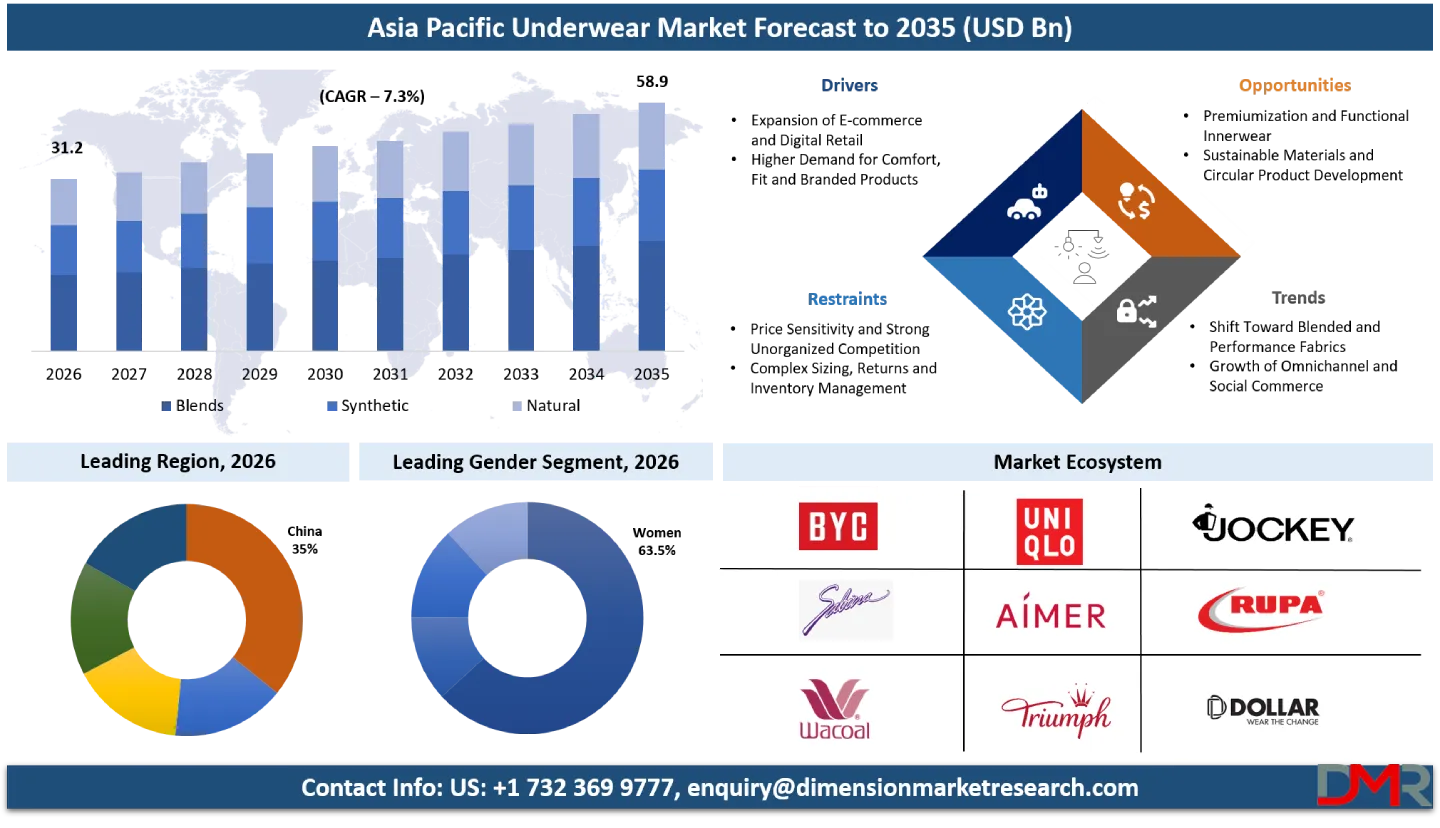
- Market Value: The Asia Pacific underwear market size is expected to reach USD 54.8 billion by 2035 from USD 31.2 billion in 2026, at a CAGR of 6.5%.
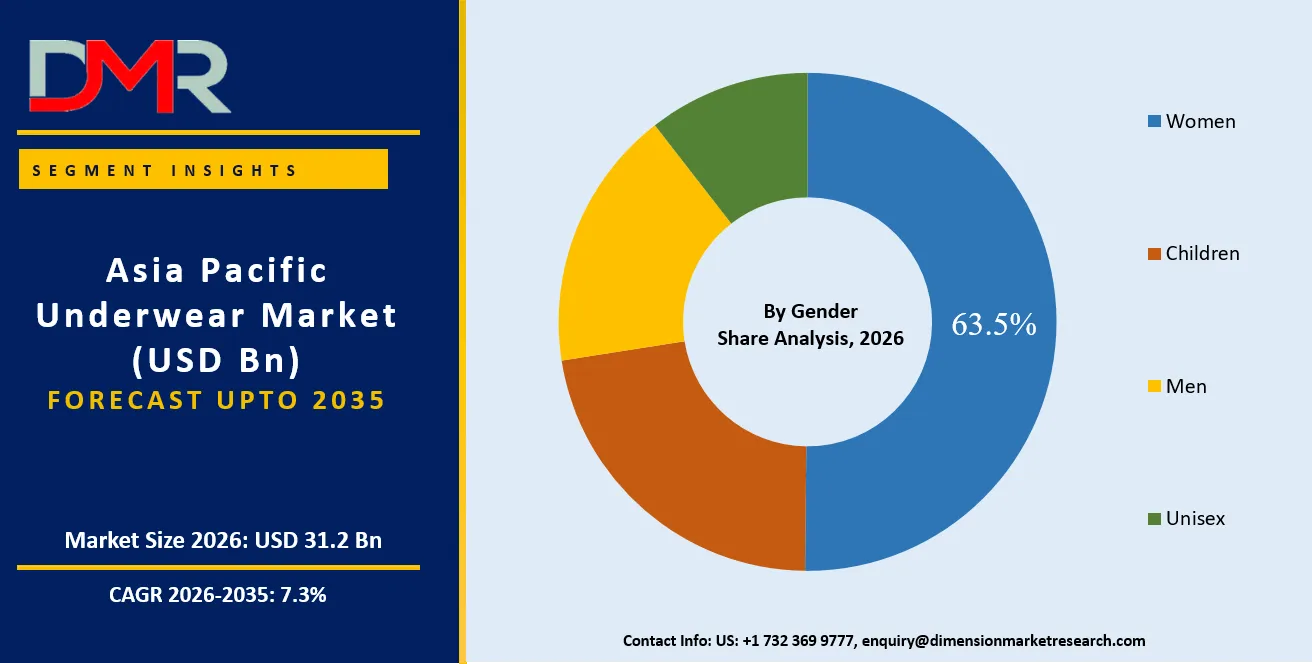
- By Gender Segment Analysis: Women segment dominated with 63.5% share in 2026.
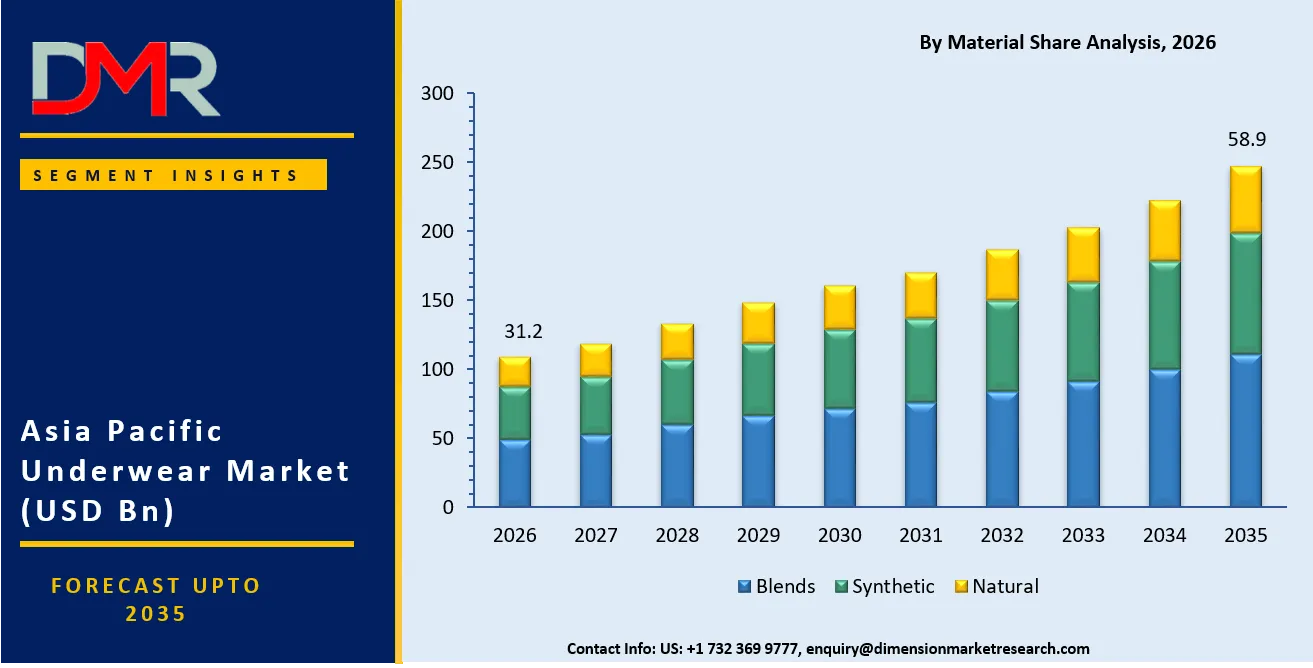
- By Material Segment Analysis: Blends segment led material types with 48.0% share in 2026.
- By Price Range Segment Analysis: Mass/Economy segment held 52.0% share in 2026.
- By Distribution Channel Segment Analysis: Online / E-commerce channel led with 38.0% share in 2026.
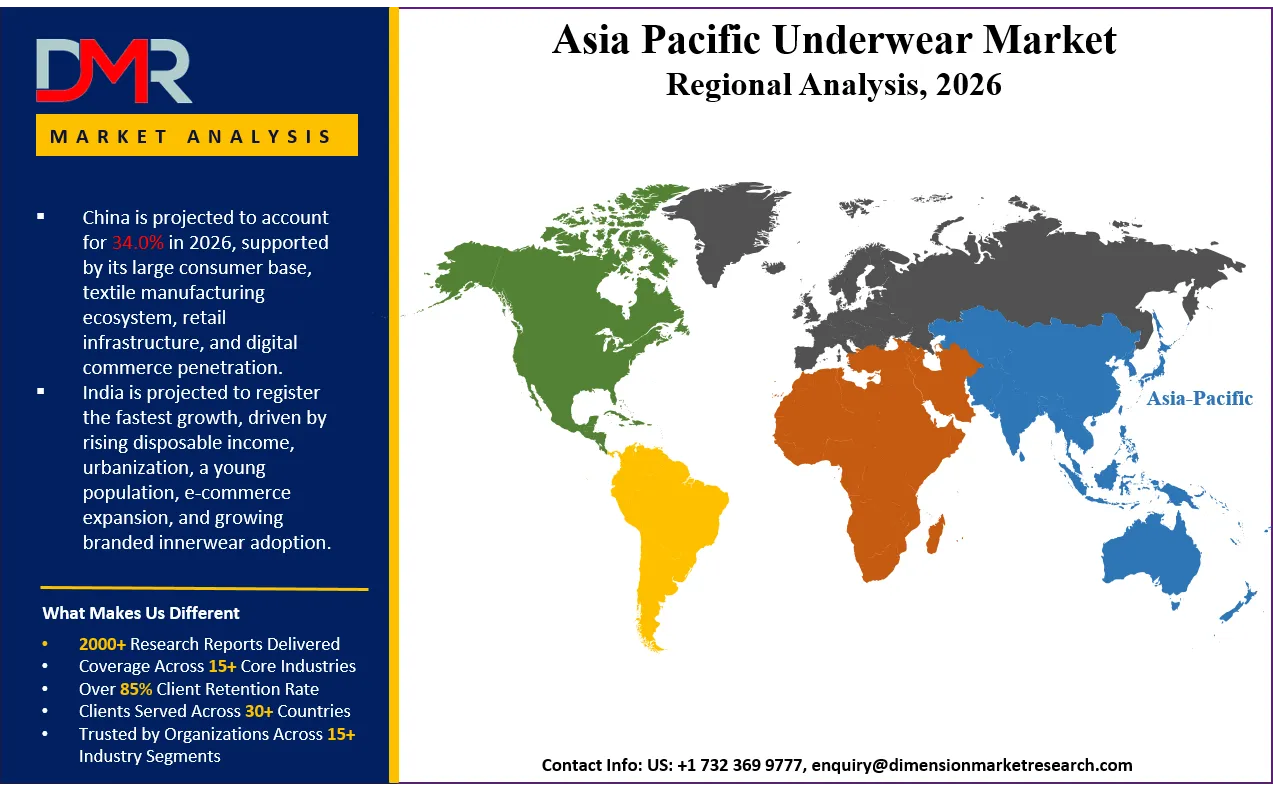
- Regional Analysis: China led Asia Pacific underwear market with 34.0% revenue share in 2026.
- Major Players: Triumph International, Uniqlo, Wacoal Holdings Corp., Rupa & Co. Ltd., Jockey, Sabina, and Others
What is the Asia Pacific Underwear Market and its Market Size?
The Asia Pacific Underwear Market size is projected to be valued at USD 31.2 billion in 2026 and is projected to reach USD 54.8 billion by 2035, expanding at a steady CAGR of 6.5% during the forecast period. Market growth is supported by rising expenditure on branded innerwear, expanding urban populations, higher awareness of comfort and fit, faster product replacement cycles, and wider access to domestic and international labels through digital retail. Women accounted for 63.5% of revenue in 2026, while blended fabrics represented 48.0% of material demand. Mass and economy products retained 52.0% of sales, highlighting the importance of affordability in high-volume Asian markets. Online and e-commerce channels held 38.0% of sales as consumers increasingly shifted toward mobile shopping, marketplace platforms, direct-to-consumer brands, and digital promotions.
ℹ
To learn more about this report –
Download Your Free Sample Report Here
The Asia Pacific underwear market includes briefs, bras, panties, boxers, trunks, shapewear, camisoles, thermal underwear, performance innerwear, and related intimate apparel designed for daily comfort, support, sports, fashion, and functional use. The market spans mass-market products and premium collections sold through department stores, supermarkets, specialty outlets, brand stores, and digital platforms. Existing industry studies also identify Asia Pacific as a major center of innerwear and lingerie demand, with digital distribution, branded products, comfort-driven purchasing, and premiumization influencing category growth.
Use Cases
- Everyday Comfort and Personal Wear: Daily-use underwear represents a recurring consumer purchase across urban and rural markets. Buyers increasingly consider softness, ventilation, stretch, fit retention, seam construction, and skin comfort. Brands are therefore expanding cotton-rich and blended ranges that balance durability with affordable pricing across high-volume consumer groups.
- Sports and Active Lifestyles: Performance underwear is gaining relevance among consumers involved in gyms, running, sports, travel, and active work environments. Moisture control, fast drying, stretch recovery, anti-chafing construction, and lightweight fabrics support demand. Rising health and fitness participation is also creating cross-category opportunities between underwear, activewear, and athleisure.
- Fashion and Premium Intimate Apparel: Underwear is increasingly treated as a fashion and lifestyle category rather than only a basic necessity. Consumers are purchasing coordinated sets, seamless designs, shapewear, lace products, premium fabrics, and fashion-led collections. Social media discovery and stronger brand visibility support premium product experimentation, especially among younger urban consumers.
- Functional and Specialized Underwear: Demand is expanding for maternity products, thermal underwear, plus-size ranges, period underwear, shapewear, seamless innerwear, and adaptive products. These categories help manufacturers address specific comfort, body type, climate, and lifestyle requirements while supporting higher product differentiation and new pricing opportunities.
- Digital and Direct-to-Consumer Retail: E-commerce enables consumers to compare prices, styles, materials, sizes, ratings, and brands without visiting physical outlets. Online channels also allow underwear companies to introduce broader assortments, subscription models, personalized offers, and regional products while collecting data that supports inventory planning and repeat-purchase strategies.
How AI/Gen AI is Transforming the Asia Pacific Underwear Market?
Artificial intelligence is changing how underwear companies forecast demand, manage inventory, plan assortments, and personalize digital retail. Brands can analyze browsing behavior, sales history, size preferences, regional demand, returns, seasonality, and promotional responses to determine which products should be stocked in particular locations. This is especially valuable in Asia Pacific, where consumer preferences vary widely across countries, climates, income groups, body profiles, and distribution formats. Better demand forecasting can help companies reduce excess inventory while improving product availability across popular sizes and styles.
Generative AI is also supporting faster merchandising, product visualization, customer service, advertising, and content localization. Digital retailers can produce market-specific product descriptions, campaign concepts, fit guidance, and multilingual customer interactions at scale. Computer vision and recommendation technologies can improve size matching and product discovery, which may reduce friction in online underwear purchases. For manufacturers and retailers, the larger opportunity lies in combining consumer data, automated planning, and rapid product development to shorten design-to-market cycles while keeping collections relevant to local demand patterns.
Key Drivers in the Asia Pacific Underwear Market
Expansion of E-commerce and Digital Retail
E-commerce is becoming a major growth engine for the Asia Pacific underwear market because intimate apparel is well suited to repeat online purchasing once consumers identify preferred brands and sizes. The online / e-commerce segment held 38.0% of the market in 2026. Mobile commerce, marketplace discounts, digital payments, wider delivery coverage, social commerce, and direct-to-consumer websites are improving product accessibility. Competing market studies also identify online distribution as one of the fastest-growing channels in regional lingerie demand.
Higher Demand for Comfort, Fit and Branded Products
Consumers across Asia Pacific are paying greater attention to fit, fabric softness, breathability, durability, body support, and styling. These preferences are encouraging established brands and local manufacturers to expand product ranges across basic, fashion, seamless, sports, and premium categories. Rising disposable income in several developing markets also increases willingness to move from unbranded products toward organized retail brands. Published Asia Pacific underwear research similarly identifies evolving preferences, disposable income, and premium branded innerwear as important market growth factors.
Restraints in the Asia Pacific Underwear Market
Price Sensitivity and Strong Unorganized Competition
Price remains an important constraint because large consumer populations in India, Southeast Asia, and other developing markets continue to compare branded products with inexpensive local alternatives. The mass/economy segment accounted for 52.0% of revenue in 2026, showing the importance of accessible pricing. Higher fabric, logistics, marketing, and retail costs can make premium positioning difficult outside major cities. Competitive pressure from organized and unorganized sellers can also limit pricing power, particularly during periods of weaker discretionary spending.
Complex Sizing, Returns and Inventory Management
Underwear brands must manage many combinations of size, style, color, material, gender, and price point. This creates inventory complexity and increases the risk of stock-outs in popular sizes while slow-moving variants remain unsold. Online growth adds another challenge because fit expectations may differ between brands and markets. Returns, exchanges, hygiene restrictions, and inconsistent regional sizing can reduce customer confidence. Companies therefore need stronger size standardization, product information, forecasting systems, and localized assortment planning to protect margins.
Growth Opportunities in the Asia Pacific Underwear Market
Premiumization and Functional Innerwear
Premium and functional products represent an attractive long-term opportunity as consumers increasingly seek performance beyond basic coverage. Seamless construction, moisture management, cooling fabrics, shapewear, maternity products, supportive designs, premium lingerie, and sports-oriented underwear can generate higher average selling prices. Global and regional brands can also use localized fits and design preferences to serve Asian consumers more effectively. Existing market research points to premiumization and comfort-focused purchasing as important forces shaping underwear and lingerie demand.
Sustainable Materials and Circular Product Development
Growing interest in responsible apparel creates opportunities for underwear made with recycled fibers, responsibly sourced cotton, lower-impact dyes, bio-based materials, and reduced packaging. Buyers are also becoming more aware of fabric origin, product durability, and manufacturing practices. Companies that combine sustainability with comfort and competitive pricing can differentiate themselves in premium urban markets. Innovation in blended materials is particularly relevant because blends already held 48.0% of the Asia Pacific underwear market in 2026 and allow brands to balance stretch, softness, strength, and performance.
Trends in the Asia Pacific Underwear Market
Shift Toward Blended and Performance Fabrics
Blended fabrics accounted for 48.0% of the market in 2026 as manufacturers combined natural and synthetic fibers to improve stretch, shape retention, softness, moisture control, durability, and cost efficiency. Cotton-elastane, nylon-elastane, modal blends, microfiber combinations, and other engineered fabrics support both daily underwear and performance categories. The trend also allows manufacturers to create thinner, seamless, quick-drying, and body-contouring products that meet changing comfort expectations across warm and humid Asian climates.
Growth of Omnichannel and Social Commerce
Underwear brands are moving toward connected retail models that combine marketplaces, brand websites, mobile applications, physical stores, social platforms, and influencer-led discovery. Consumers may discover products online, evaluate fit or quality in stores, and later reorder through digital channels. Online distribution already represented 38.0% of 2026 sales in the study. This shift encourages brands to invest in digital catalogues, customer reviews, loyalty programs, personalized promotions, creator partnerships, and faster fulfillment while maintaining physical touchpoints for fitting and product experience.
Research Scope and Analysis
The Asia Pacific underwear market is segmented based on gender, material, price range, distribution channel, and other relevant categories. The study provides an in-depth analysis of key segments and sub-segments, covering their applications, industry adoption, demand patterns, and contribution to overall market growth.
ℹ
To learn more about this report –
Download Your Free Sample Report Here
By Gender;
Women represented the leading gender segment with 63.5% of Asia Pacific underwear market revenue in 2026. The segment benefits from a broader range of product categories, including bras, panties, shapewear, camisoles, lingerie sets, maternity underwear, seamless products, sports bras, and fashion-led intimate apparel. Frequent product innovation, larger style assortments, changing fashion preferences, and growing awareness of correct fit support stronger spending across both basic and premium ranges. Digital retail has also increased access to specialized sizes and designs that may not be stocked in smaller physical outlets. Regional lingerie studies likewise show women's intimate apparel benefiting from increased product variety, e-commerce penetration, and branded purchasing.
By Material;
Blends led the material category with 48.0% share in 2026. Their market position reflects the ability to combine desirable properties from several fibers in a single product. Cotton blended with elastane can provide softness with improved stretch, while nylon, polyester, modal, microfiber, and spandex combinations enable lightweight construction, moisture management, shape retention, and faster drying. These characteristics are important for daily underwear, lingerie, seamless garments, and sports-oriented products. Blends can also help manufacturers manage costs while offering different performance levels across mass, mid-range, and premium price bands. Continued development of recycled synthetics, cellulosic fibers, and lower-impact materials may further expand innovation opportunities within this segment.
By Price Range;
The mass/economy category held 52.0% of market revenue in 2026. Its leadership is supported by the large population base of Asia Pacific and strong demand for affordable everyday essentials. Underwear is a recurring purchase, making unit price an important consideration for households purchasing several products at once. Local manufacturers, supermarket private labels, value retailers, and online marketplaces increase competition within this segment. At the same time, better fabric quality and branded value collections are narrowing the functional difference between economy and mid-priced products. Manufacturers that maintain dependable fit, durability, basic style variety, and broad distribution at accessible prices are positioned to capture high-volume demand across developing Asian economies.
ℹ
To learn more about this report –
Download Your Free Sample Report Here
By Distribution Channel;
Online / e-commerce was the largest distribution channel with 38.0% of market revenue in 2026. The channel benefits from high smartphone use, digital payment adoption, marketplace ecosystems, home delivery, broader assortments, and frequent promotional activity. Underwear is especially suitable for repeat digital purchases once customers know their preferred brand, fit, and size. E-commerce also allows smaller brands to enter new cities without extensive store networks and enables international companies to test demand before committing to physical expansion. Regional lingerie research identifies online retail as a high-growth channel, supporting continued investment in direct-to-consumer websites, marketplaces, social commerce, and omnichannel fulfillment.
The Asia Pacific Underwear Market Report is segmented on the basis of the following:
By Gender
- Women {Lingerie, Panties, and Bras}
- Children
- Men {Boxer-Briefs, Briefs, and Boxers}
- Unisex
By Material
By Price Range
- Mass/Economy
- Luxury
- Mid-range
By Distribution Channel
- Online / E-commerce
- Department Stores
- Supermarkets/Hypermarkets
- Specialty Stores/Brand Stores
ℹ
To learn more about this report –
Download Your Free Sample Report Here
Major Countries Analysis
China is the Leading Country in the Asia Pacific Underwear Market
China dominated the Asia Pacific underwear market with a 34.0% revenue share in 2026, supported by its large consumer base, established textile manufacturing ecosystem, extensive retail infrastructure, and high penetration of digital commerce. Demand is spread across mass-market basics, women's lingerie, men's innerwear, shapewear, sports underwear, and premium intimate apparel. Rising interest in comfort, fabric performance, fit, and fashion-led products is encouraging domestic and international brands to diversify their portfolios. China's mature e-commerce and social commerce ecosystem also enables companies to reach consumers beyond major metropolitan areas and introduce new collections quickly. Strong local textile and garment production supports shorter supply chains, competitive pricing, and product innovation. Growing demand for seamless designs, advanced fabric blends, sustainable materials, and premium products is expected to reinforce China's leading position through the forecast period.
India is the Fastest-Growing Country in the Asia Pacific Underwear Market
India is emerging as the fastest-growing country in the Asia Pacific underwear market, supported by rising disposable income, rapid urbanization, a young consumer population, and the shift from unorganized products toward branded innerwear. Expanding e-commerce penetration is making women's lingerie, men's underwear, athleisure-oriented innerwear, and premium products more accessible in tier-2 and tier-3 cities. Consumers are increasingly prioritizing comfort, fit, fabric quality, durability, and brand value, creating opportunities across mass, mid-range, and premium price categories. Domestic companies such as Rupa & Co. Ltd., Lux Industries Ltd., and Dollar Industries Ltd., alongside Jockey and other international brands, are strengthening distribution and product portfolios. Growing organized retail, digital-first brands, local manufacturing, sports participation, and demand for functional and sustainable products are expected to support India's rapid market expansion through 2035.
Southeast Asia Asia Pacific Underwear Market
Southeast Asia offers growing demand across Indonesia, Thailand, Vietnam, Malaysia, the Philippines, Singapore, and neighboring markets. Warm climates support demand for breathable, lightweight, moisture-managing fabrics, while rising urban populations and e-commerce penetration expand access to branded products. The region contains a mix of value-focused and premium consumer groups, creating opportunities across several price tiers. Existing Southeast Asian lingerie research also points to continuing market expansion and growing online distribution, reinforcing opportunities for regional and international brands.
Competitive Landscape
The Asia Pacific underwear market is competitive and fragmented, with international brands, regional specialists, domestic manufacturers, private labels, and digital-first companies operating across multiple price bands.
Some of the prominent players in the Asia Pacific Underwear Industry are:
- Triumph International
- Uniqlo
- Wacoal Holdings Corp.
- Rupa & Co. Ltd.
- Jockey
- Sabina
- BYC Co., Ltd.
- Aimer Group
- Lux Industries Ltd.
- Dollar Industries Ltd.
- Others
Competition centers on comfort, fit, fabric quality, design, pricing, brand recognition, retail reach, digital visibility, and frequency of product launches. International groups often compete through premium technology, broad brand recognition, and established retail concepts, while local companies use regional knowledge, lower manufacturing costs, value pricing, and extensive distribution.
Future competition is expected to become more focused on omnichannel retail, performance materials, sustainable fabrics, inclusive sizing, rapid product development, and personalized digital experiences. E-commerce is reducing barriers to entry for emerging labels, while established companies are strengthening direct-to-consumer platforms and marketplace partnerships. Strategic alliances, licensing arrangements, localized manufacturing, and brand collaborations may also support market expansion. India's Reliance Retail and Delta Galil joint venture demonstrates how companies are using partnerships to combine manufacturing, wholesale, digital retail, and brand development. At the same time, strong competitive intensity and value-conscious purchasing require companies to control inventory, maintain accessible price points, and continuously refresh products.
Regulatory Landscape
The Asia Pacific underwear market operates under textile safety, product labeling, chemical management, consumer protection, import, and sustainability regulations that differ across countries. China applies textile product standards covering fiber composition, labeling, safety, and restricted substances, while India regulates textile labeling and quality requirements through national standards and consumer protection frameworks. Japan, South Korea, and Australia maintain established rules concerning fiber identification, product claims, hazardous chemicals, and consumer safety. Manufacturers must also manage requirements related to dyes, formaldehyde, azo colorants, packaging, and product traceability where applicable. As cross-border e-commerce expands, brands face greater pressure to maintain accurate labels and market-specific compliance. Companies investing in testing, certified materials, responsible sourcing, supply-chain visibility, and standardized quality controls can reduce regulatory risks while improving access to major Asia Pacific underwear markets.
Investment and White Space Analysis
Investment opportunities in the Asia Pacific underwear market are expanding across digital retail, premium innerwear, functional products, sustainable materials, and underserved consumer segments. With the market projected to increase from USD 31.2 billion in 2026 to USD 54.8 billion by 2035, companies have room to build specialized brands rather than compete only in conventional basics. White spaces include plus-size and inclusive sizing, maternity underwear, period underwear, adaptive products, seamless innerwear, performance underwear, and climate-specific breathable designs. India and Southeast Asia offer additional potential as organized retail and e-commerce expand beyond major metropolitan areas. Investors can also target digital-first brands that use direct-to-consumer distribution to lower physical retail requirements and reach niche audiences. Material innovation presents another opportunity, particularly in recycled fibers, advanced blends, moisture-management fabrics, and durable products. Local manufacturing, regional sizing, and value-focused premium products could further improve market penetration.
Recent Developments
Report Details
| Report Characteristics |
| Market Size (2026) |
USD 31.2 Billion |
| Forecast Value (2035) |
USD 54.8 Billion |
| CAGR (2026–2035) |
6.5% |
| The China Market Size (2026) |
34.0% Revenue Share |
| Historical Data |
2021 - 2025 |
| Forecast Data |
2027 - 2035 |
| Base Year |
2025 |
| Estimate Year |
2026 |
| Segments Covered |
By Gender, By Material, By Price Range, By Distribution Channel |
| Regional Coverage |
Asia Pacific – China, India, Japan, South Korea, Southeast Asia, Australia, and Rest of APAC |
Frequently Asked Questions
What is the current size of the Asia Pacific Underwear Market?
▾ The Asia Pacific underwear market is valued at USD 31.2 billion in 2026 and is expected to reach USD 54.8 billion by 2035.
What is the growth rate of the Asia Pacific Underwear Market?
▾ The Asia Pacific underwear market is expected to grow at a CAGR of 6.5% during the 2026-2035 forecast period.
Which country dominates the Asia Pacific Underwear Market?
▾ China leads the Asia Pacific underwear market, accounting for a 34.0% revenue share in 2026.
What factors are driving the growth of the Asia Pacific Underwear Market?
▾ Rising branded innerwear demand, e-commerce expansion, higher disposable income, comfort-focused purchasing, and product innovation are driving market growth.
What are the major challenges restraining the Asia Pacific Underwear Market?
▾ Price sensitivity, competition from unorganized sellers, sizing complexity, inventory risks, and varying regulatory requirements restrain market expansion.
Which segment holds the largest share of the Asia Pacific Underwear Market?
▾ The women segment leads by gender with a 63.5% share in 2026, while blends dominate material types with a 48.0% share.
Who are the leading companies in the Asia Pacific Underwear Market?
▾ Triumph International, Uniqlo, Wacoal Holdings Corp., Rupa & Co. Ltd., Jockey, Sabina, BYC Co., Ltd., Aimer Group, Lux Industries Ltd., and Dollar Industries Ltd. are among the leading companies in the Asia Pacific underwear market.
How is AI influencing the Asia Pacific Underwear Market?
▾ AI supports demand forecasting, inventory planning, personalized recommendations, size matching, digital merchandising, customer service, and faster product development.
What are the future opportunities and trends in the Asia Pacific Underwear Market?
▾ Premium innerwear, sustainable fabrics, functional underwear, inclusive sizing, seamless products, direct-to-consumer brands, and social commerce offer major market opportunities.