What is the Asset Performance Market Size?
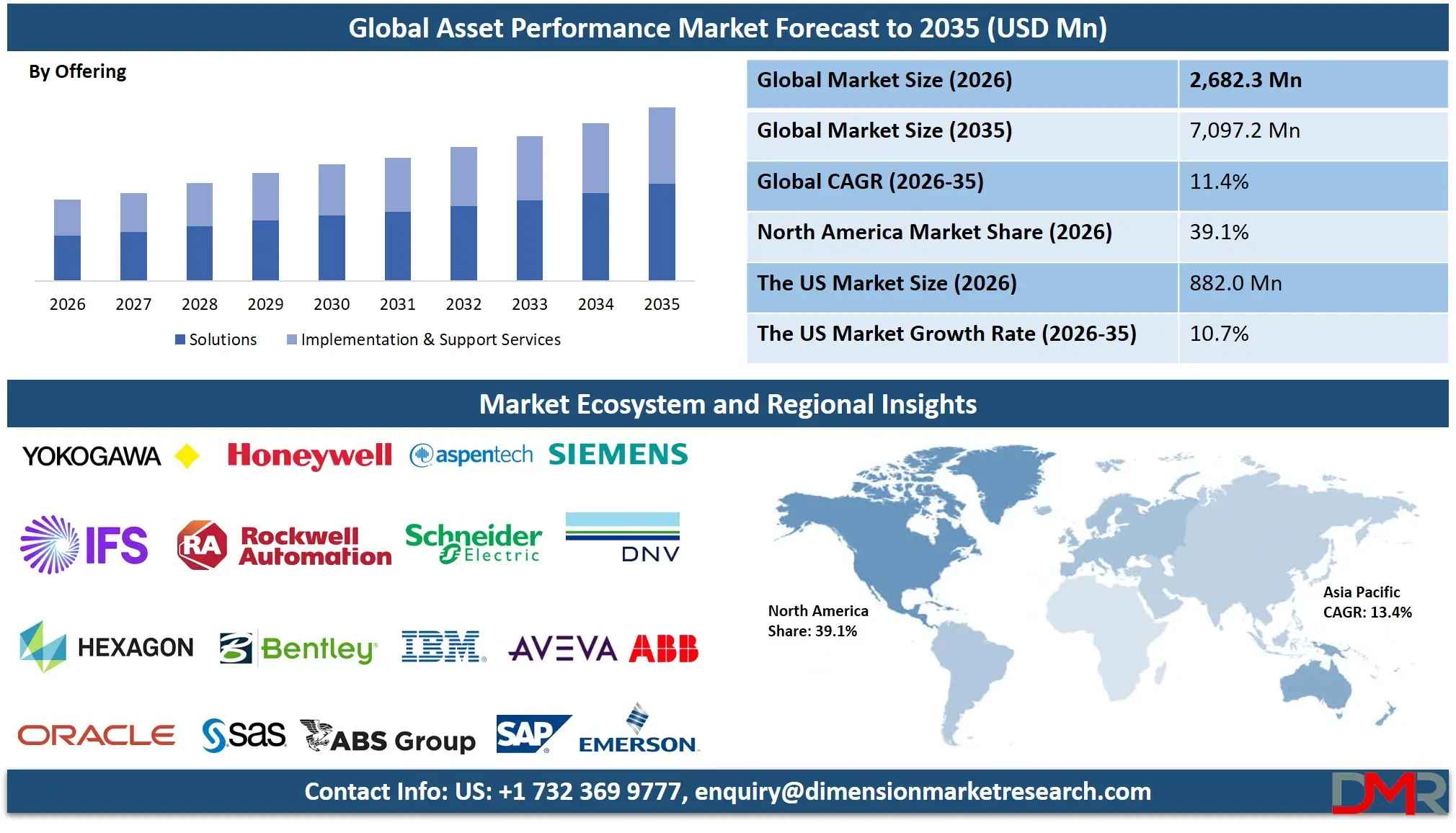
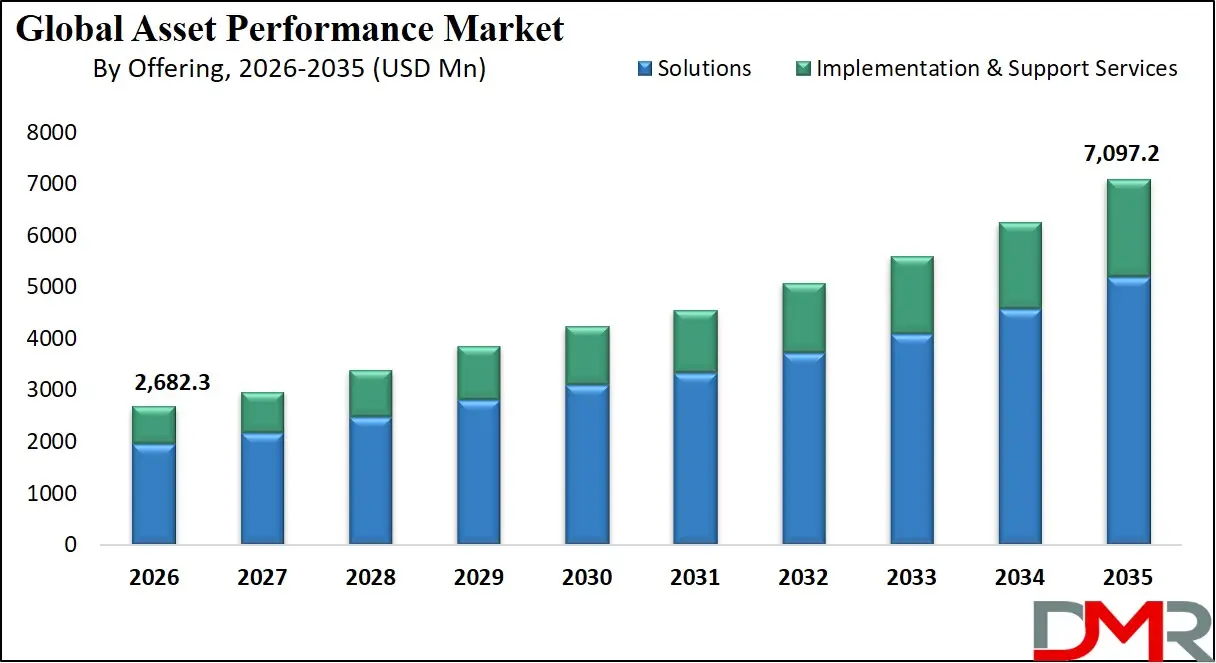
The Global Asset Performance Management Market is expected to reach a value of USD 2,682.3 million in 2026, and it is further anticipated to reach USD 7,097.2 million by 2035, growing at a CAGR of 11.4% during the forecast period.
ℹ
To learn more about this report –
Download Your Free Sample Report Here
The asset performance management market is currently witnessing a steady development with businesses in all sectors intensifying their interests in operational efficiency, asset reliability and predictive maintenance strategies to reduce unplanned downtime and increase the asset life cycle. The market includes a full range of solutions such as predictive maintenance and analytics, asset reliability and condition-based maintenance, asset integrity, and compliance management, asset strategy and optimization, and sustainability and emission management, and implementation and support services that enable companies to shift away the reactive maintenance strategies to proactive, data-driven frameworks of asset management. The rising popularity of IoT-based sensors, AI-based predictive applications, digital twins, and cloud-based APM systems are increasing the need to acquire tailored asset performance solutions capable of utilizing large volumes of operational data to create actionable insights to support maintenance planning and resource optimization.
ℹ
To learn more about this report –
Download Your Free Sample Report Here
The US Asset Performance Market
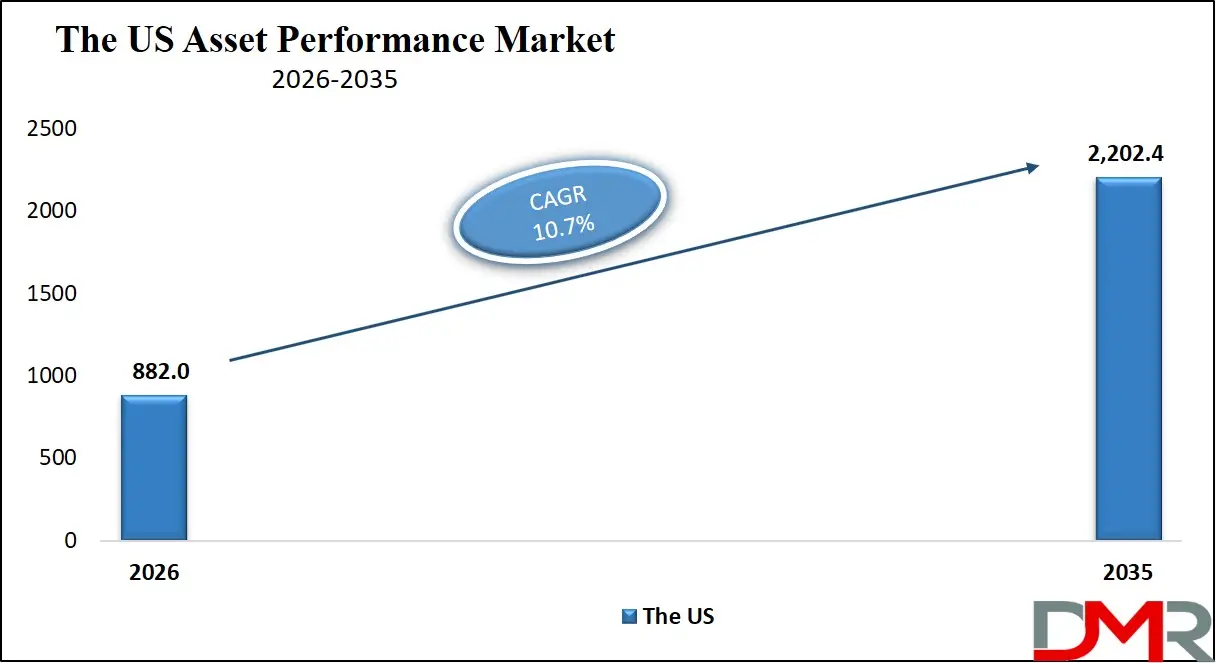
The US Asset Performance Management Market is projected to reach USD 882.0 million in 2026 at a compound annual growth rate of 10.7% over its forecast period, which is further expected to be reach a value of USD 2,202.4 million by 2035. The US remains the largest and most developed market in terms of asset performance management solutions due to the intensive modernization of the aging industrial infrastructure, the need to meet the regulatory compliance requirements of agencies like OSHA and EPA, and the general acceptance of Industry 4.0 technologies in all sectors of manufacturing, energy, and utilities.
ℹ
To learn more about this report –
Download Your Free Sample Report Here
The market is marked with the great need of Predictive Maintenance & Analytics solutions, especially AI-based predictive solutions and IoT-based analytics, with the organizations eager to use machine learning algorithms to predict equipment failures in advance. Also, Asset Twin-Based Optimization capabilities are increasingly becoming popular, allowing operators to model the behavior of assets under different conditions and optimize maintenance schedules without impacting real operations. The increased focus on sustainability reporting and carbon footprint minimization is also increasing the uptake of Sustainability and Emission Management solutions in industrial premises.
The Europe Asset Performance Market
The Europe Asset Performance Management Market is estimated to be valued at USD 778.0 million in 2026 and is further anticipated to reach USD 2,058.2 million by 2035 at a CAGR of 11.4%. The European market has strict regulatory environment comprising of the EU Industrial Emissions Directive, EU Energy Efficiency Directive, and the corporate sustainability reporting requirements as stipulated in the Corporate Sustainability Reporting Directive (CSRD). These are the regulations that are prompting significant investments into Asset Integrity and Compliance Management solutions, specifically the Risk-Based Inspections and Environmental Monitoring solutions as industrial operators in Germany, France, and the Nordic countries are trying to prove their compliance and yet minimise their maintenance costs. There is also increased uptake of Condition-Based Maintenance and Performance Tracking solutions in the manufacturing and process sectors of the region, as old equipment fleets demand high-end monitoring to ensure operational integrity. Moreover, the high decarbonization targets of the European Green Deal are driving the need of Energy Efficiency Analytics and the capacity to monitor emissions, as industrial companies are increasingly instituting sustainability measures as a part of their asset performance systems.
The Japan Asset Performance Market
The Japan Asset Performance Management Market is projected to be valued at USD 295.0 million in 2026. It is further expected to witness steady growth, reaching USD 780.5 million by 2035 at a CAGR of 11.4%.
The Japanese market has its own distinctive features, which are determined by the fact that the country has the aging industrial infrastructure, severe shortage of the workforce owing to the decline of the population, and the culture of operational excellence and maintenance accuracy. Japanese manufacturers and utility operators are moving more toward AI-Powered Predictive Tools and IoT-Powered Analytics to offset the declining numbers of skilled maintenance technicians and engineers. Asset Reliability and Condition Monitoring solutions are being extensively adopted in the market, especially Root Cause Analysis (RCA) and Performance Tracking features, as organizations attempt to put decades of tacit maintenance experience into digital form. Moreover, being prone to natural calamities has brought a high demand to Remote Asset Monitoring and Control solutions in Japan so that the centrally located infrastructure assets such as transmission lines, pipelines as well as transportation networks among others can be monitored and controlled in order to be able to respond promptly in the case of any emergency.
Key Takeaways
- Market Size & Forecast: The Global Asset Performance Management market is projected to reach USD 2,682.3 million in 2026, expanding to USD 7,097.2 million by 2035, driven by the merging of industrial IoT use, the development of artificial intelligence, and the dire necessity to streamline asset-intensive processes in the face of skilled labor shortages.
- Growth Rate & Outlook: Global market growth is expected at a CAGR of 11.4%, due to the rise in the complexity of industrial asset ecosystems, the increasing number of sensor-enabled devices creating massive streams of operational data, and the economic justification that predictive maintenance applications can offer, cutting down on unplanned downtime.
- Primary Growth Drivers: The need to continue aging asset life without affecting safety or reliability, the adoption of digital twin technologies that allow simulating maintenance scenarios virtually, and the increased regulatory demands to show environmental compliance through emissions monitoring and energy efficiency enhancements.
- Key Market Trends: Some leading trends are the integration of APM and enterprise asset management (EAM) systems, the emergence of prescriptive maintenance suggesting particular corrective measures, the introduction of asset twin-based optimization of complex rotating equipment, and the addition of sustainability indicators to core asset performance dashboards.
- By Offering Analysis: Solutions are expecetd to become the dominant category, with predictive maintenance & analytics as the largest sub-category as firms seek to transform themselves into AI-led predictive solutions and IoT-enabled analytics as they leave calendar-based maintenance behind and proceed to condition-based maintenance.
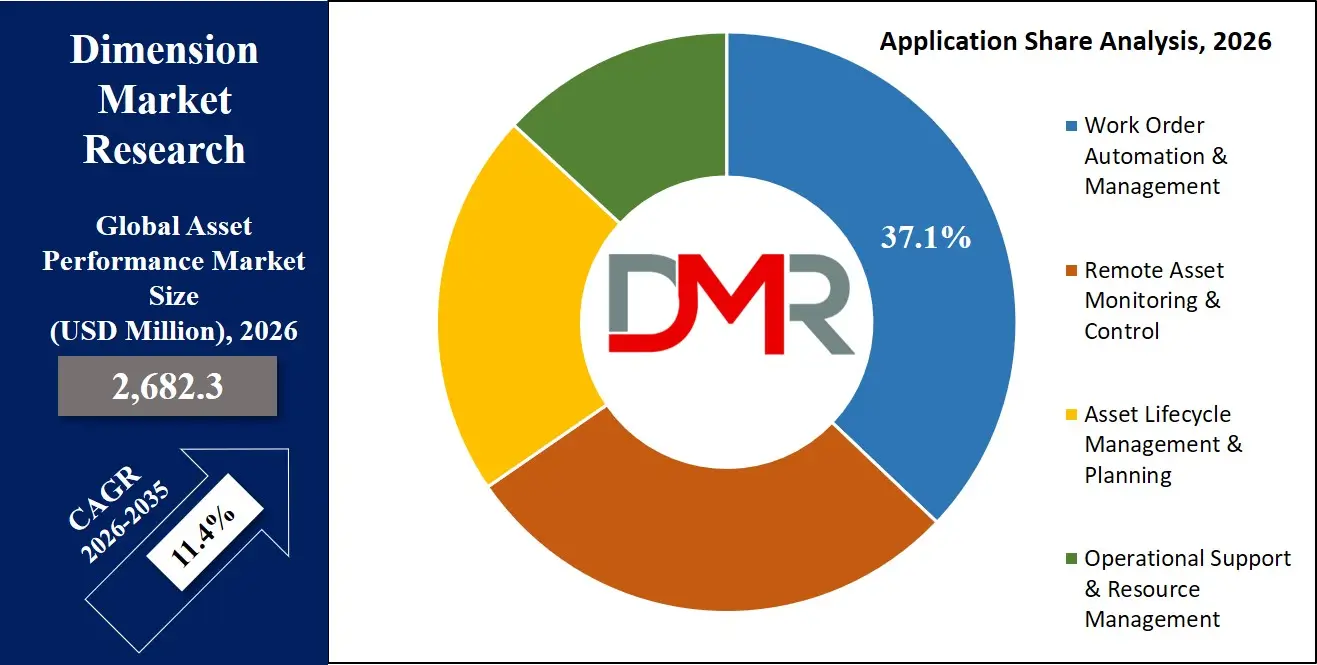
- By Application Analysis: Remote asset monitoring and control are poised to dominate this segment as the demand to have real-time visibility and proactive management is rising. IoT-based systems can be used to track performance, detect anomalies, and perform remote actions, enhance efficiency, minimize downtimes, and facilitate Industry 4.0-based automation in asset-intensive sectors.
- Regional Leadership: North America is poised to dominate this market with 39.1% of the market share in 2026, due to its developed ecosystem of industrial technology, high installed base of sensor-enabled equipment, and an established vendor base that provides end-to-end APM solutions.
What is the Asset Performance Management?
Asset Performance Management (APM) refers to the broad category of software applications, analytics, and professional services that are aimed at maximizing the performance, reliability and life of physical assets during the entire operational cycle. In contrast to conventional computerized maintenance management systems (CMMS), which are more oriented towards work order tracking and maintenance scheduling, APM solutions utilize advanced analytics, machine learning algorithms, and real-time operational data to offer predictive information about asset health, imminent failure modes, and optimal timing to perform a maintenance intervention. Such systems combine data provided by various sources such as an IoT sensor, SCADA, and control systems, past maintenance history, and environmental factors to provide a comprehensive picture of asset performance.
Use Cases
- Predictive Maintenance for Critical Rotating Equipment in Oil & Gas: The operators of the offshore platform use IoT-enabled Analytics and AI-based Predictive Tools to constantly monitor the vibration patterns, temperature fluctuations, and lubrication conditions in gas turbines and compressors.
- Asset Integrity Management Across Pipeline Infrastructure: The Midstream pipeline operators apply risk-based inspections and regulatory compliance tools to prioritize inspection and maintenance operations on thousands of miles of pipeline assets.
- Condition-Based Maintenance for Manufacturing Production Lines: Discrete manufacturers adopt condition-based maintenance and performance tracking systems on key production equipment such as CNC machines, robotic workcells, and conveyor systems.
- Asset Twin-Based Optimization for Power Generation Facilities: Utility operators use asset twin-based optimization to build virtual representations of steam turbines and generators, and simulate different operating conditions and maintenance plans.
How AI is Transforming the Asset Performance Market
The use of artificial intelligence is radically transforming the asset performance management landscape by allowing a shift to descriptive analytics, which is knowledge of what has occurred, to predictive and prescriptive analytics, which is knowledge of what will occur and prescribes the best action. Deep Learning algorithms trained on large repositories of sensor data in Predictive Maintenance and Analytics can be used to discover complex patterns of failure that could not be identified by human analysts, and that warn of the upcoming equipment problems in weeks or months before conventional monitoring methods would raise red flags. Such AI models keep getting increasingly more precise as they consume more operational data, understanding the peculiarities of the functioning of a particular asset and its degeneration patterns.
In addition to estimating the timing of a failure, the prescriptive systems use reinforcement learning and optimization algorithms to prescribe certain corrective measures, the optimal time to perform maintenance and even the changes in operating parameters that can prolong the life of an asset without compromising the production goals. These systems consider a variety of constraints such as the availability of parts, scheduling of technicians, production requirements, and safety concerns to produce actionable maintenance plans.
Market Dynamics
Key Drivers in the Global Asset Performance Market
The Critical Cost of Unplanned Downtime
The economic effect of unscheduled equipment failure remains the fundamental driver of APM implementation in the asset-based industries. In industries like oil and gas, petrochemicals, and power production, loss of just one day of production will incur millions of dollars in losses. In addition to direct revenue effect, unexpected failures can cause a series of operational outages, accidents, and regulatory reviews. Companies are starting to realize that an investment in Predictive Maintenance & Analytics solutions would have a strong payoff in the form of fewer and shorter downtimes. According to industry standards, established predictive maintenance systems are capable of cutting down unplanned downtimes by 30-50% and lowering maintenance expenses by 10-20%, which establishes a solid economic rationale of APM implementation.
Aging Industrial Infrastructure and Skilled Workforce Shortages
The two demographic trends are converging at an increasing rate that is enhancing the adoption of APM worldwide. To begin with, critical industrial infrastructure in developed economies, such as power plants, refineries, and manufacturing plants, are approaching or even surpassing original design life spans, necessitating a higher level of monitoring to ensure safe and dependable operation. Second, there is a major demographic transition in the industrial workforce with seasoned maintenance technicians and engineers retiring and decades of tacit equipment knowledge being lost. Asset Reliability and Condition Monitoring, and Root Cause Analysis (RCA) features of APM solutions assist organizations to capture and institutionalize this knowledge into digital systems so that less skilled staff can make informed decisions when it comes to maintenance based on data-driven insights and not just intuition.
Restraints in the Global Asset Performance Market
High Implementation Costs and Complex Integration Requirements
Initial investment needed to implement comprehensive APM is still a huge hindrance especially to small and medium-sized enterprises. Software licensing is not the only cost but also sensor instrumentation of the existing equipment, connection with the existing enterprise software, such as ERP and CMMS systems, data historians, and monthly subscription to cloud-based analytics services. Implementation and Integration Services and Training and Onboarding Services are also services that an organization needs to invest in to make it successful. The heterogeneity of integrating APM solutions with the heterogeneous system of industrial control, SCADA infrastructure, and IoT devices ecosystems pose further technical and financial challenges that may prolong implementation and postpone the payback period.
Data Quality and Standardization Challenges
The quality, completeness and consistency of underlying asset data is a primary determinant of the effectiveness of APM solutions, especially AI-based predictive analytics. Organizations often deal with a disjointed data environment in which vital data on assets is stored in isolated systems or paper files or tribal knowledge in the minds of individual technicians. The maintenance history can be either incomplete or irregularly coded and this restricts the possibility of training appropriate predictive models. There can be gaps in sensor data because of poor network reliability, or it can be too coarse to identify small patterns of degradation. Sometimes, organizations need to go through considerable data cleansing and standardization projects before achieving the benefit of APM investments.
Growth Opportunities in the Global Asset Performance Market
Integration of APM with Enterprise Asset Management Ecosystems
Another important growth potential is the further merging of specialized APM solutions and larger enterprise asset management platforms. Organizations are in search of integrated asset lifecycle management solutions that cut across asset commissioning and procurement, lifecycle maintenance and planning, and decommissioning and disposal. Solution providers that are capable of providing a smooth workflow between condition monitoring insights and work order generation, optimization of spare parts inventory and vendor management processes will gain market share. APM merging with spare parts and inventory management and vendor and contractor management, form complete ecosystems of operational support that are more valuable than point solutions.
APM-as-a-Service and Cloud-Based Deployment Models
The movement towards Cloud-Based APM (SaaS) deployment models is presenting considerable market expansion possibilities, especially in medium-sized enterprises who formerly regarded on-premises implementations prohibitively expensive. Cloud-based APM solutions minimize initial investment in infrastructure, shorten deployment timeframes, and allow organizations to take advantage of constantly-evolving analytics functions without maintaining intricate software update cycles. The subscriptions-based pricing plans are more cost-effective in terms of the operational budgets and allow organizations to add the APM coverage in gradual steps to the entire asset fleets. Also, cloud deployment enables the consolidation of anonymized performance data of assets across various organizations, developing industry references that increase the predictive model accuracy.
Trends in the Global Asset Performance Market
The Rise of Asset Twin-Based Optimization
The concept of digital twin technology is shifting towards the stage of addressing the concept to real-world implementation, and Asset Twin-Based Optimization is becoming a groundbreaking option in the APM portfolios. In contrast to simple digital representations, advanced asset twins use real-time operational data, physics-based degradation modeling, and AI-based analytics to develop dynamic virtual representations that develop with the physical assets. These twins allow organizations to model a maintenance situation, test other operating strategy, and optimize major overhaul time without jeopardizing physical equipment. The combination of augmented reality interfaces with asset twins is further improving the field service effectiveness, by superimposing real-time asset health data on physical equipment displays.
Convergence of Operational Technology and Information Technology
The conventional distinction between operational technology (OT) systems that run industrial processes and information technology (IT) systems that support business operations is becoming blurred due to the demands of full-scale APM implementations. Companies are adopting integrated architectures that allow the flow of data between SCADA systems, control systems and cloud-based analytics systems and enterprise applications to be seamlessly unified. This convergence is driving need of Implementation and Integration Services that interrelates the culture and technical disparities between the OT and IT spaces, so that the insights of asset performance can be transferred into the action of business decisions.
Research Scope and Analysis
The APM market analysis covers solutions, asset types, deployment models, organization size, applications, and verticals, highlighting the dominance of AI-driven, cloud-based, and predictive maintenance technologies across asset-intensive industries.
ℹ
To learn more about this report –
Download Your Free Sample Report Here
By Offering Analysis
It is expected that solutions will dominate the offering segment in the asset performance management (APM) market as more organizations focus on predictive, AI-based, and analytics-based solutions to maximize asset uptime and minimize operational expenses. More sophisticated sub-segments like predictive maintenance, asset reliability monitoring, and asset twin-based optimization are being adopted enthusiastically because of their direct effect on reducing downtimes to the shortening of asset lifespan. Businesses would be interested in combined solutions incorporating IoT-based analytics, prescriptive maintenance, and compliance management in a single architecture. Although services like consulting and managed services are still significant to implement and support, they are mainly solution deployment cycles. The measurable ROI, automation and scalability of solutions in this segment make it the main source of revenue, especially in the asset-heavy industries, such as energy, manufacturing, and transportation.
By Asset Type Analysis
Rotating equipment dominates the asset type segment as it plays a central part in the industrial process and is highly prone to failure that directly influences the productivity and safety. Turbines, compressors, motors, and pumps are assets that need constant monitoring and predictive maintenance to prevent expensive downtime. These resources yield vast amounts of operating information, so they can be deployed in sophisticated analyticss, AI-based diagnostics, and condition-driven monitoring systems. Rotating equipment is essential to industries such as oil and gas, power generation, and manufacturing, further necessitating APM solutions specific to these types of equipment. Rotating equipment has a greater ROI potential due to performance optimization, which is the center of APM investments in asset-intensive markets compared to facility or IT/OT assets.
By Deployment Type Analysis
Cloud-based APM is projected to dominate the deployment segment because of its scalability, flexibility, and capability to support real-time analytics of geographically spread assets. Companies are turning to SaaS-based models to save initial infrastructure and deploy predictive maintenance and monitoring systems more quickly. Cloud platforms enable an easy adoption of IoT devices, AI tools, and enterprise systems to provide a centralized view and control over performance of assets. Also, cloud implementation promotes constant updates, data processing, and accessibility remotely, which are essential in the contemporary industrial operations. Although on-premise solutions are still possible in highly regulated markets, on-the-whole market is moving to cloud, prompted by digital transformation programs, and the increased necessity to optimize assets through data.
By Organization Size Analysis
Large enterprises is poised to dominate the APM market that have large and multifaceted networks of assets which need advanced monitoring and optimization solutions. Such organizations can afford to invest in sophisticated APM systems, such as AI-based analytics, digital twins, and the Internet of Things. Their business usually cuts across various geographies, which require standardized performance management structures and centralized asset visibility. Also, big businesses have high regulation and operation effectiveness standards, which further stimulate the use of APM solutions. Although small and medium enterprise are slowly moving towards cloud-based APM tools, the budget constraint and less complexity in assets limit their adoption.
By Application Analysis
The application segment is dominated by remote asset monitoring and control based on the increasing demand to have real-time visibility and proactive control of the distributed assets. IoT-based monitoring and central dashboards can enable organizations to monitor the performance of their assets, identify anomalies, and take corrective measures without the need to touch the assets. This is especially important in energy, transportation, and manufacturing industries, where assets might be remote or hazardous. The growing challenge of automation, digitalization, and Industry 4.0 technologies further enhances the need to have remote monitoring solutions. Remote monitoring provides greater operational effectiveness, decreased downtime and better decision-making compared to traditional applications such as work order management, and is thus the most dominant and fastest growing application area.
By Vertical Analysis
The energy and utilities industry is the largest consumer of APM because it is an asset-intensive industry and requires its operations to be reliable. Power plants, grids, pipelines and renewable energy systems are all infrastructures that need constant monitoring and maintenance so that there is no interruption to the service delivery. APM solutions can be used to provide predictive maintenance, optimise asset lifecycle and comply with regulations, which are critical in this industry. The shift to renewable energy and smart grids also makes asset management more complex, which prompts the need to engage in more sophisticated analytics and digital solutions. Asset failures pose greater financial and operating risks to the energy and utilities compared to other verticals, which makes APM adoption a strategic focus and places this segment as the greatest market growth driver.
The Global Asset Performance Market Report is segmented on the basis of the following:
By Offering
- Solutions
- Predictive Maintenance & Analytics
- IoT-Enabled Analytics
- AI-Driven Predictive Tools
- Prescriptive Maintenance
- Other Predictive Solutions
- Asset Reliability & Condition Monitoring
- Condition-Based Maintenance
- Performance Tracking
- Root Cause Analysis (RCA)
- Other Reliability Solutions
- Asset Integrity & Compliance Management
- Risk-Based Inspections
- Regulatory Compliance Tools
- Environmental Monitoring
- Other Integrity Solutions
- Asset Strategy & Optimization
- Asset Twin-Based Optimization
- Maintenance Scheduling Tools
- Performance Benchmarking
- Other Strategy Solutions
- Sustainability & Emission Management
- Emission Monitoring
- Energy Efficiency Analytics
- Performance Benchmarking
- Other Sustainability Solutions
- Other Solutions
- Implementation & Support Services
- Implementation & Integration Services
- Training & Onboarding Services
- Consulting Services
- Managed Services
By Asset Type
- Facility Assets
- HVAC Systems
- Elevators & Lighting
- Building Management Systems
- Other Facility Assets
- Mobile & Specialized Assets
- Fleet & Vehicle Assets
- Mobile Equipment & Machinery
- Environmental & Utility Assets
- Security & Safety Equipment
- Other Mobile & Specialized Assets
- Rotating Equipment
- Turbines & Generators
- Motors & Pumps
- Compressors
- Other Rotating Equipment
- Infrastructure Assets
- Pipelines
- Bridges & Railway Systems
- Transmission Lines
- Other Infrastructure Assets
- IT/OT Assets
- IoT Devices
- SCADA Systems
- Control Systems
- Other IT/OT Assets
By Deployment Type
- On-Premises APM
- Cloud-Based APM (SaaS)
By Organization Size
- Large Enterprises
- Medium-Sized Enterprises
- Small Enterprises
By Application
- Work Order Automation & Management
- Maintenance Task Scheduling
- Field Service Dispatch
- Work Order Analytics
- Remote Asset Monitoring & Control
- IoT-Based Remote Monitoring
- Remote Control & Intervention
- Centralized Dashboards
- Asset Lifecycle Management & Planning
- Asset Commissioning & Procurement
- Lifecycle Maintenance & Planning
- Decommissioning & Disposal
- Operational Support & Resource Management
- Spare Parts & Inventory Management
- Vendor & Contractor Management
- Emergency Response & Crisis Management
- Skills & Workforce Management
By Vertical
- Energy & Utilities
- Grid & Infrastructure
- Renewable Energy
- Oil & Gas
- Upstream
- Midstream
- Downstream
- Manufacturing
- Discrete Manufacturing
- Process Manufacturing
- Government & Defense
- Defense Infrastructure
- Public Sector Infrastructure
- Other Government Applications
- IT & Telecom
- IT Hardware Lifecycle
- Tower Structural & Civil
- DCIM/BMS-Linked Facilities
- Other IT & Telecom Applications
- Healthcare & Life Sciences
- Medical Equipment
- Pharma Manufacturing
- Healthcare Facility Management
- Other Healthcare Applications
- Transportation & Logistics
- Aviation & Aerospace
- Rail & Transit
- Maritime & Port
- Fleet & Vehicle
- Other Transportation Applications
- Other Verticals
Regional Analysis
Leading Region by Market Share
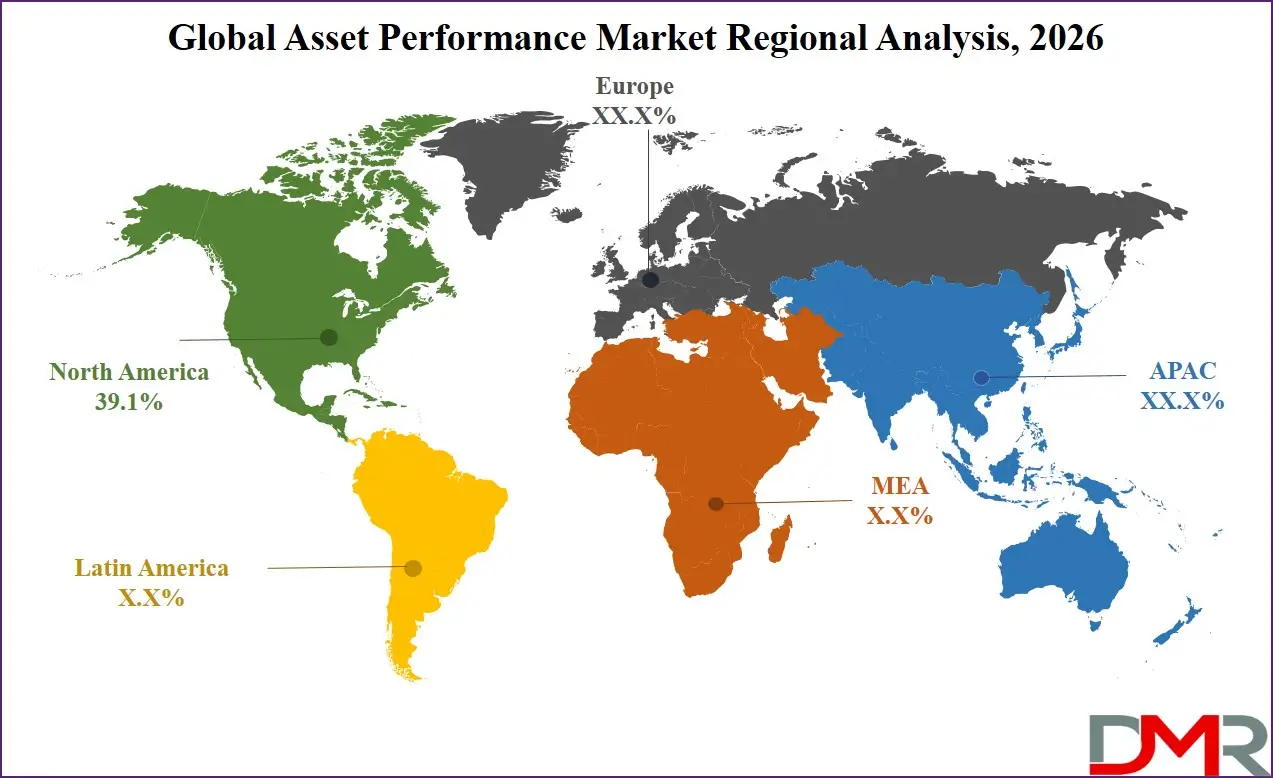
North America is poised to dominate the global asset performance management market, projected to hold 39.1% of the market share by the end of 2026. The US that is the center of North American APM activity has the advantage of unrivaled industrial technology innovation concentration, an established ecosystem of APM solution vendors, and a massive installed base of sensor-enabled industrial equipment. The leadership status of the region is strengthened by the active implementation of Industry 4.0 in all manufacturing industries, elaborate regulatory frameworks, which require maintenance of the integrity of assets in the critical sectors of infrastructure, and the existence of advanced reliability engineering agencies in the Fortune 500 industry corporations. North American companies have been among the first to embrace sophisticated APM features such as AI-based predictive models, asset twin optimization and performance management that is sustainability-oriented. The well-capitalized industrial market in the region continues to invest in APM modernization, with strong presence in oil & gas, manufacturing, and energy and utilities verticals.
ℹ
To learn more about this report –
Download Your Free Sample Report Here
Fastest-Growing Regional Market
The Asia-Pacific region is projected to be the fastest growing asset performance management market due to the high industrialization rates in Southeast Asia, the large modernization of the manufacturing sector in China, and the development of infrastructure projects in the region. Smart manufacturing programs organized by governments in China, Japan, South Korea and India are speeding up APM adoption as the industrial policy focuses more on operational efficiency and global competitiveness. The large presence of manufacturing in the region, both discrete and process, is a large market that can be approached with APM solutions of both entry level condition monitoring and advanced predictive analytics. Other major investments in Renewable Energy infrastructure, modernization of Grids and Infrastructure and Transportation and Logistics assets are generating new deployment opportunities of APM. The rising complexity of the regional industrial activities, accompanied by rising labor costs that encourage automation and remote monitoring, sets Asia-Pacific to continue to experience APM market growth well above the global average.
By Region
North America
Europe
- Germany
- The U.K.
- France
- Italy
- Russia
- Spain
- Benelux
- Nordic
- Rest of Europe
Asia-Pacific
- China
- Japan
- South Korea
- India
- ANZ
- ASEAN
- Rest of Asia-Pacific
Latin America
- Brazil
- Mexico
- Argentina
- Colombia
- Rest of Latin America
Middle East & Africa
- Saudi Arabia
- UAE
- South Africa
- Israel
- Egypt
- Rest of MEA
Competitive Landscape
The global asset performance management market has a competitive environment, which is defined by a wide ecosystem of players such as providers of specialized APM software, industrial automation firms with growing software packages, providers of enterprise asset management platforms combining advanced analytics, and providers of industrial IoT platforms. The market has continued to consolidate with larger industrial software vendors acquiring APM capability in the specialized market to complete their offerings and pure-play software vendors acquiring scale through strategic alliances with system integrators and equipment vendors. The focus of competitive differentiation is moving towards domain-specific knowledge the capability to provide accurate predictive analytics in respect to particular types of assets due to deep knowledge of failure modes and working conditions. Proprietary analytics models developed based on large volumes of data about individual types of equipment generate defensible competitive advantages. Forming strategic alliances with key equipment vendors offers excellent access to design requirements, and operation data that contributes to better predictive model accuracy.
Some of the prominent players in the Global Asset Performance Market are:
- ABB Ltd.
- AVEVA Group plc
- IBM Corporation
- SAP SE
- GE Digital
- Aspen Technology, Inc.
- DNV AS
- Siemens AG
- ABS Group of Companies, Inc.
- Uptake Technologies, Inc.
- SAS Institute Inc.
- Emerson Electric Co.
- Honeywell International Inc.
- Schneider Electric SE
- Rockwell Automation, Inc.
- Bentley Systems, Incorporated
- Oracle Corporation
- Hexagon AB
- Yokogawa Electric Corporation
- IFS AB
- Other Key Players
Recent Developments
- February 2026: GE Vernova announced the addition of new APM software features to its APM suite with improved Asset Twin-Based Optimization specifically to combined-cycle power plants, which allows operators to simulate the long-term effect of flexible operating profile on the degradation of gas turbine and heat recovery steam generations.
- December 2025: Siemens AG introduced a new sustainability and emission management component to its APM portfolio that incorporates real-time emission data with asset-performance metrics to assist industrial operators to optimize reliability and environmental compliance in manufacturing applications and process industry applications.
- September 2025: Emerson Electric Co. acquired a specialized AI-driven predictive analytics company that specializes in rotating equipment monitoring, enhancing its capabilities in AI-Driven Predictive Tools in motors, pumps, and compressors in oil and gas and chemical processing applications.
Report Details
| Report Characteristics |
| Market Size (2026) |
USD 2,682.3 Mn |
| Forecast Value (2035) |
USD 7,097.2 Mn |
| CAGR (2026–2035) |
11.4% |
| The US Market Size (2026) |
USD 882.0 Mn |
| Historical Data |
2021 – 2025 |
| Forecast Data |
2027 – 2035 |
| Base Year |
2025 |
| Estimate Year |
2026 |
| Segments Covered |
By Offering (Solutions, and Implementation & Support Services), By Asset Type (Facility Assets, Mobile & Specialized Assets, Rotating Equipment, Infrastructure Assets, and IT/OT Assets), By Deployment Type (On-Premises APM, and Cloud-Based APM (SaaS)), By Organization Size (Large Enterprises, Medium-Sized Enterprises, and Small Enterprises), By Application (Work Order Automation & Management, Remote Asset Monitoring & Control, Asset Lifecycle Management & Planning, and Operational Support & Resource Management), By Vertical (Energy & Utilities, Oil & Gas, Manufacturing, Government & Defense, IT & Telecom, Healthcare & Life Sciences, Transportation & Logistics, and Other Verticals) |
| Regional Coverage |
North America – The US and Canada; Europe – Germany, The UK, France, Russia, Spain, Italy, Benelux, Nordic, & Rest of Europe; Asia-Pacific – China, Japan, South Korea, India, ANZ, ASEAN, Rest of APAC; Latin America – Brazil, Mexico, Argentina, Colombia, Rest of Latin America; Middle East & Africa – Saudi Arabia, UAE, South Africa, Turkey, Egypt, Israel, & Rest of MEA |
Frequently Asked Questions
How big is the Global Asset Performance Management Market?
▾ The Global Asset Performance Management market is poised to be valued at USD 2,682.3 million in 2026 and is projected to reach USD 7,097.2 million by 2035, driven by the universal need for optimized asset reliability, reduced unplanned downtime, and the integration of AI-driven predictive capabilities across industrial operations.
What is the CAGR of the Global Asset Performance Management Market from 2026 to 2035?
▾ The market is expected to grow at a CAGR of 11.4% from 2026 to 2035, reflecting the increasing complexity of industrial asset ecosystems and the compelling return on investment demonstrated by mature predictive maintenance deployments.
What factors are driving the growth of the Global Asset Performance Management Market?
▾ Key drivers include the critical cost of unplanned downtime in asset-intensive industries, aging industrial infrastructure requiring sophisticated monitoring, skilled workforce shortages necessitating knowledge capture and automation, and increasing regulatory pressure to demonstrate environmental compliance through emissions monitoring and energy efficiency improvements.
Which region held the largest share of the Asset Performance Management Market in 2026?
▾ North America is projected to dominate this market with 39.1% of the market share in 2026, driven by a mature industrial technology ecosystem, extensive sensor-enabled equipment base, and aggressive Industry 4.0 adoption across manufacturing and energy sectors.
Which region is expected to grow the fastest in the Asset Performance Management Market?
▾ The Asia-Pacific region is expected to grow the fastest, fueled by rapid industrialization, government-led smart manufacturing initiatives, and extensive investments in renewable energy and transportation infrastructure across China, India, and Southeast Asia.
What are the major trends in the Global Asset Performance Management Market?
▾ Major trends include the rise of asset twin-based optimization enabling simulation of maintenance scenarios, the convergence of operational technology and information technology systems, the democratization of advanced analytics through AI-powered natural language interfaces, and the integration of sustainability metrics into core asset performance dashboards.
Who are the key players in the Global Asset Performance Management Market?
▾ Key players include industrial automation leaders like Siemens, ABB, Emerson, Rockwell Automation, and Honeywell; specialized software providers including GE Vernova, Aspen Technology, and AVEVA; and enterprise technology companies including SAP, IBM, and Oracle.
How is the Global Asset Performance Management Market segmented?
▾ The market is segmented by Offering, Asset Type, Deployment Type, Organization Size, Application, and Vertical.