Indication Covered
The report covers astigmatism as a common refractive error of the eye, with emphasis on its clinical burden, correction patterns, technology innovation, and commercial market development across the seven markets covered. Astigmatism arises when the cornea or the crystalline lens has an unequal curvature between its principal meridians, so that light is focused at more than one point on the retina. Patients experience blurred or distorted vision at all distances, glare, eye strain, headaches, and difficulty with night driving, and uncorrected astigmatism reduces vision-related quality of life and productivity. Astigmatism is classified as regular, in which the principal meridians are perpendicular and can be corrected with spectacle, toric contact, or toric intraocular lenses, and irregular, in which corneal surface distortion requires specialized correction. Regular astigmatism is further described by axis orientation as with-the-rule, against-the-rule, or oblique, and by its relationship to spherical error as simple, compound, or mixed myopic or hyperopic astigmatism. Genetics, corneal shape, eyelid and ocular surface factors, aging, ocular surgery, trauma, and corneal ectatic disease such as keratoconus are associated with disease development.
The indication scope includes major clinical presentations and associated conditions relevant to correction demand, including:
- Regular Corneal Astigmatism
- Lenticular (Internal) Astigmatism
- Irregular Astigmatism (Keratoconus and Other Corneal Ectasia)
- Post-Surgical and Post-Traumatic Astigmatism
- Myopic Astigmatism
- Hyperopic Astigmatism
- Astigmatism with Cataract (Candidates for Toric Intraocular Lenses)
- Astigmatism with Presbyopia
Regular corneal astigmatism remains the largest focus because it represents the majority of affected individuals and creates sustained demand for spectacle lenses, toric contact lenses, and surgical correction. The report also considers astigmatism in patients undergoing cataract surgery because the adoption of toric intraocular lenses and incision-based techniques allows surgeons to correct pre-existing corneal astigmatism at the time of lens replacement, and is shaping premium-lens development.
Other difficult-to-correct presentations, including high and irregular astigmatism, keratoconus, post-keratoplasty and post-refractive-surgery astigmatism, astigmatism in children with amblyopia risk, and astigmatism combined with presbyopia, are evaluated as areas of continuing clinical need.
The treatment landscape covers optical correction, surgical and procedural correction, and advanced and emerging technologies. Particular attention is given to toric soft and specialty contact lenses, toric and presbyopia-correcting intraocular lenses, laser vision correction, phakic toric lenses, and emerging toric myopia-control and multifocal toric solutions designed to improve visual quality, spectacle independence, and rotational stability, which remain inadequately addressed in a large share of patients.
Epidemiology Parameters
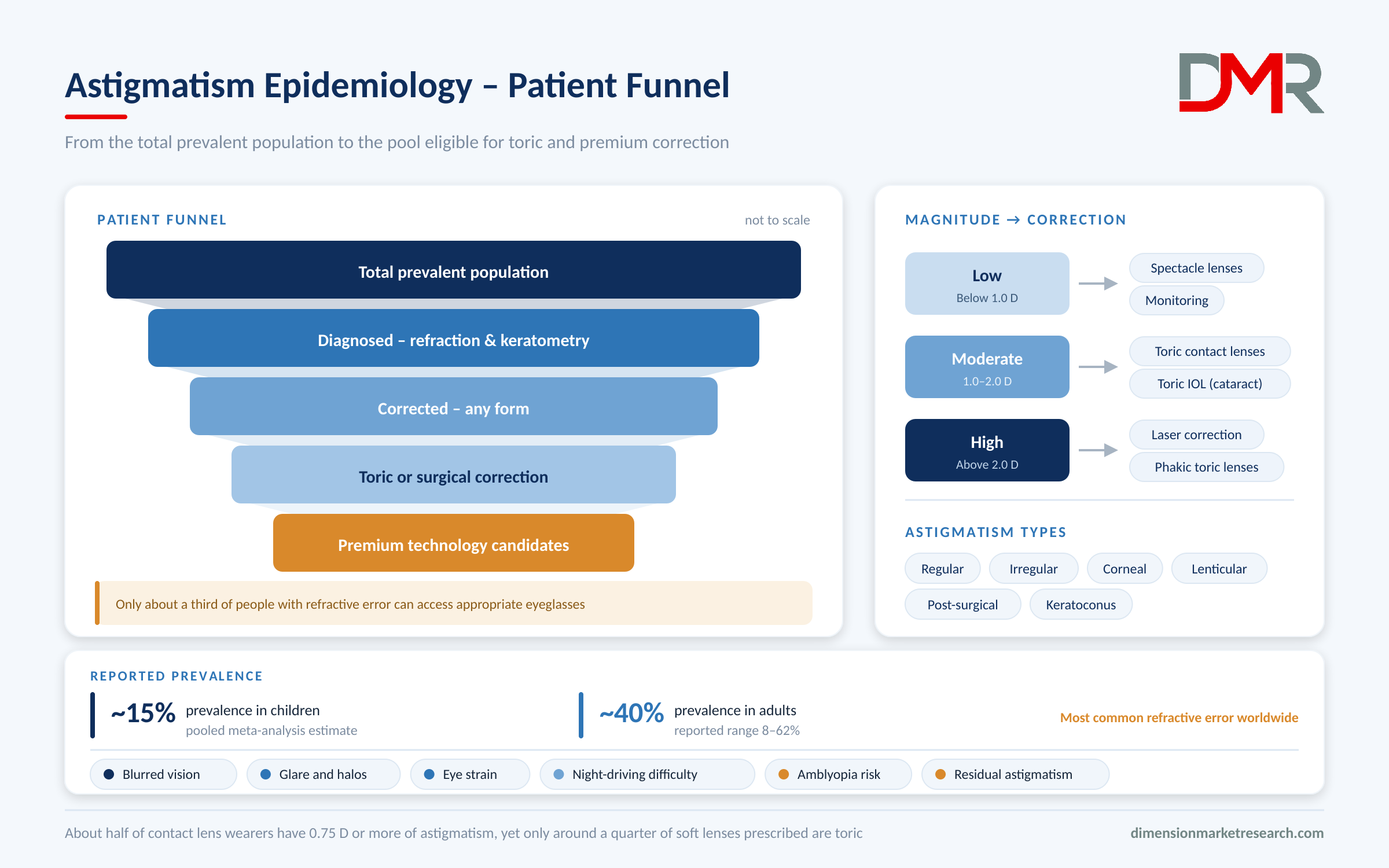
Astigmatism is the most common refractive error worldwide and affects all age groups. Pooled estimates from a systematic review and meta-analysis place prevalence at approximately 15% in children and 40% in adults, although reported rates in the general population range widely, from about 8% to 62%, depending on the definition threshold, measurement method, age, and population. Astigmatism is more common in infancy, declines in early childhood, remains relatively stable through adulthood, and increases at older ages; with-the-rule astigmatism predominates in younger adults, while against-the-rule and oblique astigmatism become more frequent with age. Prevalence is also associated with myopia, and the highest rates have been reported among South-East Asian adults. The epidemiological assessment considers both corneal and refractive astigmatism, recognizing that magnitude, axis, age, and associated ocular conditions vary considerably between patients and influence the choice of correction.
ℹ
To learn more about this report –
Download Your Free Sample Report Here
The epidemiology assessment provides a structured evaluation of the astigmatic population from overall prevalence through diagnosis and correction. Key parameters include:
- Total Astigmatic Patient Population
- Prevalent Population
- Incidence Population
- Diagnosed Patient Population
- Corrected Patient Population
- Uncorrected and Undiagnosed Patient Population
- Correction-Eligible Population
- Magnitude Distribution
- Axis Distribution
- Regular and Irregular Astigmatism Distribution
- Corneal and Lenticular Astigmatism Distribution
- Keratoconus and Corneal Ectasia Population
- Cataract Patients with Pre-Existing Astigmatism
- Patients Wearing Toric Contact Lenses
- Patients Receiving Surgical Correction
- Age and Gender Distribution
- Age at Diagnosis
- Diagnosis Rate and Access to Eye Examination
- Correction Rate
- Correction Penetration
- Association with Myopia and Other Refractive Errors
- Regional Disease Burden
- Epidemiological Trends
The analysis distinguishes between the overall prevalent population, individuals who have been diagnosed through an eye examination, and individuals using an appropriate form of correction. This distinction is important because access to eye care varies widely: it has been reported that only about one third of people with refractive error worldwide have access to appropriate eyeglasses, and many patients have never undergone a comprehensive eye examination. Astigmatism is also under-corrected among contact lens wearers, since roughly half of wearers have 0.75 D or more of astigmatism in at least one eye while only about a quarter of soft lenses prescribed are toric. Diagnosis relies on refraction, keratometry, corneal topography or tomography, and, in cataract and refractive surgery, biometry and surgical planning.
The report also evaluates the influence of school and community vision screening, comprehensive eye examination, corneal imaging, digital and AI-assisted refraction and surgical planning, and increasing consumer awareness on the identification and management of astigmatism. Earlier identification can protect visual development in children, since untreated astigmatism above 1 D carries an amblyogenic risk, and can improve access to spectacle, contact lens, and surgical options in adults. Advances in toric lens design, laser platforms, intraocular lens technology, and measurement of posterior corneal astigmatism have contributed to improved visual outcomes, increasing the need for coordinated long-term management of visual quality, spectacle independence, and associated myopia and presbyopia.
Patient Segmentation
The astigmatic patient population is segmented according to astigmatism type, magnitude, associated refractive status, age group, correction status, and correction requirements. This approach provides a clearer understanding of patients eligible for different correction categories and helps assess the potential addressable population for premium and emerging technologies.
ℹ
To learn more about this report –
Download Your Free Sample Report Here
By Astigmatism Type
Regular Astigmatism: Patients with perpendicular principal meridians who can be corrected with cylindrical spectacle lenses, toric contact lenses, toric intraocular lenses, or laser and incisional procedures. Regular astigmatism accounts for the large majority of cases, and management centers on optical correction, with surgical options for suitable patients seeking spectacle independence.
Irregular Astigmatism: Patients with distorted corneal surface geometry caused by keratoconus, corneal ectasia, scarring, trauma, or previous surgery. Irregular astigmatism cannot be fully corrected with conventional lenses, and rigid gas-permeable, scleral, and hybrid lenses, corneal cross-linking, intracorneal ring segments, and keratoplasty play an important role in managing visual function.
By Astigmatism Magnitude
- Low Astigmatism (Below 1.0 D)
- Moderate Astigmatism (1.0–2.0 D)
- High Astigmatism (2.0–3.0 D)
- Very High Astigmatism (Above 3.0 D)
Magnitude determines the clinical significance of astigmatism and the choice of correction, with toric intraocular lenses and toric contact lenses generally considered for cylinder of 1.0 D or more and higher-cylinder lens models reserved for high and very high astigmatism. These categories support assessment of therapeutic eligibility and are not mutually exclusive across the two eyes of the same patient.
By Refractive Status
- Myopic Astigmatism
- Hyperopic Astigmatism
- Mixed Astigmatism
- Astigmatism with Presbyopia
- Astigmatism with Cataract
Astigmatism frequently coexists with myopia, hyperopia, presbyopia, and cataract. These categories are therefore used to assess clinical burden and correction requirements, including the demand for myopia-control, multifocal, and presbyopia-correcting toric products, rather than representing mutually exclusive patient populations.
By Age Group
- Children and Adolescents
- Working-Age Adults
- Older Adults
Age affects both the type of astigmatism and the correction pathway. Children require early detection to protect visual development and are an emerging target for toric myopia-control lenses, working-age adults represent the core demand for contact lenses and laser vision correction, and older adults represent the main population for toric intraocular lenses at the time of cataract surgery.
By Correction Status
- Diagnosed and Corrected
- Diagnosed and Uncorrected or Under-Corrected
- Undiagnosed
The correction-status segmentation helps identify differences between the total astigmatic population and patients actively using appropriate correction. Improvements in eye examination access, optometric services, screening programs, product awareness, and affordability can gradually increase the diagnosed and corrected population.
By Correction Requirement
- Spectacle Lens Candidates
- Toric Soft Contact Lens Candidates
- Rigid Gas-Permeable and Scleral Lens Candidates
- Orthokeratology Candidates
- Laser Vision Correction Candidates (LASIK, PRK, and SMILE)
- Toric Intraocular Lens Candidates (Cataract and Refractive Lens Exchange)
- Phakic Toric Implantable Lens Candidates
- Corneal Relaxing Incision and Procedural Correction Candidates
- Advanced and Emerging Technology Candidates (Toric Myopia-Control, Multifocal Toric, and Adjustable Lenses)
This segmentation helps evaluate how changes in clinical practice, diagnostic technology, reimbursement, patient preference, and emerging product development can influence correction selection. Patients may qualify for multiple interventions at different life stages, and these categories should not be interpreted as mutually exclusive populations.
Geographic Coverage
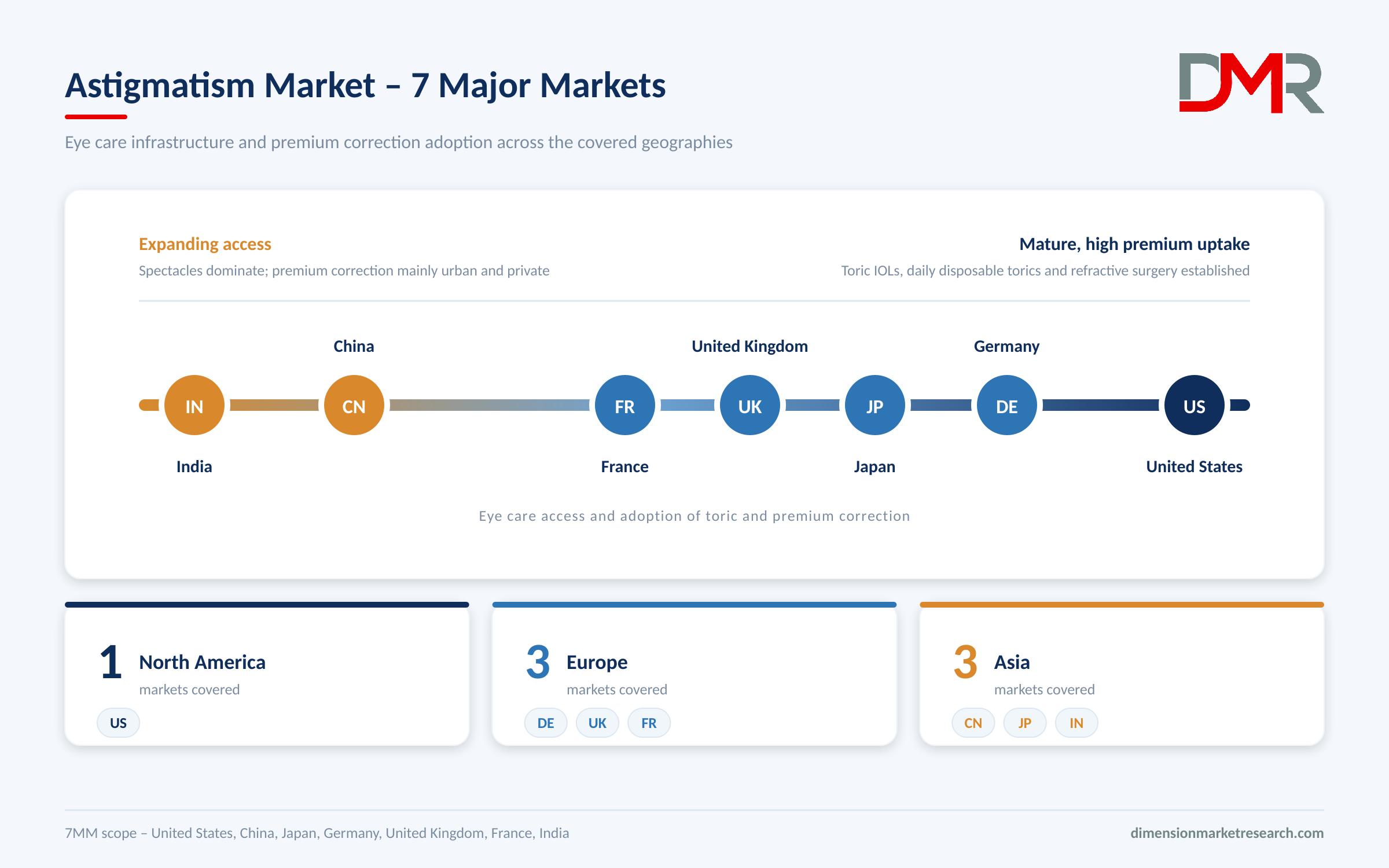
The report provides detailed market, correction, epidemiological framework, and competitive analysis across seven major markets:
- United States
- Germany
- France
- United Kingdom
- China
- Japan
- India
The geographic analysis considers differences in disease recognition, eye care infrastructure, optometry and ophthalmology workforce, availability of corneal imaging and surgical technology, reimbursement of premium correction, regulatory environment, consumer adoption, and competitive activity. These factors are important because the commercial opportunity for astigmatism correction differs between markets according to regulatory approvals, insurance coverage of toric products and procedures, and the organization of optical retail and surgical care.
ℹ
To learn more about this report –
Download Your Free Sample Report Here
United States
The United States represents the largest astigmatism market, supported by a large population with refractive error, high contact lens and surgical correction use, a strong network of ophthalmologists and optometrists, and a leading medical device innovation ecosystem. Patients commonly choose toric and premium options beyond standard coverage, particularly for cataract surgery and refractive procedures. Recent U.S. product activity includes the FDA approval in March 2026 of Johnson & Johnson's TECNIS PureSee extended depth of focus intraocular lens together with a toric version for eyes with 1 D or more of corneal astigmatism, and the launch of Alcon's Clareon TruPlus monofocal and toric intraocular lens in 2026.
The market is characterized by demand for toric intraocular lenses, daily disposable toric and multifocal toric contact lenses, laser vision correction, and phakic implantable lenses. Treatment decisions are influenced by astigmatism magnitude, patient lifestyle, out-of-pocket cost, surgeon recommendation, and the availability of advanced diagnostics and planning tools. Continued innovation in lens design and surgical planning may create opportunities for improving visual outcomes, subject to clinical, regulatory, and payer developments.
Germany
Germany represents the largest European astigmatism market, supported by developed healthcare infrastructure, a strong ophthalmology and optometry sector, and a leading domestic ophthalmic technology industry, including Carl Zeiss Meditec. Standard spectacles, contact lenses, and cataract surgery are widely accessible, while toric and premium options are often partly or fully paid by patients.
The market is influenced by statutory insurance coverage rules, availability of specialist surgical centers, optician and optometrist services, and consumer willingness to pay for premium correction. Adoption of advanced diagnostics, refractive laser platforms, and premium intraocular lenses may support future market growth.
France
France represents an important European market supported by a developed optical retail network, a strong national ophthalmic industry, and established ophthalmology services. France is home to the global spectacle lens leader Essilor, part of EssilorLuxottica, and benefits from national reimbursement arrangements that expand access to basic optical correction.
The market is influenced by reimbursement rules for spectacles and surgery, the organization of optical retail, supplementary insurance coverage, and specialist availability. Continued innovation in lens design, myopia management, and surgical correction may create opportunities for addressing the limitations of existing correction options.
United Kingdom
The United Kingdom benefits from a strong community optometry network, large high-street optical chains, a well-developed private refractive surgery sector, and experience in cataract surgery delivered through the National Health Service. Astigmatism correction involves optometric assessment, with spectacles, toric contact lenses, and, for suitable patients, private laser vision correction or premium intraocular lenses used according to patient needs and funding. Recent UK launches include Johnson & Johnson's daily disposable multifocal toric lens for astigmatic presbyopes.
Market development is influenced by NHS funding of cataract surgery, the proportion of toric and premium options funded privately, optometry practice patterns, and consumer demand for daily disposable and myopia-control products. Continued improvements in diagnostic recognition, toric fitting rates, and surgical planning technology may support the management of patients with astigmatism.
China
China represents a very large and fast-growing astigmatism market, supported by a large population, a high prevalence of myopia and associated astigmatism among children and young adults, a high volume of cataract surgery, and expanding access to optometry and ophthalmology services. Spectacles remain the primary form of correction, while contact lenses and refractive surgery, including SMILE and other laser procedures, are increasingly adopted in urban populations.
The market is influenced by national and regional procurement policies for intraocular lenses, the balance between imported and domestic products, out-of-pocket spending on premium lenses and procedures, school vision screening programs, and growing demand for myopia control. Continued expansion of eye care capacity and consumer awareness may support future adoption of toric and premium correction, subject to regulatory approvals and pricing conditions.
Japan
Japan represents an established market with a rapidly aging population, a high prevalence of myopia, a large volume of cataract surgery, and developed optical and ophthalmic care infrastructure. Spectacles, contact lenses, and surgical correction are widely used, and Japan is an important center of contact lens and ophthalmic device innovation.
Japan is also an important market for myopia management, with new myopia-control contact lens options introduced in 2026. Correction selection is influenced by age, astigmatism magnitude, reimbursement conditions for surgical products, and consumer preference for convenience. Growing awareness of premium intraocular lenses and the continued development of toric myopia-control and multifocal toric products may support future opportunities.
India
India represents a large and developing astigmatism market, with a large population, a substantial burden of uncorrected refractive error, a high volume of cataract surgery delivered through public programs, charitable hospitals, and private providers, and a rapidly growing organized optical retail sector. Spectacles are the dominant form of correction, while toric contact lenses, refractive surgery, and premium intraocular lenses are used mainly in urban and private settings.
The market is influenced by predominantly out-of-pocket payment, availability of optometrists and eye examination services, the urban and rural gap in access, and price sensitivity toward premium lenses and procedures. Expansion of eye care access, school and community screening, and domestic manufacturing of ophthalmic products may support future market growth.
Market Segmentation
The global astigmatism market is segmented by type, correction type, and end user, with detailed analysis across seven major countries. The segmentation encompasses established optical correction, surgical and procedural correction, and emerging technology approaches, including toric myopia-control contact lenses, multifocal toric lenses, extended depth of focus toric intraocular lenses, and adjustable lens technologies.
By Type
Regular Astigmatism
Regular Astigmatism represents the most common form of the condition and includes with-the-rule, against-the-rule, and oblique astigmatism. The segment benefits from a very large patient base and sustained demand for cylindrical spectacle lenses, toric contact lenses, toric intraocular lenses, and laser vision correction throughout the patient's life.
Irregular Astigmatism
Irregular Astigmatism arises from corneal distortion such as keratoconus, ectasia, scarring, or prior surgery. Although the patient population is smaller, the segment is a focus of specialty product and procedural development, including rigid gas-permeable and scleral lenses, corneal cross-linking, and advanced corneal imaging, because conventional correction is often insufficient.
By Correction Type
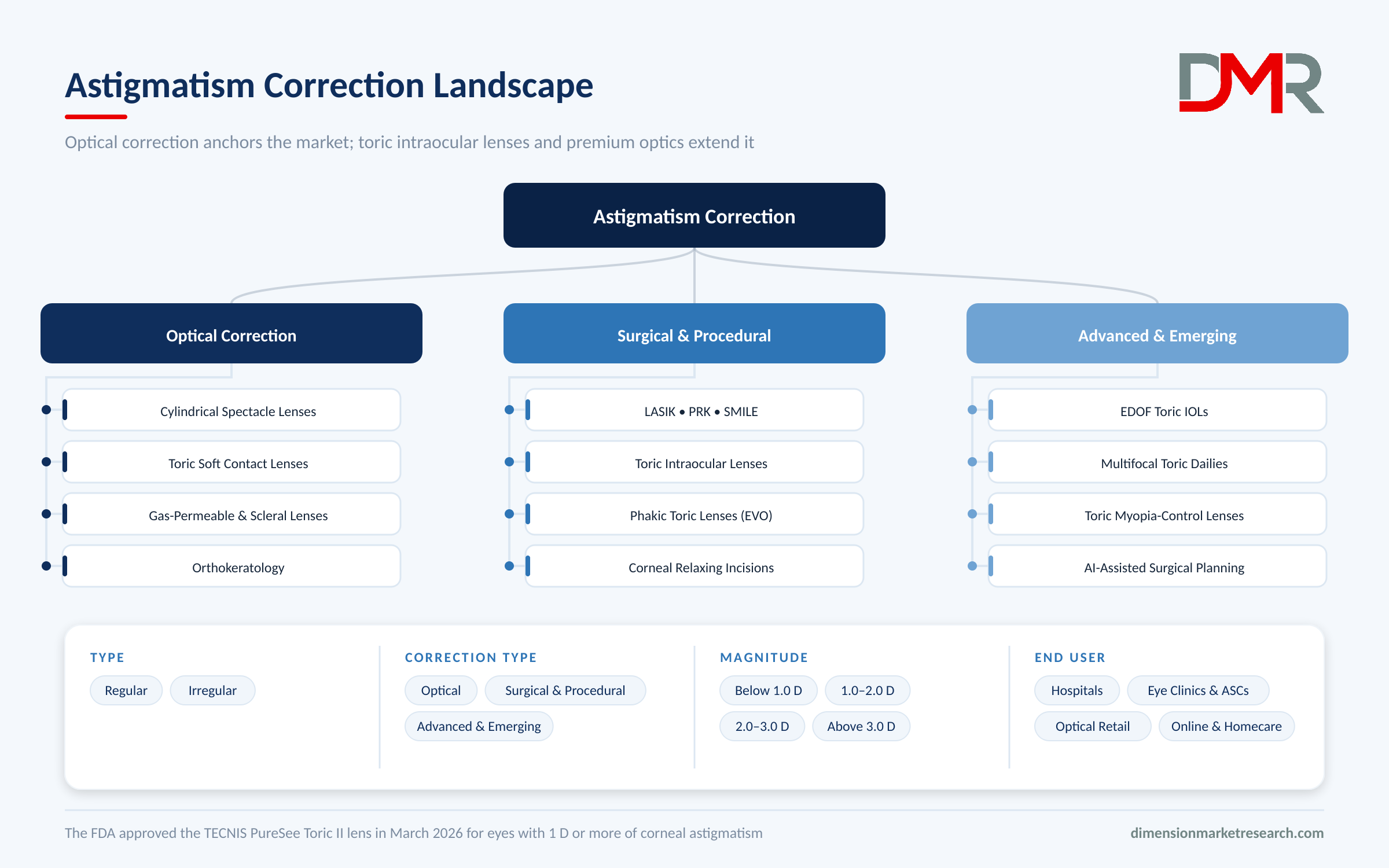
- Optical Correction
- Surgical and Procedural Correction
- Advanced and Emerging Technologies
Optical Correction encompasses spectacle lenses and soft, rigid gas-permeable, scleral, and orthokeratology contact lenses used to correct astigmatism non-invasively. Recurring replacement and consumable demand, particularly for daily disposable toric lenses, generates sustained revenue, and the segment benefits from broad accessibility and the large number of patients seeking correction.
Surgical and Procedural Correction encompasses laser vision correction such as LASIK, PRK, and SMILE, toric intraocular lenses implanted at cataract surgery or refractive lens exchange, phakic toric implantable lenses, corneal relaxing and arcuate incisions, and corneal procedures for irregular astigmatism. These interventions address astigmatism at its source and are often selected by patients seeking spectacle independence, with adoption influenced by cost, clinical suitability, and surgeon recommendation.
Advanced and Emerging Technologies encompass innovative approaches including extended depth of focus and presbyopia-correcting toric intraocular lenses, adjustable and light-adjustable lenses, daily disposable multifocal toric and toric myopia-control contact lenses, AI-assisted refraction and surgical planning, intraoperative aberrometry, and customized corneal procedures. Commercial adoption depends on clinical evidence, long-term safety, regulatory approval, and reimbursement or patient willingness to pay.
By End User
- Hospitals
- Eye Clinics and Ambulatory Surgical Centers
- Optical Retail Stores and Optometry Practices
- Online and Homecare
Hospitals are important for cataract surgery, corneal procedures, management of keratoconus and complex astigmatism, and pediatric eye care. Eye clinics and ambulatory surgical centers support specialist diagnosis, refractive and cataract surgery, implantable lens procedures, and postoperative follow-up, and are a primary channel for premium toric intraocular lenses and laser vision correction.
Optical retail stores and optometry practices are the largest point of access because most patients first receive correction through eye examination and the dispensing of spectacles and contact lenses. Online and homecare channels are growing as consumers reorder daily disposable and monthly contact lenses and spectacles through e-commerce and subscription models, while tele-optometry and home delivery expand access for patients with limited mobility or limited local services.
Market Dynamics
Growth Drivers
High Prevalence of Astigmatism and Growing Aging Population
Astigmatism affects a large share of the adult population and is closely associated with myopia, which is increasing worldwide. Demographic aging expands the population undergoing cataract surgery and the number of patients with pre-existing corneal astigmatism who are candidates for toric intraocular lenses, while a large younger population sustains demand for contact lenses and refractive surgery. Improvements in screening and eye examination access also expand the diagnosed patient population.
Advancements in Lens Technology and Surgical Platforms
The introduction of new toric intraocular lenses, daily disposable toric and multifocal toric contact lenses, and improved laser and implantable lens platforms represents an important expansion of correction options. Continued progress in lens materials, rotational stability, extended depth of focus optics, and measurement of posterior corneal astigmatism may support better visual outcomes and encourage further investment, although approval and commercial availability of investigational products remain uncertain.
Growing Healthcare Investments and Consumer Demand for Premium Vision Correction
Eye care providers are increasingly investing in advanced diagnostics, surgical technology, and patient education, while consumers are showing greater willingness to pay for spectacle independence and convenience. Expansion of optometry services, premium lens portfolios, and elective refractive procedures supports patient identification, specialist referral, and sustained utilization of both consumable and surgical products.
Market Restraints
High Cost of Premium Correction and Limited Reimbursement
Toric intraocular lenses, laser vision correction, and implantable lenses often involve substantial out-of-pocket costs because they are classified as elective or premium services in many health systems. Advanced lens platforms also involve considerable development, manufacturing, and clinical-support expenses. Cost can limit adoption among price-sensitive patients and in publicly funded systems that cover only standard correction.
Under-Correction, Limited Access to Eye Care, and Technical Limitations
Many patients with astigmatism remain uncorrected or under-corrected because of limited access to eye examinations, low awareness, and low toric fitting rates among contact lens wearers. Surgical correction is limited by factors such as lens rotation, residual astigmatism, imprecise measurement of corneal astigmatism including the posterior cornea, ocular surface disease, and variability in surgically induced astigmatism, all of which can affect outcomes and patient satisfaction.
Market Opportunities
Expanding Potential for Toric Myopia-Control and Multifocal Toric Products
Growing recognition of the relationship between astigmatism and myopia is encouraging the development of myopia-control lenses for children who also have astigmatism, a population with limited current options. Daily disposable multifocal toric lenses for astigmatic presbyopes and toric intraocular lenses with extended depth of focus are expanding the addressable population. Advances in lens design and manufacturing support more personalized correction.
Expansion of Eye Care Access Across Emerging Economies
Improving healthcare infrastructure, growing awareness of refractive error, expanding optometry capacity, and rising incomes may increase access to spectacles, contact lenses, and surgical correction in developing healthcare systems. Regulatory approvals and product launches in additional countries illustrate the potential for broader international access to advanced correction.
Development of Digital Planning Tools and Adjustable Technologies
Ongoing development of AI-assisted refraction, preoperative planning, intraoperative aberrometry, and adjustable lens technologies is improving the accuracy of astigmatism correction and reducing residual error. Collaborations between ophthalmic device companies, software developers, academic institutions, and clinical research organizations may accelerate translation of these technologies into routine practice.
Market Trends
Increasing Integration of Digital Health and Tele-Optometry
Eye care providers and retailers are adopting digital refraction, remote consultation, online ordering, and subscription models that extend access beyond conventional practice settings. These technologies facilitate refraction and follow-up with fewer visits, support contact lens reordering, and increase convenience for working-age adults and patients with limited mobility.
Rising Adoption of Daily Disposable Toric Lenses and Premium Intraocular Lenses
Manufacturers are expanding daily disposable toric portfolios, including broader parameter ranges and multifocal toric designs, while premium toric intraocular lenses with extended depth of focus are gaining attention in cataract surgery. Together with growing use of AI-assisted surgical planning and implantable lens options, these developments reflect a shift toward personalized correction and spectacle independence.
Competitive Landscape
The global astigmatism market is characterized by a number of large, established ophthalmic and optical companies and a broad group of specialist developers focused on toric contact lenses, toric intraocular lenses, refractive laser platforms, and digital planning technology.
Leading companies covered in the competitive assessment include:
- Alcon Inc.
- Johnson & Johnson (Johnson & Johnson Vision)
- Bausch + Lomb Corporation
- Carl Zeiss Meditec AG
- The Cooper Companies, Inc. (CooperVision)
- EssilorLuxottica SA
- HOYA Corporation
- STAAR Surgical Company
- Rayner Intraocular Lenses Limited
- Menicon Co., Ltd.
Competition in the Global Astigmatism Market is increasingly focused on developing correction options capable of delivering accurate astigmatism reduction, stable axis alignment, high visual quality, and convenience, particularly through toric intraocular lenses with extended depth of focus and daily disposable toric and multifocal toric contact lenses. Established companies benefit from broad product portfolios, regulatory approvals, surgeon and practitioner relationships, and global distribution, while emerging developers are exploring differentiated optical designs, adjustable lenses, and digital tools to address the limitations of existing correction.
The competitive environment is shaped by Alcon Inc. through its Clareon family of toric and presbyopia-correcting intraocular lenses, including Clareon TruPlus, and its toric contact lens range. Johnson & Johnson competes through TECNIS toric intraocular lenses, including the newly approved TECNIS PureSee Toric II in the United States, and through ACUVUE OASYS MAX 1-Day toric lenses, including the first daily disposable multifocal toric lens for astigmatic presbyopes. Bausch + Lomb Corporation contributes across toric intraocular lenses, toric contact lenses, and specialty gas-permeable lenses. Carl Zeiss Meditec AG contributes through refractive laser systems, including SMILE technology, toric intraocular lenses, and diagnostic and planning solutions. The Cooper Companies, Inc. competes through CooperVision toric contact lenses, with a toric multifocal contact lens scheduled for 2026 launch and a pipeline that includes toric myopia-control lenses.
EssilorLuxottica SA is the leading supplier of spectacle lenses used for astigmatism correction and a major participant in myopia management and optical retail. HOYA Corporation contributes through spectacle lenses and intraocular lenses, and Rayner Intraocular Lenses Limited through toric intraocular lens platforms. STAAR Surgical Company contributes through the EVO family of implantable collamer lenses, including options for myopia with astigmatism, and remained independent after its proposed acquisition by Alcon was terminated in January 2026. Menicon Co., Ltd. contributes through contact lenses, including toric and orthokeratology designs. These companies reflect the evolving competitive environment, encompassing established optical correction, surgical platforms, implantable lenses, and emerging digital and adjustable technologies.
The competitive assessment distinguishes between commercially available correction products, newly launched premium platforms, and emerging technologies. Product differentiation, rotational stability, visual quality, parameter range, geographic expansion, regulatory approvals, price, and pipeline innovation remain important competitive factors. Companies with expertise in optics, materials science,