What is the Austin Data Center Market Size?
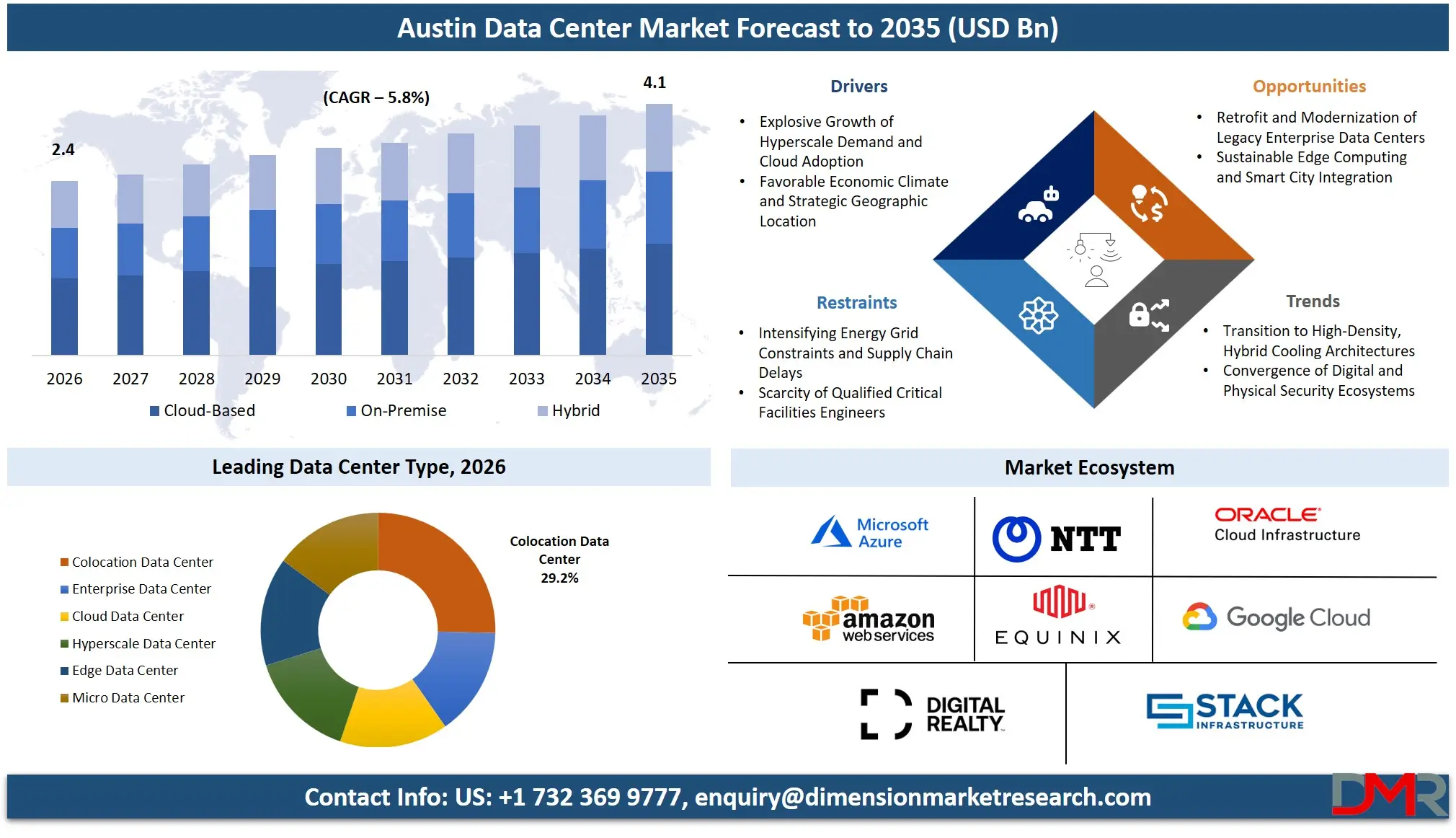
The Austin Data Center Market is expected to reach a value of USD 2.4 billion in 2026, and it is further anticipated to reach USD 4.1 billion by 2035, growing at a CAGR of 5.8% during the forecast period.
ℹ
To learn more about this report –
Download Your Free Sample Report Here
The data center market in Austin has witnessed impressive growth, cementing the city's status as a burgeoning hub for digital infrastructure, cloud connectivity, and enterprise colocation. The market comprises a diverse array of hardware, software, and service offerings designed to support mission-critical IT workloads across hyperscale, cloud, colocation, and edge facilities. The escalating demand for low-latency compute resources, fueled by technology sector expansion and a wave of corporate relocations to Central Texas, has necessitated robust data center investment. Hyperscale cloud providers, colocation operators, and large enterprises are the primary drivers in this industry. Rack-level power densities and sustainable liquid cooling solutions continue to dominate design conversations due to their efficiency for high-performance computing (HPC) and AI inference workloads.
Key Takeaways
- Market Size & Forecast: Based on forecasts, the size of the Austin data center market will experience steady growth, attaining a value of USD 2.4 billion by 2026 and expanding to USD 4.1 billion by 2035, driven by substantial hyperscale campus build-outs and a robust demand pipeline for hybrid cloud deployments.
- Growth Rate & Outlook: It is predicted that the market will register a CAGR of 5.8%, attributed to growth factors such as the influx of technology talent, competitive power costs relative to other major metros, and escalating demand for disaster recovery and business continuity solutions away from coastal risk zones.
- Primary Growth Drivers: Important growth factors will include the proliferation of AI/ML workloads requiring dense GPU clusters, the strategic advantages of Texas tax incentives for data centers, and an accelerating migration from on-premise server rooms to carrier-neutral colocation facilities.
- Key Market Trends: The market trends are mainly related to the retrofit of enterprise data halls for liquid cooling, the integration of smart building analytics for real-time power usage effectiveness (PUE) optimization, and the deployment of far-edge micro data centers to support IoT and 5G latency requirements in the region.
- By Offerings Analysis: The Austin data center market is significantly driven by power and cooling hardware modules, as operators seek to manage thermal runaway in AI-driven racks. Lithium-ion UPS systems and precision air-liquid hybrid cooling solutions are extensively deployed for new hyperscale halls, whereas monitoring software platforms see considerable backing from managed service providers.
- By Data Center Type Analysis: The Austin market is projected to be dominated by hyperscale and colocation data centers, as they allow cloud providers and enterprises to rapidly scale digital operations without the capital expenditure burden of building wholly-owned standalone facilities.
What is the Data Center?
The Austin data center market can be described as the ecosystem of physical facilities, technical infrastructure, and managed services that enable the storage, processing, and distribution of digital information for businesses. Unlike traditional real estate assets, data centers are specialized structures engineered to deliver high-availability power, precision cooling, and multi-layered physical security. This is achieved through two primary deployment approaches: a hyperscale model, which involves massive self-contained compute warehouses for cloud giants, and a colocation model that entails multi-tenant facilities where enterprises lease space, power, and connectivity. Considering the rapid expansion of tech firms along the I-35 corridor, Austin data centers require carrier-grade fiber density and scalability for fluctuating compute demands, often featuring modular designs for future-proofing.
Use Cases
- Supporting Cloud-Native Workloads: Hyperscale and cloud data centers are employed by major cloud service providers to orchestrate vast server clusters, utilizing virtualization software and software-defined networking (SDN) to deliver seamless SaaS applications.
- Digital Transformation of Enterprise IT: Colocation facilities provide a secure, rack-ready environment where large enterprises can deploy their own storage systems and networking equipment, interconnected via on-ramps to public cloud providers.
- High-Density AI Model Training: Technology providers and research institutions adopt liquid cooling modules and high-performance computing servers to sustain the massive thermal load required for training large language models and generative AI algorithms.
- Enabling Edge Computing and 5G: Micro and edge data centers are deployed by telecom operators to cache content and process latency-sensitive data closer to end-users, utilizing far-edge power modules and remote monitoring management software.
How AI is Transforming the Data Center Market?
The impact of AI on the Austin data center market encompasses fundamentally altering physical infrastructure design, predictive maintenance, and energy optimization. AI-driven design tools now simulate thermal fluid dynamics to optimize the placement of liquid cooling distribution units and perforated tiles, preventing hot spots before a rack is ever energized. AI-based analytics platforms allow operators to predict failures in power modules like UPS systems and busways by continuously monitoring harmonic distortions.
Furthermore, the role of AI in sustainability is critical. Machine learning algorithms linked to automation & orchestration software autonomously adjust cooling module parameters in real time based on GPU load, dramatically lowering Power Usage Effectiveness (PUE) and water utilization. AI also assists in security through intelligent video surveillance analytics, detecting physical tampering or unauthorized provisioning of hardware, ensuring a zero-trust operational posture.
Market Dynamics
Key Drivers in the Austin Data Center Market
Explosive Growth of Hyperscale Demand and Cloud Adoption
A mass migration of enterprise workloads to off-premise environments, combined with the regional expansion of the world's largest cloud service providers, forms a primary catalyst for data center absorption in Austin. Hyperscale clients are pre-leasing entire campuses before construction is complete. The presence of a diverse technology ecosystem and a growing startup culture generates massive compute requirements that can only be satisfied by scalable cloud data centers and wholesale colocation shells.
Favorable Economic Climate and Strategic Geographic Location
Austin's strategic location in Central Texas offers a non-disaster-prone alternative to coastal hubs, making it a prime target for business continuity infrastructure. The state's attractive tax incentives for data center hardware and the availability of competitively priced renewable energy sources significantly lower the Total Cost of Ownership (TCO). This economic matrix, coupled with low latency connectivity to both East and West Coast financial hubs, drives BFSI and entertainment media investments.
Restraints in the Austin Data Center Market
Intensifying Energy Grid Constraints and Supply Chain Delays
The extraordinary power density required by contemporary compute hardware has placed immense strain on the local electrical grid, with lead times for new substation installations extending significantly. Long-duration backup power systems and generators face supply chain bottlenecks, specifically for large-bore diesel reciprocating engines. The escalating power consumption is also drawing regulatory scrutiny regarding grid stability. Furthermore, the struggle to procure long-lead-time switchgear and cooling tower components forces developers to extend construction timelines, straining capital allocation.
Scarcity of Qualified Critical Facilities Engineers
Operating a Tier 3 or Tier 4 data center requires a specialized electrical and mechanical engineering skillset that is currently in short supply in the Austin labor market. The technical complexity of maintaining liquid cooling systems, high-voltage switchgear, and sophisticated building management software creates a fierce battle for talent. Without sufficient on-site critical facility engineers and NOC technicians, outsourcing maintenance contracts drives operational expenditure upward, potentially negating the tax incentives gained on the capital side.
Growth Opportunities in the Austin Data Center Market
Retrofit and Modernization of Legacy Enterprise Data Centers
A significant growth opportunity lies in the integration and deployment of services aimed at updating older, on-premise enterprise data centers. As AI workloads push power densities beyond the capacity of traditional air-based cooling, local enterprises require partners to retrofit existing white space with hybrid cooling modules and dense PDUs. This involves wrapping raised-floor environments with passive chimney cabinets and direct-to-chip cooling loops, bringing legacy infrastructure up to Tier 3 performance standards without the latency or cost of a full colocation migration.
Sustainable Edge Computing and Smart City Integration
As Austin continues its smart city trajectory, the need for regional edge data centers to process municipal IoT data will grow dramatically. This opens avenues for deploying micro data centers built with sustainable materials and immersed in the city's distributed fiber grid. Technology providers can capitalize on offering integrated solutions combining far-edge enclosures, solar-ready power modules, and AI-driven monitoring & management tools to local government agencies and utilities looking to manage traffic, water resources, and public safety via low-latency analytics.
Trends in the Austin Data Center Market
Transition to High-Density, Hybrid Cooling Architectures
The Austin market is witnessing a decisive architectural shift away from perimeter air handlers toward direct-to-chip liquid cooling and immersion tanks. As standard rack loads break the 20kW to 40kW ceiling, operators are adopting precision liquid cooling as the primary rejection mechanism, using air-based cooling merely to manage the residual heat from memory and cabling. This trend is enabling higher compute density per square foot, a critical metric for colocation providers aiming to maximize revenue in a market with finite power availability.
Convergence of Digital and Physical Security Ecosystems
A major trend is the convergence of physical hardware access and logical cybersecurity protocols. Modern facilities are integrating security software that unifies badge access, biometric scanning, and intra-cage intrusion detection with the network provisioning layer. In practice, this means a rack within a colocation data center cannot be accessed physically until the automation software verifies that the relevant VMs have been logically isolated, closing the gap between IT and Facilities Management.
Research Scope and Analysis
The Austin Data Center Market is segmented by offerings into hardware (IT, power, and cooling modules), software, and services, by deployment model, by data center type, by Tier Standard level, by enterprise size, and by end-user including cloud service providers, technology providers, telecom, BFSI, healthcare, and energy & utilities.
ℹ
To learn more about this report –
Download Your Free Sample Report Here
By Offerings Analysis
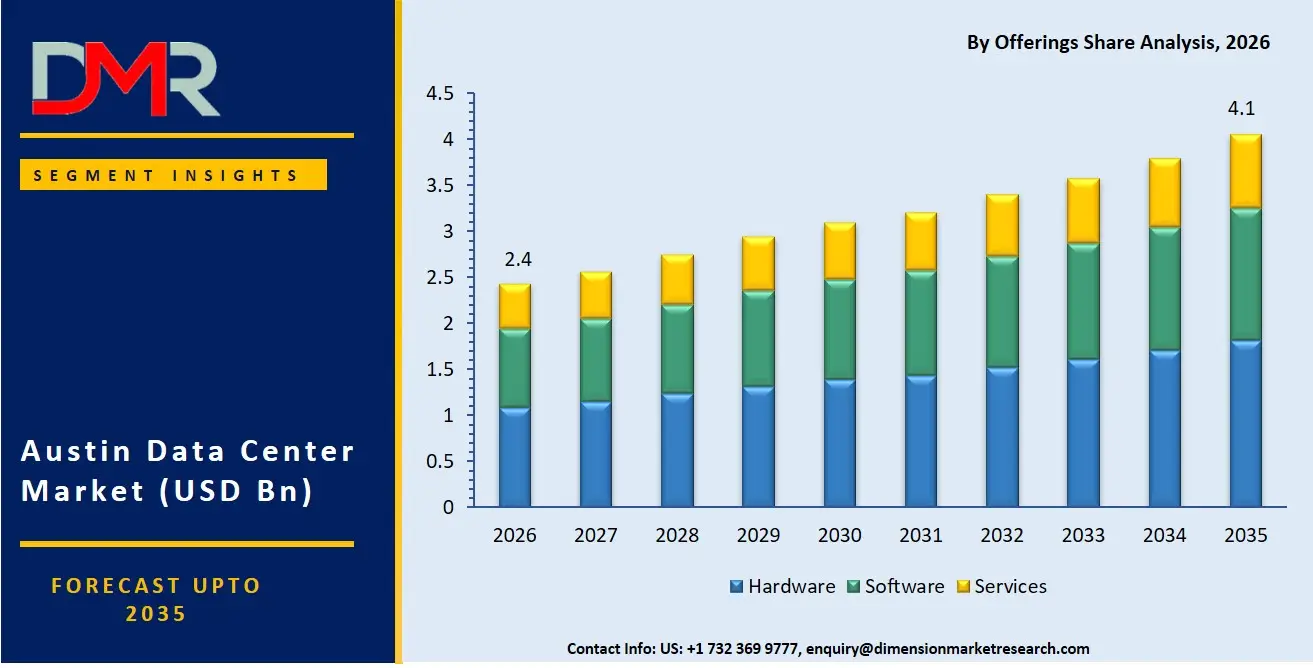
The hardware segment is projected to dominate the Austin data center market offerings, specifically the power and cooling modules, owing to the criticality of electrical infrastructure resilience and thermal management in Central Texas's climatic conditions.
ℹ
To learn more about this report –
Download Your Free Sample Report Here
As rack densities skyrocket due to GPU clusters, the deployment of high-efficiency lithium-ion UPS systems and intelligent power distribution units (PDUs) is essential for ensuring uptime. In the cooling domain, the shift is rapidly moving from traditional air-based precision systems to hybrid and full liquid cooling modules, enabling operators to sustainably manage the heat rejection of high-performance IT modules without throttling performance.
By Deployment Model Analysis
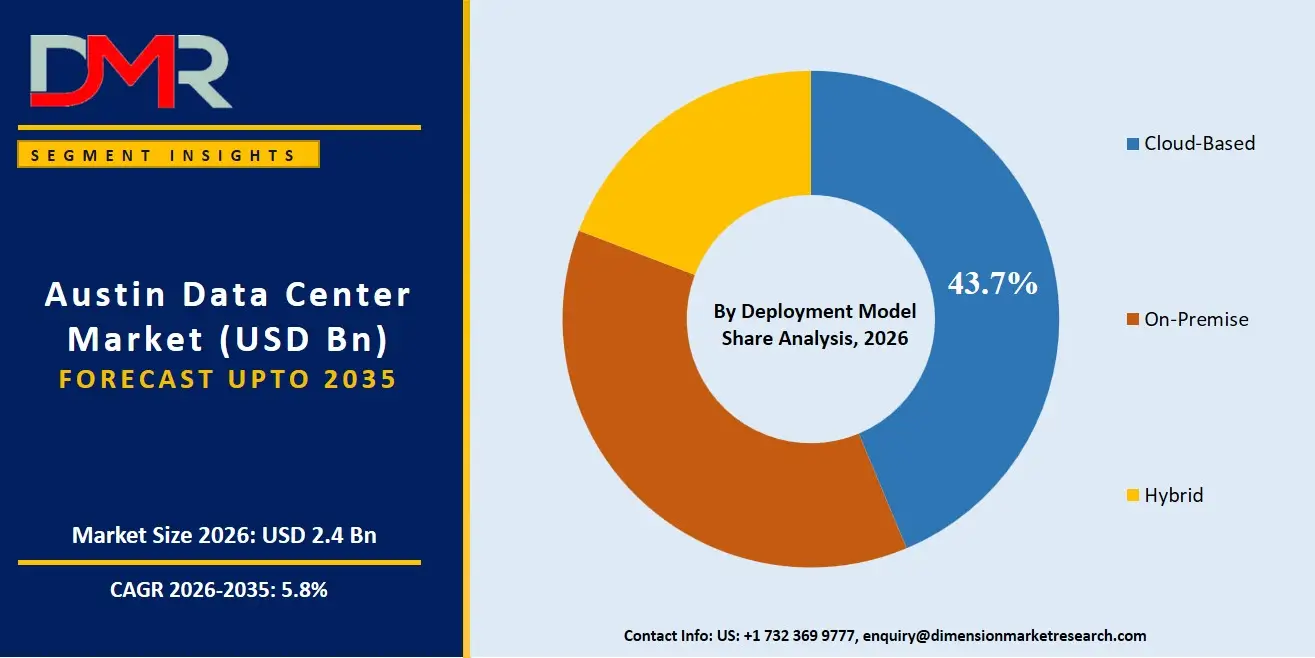
Cloud-based deployment is poised to dominate the Austin Data Center Market as organizations increasingly migrate workloads to scalable public and hybrid cloud environments. Austin has become a preferred location for cloud infrastructure investments due to abundant fiber connectivity, a strong technology ecosystem, business-friendly regulations, and proximity to major enterprise customers across Texas. Global cloud providers continue expanding regional availability zones and hyperscale campuses to meet growing demand for AI, analytics, SaaS, and digital transformation initiatives. Enterprises favor cloud deployments for flexibility, rapid scalability, lower infrastructure management requirements, and improved disaster recovery capabilities, making cloud-based infrastructure the leading deployment model throughout the forecast period.
By Data Center Type Analysis
Colocation and Hyperscale data centers are poised to dominate the square footage absorption in the Austin area. Wholesale colocation facilities offer modular power shells to cloud service providers, allowing them to scale their cloud data center capacity rapidly. Simultaneously, the hyperscale segment is building at an unprecedented velocity, driven by the insatiable capacity demands of AI inference. The edge data center segment is also emerging rapidly, as telecom providers deploy regional edge nodes to reduce back-haul latency for entertainment media streaming and upcoming autonomous vehicle applications navigating the Austin metroplex.
By Level (Tier Standard) Analysis
Tier 3 and Tier 4 certified facilities are expected to dominate the Austin market. The Tier 3 standard, with its concurrently maintainable infrastructure and N+1 redundancy, represents the baseline requirement for any major colocation or enterprise data center ensuring business continuity. For mission-critical applications in BFSI and hyperscale gateways, Tier 4 facilities providing fault tolerance and 2N+1 redundancy on power modules and cooling modules are becoming increasingly common. This trend ensures that power disruptions or maintenance on a single UPS system or chiller plant will not impact the high-availability operations of cloud service providers.
By Enterprise Size Analysis
Large Enterprises are expected to be the primary consumers of wholesale colocation and dedicated infrastructure in Austin, as they migrate away from owning aging on-premise capital-intensive buildings. These organizations seek carrier-neutral facilities to cross-connect with a broad ecosystem of technology providers and networks. However, the Small & Medium Enterprises (SMEs) segment represents a high-growth vector for retail colocation and managed services, offering design & consulting and support & maintenance wrappers that allow smaller tech startups to access enterprise-grade TIER infrastructure without dedicated mechanical engineering staff.
By End User Analysis
Cloud service providers is poised to dominate the Austin Data Center Market as they account for the majority of new capacity additions and infrastructure investments across the region. Rising adoption of cloud computing, artificial intelligence, machine learning, streaming platforms, enterprise SaaS, and digital business applications has driven continuous expansion of hyperscale facilities operated by major cloud companies. Austin's strategic geographic location, excellent fiber connectivity, favorable business environment, and growing technology ecosystem support large-scale cloud infrastructure deployments. Continuous investments in high-density computing, scalable storage, and advanced networking enable cloud providers to maintain the largest share of data center demand and overall market revenue.
The Austin Data Center Market Report is segmented on the basis of the following:
By Offerings
- Hardware
- IT Modules
- Servers
- Storage Systems
- Networking Equipment
- Power Modules
- UPS Systems
- Power Distribution Units
- Backup Power Systems
- Cooling Modules
- Air-Based Cooling
- Liquid Cooling
- Precision Cooling Systems
- Software
- Monitoring & Management Tools
- Automation & Orchestration Software
- Backup & Disaster Recovery Software
- Security Software
- Virtualization Software
- Analytics & Optimization Software
- Services
- Design & Consulting
- Integration & Deployment
- Support & Maintenance
- Managed Data Center Services
By Deployment Model
- Cloud-Based
- On-Premise
- Hybrid
By Data Center Type
- Colocation Data Center
- Retail Colocation
- Wholesale Colocation
- Enterprise Data Center
- Cloud Data Center
- Hyperscale Data Center
- Edge Data Center
- Micro Data Center
By Level (Tier Standard)
- Tier 1
- Tier 2
- Tier 3
- Tier 4
By Enterprise Size
- Large Enterprises
- Small & Medium Enterprises (SMEs)
By End User
- Technology Providers
- Cloud Service Providers
- Telecom
- BFSI
- Healthcare
- Retail & E-commerce
- Entertainment & Media
- Energy & Utilities
Competitive Landscape
The nature of competition in the Austin data center market has become intensely dynamic, featuring a mix of global hyperscale giants, publicly traded REITs specializing in colocation, and private equity-backed developer-operators. Strategic land banking in power-friendly corridors and the securing of long-term renewable energy agreements are crucial competitive moats, as power access rather than connectivity is now the primary site selector. The trend of consolidation is growing, as real estate asset managers acquire local data center firms to gain standing inventory in this capacity-constrained market. IP differentiators, such as proprietary high-density cooling designs, autonomous facility management software, and pioneering liquid cooling retrofits, are playing an increasingly significant role compared to simply providing square footage or raw kilowatts.
Some of the prominent players in the Austin Data Center Market are:
- Digital Realty Trust
- QTS Data Centers
- CyrusOne
- Equinix
- Aligned Data Centers
- Flexential
- DataBank
- EdgeConneX
- Compass Datacenters
- Vantage Data Centers
- STACK Infrastructure
- Iron Mountain Data Centers
- Switch, Inc.
- NTT Global Data Centers
- Google Cloud
- Microsoft Azure
- Amazon Web Services (AWS)
- Meta Platforms
- Oracle Cloud Infrastructure (OCI)
- CoreSite Realty Corporation
- Other Key Players
Recent Developments
- September 2025: QTS Data Centers announced the expansion of its Austin hyperscale campus, adding new data halls designed for high-performance computing (HPC) and AI workloads while increasing available power capacity.
- June 2025: Compass Datacenters initiated construction of additional facilities in the Austin region, focusing on scalable, build-to-suit data centers with advanced water-efficient cooling systems for hyperscale cloud providers.
- January 2026: Digital Realty expanded its Austin data center campus with additional AI-ready capacity, incorporating high-density liquid cooling infrastructure and enhanced renewable energy sourcing to support hyperscale and enterprise customers.
Report Details
| Report Characteristics |
| Market Size (2026) |
USD 2.4 Bn |
| Forecast Value (2035) |
USD 4.1 Bn |
| CAGR (2026–2035) |
5.8% |
| Historical Data |
2021 – 2025 |
| Forecast Data |
2027 – 2035 |
| Base Year |
2025 |
| Estimate Year |
2026 |
| Segments Covered |
By Offerings, By Deployment Model, By Data Center Type, By Level, By Enterprise Size, By End User |
| Country Coverage |
Austin |
Frequently Asked Questions
How big is the Austin Data Center Market?
▾ The Austin Data Center market is poised to be valued at USD 2.4 billion in 2026 and is projected to reach USD 4.1 billion by 2035, driven by the universal need for low-latency digital infrastructure supporting AI, cloud, and enterprise IT workloads in a growing technology hub.
What is the CAGR of the Austin Data Center Market from 2026 to 2035?
▾ The market is expected to grow at a CAGR of 5.8% from 2026 to 2035, reflecting the accelerating construction pipeline and the region's strategic advantages in power cost and disaster avoidance for mission-critical deployments.
What factors are driving the growth of the Austin Data Center Market?
▾ Key drivers include insatiable demand from cloud service providers for wholesale capacity, the escalating compute power and cooling requirements of AI hardware clusters, and the migration of large enterprises seeking cost-competitive colocation options outside traditional coastal hubs.
What are the major trends in the Austin Data Center Market?
▾ Major trends include the retrofit of legacy white space with direct-to-chip liquid cooling, the integration of AI-driven analytics and optimization software to autonomously tune PUE, and the proliferation of far-edge data centers to support 5G and smart city IoT applications.
Who are the key players in the Austin Data Center Market?
▾ Key players in the Austin Data Center Market include Equinix, Digital Realty, CyrusOne, QTS, DataBank, NTT, along with critical infrastructure suppliers like Schneider Electric and Vertiv, driving innovation through modular construction, sustainability, and high-density power design.
How is the Austin Data Center Market segmented?
▾ The market is segmented by Offerings, Deployment Model, Data Center Type, Level (Tier Standard), Enterprise Size, and End User.