Australia Applicant Tracking System Market Snapshot
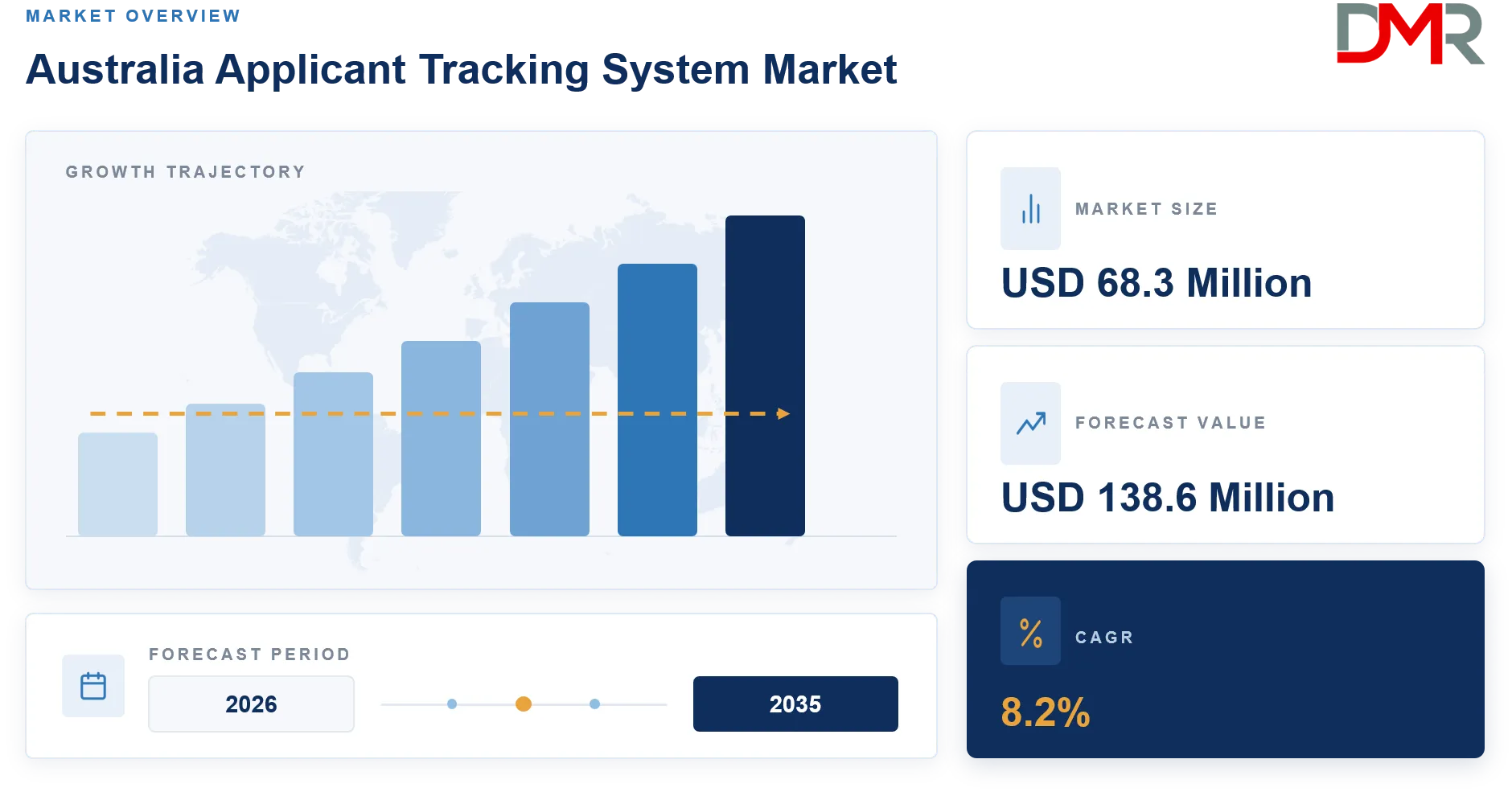
- Market Value: Australia applicant tracking system market is valued at USD 68.3 million in 2026 and is projected to reach USD 138.6 million by 2035.
- CAGR: Australia applicant tracking system market is expected to grow at a CAGR of 8.2% from 2026 to 2035.
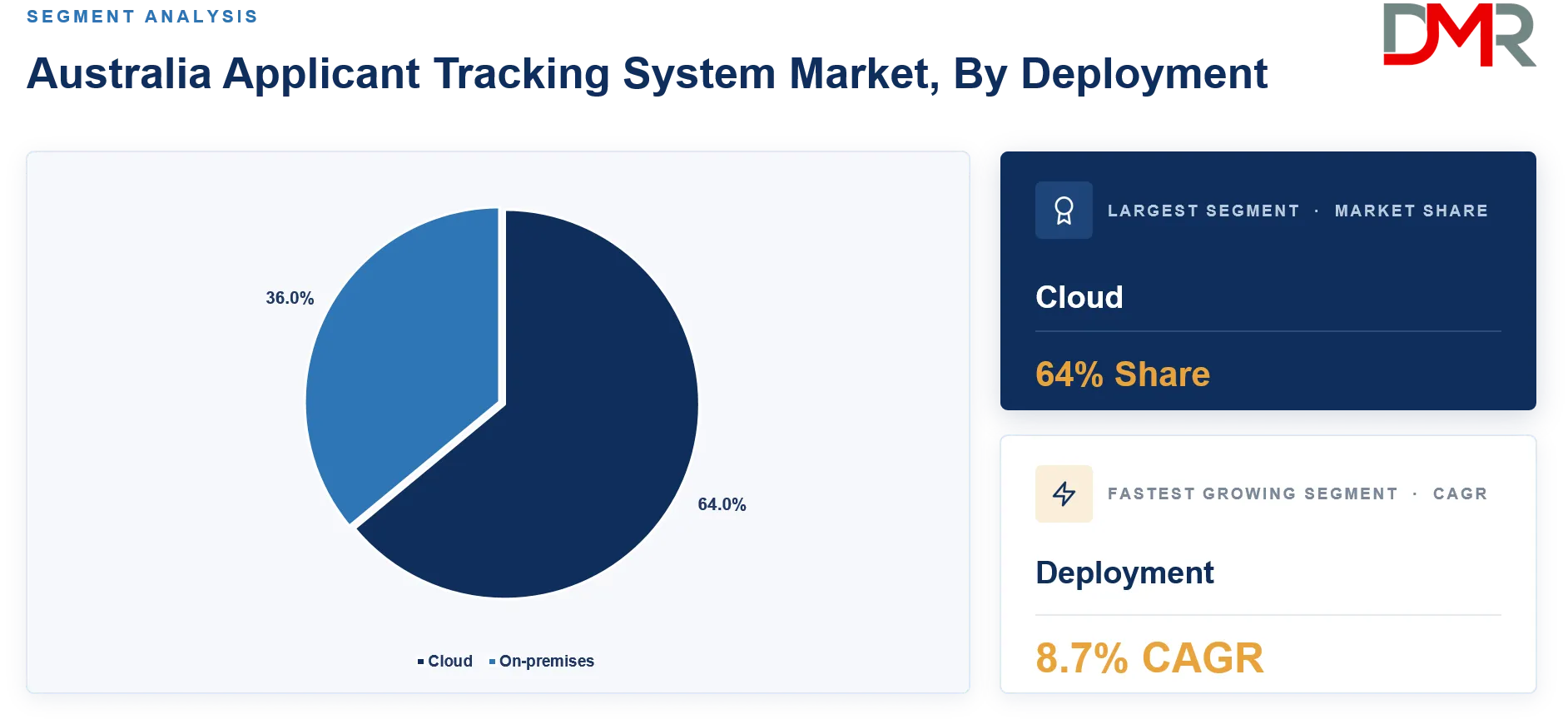
- By Deployment Segment Analysis: Cloud deployment led the market with a 64.0% share in 2026.
- By Component Segment Analysis: Software led the component segment with a 71.0% share in 2026.
- By End-User Industry Segment Analysis: IT & telecommunications held the largest industry share at 22.0% in 2026.
- Major Players: JobAdder, Employment Hero, PageUp, Bullhorn, Greenhouse Software and Others.
What is the Australia Applicant Tracking System Market and its Market Size?
The Australia Applicant Tracking System Market size is projected to be valued at USD 68.3 million in 2026 and reach USD 138.6 million by 2035, expanding at a CAGR of 8.2% during the forecast period. Applicant tracking systems are recruitment software platforms used by employers and recruitment agencies to manage job advertising, applications, candidate records, screening, interview workflows, communications, approvals, offers, and recruitment analytics. Growing demand for cloud recruitment software, automated hiring workflows, centralized candidate data, talent acquisition analytics, and integration with HR and payroll platforms is supporting Australia applicant tracking system market growth.
ℹ
To learn more about this report –
Download Your Free Sample Report Here
Australian employers operate in a sizable and active recruitment environment. The Australian Bureau of Statistics reported 329,500 job vacancies in May 2026, including 293,800 vacancies in the private sector. The continuing movement of candidates between occupations, employers, and locations creates a practical need for systems that can organize applications and improve recruiter productivity. ATS platforms increasingly connect applicant management with job boards, career sites, interview scheduling, onboarding, HR information systems, payroll applications, background checks, and workforce analytics.
Use Cases
- Candidate Application Management: Applicant tracking systems create a centralized record for resumes, applications, recruiter notes, interview feedback, communication history, and candidate status. Australian employers can replace fragmented spreadsheets and email-based workflows with searchable candidate pipelines that give HR teams and hiring managers a consistent view of every active vacancy.
- High-Volume Recruitment: Employers in retail, telecommunications, healthcare, customer service, government contracting, and other workforce-intensive industries use ATS platforms to process large applicant pools. Screening questions, workflow rules, interview scheduling, templates, and bulk communication help recruitment teams manage repeated hiring campaigns without increasing administrative work at the same rate as application volume.
- Recruitment Agency Operations: Australian staffing and recruitment firms use ATS and recruitment CRM platforms to manage client vacancies, candidate databases, recruiter activity, placement pipelines, communications, and job-board distribution. Platforms such as JobAdder, Bullhorn, Vincere, Recruiterflow, and Loxo compete for agencies that require both candidate tracking and customer relationship management capabilities.
- Enterprise Talent Acquisition: Large organizations use applicant tracking software to standardize recruitment across business units, locations, recruiters, and hiring managers. Approval workflows, role-based permissions, talent pools, compliance records, integrations, dashboards, and reporting become particularly important when enterprises manage hundreds of open positions and large volumes of candidate information.
- Recruitment Analytics and Planning: ATS reporting gives HR leaders visibility into application sources, recruitment funnel conversion, hiring activity, time-to-fill, candidate progression, recruiter workloads, and offer outcomes. These metrics support decisions on recruitment channels, workforce planning, process bottlenecks, and technology spending, making analytics an increasingly important buying criterion for Australian organizations.
How AI and Generative AI are Transforming the Australia Applicant Tracking System Market?
Artificial intelligence is moving applicant tracking systems beyond basic application storage toward automated candidate discovery, matching, prioritization, communication, and workflow support. Australian ATS vendors are adding features that interpret job descriptions, compare candidate profiles with role requirements, recommend prospects, summarize applications, assist with job advertisements, and automate repetitive recruiter actions. Employment Hero, for example, has developed candidate matching and screening capabilities alongside its recruitment platform, while JobAdder promotes embedded automation and intelligent recruiting workflows. Employment Hero reported that one customer using its matching and screening tools saved 30 to 45 minutes per candidate during screening, illustrating how automation can affect recruiter workload in practical hiring environments.
Generative capabilities are also changing how recruiters create job descriptions, prepare candidate communications, summarize interview information, search talent databases, and move candidates through recruitment funnels. At the same time, buyers are placing more attention on explainability, privacy, human oversight, and fair treatment because ATS platforms process resumes and other personal information. The Office of the Australian Information Commissioner states that the Privacy Act applies to uses of commercially available artificial intelligence involving personal information. This raises the importance of governance controls, data handling policies, permission management, auditability, and human review as Australian employers expand automated recruitment.
Key Drivers in the Australia Applicant Tracking System Market
Large and Continuously Moving Recruitment Pipeline
Australia's active labour market generates a steady flow of vacancies, applications, interviews, and hiring decisions that organizations must manage efficiently. ABS data recorded 329,500 job vacancies in May 2026, demonstrating the continuing scale of employer recruitment activity. When multiple vacancies and candidate pools run simultaneously, manual email and spreadsheet processes become harder to control. Applicant tracking systems address this operational issue by centralizing applications, automating workflow steps, and giving recruiters and management teams real-time pipeline visibility.
Integration of Recruitment with Broader HR Technology
Australian companies are increasingly seeking recruitment platforms that connect hiring with onboarding, HR administration, payroll, workforce management, and employee data. This is influencing ATS demand because decision-makers can reduce duplicate data entry and move successful candidates directly into downstream HR workflows. Employment Hero positions recruitment within a wider employment platform, while PageUp connects applicant tracking with broader talent management functionality. The trend favors vendors with APIs, HRIS integrations, payroll connections, job-board connectivity, and configurable workflows rather than isolated candidate databases.
Restraints in the Australia Applicant Tracking System Market
Privacy, Data Governance and Automated Hiring Risk
Applicant tracking platforms contain resumes, contact details, employment histories, interview information, assessment results, and other candidate data, making governance an important purchase consideration. Australian privacy requirements can influence how organizations collect, store, access, share, and use personal information. The OAIC states that personal information must be collected through lawful and fair means under relevant Australian Privacy Principles. Organizations evaluating automated screening therefore need suitable access controls, retention policies, vendor oversight, security measures, and transparent processes, which can increase implementation requirements.
Implementation Complexity Across Existing HR Systems
ATS adoption can become more complex for employers with established payroll systems, HR information systems, identity tools, career portals, assessment providers, background-check services, and recruitment agency relationships. Large organizations may require data migration, workflow configuration, permissions, integrations, reporting structures, user training, and change management before gaining full value. Switching costs can also rise when historical applicant records and recruitment processes are deeply embedded in an incumbent platform. These issues may lengthen procurement cycles and encourage some companies to retain existing systems.
Growth Opportunities in the Australia Applicant Tracking System Market
Expansion Among Small and Medium-sized Enterprises
SMEs represent a significant expansion opportunity as cloud platforms lower the technical barriers associated with applicant tracking software. Subscription delivery enables businesses to access centralized applicant pipelines, job-board posting, scheduling, screening, templates, and onboarding workflows without operating dedicated recruitment infrastructure. Employment Hero specifically markets applicant tracking capabilities to Australian businesses, including smaller employers. Vendors that combine simple deployment, predictable pricing, payroll or HR integration, and automated administration can expand ATS penetration among growing businesses that previously relied on email and spreadsheets.
Recruitment Intelligence and Talent Pool Monetization
A growing opportunity lies in turning historical candidate databases into reusable talent pools rather than treating each vacancy as a separate recruitment project. Modern ATS platforms can classify profiles, search previous applicants, identify suitable candidates, automate rediscovery, and measure source effectiveness. This can reduce dependence on repeated job advertising and external sourcing. Vendors that combine applicant tracking, recruitment CRM, semantic search, candidate matching, communications, and analytics can offer stronger value to employers and agencies managing large proprietary candidate databases.
Trends in the Australia Applicant Tracking System Market
Shift Toward Cloud-Based Applicant Tracking Platforms
Cloud deployment accounted for 64.0% of the Australia applicant tracking system market in 2026, establishing it as the leading deployment model. Browser-based access supports distributed recruiting teams and simplifies deployment across offices without maintaining local ATS infrastructure. Cloud platforms also make continuous feature releases, integrations, workflow updates, analytics, and subscription-based scaling easier to manage. This model aligns particularly well with employers operating hybrid workforces, multi-location recruitment teams, and outsourced recruitment relationships, supporting further cloud ATS market growth through 2035.
Convergence of ATS, Recruitment CRM and Employee Platforms
The boundary between applicant tracking, candidate relationship management, onboarding, HR management, and workforce software is becoming less distinct. JobAdder combines ATS and recruitment CRM capabilities, while Employment Hero links hiring with HR and payroll workflows, and PageUp connects applicant tracking with talent management. This convergence is changing purchasing criteria. Buyers increasingly compare platforms based on the complete recruitment lifecycle, integrations, automation, candidate engagement, reporting, and post-hire workflows rather than applicant storage alone.
Research Scope and Analysis
The Australia Applicant Tracking System Market is segmented based on Deployment, Organization Size, Component, and End-User Industry. The study evaluates adoption patterns, software demand, enterprise requirements, cloud migration, recruitment automation, integration priorities, candidate management workflows, and competitive positioning across each segment. It also assesses how employers, recruitment agencies, HR teams, and talent acquisition departments use ATS platforms to improve sourcing, screening, workflow control, candidate communication, compliance management, and recruitment analytics.
By Deployment
Cloud deployment dominated the Australia applicant tracking system market with a 64.0% share in 2026. Its leadership reflects the move toward subscription recruitment software that can be accessed by recruiters, HR teams, hiring managers, and agencies across different locations. Cloud ATS platforms support rapid implementation, centralized updates, integration with job boards and HR applications, scalable candidate storage, and remote access. Vendors can continuously add automation, analytics, security controls, and recruitment intelligence without requiring customers to maintain local application infrastructure. On-premises deployment remains relevant for organizations with specific internal architecture, data control, or legacy integration requirements, but cloud platforms are expected to capture a larger portion of incremental ATS demand.
ℹ
To learn more about this report –
Download Your Free Sample Report Here
By Component
Software accounted for 71.0% of the Australian ATS market in 2026 and remained the dominant component. Core software includes candidate databases, requisition management, application workflows, career-site functionality, sourcing tools, screening, interview management, communication, offer workflows, analytics, and integrations. Increasing demand for automation and embedded recruitment intelligence is expanding the functional value of the software layer. Services include implementation, configuration, integration, migration, training, support, consulting, and process optimization. Service demand is particularly important in enterprise deployments where existing HR systems, organizational structures, compliance rules, and recruitment workflows must be connected with the selected applicant tracking platform.
By End-User Industry
IT & telecommunications led the Australia applicant tracking system market with a 22.0% share in 2026. Technology-oriented employers regularly recruit for software development, cybersecurity, data, cloud infrastructure, networking, engineering, customer operations, sales, and digital roles, making structured candidate sourcing and pipeline management important. ATS platforms help these organizations manage specialist applications, build reusable talent pools, collaborate between recruiters and technical hiring managers, and measure sourcing performance. Manufacturing, government and public sector, healthcare and life sciences, retail, and BFSI also generate substantial ATS demand because each requires repeatable recruitment processes across distinct occupations, locations, regulatory requirements, and hiring volumes.
The Australia Applicant Tracking System Market Report is Segmented on the Basis of the Following:
By Deployment
By Organization Size
- Large Enterprises
- Small and Medium-sized Enterprises
By Component
By End-User Industry
- Manufacturing
- Government & Public Sector
- Healthcare & Life Sciences
- Retail
- IT & Telecommunications
- BFSI
- Others
Competitive Landscape
The Australia applicant tracking system market has a diverse competitive structure that includes locally established recruitment technology companies, specialist agency platforms, global ATS vendors, and broader human capital management providers.
Some of the prominent players in the Australia Applicant Tracking System Industry are:
- JobAdder
- Employment Hero
- PageUp
- Compono
- Pitch N Hire
- Bullhorn
- Vincere
- Recruiterflow
- Loxo
- Greenhouse Software
- iCIMS
- Workday
- Oracle
- SmartRecruiters
- Lever
- Others
Regulatory Landscape
The Australia applicant tracking system market operates within a regulatory environment shaped by privacy, workplace relations, anti-discrimination, data security, and employment obligations. The Privacy Act 1988 and Australian Privacy Principles influence how covered organizations collect, use, disclose, secure, and retain personal information contained in resumes, applications, assessments, and candidate profiles. The Office of the Australian Information Commissioner also provides guidance on privacy considerations when organizations use commercially available AI products involving personal information. The Fair Work Act 2009 and federal and state anti-discrimination frameworks add another layer of responsibility to recruitment decisions, particularly where automated screening supports candidate selection. These requirements are increasing demand for ATS capabilities such as role-based access, consent management, audit records, secure data handling, configurable retention, and transparent workflows. Vendors serving government, BFSI, healthcare, and large enterprises can strengthen their position through robust governance, security, and human oversight features.
Investment and White Space Analysis
The Australia applicant tracking system market presents investment white space in SME adoption, recruitment intelligence, vertical-specific workflows, candidate rediscovery, integrations, and unified hiring-to-payroll platforms. Cloud deployment already represented 64.0% of the market in 2026, while SMEs remain less penetrated than large enterprises, creating room for affordable subscription ATS products with faster onboarding and limited implementation complexity. Additional opportunity exists in solutions designed for healthcare, retail, manufacturing, government suppliers, and other employers with high-volume or specialized recruitment requirements. Investors and vendors can also target gaps between traditional applicant databases and advanced talent intelligence by developing semantic candidate search, automated talent pooling, recruitment analytics, skills matching, interview workflow automation, and measurable source attribution. Australia-based ecosystems around JobAdder, Employment Hero, PageUp, and Compono demonstrate local technology capability, while integration with payroll, HRIS, job boards, background screening, and workforce management offers further differentiation and recurring revenue potential.
Recent Developments
Report Details
| Report Characteristics |
| Market Size (2026) |
USD 68.3 Million |
| Forecast Value (2035) |
USD 138.6 Million |
| CAGR (2026–2035) |
8.2% |
| Historical Data |
2021 – 2025 |
| Forecast Data |
2027 – 2035 |
| Base Year |
2025 |
| Estimate Year |
2026 |
| Segments Covered |
By Deployment (Cloud and On-premises), By Organization Size (Large Enterprises and Small and Medium-sized Enterprises), By Component (Software and Services), and By End-User Industry (Manufacturing, Government & Public Sector, Healthcare & Life Sciences, Retail, IT & Telecommunications, BFSI, and Others) |
| Regional Coverage |
Australia |
Frequently Asked Questions
What is the current size of the Australia Applicant Tracking System Market?
▾ The Australia Applicant Tracking System Market is valued at USD 68.3 million in 2026 and is forecast to reach USD 138.6 million by 2035.
What is the growth rate of the Australia Applicant Tracking System Market during?
▾ The Australia Applicant Tracking System Market is expected to grow at a CAGR of 8.2% during the forecast period 2026-2035.
Which deployment dominates the Australia Applicant Tracking System Market?
▾ Cloud deployment leads the Australia Applicant Tracking System Market with a 64.0% share in 2026, supported by scalable adoption.
What factors are driving the growth of the Australia Applicant Tracking System Market
▾ Cloud recruitment, hiring automation, talent shortages, and HR software integration are driving Australia Applicant Tracking System Market growth.
What are the major challenges restraining the Australia Applicant Tracking System Market?
▾ Data privacy, integration complexity, implementation costs, and automated hiring risks restrain Australia Applicant Tracking System Market growth.
Which segment holds the largest share of the Australia Applicant Tracking System Market?
▾ The software component holds a 71.0% share of the Australia Applicant Tracking System Market, making it the largest segment in 2026.
Who are the leading companies in the Australia Applicant Tracking System Market?
▾ JobAdder, Employment Hero, PageUp, Compono, Pitch N Hire, Bullhorn, Vincere, Recruiterflow, Loxo, Greenhouse Software, iCIMS, Workday, Oracle, SmartRecruiters, and Lever are leading companies in the Australia Applicant Tracking System Market.
How is AI influencing the Australia Applicant Tracking System Market?
▾ AI is advancing the Australia Applicant Tracking System Market through candidate matching, screening, search, workflow automation, and analytics.
What are the future opportunities and trends in the Australia Applicant Tracking System Market?
▾ SME adoption, cloud ATS, talent intelligence, recruitment automation, and HR integration offer opportunities in the Australia Applicant Tracking System Market.